
Judge, 1922-09-16 · page 32 of 36
Judge — September 16, 1922 — page 32: what you’re looking at
What you’re looking at
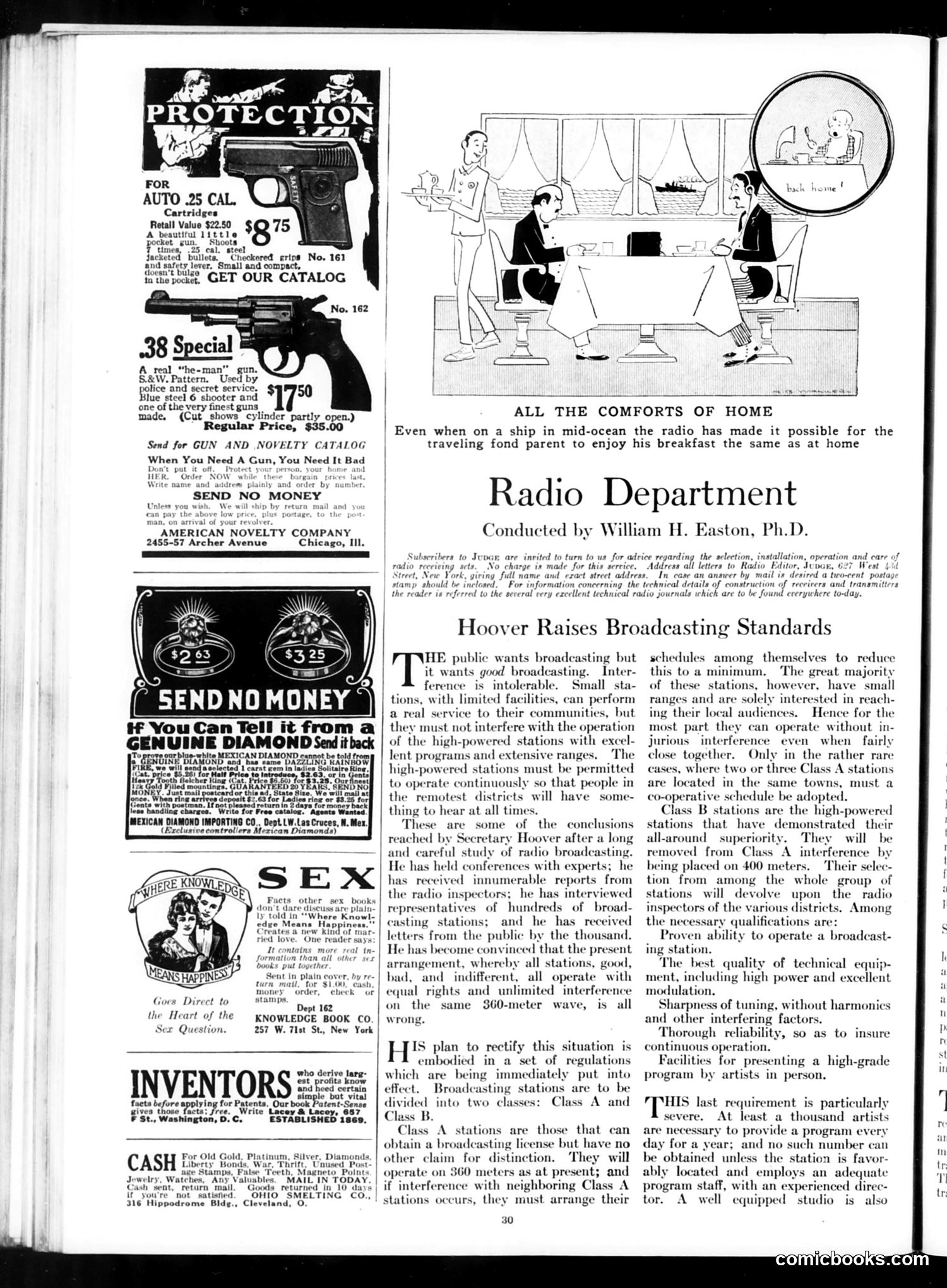
This page is primarily **advertising and editorial content**, not political satire. The main items are: **Advertisements:** Gun and ammunition sales (top left); diamond rings; a "sex question" advice book; and inventor services. **Editorial Content:** The "Radio Department" column discusses Secretary **Herbert Hoover's broadcasting standards initiative**. The accompanying cartoon shows a couple dining on a ship, with an inset showing them listening to radio—illustrating Hoover's vision that radio technology brings "comforts of home" even at sea. **The Context:** In the 1920s, radio broadcasting was chaotic, with stations interfering with each other on crowded frequencies. Hoover (then Commerce Secretary) advocated organizing broadcasting into Class A and Class B stations to reduce interference and improve service quality—a regulatory achievement before the FCC existed. The cartoon is promotional rather than satirical, celebrating technological progress and Hoover's modernizing efforts. There are no caricatures or political attacks visible.
📄 Transcribed text from this page (OCR, searchable)
Machine-transcribed from the original scan — historical spelling and the odd misread are preserved.
FOR AUTO .25 CAL. Cartridges Retail Value $22.50 A beautiful Little pocket sun, Shoots times, .25 cal. ; jacketed bullets {Cttekore rine No. 161 y Le I inthe pocket, GET OUR CATALOG | No. 162 ; A_real “he-man” gun. S.&W. Pattern. Used by | police and secret service. 50 lue steel 6 shooter and one of the very finest guns made. (Cut shows cylinder partly open.) | Regular Price, $35.00 Send for GUN AND NOVELTY CATALOG When You Need A Gun, You Need It Bad Don't put it off fr der Now ve ba HER : “SEND, No MONEY ; v sy 7 willl sh D by recs ro mail and "AMERICAN NOVELTY COMEANY 2455-57 Archer Avenue ff You Can Tell it GENUINE DIAMOND Seed back sea ep age PAN DLAMOND se PUI ota ae ont hee teaee Z2LANG SEX ried love. One reader says n than all dt together n plain cover, b tl. for $1.00, order, check Dept 162 KNOWLEDGE BOOK CO. 257 W. 7st St, New York money stamps Goes Direct to the Heart of the Sex Question. INVENTORS 2222 facts before tents gives thos free Write Lacey & #'St., Washington, D.C. Ht contains more reat tn-| Sie Hippodrome ‘Bldg. Cleveland, ALL THE COMFORTS OF HOME | Even when on a ship in mid-ocean the radio has made it possible for the traveling fond parent to enjoy his breakfast the same as at home Radio Department Conducted by William H. Easton, Subscribers to Jupar are invited to turn to us for advice regarding the selection, radio receiving sets. No charge is made for this service. d be i the reader is t, New York, giving full name and ezact street address, m” sed. For information concerning the technical details of construction of receirers and transm » the several very excellent technical radio journals whick are to be found everywhere today. Ph.D. stallation, operation and care W Address all letters to Radi In case Gm Gntoer by teil ts devired tooceat poston Hoover Raises Broadcasting Standards HE public wants broadcasting but it wants good broadcasting. Inte ference is intolerable. Small. sta- tions, with limited fa can perform a re to their communities, but they must not interfere with the operation of the high-powered stations with excel- lent programs and extensive ranges. ‘The high-powered stations must be permitted to operate continuously so that people in districts will have some- at all times. some of the conclusions reached by Secretary Hoover after a long and careful study of radio br He has held conferences with has received innumerable reports from the radio inspectors; he has interviewed representatives of hundreds of broad- casting stations; and he has received letters from the public by the thousand. He has become convinced that the present arrangement, whereby all stations, good, the remotest thing to h These are bad, and indifferent, all operate with equal rights and unlimited interference on the same 360-meter wave, is all wrong. HHS plan to rectify this situation is embodied in a ‘set of regulations which are being immediately put into effect. Broadcasting stations are to be divided into two classes: Class A and A stations are those that can obtain a broadcasting license but have no other claim for distincti They will operate on 360 meters as at present; and if interference with neighboring Class A stations occurs, they must arrange their 30 schedules among themselves to reduce this toa minimum. The great majority of these stations, however, have small ranges and are solely interested in reach- ing their local audien Hence for the most part they can operate without in- jurious interference even when fairly close together. Only in the rather rare cases, where two or three Class A stations: are located in the same towns, must a co-operative schedule be adopted. s B stations are the high-powered stations that have demonstrated their all-around — superiori They will be removed from ( “A. interference by being placed on 400 mete rs. Their selec tion from among the whole group of stations will devolve upon the radio inspectors of the various districts. Among the necessary qualifications are: Proven ability to operate a broadcast- ing station. The best quality of technical equip- ment, including high power and excellent modulation, Sharpness of tuning, without harmonies and other interfering factors. Thorough reliability, so as to insure tinuous operation. ities for presenting a high-grade program by artists in person. HIS last requirement is particularly severe. At least a thousand artists are necessary to provide a program every day for a year; and such number can be obtained unless the station is favoi ably located and employs an adequate program staff, with an experienced direc- tor. A well’ equipped studio is also