
Judge, 1922-09-16 · page 23 of 36
Judge — September 16, 1922 — page 23: what you’re looking at
What you’re looking at
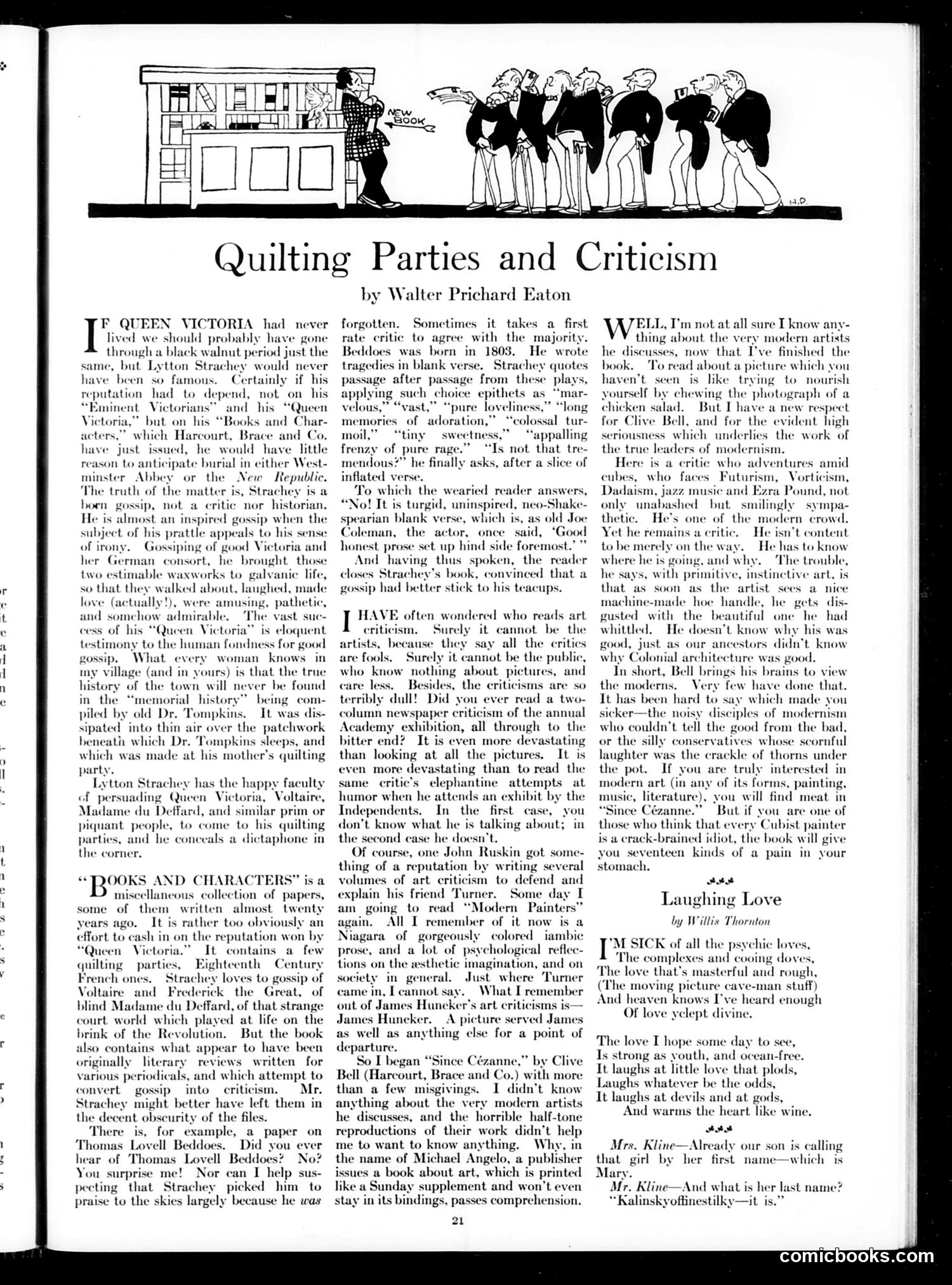
The illustration shows a woman in a checkered dress pointing at a dollhouse-like structure, with six men in formal attire standing to the right—a visual metaphor for Eaton's essay about literary critic Lytton Strachey. Eaton compares Strachey's biographical method to "quilting parties"—informal gatherings where women shared gossip disguised as innocent conversation. The satire suggests Strachey presents himself as a serious historian and critic, but actually traffics in entertaining gossip about famous figures (Queen Victoria, Voltaire, Madame du Deffard). Eaton criticizes Strachey's recent book "Books and Characters" for attempting to disguise gossip as literary criticism. He mocks Strachey's extravagant praise of the obscure poet Thomas Lovell Beddoes, suggesting Strachey champions forgotten figures precisely because they're forgotten—inverting genuine critical judgment. The underlying point: Strachey is a skilled raconteur, not a serious intellectual, and should stick to what he does best rather than pretending to serious literary analysis.
📄 Transcribed text from this page (OCR, searchable)
Machine-transcribed from the original scan — historical spelling and the odd misread are preserved.
Quilting Parties and Criticism by Walter Prichard Eaton lived we should probably hi through a black walnut period just the same, but have been so famous. reputation had to depend, not on his “Eminent Victorians” and his “Queen Victoria,” but on his “Books and Char- acters,” which Harcourt, Brace and Co. have just issued, he would have little reason to anticipate burial in either West- minster Abbey or the New Republic. The truth of the matter is, Strachey is a born gossip, not a critic nor_ historian. He is almost an inspired gossip when the subject of his prattle appeals to his sense of irony. Gossiping of good Victoria and her German consort, he brought those two estimable waxworks to galvanic life, so that they walked about, laughed, made (actually!), were amusing, pathetic, and somehow admirable. The vast: suc- cess of his “Queen Vieto: is eloquent testimony to the human fondness for good gossip. What every woman knows. in my village (and in yours) is that the true history of the town will never be found in the “memorial history’ being com- piled by old Dr. Tompkins. It was dis- sipated into thin air over the patchwork beneath which Dr. Tompkins sleeps, which was made at his mother’s quilting party. Lytton Strachey has the happy faculty of persuading Queen Victoria, Voltaire, Madame du Deffard, and similar prim or piquant people, to come to his quilting parties, and he conceals a dictaphone in the corner. I QUEEN VICTORIA had n Lytton Strachey would never Certainly. if his love OOKS AND CHARACTERS?” is a miscellaneous collection of papers, some of them written almost’ twenty years ago. It is rather too obviously an cffort to cash in_on the reputation won by “Queen Victori It contains a few quilting parties, Eighteenth Century French ones. Strachey loves to gossip of Voltaire and Frederick the Great, of blind Madame du Deffard, of that strange court world which played at life on the brink of the Revolution. But the book also contains what appear to have been originally literary reviews written for various periodicals, and which attempt to convert gossip into criticism. = Mr. Strachey might better have left them in the decent obscurity of the files. There is, for example, a paper on Thomas Lovell Beddoes. Did you ever hear of Thomas Lovell Beddoes? No? You surprise me! Nor can I help sus- pecting that Strachey picked him to praise to the skies largely because he was forgotten. Sometimes it takes a first rate critic to agree with the majorit) Beddoes was born in 1803. He wrot tragedies in blank verse. Strachey quotes passage after passage from these plays, applying such choice epithets as “mar- velous,” “vast,” “pure love! “long memories of adoration,” “colossal tur- moil,” “tiny sweetness,” “appalling frenzy of pure rage.” “Is not that tre- mendous?” he finally asks, after a slice of inflated verse. To which the wearied reader answers. “No! It is turgid, uninspired, neo-Shake spearian blank verse, which is, as old Joe Coleman, the actor, once said, ‘Good honest prose set up hind side foremost.’ ” And having thus spoken, the reader closes Strachey’s book, convinced that a gossip had better stick to his teacups. ness, HAVE often wondered who reads art criticism, Surely it cannot be the artists, because they say all the critics are fools, Surely it cannot be the public, who know nothing about pictures, and care less. Besides, the criticisms are so terribly dull! Did you ever read a two- column newspaper criticism of the annual Academy exhibition, all through to the bitter end? It is even more devastating than looking at all the pictures. It is more devastating than to read the same critic’s elephantine attempts at humor when he attends an exhibit by the Independents. In the first case, you don’t know what he is talking about; in the second case he doesn’t. Of course, one John Ruskin got some- thing of a reputation by writing several volumes of art criticism to defend and explain his friend Turner. Some y am going to read ‘Modern Painters” again. All I remember of it now is a Niagara of gorgeously colored iambic and a lot of psychological reflec- on the wsthetic imagination, and on ty in general. Just. where’ Turner came in, I cannot sa What I remember out of James Huneker’s art criticism James Huncker. A picture served James as well as anything else for a point of departure. So I began “Since Cézanne,” by Clive Bell (Harcourt, Brace and Co.) with more than a few misgivings. I didn’t know anything about the very modern artists he discusses, and the horrible half-tone reproductions of their work didn’t help me to want to know anything. Why, in the name of Michael Angelo, a publisher ssues a book about art, which is printed like a Sunday supplement and won't even stay in its bindings, passes comprehension. 21 ELL, I’m not at all sure I know any- thing about the very modern artists he discusses, now that I've finished the boc To read about a picture which you haven't is like trying to nourish yourself by chewing the photograph of a chicken salad. But I have a new respect for Clive Bell, and for the evident high seriousness which underlies the work of the true leaders of modernism. Here is a critic who adventures amid cubes, who faces Futurism, Vorticism, Dadaism, jazz music and Ezra Pound, not only unabashed) but smilingly sympa- the: He’s one of the modern crowd. Yet he remains a critic. He isn’t content to be merely on the way. He has to know where he is going, and why. The trouble, he says, with primitive, instinctive art, is that as soon as the artist machine-made hoe handle, he gets dis- gusted with the beautiful one he had whittled. He doesn’t know why his was good, just as our ancestors didn’t: know why Colonial architecture was good. In short, Bell brings his brains to view the moderns. Very few have done that. It has been hard to say which made you sicker—the noisy disciples of modernism who couldn’t tell the good from the bad, or the silly conservatives whose scornful laughter was the crackle of thorns under the pot. If you are truly interested in modern art (in any of its forms, p: music, literature), you will find 1 “Since Cézanne.” “But if you are one of those who think that every Cubist painter is a crack-brained idiot, the book will give yu seventeen kinds of a pain in your stomach. seen sees a nice ast Laughing Love by Willis Thornton °M SICK of all the psychic loves, The complexes and cooing doves, The love that’s masterful and rough, (The moving picture cave-man stuff) And heaven knows I've heard enough Of love yelept divine. The love I hope some day to se ee Is strong as youth, and oc : It laughs at little love that arate Laughs whatever be the odds, It laughs at devils and at gods, And warms the heart like wine. at . Kline—Already our son is calling by her first’ name—which is Mr. Kline—And what is her last name? *Kalinskyoftinestilky—it is.” comicbooks.com