
Judge, 1922-09-16 · page 4 of 36
Judge — September 16, 1922 — page 4: what you’re looking at
What you’re looking at
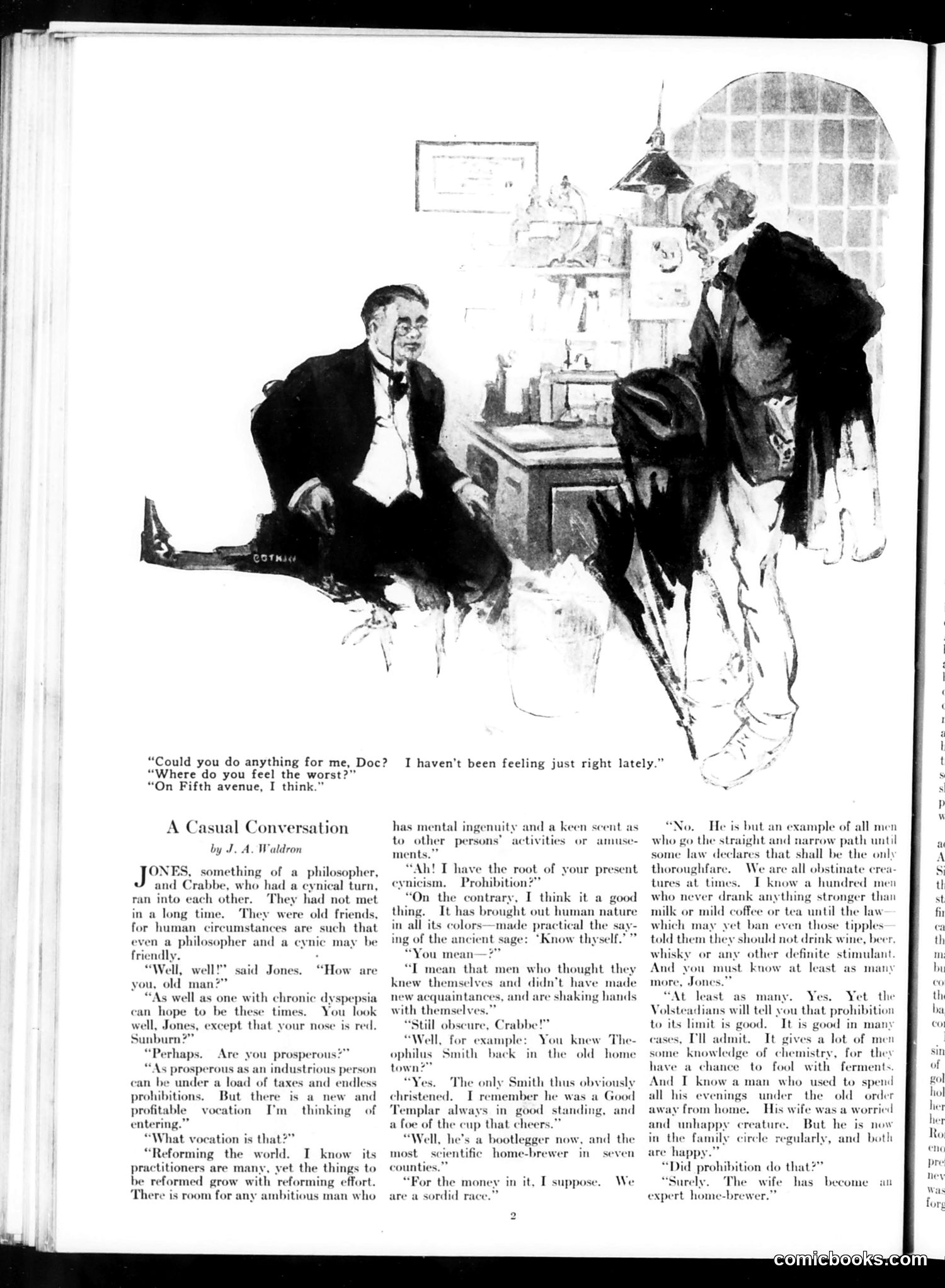
This appears to be a humorous dialogue between two well-dressed men in what looks like a study or office, with a cityscape visible through the window behind them. The satire centers on **Prohibition**—the characters discuss home-brewing and alcohol consumption during the dry era. One man mentions feeling unwell and asks his doctor friend for help; the doctor suggests Fifth Avenue as a cure. The conversation then pivots to the "old Smith" being a "Good Templar" (a temperance advocate) who nonetheless enjoyed drinking and hosting parties. The joke targets the **hypocrisy of Prohibition's era**—respectable citizens and even temperance advocates secretly consumed alcohol while publicly supporting the ban. The cartoon mocks the gap between stated moral principles and actual behavior during this period.
📄 Transcribed text from this page (OCR, searchable)
Machine-transcribed from the original scan — historical spelling and the odd misread are preserved.
“Could you do anything for me, Doc? “Where do you feel the worst?” “On Fifth avenue, I think.” A Casual Conversation by J. A. Waldron ON something of a philosopher, J and Crabbe, who had a cynical turn, ran into each other. ‘They had not met in a long time. They were old friends, for human circumstances are such that even a philosopher and a cynic may be friendly. “Well, well!” said Jones. you, old man?” “As well as one with chronic dyspepsia can hope to be these times. You look well, Jones, except that your nose is red. Sunburn?” “Perhaps. Are you prosperous?” “As prosperous as an industrious person can be under a load of taxes and endless prohibitions. But there is a new and profitable vocation [I'm thinking of entering.” “What vocation is that?” “Reforming the world. I know its practitioners are many, yet the things to be reformed grow with reforming effort. There is room for any ambitious man who “How are has mental ingenuity and a keen scent as to other persons’ activities or amuse- ments.” “Ah! T have the root of your present cynicism. Prohibition?” “On the contrary, I think it a good thing. It has brought out human nature in all its colors—made practical the f the ancient sage: ‘Know thyself. You mean : “[ mean that men who thought they knew themselves and didn’t have made new acquaintances, and are shaking hands with th “Still obscure, Crabbe!” “Well, for example: You knew The- ophilus Smith back in the old home town?” “Yes. msel ves.” The only Smith thus obviously christened. T remember he was a Good Templar always in good standing, and a foe of the cup that cheers, “Well, he’s a bootlegger now, and the most scientific home-brewer in seven counties.” “For the money are a sordid race. in it, I suppose. We I haven't been feeling just right lately.” He is but an example of all men who go the straight and narrow path until some law declares that shall be the on! We are all obstinate crea T know a hundred men who never drank anything stronger than milk or mild coffee or tea until the law which may yet ban even those tipples told them they should not drink wine, beer whisky or any other definite stimulant And you must know at least as many thoroughfare, tures at times. more, Jones.” “At many. Yes. Yet the Volsteadians will tell you that prohibition to its limit is good. It is good in man Til admit. It gives a lot of men some knowledge of chemistry, for they have a chance to fool with ferments And IT know a man who used to spend all his evenings under the old order away from home. His wife was a worried and unhappy creature. But he is now in the family circle regularly, and both are happy.” did prohibition do that? “Surely. The wife has become au expert home-brewe least as cases,