
A complete issue · 36 pages · 1922
Judge — September 2, 1922
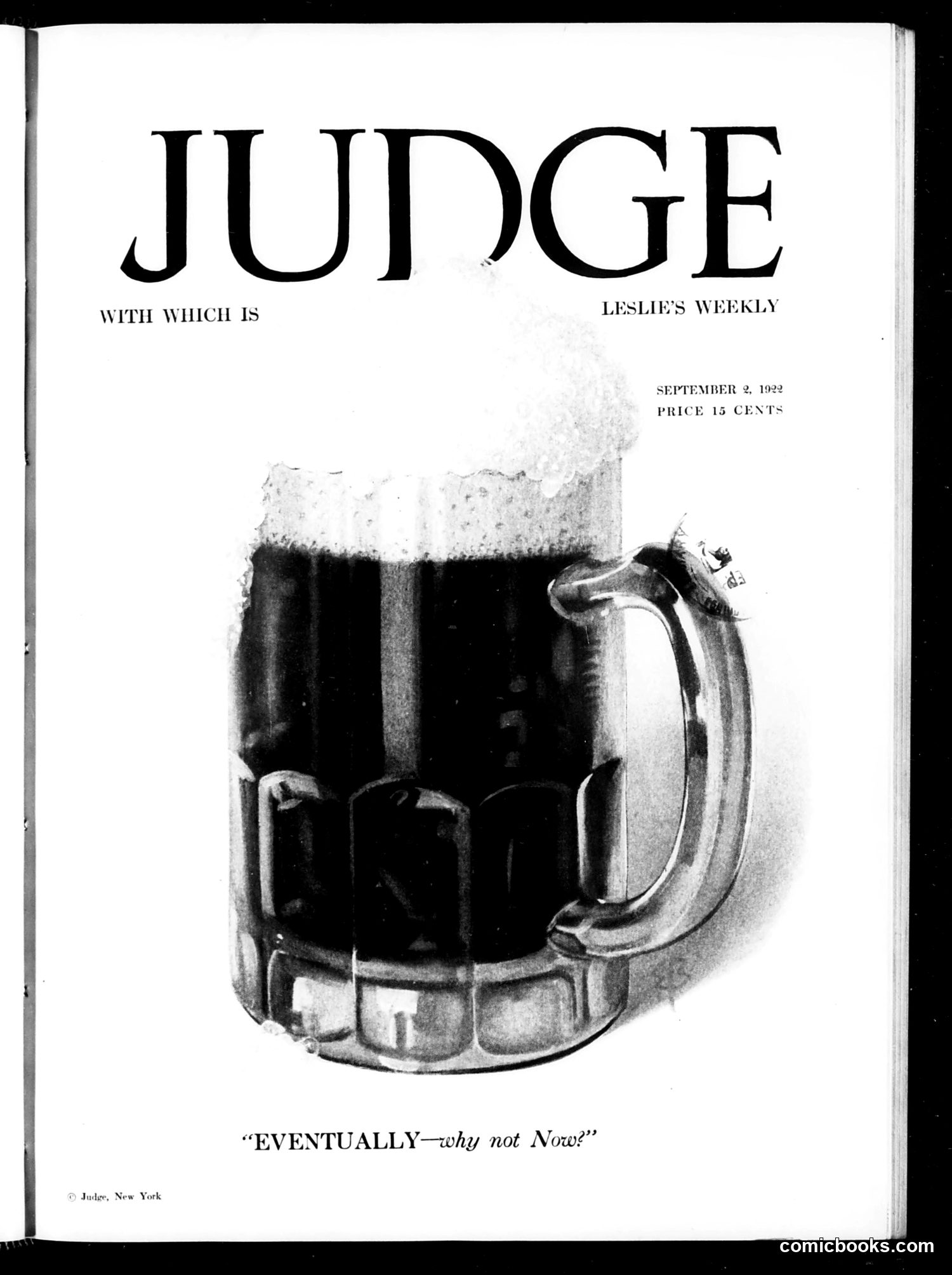
This is a Judge magazine cover from September 2, 1922, featuring a beer mug overflowing with foam as the central image. The caption reads "EVENTUALLY—why not Now?" **Context:** This is clearly a Prohibition-era satire. The 18th Amendment (ratified 1919) banned alcohol production and sale in the United States. The cartoon mocks the inevitable failure of Prohibition by depicting beer—the forbidden beverage—suggesting that despite the law's enforcement, Americans will eventually drink again anyway. The tagline's rhetorical question ("why not Now?") ironically argues for immediate repeal rather than waiting for Prohibition's predicted collapse. This reflects widespread public skepticism about the amendment's viability and growing calls for its repeal, which would ultimately succeed in 1933. The cartoon represents Judge's satirical stance against Prohibition policy.
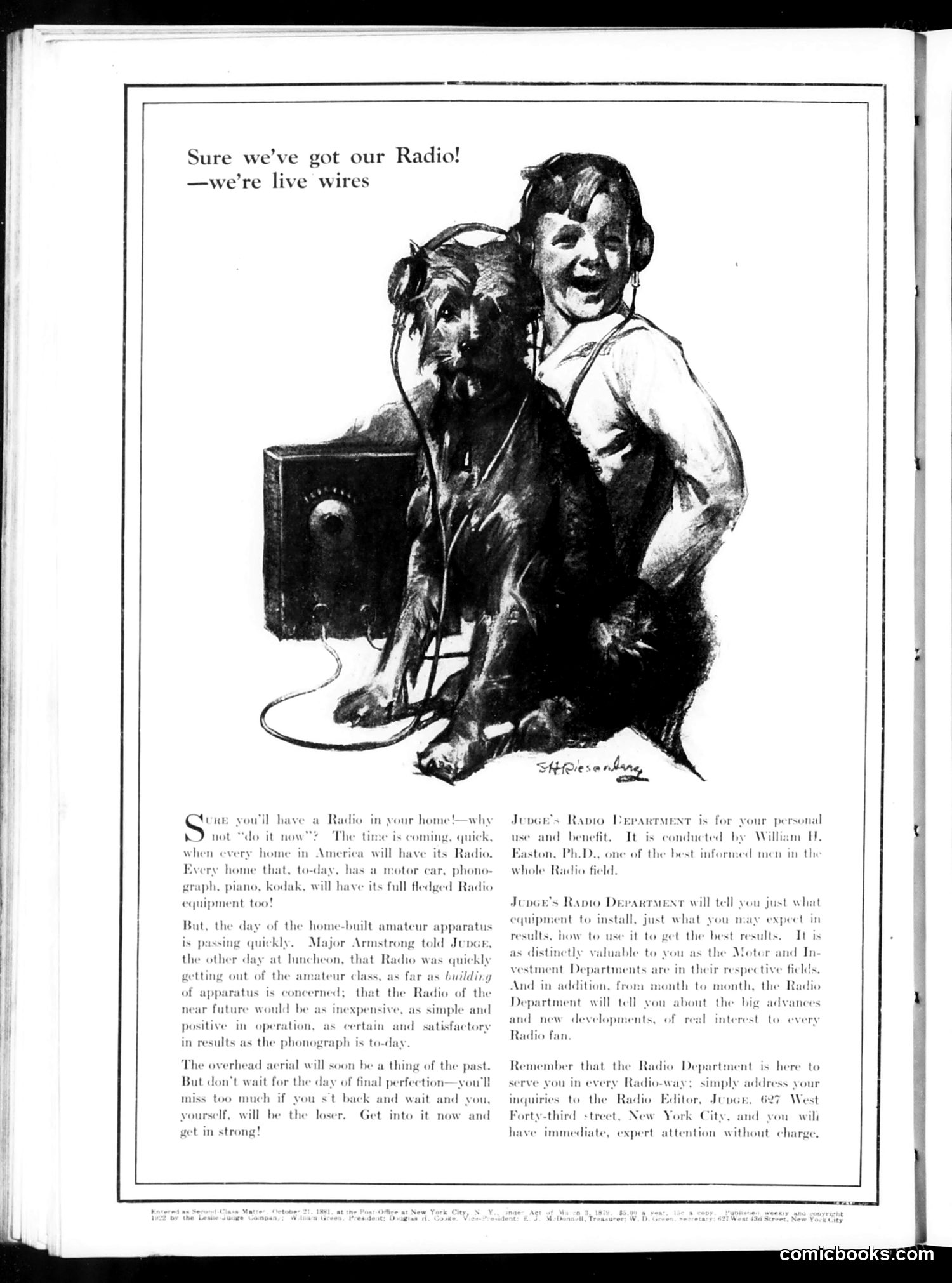
This page from *Judge* magazine advertises the publication's new "Radio Department," presented as a humorous editorial feature. The cartoon depicts a man and dog both wearing radio headphones, with the caption "Sure we've got our Radio!—we're live wires." The satire targets the early radio craze of the 1920s, when home radio ownership was rapidly becoming fashionable. The joke equates radio enthusiasm with being "live wires" (slang for energetic people), while the anthropomorphized dog suggests the technology's appeal transcends rational human judgment. The accompanying text by William H. Easton, Ph.D., promises expert guidance on radio equipment, installation, and developments. The satire implies that radio enthusiasm had become so widespread and sometimes irrational that even dogs participated—poking fun at the technology's near-universal adoption among American households.
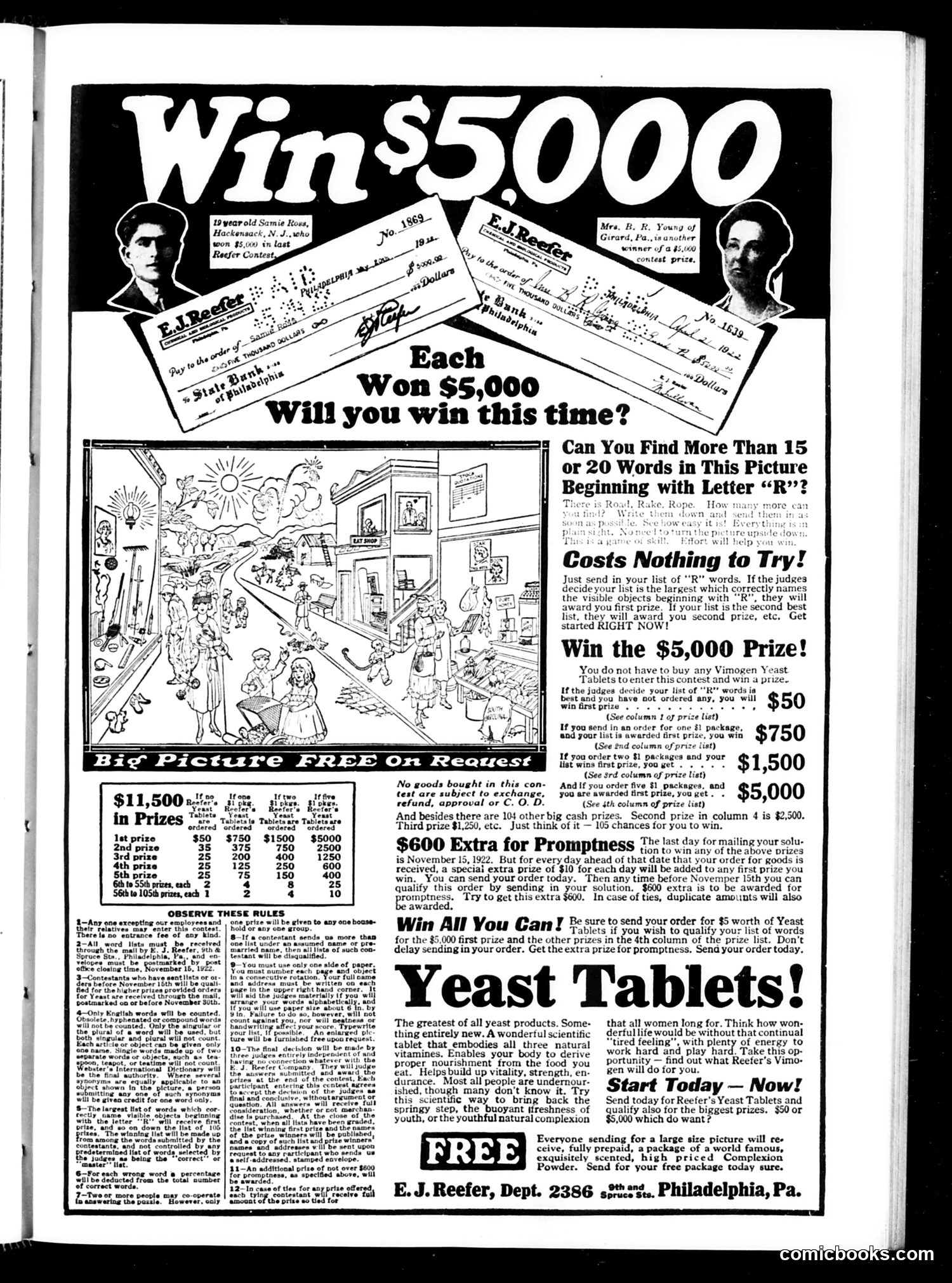
This page is primarily **advertising, not political satire**. The dominant content is a "$5,000 Win" contest sponsored by E.J. Reefer Company, with a word-search puzzle (find words beginning with "R") as the entry mechanism. The layout includes: - Prize money details ($11,500 total in prizes) - Contest rules and procedures - A busy illustration featuring various household objects for the puzzle - Multiple advertisements, including one for "Yeast Tablets" at bottom right The only recognizable figures are **E.J. Reefer** (appears as a portrait), identified as a company representative, and what appear to be **past contest winners** shown on checks. This represents typical early 20th-century magazine advertising combined with promotional contests—common practices before modern regulations on sweepstakes and advertising claims.
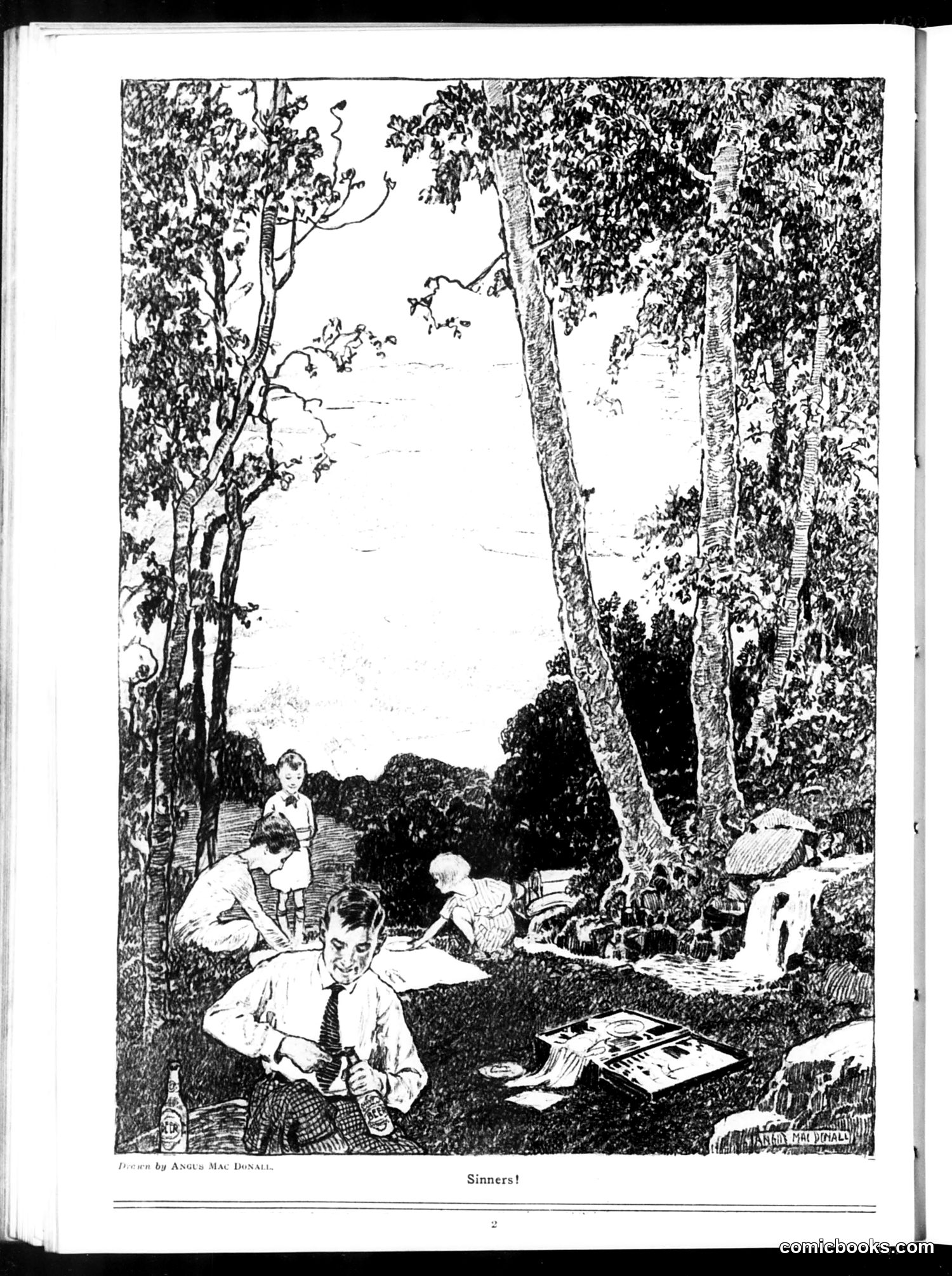
This illustration by Angus MacDonnall depicts a woodland picnic scene with a moralistic title. A man in business attire (white shirt, tie, suspenders) sits prominently in the foreground, appearing to play cards or gamble while others—including women and children—relax nearby among tall trees. The satire critiques hypocrisy: the title "Sinners!" suggests moral judgment, yet the well-dressed man engaged in card-playing (gambling being considered sinful in early 20th-century moral standards) exemplifies the very vice he might condemn in others. The casual, recreational setting among innocent family members underscores the irony—vice masquerading as respectable leisure. This likely reflects contemporary anxieties about urban corruption infiltrating pastoral innocence.
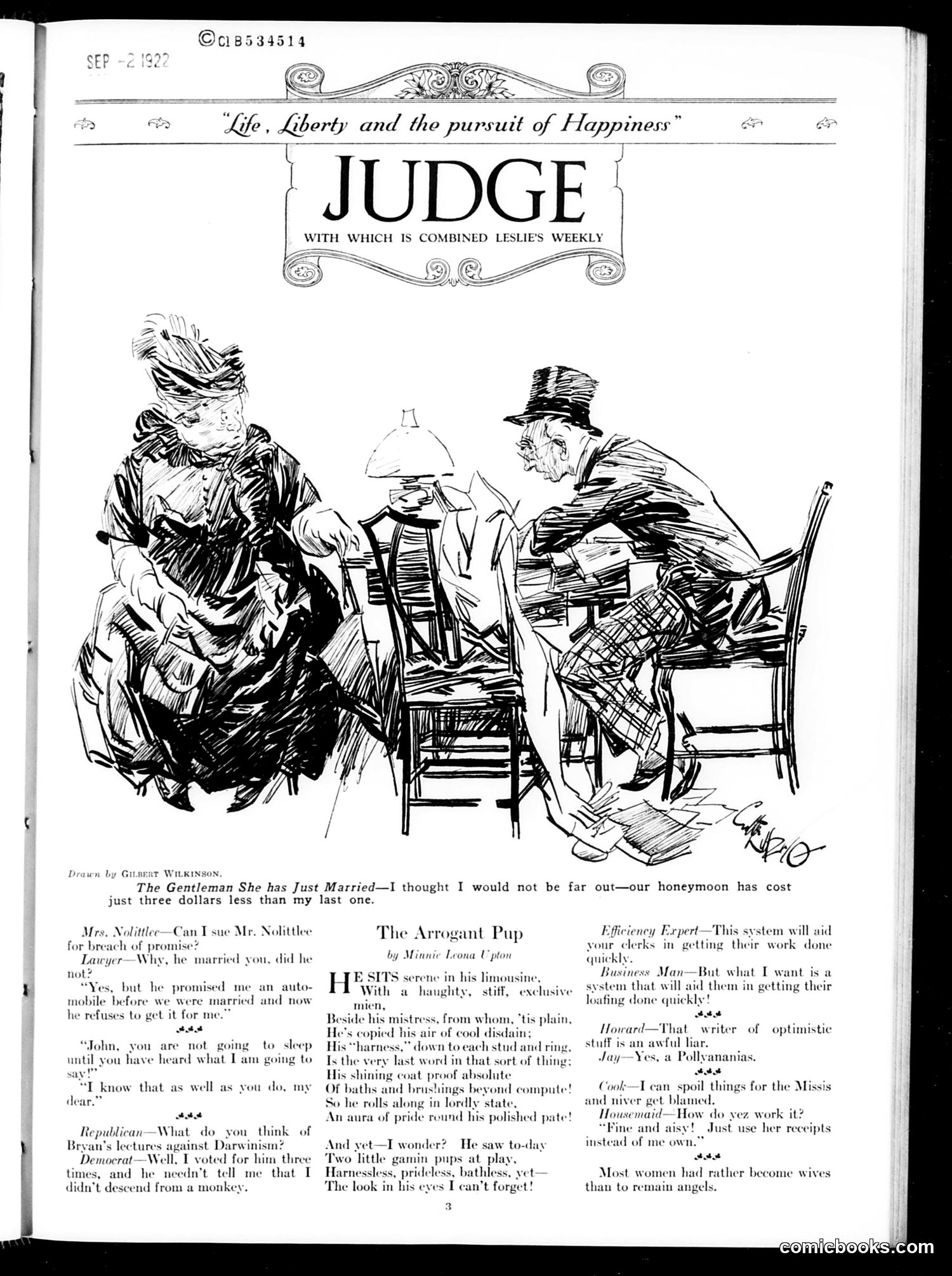
This page from Judge magazine (dated September 2, 1922) contains satirical commentary on contemporary social issues. The main illustration depicts three figures in conversation, drawn by Gilbert Wilkinson. The text pieces mock various subjects: a newlywed husband boasting his honeymoon cost less than the previous one (satirizing serial marriages); a lawyer who married despite refusing to represent divorce cases (hypocrisy); and commentary on Bryan's anti-Darwinian lectures (likely referencing William Jennings Bryan's involvement in evolution debates). Additional satirical items target "efficiency experts" promising to streamline office work, an "arrogant pup" with a fancy car, and observations about women becoming wives rather than remaining "angels"—typical early-20th-century social commentary on courtship, marriage, and changing gender roles.
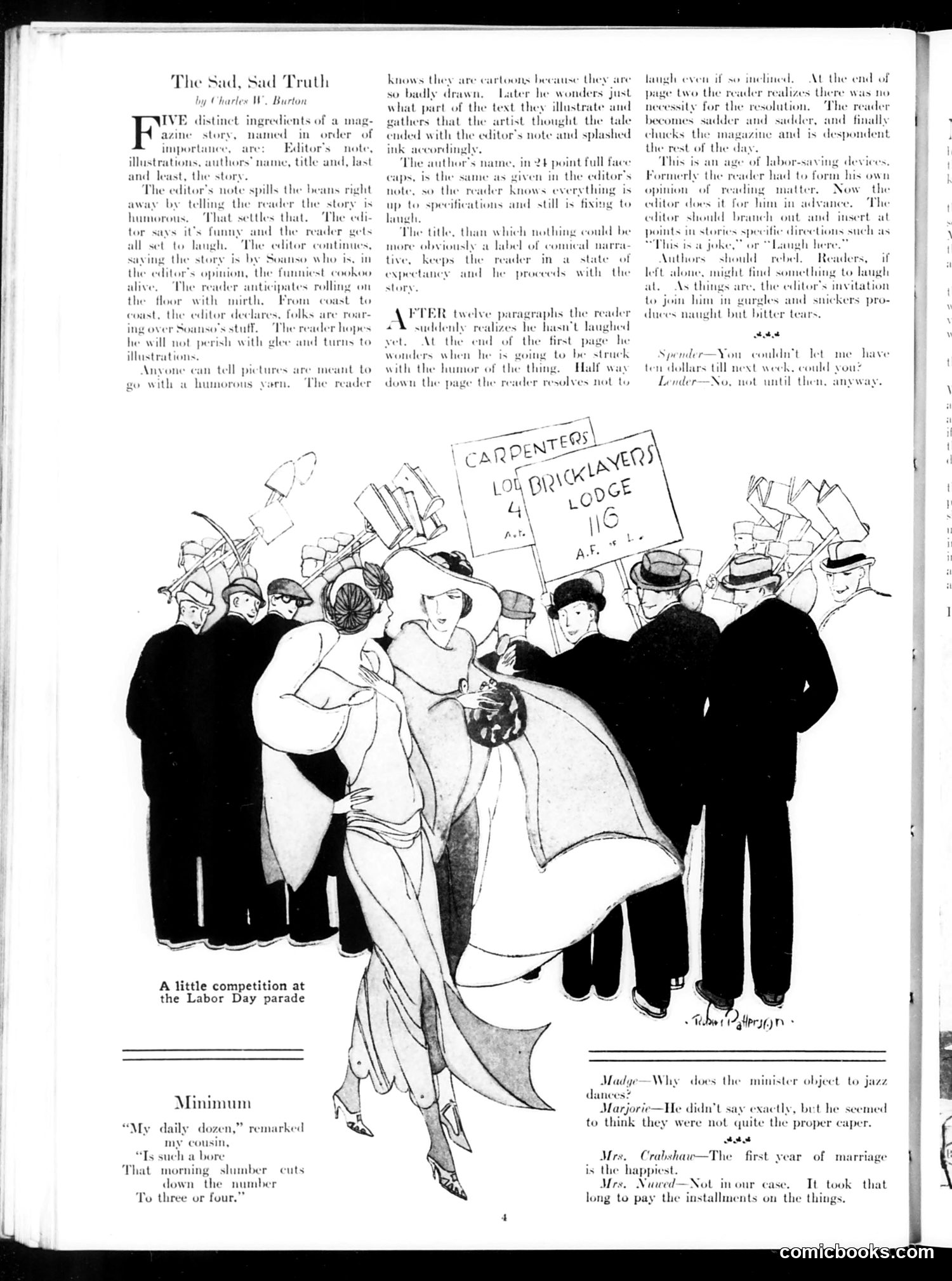
This cartoon satirizes labor union organizing efforts, likely from the early 20th century. The central female figure represents Lady Liberty or America being pulled in competing directions by various labor groups holding signs for different unions and organizations ("Carpenters," "Los Bricklayers Lodge," etc.). The satire suggests that excessive labor union competition and infighting—rather than unified action—creates chaos and actually weakens the labor movement's ability to effectively advocate for workers. The groups are literally tugging at the nation's ideals, portrayed as comical and counterproductive rather than noble. The cartoon critiques fragmentation within organized labor as destructive to their collective goals.
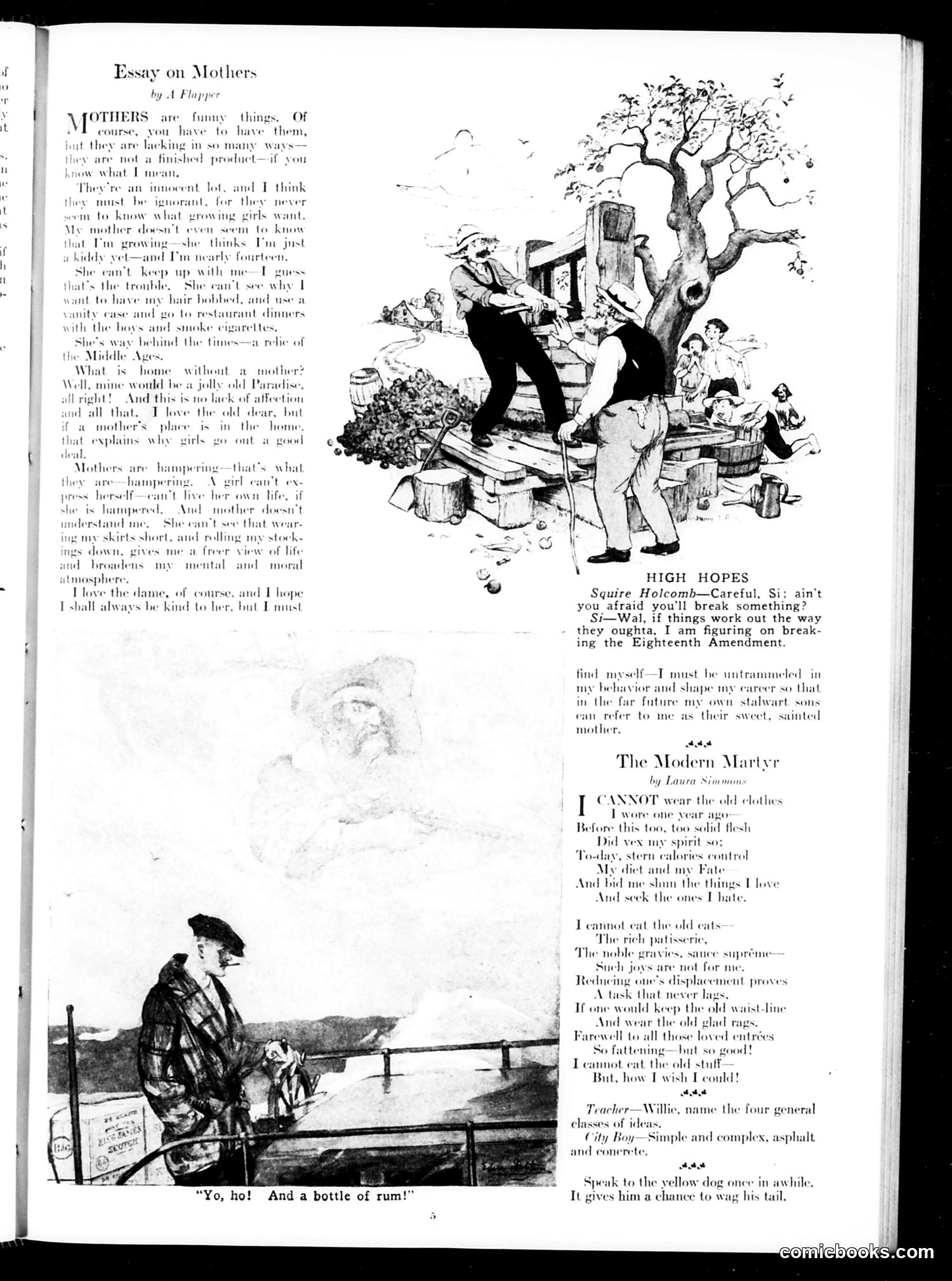
This page contains three satirical pieces mocking 1920s social trends: **"Essay on Mothers"** features a flapper (young woman) complaining that her mother is hopelessly old-fashioned—unable to understand bobbed hair, cosmetics, restaurant dining, and short skirts. The satire cuts both ways: while mocking generational conflict, it also ridicules the flapper's self-centered entitlement and her mother's bewilderment at modern youth culture. **"High Hopes"** depicts rural characters (Squire Holcomb and Si) discussing plans to violate Prohibition (the Eighteenth Amendment banning alcohol). The joke satirizes rural defiance of federal law and the widespread flouting of Prohibition. **"The Modern Martyr"** mocks women's diet culture, describing a woman tortured by calorie-counting and forced to reject rich foods she loves. It satirizes the emerging diet industry and changing beauty standards emphasizing thinness. All three pieces reflect post-WWI anxieties about rapid social change, generational conflict, and new consumer culture.
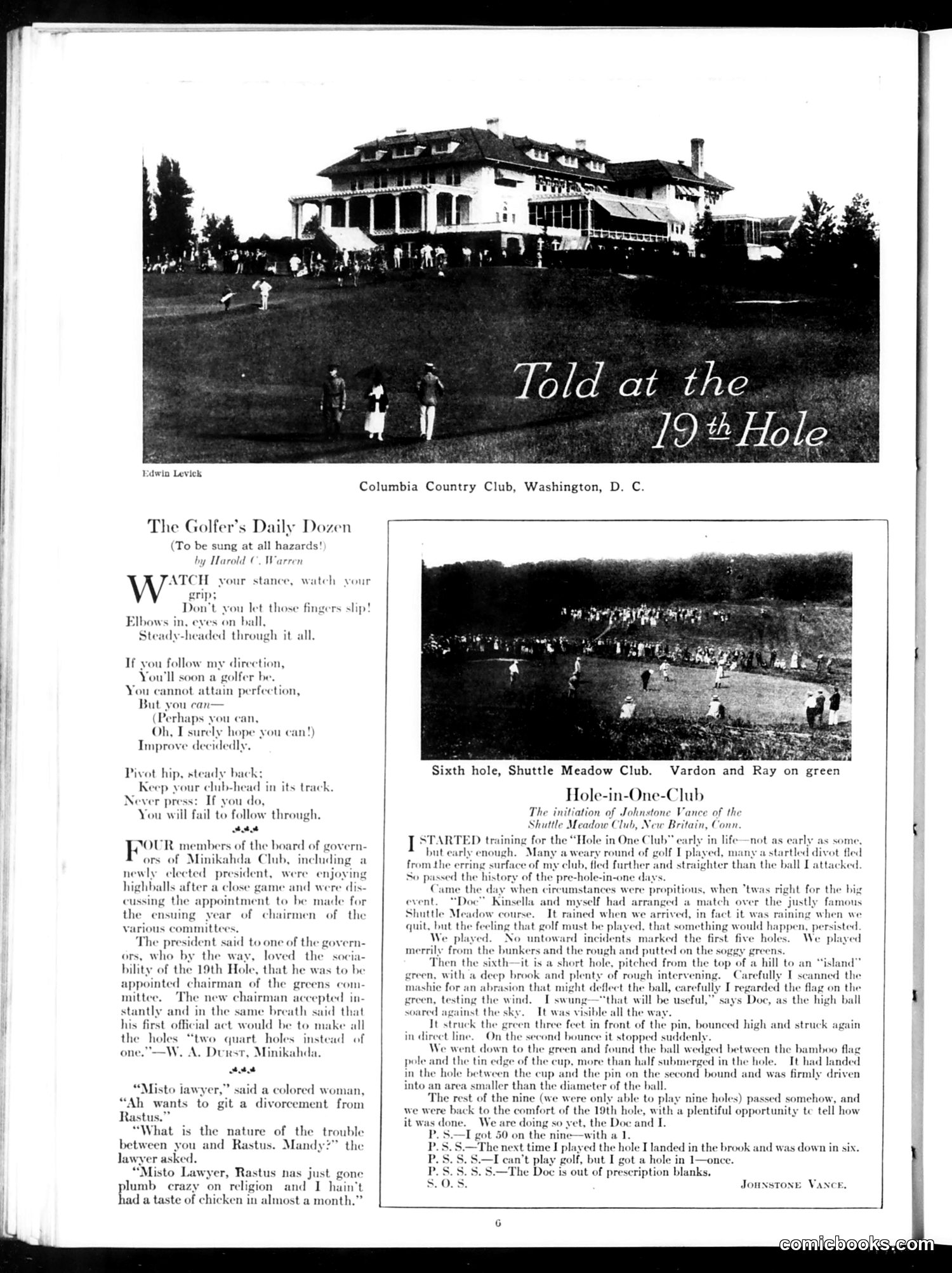
This Judge magazine page (date unclear from image) presents three golf-themed pieces of humor: 1. **"The Golfer's Daily Dozen"** — A humorous instructional song by Harold C. Warren mocking golf instruction, with exaggerated advice about stance, grip, and swing technique. The joke is that despite following these directions, golfers still struggle and can't achieve perfection. 2. **Two brief anecdotes**: - A joke about a newly appointed greens committee chairman wanting to make holes "two quart holes" (larger/easier) — a drinking reference - A racist stereotype joke about a Black woman seeking divorce because her husband's religious conversion meant no more chicken dinners 3. **"Hole-in-One-Club"** — A longer story by Johnstone Vance describing an actual hole-in-one at Shuttle Meadow Club, Connecticut. The humor lies in the ball's improbable path: it bounced twice, became lodged between the flagpole and cup, yet still counted as a legitimate hole-in-one. The page reflects early 20th-century country club culture and period attitudes, including casual racism typical of that era's popular magazines.
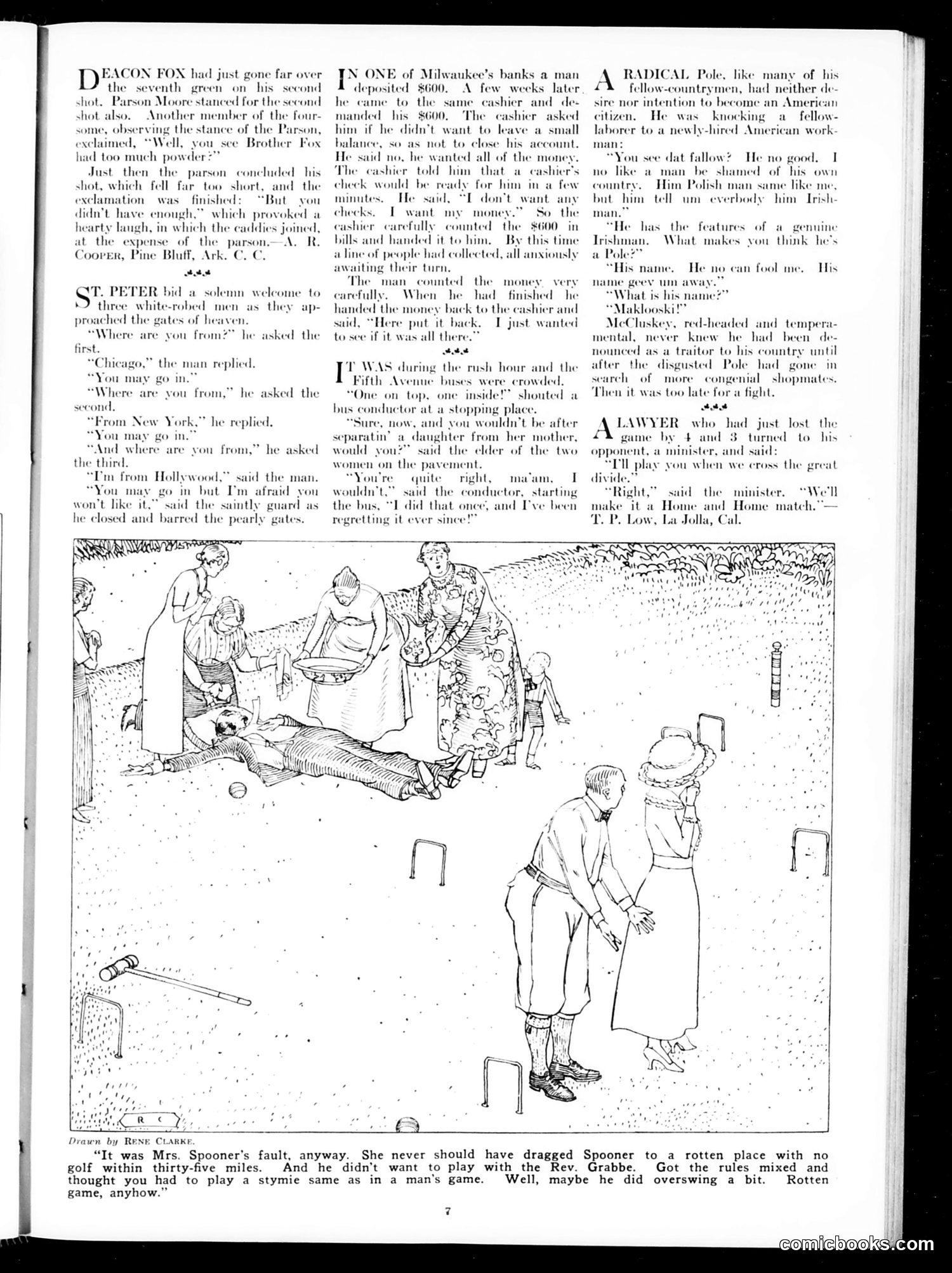
This page contains four separate humorous anecdotes, primarily satirizing American social attitudes and immigrant experience circa early 20th century. **The main cartoon** (bottom) depicts a golf scene where Mrs. Spooner brought her husband to play golf at an unsuitable course. The caption mocks her for this, suggesting she caused his poor performance and rule confusion. **Key satirical content:** 1. **"Radical Pole" story**: A Polish immigrant criticizes a fellow Polish worker (McCluskey) for claiming Irish identity instead. The satire targets immigrant shame about ethnic origin—the Pole sees this as cowardly national betrayal. The "Maklooski" name joke plays on stereotypical Polish surnames. 2. **St. Peter/Hollywood anecdote**: Satirizes Hollywood's moral reputation, suggesting entertainers wouldn't enjoy heaven. 3. **Bank depositor story**: Mocks obsessive money-counting behavior. 4. **Bus conductor anecdote**: Light humor about overcrowding. The **"Radical Pole" segment is the sharpest satire**, exposing how immigrant communities judged assimilation—some saw ethnic identity-shedding as shameful, others as practical survival. The humor relies on period stereotypes about Polish and Irish workers.
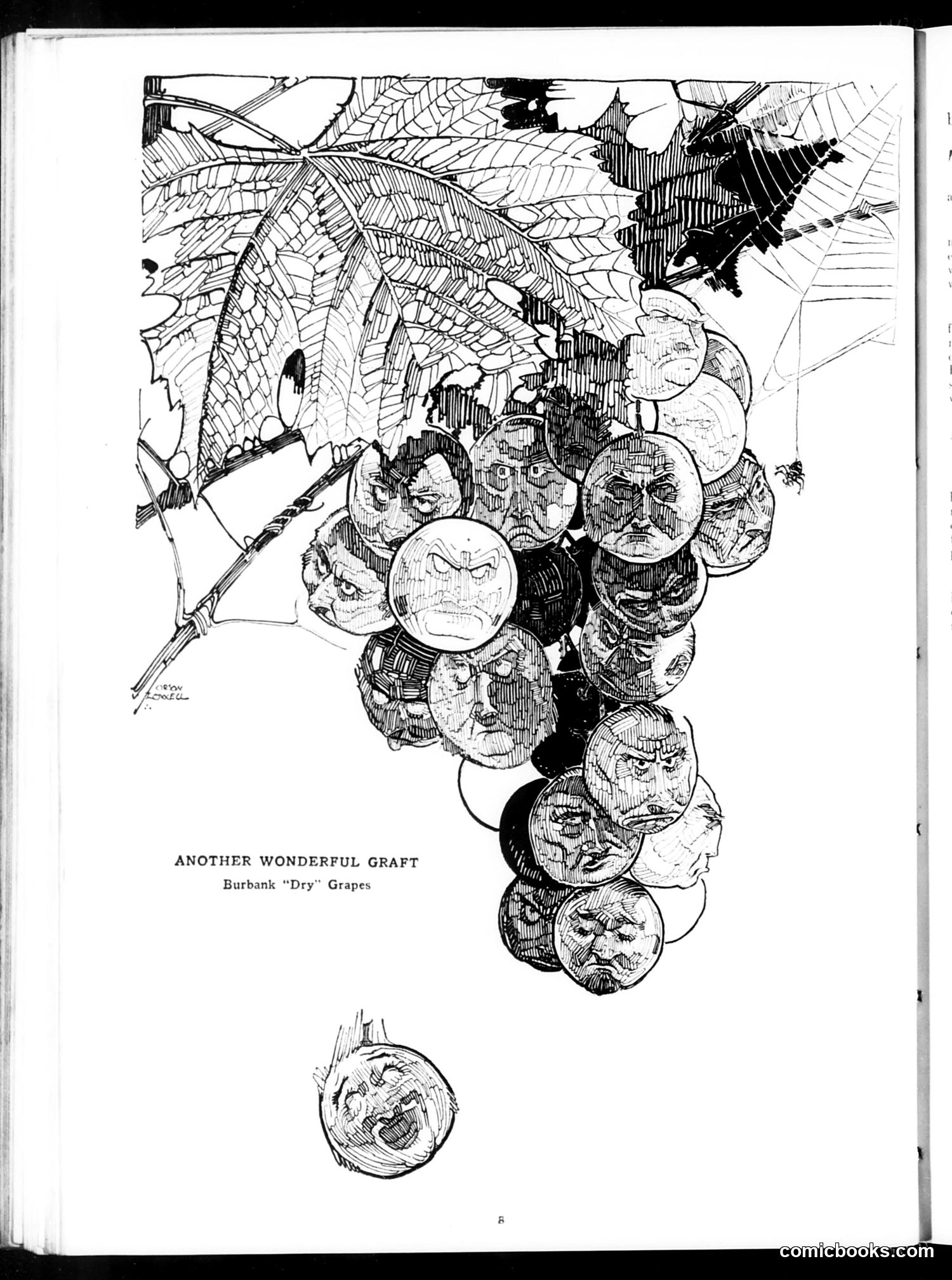
This Judge magazine cartoon satirizes Luther Burbank, the famous plant breeder, through a darkly comic visual pun. The image shows a bunch of grapes where each grape is replaced with a human face displaying angry or scowling expressions—a grotesque parody of his agricultural innovations. The title "Another Wonderful Graft" plays on double meaning: "graft" refers both to Burbank's horticultural grafting techniques and to political corruption (embezzlement). The "Dry" grapes reference appears to allude to Prohibition-era politics. The satire suggests that Burbank's celebrated scientific achievements, while impressive, are being cynically reframed as examples of questionable "graft"—implying his work serves corrupt or self-serving purposes rather than genuine public benefit. The angry faces suggest the bitter fruit of his efforts.
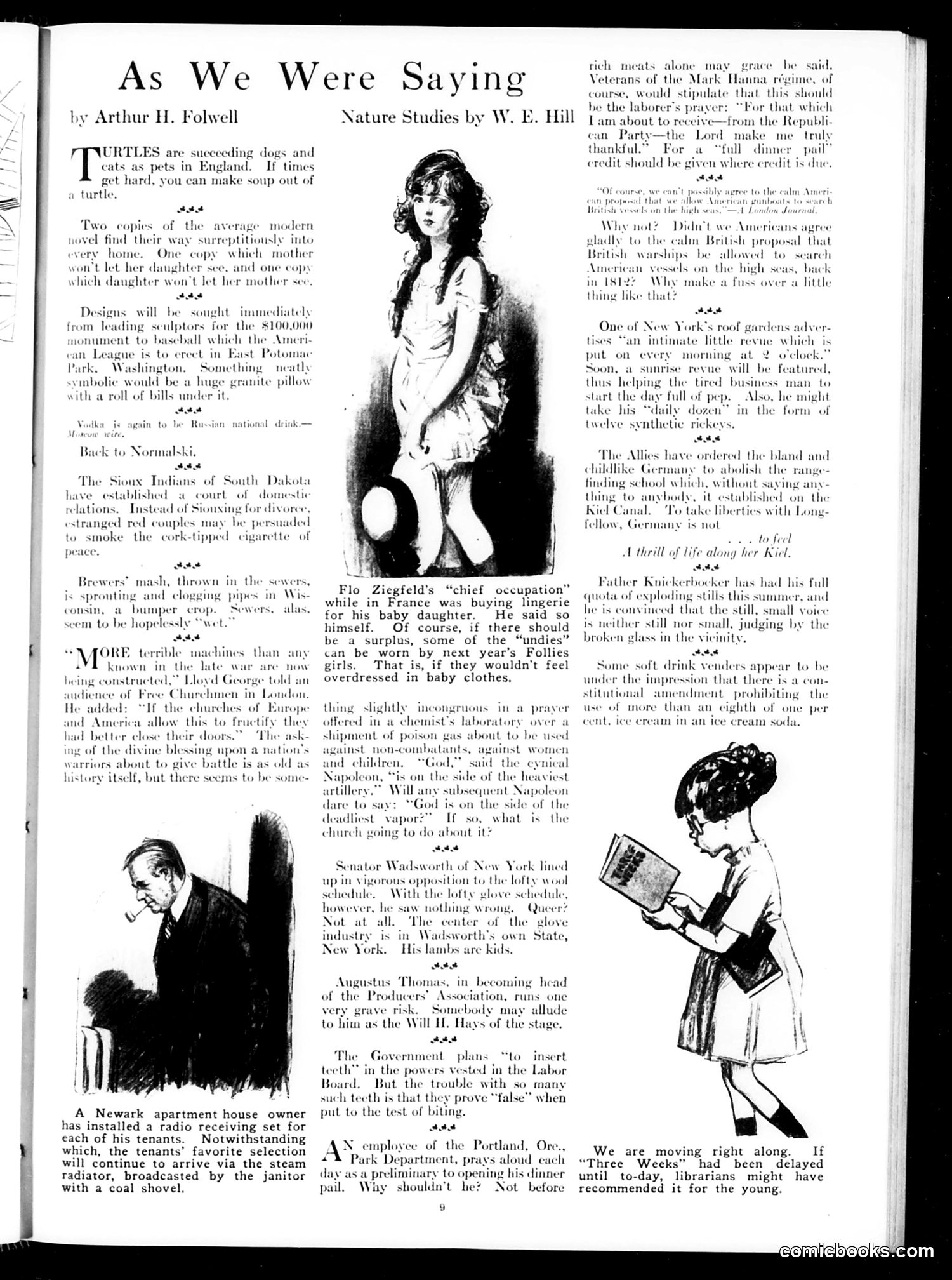
This page from Judge magazine contains satirical commentary on post-WWI American politics and society, circa 1920s. Key items include: **Political References:** - Criticism of Republican Party's treatment of laborers ("full dinner pail") - Mockery of British naval proposals (searching American vessels) - Commentary on German reparations and Allied occupation **Social Satire:** - Turtles as pets replacing dogs/cats (frivolous wealth) - Roof garden "revues" catering to tired businessmen - Concerns about "poison gas" and weapons manufacturing (post-war anxiety) - References to Prohibition enforcement ("soft drink venders" selling ice cream sodas with alcohol) **Cultural Notes:** The illustrations include what appears to be a Flo Ziegfeld reference (Broadway showgirl culture) and commentary on American excess during the Jazz Age. Lloyd George quote suggests anti-war sentiment regarding military chaplains blessing soldiers. The overall tone is cynical about post-war "normalcy," corporate greed, and government hypocrisy—typical Judge magazine criticism of the era.
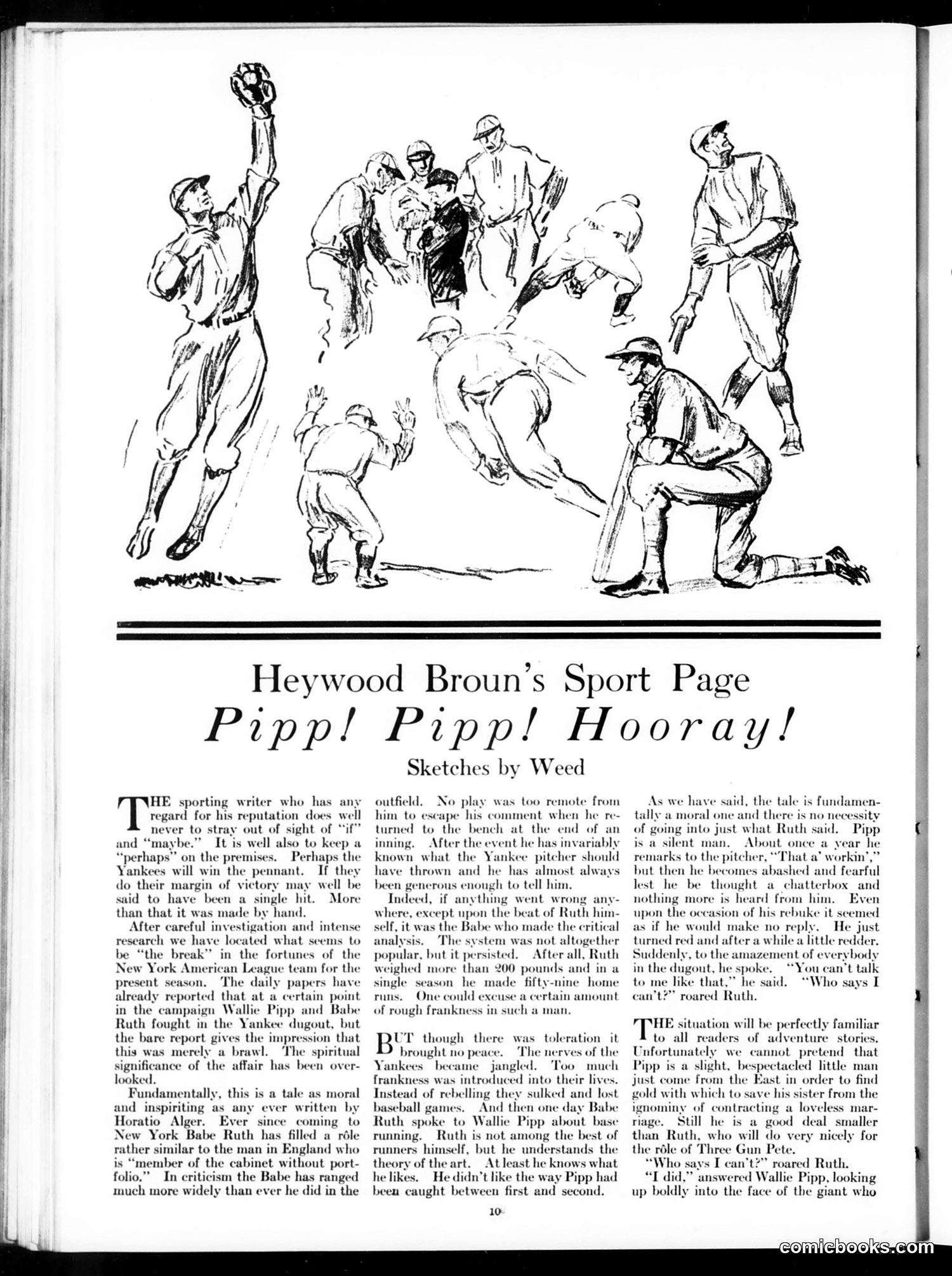
This is a sports humor piece about a real 1920s conflict between Babe Ruth and Wally Pipp of the New York Yankees. The sketches illustrate baseball action. The narrative frames a dugout argument between Ruth and Pipp as a moral tale. Ruth, despite his extraordinary talent (59 home runs in a season, weighing 200+ pounds), habitually criticized teammates and strategy from the bench. When he finally rebukes Pipp about base-running technique, Pipp initially stays silent but then stands up to him. The piece sarcastically compares this to adventure-story tropes: Ruth as the domineering "Three Gun Pete" character, Pipp as the quiet hero who must finally challenge the bully. The humor lies in elevating a petty dugout squabble into mock-heroic drama while acknowledging Ruth's genuine athletic dominance made his criticism difficult to resist.
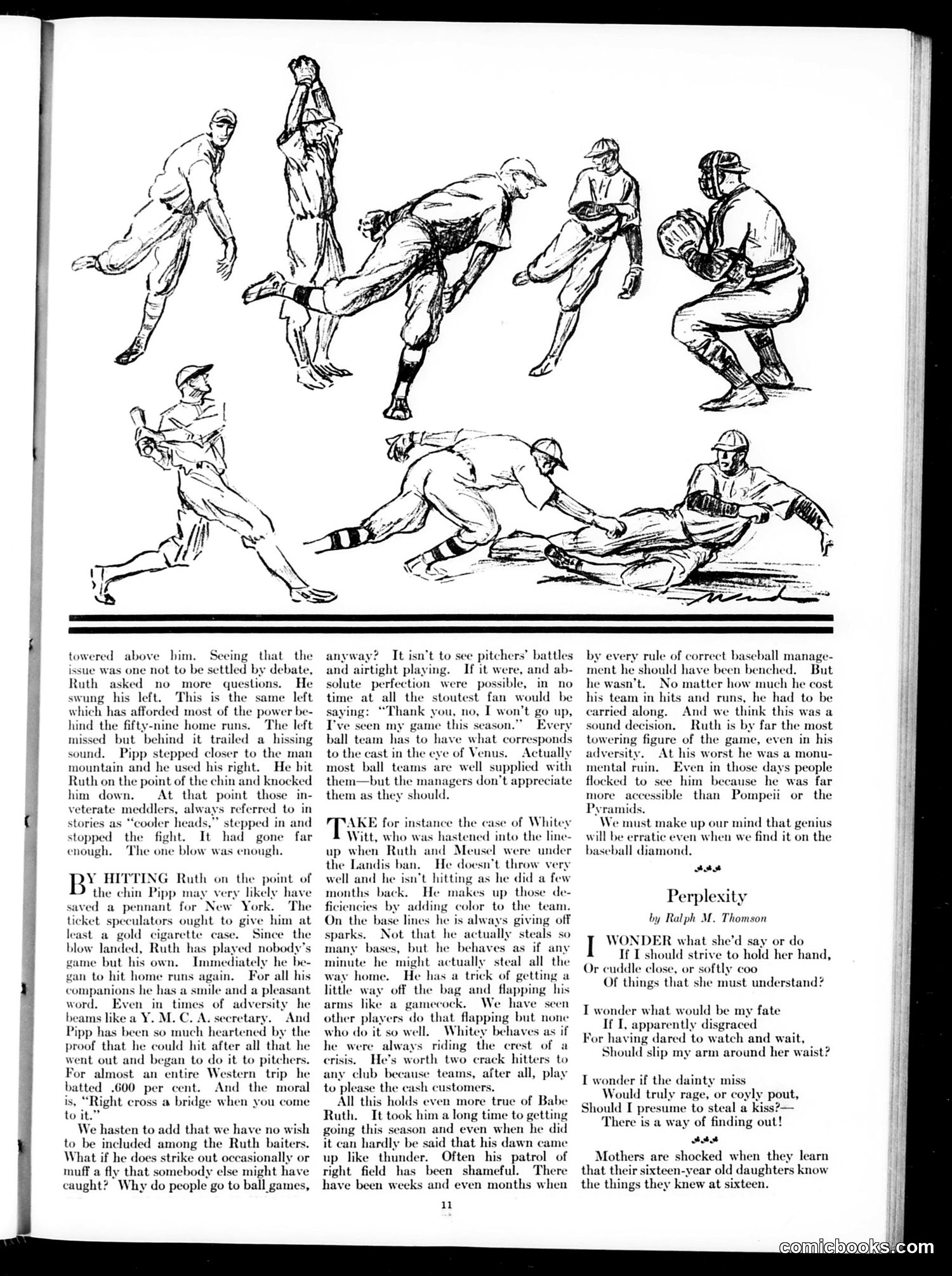
This page contains two distinct pieces: a baseball essay and an unrelated poem. ## Main Article: Ruth and Baseball Management The illustrated essay discusses **Babe Ruth's behavior and value to the New York Yankees**. The cartoons show baseball plays and positions. The text references a fight between Ruth and teammate **Pipp** (likely Bob Meusel or another player), where Pipp struck Ruth, apparently resetting his focus—Ruth subsequently hit better. The essay argues that Ruth's **entertainment value outweighs his occasional poor play**. The writer defends keeping Ruth on the team despite strikeouts and missed fly balls, noting that fans attend for Ruth's spectacle, not "pitchers' battles." He compares Ruth to other colorful players like **Whitey Witt**, arguing genius athletes should be tolerated for their drawing power and charisma—they're "monuments" attracting crowds like Pompeii. ## Secondary Content A separate poem titled "Perplexity" (by Ralph M. Thomson) addresses romantic uncertainty—unrelated to sports. The satire targets **baseball management's economics**: star power matters more than statistical perfection.
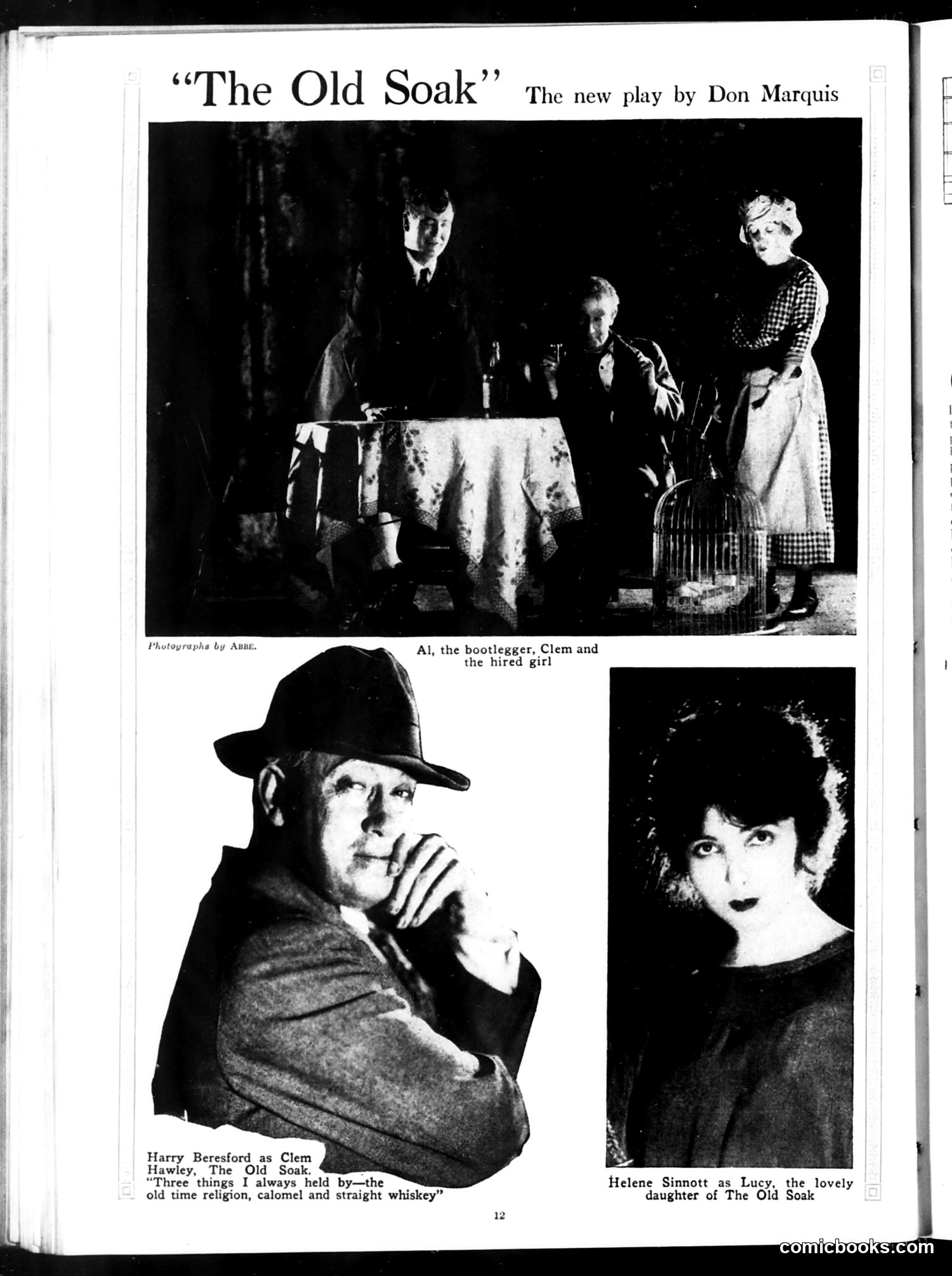
This page promotes Don Marquis's new play "The Old Soak," showing photographs from the production. The images feature cast members including Harry Beresford as Clem Hawley and Helene Sinnott as Lucy. The quoted line—"Three things I always held by—the old time religion, calomel and straight whiskey"—humorously characterizes the protagonist as someone clinging to old-fashioned values during Prohibition. The play appears to satirize rural American traditionalism and the bootlegging trade (referenced through "Al, the bootlegger"). The comedy likely derives from the clash between the titular "old soak's" moral pretensions and his illegal alcohol consumption, reflecting 1920s anxieties about Prohibition's enforcement and social hypocrisy.
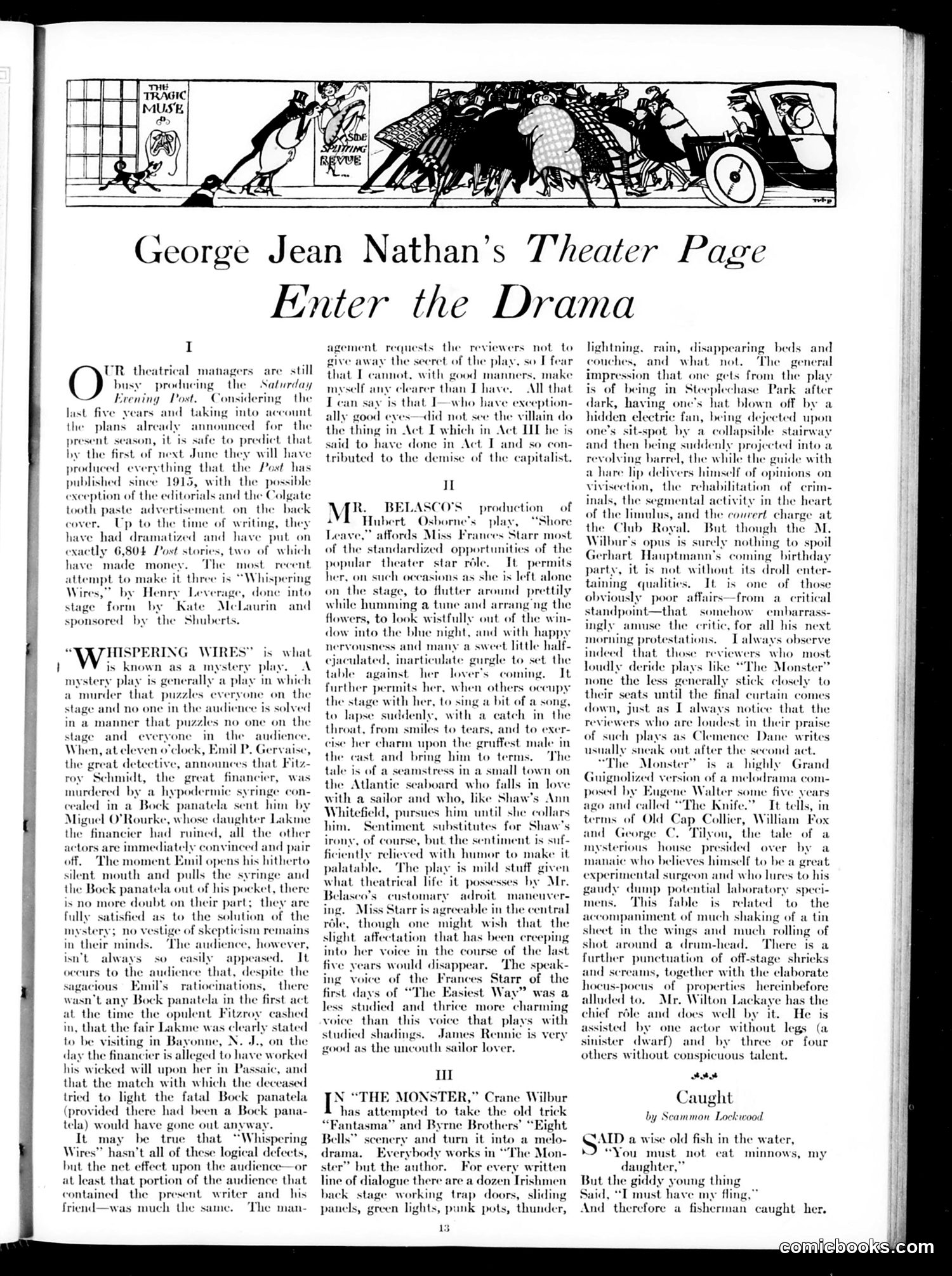
This is George Jean Nathan's theater criticism column from Judge magazine. The top cartoon strip satirizes theatrical producers' tendency to adapt Saturday Evening Post stories for the stage—Nathan quips they've dramatized 6,804 Post stories since 1915, with only two making money. Nathan reviews three current productions: 1. **"Whispering Wires"** — a mystery play he finds logically absurd. Audiences accept the detective's solution despite glaring plot holes (a crucial clue couldn't physically exist as described). Nathan sardonically notes the audience suspends disbelief more readily than the evidence warrants. 2. **"Shore Leave"** — starring Frances Starr, which Nathan finds mild but competent. It permits standard "star vehicle" moments: prettily humming, gazing wistfully out windows, singing emotionally. 3. **"The Monster"** — mentioned briefly at column's end. Nathan's tone is witty and skeptical, mocking both producers' formula-driven adaptations and audiences' willingness to ignore logical impossibilities in theatrical plots.
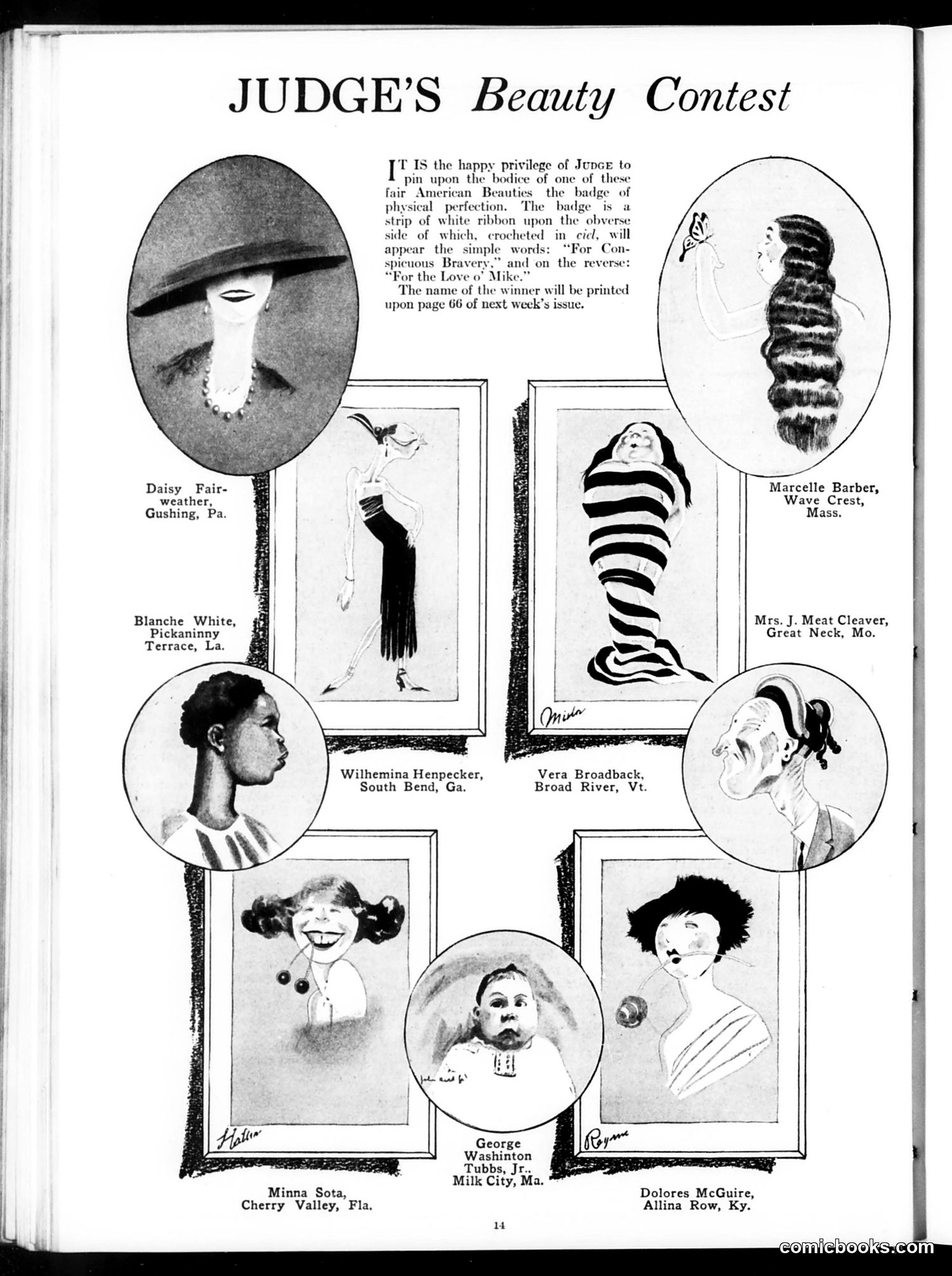
This is a "beauty contest" feature from Judge magazine where readers vote on illustrated female contestants. Each woman is identified by name and location, presented through portrait sketches and full-body fashion illustrations typical of 1920s periodicals. The humor relies on deliberate incongruity: the contestants have absurd, obviously fake names—"Daisy Fairweather," "Blanche White," "Wilhelmina Henpecker," "Minna Sota" (Minnesota), "Mrs. J. Meat Cleaver"—satirizing the superficiality of beauty pageants and advertising culture. The exaggerated hairstyles and fashion poses mock contemporary beauty standards and commercialism. The winner receives a ribbon badge reading "For Conspicuous Bravery," inverting typical contest language to suggest that participating in a beauty contest requires courage—a satirical jab at the commodification of women's appearance. This reflects Judge magazine's satirical tradition of mocking American consumer culture and vanity through humor.
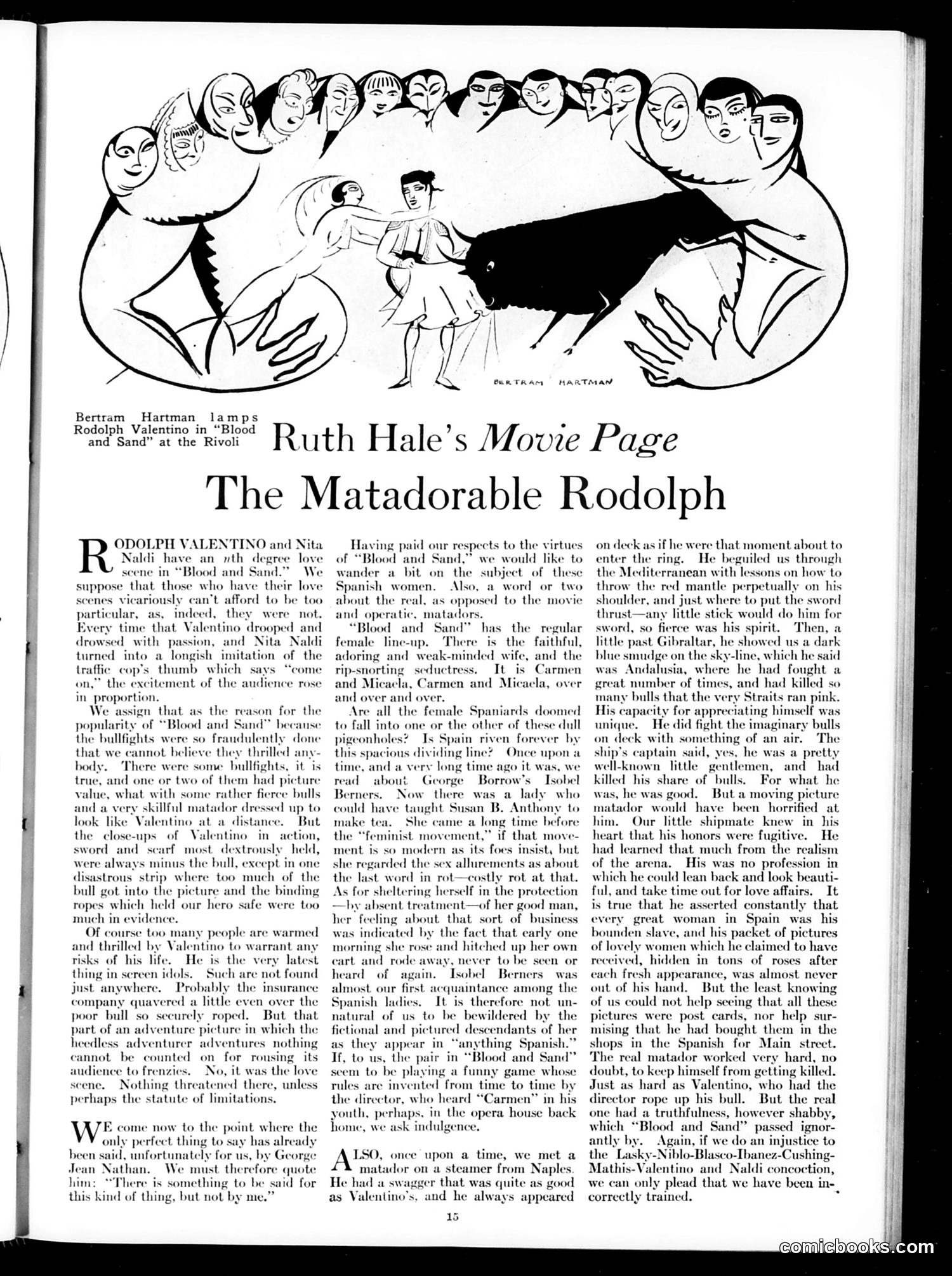
This is a film review by Ruth Hale (visible in the masthead) critiquing Rudolph Valentino's 1922 movie *Blood and Sand*. The cartoon shows Valentino as a matador surrounded by admiring women's faces. The review's satire targets: 1. **Valentino's popularity with female audiences**: Hale sardonically notes audiences were thrilled by Valentino's "passion" scenes with actress Nita Naldi rather than the actual bullfighting scenes, which were poorly staged and unconvincing. 2. **Spanish female stereotypes**: Hale mocks the film's reliance on tired archetypes—the faithful wife, the seductress—claiming all Spanish women in cinema fall into these categories. 3. **Gender commentary**: Hale references George Borrow's historical account of Isobel Berners, an independent Spanish woman who rejected both sexual allure and male protection, implying more nuanced female characters exist beyond movie clichés. The review is witty and dismissive of both the film's technical failings and Hollywood's reductive portrayal of women.
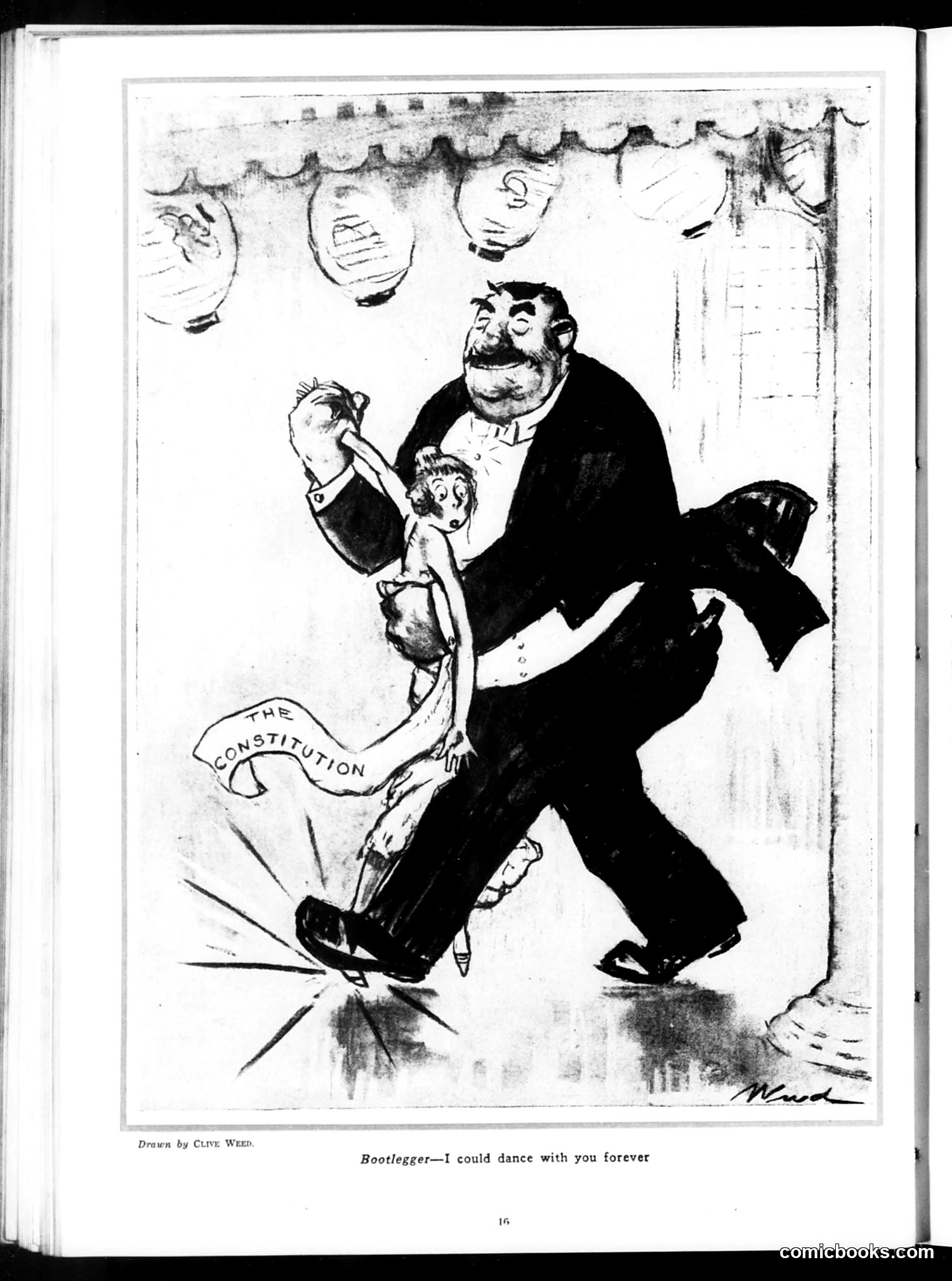
This cartoon by Clive Weed depicts a well-dressed man labeled "Bootlegger" dancing with a figure representing "The Constitution," shown as a small, vulnerable child-like form. The cartoonist illustrates the bootlegger's metaphorical "dance" with constitutional law during Prohibition era. The satire suggests that bootleggers—illegal alcohol traffickers—are openly flouting the Constitution with impunity, treating it as a casual partner rather than respecting legal authority. The hanging heads above appear to represent consequences or victims. The cartoon critiques how Prohibition's enforcement failed to stop illegal liquor distribution, instead allowing criminals to brazenly circumvent constitutional protections and law enforcement. This reflects Judge magazine's satirical commentary on Prohibition's practical failure in 1920s America.
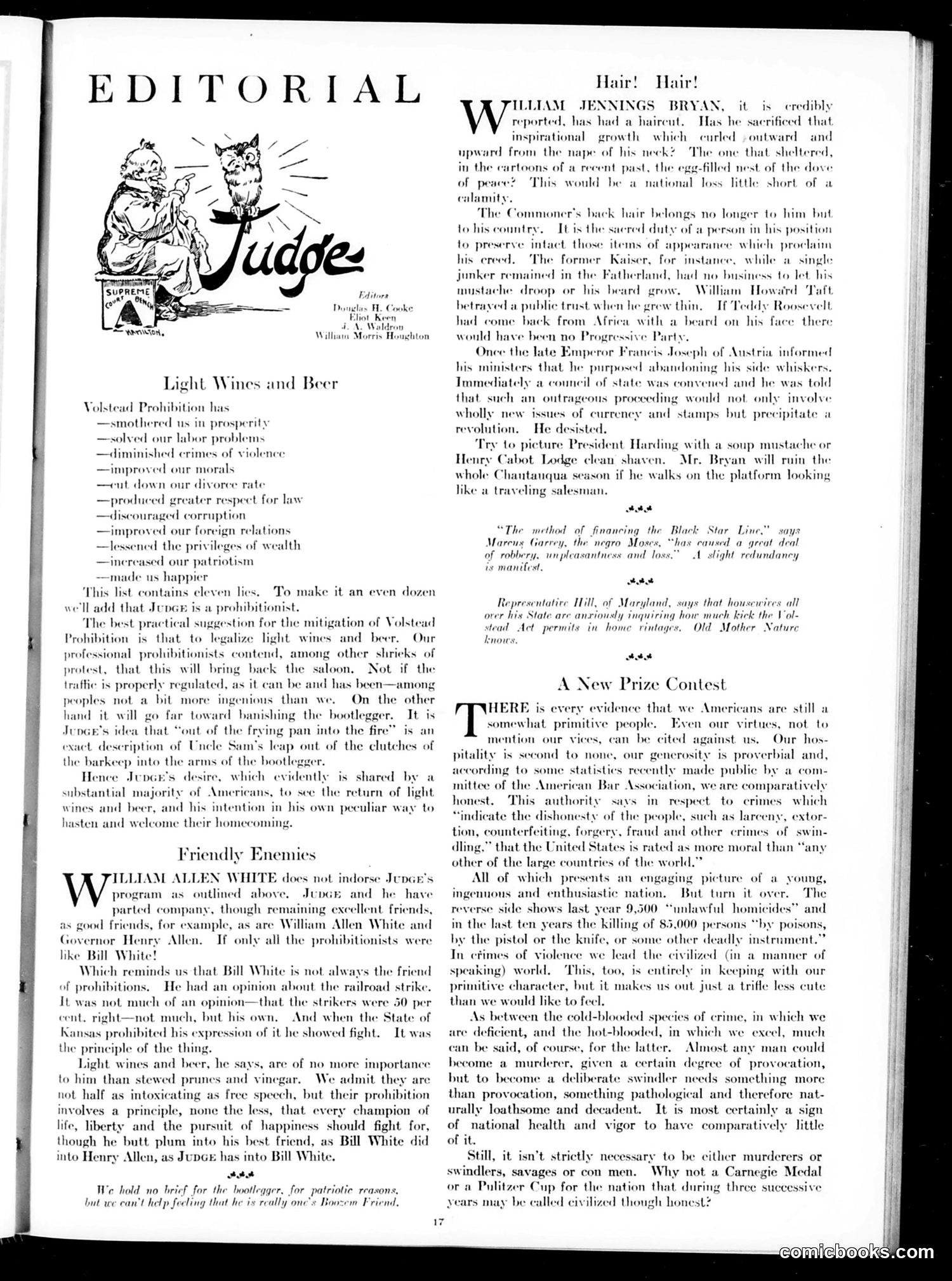
This editorial page from *Judge* magazine satirizes Prohibition's failures through multiple critiques: **"Light Wines and Beer"**: The main editorial mocks the Volstead Prohibition Act (enforced 1920-1933) by listing eleven supposed benefits—all presented as lies. The joke is that Prohibition accomplished the opposite: it increased bootlegging, corruption, and crime rather than improving morality and society. The editorial advocates legalizing light beer as a practical compromise. **"Hair! Hair!"**: This piece mocks William Jennings Bryan's reported haircut. The satire argues that public figures have a "sacred duty" to maintain their appearance, citing examples: the Kaiser's mustache, Taft's weight, Theodore Roosevelt's beard—all supposedly tied to their political viability. The absurdity of the argument is the point. **"Friendly Enemies"**: This defends editor William Allen White's right to disagree with *Judge* on prohibition while remaining respected, contrasting this with bootleggers who are "really one's Boozem Friend"—a pun suggesting even criminals are preferable to Prohibition's failures. The overall message: Prohibition is counterproductive and ridiculous.
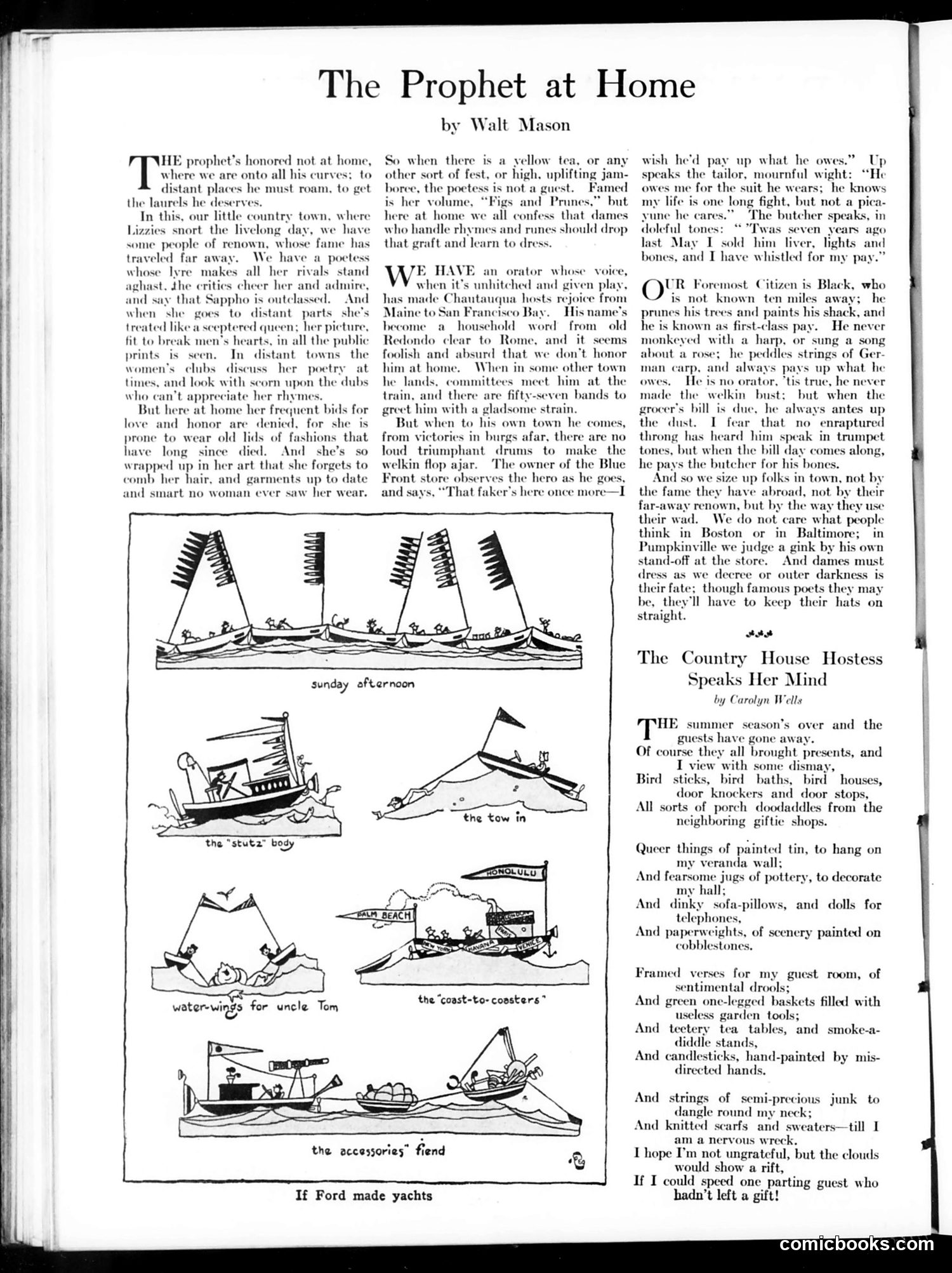
This page contains two humorous poems satirizing a common social paradox: people celebrated elsewhere are dismissed at home. **"The Prophet at Home"** (Walt Mason) critiques how a celebrated poetess and orator receive acclaim in distant towns but are scorned locally. The poetess, famous nationally, is ignored at home because she dresses unfashionably and neglects her appearance. The orator draws huge crowds elsewhere but locals resent him—the tailor, butcher, and store owner all complain he owes them money. The poem's ironic conclusion praises "Our Foremost Citizen," a modest, unglamorous man admired simply because he **pays his bills promptly**—suggesting small-town values prioritize financial reliability over artistic talent or rhetorical skill. The cartoons show absurdist "Ford yachts"—toy boats made from household items—mocking consumerism and pretension. **"The Country House Hostess Speaks Her Mind"** (Carolyn Wells) humorously catalogs tacky guest gifts: painted-tin decorations, pottery jugs, and sofa pillows—the sort of inexpensive trinkets from "neighboring giftie shops" that clutter rather than beautify a home. Both pieces gently mock provincial attitudes and social pretension.
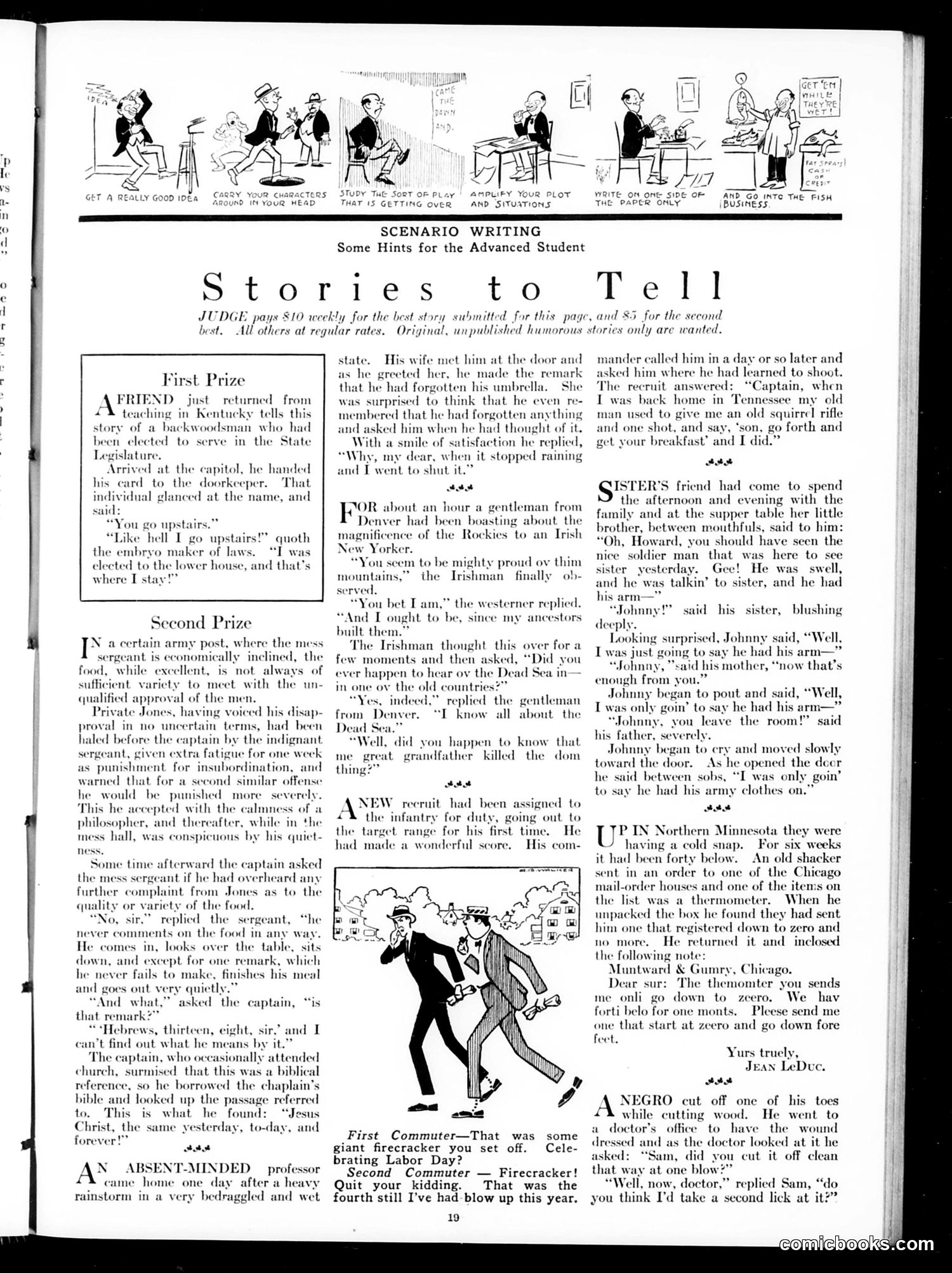
This page presents **humorous short stories** rather than political cartoons. The small cartoon strip at the top shows "Scenario Writing" advice for aspiring writers. The stories themselves are genteel humor for early 20th-century readers: 1. **First Prize**: A backwoods Kentucky legislator, newly elected to the state house, refuses to go upstairs in the capitol building because he was "elected to the lower house"—a pun on his literal interpretation of "lower house." 2. **Second Prize**: A soldier punished for complaining about mess hall food responds by quoting Hebrews 13:8 ("Jesus Christ the same yesterday, and to day, and for ever") with no comment—implying the food never changes. 3. Other brief anecdotes mock: a professor forgetting his umbrella, a Denver man claiming his ancestors built the Rocky Mountains, and a Prohibition-era joke about illegal stills exploding. The page **advertises a writing contest** ($10 for best story, $5 for second) to encourage reader submissions. The humor relies on wordplay, irony, and gentle mockery of authority figures—typical of Judge's satirical tone.
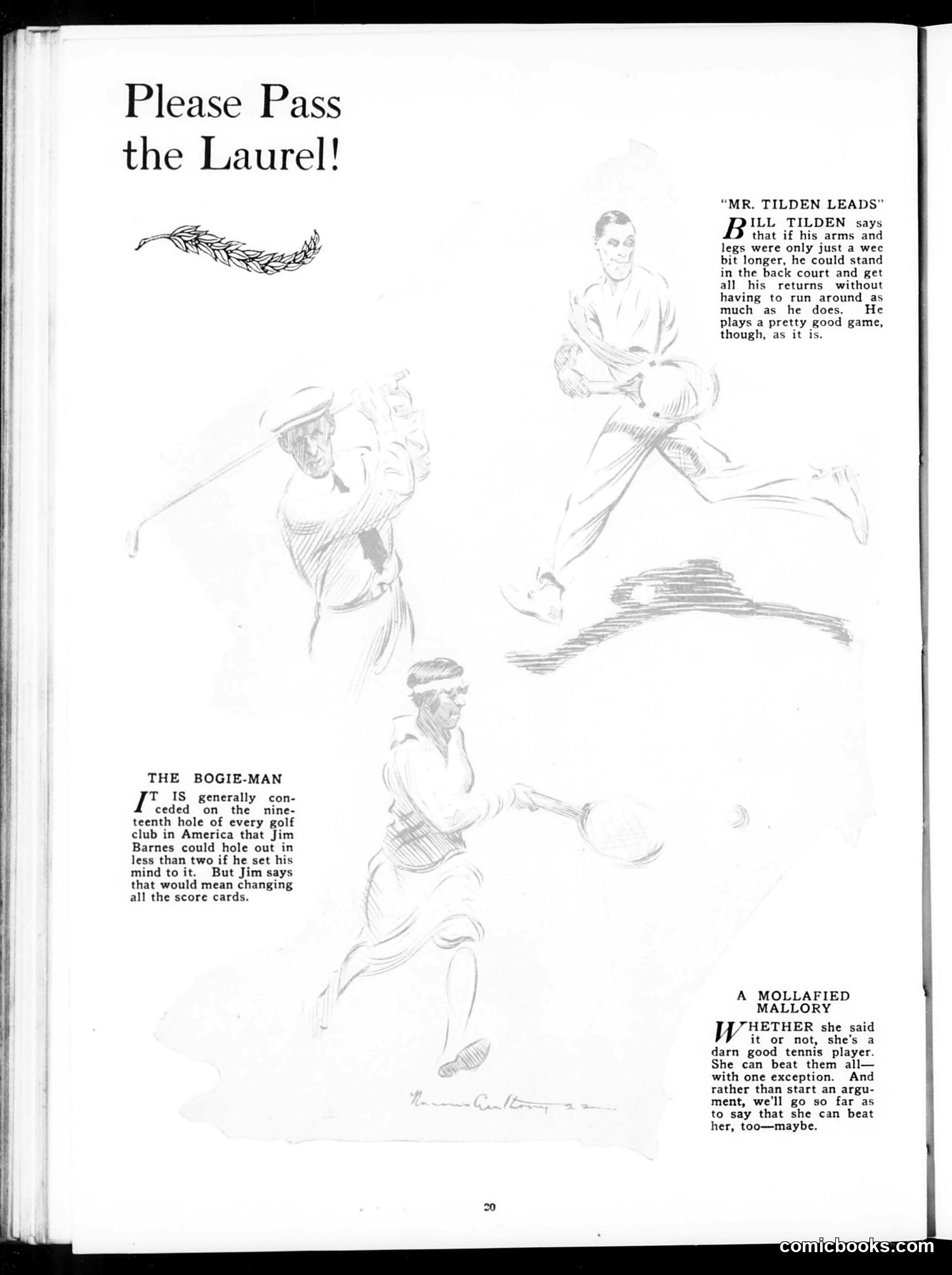
This page contains three sports humor pieces celebrating contemporary athletic champions: **"Mr. Tilden Leads"** mocks tennis star Bill Tilden with a joke about his height—if his arms and legs were longer, he wouldn't need to run around the court as much. It's gentle ribbing of his playing style. **"The Bogie-Man"** references golfer Jim Barnes, suggesting he could score impossibly well (hole out in under two) if he wanted to, but changing all scorecard records would be impractical. **"A Mollafied Mallory"** discusses a female tennis player (likely Molla Bjurstedt Mallory, a dominant player of the 1920s). The joke is deliberately evasive—she beats everyone except one opponent, and the writer humorously refuses to settle whether she could beat that rival, calling it too contentious to argue. The page celebrates these sports figures as public celebrities while poking fun at their competitive personas and abilities.
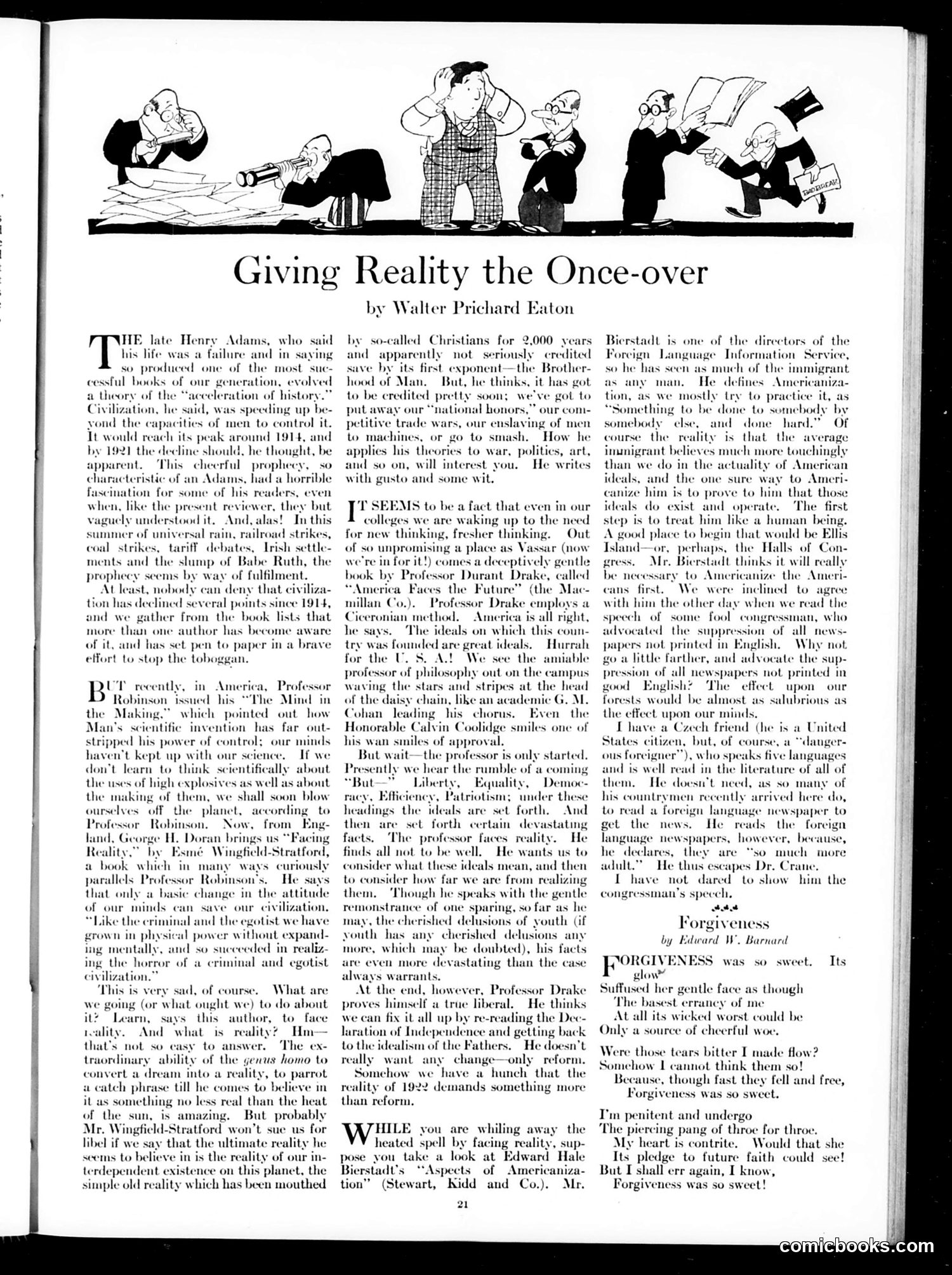
This is a book review essay by Walter Prichard Eaton discussing contemporary intellectual anxieties about modern civilization. The cartoon header depicts figures representing different approaches to reality—from overwhelmed bureaucrats drowning in paperwork to bemused observers—illustrating the essay's central debate. The text critiques historians and philosophers (Henry Adams, Professor Robinson, Esmé Wingfield-Stratford, and Professor Durant Drake) who argue that humanity's technological and scientific advancement has outpaced moral and intellectual development. The authors warn that without fundamental changes in thinking and embracing interdependent existence ("Brotherhood of Man"), civilization faces collapse. The satire targets intellectuals' tendency to package familiar truths in elaborate new theories. Eaton notes ironically that these professors essentially rediscover Christianity's 2,000-year-old message about human interconnection while presenting it as urgent modern discovery. The cartoon's chaos visualizes the "acceleration of history" Adams described—society spinning out of control.
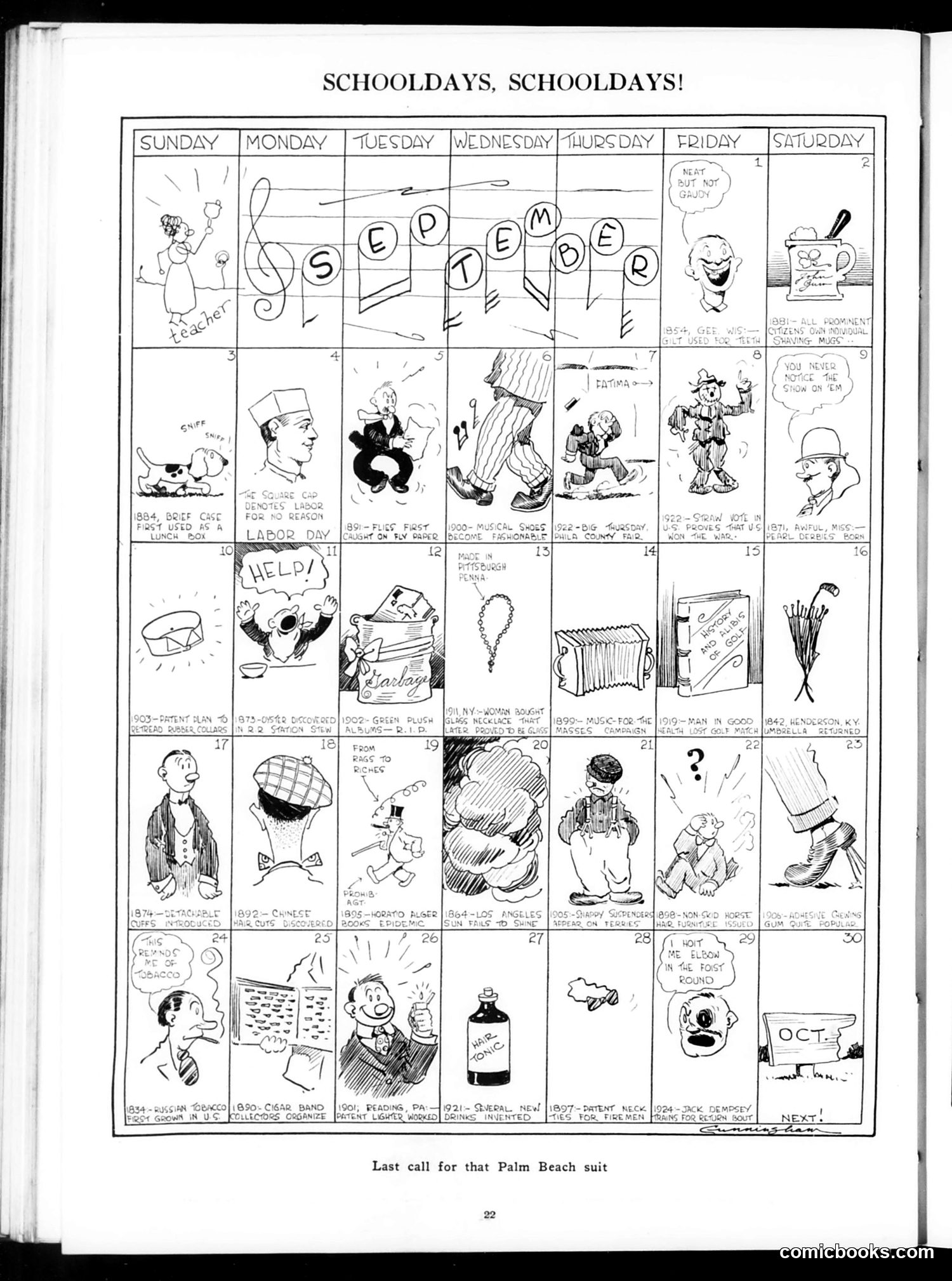
This is a seven-day comic strip calendar satirizing American life and current events circa 1921. Each numbered panel depicts a different historical reference or social commentary: The strip includes references to **Labor Day** (panel 11, showing a labor-related figure), **Prohibition-era drinking** (visible bottle imagery), and period fashion like the **"Palm Beach suit"** mentioned in the caption—a lightweight suit popular during the 1920s. Various panels appear to reference **Jack Dempsey** (the heavyweight boxing champion), **patent/invention themes**, and everyday American anxieties and humor of the era. The drawings use exaggerated caricature typical of Judge magazine's satirical style. The overall structure presents a week in the life filled with topical jokes—boxing, drinking culture, fashion, and social concerns—that would have been immediately recognizable to Judge's contemporary 1920s readers but require historical context for modern audiences.
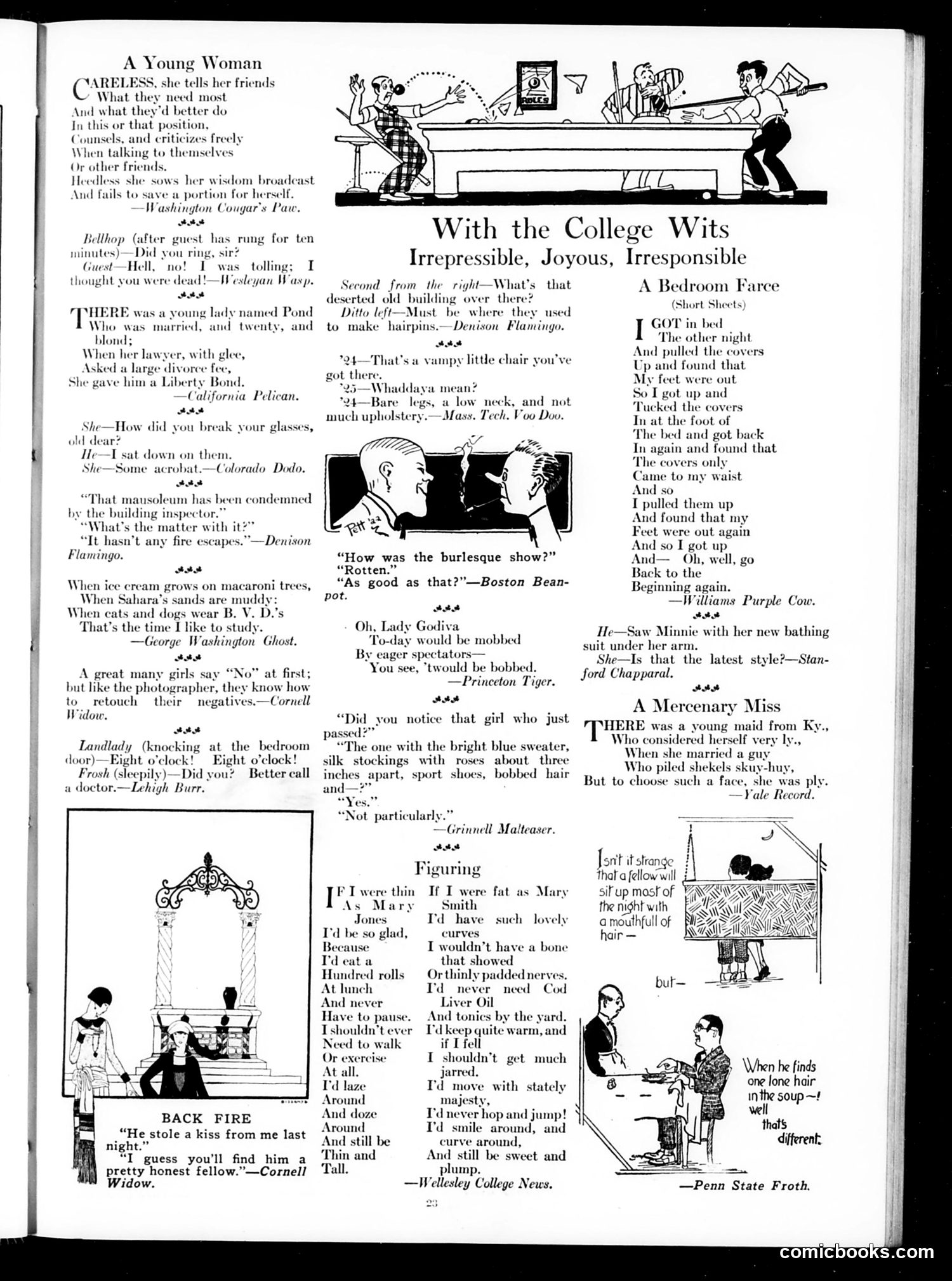
This page from Judge magazine collects **college humor** — jokes and cartoons sourced from university publications (Wesleyan Wasp, Cornell Widow, Princeton Tiger, etc.). The content reflects 1920s campus life and attitudes. **Key themes:** - **Women's behavior**: "A Young Woman" satirizes young women who give unsolicited advice to friends but fail to follow it themselves — a dig at perceived female hypocrisy. - **Dating/romance**: Multiple jokes mock courtship conventions, bobbed hair (a controversial 1920s fashion), and women's fashion choices. "A Mercenary Miss" jokes that a woman married a wealthy man despite his ugly face. - **College life**: Pranks, dormitory mishaps ("Bedroom Farce" about short bedsheets), and bellhop/landlord interactions typical of student housing. - **Body image**: "Figuring" compares thin versus fat women in tongue-in-cheek verse, reflecting period obsessions with feminine curves. The humor is **light, collegiate, and gender-focused**, relying on observations about dating rituals and women's appearance rather than political commentary.
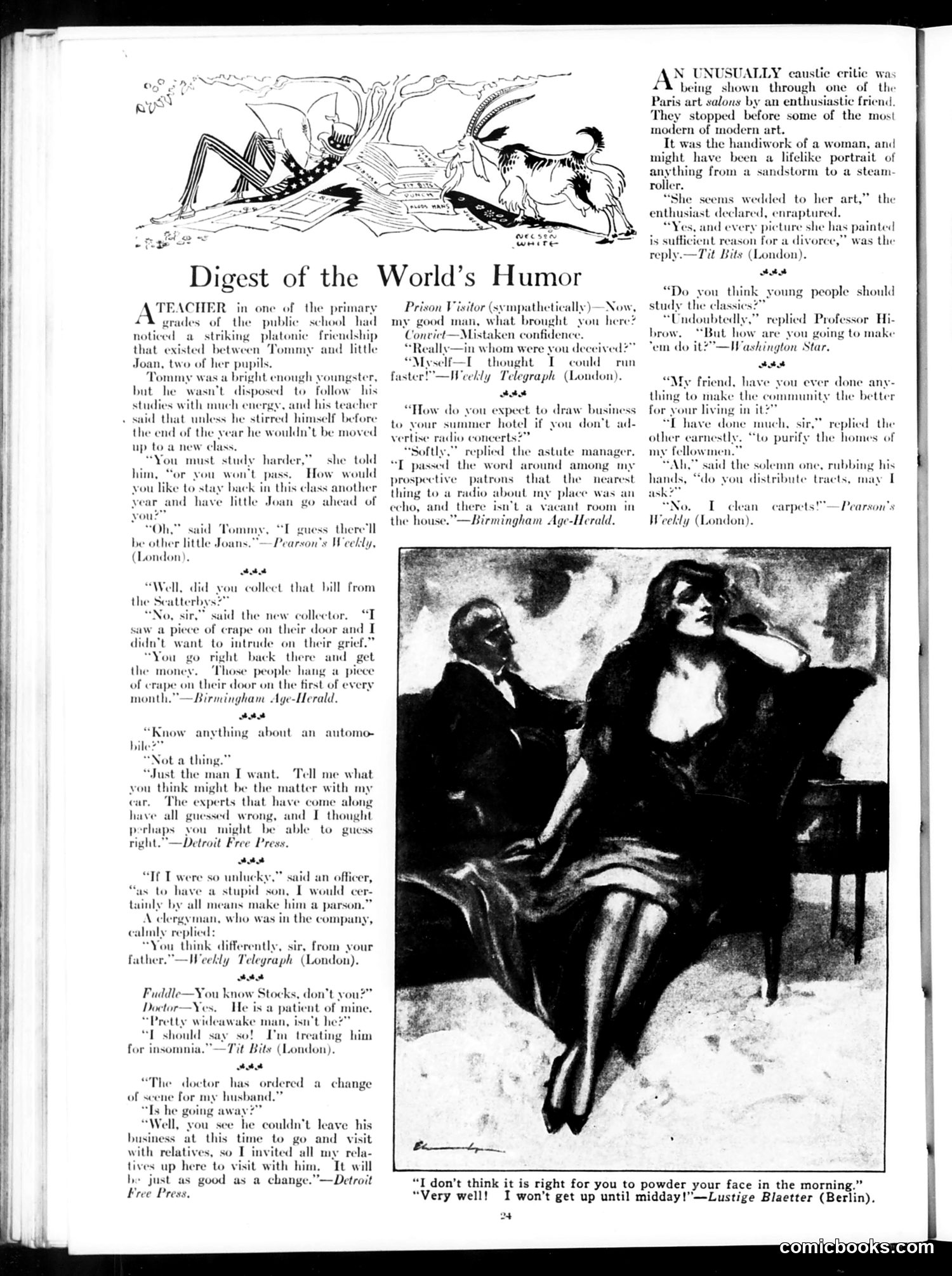
This page collects brief humorous anecdotes from various international newspapers, typical of Judge's "Digest of the World's Humor" feature. The jokes reflect early 20th-century social attitudes: **Key themes:** - **Gender relations**: A woman artist's devotion to modern art; a woman negotiating domestic routines (powdering makeup, sleeping late) - **Class attitudes**: A clergyman dismissing a stupid son's worth; working-class characters (collectors, drivers) outwitting educated people through common sense - **Modern anxieties**: Radio technology, automobile trouble, business concerns - **Youth and education**: A schoolboy prioritizing romance over studies **The cartoon** (top left) illustrates one anecdote about an insect, likely depicting Tommy's indifference to advancement when Joan might follow him. The humor operates through role reversals and verbal comebacks—the unqualified mechanic proves helpful; the con artist outsmarts respectable businessmen. This reflects Judge's satirical stance on American social pretension and institutional hypocrisy, popular with the magazine's educated middle-class readership.
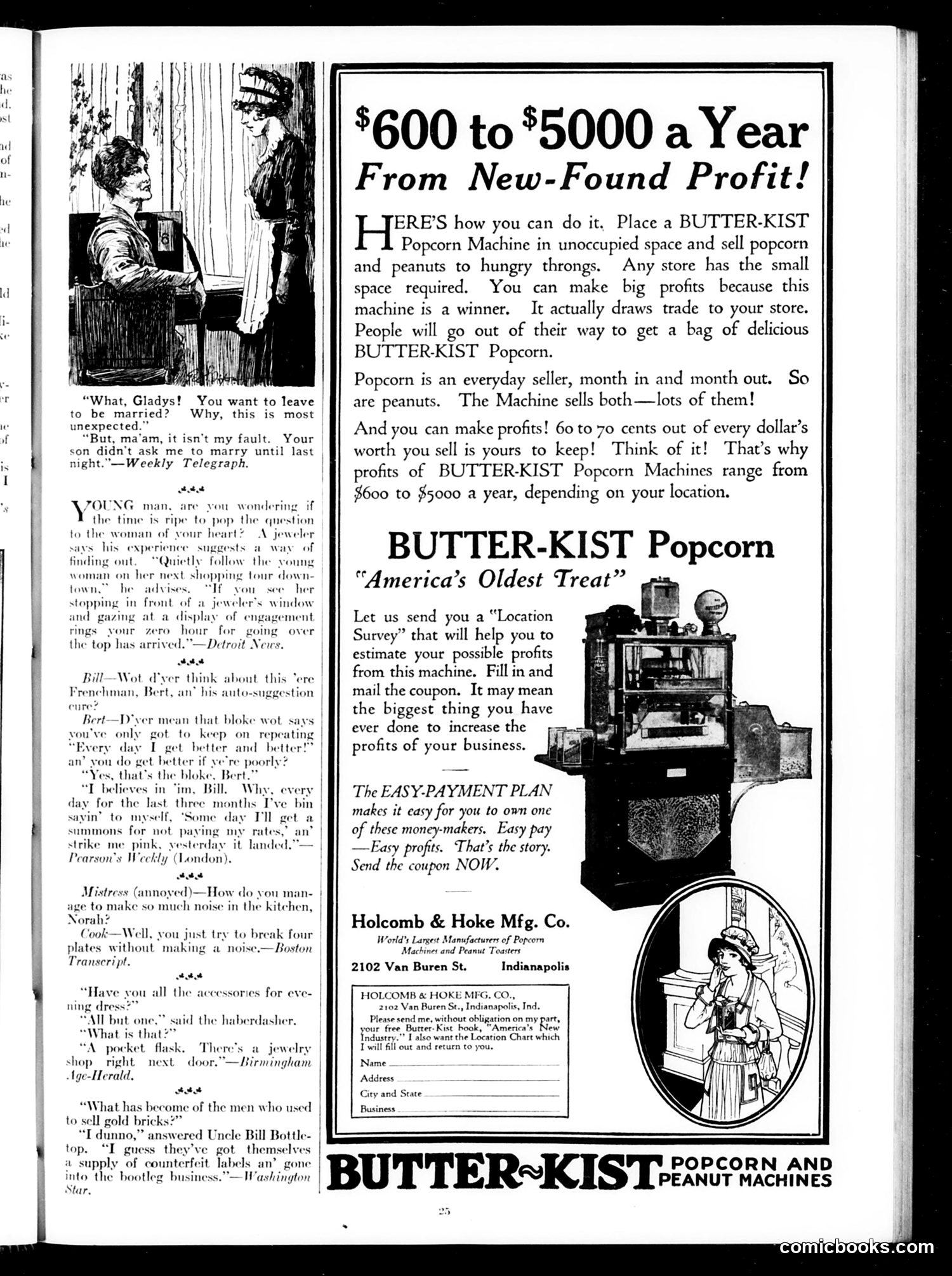
This page is **primarily a full-page advertisement** for Butter-Kist Popcorn Machines, with decorative satirical content surrounding it. ## The Advertisement The ad promises "$600 to $5000 a Year" profit from operating a popcorn/peanut vending machine in small retail spaces. It emphasizes 60-70 cent profit margins and uses an "easy payment plan" to attract entrepreneurs. ## The Satirical Vignettes The page includes small humorous sketches mocking contemporary social situations: - A servant asking to leave her job because the employer's son only proposed last night - A jeweler advising young men to follow women shopping and watch their jewelry-store behavior to gauge marriage prospects - A working-class man's cynicism about French "auto-suggestion" self-help cure methods - A domestic servant defended for kitchen noise-making ## The Satire's Purpose These jokes collectively mock the era's commercialism and self-help culture. They satirize how advertising preys on aspirational desires (quick profits, romance advice, pseudoscientific cures). The placement of cynical humor around a get-rich-quick scheme ad suggests Judge's skeptical, sometimes sardonic tone toward American consumer culture and dubious business promises.
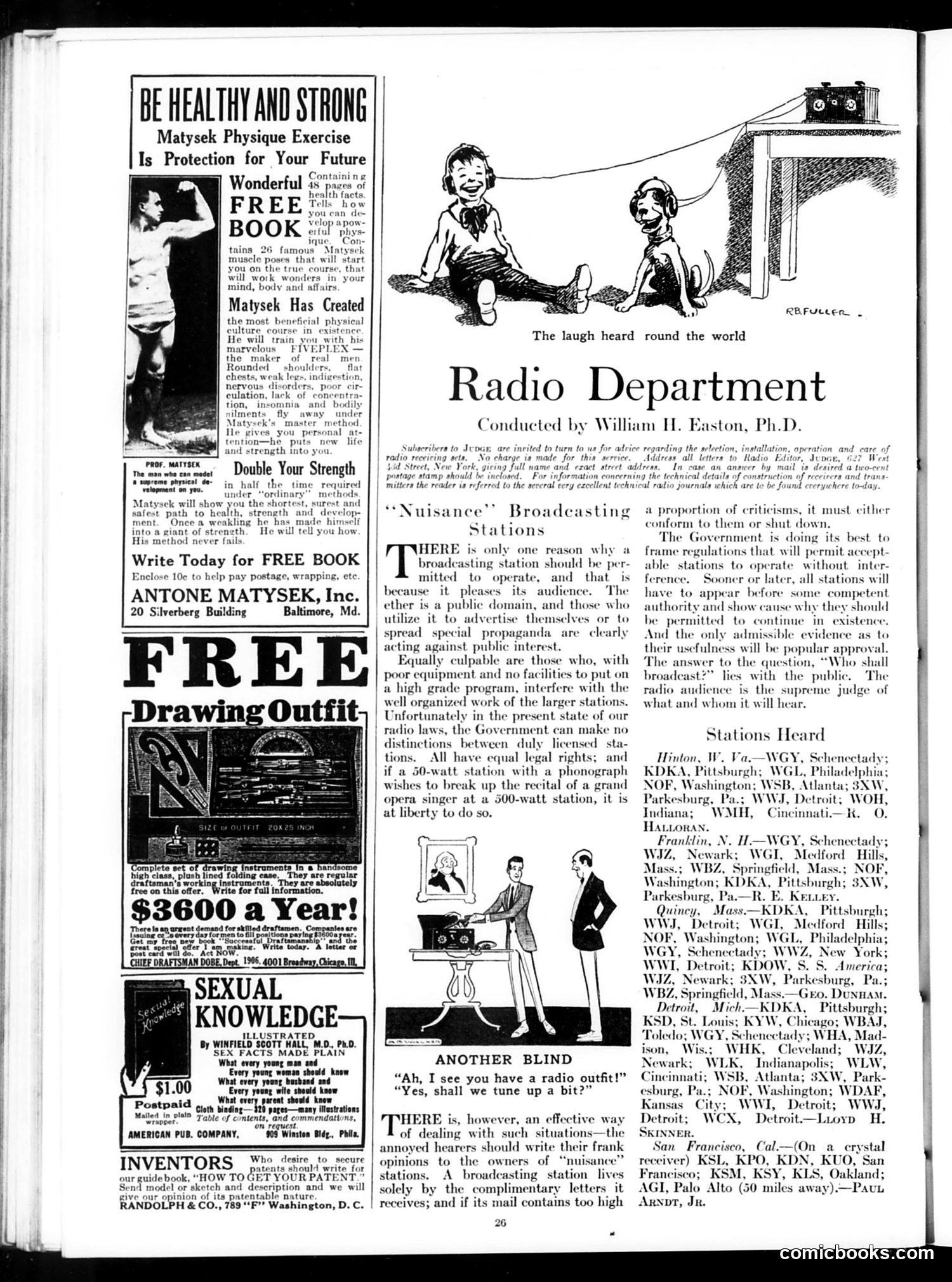
This page mixes ads and articles about radio's emerging regulatory landscape. The cartoon shows two figures with a radio setup indoors, illustrating the humor of early radio culture—the caption "Another Blind" appears to joke about radio owners' tendency to try tuning stations indiscriminately. The main article criticizes "nuisance" broadcasting stations: operators with poor equipment who interfere with legitimate transmissions or use airtime for propaganda rather than serving audiences. At this early regulatory moment, the author notes the government cannot legally distinguish between licensed stations despite their quality differences. The proposed solution is public feedback—station owners reading complaints in their mail should voluntarily improve or cease operations. The list of "Stations Heard" provides evidence of radio's expanding geographic reach across America, demonstrating this technology's rapid adoption and the article's timeliness in discussing broadcast standards.
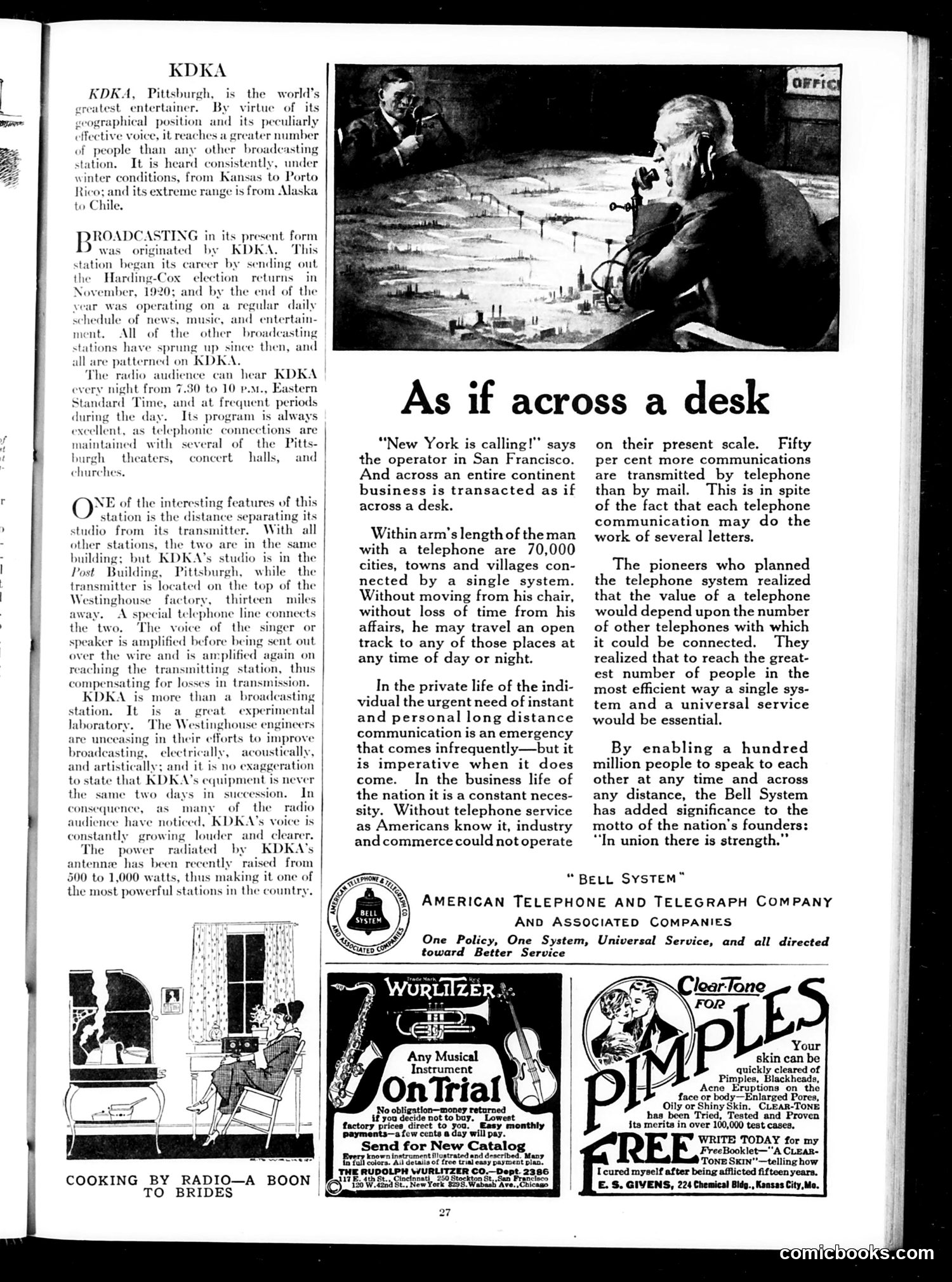
This page primarily advertises early radio broadcasting and telephone service rather than presenting political satire. The main content celebrates **KDKA Pittsburgh**, pioneering radio station that began broadcasting election returns in November 1920. The text emphasizes KDKA's technological achievement: its signal reaches from Alaska to Chile, and operates a 13-mile telephone line connecting studio to transmitter—innovative for the era. The accompanying photograph shows two men examining what appears to be a map or broadcast coverage area, illustrating the station's far-reaching range. Below are period advertisements: Bell System telephone service ("As if across a desk"), a Wurlitzer musical instrument, and a ClearTone pimple remedy. The small cartoon titled "Cooking by Radio—A Boon to Brides" likely plays on contemporary fascination with radio's domestic applications. This represents **boosterism** for new communication technology rather than satire—Judge magazine showcasing American industrial progress during the 1920s radio revolution.
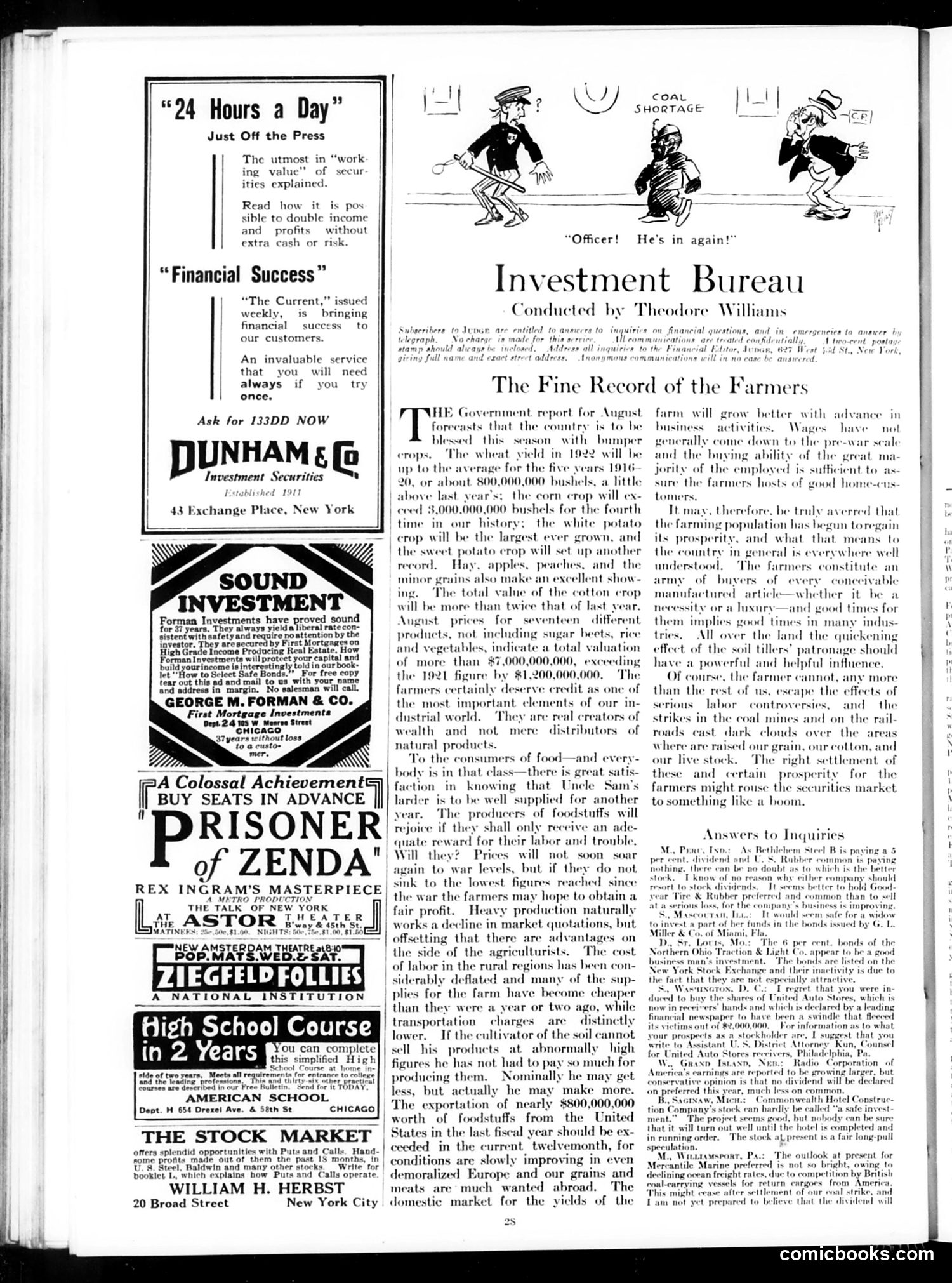
This page is primarily **advertisements and financial content**, not political satire. The small cartoon at top shows three figures labeled "Officer! He's in again!" with a "Coal Shortage" reference—likely satirizing recurring coal shortages during this era (appears to be early 1920s based on content). The main feature is Theodore Williams's "Investment Bureau," an article on farm economics projecting strong 1922 crop yields and arguing farmers deserve fair prices for their labor. The piece emphasizes agriculture's importance to the national economy and suggests food exports will remain strong despite post-WWI market adjustments. The page is dominated by investment and business advertisements promoting stocks, bonds, real estate, and financial services—reflecting the economic optimism of the early 1920s before the 1929 crash. The coal shortage cartoon is incidental to the page's primary purpose of selling financial products and information to readers.
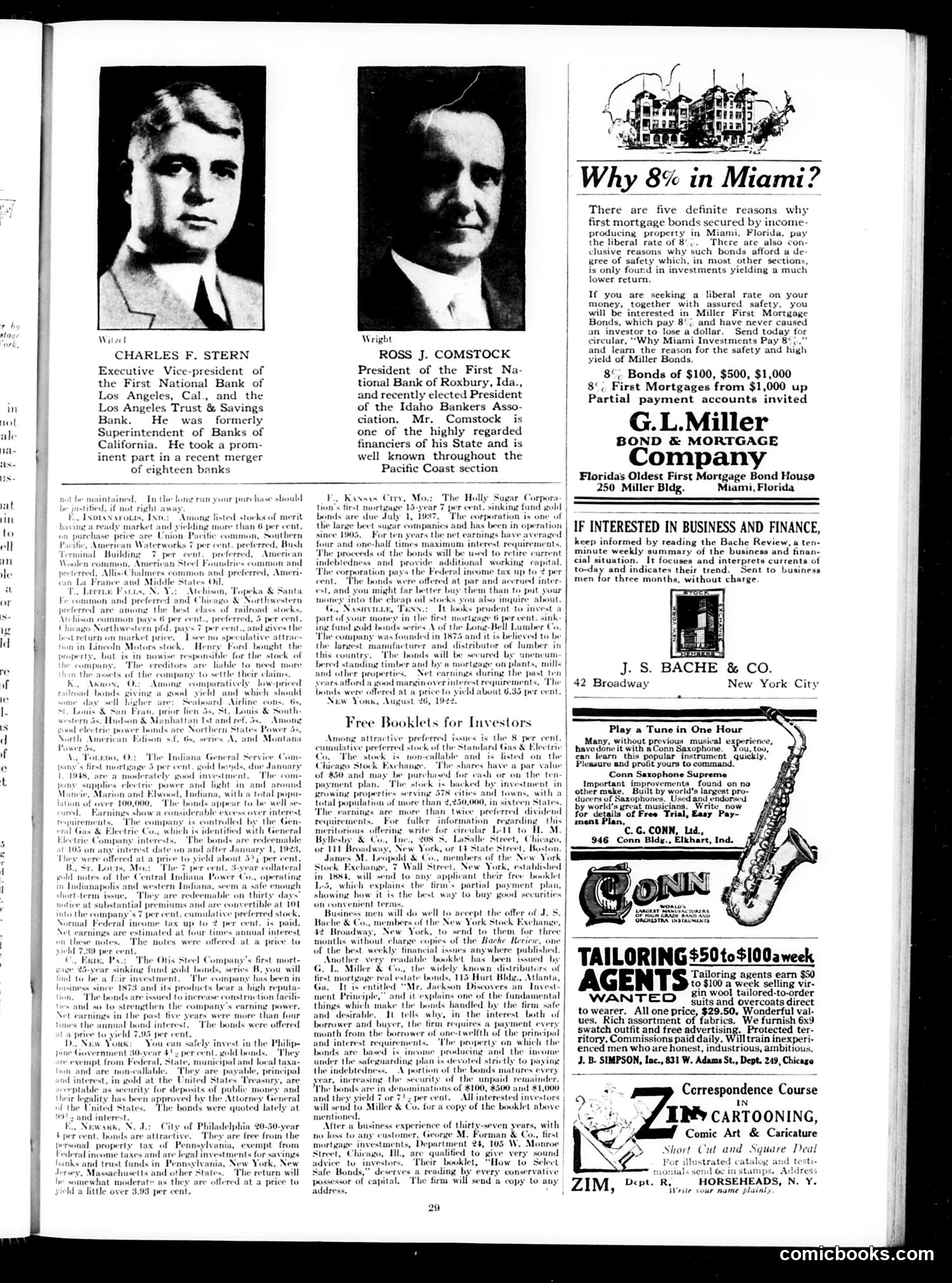
This page is primarily **advertising and financial content** aimed at investors, not a satirical cartoon page. The top portion features portraits and biographical sketches of two West Coast bankers: **Charles F. Stern** (executive vice-president, First National Bank of Los Angeles) and **Ross J. Comstock** (president, First National Bank of Roxbury, Idaho). Below their photos is detailed financial advice promoting Miami real estate bonds. The remainder of the page consists of **investment advertisements**—listings for preferred stocks, bonds, and financial booklets from various banks and investment firms. There are also small ads for unrelated products (a saxophone, tailoring services, a cartooning correspondence course). **No cartoons or satire appear on this page.** This is a financial-advice section typical of Judge's mixed content, where satirical humor shared space with legitimate business information and paid advertising aimed at the magazine's affluent readership.
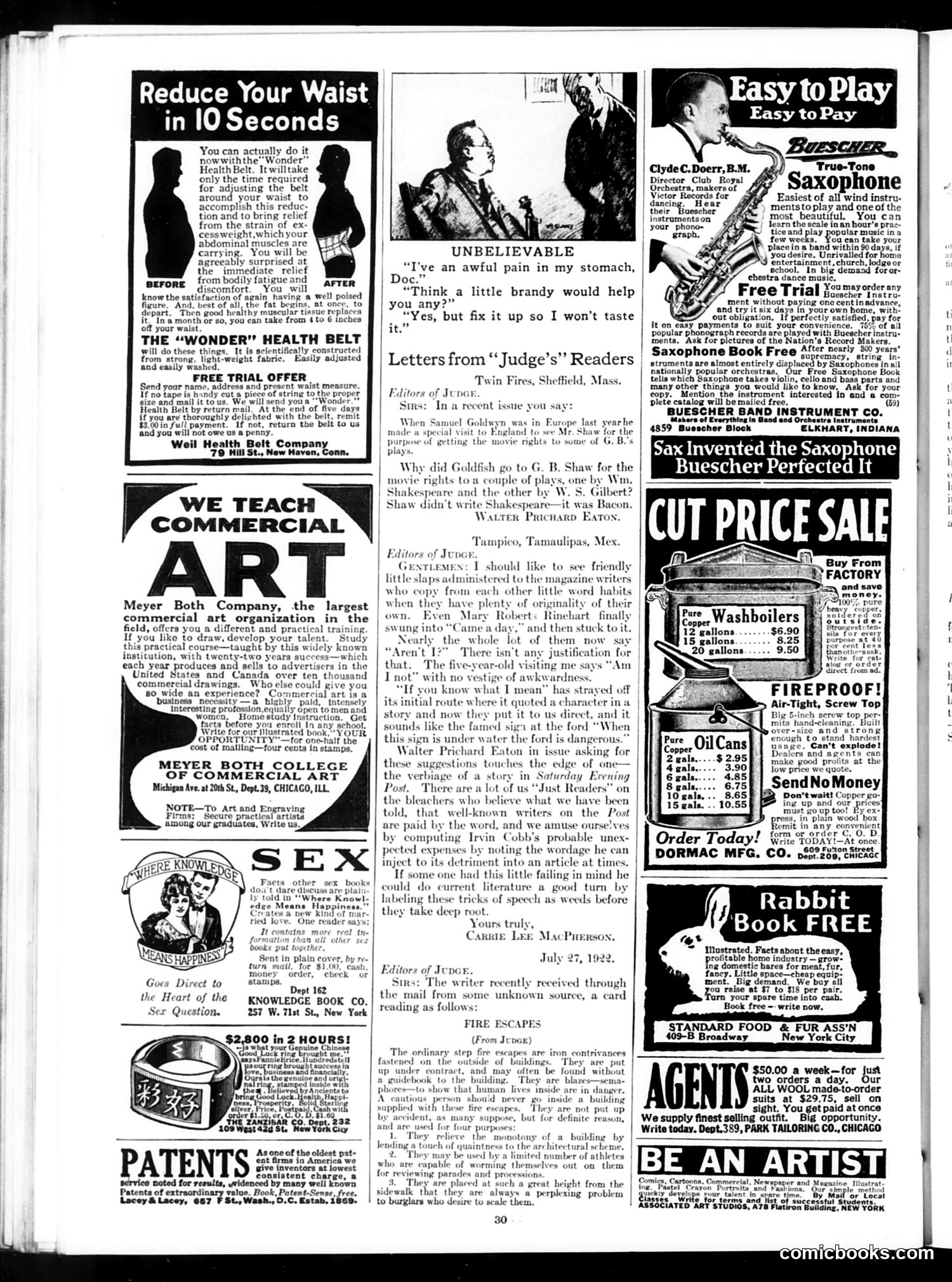
This page is primarily **advertising and reader letters**, not political satire. The main cartoon appears at top center: a doctor and patient discussing stomach pain. The doctor suggests brandy as treatment; the patient asks him to "fix it up so I won't taste it"—likely satirizing both medicinal alcohol use (common in the 1920s) and patients' reluctance to take unpleasant medicine. The "Letters from Judge's Readers" section contains literary criticism: readers correct the magazine's claim that Samuel Goldwyn got Shakespeare movie rights from G.B. Shaw (pointing out Shakespeare didn't write those plays), and another correspondent criticizes magazine writers for copying each other's repetitive phrases like "Aren't I?" and "If you know what I mean." The remainder is **commercial advertising**: health belts for weight reduction, correspondence courses in commercial art, patent services, and various products—typical of 1920s magazines. These ads reveal period concerns: body image, business education, and self-improvement schemes.
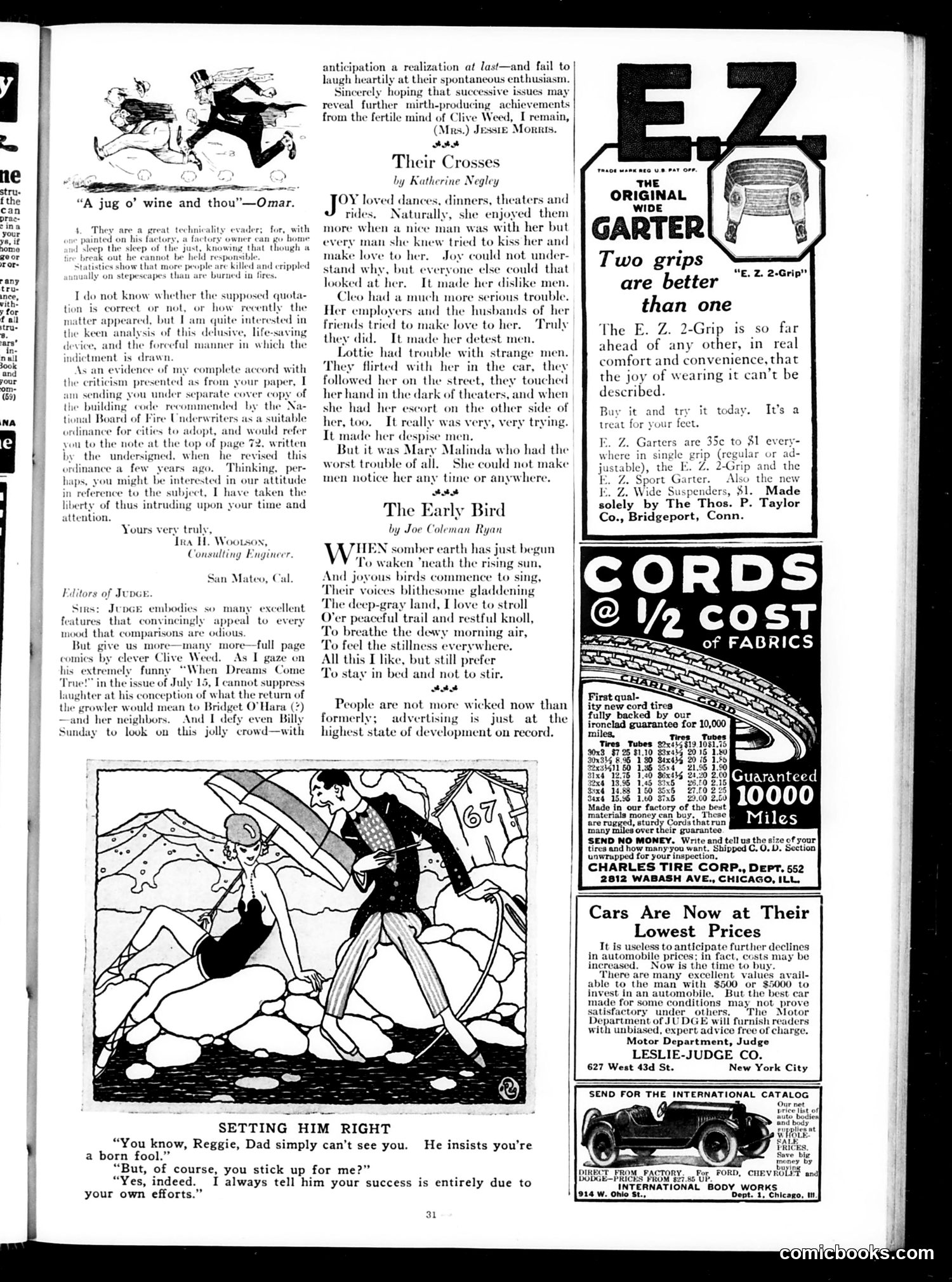
This page contains three fictional stories and one cartoon, typical of Judge's satirical humor circa the 1910s-20s. **"Their Crosses"** satirizes men's unwanted romantic advances toward women. The story presents four women with different "troubles": Joy is pestered by suitors, Cleo by married men and employers, Lottie by strangers in public places, and Mary Malinda—the punchline—cannot *attract* male attention at all. The satire mocks both male behavior (constant flirtation as presumed entitlement) and suggests female dissatisfaction regardless of circumstance. **"The Early Bird"** is a gentle poem praising nature walks while admitting the speaker prefers staying in bed—mild humor about conflicting impulses. **"Setting Him Right"** cartoon shows a father dismissing his son ("born fool") while the son claims his success is entirely self-made. The son's smugness and the father's skepticism create the joke—typical generational family humor. The page is otherwise dominated by **advertisements** for garters, tires, and automobiles, reflecting 1920s commercial interests.
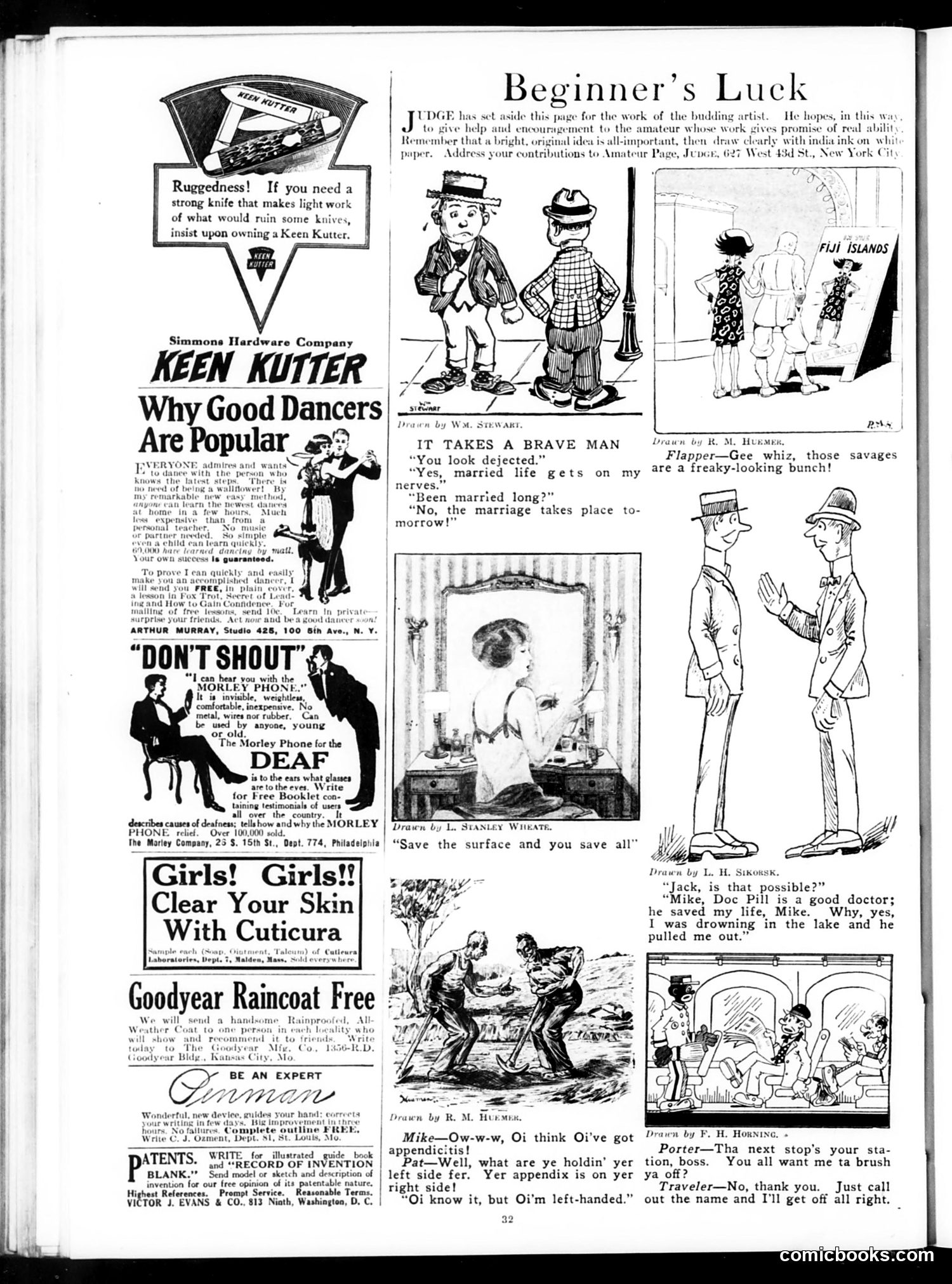
This page contains multiple cartoon vignettes and advertisements typical of early 1920s *Judge* magazine. The main cartoons depict everyday social situations with humorous dialogue: a dejected man joking about his impending marriage, a flapper's dismissive reaction to Pacific Islanders, a man mistakenly holding his right side thinking his appendix is on the left, and exchanges between a porter and travelers on a train. The humor relies on wordplay, malapropisms (particularly in Irish-accented dialect dialogue), and simple situational comedy. The "Fiji Islands" cartoon suggests the era's casual, exoticizing attitude toward non-Western peoples. The page mixes these cartoons with advertisements for commercial products (Keen Kutter knives, Cuticura skin cream, Morley Phone for the deaf) and patent services—typical *Judge* monetization. Overall, it's a representative slice of 1920s American satirical humor: relatively gentle, advertisement-heavy, and reflecting period attitudes toward class, ethnicity, and consumer culture.
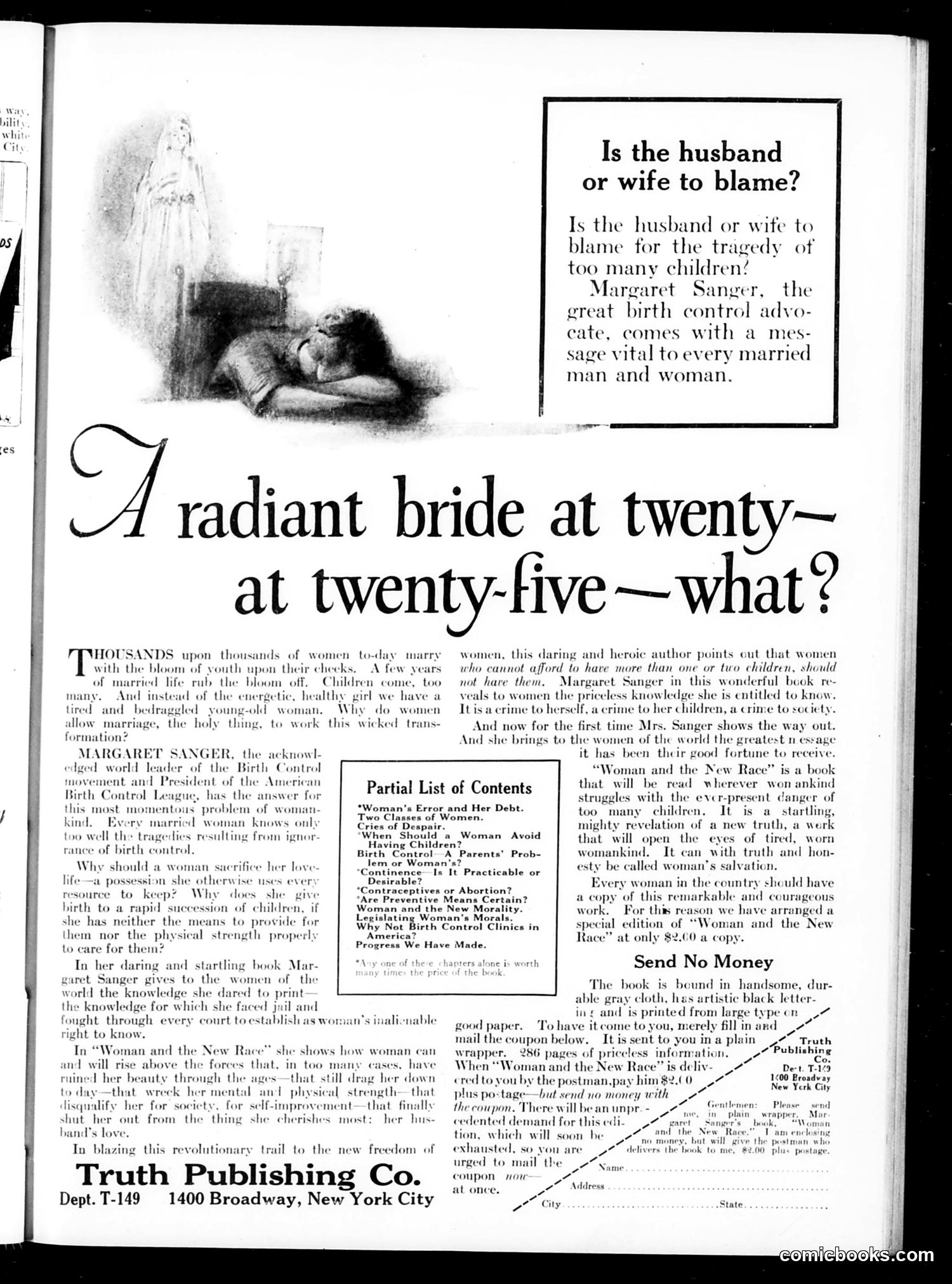
This page is primarily **advertising for Margaret Sanger's birth control book** "Woman and the New Race," not satirical content. The small illustration at top shows a distressed woman, establishing the emotional appeal. The ad argues that **poor women suffer physical and emotional exhaustion** from bearing too many children, losing their youth and beauty by age twenty-five. It frames birth control knowledge as women's fundamental right and "salvation." The text positions Sanger as a heroic figure who faced legal persecution ("jail and fought through every court") to make contraceptive information publicly available. The ad appeals to both **humanitarian concerns** (women's health, child welfare) and **economic arguments** (families lacking means shouldn't have many children). This reflects the 1920s-30s birth control movement's core messaging: contraception as women's liberation and social responsibility. The advertisement's earnest tone—not satirical—suggests *Judge* was promoting progressive causes alongside its typical humor content.
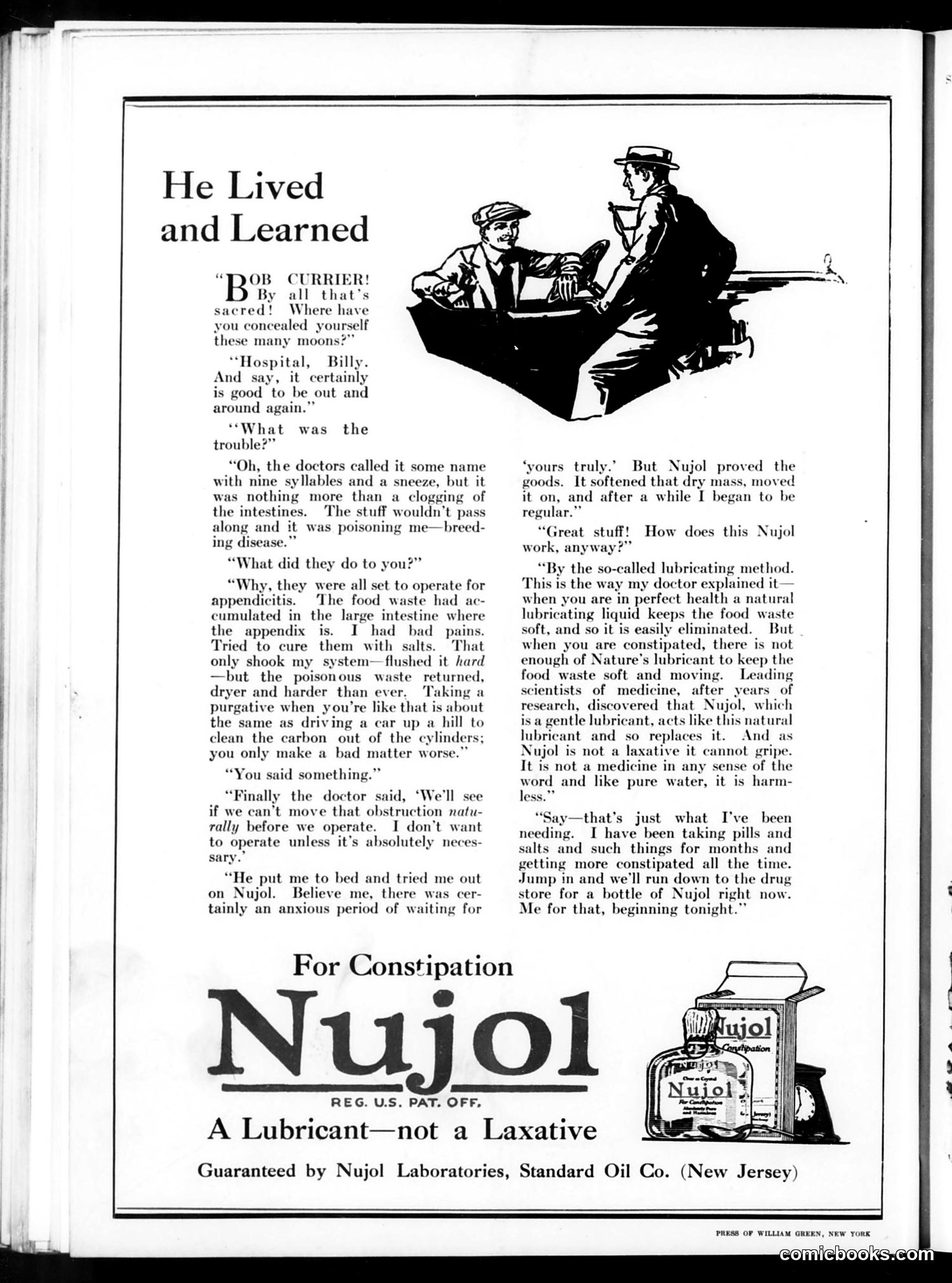
This page is primarily **advertising disguised as editorial content**—a common Judge magazine format. The cartoon depicts two men in conversation: Bob Currier has just left the hospital after intestinal trouble. His friend Billy asks what treatment cured him. The narrative explains that doctors initially planned surgery for appendicitis, but instead prescribed **Nujol**, a mineral oil product. The satire here targets **contemporary medical practice**: doctors eager to operate unnecessarily, and patients' reliance on harsh purgatives and salts that worsen constipation. Nujol's pitch—that it's a "lubricant, not a laxative"—positions the product as a gentler, more natural alternative based on "leading scientists of medicine." This reflects early 20th-century skepticism of invasive surgery and aggressive treatments. The dialogue serves as testimonial advertising, making the product seem medically endorsed while appearing to be genuine conversation. The page demonstrates how Judge blended satirical commentary on medical trends with branded content.