
Judge, 1922-09-02 · page 17 of 36
Judge — September 2, 1922 — page 17: what you’re looking at
What you’re looking at
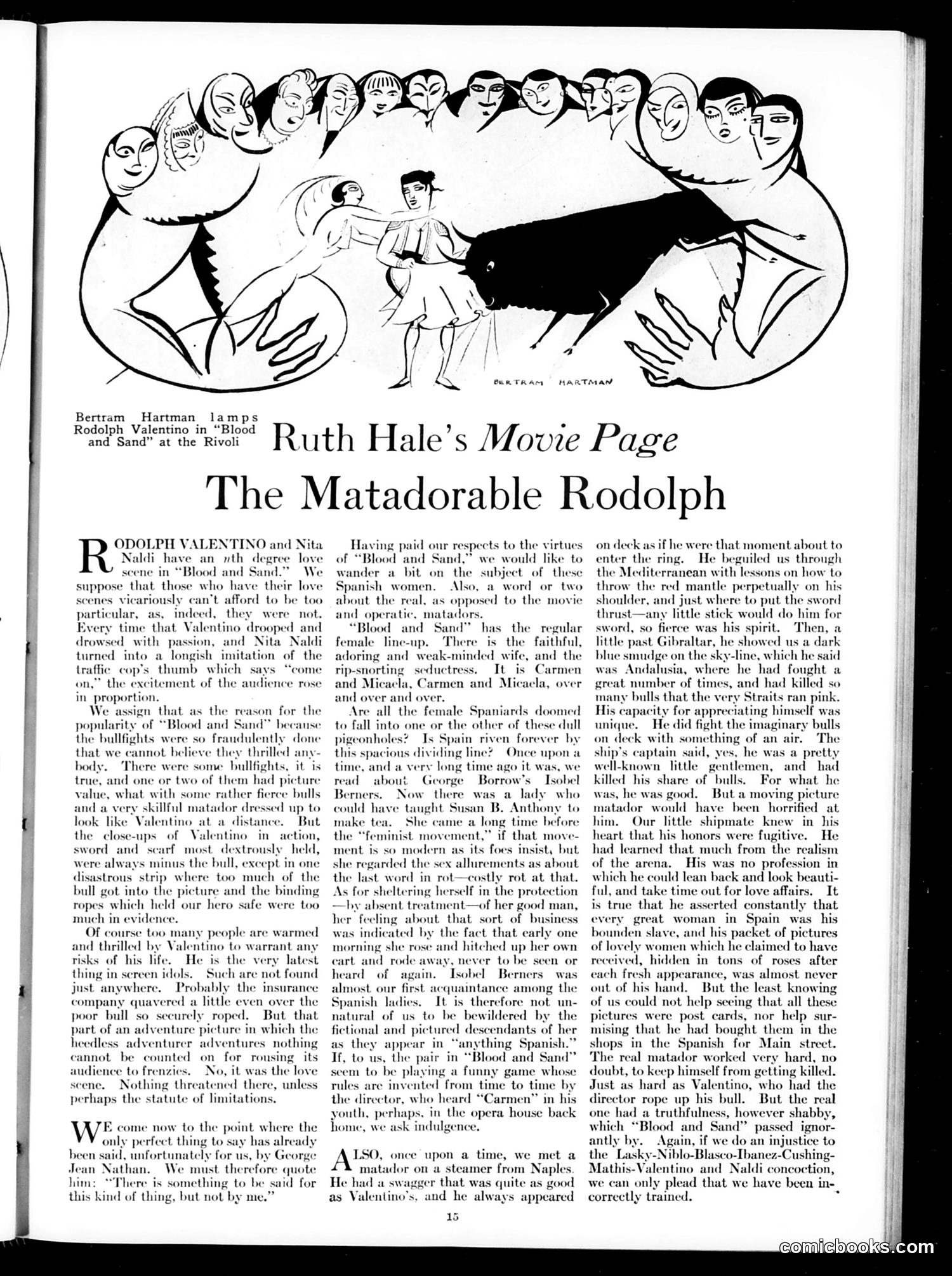
This is a film review by Ruth Hale (visible in the masthead) critiquing Rudolph Valentino's 1922 movie *Blood and Sand*. The cartoon shows Valentino as a matador surrounded by admiring women's faces. The review's satire targets: 1. **Valentino's popularity with female audiences**: Hale sardonically notes audiences were thrilled by Valentino's "passion" scenes with actress Nita Naldi rather than the actual bullfighting scenes, which were poorly staged and unconvincing. 2. **Spanish female stereotypes**: Hale mocks the film's reliance on tired archetypes—the faithful wife, the seductress—claiming all Spanish women in cinema fall into these categories. 3. **Gender commentary**: Hale references George Borrow's historical account of Isobel Berners, an independent Spanish woman who rejected both sexual allure and male protection, implying more nuanced female characters exist beyond movie clichés. The review is witty and dismissive of both the film's technical failings and Hollywood's reductive portrayal of women.
📄 Transcribed text from this page (OCR, searchable)
Machine-transcribed from the original scan — historical spelling and the odd misread are preserved.
Bertram Hartman lamps Rodolph Valentino in “Blood and Sand” at the Rivoli een tTRAm HARTMAN Ruth Hale’s Movie Page The Matadorable Rodolph ODOLPH VALENTINO and Nits R Naldi have an nth degree scene in “Blood and Sand. suppose that those who have their love nes vicariously can't afford to be too articular, as, indeed, they were not. Every time that Valentino drooped and drowsed with passion, and Nita Naldi turned into a longish imitation of the traffie cop’s thumb which says “come on,” the excitement of the audience rose in proportion. We assign that as the reason for the popularity of “Blood and Sand” because the bullfights were so fraudulently done that we cannot believe they thrilled any- body. There were some bullfights, it’ is and one or two of them had picture . what with some rather fierce bulls and a very skillful matador dressed up to look like Valentino at a distance. But the close-ups of Valentino in action, sword and. scarf most dextrously held, were always minus the bull, except in one disastrous strip where too much of the bull got into the picture and the binding ropes which held our hero safe were too much in evidence. Of course too 1 and thrilled by V risks of his life. y people are warmed lentino to warrant any He is the very latest thing in screen idols. Such are not found just anywhere. P, » the insurance company quavered a little even over the poor bull so securely roped. But that part of an adventure picture in which the heedless adventurer adventures nothing cannot. be counted on for rousing. its audience to frenzies. No, it was the love scene. Nothing threatened there, unless perhaps the statute of limitations. WE come now to the point where the only perfect thing to say has already been said, unfortunately for us, by George Jean Nathan. We must therefore quote him: “There is something to be said for this kind of thing, but not by me.” Having paid our respects to the virtues of “Blood and Sand,” we would like to wander a bit on the subject of these Spanish women. Also, a word or two about the real, as opposed to the movie and operatic dors. “Blood and Sand” has the regular female line-up. There is the faithful, ado and weak-minded wife, and the rmen over rip-snorting seductress. Tt_ is and Micaela, Carmen and Micacl and over and over. Are all the female Spaniards doomed to fall into one or the other of these dull Is Spain riven forever by Once upon a pigconholes? this spacious dividing line time, and a very long time ago it was, we read — abot corge Borrow’s — Isobel Berners. Now there was a lady who could hi taught Susan B. Anthony to make She came a long time before the minist movement,” if that: move- ment is so mode its foes insist, but she regarded the sex allurements as about the last word in rot—costly rot at that. As for sheltering herself in the protection —hby absent treatment—of her good man, her feeling about that sort of business was indicated by the fact that early one morning she rose and hitched up her own cart and rod never to be seen or heard of Isobel Berners was almost our first acquaintance among the Spanish ladies. It is therefore not un- natural of us to be bewildered by the fictional and pictured de as they appear in * If, to us, the 7 i seem to be playing a funny game whose rules are invented from time to time by the director, who heard “Carmen” in his youth, perhaps, in the opera house back home, we ask indulgence, A once upon a time, we met a matador on a steamer from Naples. He had a swagger that was quite as good as Valentino's, and he always appeared 15 on deck as if he were that moment about to enter the ring. He beguiled us through the Mediterranean with lessons on how to throw the red mantle perpetually on his shoulder, and just where to put the sword thrust iy little stick would do him for sword, so fierce was his spirit. Then, a little past Gibraltar, he showed us a dark blue smudge on the sky-line, which he said was Andalusia, where he had fought a g number of times, a d_ killed so many bulls that the Straits ran pink. His capacity for appreciating himself was unique. He did fight the imaginary bulls on deck with something of an air. The ship’s captain said, yes, he was a pretty well-known. little gentlemen, and had killed his share of bulls. For what he was, he was good. But a moving picture matador would have been horrified at him. Our little shipmate knew in his heart that his honors were fugitive. He had learned that much from the i of the arena. His was no profess which he could lean back and look be bounden slave, and his packet of pictures of lovely women which he claimed to have received, hidden in tons of roses after each fresh appearance, was almost never out of his hand. But the least knowing of us could not help seeing that all these pictures were post cards, nor help sur- mising that he had bought them in the shops in the Spanish for Main street. The real matador worked very hard, no doubt, to keep himself from i Just as hard as Valentino, who had the director rope up his bull. But the real one had a truthfulness, however shabby, which “Blood and Sand” passed ignor- antly by. if we do an injustice to the Lask, jasco-[banez-Cushing- 1 entino and Naldi concoction, can only plead that we have been in- correctly trained. =