
Judge, 1922-09-02 · page 15 of 36
Judge — September 2, 1922 — page 15: what you’re looking at
What you’re looking at
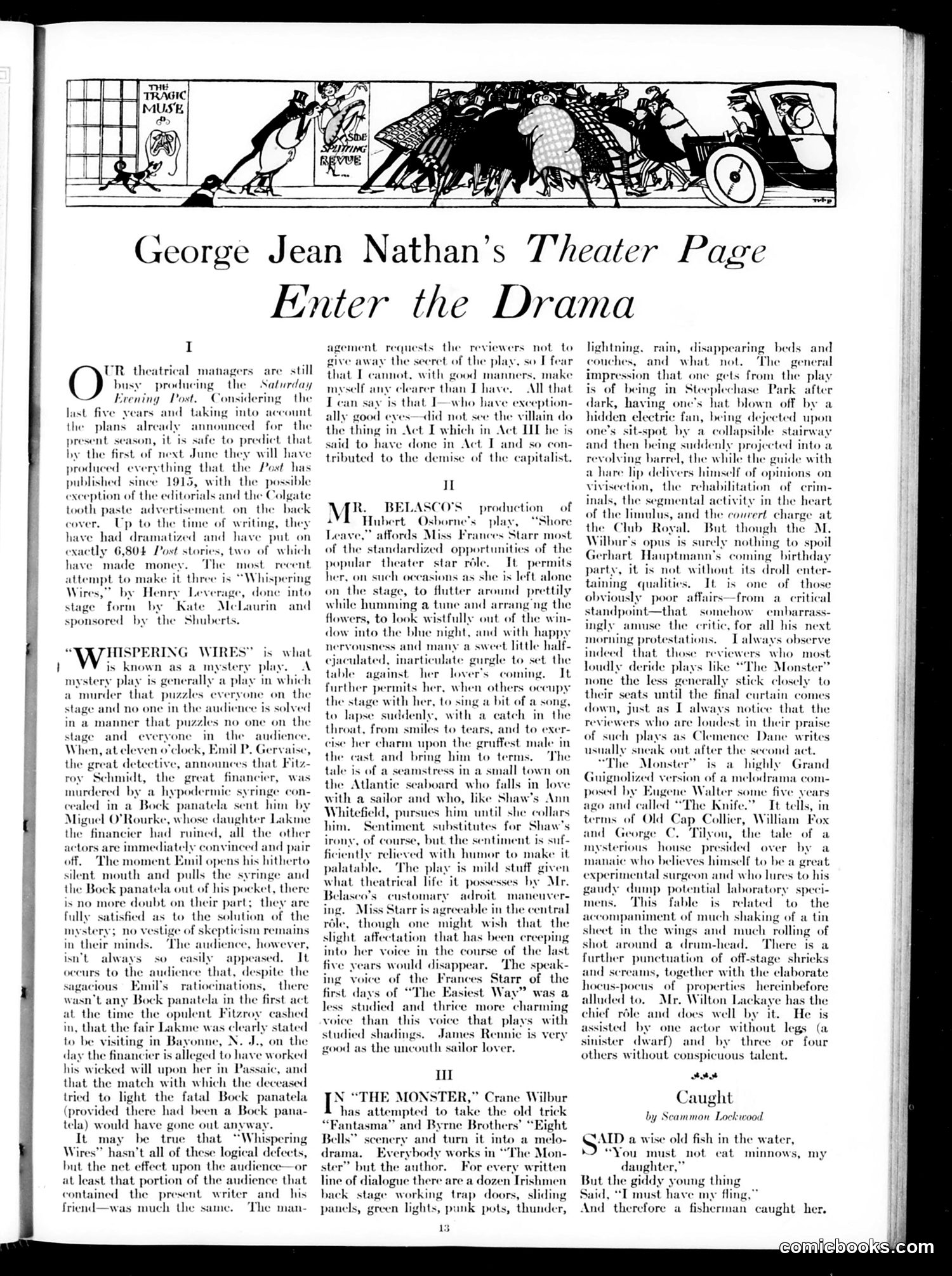
This is George Jean Nathan's theater criticism column from Judge magazine. The top cartoon strip satirizes theatrical producers' tendency to adapt Saturday Evening Post stories for the stage—Nathan quips they've dramatized 6,804 Post stories since 1915, with only two making money. Nathan reviews three current productions: 1. **"Whispering Wires"** — a mystery play he finds logically absurd. Audiences accept the detective's solution despite glaring plot holes (a crucial clue couldn't physically exist as described). Nathan sardonically notes the audience suspends disbelief more readily than the evidence warrants. 2. **"Shore Leave"** — starring Frances Starr, which Nathan finds mild but competent. It permits standard "star vehicle" moments: prettily humming, gazing wistfully out windows, singing emotionally. 3. **"The Monster"** — mentioned briefly at column's end. Nathan's tone is witty and skeptical, mocking both producers' formula-driven adaptations and audiences' willingness to ignore logical impossibilities in theatrical plots.
📄 Transcribed text from this page (OCR, searchable)
Machine-transcribed from the original scan — historical spelling and the odd misread are preserved.
George Jean Nathan’s Theater Page Enter the Drama I UR theatrical managers are still busy producing the Saturday Evening Post. Considering the last five and taking into account the plans already announced for the present season, it is safe to predict that hy the first of next June they will have produced everything that. the Post has published since 1915, with the possible exception of the editorials and the Colgate tooth paste advertisement. on the back cover. Up to the time of writing, they have had dramatized and have put on exactly 6,804 Post stories, two of which have made money. The most recent attempt to make it three is “Whispering Wires,” by Henry Leverage, done into stage form by Kate) MeLaurin and sponsored by the Shuberts. years HISPERING WIRE is known as a myste mystery play is gene a murder that puzzle and no one in th manner that puzzles no one on the everyone in’ the audience. “clock, Emil P, Gervaise, ve, announces that Fitz- ; the great financier, was murdered by a hypodermic syringe con- cealed ina’ Bock panatela sent him by Miguel O'Rourke, whose daughter Lakme the ancier had ruin ll the other actors are immedia ivinced and pair off. The moment Emil opens his hither silent mouth and pulls the syringe and the Boel ela out of his pocket, there is no more bt on their part; they are fully satisfied as to the solution of the ; no vestige of skepticism remains in their minds. The audience, however, isn’t always so. easily appeased. It occurs to the audience that, despite the ious) Emil’s ratiocinations, — th wasn't any Bock panatela in the first at the time the opulent Fitzroy cashed in, that the fair Lakme was clearly stated to be visiting in Bayonne, N. J., on the day the financier is alleged to have work his wick that the ch with which the dec tried to light the fatal Bock p (provided there had been a Bock tela) would have gone out anyway. Tt may be true that “Whispering ‘al defects, but the net effect upon the audience—or at least that portion of the audience that contained the present. writer. and his friend—was much the same. The man- son the adience is solved mys pana- reviewers not to vs so [fear anners, make rment requests the ay the seeret of the 7 unnot. with good 1 ny clearer than T have, AI that an say is that I—who have exception- ally good eyes—did not see the villain do the thing in Act which in Act HL he is said to have done in Act T and so con- tributed to the demise of the capitalist. ME BELASCO’S — production — of AYE Hubert) Osborne's play, “Shore Leave,” affords Miss Frances Starr most of the standardized opportunities of the popular theater star rile. Tt permits her, on such occasions as she is left alone on the stage, to flutter around prettily while humming a tune and arrang ng the flowers, to look wistfully out of the win- dow into the blue night, and with happy nervousness and many a sweet little half- inarticulate gurgle to set the table against her lover's coming. It further permits her, when others oceupy the s stage with her, to sing a bit of a song, Ivy, with a catch in’ the . from smiles to tears, and to e' Sharm upon the gruffest- mi cast and bring him to terms. The mstress in a small town on seaboard who falls in love and who, like id, pursues him until ntiment substitutes for Shaw's irony, of course, but the sentiment is suf- ficiently relieved with humor to make it palatable. ‘The play is mild stuff ¢ rical life it possesses by) Mr. customary adroit) maneuver- Miss Starr is agreeable in the though one might wish th: ation that has been ereeping in the course of the last The speak- es Starr of the st Way” was a more charming that plays with Rennie is very lor lover. the role, five ing voice of the first days of “The less studied and_ thrice ice than this voice sd shadings. Jami good as the uncouth Il TER,” Crane Wilbur the old trick asma” and Byrne Brothers’ “Eight seenery and turn it into a melo- drama. Everybody works in “The Mon- ster” but the author. For every written line of dialogue there are a dozen Irist n back stage working trap doors, sliding panels, green lights, punk pots, thunder, N “THE MON has attempted to Bells lightning. rain, disappearing beds and couches, and what not. The general impression that one gets from the play is of being in Steeplechase Park after dark, having one’s hat blown off by a hidden electric fan, being dejected upon one’s sit-spot by a collapsible stairway and then being suddenly projected into a revolving barrel, the while the guide with a hare lip delivers himself of opinions on vivisection, the rehabilitation of crim- inals, the segmental activity in the heart of the limulus, and the courert charge at the Club Royal. But though the M. Wilbur's opus is surely nothing to spoil Gerhart Hauptmann’s coming birth party, it is not without its droll en taining qualities. It is one of tho: obviously poor affairs—from a critic standpoint—that somehow —embarrass- ingly amuse the critic, for all his next morning protestations. Lalways observe indeed that thos s who most loudly deride | he Monster” none the less *k closely to their seats until the final curtain comes down, just as T always notice that the reviewers who are loudest in their praise of such plays as Clemence Dane writes sneak out after the second act. Monste is a highly Grand Gnignolized version of a melodrama com- VE i five years ago and called “The Knife It tells, in terms of Old Cap Collier, William Fox and George C. Tilyou, the tale of a mysterious presided over by a manaie who believes himself to be a great experimental surgeon and who lures to his gaudy dump potential laboratory speci- mens. This fable is rela to the accompaniment of much shaking of a tin sheet in the wings and much. rolli shot around a drum-head. There is a further punctuation of off-stage shricks and screams, together with the elaborate hocus-pocus of properties hereinbefore alluded to. Mr. Wilton Lac! > has the chief rdle and does well: by He is sisted by one actor without legs (a sinister dwarf) and by three or four others without conspicuous talent. house ry Caught by Scammon Lockwood SAID a wise old fish in the water, “You must not cat minnows, daughter,” But the giddy young thing S “LT must have my fling.” ret therefore a fisherman caught her. my