
Judge, 1922-09-02 · page 26 of 36
Judge — September 2, 1922 — page 26: what you’re looking at
What you’re looking at
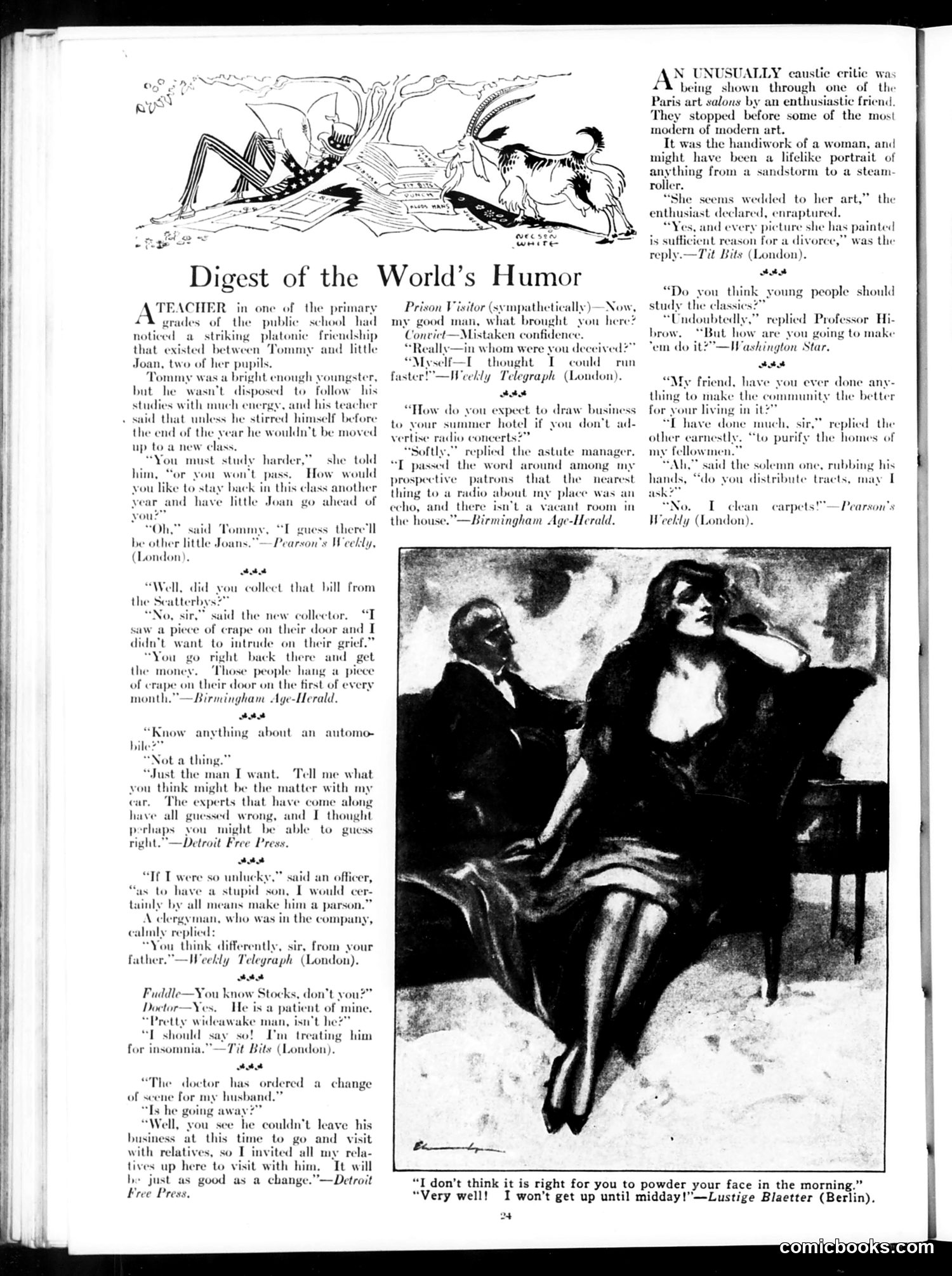
This page collects brief humorous anecdotes from various international newspapers, typical of Judge's "Digest of the World's Humor" feature. The jokes reflect early 20th-century social attitudes: **Key themes:** - **Gender relations**: A woman artist's devotion to modern art; a woman negotiating domestic routines (powdering makeup, sleeping late) - **Class attitudes**: A clergyman dismissing a stupid son's worth; working-class characters (collectors, drivers) outwitting educated people through common sense - **Modern anxieties**: Radio technology, automobile trouble, business concerns - **Youth and education**: A schoolboy prioritizing romance over studies **The cartoon** (top left) illustrates one anecdote about an insect, likely depicting Tommy's indifference to advancement when Joan might follow him. The humor operates through role reversals and verbal comebacks—the unqualified mechanic proves helpful; the con artist outsmarts respectable businessmen. This reflects Judge's satirical stance on American social pretension and institutional hypocrisy, popular with the magazine's educated middle-class readership.
📄 Transcribed text from this page (OCR, searchable)
Machine-transcribed from the original scan — historical spelling and the odd misread are preserved.
Digest of the World’s Humor TEACHER in one of the primary grades of the public school had noticed a striking platonic friendship that existed between ‘Tommy and little Joan, two of her pupils. Tommy was a bright cnough youngster, but he wasn’t disposed to. follow his ind his teacher studies with much ene » said that unless he stirred himself before the end of the year he wouldn't be moved up to a new class. ‘You must study harder,” she told him, “or you won't pass. How would you like to stay back in this class another nd have little Joan go ahead of * said Tommy, “DE guess there'll be other little Joans.”—Pearson’s Weebly, (London). tote “Well, did you collect: that bill from . sir,” said the new collector. “T saw a piece of crape on their door and I didn’t want to intrude on their grief.” “You go right back there and get the money. ‘Those people 1 of « mn their door on the first of every mont Birmingham Age-Herald. ng at piece eet “Know anything about an automo hile?” “Not a thing.” “Just the man I want. Tell me what you think might be the matter with my car. The experts that have come have all guessed wrong, and I thought perhaps you might be able to. guess right.” —Detroit Free Press. se “Tf T were so unlucky,” said an officer, ‘as to have a stupid ‘son, [would tainly by all means make him a parson.” . Who was in the company, calmly repl “You think differently, sir, from your father.”—Weekly Telegraph (London). ocks, don’t you?” Doctor—Yes. 1 patient of mine. “Pretty wideawake man, isn’t he “TD should I'm treating him for insomnia.” —Tit Bits (London). se “Is he going away?” “Well, you see he couldn't leave his business at this time to go and visit with relatives, so I invited all my rela- tives up here to visit with him, ‘Tt will Inv just as good as a change.”"—Detroit Prison Visitor (sympathetically) —Now, my good man, what brought) you here? Convict—Mistaken confidence. “Really—in whom were you deceived?” Lyself—I thought IT could run faster!”’—MWeekly Telegraph (Loudon). to draw business if you don’t ad- “How do you expe to your summer he vertise radio concerts “Softly,” replied the astute manager, “[ passed the word around among mj prospective patrons that the nearest thing to a radio about my place was an echo, and there isn'ta Vacant room in the house.”"—Birmingham Age-Herald. NU UALLY caustic critic wa £% being shown through one of the rt salons by an enthusiastic friend , stopped before some of the most modern of modern art. Tt was the handiwork of a woman, and might have been a lifelike portrait of anything from a sandstorm to a steam » seems wedded to her art,” the iast declared, enraptu and every picture she b treason for a divorce,” y.—Tit Bits (London). tt s painted was the “Do you think young people should study the classic “Undoubtedly,” replied Professor Hi- brow. “But how are you going to make “em do it?”—Washington Star. sae » friend, have you eve \ thing to make the community the better for your living in it? “LE have done much, sir,” replied the other earnestly. “to purify the homes of my fellowme “Ah.” said the solemn one, rubbing his ‘do you distribute tracts, may I I clean carpets!"—Pearson’s ly (London). “I don’t think it is right for you to powder your face in the morning.” “Very well! I won't get up until midday!"—Lustige Blaetter (Berlin). M4 ‘