
Judge, 1922-09-02 · page 23 of 36
Judge — September 2, 1922 — page 23: what you’re looking at
What you’re looking at
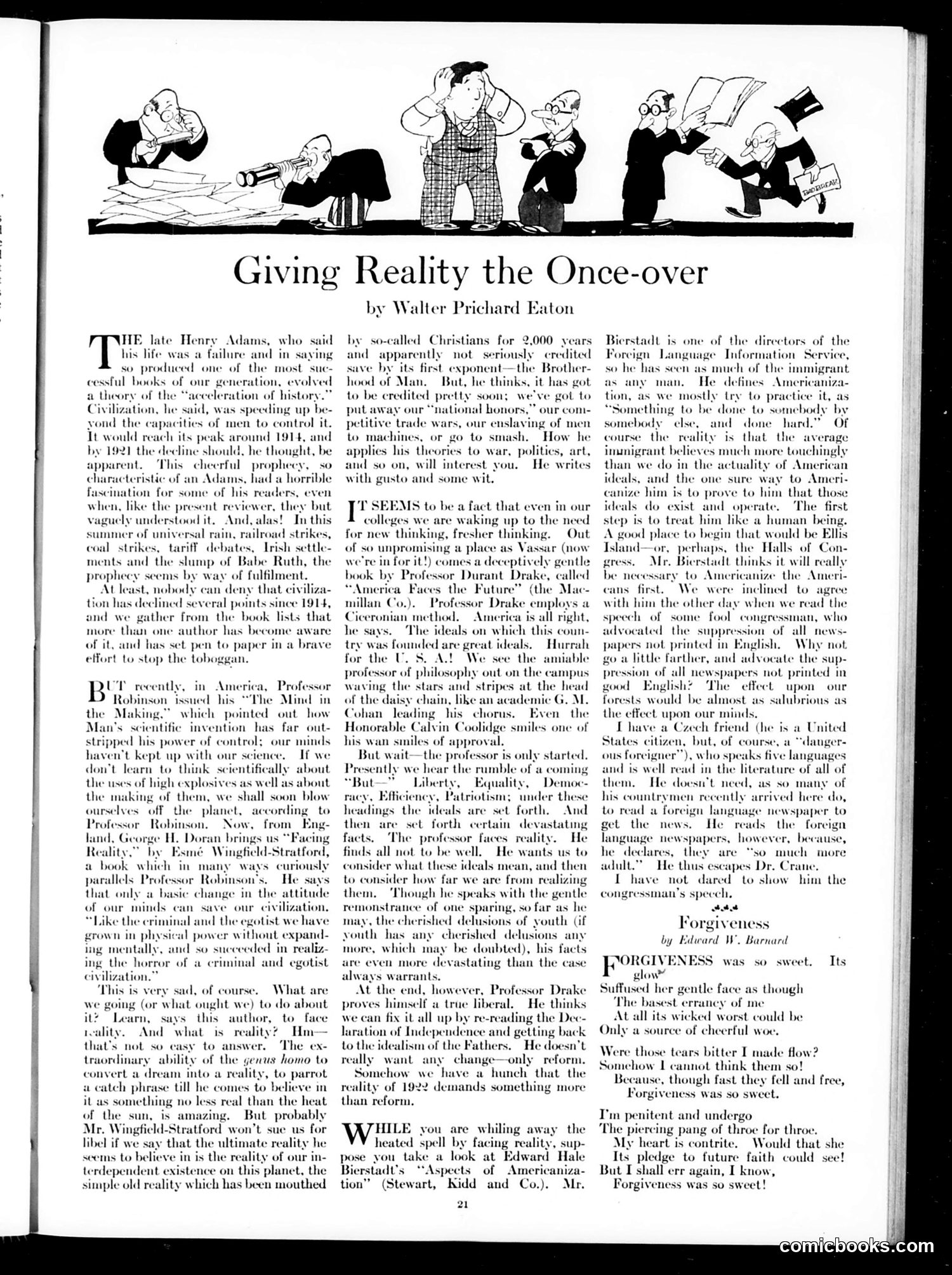
This is a book review essay by Walter Prichard Eaton discussing contemporary intellectual anxieties about modern civilization. The cartoon header depicts figures representing different approaches to reality—from overwhelmed bureaucrats drowning in paperwork to bemused observers—illustrating the essay's central debate. The text critiques historians and philosophers (Henry Adams, Professor Robinson, Esmé Wingfield-Stratford, and Professor Durant Drake) who argue that humanity's technological and scientific advancement has outpaced moral and intellectual development. The authors warn that without fundamental changes in thinking and embracing interdependent existence ("Brotherhood of Man"), civilization faces collapse. The satire targets intellectuals' tendency to package familiar truths in elaborate new theories. Eaton notes ironically that these professors essentially rediscover Christianity's 2,000-year-old message about human interconnection while presenting it as urgent modern discovery. The cartoon's chaos visualizes the "acceleration of history" Adams described—society spinning out of control.
📄 Transcribed text from this page (OCR, searchable)
Machine-transcribed from the original scan — historical spelling and the odd misread are preserved.
Giving Reality the Once-over Ti late Henry Adams, who said his life was a failure and in saying so produced one of the most suc- s of our generation, evoly the “acceleration of histor) ion, he said, was speeding up be- yond the capacities of men to control it. Tt would ‘its peak around 1914, and by 1921 the decline should, he thought, be apparent. ‘This cheerful prophecy, so characteristic of an Adams, had a horrible fascination for some of his ters, even when, like the present reviewer, they but vaguely understood it ! Inthis summer i q id strikes, coal strikes, tari Irish settle- ments and the slump of Babe Ruth, the prophecy seems by way: of fulfilm At least, nobody can deny that tion has declined several points since 1914, and we gather from the book lists th more than one author has become fit, and has set pen to paper in a brave effort to stop the toboggan. cessful I UT recently, in’ An Professor Robinson issued his “The Mind in the Making.” which pointed out how Man's scientific invention has far out- stripped his power of control; our minds haven't kept up with our se If we don’t learn to think scientific the uses of high explosives as wel the making of them, we shall soon blow ourselves off the planet, according to Professor Robinson. from Eng- land, George H. Doran brings us Realit by Esmé Wingfield-Stratf rd, a book which in many ways curiously Hels Professor Robinson's, He says ut only a basic change in the attitude our minds can save our civilization, ike the criminal and the egotist we have grown in physical power without expand- and so succeeded in realiz- wr of a criminal and egotist Now, ing mentall ing the hor! civilization. ‘This is very sad, of course. What are we going (or what ought we) to do about it? Learn, says this author, to face reality. And what is ity? Hm— that’s not so easy to answer. The ex- traordinary - of the genus homo to cony to | a catch phrase till he comes to belic it as something no less real than the heat of the sun, is amazing, But probably Mr. Wingficld-Stratford won't sue us for libel if we say that the ultima ality he seems to believe in is the reality of our in- terdependent existence on this planet, the simple old reality which has been mouthed by Walter Prichard Eaton by so-called Christians for 2,000. years and apparently not seriously credited save by its first exponent—the Brother- hood of Man. But, he thinks, it as got to be credited pretty soon; we've got to way our “national honors,” our com- e trade wars, our cnslaving of men ies, or go to smash. How he applies his theories to war, politics, art, and so on, will interest you. He writes with gusto and some wit. 'T SEEMS to be a fact that even in our colleges we are waking up to the need for new thinking, fresher thinking. Out of so unpromising a place as Vassar (now we're in for it!) comes a deceptively gentle book by Professor Durant Drake, called a Faces the Future” (the Mac- millan Co.) Professor Drake employs a Ciceronian method. America is all right, he says. ‘The ideals on which this coun. try was founded are great ideals. Hurrah for the U.S. ALD We the amiable ssor of philosophy out on the campus and stripes at the head in, like an academic G. M. Cohan leading his chorus. Even the Honorable Calvin Coolidge smiles one of his wan smiles of approval. But wait—the professor is only started. Presently we hear the rumble of a coming “But Liberty, Equality, Democ- acy, Efficiency, Patriotism; under these headings the ideals are set forth. And then are set forth certain devastating facts. ‘The professor faces. reality. finds all not to be we He wants us to consider what these ideals mean, and then to consider how far we are from re: them, ‘Though he speaks with the gentle remonstrance of one sparing, so far as he + the cherished delusions of youth (if youth has any cherished delusions any more, which may be doubted), his facts ure even more devastating than the case always warrants. At the end, however, Professor Drake proves himself a true liberal. He thinks of the daisy el luration of Independence Sane ‘ to the idealism of the Fathers. He doesn’t really want any change—only reform. pmehow we have a hunch that the reality of 1922 demands something more than reform, HILE you are whiling away the sated Spell by facing reality, sup- ou take a look at Edward Hale It’s “Aspects of Americaniza- (Stewart, Kidd and Co.). Mr. 21 pose ) Bierst tion” Bierstadt is one of the directors of th sign Language Information Servi so he has seen as much of the imn as any man. He defines Am tion, as we mostly try to practice it, as “Something to be done to somebody by somebody else, and done hard.” Of course the reality is that the average inunigrant believes much more touchingly than we do in the actuality of American ideals, and the one sure way to Ameri- canize him is to prove to him that those ideals do exist and operate. The first step is to treat him like a human being. A good pl to begin that would be Ellis Island perhaps, the Halls of Con- gress, Bierstadt thinks it will really be necess: to Americanize the Ameri- cans first. We were inclined to agree with him the other day when we red speech of some fool’ congresst advocated the suppression of papers not printed in English. Why not. go a little farther, and advocate the sup- pression of all newspapers not printed in good) English? ‘The effec nour forests would be almost as salubrious as. the effect upon our minds. T hav Czech friend (he is States citizen, but, of course r ous foreigner”), who speaks five languages and is well fin the literature of all of them. He doesn’t need, as so many of his countrymen recently arrived here do, to read a foreign langu get the news. He language newspapers, however, because, he declares, they are “so much more adult.” He thus escapes Dr. Crane. I have not dared to show him the congressman’s specch, rey Forgiveness by Edward W. YORGIVENESS glow” Suffused her gentle face as though The basest errancy of me At all its wicked worst could be Only a source of cheerful woe. Were those te: Somehow L cannot think them so! Because, though fast they fell and free, Forgiveness was so sweet. United Barnard was so sweet. Its I'm penitent and undergo ‘The piercing pang of throe for throe. My heart is contrite. Would that she Its pledge to future faith could see! But I shall err again, I know, Forgiveness was so sweet!