
Judge, 1922-09-02 · page 9 of 36
Judge — September 2, 1922 — page 9: what you’re looking at
What you’re looking at
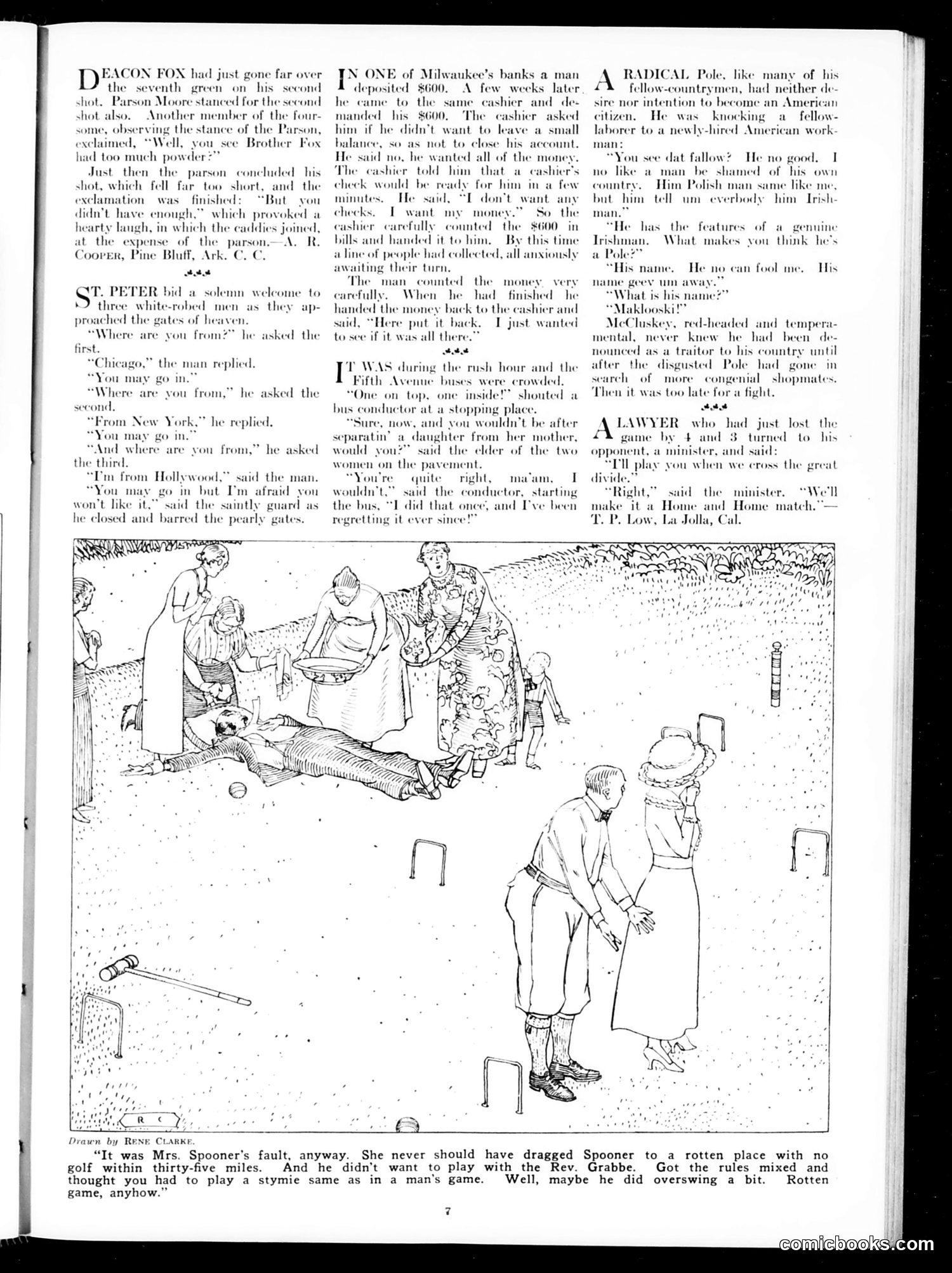
This page contains four separate humorous anecdotes, primarily satirizing American social attitudes and immigrant experience circa early 20th century. **The main cartoon** (bottom) depicts a golf scene where Mrs. Spooner brought her husband to play golf at an unsuitable course. The caption mocks her for this, suggesting she caused his poor performance and rule confusion. **Key satirical content:** 1. **"Radical Pole" story**: A Polish immigrant criticizes a fellow Polish worker (McCluskey) for claiming Irish identity instead. The satire targets immigrant shame about ethnic origin—the Pole sees this as cowardly national betrayal. The "Maklooski" name joke plays on stereotypical Polish surnames. 2. **St. Peter/Hollywood anecdote**: Satirizes Hollywood's moral reputation, suggesting entertainers wouldn't enjoy heaven. 3. **Bank depositor story**: Mocks obsessive money-counting behavior. 4. **Bus conductor anecdote**: Light humor about overcrowding. The **"Radical Pole" segment is the sharpest satire**, exposing how immigrant communities judged assimilation—some saw ethnic identity-shedding as shameful, others as practical survival. The humor relies on period stereotypes about Polish and Irish workers.
📄 Transcribed text from this page (OCR, searchable)
Machine-transcribed from the original scan — historical spelling and the odd misread are preserved.
I EACON FOX had just gone far over the seventh green on his second shot. Parson Moore stanced for the s shot also. Another member of the four- some, observing the stance of the P: exclaimed, “Well, you sce Brothe had too much powder?” Just then the parson conclude shot, which fell far too short, andthe exclamation was _ finishe But you didn’t have enough,” which prove hearty laugh, in which the caddic at the expense of the parson.—A. R Coorer, Pine Bluff, Ark. C. C. ttt YT. PETER bid a solemn welcome to DDiGince wlitevobel tan as they ap- proached t “Where : first. “Chic: es of heaven. you from?” he asked the ” the man replied. in.” you from,” he asked. the he asked m from Hollywood,” said the man. “You may go in but Dm afraid you won't like it,” said the saintly guard as he closed and barred the pearly 4 tes. N ONE of Milwaukee’s banks a man deposited $600, A few weeks later he 1e to the same cashier and de- manded his $600. The cashier him if he didn’t want to leave a hy as not to close his account. I tid no, he wanted all of the money. The cashier told him that a cashier’ check would be ready for him in a few minutes. He said, “LT don’t want any checks. To want) my money.” So- the cashier carefully counted the $600— in bills and handed it to him. By this time a line of people had collect anxiously awaiting their turn, The man counted the money. very carefully. When he had finished he handed the money back to the cashier and said, “Here put it back. 1 just: wanted to see if it was all there.” altel Ie WAS during the rush hour and the ifth Avenue buses were crowded, “One on top, one inside!” shouted a a stopping place. und you wouldn't be after wughter from her mother, said the elder of the two bus conductor « Ire, now atin would. you? women on the pavement. “You're quite right, ma’am, I would” said the conductor, starting did that once, and Pye been regretting it ever since!” RADICAL Pole, like many of his 2X fellow-countrymen, had neither de sire nor intention to become an American citizen, He was knocking a fellow- laborer to a newly-hired American work mi You see dat fallow? He no good. 1 no like a man be shamed of his own country, Him Polish man same like me, but him tell um = everbody him’ Irish man.” “He has the features of a) genuine Irishman. What makes you think he’s a Pole?” “His name, He no can fool me. His name geev um away.” Vhat is his name?” Maklooski!” McCluskey, red-headed and tempera- mental, never knew he had been de- nounced as a traitor to his country until the disgusted Pole had) gone in of more congenial shopmiates. ‘Then it was too late for a fight. eee LAWYER who had just lost the rned to his said the minister, “We'll a Home and Home match.”- a) en by RENE CLARKE “It was Mrs. Spooner’s fault, anyway. She never should have dragged Spooner to a rotten place with no And he didn’t want to play with the Rev. maybe he did overswing a bit. golf within thirty-five miles. thought you had to play a stymie same as in a man’s game. game, anyhow.” Well, Grabbe. Got the rules mixed and Rotten