
A complete issue · 36 pages · 1922
Judge — July 15, 1922
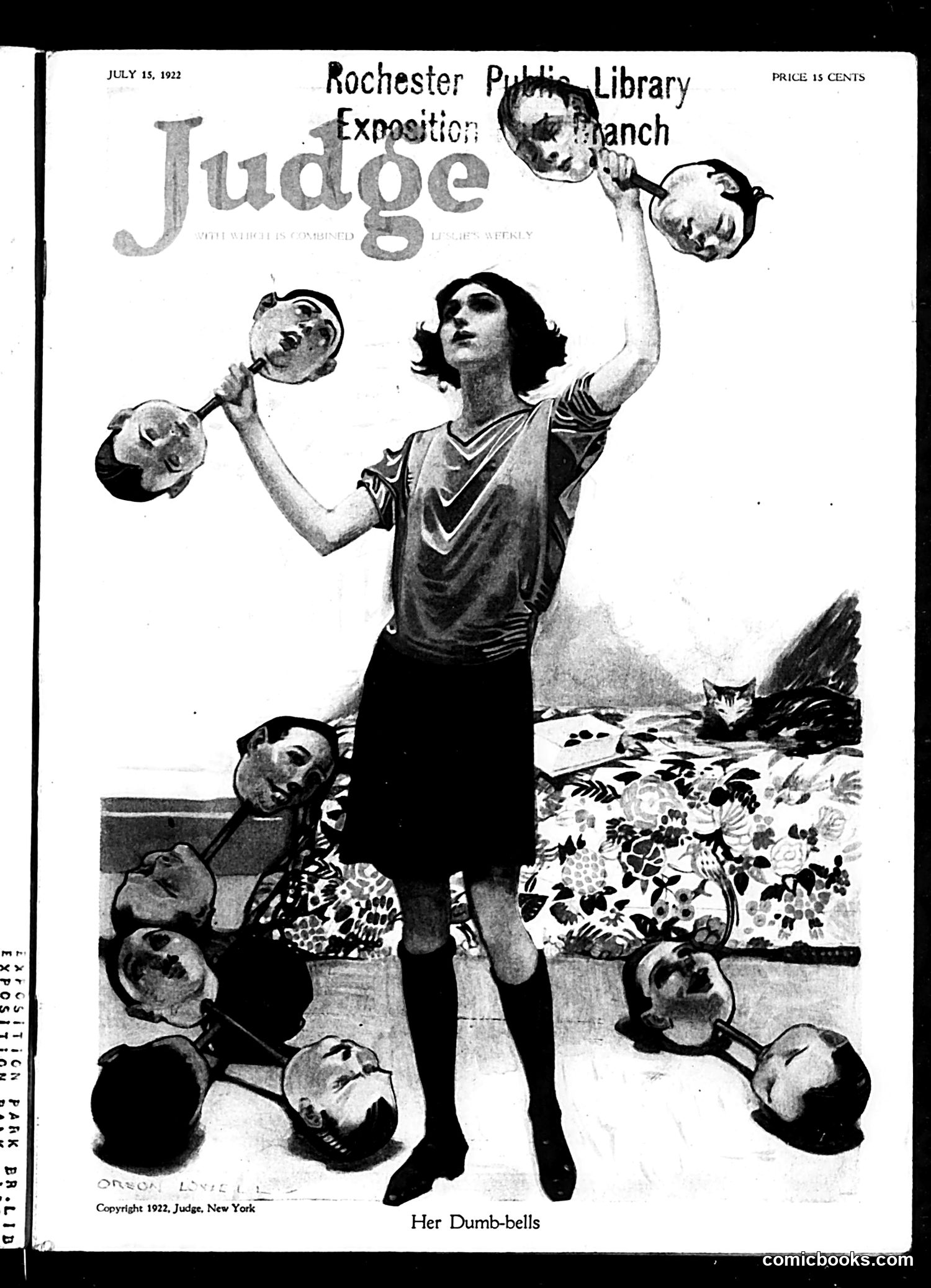
This July 1922 *Judge* magazine cover satirizes women's fitness culture of the era. The illustration shows a woman juggling what appear to be human heads like dumbbells—a darkly comedic visual pun on the term "dumb-bells" (exercise weights). The joke likely critiques the growing "physical culture" movement and women's increasing participation in athletics and gym culture, which was still considered somewhat scandalous or ridiculous by conservative audiences. The grotesque imagery of severed heads transforms ordinary exercise equipment into something absurd and morbid, suggesting the satirist viewed this fitness trend as foolish or unnatural for women. The cat observing the scene adds an additional layer of detached irony to the composition.
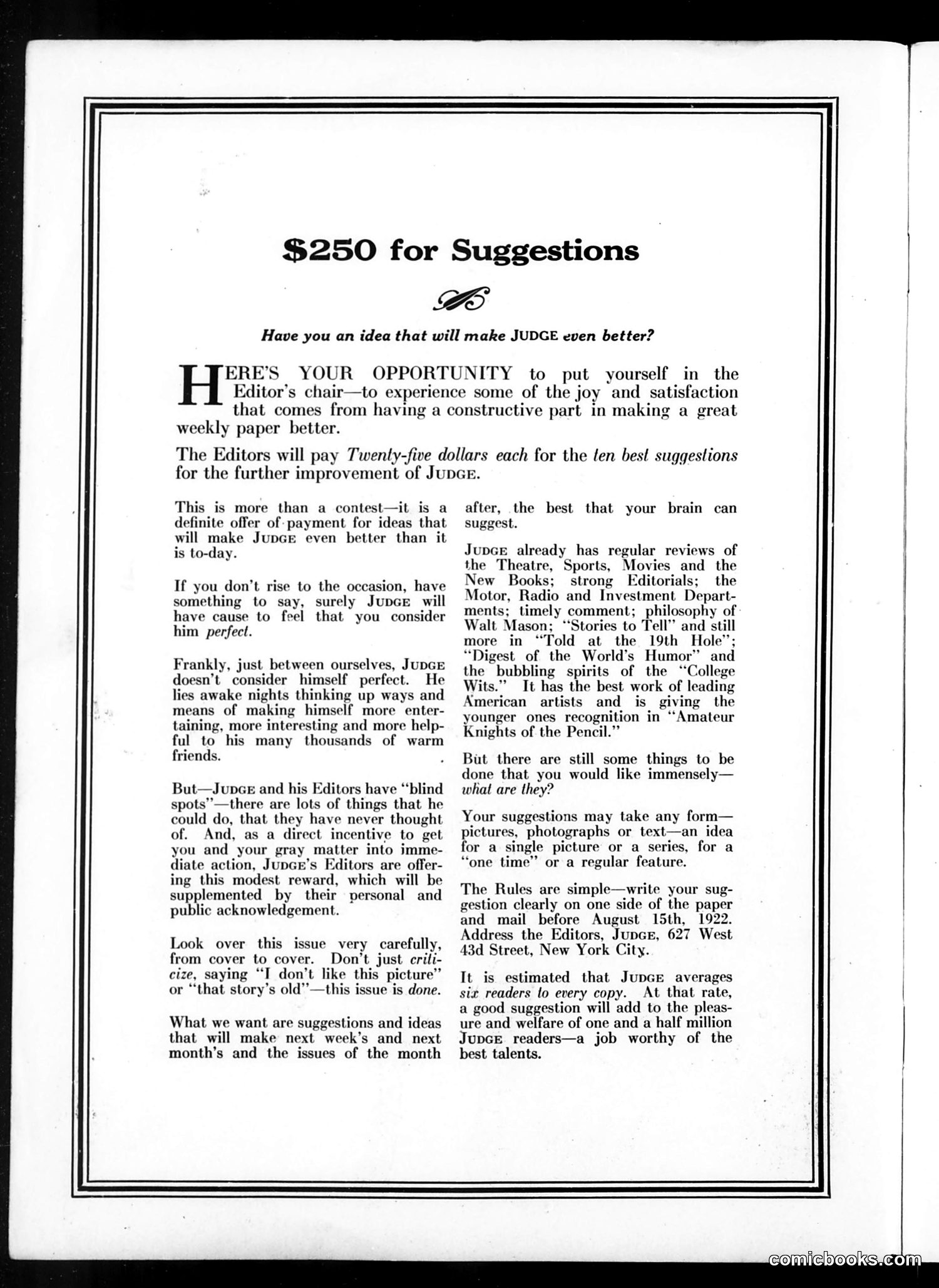
This page is entirely **advertising content**, not a cartoon or satirical article. It's a call for reader submissions to *Judge* magazine, offering "$250 for Suggestions"—specifically, "$25 each for the ten best suggestions" to improve the publication. The text addresses readers directly, inviting them to propose ideas for features, pictures, photographs, or text that would enhance the magazine. It mentions *Judge*'s existing content (theater reviews, sports coverage, editorials, humor digests, and artist recognition) and solicits suggestions for what else readers want. The deadline was August 15, 1922, with submissions addressed to the editors at 627 West 43rd Street, New York City. This is essentially a crowdsourced feedback mechanism disguised as a prize offer.
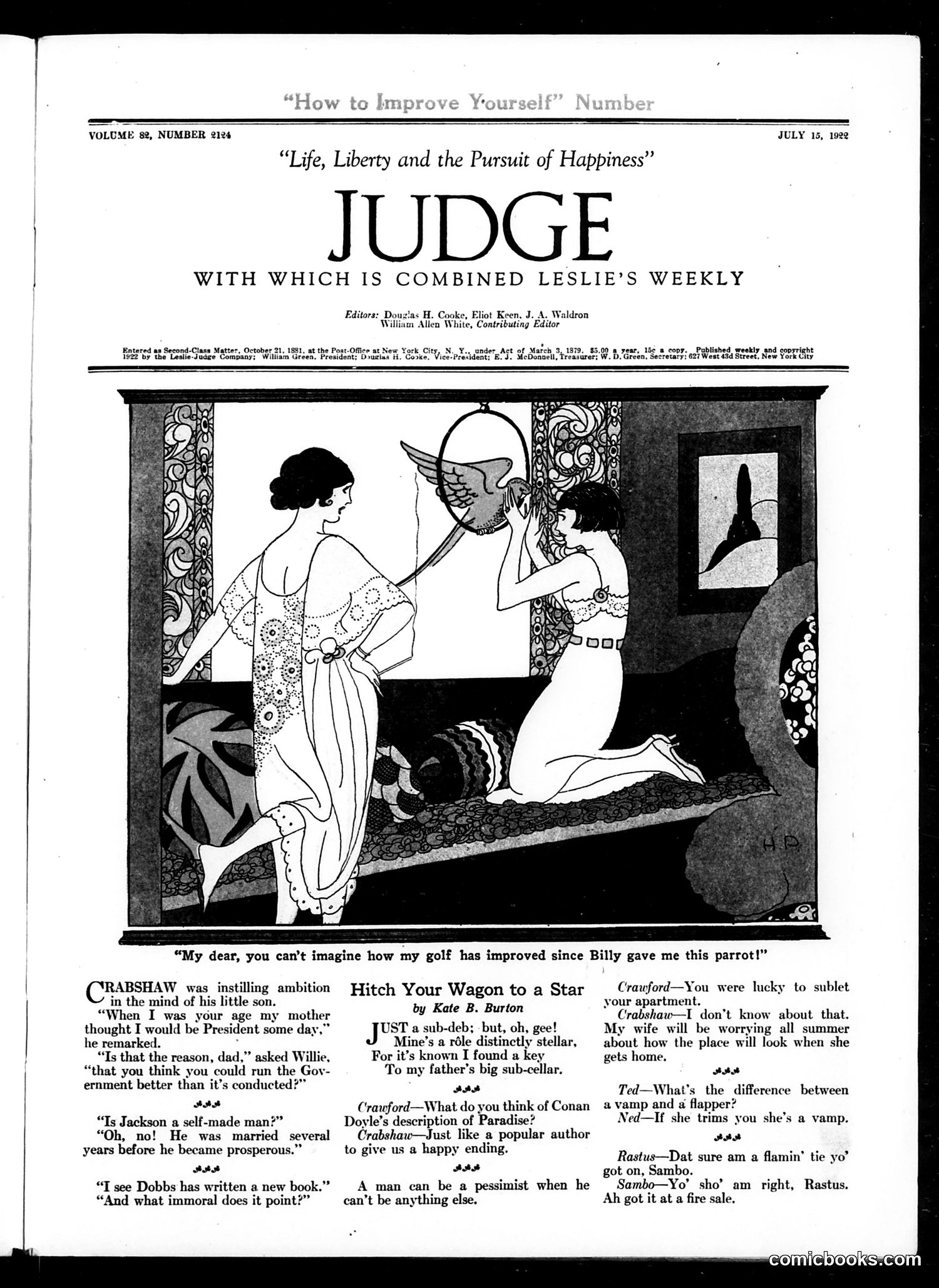
The main cartoon depicts two women admiring a decorative parrot, with the caption: "My dear, you can't imagine how my golf has improved since Billy gave me this parrot!" **The Satire:** This is a joke about the 1920s craze for exotic pets as status symbols. The humor lies in the absurd non-sequitur—a parrot has no logical connection to golf improvement, yet the woman proudly attributes her athletic success to this gift from "Billy" (likely a romantic interest). The cartoon mocks both the pretentiousness of wealthy women displaying luxury possessions and the tendency to credit personal improvements to material goods rather than actual effort. The surrounding text contains various humorous short dialogues and jokes typical of Judge's satirical humor, unrelated to the main illustration.
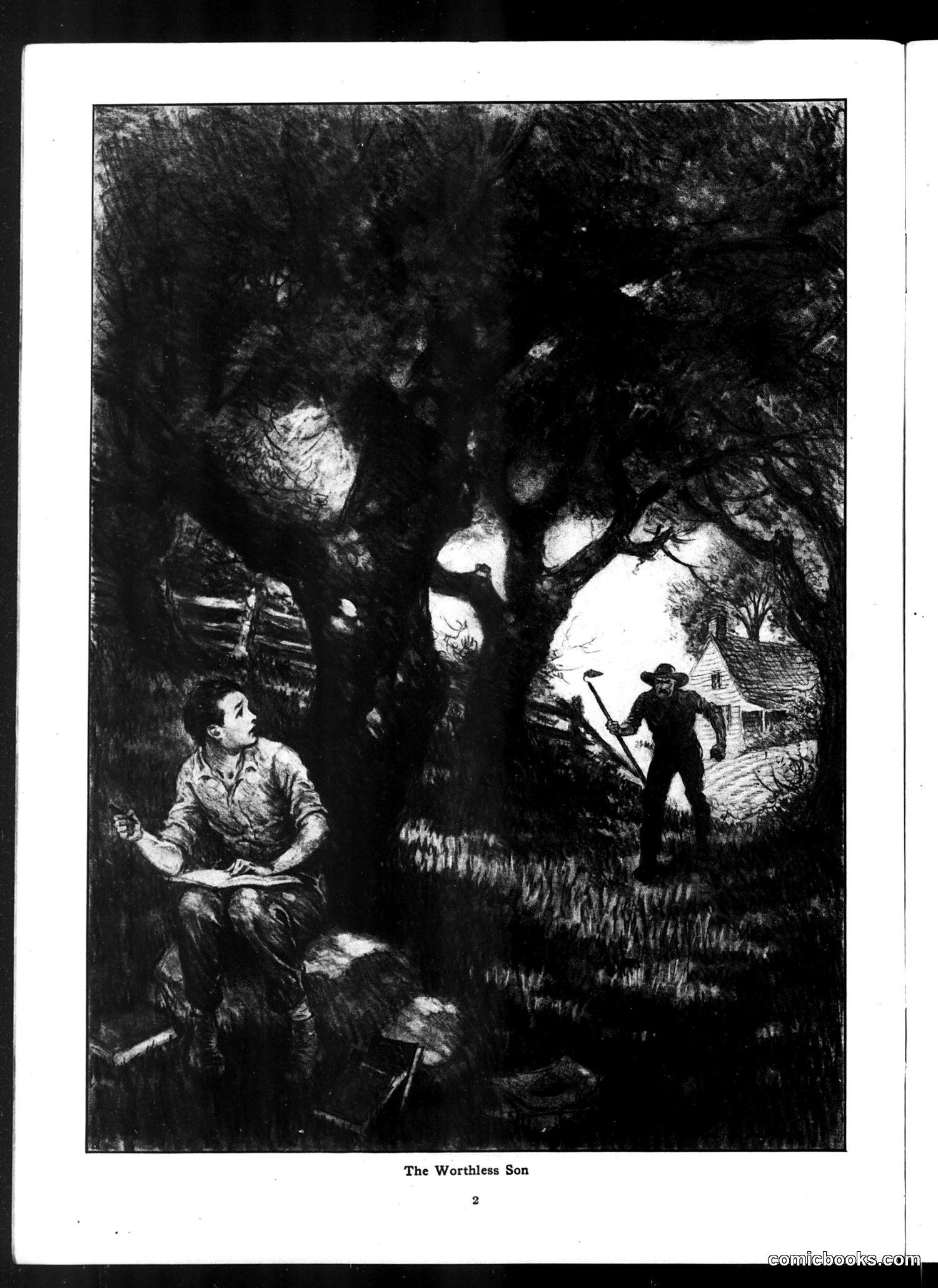
This illustration from *Judge* magazine depicts a dramatic scene in a forest setting. Two figures appear to be woodcutters or laborers—one seated on the left, one standing on the right with an axe. Between them stands a large, gnarled tree, which serves as the central visual metaphor. The title "The Worthless Son" suggests allegorical commentary: the tree likely represents a family lineage or legacy, while the figures may personify different generations or social classes. The composition implies judgment about inheritance, capability, or character—suggesting that one "son" (possibly representing a younger generation or heir) lacks the value or utility of his predecessor. Without additional context from *Judge*'s publication date and surrounding articles, the specific political or social target remains unclear, though it appears to critique generational decline or unfulfilled potential.
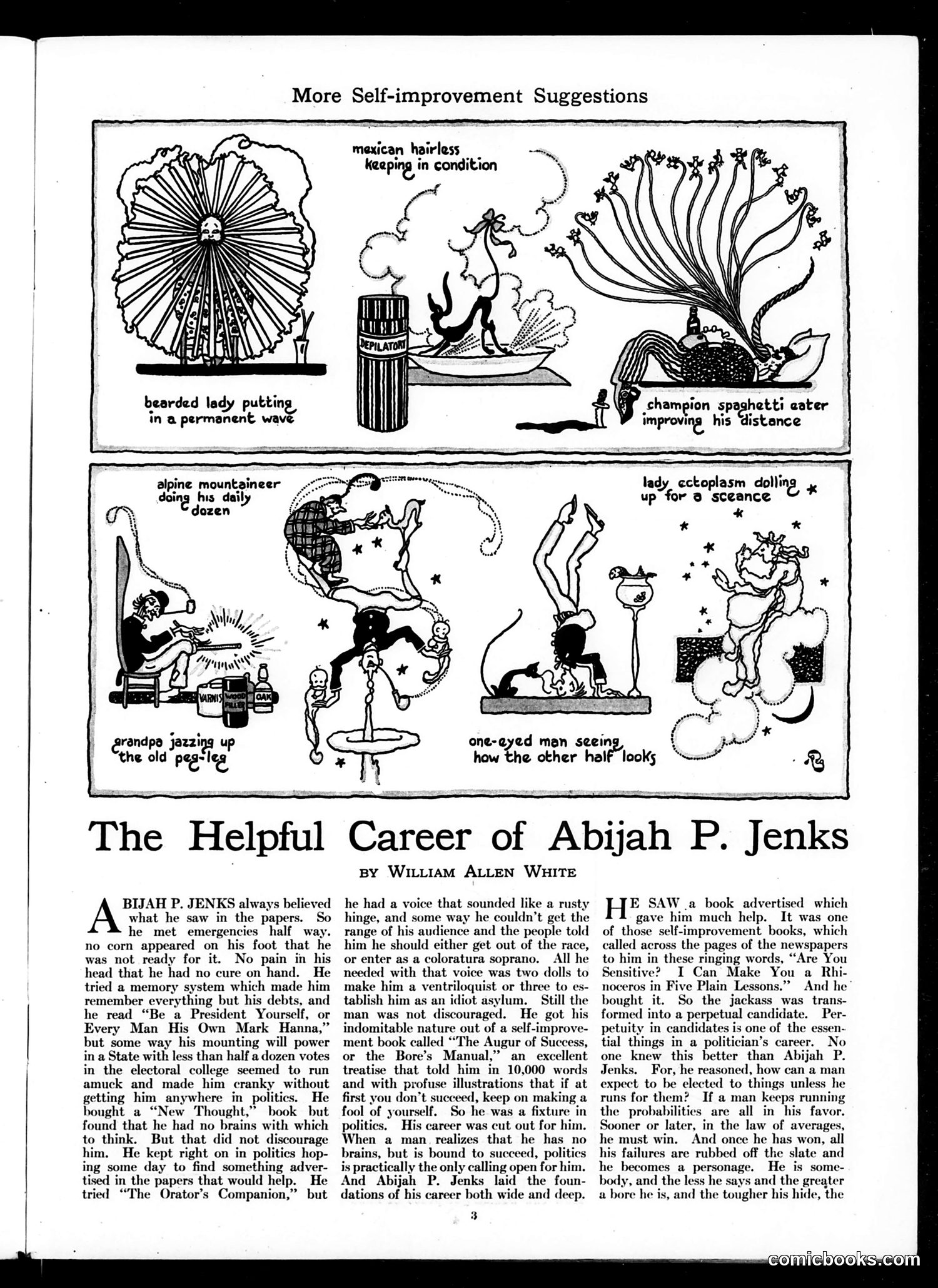
This page contains two distinct elements: **Top section:** "More Self-improvement Suggestions"—a satirical comic strip mocking self-help culture. The absurd scenarios (a bearded lady getting a permanent wave, a man eating spaghetti to improve distance, a woman doing "ectoplasm dolling" for séances) ridicule the era's proliferation of dubious self-improvement books and schemes promising unrealistic results. **Bottom section:** "The Helpful Career of Abijah P. Jenks," a short story satirizing opportunistic self-help authors. Jenks, a man with no genuine talent or knowledge, builds a lucrative career writing fraudulent self-improvement manuals with titles like "The Augur of Success." The satire criticizes how such authors exploited readers while personally lacking merit or expertise—a critique of charlatanry in popular publishing.
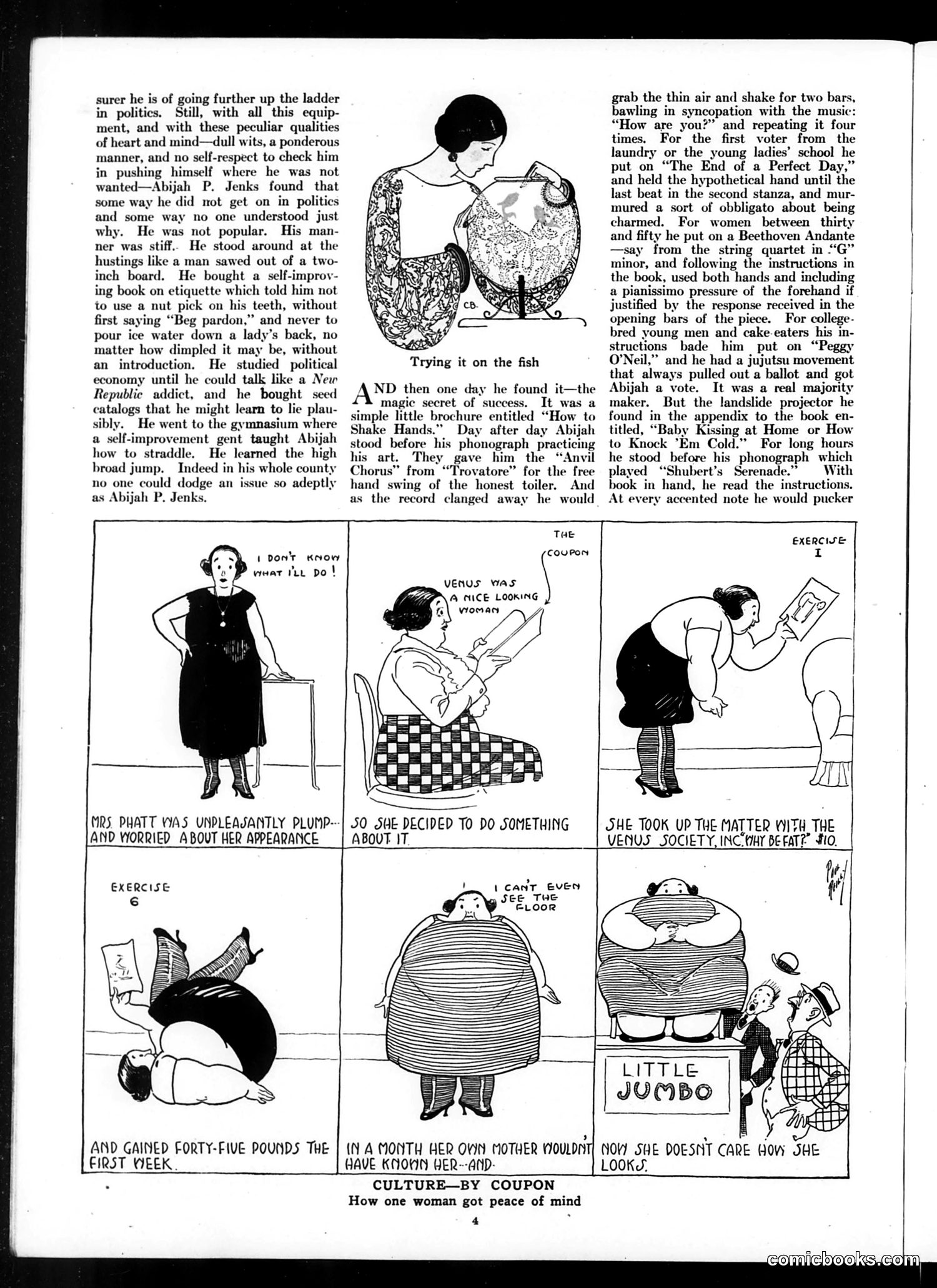
This satirical comic strip mocks the commercialization of self-improvement culture. Mrs. Phaff, concerned about her appearance, purchases a "Venus" beauty/diet program from the "Venus Society, Inc." The humor targets: 1. **Mail-order self-help schemes**: The society promises transformation through purchased courses and exercises 2. **Women's body image anxiety**: Mrs. Phaff's insecurity drives her to buy solutions 3. **False advertising**: "Exercise 6" shows her gaining 45 pounds despite following the program 4. **Contradiction**: The final panel reveals she achieved "peace of mind" only by embracing her weight gain ("Little Jumbo"), not through the purchased regimen The satire critiques how commercial enterprises exploit women's insecurities while delivering opposite results from their promises.
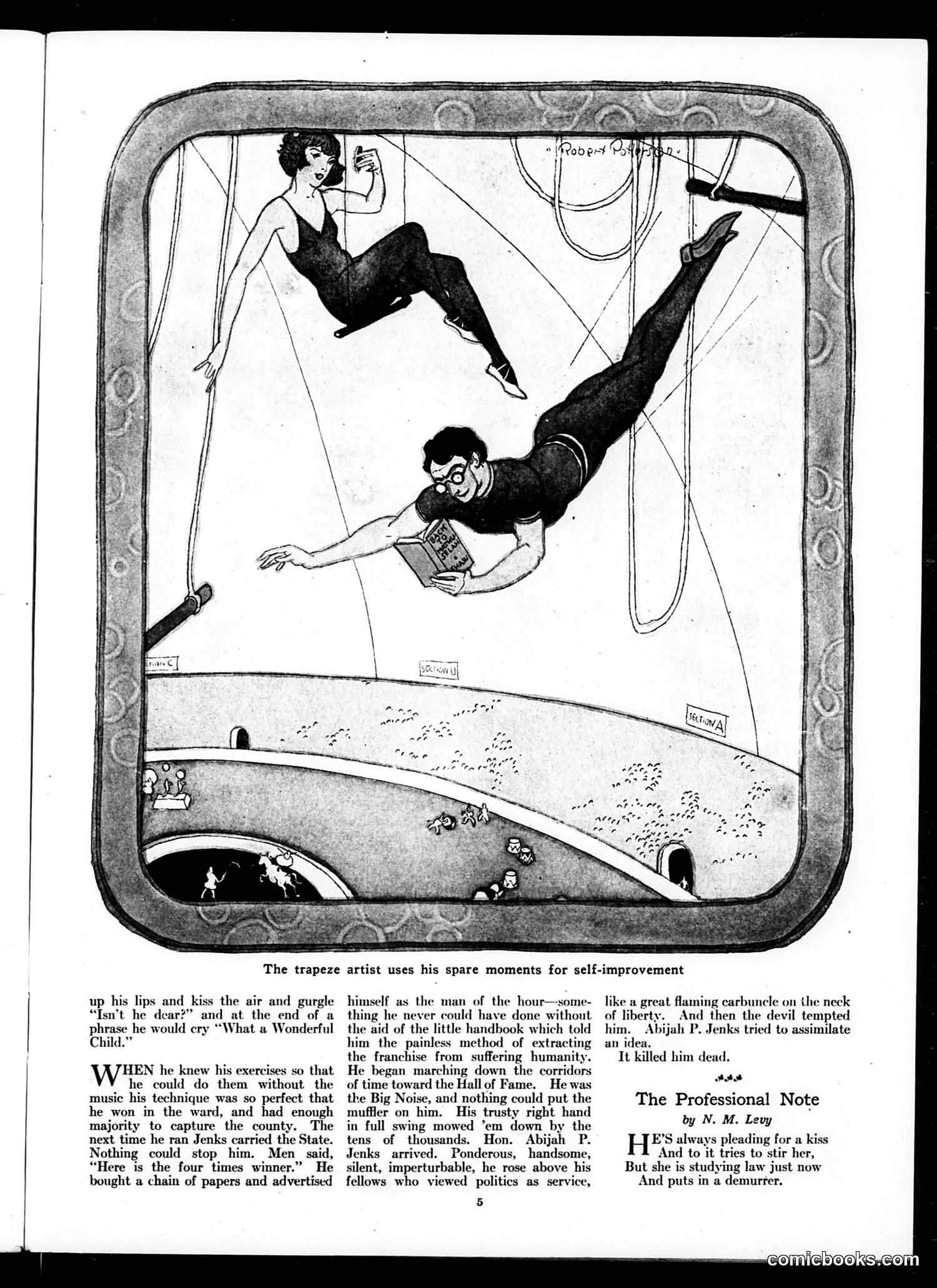
This page satirizes political ambition and corruption. The main illustration shows a trapeze artist who uses self-improvement exercises to advance politically—he practices trapeze work so perfectly that he wins ward, county, and state elections four times running. The accompanying text describes how this "man of the hour" uses a "painless method of extracting the franchise from suffering humanity" (voter manipulation) and media ownership to build power. His rise is described cynically: he becomes "the Big Noise," his right hand "mowed 'em down by the tens of thousands." The satire's punch: Hon. Abijah P. Jenks arrives as his rival—described as a "great flaming carbuncle on the neck of liberty" because he operates above such schemes. The idea of assimilating Jenks's methods "killed him dead," suggesting honest politics ultimately defeats corruption. The small "Professional Note" joke plays on similar themes of self-interested manipulation in courtship.
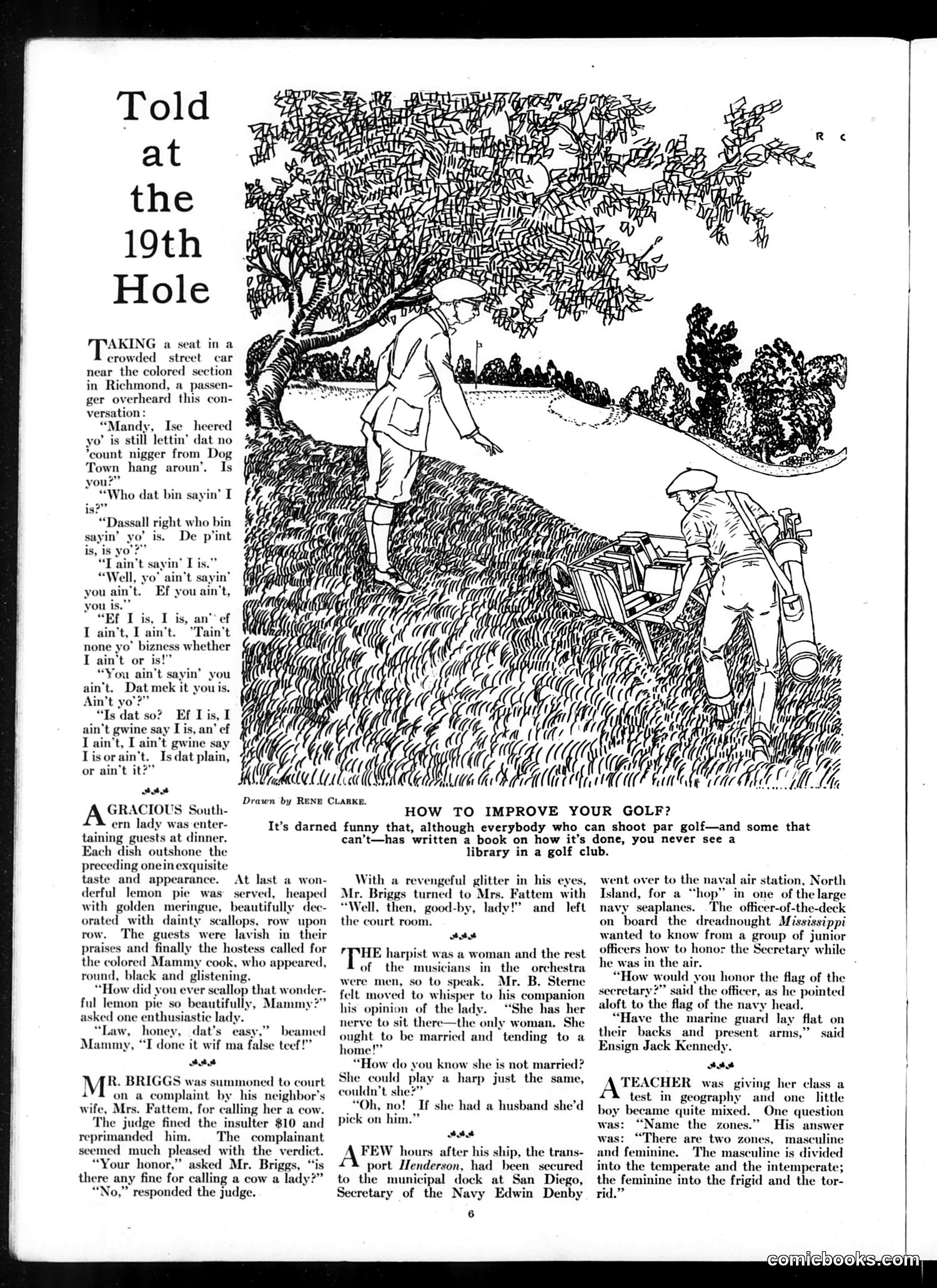
This page contains several short humorous pieces typical of early 20th-century *Judge* magazine. The main features are: **Top cartoon**: "Told at the 19th Hole" depicts a dialogue between two Black men in Richmond using heavy dialect. The joke plays on circular logic and contradictory statements—a common (though dated and offensive) vaudeville format of the era. **Middle sections**: Various anecdotes mocking social situations—a Southern hostess, a court case where a man calls his wife a cow, and a story about a harpist in an orchestra. These are gentle humor pieces without clear political content. **Bottom section**: "How to Improve Your Golf?" criticizes golf enthusiasts who write instructional books but never visit golf club libraries. Includes anecdotes about naval personnel (mentioning Secretary of the Navy **Edwin Denby**) and a teacher's geography test mixing gender with climate zones—wordplay rather than satire. The page is primarily entertainment-focused rather than political commentary.
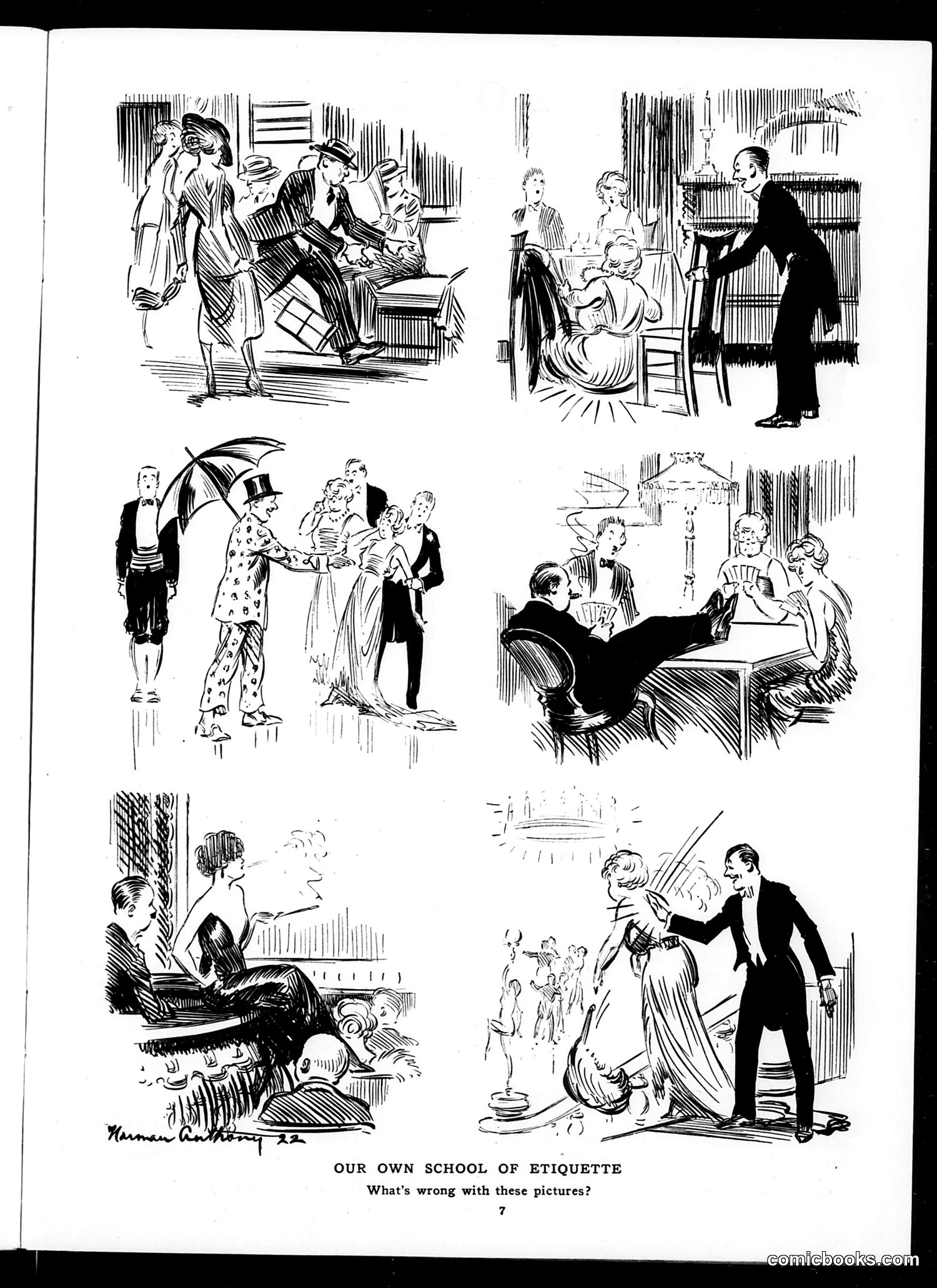
This is a satirical instructional page presenting six scenarios of deliberately bad manners and social impropriety. The caption asks "What's wrong with these pictures?" — implying readers should identify the breaches of etiquette depicted. The scenes show violations such as: improper hat removal indoors, disruptive behavior at social gatherings, rudeness to women, and general discourteous conduct in formal settings. This appears to be humorous social commentary on declining manners in early 20th-century America, presented as intentionally "wrong" examples — the inverse of typical etiquette guides. The cartoons mock both those committing these breaches and, implicitly, broader social anxieties about propriety and class distinction during this period. Judge's satirical approach inverts the instruction: instead of teaching correct behavior, it teaches through negative example.
This is a political editorial page (no cartoons visible) by William Allen White from what appears to be the early 1920s. The editorials critique the Harding administration's domestic chaos—the tariff colliding with war bonuses, rail and coal strikes threatening autumn paralysis, scandals involving Harry Daugherty and Senator Newberry, and Secretary of State Hughes's Russian policy disputes with Senator Borah. The piece mocks how the presidential "honeymoon" has ended after six months, describing governance as a "cubist picture of the Taft Administration." White sardonically praises the president for "earning" his $75,000 salary amid this disorder. The Red Cross editorial celebrates American altruism in post-WWI Europe (1917-1922), contrasting noble humanitarian idealism with the messy politics now visible at home. The tone suggests disillusionment with how quickly wartime unity dissolved into partisan bickering.
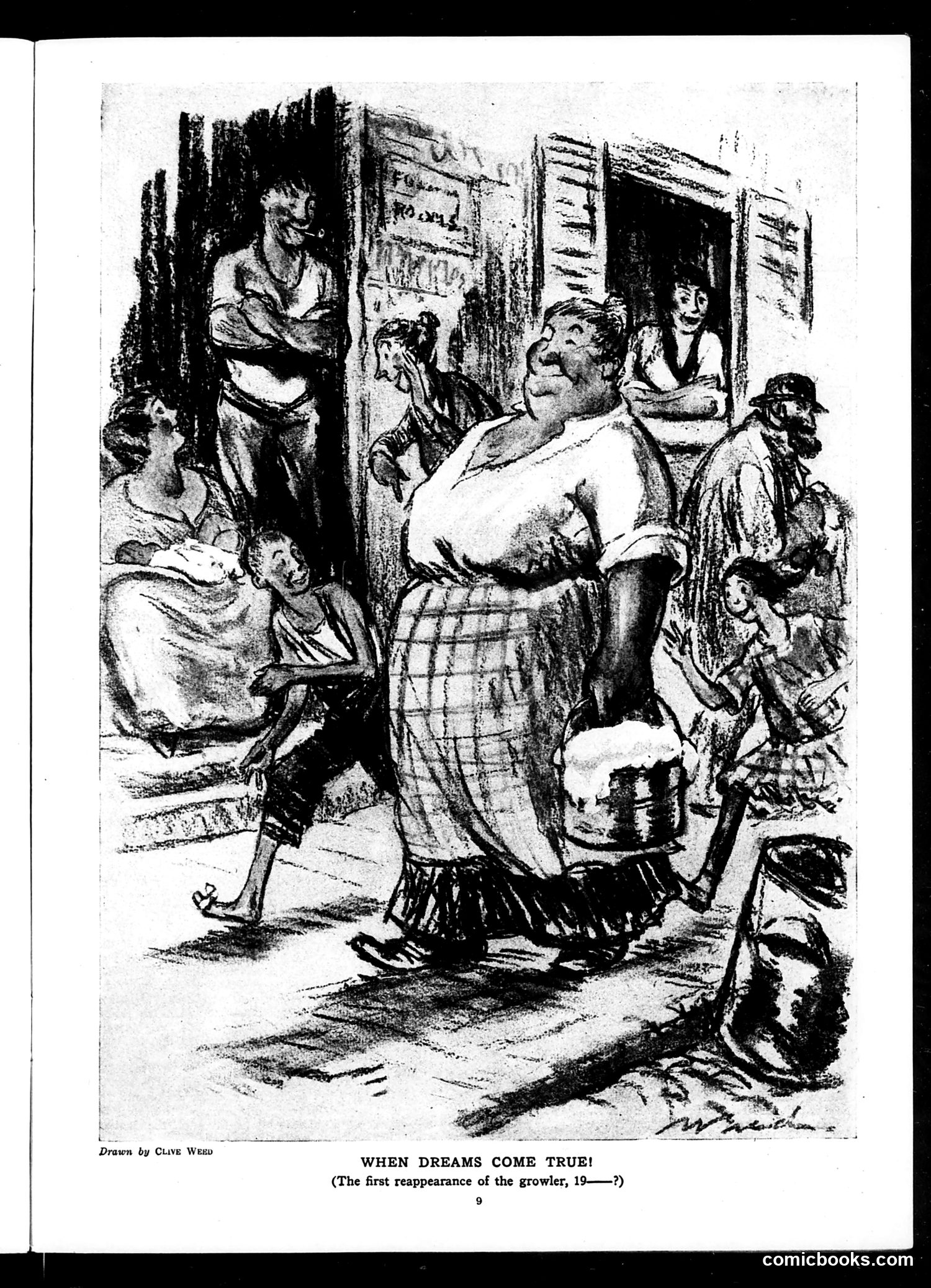
This cartoon by Clive Wedd satirizes the return of the "growler"—a term for a cheap bucket of beer sold by saloons, typically carried home by working-class customers. The caption suggests this is imagined as a future scenario ("19——?"), implying prohibition-era anxieties. The scene depicts a crowded street where a large woman in the center appears delighted or surprised, surrounded by various working-class figures. The satire likely mocks either: (1) the potential social chaos if growlers returned after prohibition ended, or (2) working-class enthusiasm for cheap beer's reappearance. The cartoon reflects Judge magazine's perspective on alcohol regulation and class dynamics during America's prohibition debate, using exaggerated caricature to comment on lower-class drinking culture and urban life.
This is a **humor submission page** from Judge magazine, not a political cartoon. It presents five comic anecdotes competing for prizes ($10 for first place, $5 for second). The jokes reflect early 20th-century American attitudes: 1. **First Prize**: Two Black soldiers discuss a long-range gun—the humor relies on dialect stereotyping and the ironic punch line about running all day to be shot. 2. **Second Prize**: A professor mistakes a farmer's rheumatism exercises for deaf-mute sign language and overpays for sour milk—humor from the "educated fool" trope. 3. Other stories include: a man obsessed with cheese (rubbing bread on a bottle), a wife obsessing over pronouns and her husband's lost hat, a bank robber's one-night "employment," a child thinking storks literally flew her, and a condemned man cheering over a lawyer's bill being paid. The comedy relies on wordplay, misunderstandings, and character types rather than political content. The racial caricature in the first piece reflects the era's casual prejudice.
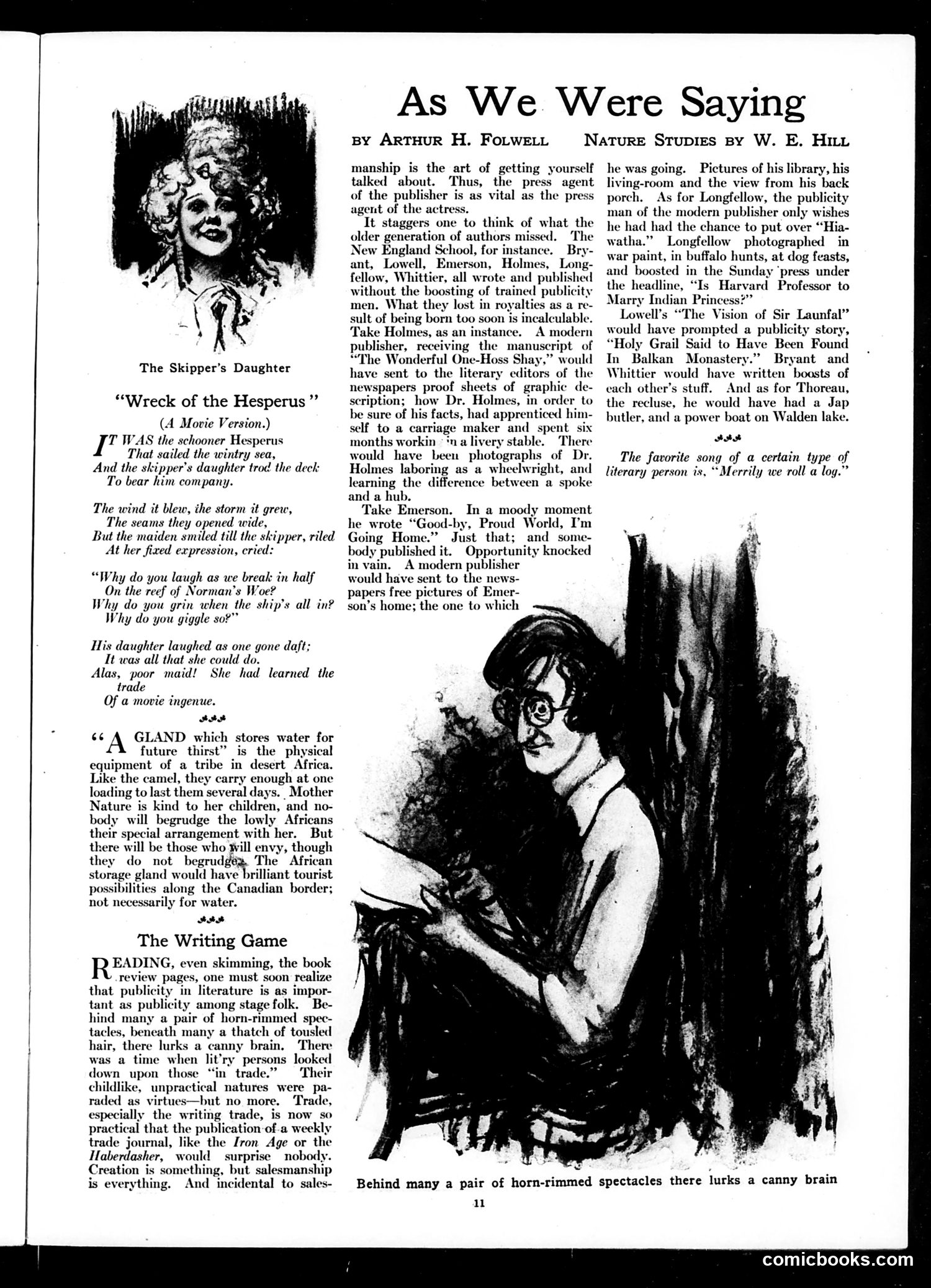
This page contains two satirical pieces mocking early 20th-century publishing and entertainment culture. **"The Skipper's Daughter"** parodies the famous Longfellow poem "Wreck of the Hesperus" as adapted into a silent film. The joke: the skipper's daughter keeps smiling and giggling even as the ship sinks because she's learned "the trade of a movie ingenue"—the exaggerated, emotionless expressions required of silent-film actresses. It's satire of both silent cinema's wooden acting conventions and the disconnect between realistic situations and film performance. **"As We Were Saying"** criticizes modern publishers' obsession with publicity and salesmanship over literary merit. The author argues that 19th-century literary giants (Emerson, Longfellow, Holmes, Whittier) lost royalties because they lacked modern press agents to generate promotional stories and photos. The satire suggests publishers would have invented ridiculous backstories—Holmes apprenticing as a carriage maker, photos of Emerson's home—to sell serious literature. It's a critique of marketing replacing artistry in publishing.
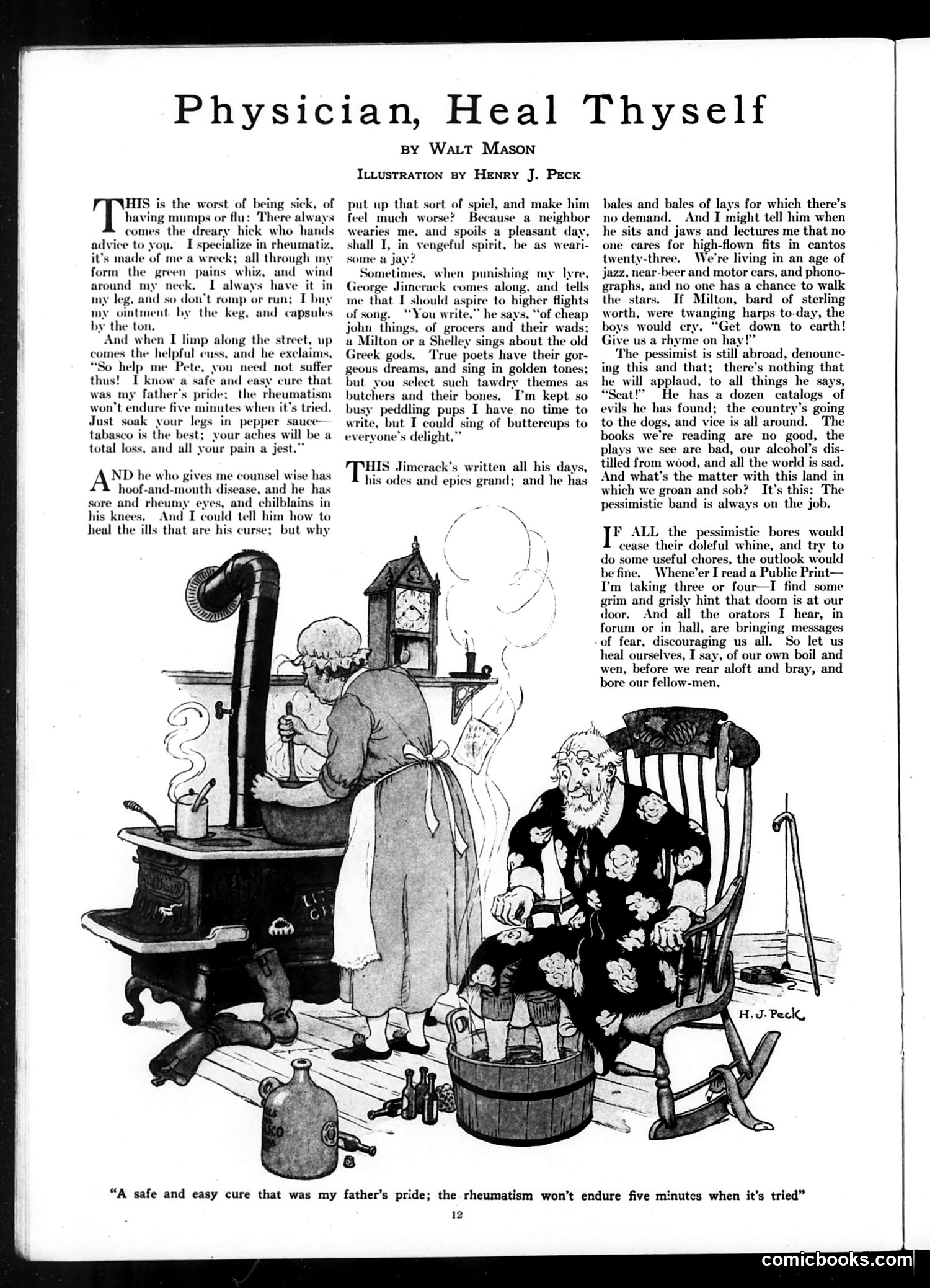
This humorous essay by Walt Mason, illustrated by Henry J. Peck, satirizes people who offer unwanted remedies and criticism while ignoring their own problems. The cartoon shows an elderly man seated while a woman at a stove offers folk cures (pepper sauce and tabasco for rheumatism). The accompanying text uses this as a framework for broader social criticism: well-meaning neighbors dispense bad advice about health, writing, and morality despite their own obvious ailments and failures. Mason's main targets are: - **Folk medicine peddlers** offering bogus cures - **Amateur literary critics** (like "George Jimcrack") who dismiss practical subjects while producing their own mediocre work - **Chronic pessimists** who spread doom-saying through newspapers and speeches without addressing actual problems The phrase "Physician, heal thyself" (a biblical reference) is the key: Mason argues that before criticizing others, people should address their own shortcomings. The satire reflects early 20th-century American skepticism about quack remedies, literary pretension, and pessimistic public discourse.
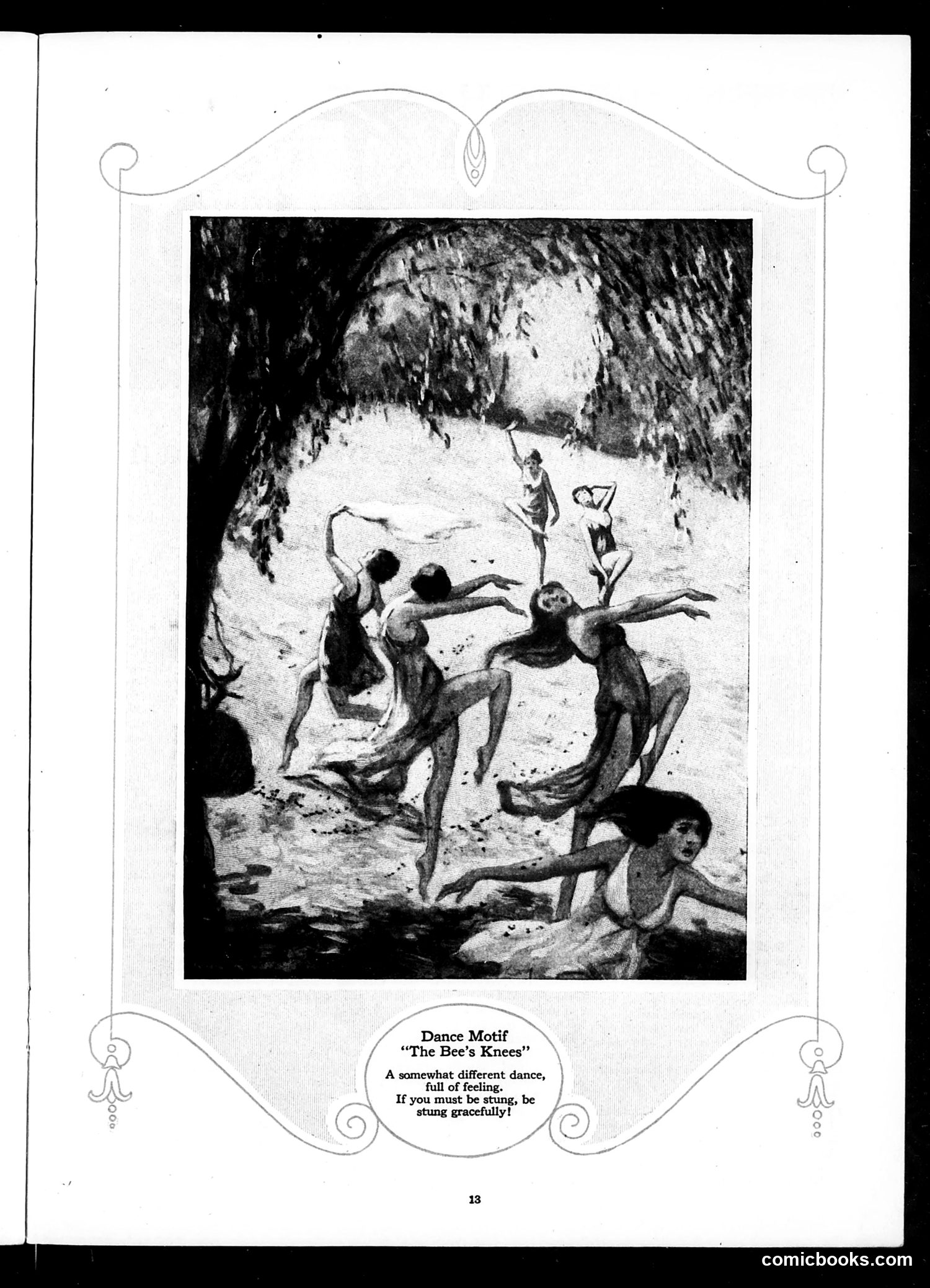
This page satirizes the 1920s dance craze called "the Bee's Knees," a popular Jazz Age slang term for something excellent. The illustration shows figures dancing energetically in what appears to be a cave or enclosed space, with exaggerated, contorted postures. The satire mocks both the dance itself and the era's moral anxieties about modern youth culture. The caption's warning—"If you must be stung, be stung gracefully!"—plays on the "bee" reference while suggesting disapproval: the dance is presented as inherently problematic ("stinging"), with the joke being that if young people insist on this questionable behavior, they should at least maintain decorum. This reflects Judge magazine's conservative satirical stance toward 1920s social liberalism and changing dance styles viewed as scandalous by older generations.
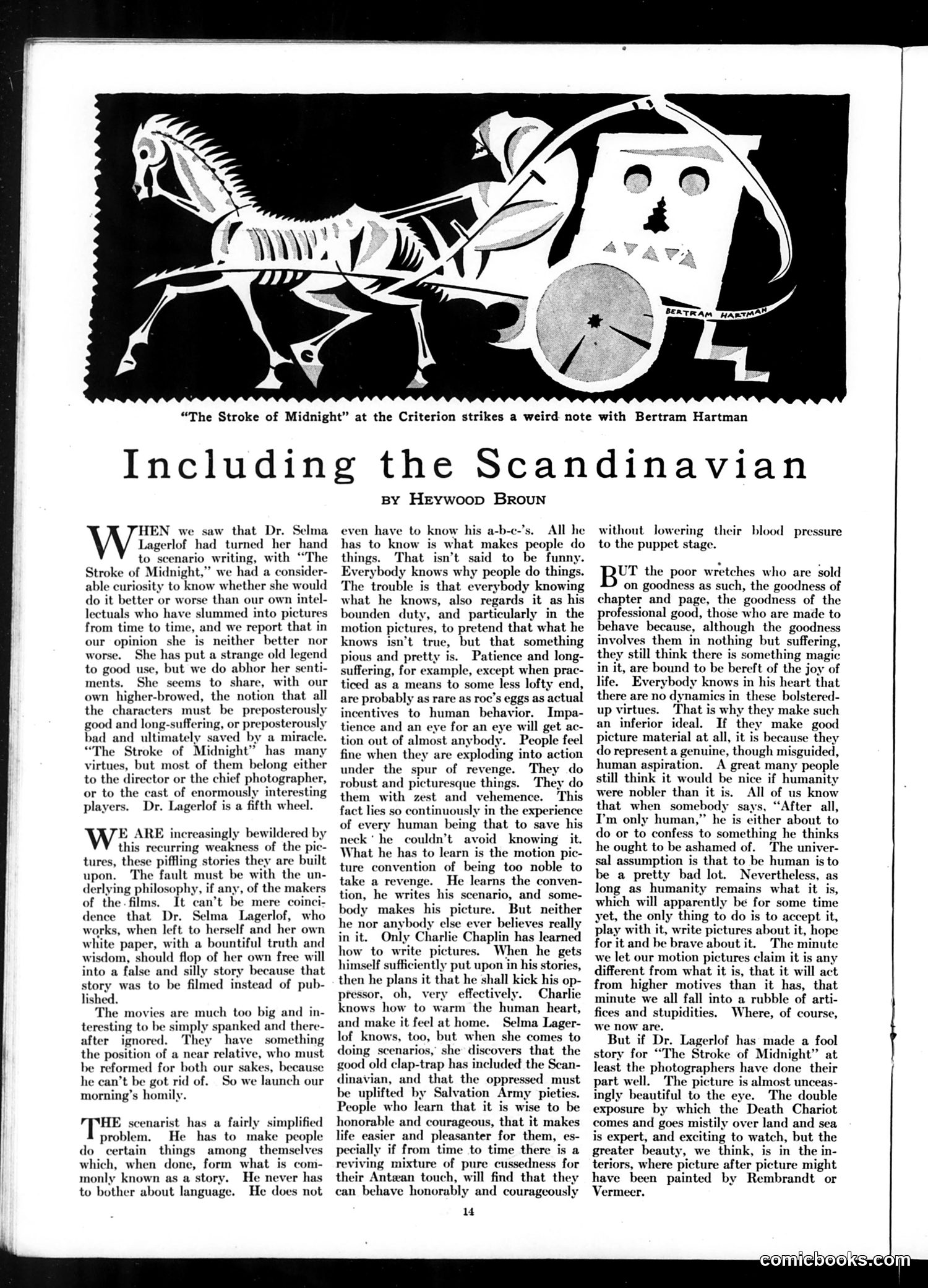
This page critiques Swedish author Selma Lagerlöf's attempt at screenwriting for the 1914 film "The Stroke of Midnight." The cartoon at top shows a skeletal horse pulling a cart with an abstract figure labeled with Nordic symbols—likely satirizing the film's Scandinavian melodrama aesthetic. Critic Heywood Broun argues that Lagerlöf, despite her literary talent, fails as a screenwriter because she adheres to sentimental movie conventions: characters must be unrealistically noble and patient rather than driven by authentic human impulses like revenge or self-interest. Broun contrasts this with Charlie Chaplin, who understands that audiences connect with characters who act on genuine motivations. The satire targets both Lagerlöf's artistic compromise and the broader Hollywood tendency to impose false morality ("Salvation Army piety") on stories, undermining their human truth.
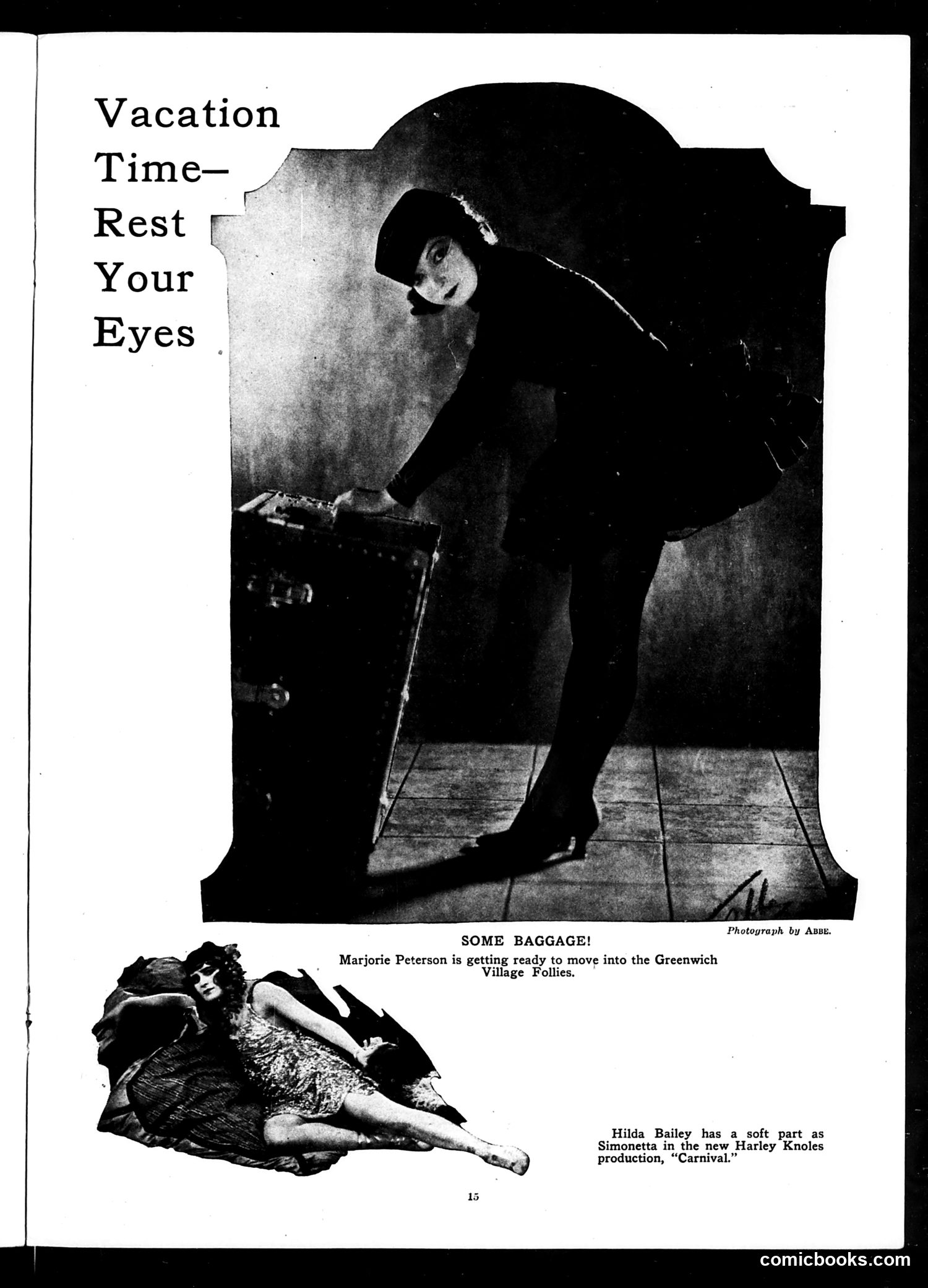
This Judge magazine page satirizes theatrical life circa the 1920s. The main cartoon shows a woman posing dramatically with luggage, captioned "Vacation Time—Rest Your Eyes," suggesting tired theatergoers need relief from seeing performers. Below are two photographs of actresses: Marjorie Peterson, preparing to join the "Greenwich Village Follies" (a popular Broadway revue), and Hilda Bailey in a role for producer Harley Knoles's "Carnival" production. The satire appears to mock the theatrical world's constant churn of performers and productions—presenting these actresses' career moves as humorous "baggage" to contemplate during vacation. The page conflates entertainment gossip with visual exhaustion, suggesting audiences found endless theater promotion tiresome.
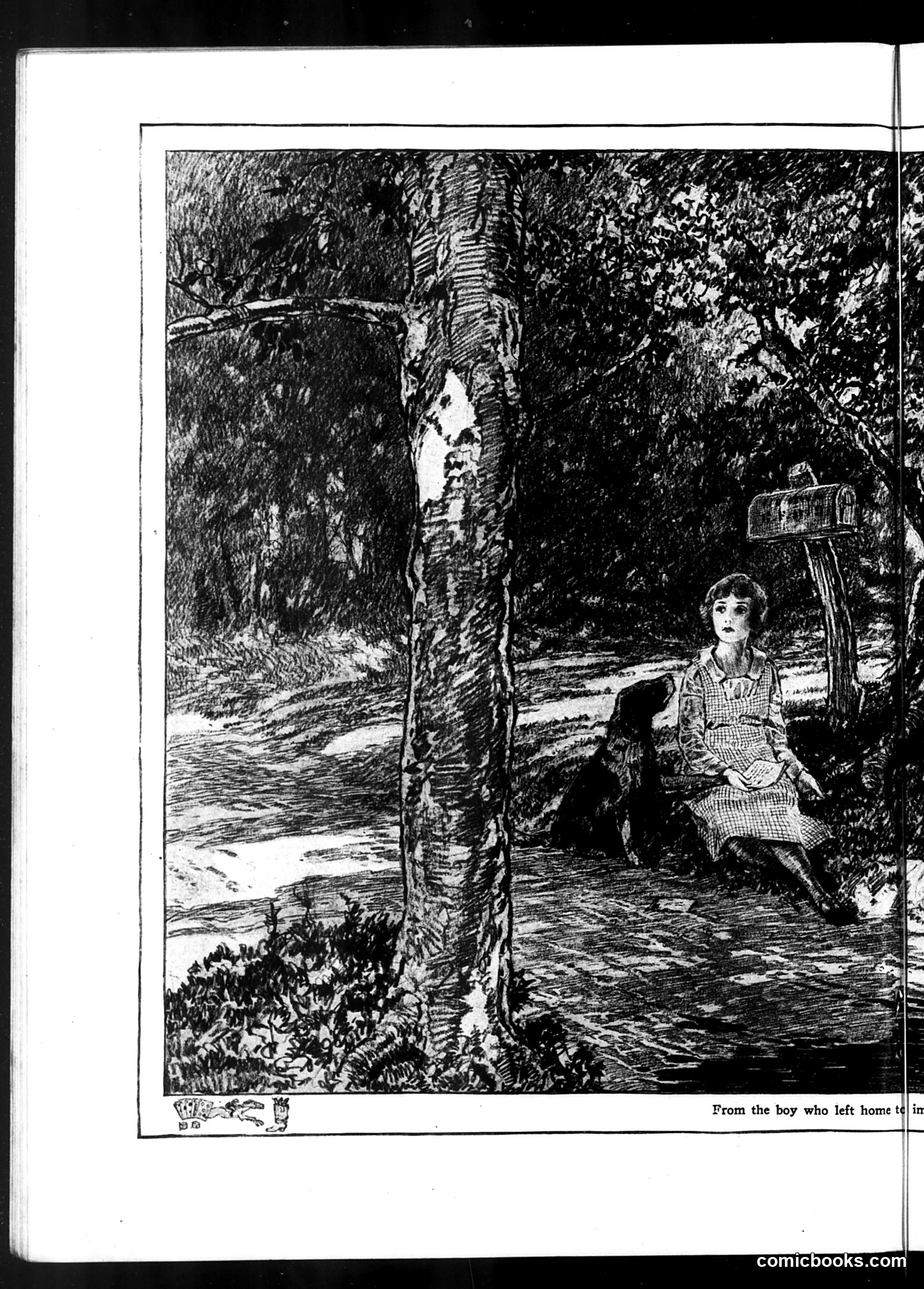
This appears to be an illustration from *Judge* magazine showing a domestic or romantic scene in a natural setting. A woman sits by a stream near a prominent birch tree, gazing upward thoughtfully while a figure (partially visible) sits nearby. A mailbox is visible in the background. The caption reads "From the boy who left home t..." (text is cut off). Without the complete caption or additional context visible on the page, the specific satirical point is unclear. This could be commenting on rural life, correspondence, romantic longing, or emigration—all common *Judge* themes—but the truncated text prevents confident interpretation of what social or political condition is being satirized. The illustration's quality and composition suggest it's a substantial piece rather than a minor filler, indicating the subject held editorial interest.
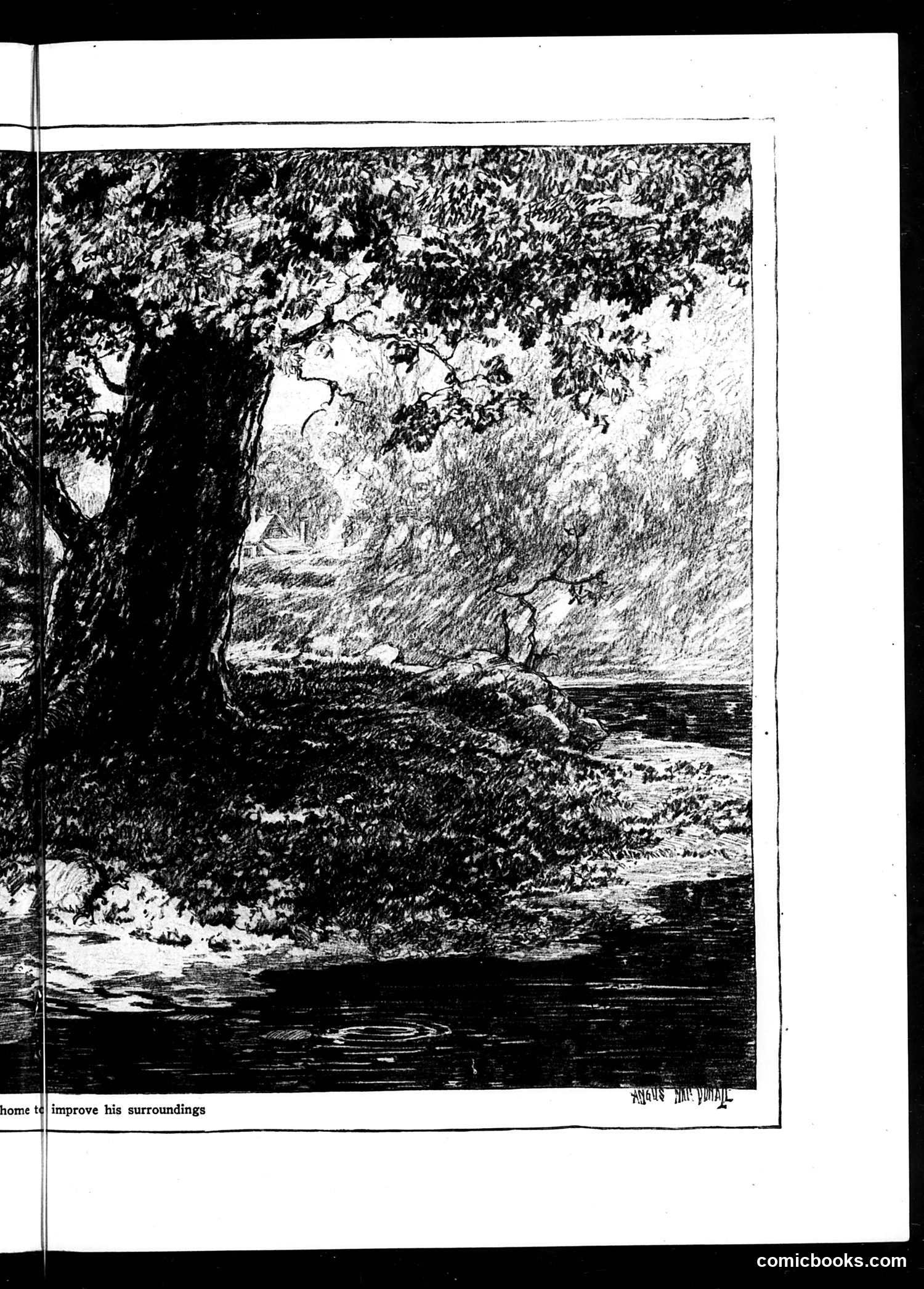
This appears to be an editorial illustration from *Judge* magazine showing a gnarled tree beside a stream or river in a natural landscape. The caption reads "home to improve his surroundings," suggesting commentary on someone's attempt to improve their environment or living conditions. Without additional context from the magazine's text or date, the specific satirical target remains unclear. However, given *Judge's* focus on social and political satire, this likely critiques either: an individual's futile efforts at self-improvement, hypocrisy about environmental or domestic reform, or possibly commentary on a public figure's home improvements or real estate dealings. The stark black-and-white engraving style emphasizes the wild, untamed nature of the landscape, which may underscore the satire's point.
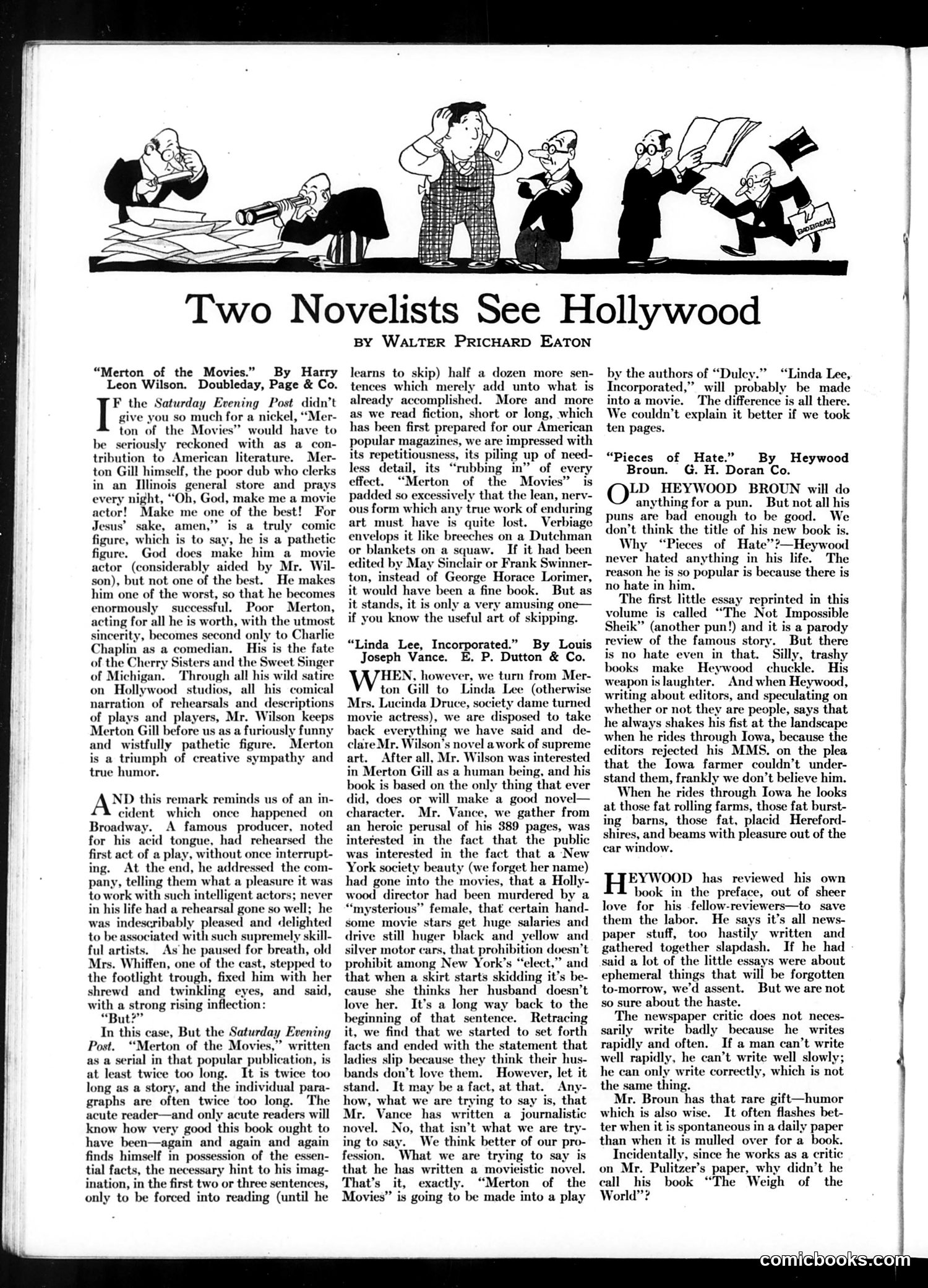
This is a book review article by Walter Prichard Eaton comparing two novels about Hollywood: Harry Leon Wilson's "Merton of the Movies" and Louis Joseph Vance's "Linda Lee, Incorporated." The **cartoon header** depicts the Hollywood film industry—showing figures examining documents, looking through telescopes, and waving flags, representing the chaotic, superficial nature of the movie business. **Eaton's critique**: He praises Wilson's novel for its character-driven narrative about a sincere but talentless movie extra, comparing him favorably to Charlie Chaplin. However, he faults the book for excessive verbosity—claiming it's "padded" with unnecessary detail and would have benefited from editorial trimming by serious literary figures like May Sinclair. By contrast, Vance's novel is dismissed as superficial—interested only in exploiting public fascination with a society woman entering films, rather than exploring genuine character. The satire targets both **Hollywood's shallow values** and **magazine-serialized fiction's tendency toward verbose repetition**—a common complaint about popular American writing of this era.
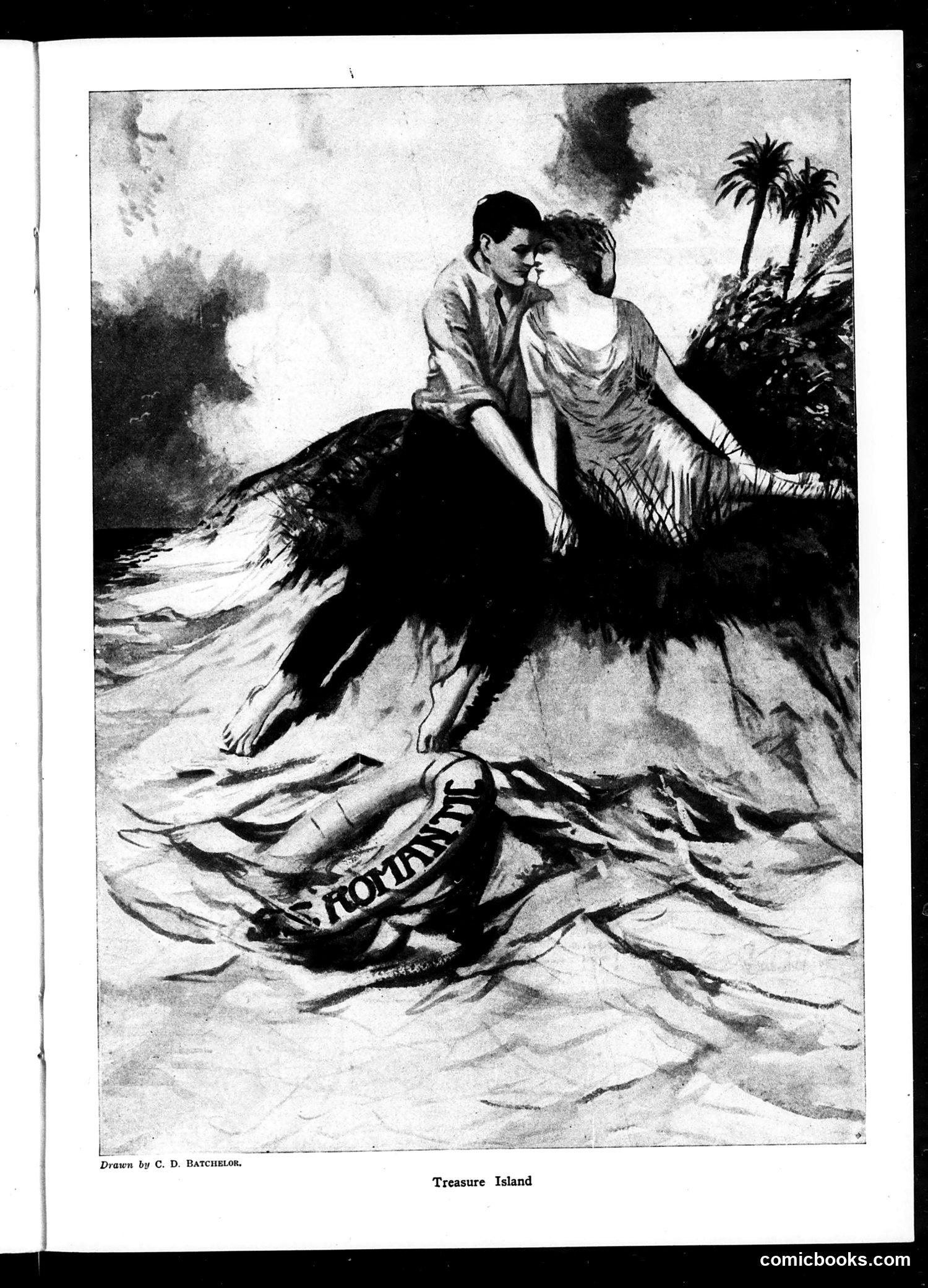
This illustration by C. D. Batchelor depicts a scene from Robert Louis Stevenson's classic novel "Treasure Island." The image shows a young man and woman in an intimate moment on a tropical beach, with palm trees visible and what appears to be a dead body or fallen figure in the foreground. Rather than political satire, this appears to be literary illustration—likely commentary on or parody of the romantic subplot often added to adventure stories. Judge magazine, while primarily satirical, also published illustrated fiction and literary humor. The juxtaposition of romance against the darker elements of treasure-hunting adventure creates gentle mockery of how Victorian-era adaptations sentimentalized such tales.
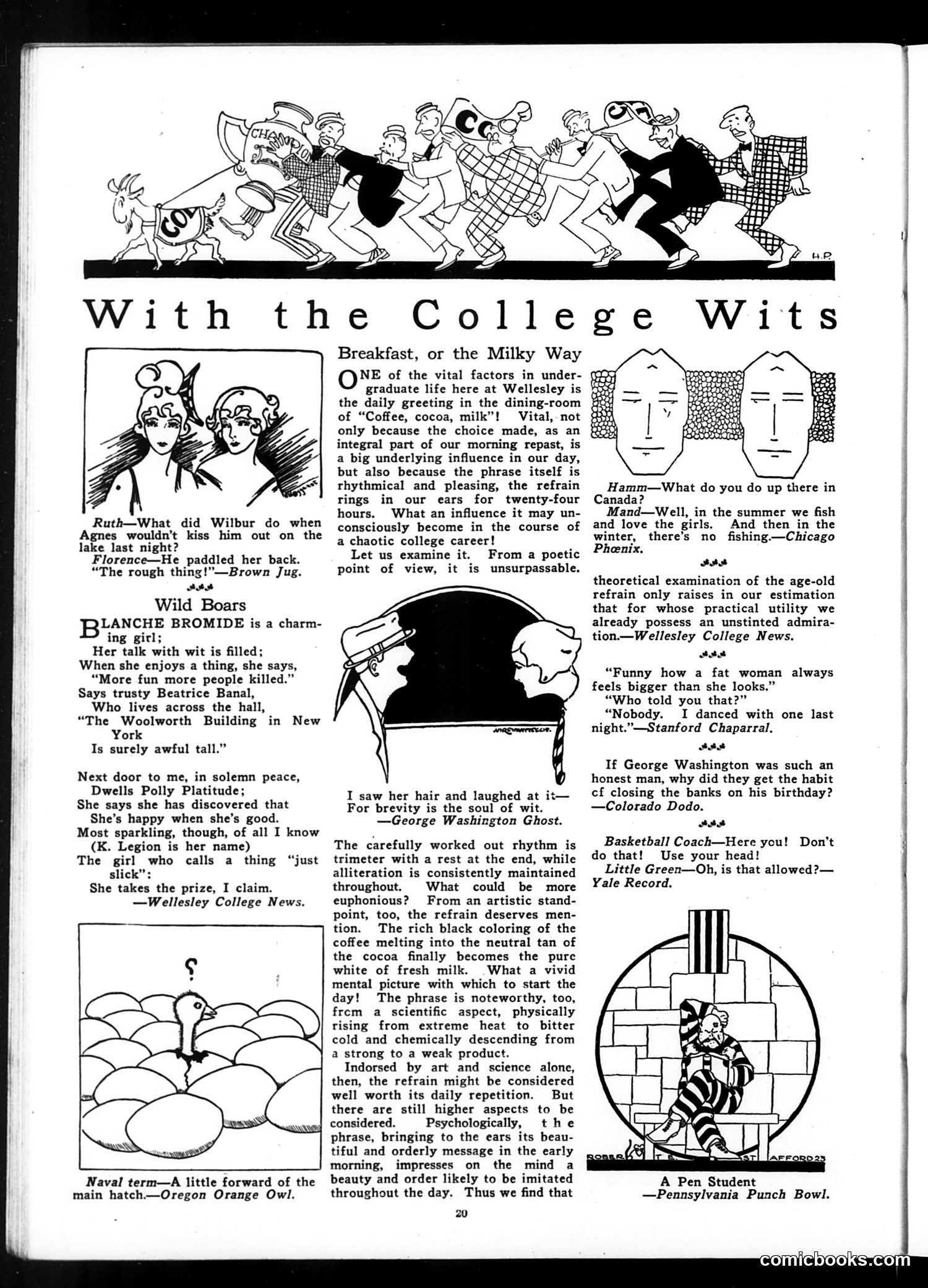
This page collects brief humorous anecdotes and jokes from college newspapers, primarily targeting undergraduates at elite women's colleges like Wellesley. The satire targets **clichéd, pretentious college speech**: characters like "Blanche Bromide" who constantly repeats bland phrases ("More fun more people killed"); "Polly Platitude" spouting obvious truisms; and the girl who calls everything "just slick." The humor mocks how college students adopt affected, repetitive speech patterns and call them wit. The long piece "Breakfast, or the Milky Way" parodies **overwrought academic analysis**—treating the mundane dining-hall greeting "Coffee, cocoa, milk" as if it deserves poetic, artistic, scientific, and psychological examination. This satirizes how college intellectuals inflate trivial matters into grandiose significance. Scattered jokes mock typical college romance (the lake paddle) and naive Canadian tourism. The page essentially ridicules **college pretension and the gap between students' inflated self-importance and actual substance**. The cartoons at the page top show "college wits" in various comedic poses, visually reinforcing the mockery of campus intellectual posturing.
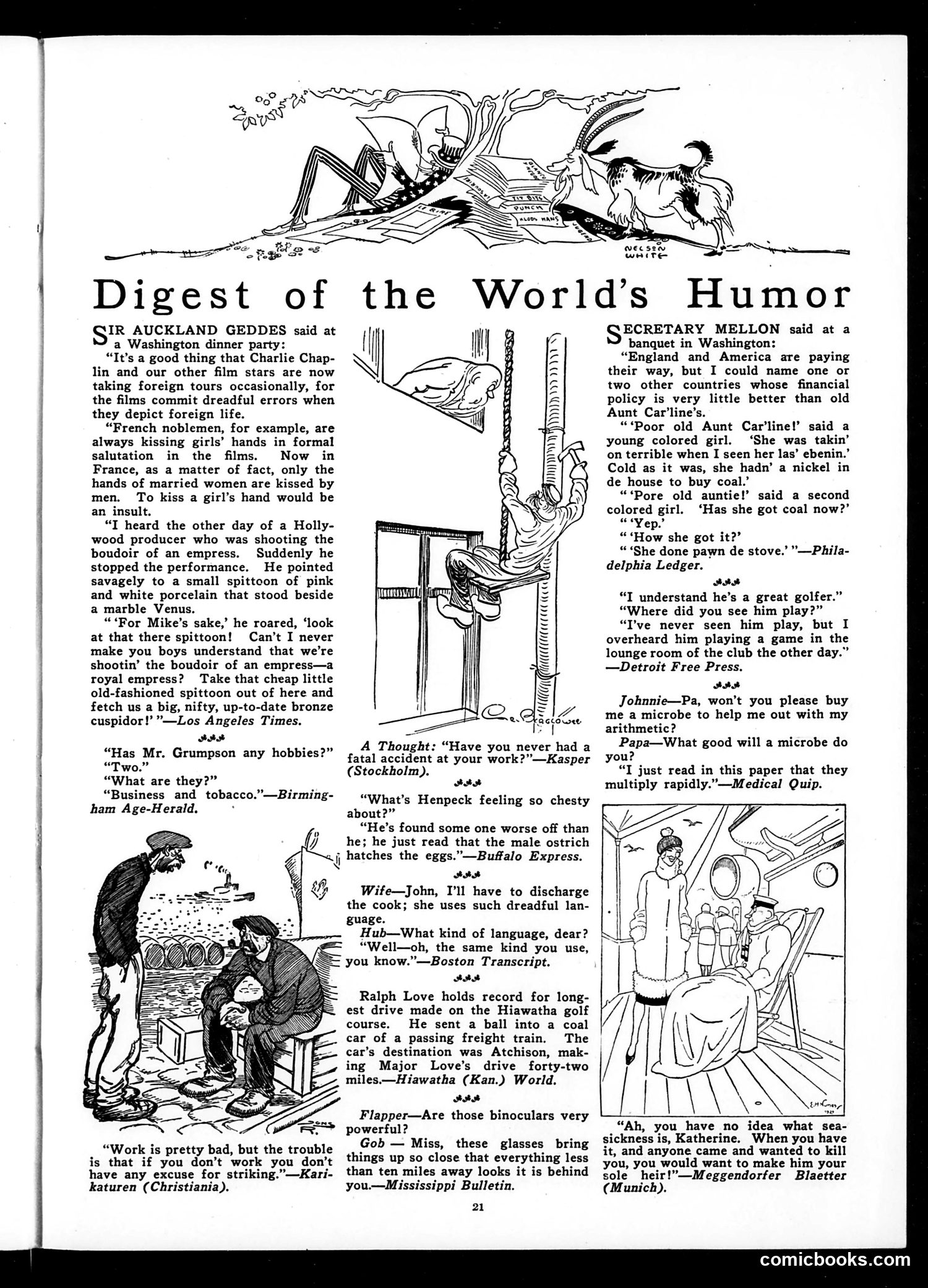
This page collects humorous anecdotes from various international newspapers, representing Judge's "World's Humor" column. Key items include: **Sir Auckland Geddes's anecdote** mocks Hollywood's ignorance of foreign customs—a film producer absurdly replaces a delicate spittoon with a crude "cuspidor," misunderstanding French etiquette about hand-kissing. **Secretary Mellon's story** uses racist dialect humor featuring Black characters discussing poverty and pawning a stove—typical of 1920s-era "humor." **Other jokes** target contemporary subjects: labor strikes, nagging wives, golf obsession, and flapper culture. One compares an ostrich (which hatches eggs) to a henpecked husband—humor based on gender role stereotypes. The cartoons illustrate working-class and domestic scenes. The page reflects 1920s American magazine culture: cosmopolitan in scope but reliant on ethnic/racial stereotypes, gender-based mockery, and upper-class perspectives on leisure and marriage as sources of comedy.
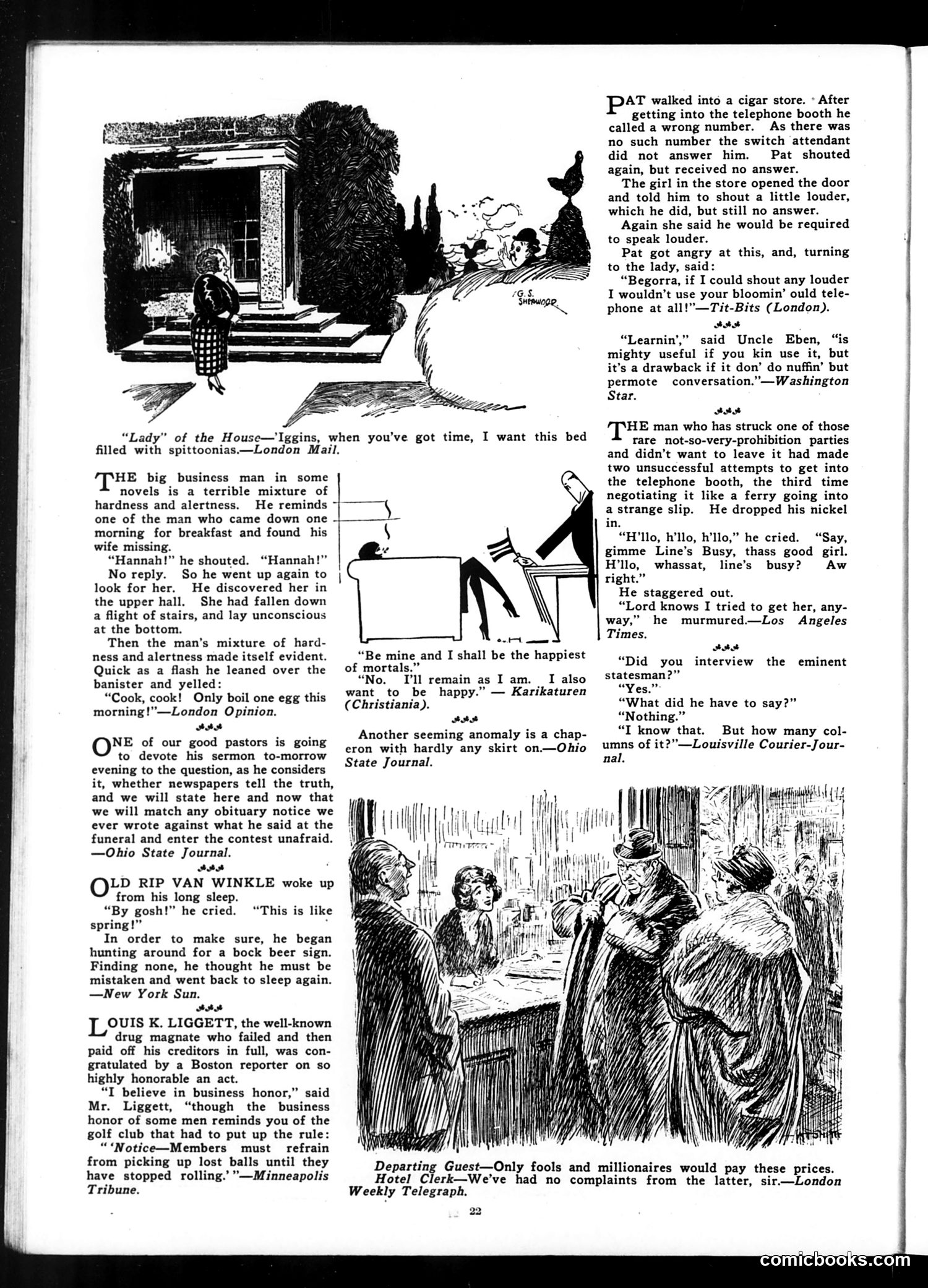
This page collects humorous anecdotes and jokes typical of early 20th-century American satirical magazines. Key content includes: **Main Cartoons/Jokes:** - A Pat (Irish stereotype character) frustrated with a telephone booth, unable to reach a wrong number - A man leaving a Prohibition-era party, drunk and unable to operate a telephone booth - Social commentary on newspaper truthfulness, business ethics, and gender dynamics **Social References:** - **Prohibition era**: Multiple jokes reference illegal drinking parties and "bock beer" (suggesting Prohibition's impact) - **Telephone technology**: New enough to be comedic; misuse by drunk or confused callers - **Class satire**: A hotel clerk's joke about wealthy guests not complaining about inflated prices - **Gender roles**: Brief reference to chaperons with inadequate clothing **The Satire's Point:** These pieces mock modern life's absurdities—technology failures, Prohibition hypocrisy, business dishonesty, and class pretension—through exaggerated scenarios. The Irish character, drunk revelers, and ethical questions reflect contemporary anxieties about urbanization and changing social norms.
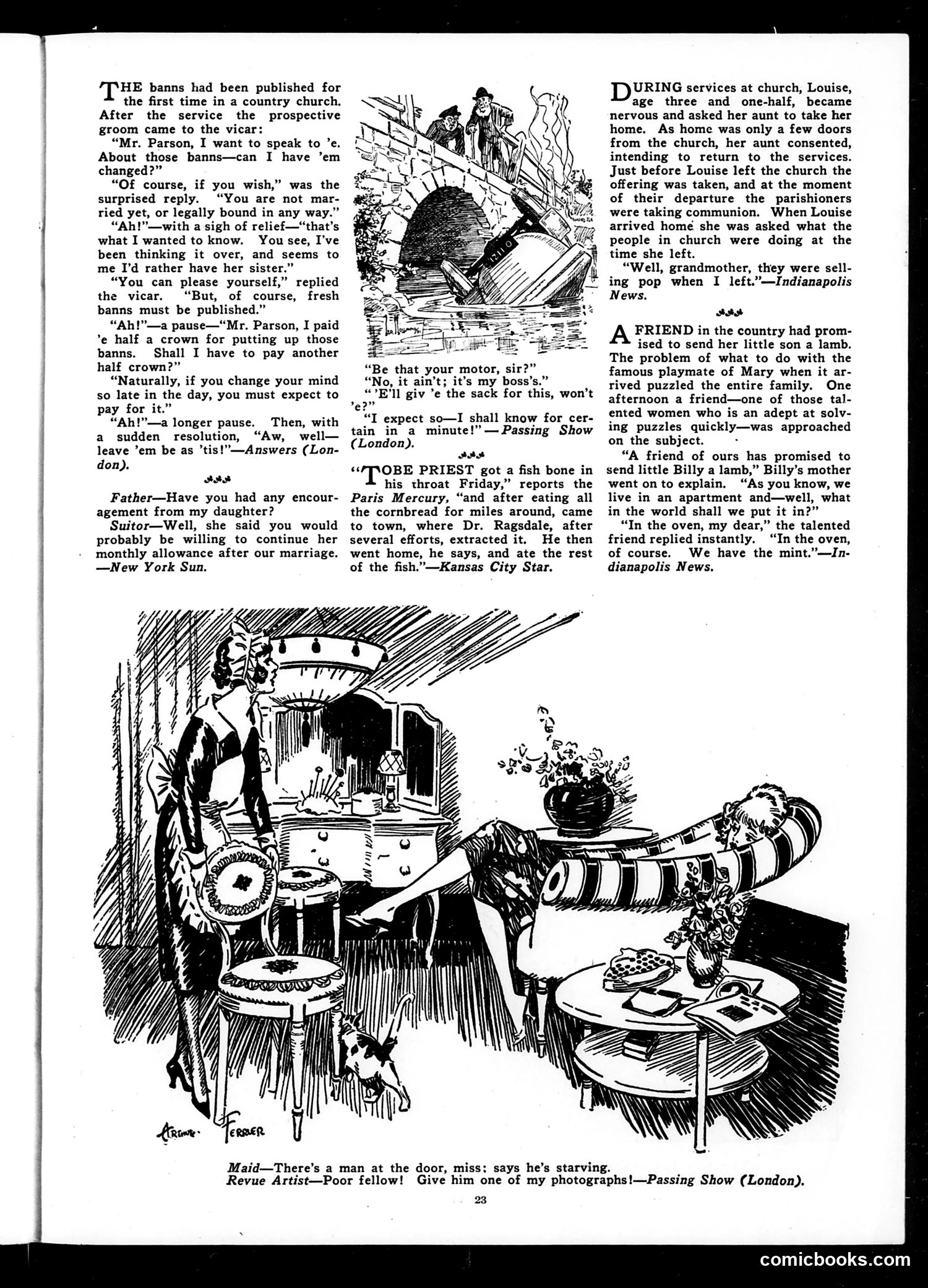
This page contains multiple humor pieces typical of early 20th-century satirical magazines: **Top Story**: A rural comedic dialogue where a prospective groom attempts to switch from marrying one sister to another after banns are published. The humor lies in his misplaced priorities—he's relieved he's not legally bound, but balks at paying another half-crown for new banns, ultimately deciding to marry the original sister rather than pay twice. **Bottom Cartoon**: A sketch of a fashionable woman with a photographer, playing on vanity. When a starving man appears at the door, she offers him one of her photographs instead of food—satirizing both her self-importance and her uselessness as charity. **Other Anecdotes**: Brief humorous stories about a child misunderstanding communion as "selling pop," a suitor motivated only by continued allowance, and a priest's fish-bone incident. The humor is gentle, domestic, and relies on wordplay and situational irony rather than political commentary.
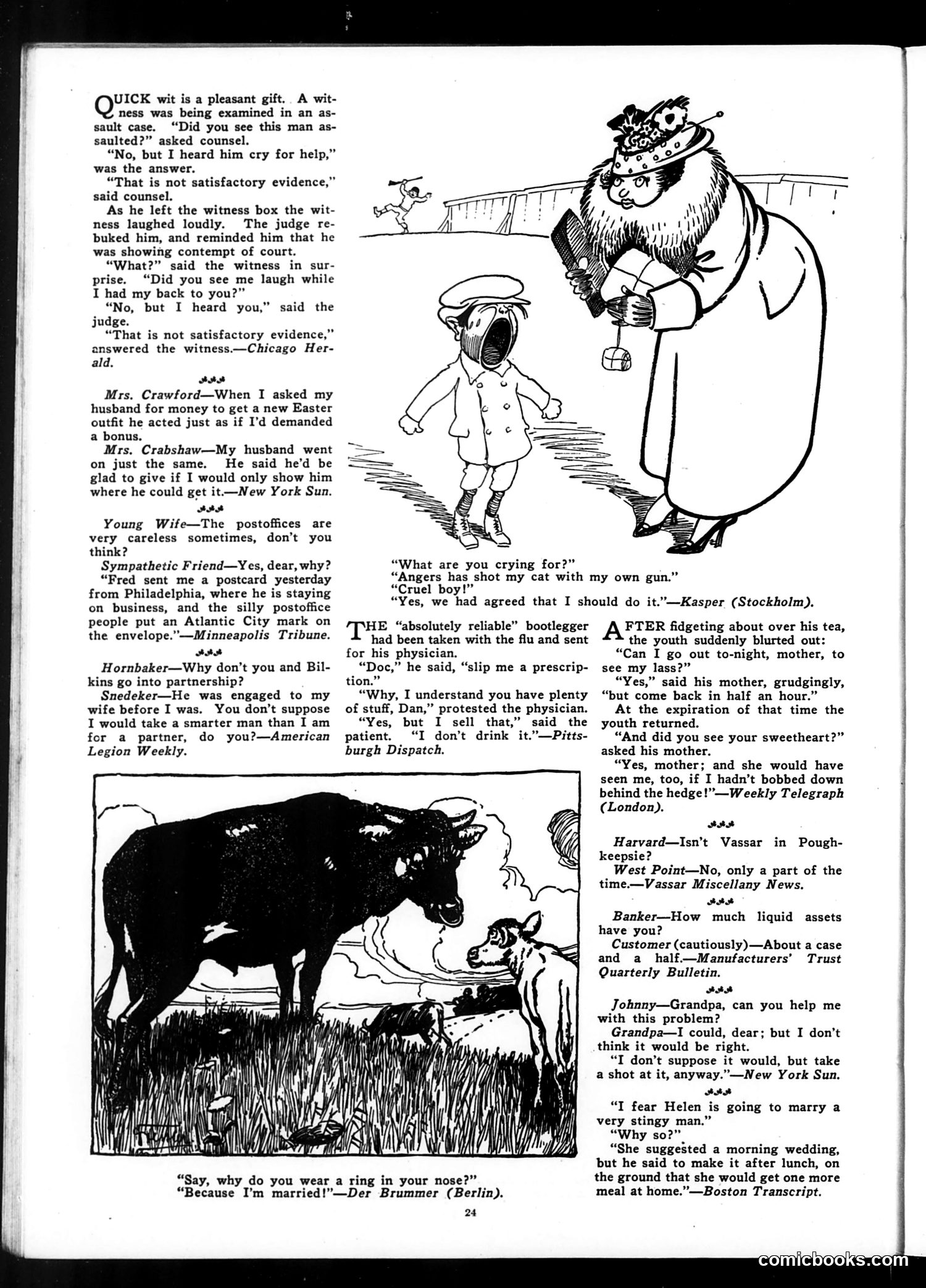
This page contains **brief satirical jokes and anecdotes** typical of Judge's humor format, plus **two cartoon illustrations**. **The Main Cartoons:** 1. **Top cartoon** shows a well-dressed man with a large nose offering something to a small child. The caption reveals a dark joke: A German boy cries because "Angers" shot his cat with his own gun. When called cruel, the boy says they had "agreed" he should do it—satirizing either childhood cruelty or potentially darker themes about obedience and violence. 2. **Bottom cartoon** depicts a cow and small dog, captioned with a marriage joke: "Because I'm married!"—a visual pun suggesting the nose ring represents marital constraint (from Berlin's *Der Brummer*). **The Text Items** are mostly short anecdotes mocking: - Courtroom logic and judicial absurdity - Marital dynamics and wives requesting money - Prohibition-era bootleggers - Stingy suitors The humor reflects 1920s American attitudes toward marriage, class, law, and social propriety—often cynical about romantic and domestic relationships.
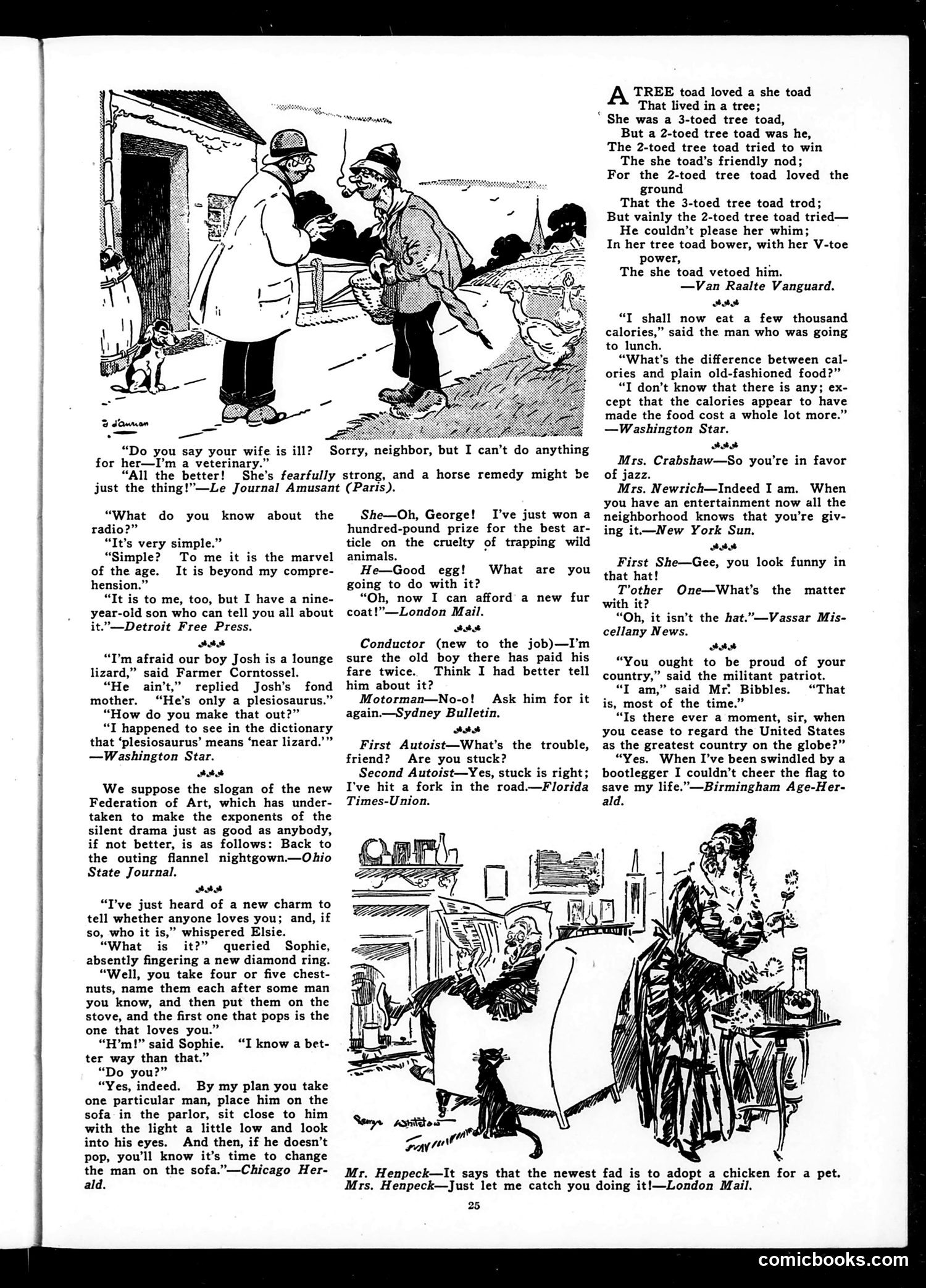
This is a humor/joke collection page from Judge, mixing brief comic anecdotes with two illustrated cartoons. The jokes reflect 1920s American concerns: **Top cartoon**: Shows a veterinarian being called for a sick wife—the humor relies on the absurdity of treating humans with animal remedies, suggesting the wife is "strong as a horse." **Recurring themes in the text jokes**: - Modern technology (radio, automobiles) baffling older generations - Jazz and Prohibition-era social changes (bootleggers mentioned) - Dating rituals and romance - Wildlife conservation sentiment (the ironic "fur coat" joke: woman wins prize against animal trapping, then buys fur coat) **Bottom cartoon**: Depicts a domestic scene where a woman surrounded by perfume bottles and cosmetics discusses love charms with another woman—typical 1920s satirical commentary on female materialism and romance. The page satirizes contemporary anxieties about modernity, generational gaps, and changing social mores in post-WWI America.
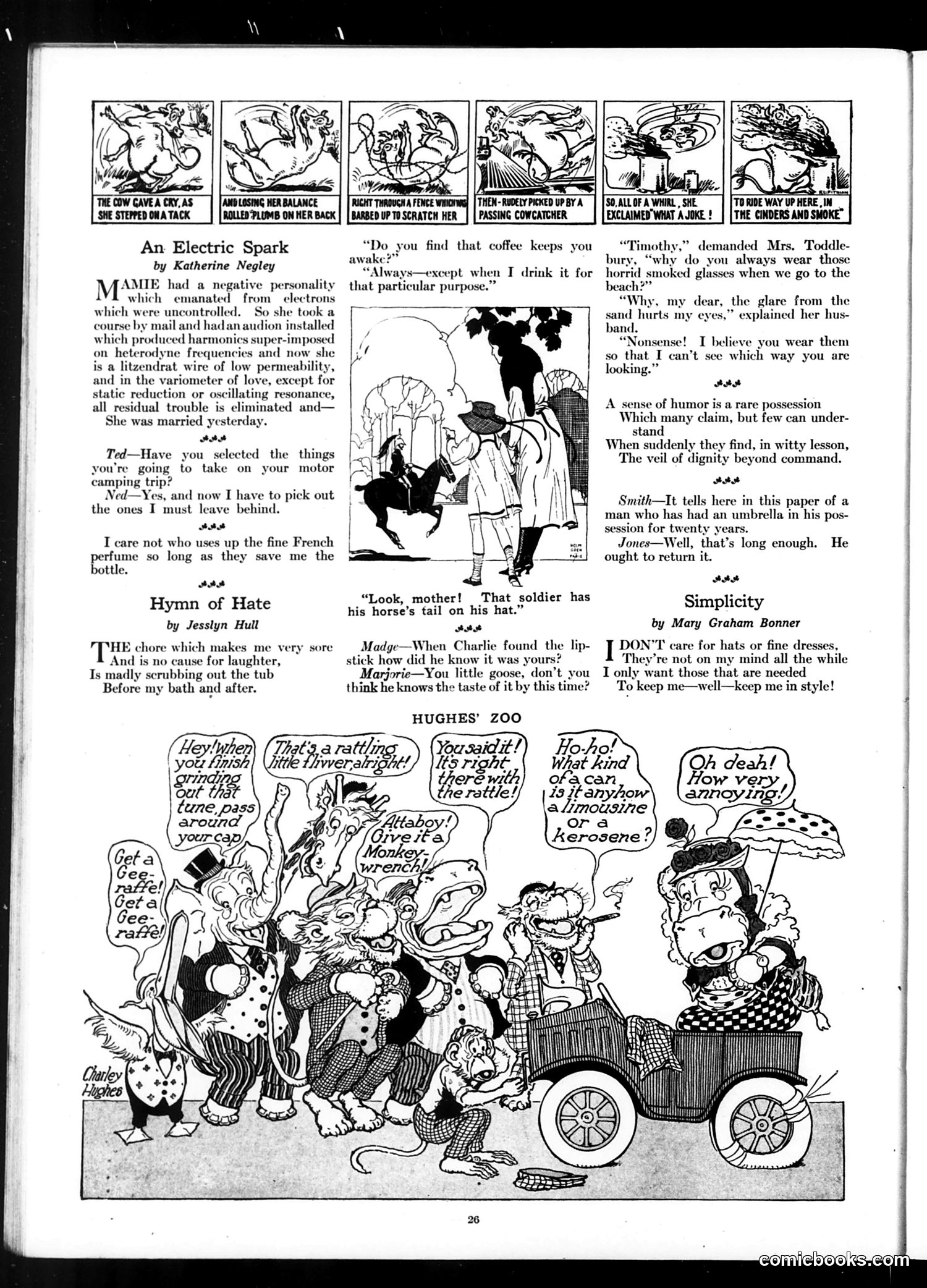
This is a humorous comic strip featuring anthropomorphic animals in a chaotic scene. The dialogue consists of rapid-fire puns and wordplay among characters who appear to be discussing mechanical or automotive objects ("rattle," "Altaboy," "wrench," "Kerosene," "car"). The cartoon plays on verbal absurdity rather than specific political satire. One character exclaims "Oh deah! What kind of can is it anyhow—a limousine? Or a Kerosene?"—conflating automobiles with other objects through homophone jokes. The artist (Cessley Hastings, per signature) uses exaggerated animal caricatures and slapstick visual chaos to emphasize the nonsensical humor. This appears to be pure comedic entertainment rather than commentary on contemporary events or figures. The "Zoo" title suggests the animals themselves are the joke—wild, uncontrolled creatures creating mayhem through their confused dialogue about modern contraptions, likely amusing Judge's readers through absurdist humor.
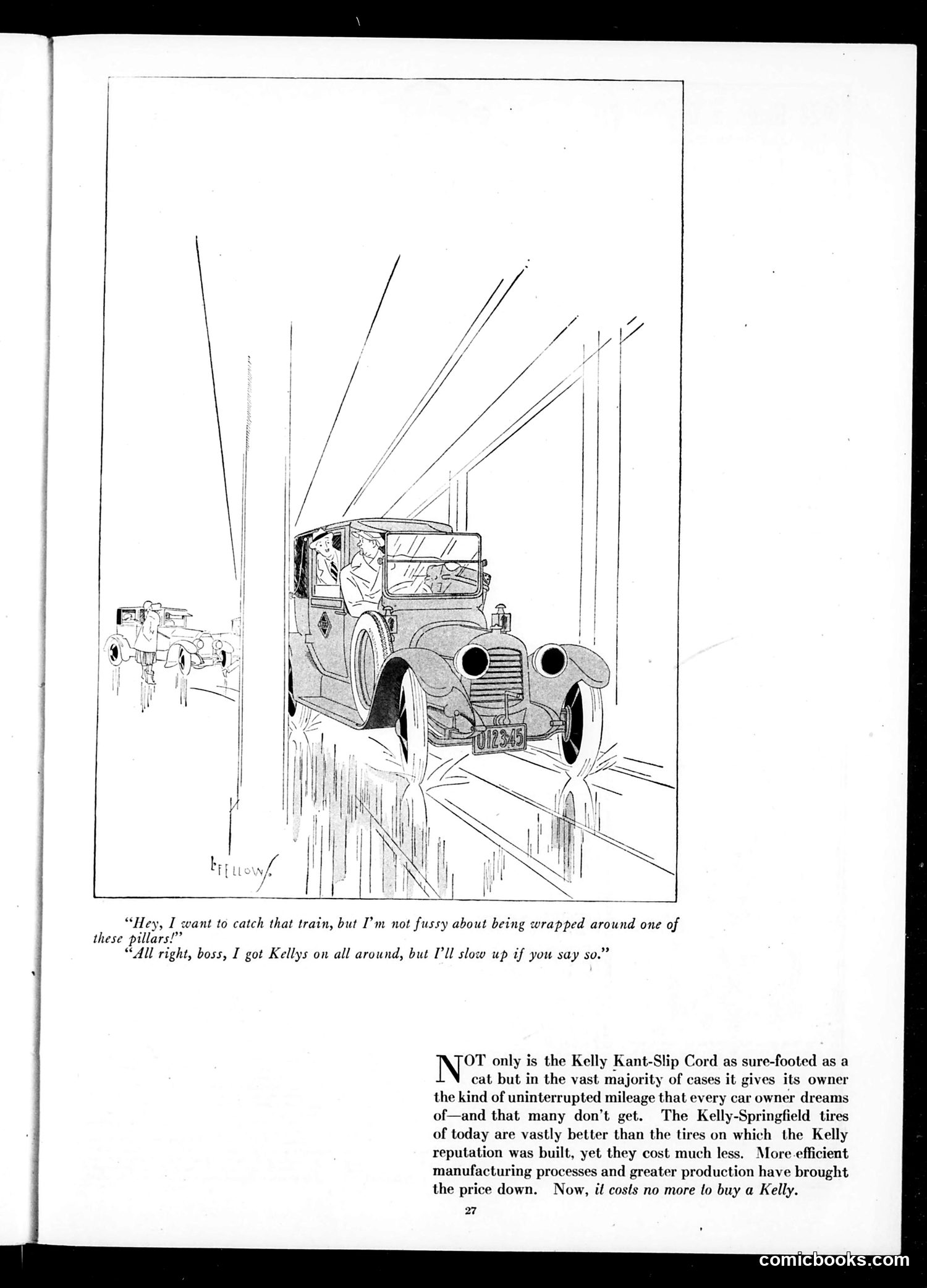
This is a **tire advertisement** disguised as comedy. The cartoon shows a driver anxious about hitting a railroad pillar while speeding to catch a train. His chauffeur reassures him that Kelly tires provide reliable grip ("I got Kellys on all around"). The joke plays on the driver's casual attitude toward danger—he's willing to risk wrapping around a pillar as long as the car doesn't slip. The ad's message: Kelly-Springfield tires are now affordable AND high-quality, undercutting competitors through better manufacturing. The historical context: This appears to be early 20th-century advertising when automobile ownership was still relatively exclusive, and tire quality directly affected safety and mileage. The ad emphasizes that Kelly tires—once a premium product—are now democratized through mass production and reduced pricing, making them accessible to average car owners.
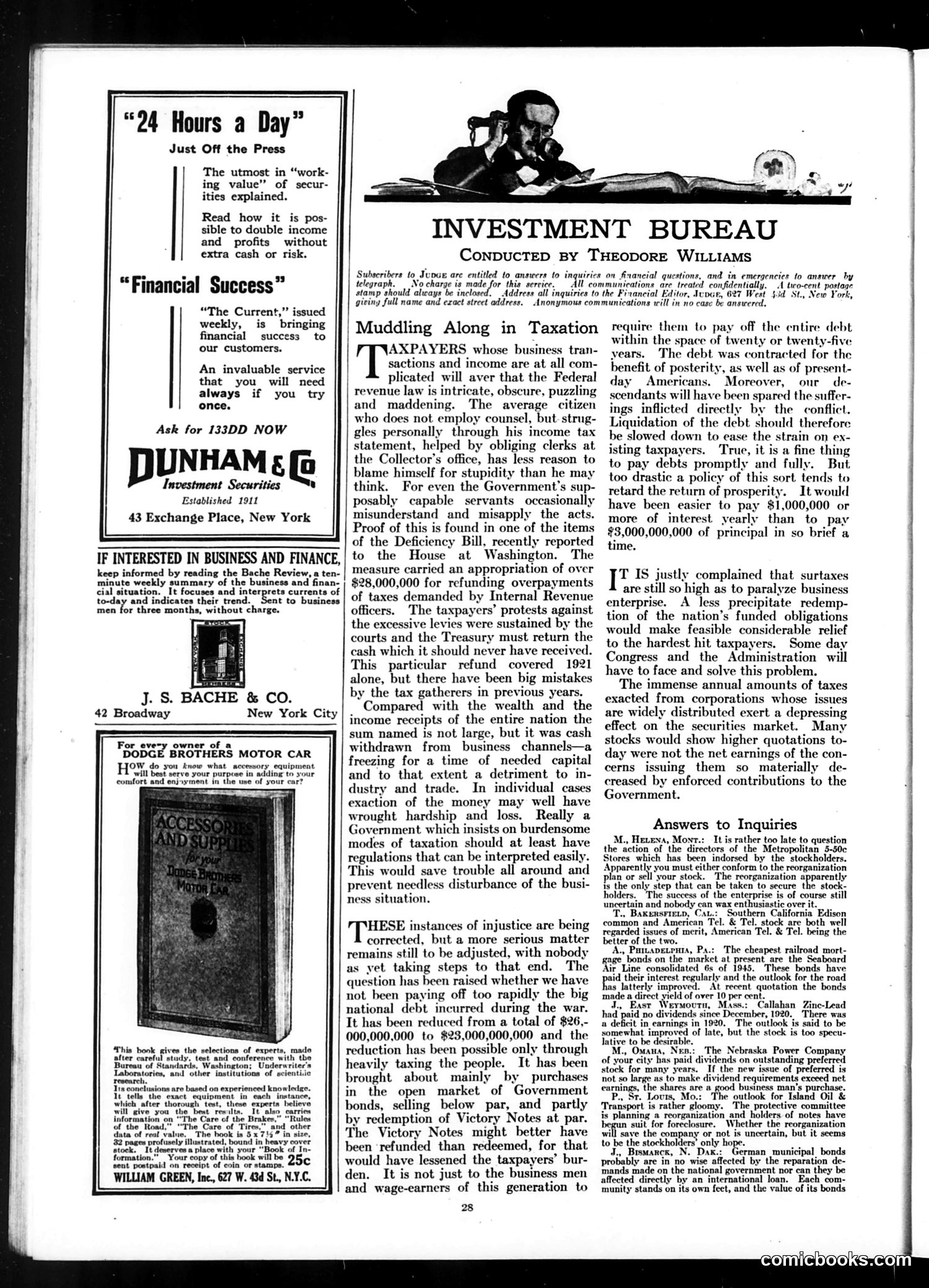
This is primarily a **business/finance magazine page**, not a political cartoon. The content consists of investment advertisements and a serious editorial column titled "Muddling Along in Taxation." ## The Main Article's Point: The editorial critiques the federal tax system as confusing and poorly administered. It cites a specific example: Congress appropriated **$28 million to refund overpayments** of 1921 taxes that the government had wrongly collected. The author argues that while the sum seems small relative to national wealth, it represents capital unnecessarily frozen in business channels—harming industry and trade. The core complaint: a government that imposes heavy taxation should at least make its tax code **clear and easy to interpret** to avoid such costly mistakes. The editorial then transitions to a secondary concern about rapid national debt reduction through heavy taxation and bond purchases. ## Visual Elements: The page header shows a figure examining documents—likely representing a taxpayer struggling with complex tax forms.
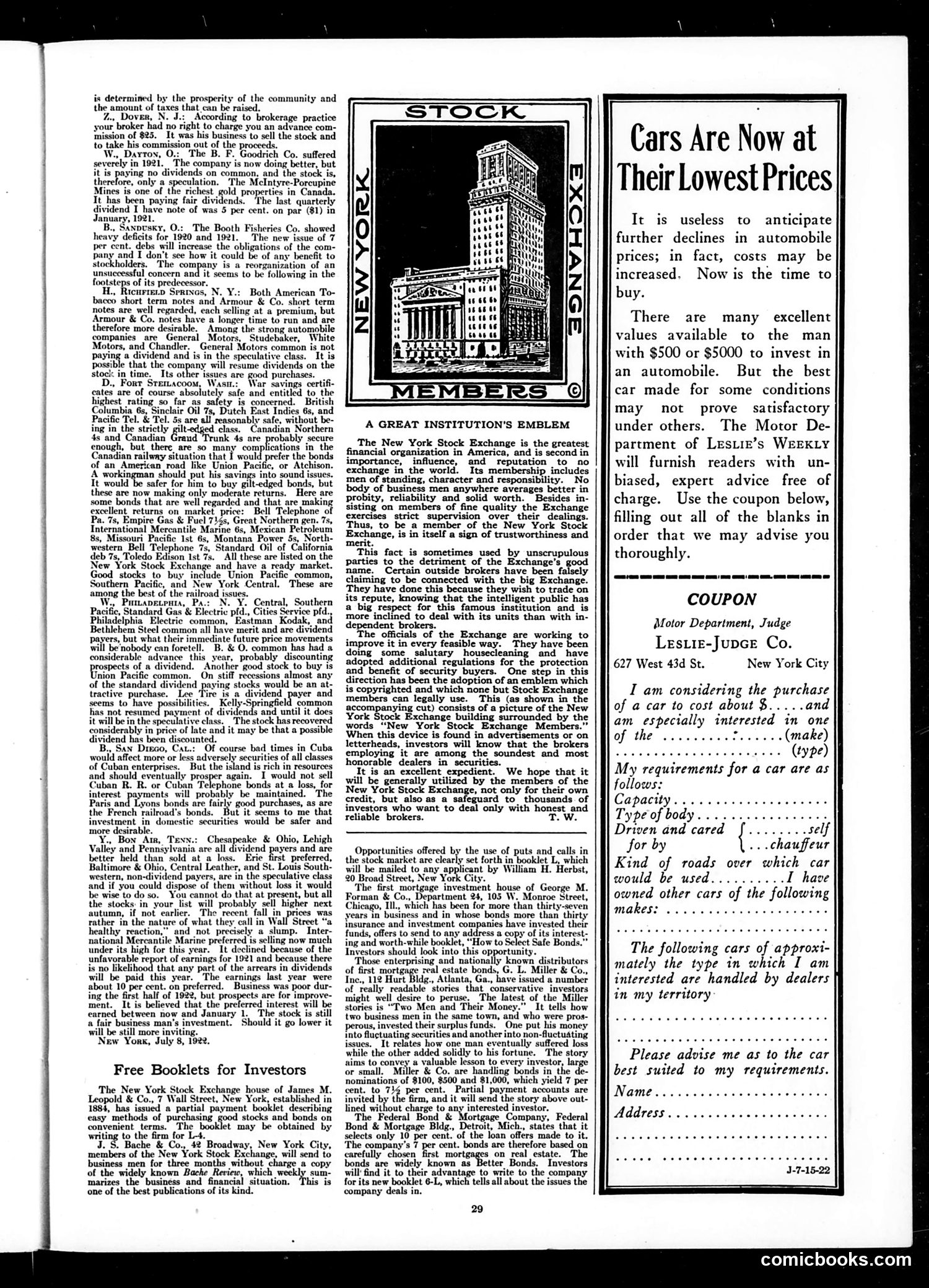
This page primarily contains **investment advice columns** rather than political satire. The content consists of Q&A responses about stocks and bonds from readers, addressing topics like General Motors, Studebaker, Bell Telephone, and various railroad securities. The only cartoon visible is the **New York Stock Exchange building emblem** at the top—labeled "A Great Institution's Emblem"—which serves as a decorative header rather than satirical commentary. On the right side is an **automobile advertisement** titled "Cars Are Now at Their Lowest Prices," encouraging purchases from the Motor Department of Leslie-Judge Co., with a coupon for readers considering car purchases. The page reflects **1922 economic conditions**: post-WWI recovery, investment opportunities in industrial stocks, and the early automobile boom. There is no political satire or caricature present—this is straightforwardly a financial advice and advertising page from Judge magazine.
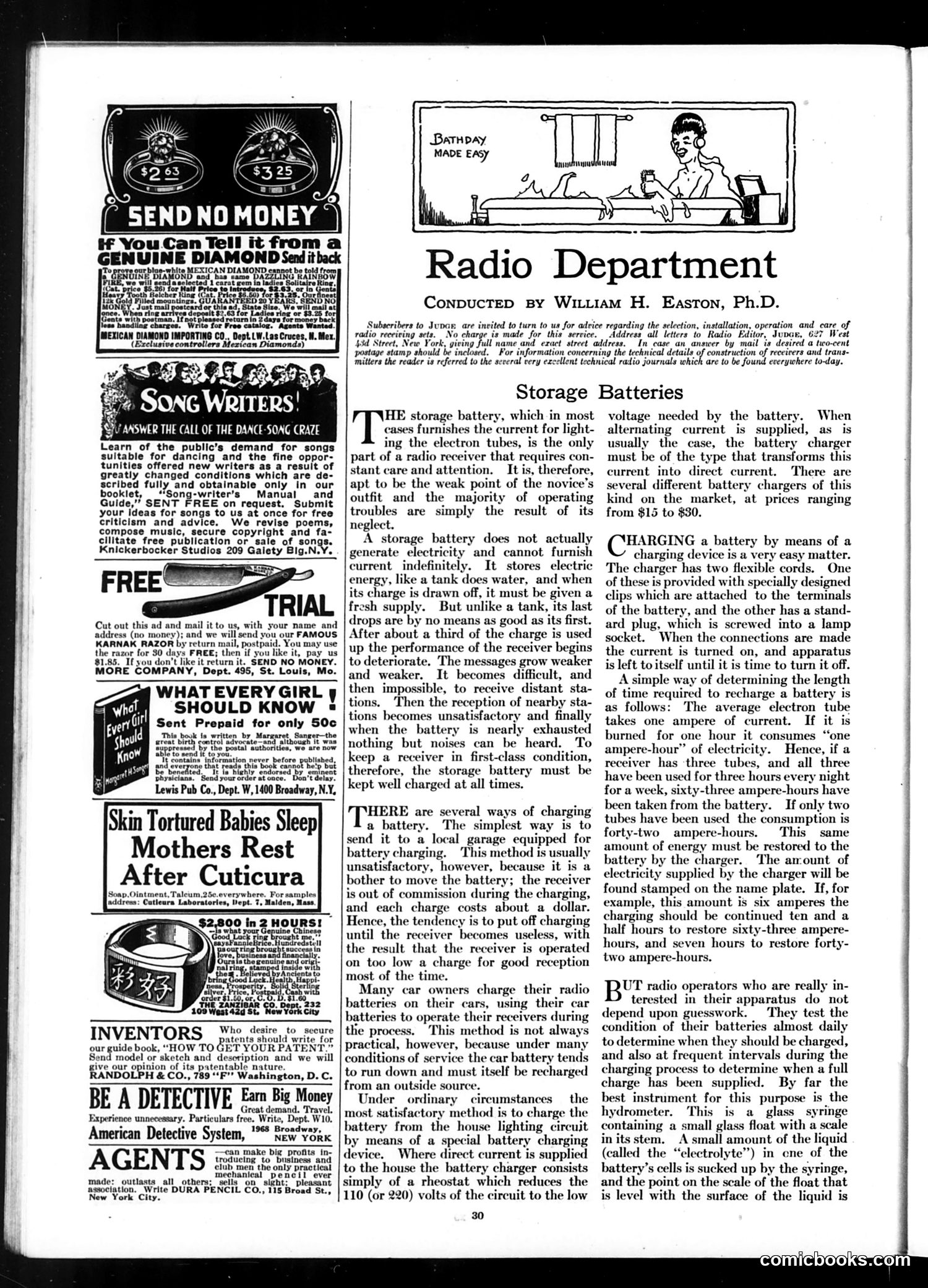
This page is primarily **advertisements and a technical advice column** rather than satire. The main content is a "Radio Department" column by William H. Easton, Ph.D., explaining **storage batteries for early radio receivers**—a practical guide for 1920s radio hobbyists. The text describes how batteries power vacuum tubes, why they deteriorate, and charging methods. The surrounding ads reflect period concerns: a diamond-testing scam ("if you can tell it from genuine, send it back"), song-writing opportunities capitalizing on dance crazes, razor trials, Margaret Sanger's birth control information (then controversial), baby skincare products, and patent/detective/pencil sales pitches. The small cartoon at top shows "Birthday Made Easy"—a woman in a bathtub, likely advertising bath products. **This is not political satire**, but rather a snapshot of 1920s consumer culture and the emerging amateur radio hobby, showing what advertisers believed would interest readers.
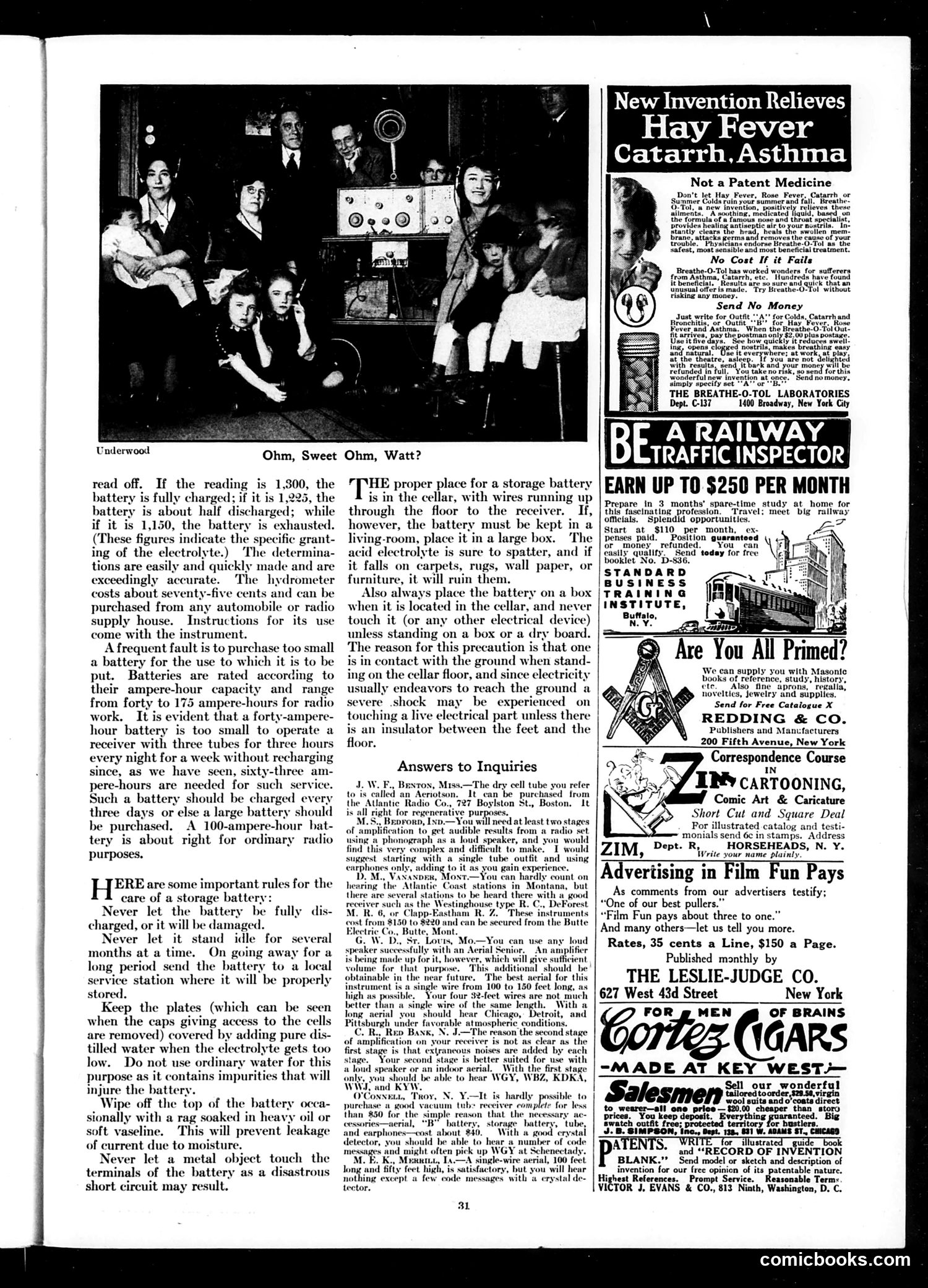
This page is primarily **instructional content about radio equipment**, not political satire. The cartoon heading "Ohm, Sweet Ohm, Watt?" is a pun on the song "Home, Sweet Home," playing on electrical terminology (ohms and watts are units of electrical measurement). The photograph shows a **family gathered around an early radio receiver**, illustrating the domestic context of 1920s radio technology. The accompanying text provides practical advice for maintaining storage batteries that powered these radios—including proper placement, charging procedures, water levels, and safety precautions against electrical shock. The page also contains period **advertisements** for correspondence courses and commercial products, typical of Judge magazine's revenue model. This reflects radio's novelty status and the public's need for technical guidance during early broadcasting.
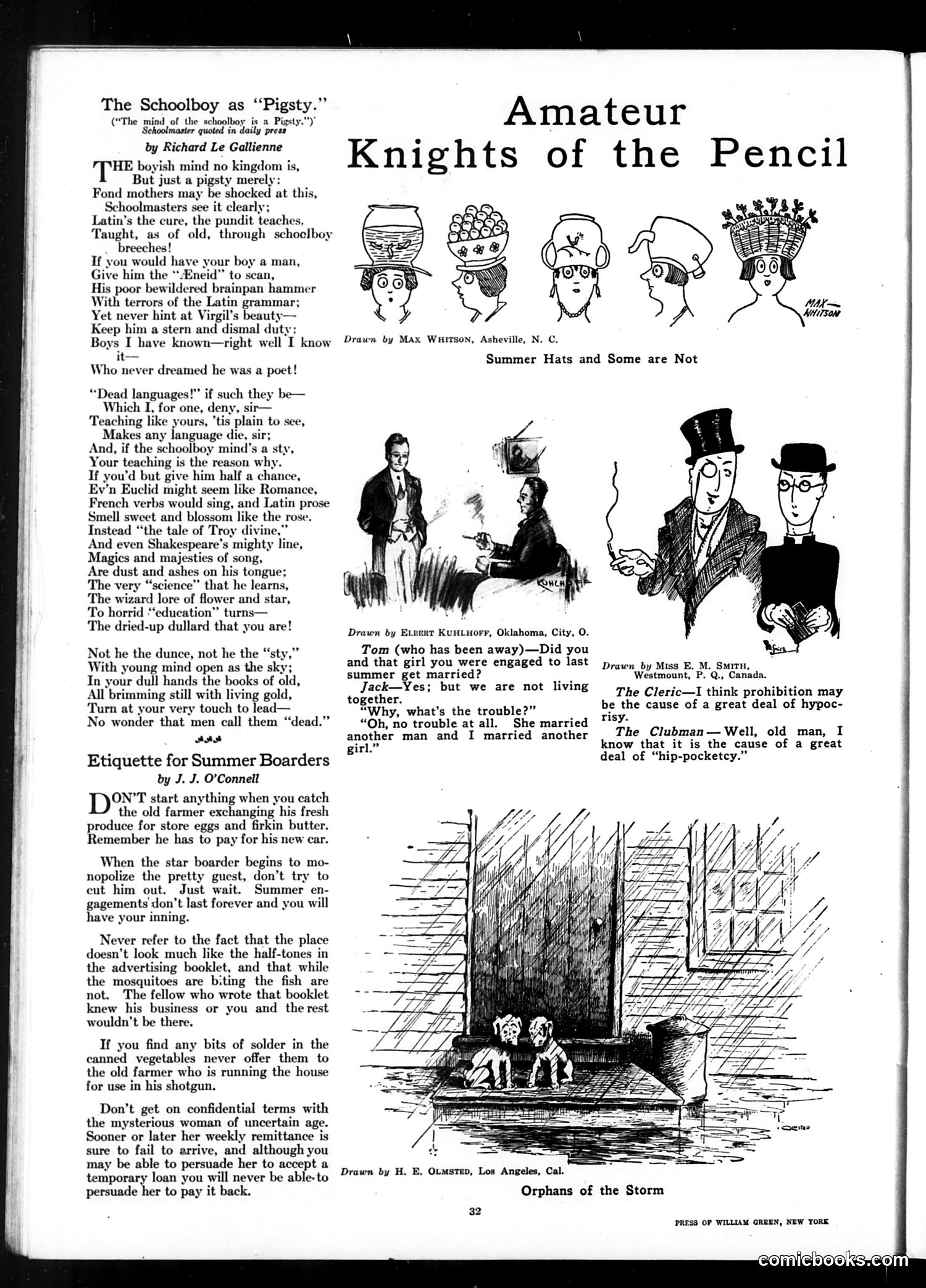
This page satirizes early 20th-century education and includes social humor pieces. **"The Schoolboy as Pigsty"** — a poem by Richard Le Gallienne — attacks the dry, mechanical teaching methods of classical schoolmasters. The text quotes schoolmasters dismissing boys' minds as "pigsties," then rebuts this by arguing their *teaching* kills students' natural curiosity and passion for literature. The poem defends poetry, beauty, and imagination against rote instruction in Latin grammar. **"Etiquette for Summer Boarders"** humorously advises guests at rural boarding houses on avoiding awkwardness—don't question the farmer's financial priorities, don't interrupt boarders' romantic interests, and beware of deadbeat boarders claiming poverty. **Three cartoon vignettes** mock social pretension: elaborate summer hats, marital confusion (a comedic misunderstanding about ex-engagements), and "hip-pocketcy"—slang for smuggling alcohol during Prohibition, presented as causing hypocrisy. The drawings are credited to various artists.
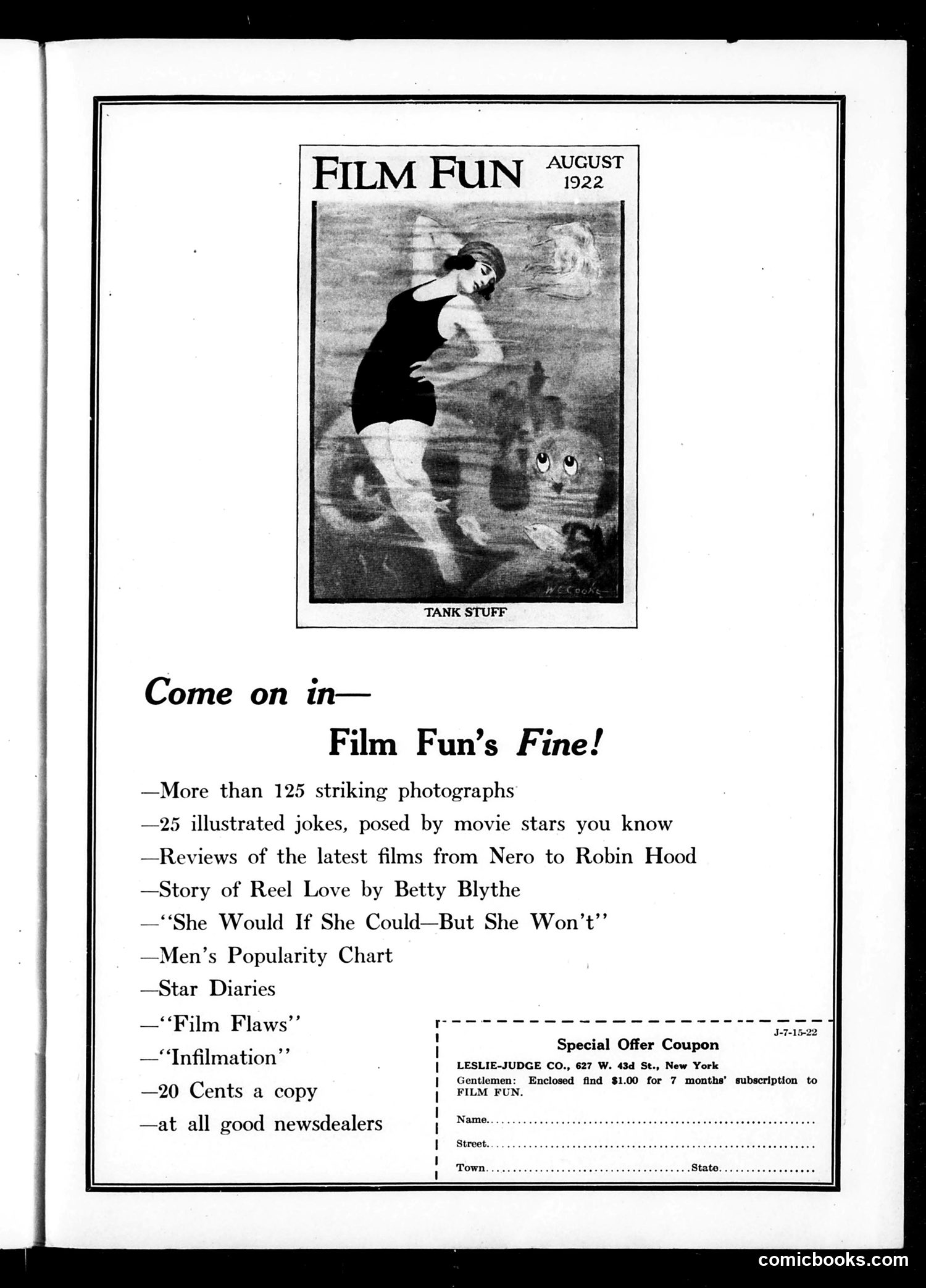
This is an advertisement for *Film Fun*, a companion magazine to *Judge*, promoting its August 1922 issue. The illustration labeled "Tank Stuff" depicts a woman in a bathing suit in water with what appears to be a fish or underwater creature—likely a humorous, slightly risqué image typical of 1920s entertainment magazines. The ad promotes *Film Fun* as a movie-focused publication featuring celebrity content popular with the era's cinema audiences: photographs, jokes posed by "movie stars you know," and reviews referencing contemporary films (including *Nero* and *Robin Hood* adaptations). Notable is Betty Blythe, a silent film star, contributing a story titled "Reel Love." The content reflects 1920s fan culture obsession with Hollywood gossip, star rankings ("Men's Popularity Chart"), and behind-the-scenes celebrity content. At 20 cents per copy, it targeted middle-class readers seeking accessible entertainment news during the silent film era's peak popularity.
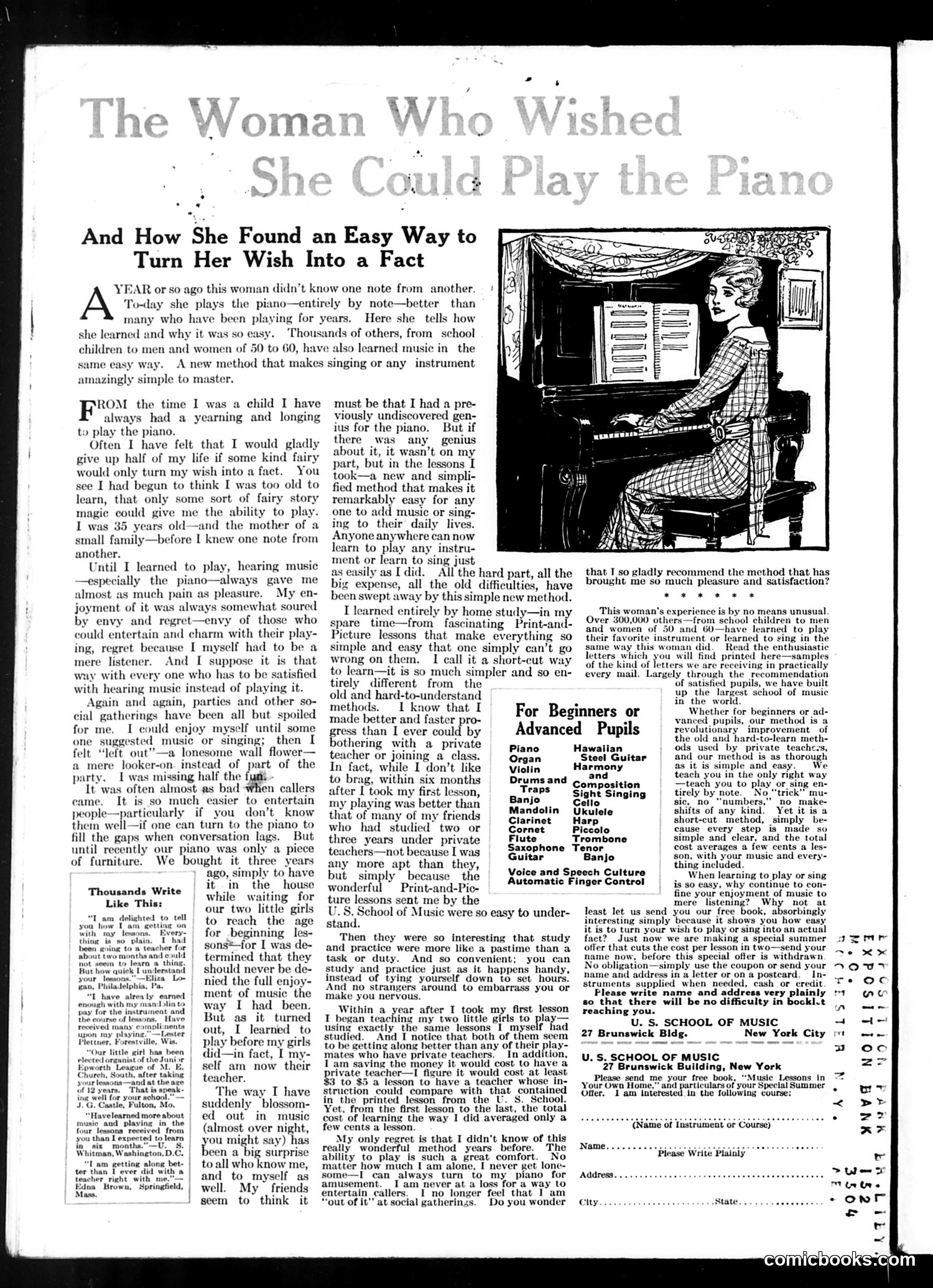
This is **not a cartoon or satire**, but rather a **full-page advertisement** disguised as a testimonial article in Judge magazine. The piece presents a first-person account from a woman who learned piano as an adult through a correspondence course called the "U.S. School of Music" (visible in the ad at bottom right). The narrative emphasizes her previous longing to play, her age and self-doubt, and her surprise at learning quickly through this "new method" of "Print-and-Picture lessons." **The pitch**: Anyone can learn music at home, in spare time, without expensive private teachers. **Social context**: This reflects early 20th-century American optimism about self-improvement and mail-order education. The emotional appeal—regret at missing out, social embarrassment, sudden transformation—targets insecure adults. The scattered testimonial quotes ("Thousands Write Like This") reinforce the sales message that this method works for ordinary people. This is essentially a **hidden advertisement using narrative persuasion** rather than direct selling.