
Judge, 1922-07-15 · page 8 of 36
Judge — July 15, 1922 — page 8: what you’re looking at
What you’re looking at
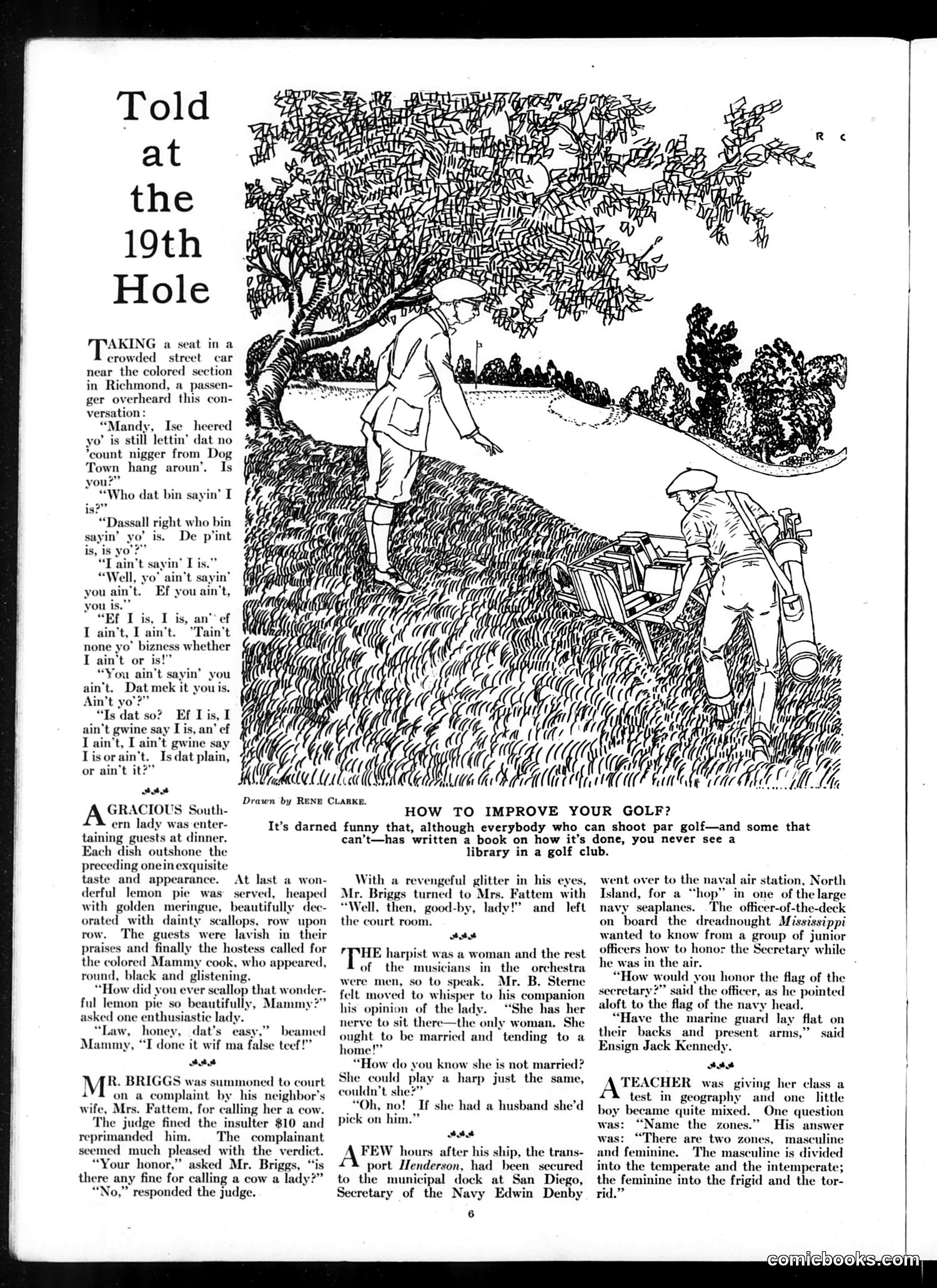
This page contains several short humorous pieces typical of early 20th-century *Judge* magazine. The main features are: **Top cartoon**: "Told at the 19th Hole" depicts a dialogue between two Black men in Richmond using heavy dialect. The joke plays on circular logic and contradictory statements—a common (though dated and offensive) vaudeville format of the era. **Middle sections**: Various anecdotes mocking social situations—a Southern hostess, a court case where a man calls his wife a cow, and a story about a harpist in an orchestra. These are gentle humor pieces without clear political content. **Bottom section**: "How to Improve Your Golf?" criticizes golf enthusiasts who write instructional books but never visit golf club libraries. Includes anecdotes about naval personnel (mentioning Secretary of the Navy **Edwin Denby**) and a teacher's geography test mixing gender with climate zones—wordplay rather than satire. The page is primarily entertainment-focused rather than political commentary.
📄 Transcribed text from this page (OCR, searchable)
Machine-transcribed from the original scan — historical spelling and the odd misread are preserved.
crowded _ stre near the colored section in Richmond, a passen- ger overheard this con- versation : Ise heered yo’ ii lettin’ dat no ‘count nigger from Dog Town hang aroun’. Is you?” “Who dat bin sayin’ I Dassall right who bin De p'int ain't sayin’ Ef you ain't, " “Ef I is, I is, an” ef I ain't, I ain fain’t none yo" bi: whether I ain't or “You air ain't. Dat mek it youis. Ain’t yo'?” “Is dat so? Ef Lis, I ain't gwine say Lis, an’ ef T ain't, I ain’t gwine say Lisorai Is dat plain, or ain't it?” Por RACIOUS South- ern lady was enter- taining guests at dinner. Each dish outshone the preceding oneinexqu taste and appearance derful_ lemon pie with golden meringue, orated with da r ite round, black and gl “How did you e ful lemon pie so be asked one enthusi y, honey, Mammy et 4 on a compl. reprimanded him. “Your honor,” “No,” At last a won- was’ ser’ beautifully dec- ‘s and finally the hostess called for » colored Mammy cook, who appeared, Ig. lop that wonde itifully, Mammy lady dat’s easy,” “I done it wif ma false teef!” R. BRIGGS was summoned to court nt by wife, Mrs. Fattem, for calling her a cow. The judge fined the insulter $10 The complainant seemed much ple ased with the verdict asked Mr. Brig; there any fine for calling a cow a lady? responded the judge. Me if Us et & he it Gh HOW TO IMPROVE YOUR GOLF? It’s darned funny that, although everybody who can shoot par golf—and some that can’t—has written a book on how it’s done, you never see a library in a golf club. Lae A Drawn by RENE CLARKE. went over to the air station, North Island, for a “hop” in one of the large navy seaplanes. The officer-of-the-deck on board the dreadnought Mississippi wanted to know from a group of junior officers how to honor the Secretary while sin the air. you honor the flag of the ‘ id the officer, as he pointed aloft to the flag of the navy head. “Have the marine guard lay flat on their backs and present arms,” said Ensign Jack Kennedy. soe A TEACHER was giving her class a test in geography and one little boy became quite mixed was: “Name the zones. GIS was: “There are two zone and feminine. The masculine is divided into the temperate and the intemperate; te feminine into the frigid and the tor- rid. With a revengeful glitter in his eyes, Mr. Briggs turned to Mrs. Fattem with “Well, then, good-by, lady!” and left the court room. heaped ery HE harpist was a woman and the rest of the musici in the orchestra were men, so to speak. Mr. B. Sterne felt moved to whisper to his companion his opinion of the lady. “She has her nerve to there—the only woman, She ought to be married and tending to a home!” “How do you know she is not married? She could play a harp just the same, couldn’t she?” Ih, no! If she had a husband she’d pick on him.” beamed his neighbor's FEW hours after his ship, the trans- port Henderson, had been secured to the municipal dock at San Diego, Secretary of the Navy Edwin Denby 6