
Judge, 1922-07-15 · page 26 of 36
Judge — July 15, 1922 — page 26: what you’re looking at
What you’re looking at
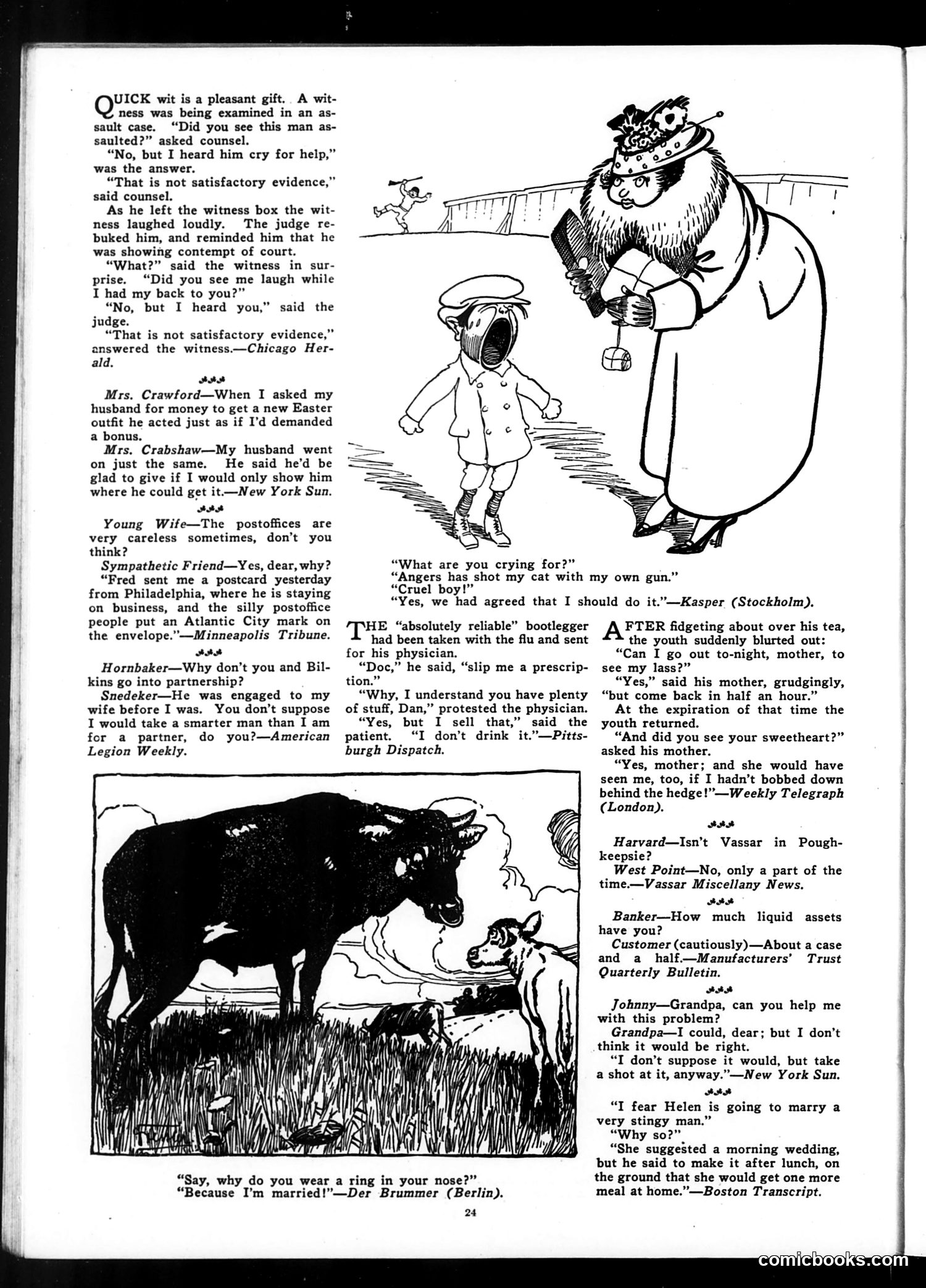
This page contains **brief satirical jokes and anecdotes** typical of Judge's humor format, plus **two cartoon illustrations**. **The Main Cartoons:** 1. **Top cartoon** shows a well-dressed man with a large nose offering something to a small child. The caption reveals a dark joke: A German boy cries because "Angers" shot his cat with his own gun. When called cruel, the boy says they had "agreed" he should do it—satirizing either childhood cruelty or potentially darker themes about obedience and violence. 2. **Bottom cartoon** depicts a cow and small dog, captioned with a marriage joke: "Because I'm married!"—a visual pun suggesting the nose ring represents marital constraint (from Berlin's *Der Brummer*). **The Text Items** are mostly short anecdotes mocking: - Courtroom logic and judicial absurdity - Marital dynamics and wives requesting money - Prohibition-era bootleggers - Stingy suitors The humor reflects 1920s American attitudes toward marriage, class, law, and social propriety—often cynical about romantic and domestic relationships.
📄 Transcribed text from this page (OCR, searchable)
Machine-transcribed from the original scan — historical spelling and the odd misread are preserved.
UICK wit is a pleasant gift. A wit- Q ness was being examined in an as- sault case. “Did you see this man as- saulted?” asked counsel. “No, but I heard him cry for help,” was the answer. “That is not satisfactory evidence,” said counsel. As he left the witness box the wit- ness laughed loudly. The judge re- buked him, and reminded him that he was showing contempt of court. “What?” said the witness in sur- prise. “Did you see me laugh while I had my back to you?” “No, but I heard you,” judge. “That is not satisfactory evidence,” answered the witness.—Chicago Her- ald. said the rd Mrs. Crawford—When I asked my husband for money to get a new Easter outfit he acted just as if I’d demanded a bonus, Mrs, Crabshaw—My husband went on just the same. He said he'd be glad to give if I would only show him where he could get it—New York Sun. tae Young Wife—The postoffices are very careless sometimes, don’t you think? Sympathetic Friend—Yes, dear, why? “Fred sent me a postcard yesterday from Philadelphia, where he is staying on business, and the silly postoffice people put an Atlantic City mark on the envelope.”—Minneapolis Tribune. eg Hornbaker—Why don’t you and Bil- kins go into partnership? Snedeker—He was engaged to my wife before I was. You don’t suppose I would take a smarter man than I am for a partner, do you?—American Legion Weekly. I m “Say, why do you wear a ring in your nose?” “Because I’m married!”—Der Brummer (Berlin). “What are you crying for?” “Angers has shot my cat with my own gun.” “Cruel boy!” “Yes, we had agreed that I should do it.” HE “absolutely reliable” bootlegger had been taken with the flu and sent for his physician. “Doc,” he said, “ tion.” “Why, I understand you have plenty ‘slip me a prescrip- of stuff, Dan,” protested the physician. “Yes, but I sell that,” said the patient. “I don’t drink it.”—Pitts- burgh Dispatch. 24 '—Kasper (Stockholm), AFIER fidgeting about over his tea, the youth suddenly blurted out: “Can I go out to-night, mother, to see my lass?” “Yes,” said his mother, grudgingly, “but come back in half an hour.” At the expiration of that time the youth returned. “And did you see your sweetheart?” asked his mother. “Yes, mother; and she would have seen me, too, if I hadn’t bobbed down behind the hedge!” —Weekly Telegraph (London). Fas Harvard—Isn’t Vassar keepsie? West Point—No, only a part of the time.—Vassar Miscellany News. tte Banker—How much liquid assets have you? Customer (cautiously)—About a case and a half.—Manufacturers’ Trust Quarterly Bulletin. tas Johnny—Grandpa, can you help me with this problem? Grandpa—I could, dear; but I don’t think it would be right. “I don’t suppose it would, but take a shot at it, anyway.”—New York Sun. tae “I fear Helen is going to marry a very stingy man.” “Why so?” “She suggested a morning wedding, but he said to make it after lunch, on the ground that she would get one more meal at home.”—Boston Transcript. in Pough-