
Judge, 1922-07-15 · page 12 of 36
Judge — July 15, 1922 — page 12: what you’re looking at
What you’re looking at
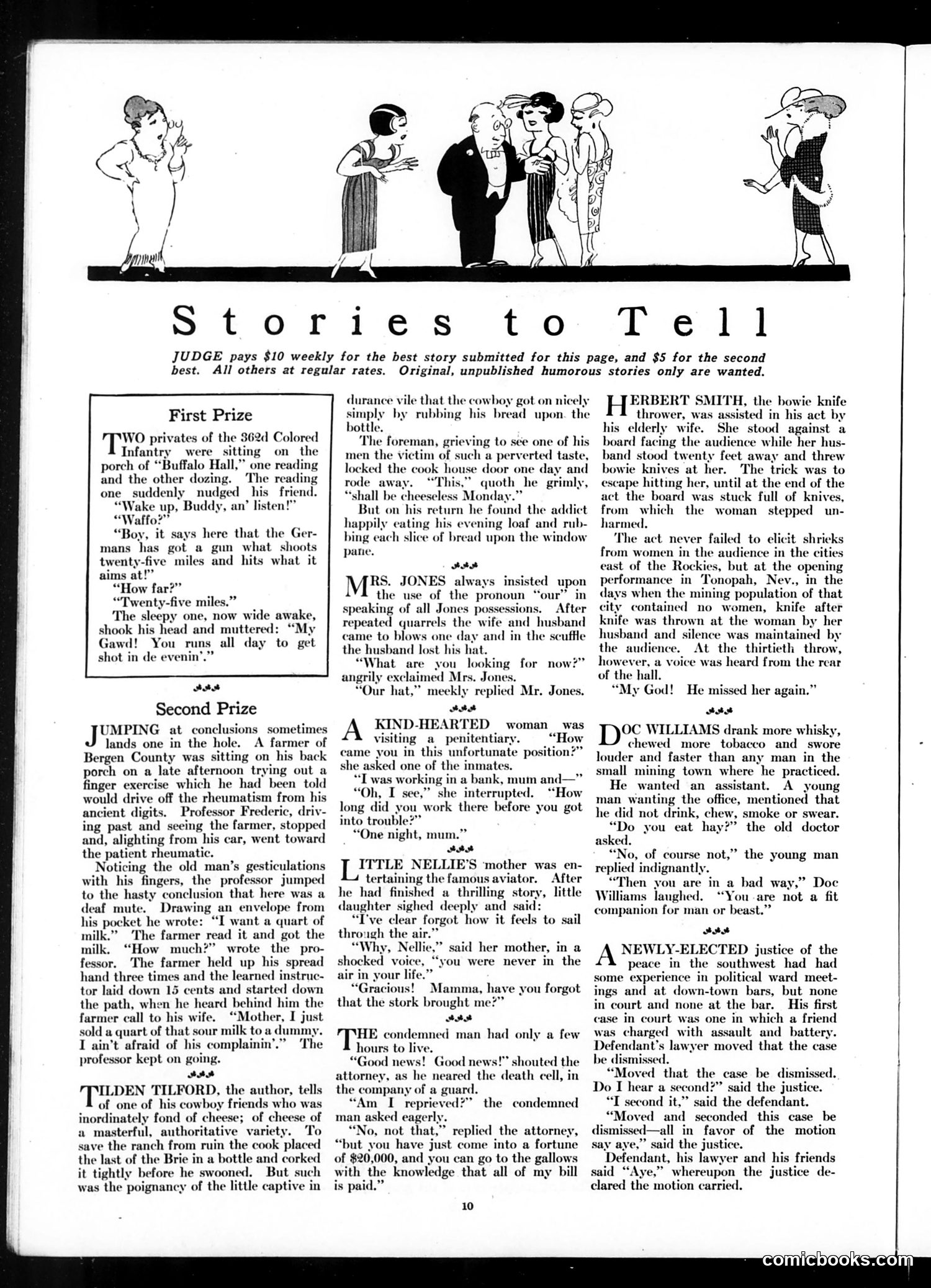
This is a **humor submission page** from Judge magazine, not a political cartoon. It presents five comic anecdotes competing for prizes ($10 for first place, $5 for second). The jokes reflect early 20th-century American attitudes: 1. **First Prize**: Two Black soldiers discuss a long-range gun—the humor relies on dialect stereotyping and the ironic punch line about running all day to be shot. 2. **Second Prize**: A professor mistakes a farmer's rheumatism exercises for deaf-mute sign language and overpays for sour milk—humor from the "educated fool" trope. 3. Other stories include: a man obsessed with cheese (rubbing bread on a bottle), a wife obsessing over pronouns and her husband's lost hat, a bank robber's one-night "employment," a child thinking storks literally flew her, and a condemned man cheering over a lawyer's bill being paid. The comedy relies on wordplay, misunderstandings, and character types rather than political content. The racial caricature in the first piece reflects the era's casual prejudice.
📄 Transcribed text from this page (OCR, searchable)
Machine-transcribed from the original scan — historical spelling and the odd misread are preserved.
Stor best. All others at regular rates. First Prize WO privates of the 362d Colored Infantry were sitting on the porch of “Buffalo Hall,” one reading and the other dozing. The reading one suddenly nudged his friend. “Wake up, Buddy, an’ listen!” “Waffo?” “Bo; s here that the got a gun what shoots mans t miles and hits what it twenty aims at! “How far?” “Twenty-five miles.” ‘The sleepy one, now wide awake, shook his head and muttered: “My Gawd! You runs all day to get shot in de evenin’.” rad Second Prize UMPING at conclusions sometimes lands one in the hole. A farmer of Bergen County was sitting on his back porch on a late afternoon trying out a finger exercise which he had been told would drive off the rheumatism from his ancient digits. Professor Frederic, driv- ing past and seeing the farmer, stopped and, alighting from his car, went toward the patient rheumatic. Noticing the old man’s gesticulations with fingers, the professor jumped to the hasty conclusion that here was a deaf mute. Drawing an envelope from his pocket he wrote: “I want a quart of mil ‘The farmer read it and got the milk. “How much?” wrote the pro- fessor. The farmer held up his spread hand three times and the learned instruc- tor laid down 15 cents and started down the path, wl he heard behind him the farmer call to his wife. “Mother, I just sold a quart of that sour milk toa dummy, I ain’t afraid of his complainin’.” The professor kept on going. PAP TILDEN TILFORD, the author, tells of one of his cowboy friends who was inordinately fond of chee: a masterful, authoritative variety, save the ranch from ruin the cook placed the last of the Brie in a bottle and corked it tightly before he swooned. But such was the poignancy of the little captive in to ies JUDGE pays $10 weekly for the best story submitted for this page, and $5 for the second durance vile that the cowboy got on nicely simply by rubbing his bread upon. the bottle. ‘The foreman, grieving to see one of his men the victim of such a perverted taste, locked the cook house door one day and rode aw s.” quoth he grimly, “shall be cheeseless Monday.” But on his return he found the addict happily eating his evening loaf and rub- bing each slice of bread upon the window pane. Rr RS. JONES always insisted upon the use of the pronoun “our’’ in speaking of all Jones possessions. After repeated quarrels the wife and husband came to blows one day and in the seufle the husband lost his hat. “What are you looking for now?” ned Mrs. Joi meekly replied Mr. Jones. ur A KIND-HEARTED woman _ was visiting a penitentiary. “How came you in this unfortunate position?” she 1 one of the inmates. “T was working in a bank, mum and—” “Oh, I see,” she interrupted. “How long did you work there before you got into trou “One night, mum.” Rad ITTLE NELLIE’S ‘mother was en- tertaining the fame After he had finished a thrill little daughter sighed deeply and si “I've clear forgot how it feels to sail through the air.” “Why, Nell said her mothe ‘you were never in the air in your life.” “Gracious! Mamma, have you forgot that the stork brought me?” tae HE condemned man had only a few hours to liv “Good news! Good news!” shouted the attorney, as he neared the death cell, in the company of a “Am I repriev man asked eagerly. the condemned replied the attorney, “but you have just come into a fortune of $20,000, and you can go to the gallows with the knowledge that all of my bill is paid.” 10 Tell Original, unpublished humorous stories only are wanted. ERBERT SMITH, the bowie knife thrower, was assisted in his act by elderly wife. She stood against a board facing the aud while her hu: band stood twenty fee yy and thre bowie knives at her. The trick was to escape hitting her, until at the end of the act the board was stuck full of knives, from which the woman stepped un- harmed. ‘The act never failed to elicit shrieks from women in the audience in the cities east of the Rockies, but at the opening performance in Tonopah, Nev., in the days when the mining population of that contained no women, knife after e was thrown at the woman by her husband and silence was maintained by the audien At the thirtieth throw, however, a voice was heard from the rear of the hall. “My God! He missed her again.” st OC WILLIAMS drank more whisky, chewed more tobacco and swore louder and faster than any man in the small mining town where he practiced. He wanted an assistant. A young man wanting the office, mentioned that he did not drink, chew, smoke or swear. “Do you eat hay? the old doctor asked. “No, of course not,” the young man replied indignantly. “Then you are in a bad way,” Doe Williams laughed. “You are not a fit companion for man or beast.” sae NEWLY-ELECTED justice of the peace in the southwest had had some experience in political ward meet- ings and at down-town bars, but none in court and none at the bar. His first case in court was one in which a friend was charged with assault and battery. Defendant's lawyer moved that the case be dismissed. “Moved that the case be dismissed. Do I hear a second?” said the justice. “T second it,” said the defendant. “Moved and seconded this case be dismissed—all in favor of the motion say aye,” said the justice. Defendant, his lawyer and his friends said “Aye,” whereupon the justice de- clared the motion carried.