
Judge, 1922-07-15 · page 13 of 36
Judge — July 15, 1922 — page 13: what you’re looking at
What you’re looking at
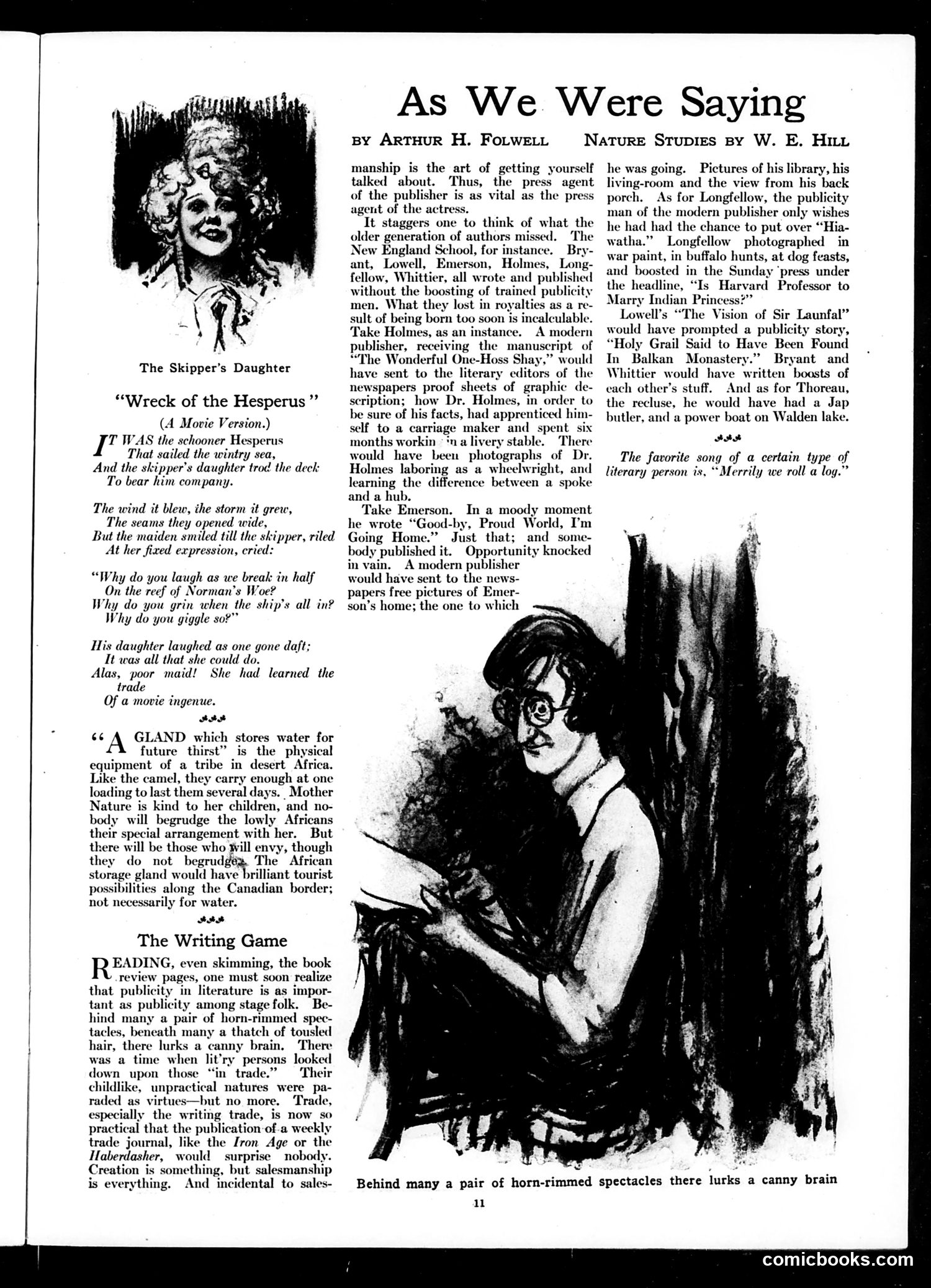
This page contains two satirical pieces mocking early 20th-century publishing and entertainment culture. **"The Skipper's Daughter"** parodies the famous Longfellow poem "Wreck of the Hesperus" as adapted into a silent film. The joke: the skipper's daughter keeps smiling and giggling even as the ship sinks because she's learned "the trade of a movie ingenue"—the exaggerated, emotionless expressions required of silent-film actresses. It's satire of both silent cinema's wooden acting conventions and the disconnect between realistic situations and film performance. **"As We Were Saying"** criticizes modern publishers' obsession with publicity and salesmanship over literary merit. The author argues that 19th-century literary giants (Emerson, Longfellow, Holmes, Whittier) lost royalties because they lacked modern press agents to generate promotional stories and photos. The satire suggests publishers would have invented ridiculous backstories—Holmes apprenticing as a carriage maker, photos of Emerson's home—to sell serious literature. It's a critique of marketing replacing artistry in publishing.
📄 Transcribed text from this page (OCR, searchable)
Machine-transcribed from the original scan — historical spelling and the odd misread are preserved.
The Skipper’s Daughter ‘Wreck of the Hesperus” (A Movie Version.) T WAS the schooner Hesperus That sailed the wintry sea, And the skipper’s daughter trod the deck To bear him company. The wind it blew, ihe storm it grew, The seams they opened wide, But the maiden smiled till the skipper, riled At her fixed expression, cried: “Why do you laugh as we break in half On the reef of Norman’s Woe? Why do you grin when the ship's all in? Why do you giggle so?” His daughter laughed as one gone daft; It was all that she could do. Alas, poor maid! She had learned the trade Of a movie ingenue. tat 73 GLAND which stores water for future thirst” is the physical equipment of a tribe in desert Africa. Like the camel, they carry enough at one loading to last them several days. Mother Nature is kind to her children, and no- body will begrudge the lowly Africans their special arrangement with her. But there will be those who will envy, though they do not begrudgég. The African storage gland would have br nt tourist possibilities along the Canadian border; not necessarily for water. Rad The Writing Game EADING, even skimming, the book ‘iew pages, one must soon realize in literature is as impor- tant as publicity among stage folk. Be- hind many a pair of horn-rimmed spec- tacles, beneath many a thatch of tousled hair, there lurks a canny brain, There was a time when lit’ry persons looked down upon those “in trade.” — Their childlike, unpractical natures were pa- raded as virtues—but no more. Trade, especially the writing trade, is now so practical that the publication: of.a weekly trade journal, like the Iron Age or the Haberdasher, would surprise nobody. Creation is something, but salesmanship is everything. And incidental to sales- As We Were Saying By ARTHUR H. FoLweELi manship is the art of getting yourself talked about. Thus, the press agent of the publisher is as vital as the press agent of the actr It staggers one to think of what the older generation of authors missed. The New England School, for instance. _ Bry- ant, Lowell, Emerson, Holmes, Long- fellow, Whittier, all wrote and published without the boosting of trained publicity men. What they lost in royalties as a re- sult of being born too soon is incalculable. Take Holmes, as an instance. A modern publisher, receiving the manuscript of “The Wonderful One-Hoss Shay,” would have sent to the literary editors of the newspapers proof sheets of graphic de- scription; how Dr. Holmes, in order to be sure of his facts, had apprenticed him- self to a carriage maker and spent six months workin ‘na livery stable. There would have been photographs of Dr. Holmes laboring as a wheelwright, and learning the difference between a spoke and a hub. Take Emerson. In a moody moment he wrote “Good-by, Proud World, I'm Going Home.” Just that; and some- body published it. Opportunity knocked in vain. A modern publisher would have sent to the nev papers free pictures of E: er- son’s home; the one to which 1 Nature Stupies sy W. E. Hitt he was going. Pictures of his library, his living-room and the view from his back porch. As for Longfellow, the publicity man of the modern publisher only wishes he had had the chance to put over “Hia- Longfellow photographed in t, in buffalo hunts, at dog feasts, ed in the Sunday ‘press under rvard Professor to Marry Ind: Lowell’s “The Vision of Sir Launfal” would have prompted a publicity story, “Holy Grail Said to Have Been Found In Balkan Monastery.” Bryant and Whittier would have written boosts of each other’s stuff. And as for Thoreau, the recluse, he would have had a Jap butler, and a power boat on Walden lake. Rad The favorite song of a certain type of literary person is, “Merrily we roll a log.” Behind many a pair of horn-rimmed spectacles there lurks a canny brain comicbooks.com