
Judge, 1922-07-15 · page 5 of 36
Judge — July 15, 1922 — page 5: what you’re looking at
What you’re looking at
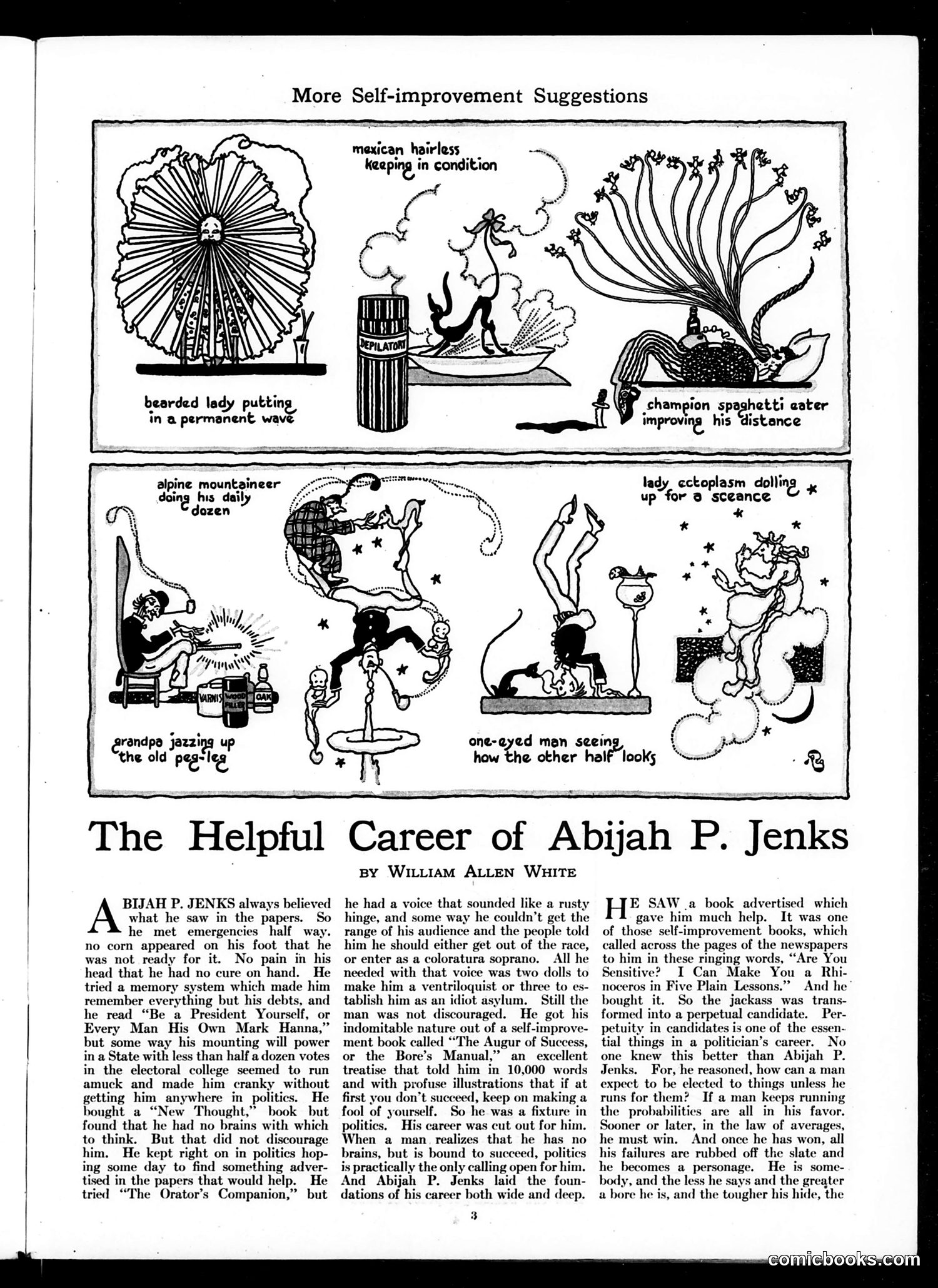
This page contains two distinct elements: **Top section:** "More Self-improvement Suggestions"—a satirical comic strip mocking self-help culture. The absurd scenarios (a bearded lady getting a permanent wave, a man eating spaghetti to improve distance, a woman doing "ectoplasm dolling" for séances) ridicule the era's proliferation of dubious self-improvement books and schemes promising unrealistic results. **Bottom section:** "The Helpful Career of Abijah P. Jenks," a short story satirizing opportunistic self-help authors. Jenks, a man with no genuine talent or knowledge, builds a lucrative career writing fraudulent self-improvement manuals with titles like "The Augur of Success." The satire criticizes how such authors exploited readers while personally lacking merit or expertise—a critique of charlatanry in popular publishing.
📄 Transcribed text from this page (OCR, searchable)
Machine-transcribed from the original scan — historical spelling and the odd misread are preserved.
More Self-improvement Suggestions bearded lady putting, in a permanent wave alpine mountaineer doing his daily dozen randpe jazzing uy “the ola pagel P mexican hairless keeping in condition shampion spaghetti cater improving his ‘distence lady ectoplasm dollin up for C) Tceance ox one-eyed man ee, how the other half looks The Helpful Career of Abijah P. Jenks what he saw in the papers. So he met emergencies half way. no corn appeared on his foot that he was not ready for it. No pain in his head that he had no cure on hand. He tried a memory system which made him remember everything but his debts, and he read “Be a President Yourself, or Every Man His Own Mark Hanna,” but some way his mounting will power in a State with less than half a dozen votes in the electoral college seemed to run amuck and made him cranky without getting him anywhere in pol He bought a “New Thought,” book but found that he had no brains with which to think. But that did not discourage him. He kept right on in politics hop- ing some day to find something adver- tised in the papers that would help. He tried “The Orator’s Companion,” but A BIJAH P. JENKS always believed BY Wituiam ALLEN WHITE he had a voice that sounded like a rusty hinge, and some way he couldn’t get the range of his audience and the people told him he should either get out of the race, or enter as a coloratura soprano. All he needed with that voice was two dolls to make him a ventriloquist or three to es. tablish him as an idiot asylum. Still t man was not discouraged. He got his indomitable nature out of a self-improve- ment book called “The Augur of Success, or the Bore’s Manual,” an_ excellent treatise that told him in 10,000 words and with profuse illustrations that if at first you don’t succeed, keep on making a fool of yourself. So he was a fixture in politics. His career was cut out for him. When a man realizes that he has no brains, but is bound to succeed, politics is practically the only calling open for him. And Abijah P. Jenks laid the foun- dations of his career both wide and deep. 3 E SAW .a book advertised which gave him much help. It was one of those self-improvement books, which called across the pages of the newspapers to him in these ringing words, “Are You Sensitive? I Can Make You a Rhi- noceros in Five Plain Lessons.” And he bought it. So the jackass was trans- formed into a perpetual candidate. Per- petuity in candidates is one of the essen- tial things in a politician’s career. No one knew this better than Abijah P. Jenks. For, he reasoned, how can a man expect to be elected to things unless he runs for then If a man keeps running the probabilities are all in his favor. Sooner or later, in the law of averages, he must win. And once he has won, all his failures are rubbed off the slate and he becomes a personage. He is some- body, and th s he says and the greater a bore he is, and the tougher his hide, the