
Judge, 1922-07-15 · page 34 of 36
Judge — July 15, 1922 — page 34: what you’re looking at
What you’re looking at
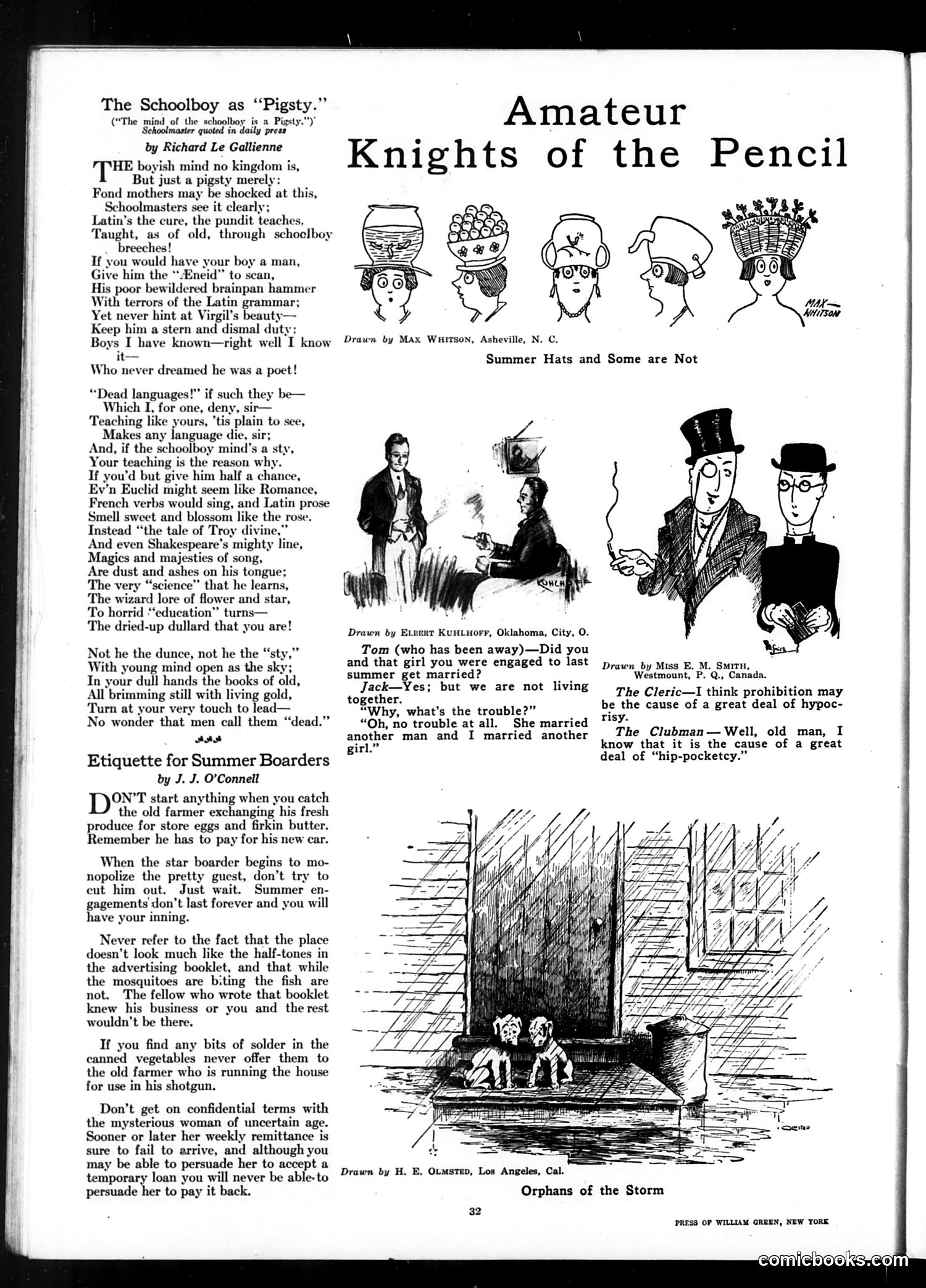
This page satirizes early 20th-century education and includes social humor pieces. **"The Schoolboy as Pigsty"** — a poem by Richard Le Gallienne — attacks the dry, mechanical teaching methods of classical schoolmasters. The text quotes schoolmasters dismissing boys' minds as "pigsties," then rebuts this by arguing their *teaching* kills students' natural curiosity and passion for literature. The poem defends poetry, beauty, and imagination against rote instruction in Latin grammar. **"Etiquette for Summer Boarders"** humorously advises guests at rural boarding houses on avoiding awkwardness—don't question the farmer's financial priorities, don't interrupt boarders' romantic interests, and beware of deadbeat boarders claiming poverty. **Three cartoon vignettes** mock social pretension: elaborate summer hats, marital confusion (a comedic misunderstanding about ex-engagements), and "hip-pocketcy"—slang for smuggling alcohol during Prohibition, presented as causing hypocrisy. The drawings are credited to various artists.
📄 Transcribed text from this page (OCR, searchable)
Machine-transcribed from the original scan — historical spelling and the odd misread are preserved.
The Schoolboy as ‘“‘Pigsty.” (“The mind of the schoolboy is a Pigsty.”)° Schoolmaster quoted in daily press by Richard Le Gallienne TH boyish mind no kingdom is, But just a pigsty merely: Fond mothers may be shocked at this, Schoolmasters see it clearly; Latin’s the cure, the pundit teaches, Taught, as of old, through schoclboy breeches! If you would have your boy a man, Give him the “Eneid” to scan, His poor bewildered brainpan hammer With terrors of the Latin grammar; Yet never hint at Virgil’s beauty— Keep him a stern and dismal duty: Boys I have known—right well I know it— Who never dreamed he was a poet! “Dead languages!” if such they be— Which I, for one, deny, sir— Teaching like yours, ‘tis plain to see, Makes any language die, si And, if the schoolboy mind's a Your teaching is the reason wh) If you'd but give him half a chance, Ev’n Euclid might seem like Romance, French verbs would sing, and Latin prose Smell sweet and blossom like the rose. Instead “the tale of Troy divine,” And even Shakespeare's mighty line, Magics and majesties of song, Are dust and ashes on his tongue; The very “science” that he learns, ‘The wizard lore of flower and star, To horrid ‘education turns— The dried-up dullard that you are! Not he the dunce, not he the “sty, With young mind open as the sky; In your dull hands the books of old, All brimming still with living gold, Turn at your very touch to lead— No wonder that men call them “dead.” Sas Etiquette for Summer Boarders by J. J. O'Connell Det start anything when you catch the old farmer exchanging his fresh produce for store eggs and firkin butter. Remember he has to pay for his new car. When the star boarder begins to mo- nopolize the pretty guest, don’t try to cut him out. Just wait. Summer en- gagements don’t last forever and you will have your inning. Never refer to the fact that the place doesn’t look much like the half-tones in the advertising booklet, and that while the mosquitoes are biting the fish are not. The fellow who wrote that booklet knew his business or you and the rest wouldn’t be there. If you find any bits of solder in the canned vegetables never offer them to the old farmer who is running the house for use in his shotgun. Don’t get on confidential terms with the mysterious woman of uncertain age. Sooner or later her weekly remittance is sure to fail to arrive, and although you may be able to persuade her to accept a temporary loan you will never be able-to persuade her to pay it back. Amateur Drawn by MAX WuiTson, Asheville, N. C. Pencil Summer Hats and Some are Not Drawn by Eteert KUHLHoFF, Oklahoma, City, 0. Tom (who has been away)—Did you and that girl you were engaged to last summer get married? Jack—Yes; but we are not living together. “Why, what’s the trouble?” “Oh, no trouble at all. She married another man and I married another girl.” Drawn by Miss E. M. Sairu, Westmount, P. Q., Canada. The Cleric—I think prohibition may be the cause of a great deal of hypoc- risy. The Clubman— Well, old man, I know that it is the cause of a great deal of “hip-pocketcy.” Drawn by H. E. Otmstep, Los Angeles, Cal. Orphans of the Storm 32 PRESS OP WILLIAM GREEN, NEW YORK