
Judge, 1922-07-15 · page 32 of 36
Judge — July 15, 1922 — page 32: what you’re looking at
What you’re looking at
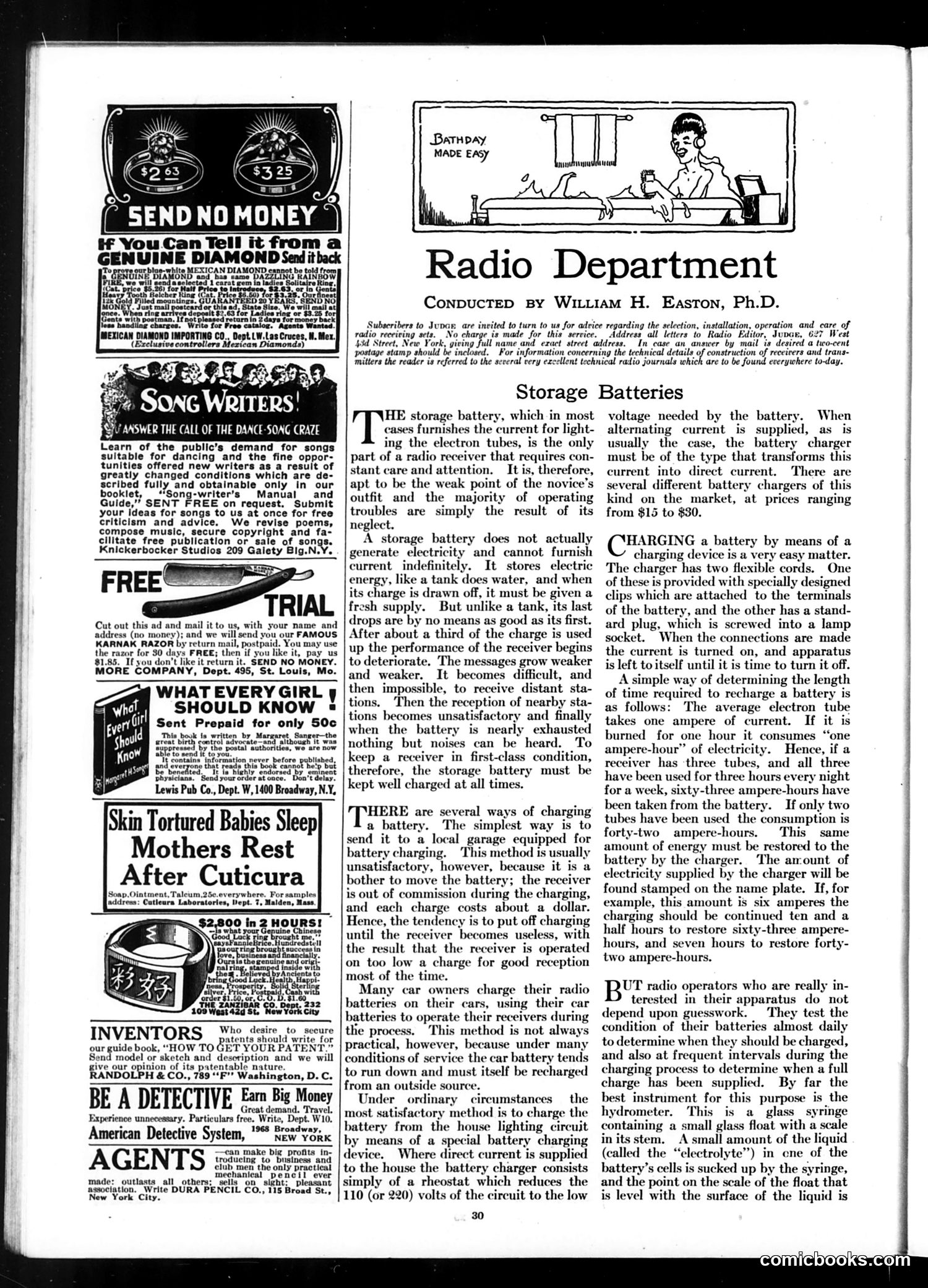
This page is primarily **advertisements and a technical advice column** rather than satire. The main content is a "Radio Department" column by William H. Easton, Ph.D., explaining **storage batteries for early radio receivers**—a practical guide for 1920s radio hobbyists. The text describes how batteries power vacuum tubes, why they deteriorate, and charging methods. The surrounding ads reflect period concerns: a diamond-testing scam ("if you can tell it from genuine, send it back"), song-writing opportunities capitalizing on dance crazes, razor trials, Margaret Sanger's birth control information (then controversial), baby skincare products, and patent/detective/pencil sales pitches. The small cartoon at top shows "Birthday Made Easy"—a woman in a bathtub, likely advertising bath products. **This is not political satire**, but rather a snapshot of 1920s consumer culture and the emerging amateur radio hobby, showing what advertisers believed would interest readers.
📄 Transcribed text from this page (OCR, searchable)
Machine-transcribed from the original scan — historical spelling and the odd misread are preserved.
if You Can Tell it from a GENUINE DIAMOND Send itback [To Be a ee 2 ¥ cannot be told fr cay 261 Hielcher’ wena BARONS IMPORTING CO.. Dept LW, a Cruces, W. Mex,| Exclusive controllers Mezican Diam Bu AASWER THE CALL OF THE DANCE-SONG CRAZE Learn of the public’s demand for songs suitable for dancing and the fine oppor- tunities offered new writers as a result of greatly changed conditions which are de- scribed fully and obtainable only in our songs writer’s Manual and ENT FREE on request. Submit your ideas for songs to us at once for free criticism and advice. We revise poems, compose music, secure copyright and fa- cilitate free publication or sale of songs. Knickerbocker Studios 209 Gaiety Big.N. FREE TRIAL Cut out this ad and mail it to us, with your name and address (no money); and we will send you our FAMOUS KARNAK RAZOR by return mail, postpaid. You may use the razor for 30 days FREE; then if you like it, pay us $1.85. If you don't like it return it. SEND NO MONEY. MORE COMPANY, Dept. 495, St. Louis, Mo. WHAT EVERYGIRL y SHOULD KNOW = Bent Prepaid for only 50c book is written by Margaret, Sanger—the control advocate-and although 1t was booklet, Guid great pressed by the postal authorities, we are now able to send Ie to you if contalnn information never before pxbllabed, reads 8 ‘cannot hetp but lied i; inhtehy” endorsed fy. mpnent Physicians. Send your order at once. Don't delay Lewis Pub Co., Dept. W, 1400 Broadwi ANY, Skin Tortured Babies Sleep Mothers Rest After Cuticura Ssap-Olatment, Talogm.35e evecrwbere, Por samples jaddrens:: Ce te ‘Mass. fauccessin ye genuine and orig|= Eee fheg “fislieved byancients to tates Lathes liver, Prices i defi e C-B. Bato, 32 LOSER EE Kass BA as Who desire to secure INVENTORS. pitenss should write tor ba teciier’ “HOW TOGET YOUR PATENT.” model or sketch and description and we will give our opinion of its patentable nature. RANDOLPH & CO., 789 “‘F’’ Washington, D. C. BE A DETECTIVE Fam Big Money Great demand. Travel. AGENTS 352i Experience unnecessary. Particulars free. Write, Dept. W10. = “3 1968 Broadway, American Detective System, if —can make big profits in- troducing to business and club y men spe caly uy pepetical made: outlasts all_ others; is an H iphes Pleasant association. Write DURA PENCIL CO., 115 Broad St., New York City. Batupay MADE EAsy uth Subscribers to. Jv’ radio receiving acts. charge is made for this service. postage stamp should be inclosed. cases furnishes the current for light- ing the electron tubes, is the only part of a radio receiver that requires con- stant care and attention. _ It is, therefor apt to be the weak point of the novice’s outfit and the majority of operating troubles are simply the result of its neglect. A storage battery does not actually generate electricity and cannot furnish current indefinitely. It stores electric energy, like a tank does water, and when its charge is drawn off, it must be given a fresh supply. But unlike a tank, its last drops are by no means as good as its first. After about a third of the charge is used up the performance of the receiver begins to deteriorate. The messages grow weaker and weaker. It becomes difficult, and then impossible, to receive distant sta- tions. Then the reception of nearby sta- tions becomes unsatisfactory and finally when the battery is nearly exhausted nothing but noises can be heard. To keep a receiver in first-class condition, therefore, the storage battery must be kept well charged at all times. T= storage battery, which in most HERE are several ways of charging a battery. The simplest way is to send it to a local garage equipped for battery charging. This method is usually unsatisfactory, however, because it is a bother to move the battery; the recei is out of commission during the charging, and each charge costs about a dollar. Hence, the tendency is to put off charging until the receiver becomes useless, with the result that the receiver is operated on too low a charge for good reception most of the time. Many car owners charge their radio batteries on their cars, using their car batteries to operate their receivers during the process, This method is not alway practical, however, because under many conditions of service the car battery tends to run down and must itself be recharged from an outside source. Under ordinary circumstances _ the most satisfactory method is to charge the battery from the house lighting circuit by means of a special battery charging device. Where direct current is supplied to the house the battery charger consists simply of a rheostat which reduces the 110 (or 220) volts of the circuit to the low 30 Radio Department ConpucTeD By Witu1amM H. Easton, Ph.D. 43d Street, New York, giving full name and exact street address. For information concerning the technical details of mitters the reader is referred to the several very excellent technical radio journals which are to be found everywhere to-day. are invited to turn to us for advice regarding the selection, installation, operation and care of Address all letters to Radio Editor, Juve 627 West In case an answer by mail is desired a tico-cent ‘construction of receivers and trans- Storage Batteries voltage needed by the battery. When alternating current is supplied, as is usually the case, the battery charger must be of the type that transforms this current into direct current. There are several different battery chargers of this kind on the market, at prices ranging from $15 to $30. IHARGING a battery by means of a charging device is a very easy matter. The charger has two flexible cords. One of th provided with specially designed clips which are attached to the terminals of the battery, and the other has a stand- ard plug, which is screwed into a lamp socket. When the connections are made the current is turned on, and apparatus is left to itself until it is time to turn it off. A simple way of determining the length of time required to recharge a battery is as follows: The average electron tube takes one ampere of current. If it is burned for one hour it consumes “one ampere-hour” of electricity. Hence, if a receiver has three tubes, and all three have been used for three hours every night for a week, sixty-three ampere-hours have been taken from the battery. If only two tubes have been used the consumption is forty-two ampere-hou: This same amount of energy must be restored to the battery by the charger. The amount of electricity supplied by the charger will be found stamped on the name plate. If, for example, this amount is six amperes the charging should be continued ten and a half hours to restore sixty-three ampere- hours, and seven hours to restore forty- two ampere-hours. B 'T radio operators who are really in- terested in their apparatus do not depend upon guesswork. They test the condition of their batteries almost daily to determine when they should be charged, and also at frequent intervals during the charging process to determine when a full charge has been supplied. By far the best instrument for this purpose hydrometer. This is a containing a small glass float with a scale in its stem. A small amount of the liquid (called the “electrolyte”) in ene of the battery’s cells is sucked up by the syringe, and the point on the scale of the float that is level with the surface of the liquid is