
Judge, 1922-07-15 · page 20 of 36
Judge — July 15, 1922 — page 20: what you’re looking at
What you’re looking at
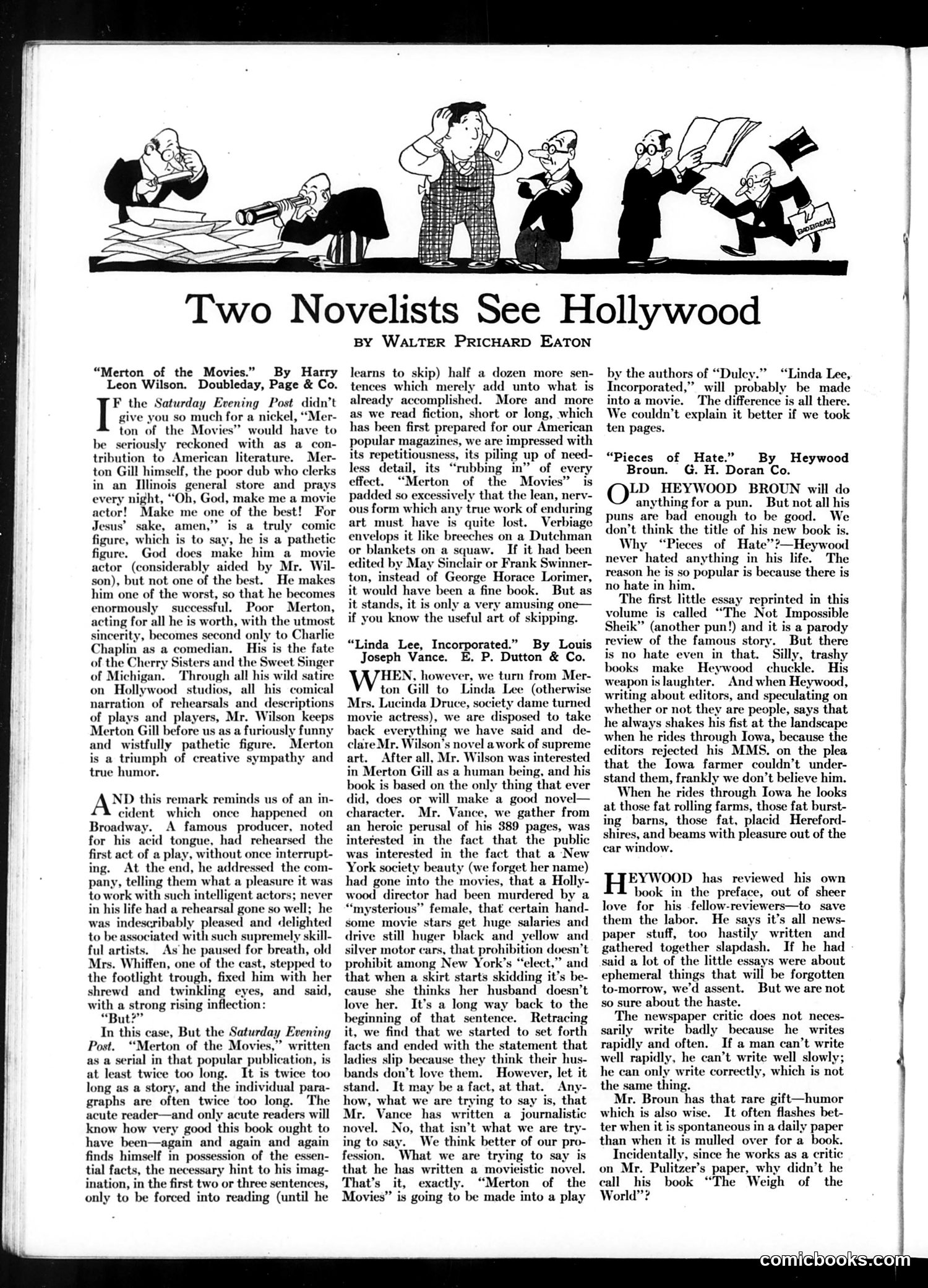
This is a book review article by Walter Prichard Eaton comparing two novels about Hollywood: Harry Leon Wilson's "Merton of the Movies" and Louis Joseph Vance's "Linda Lee, Incorporated." The **cartoon header** depicts the Hollywood film industry—showing figures examining documents, looking through telescopes, and waving flags, representing the chaotic, superficial nature of the movie business. **Eaton's critique**: He praises Wilson's novel for its character-driven narrative about a sincere but talentless movie extra, comparing him favorably to Charlie Chaplin. However, he faults the book for excessive verbosity—claiming it's "padded" with unnecessary detail and would have benefited from editorial trimming by serious literary figures like May Sinclair. By contrast, Vance's novel is dismissed as superficial—interested only in exploiting public fascination with a society woman entering films, rather than exploring genuine character. The satire targets both **Hollywood's shallow values** and **magazine-serialized fiction's tendency toward verbose repetition**—a common complaint about popular American writing of this era.
📄 Transcribed text from this page (OCR, searchable)
Machine-transcribed from the original scan — historical spelling and the odd misread are preserved.
“Merton of the Movies.” By Harry Leon Wilson. Doubleday, Page & Co. F the Saturday Evening Post I give you so much for a nickel, ton of the Movies” would have to be seriously reckoned with as a con- tribution to American literature. Mer- ton Gill himself, the poor dub who clerks in an Illinois general store and prays night, “Oh, God, make me a movie Make me one of the best! For ke, amen,” is a truly comic gure) he is a pathet figure. e him a movie actor (considerably aided by Mr. Wil- son), but not one of the best. He makes him one of the worst, so that he becomes enormously successful. Poor Merton, acting for all he is worth, with the utmost sincerity, becomes second only to Charlie Chaplin as a c is the fate of the Cherry Sis Sweet Singer of Michigan. Through all his wild satire on Hollywood studios, all his comical narration of rehearsals and descriptions of plays and players, Mr. Wilson keeps Gill before us as a furiously funny figure. Merton is a triumph of creative sympathy and true humor. ND this remark reminds us of an in- cident which once happened on Broadway. A famous producer, noted for his acid tongue, had rehearsed the first act of a play, without once interrupt- ing. _At the end, he addressed th life had a rehe acaal gone so well; he ibably pleased and delighted to be associated with such supremely skill- ful artists. As he paused for breath, old Mrs. Whiffen, one of the cast, stepped to the footlight trough, fixed him with her shrewd and twinkling eyes, and said, with a strong rising inflection: case, But the Saturday Evening Lerton of the Movies,” written in that popular publication, is at least twice too long. It is twice too long as a story, and the individual para- graphs are often twice too long. The acute reader—and only acute readers will know how very good this book ought to have been—again and again and again finds himself in po: on of the essen- tial facts, the necessary hint to his imag- ination, in the first two or three sentences, only to be forced into reading (until he Two Novelists See Hollywood BY WALTER PRICHARD EATON learns to skip) half a dozen more sen- tences which merely add unto what is already accomplished. More and more as we read fiction, short or long, which has been first prepared for our American popular magazines, we are impressed with its repetitiousness, its piling up of need- less detail, its “rubbing in” of every effect. “Merton of the Movies” is padded so excessively that the lean, nerv- ous form which any true work of enduring art must have is quite lost. Verbiage envelops it like breeches on a Dutchman or blankets on a squaw. If it had been edited by May Sinclair or Frank Swinner- ton, instead of George Horace Lorimer, it would have been a fine book. But as it stands, it is only a very amusing one— if you know the useful art of skipping. “Linda Lee, Incorporated.” By Louis Joseph Vance. E. P. Dutton & Co. HEN, however, we turn from M ton Gill to Linda Lee (otherwi Mrs. Lucinda Druce, society dame turned movie actress), we are disposed to take hing we have said and de- clare Mr. Wilson’s novel a work of supreme art. After all, Mr. Wilson was interested in Merton Gill as a human being, and his book is based on the only thing that ever did, does or will make a good novel— character. Mr. Vance, we gather from an heroic perusal of his 389 pages, was interested in the fact that the public was interested in the fact that a New York society beauty (we forget her name) had gone into the movies, that a Holly- wood director had been murdered by a “mysterious” female, that certain hand- some movie stars get huge salaries and drive still huger black and yellow and silver motor cars, that prohibition doesn’t prohibit among New York’s “elect,” and that when a skirt starts skidding it’s be- cause she thinks her husband doesn’t love her. It’s a long way back to the beginning of that sentence. Retracing it, we find that we started to set forth facts and ended with the statement that ladies slip because they think their hus- bands don’t love ther However, let it stand. It may be a fact, at that. Any- how, what we are trying to say is, that Mr. Vance has written a journalisti novel. No, that isn’t what we are try- ing to say. We think better of our pro- fession. What we are trying to sa; that he has written a movieistic novel. That’s it, exactly. “Merton of the Movies” is going to be made into a play by the authors of “Duley.” “Linda Lee, Incorporated,” will ably be made into a movie. The difference is all there. We couldn’t explain it better if we took ten pages. “Pieces of Hate.” By Heywood Broun. G. H. Doran Co. LD HEYWOOD BROUN will do anything for a pun. But not all his puns are bad enough to be good. We don’t think the title of his new book is. Why “Pieces of Hate”?—Heywood never hated anything in his life. The reason he i: popular is because there is no hate in him. The first little essay reprinted in this volume is called “The Not Impossible Sheik” (another pun!) and it is a parody review of the famous story. But there is no hate even in that. Silly, trashy books make Heywood chuckle. His weapon is laughter. And when Heywood, ng about editors, and speculating on are people, says that shakes his fist at the landscape when he rides through Iowa, because the editors rejected his MMS. on the plea that the Iowa farmer couldn’t under- stand them, frankly we don’t believe him. When he rides through Iowa he looks at those fat rolling farms, those fat burst- ing barns, those fat, placid Hereford- shires, and beams with pleasure out of the car window. EYWOOD has reviewed his own book in the preface, out of sheer love for his fellow-reviewers—to save them the labor. He says it’s all news- paper stuff, too hastily written and gathered together slapdash. If he had said a lot of the little essays were about ephemeral things that will be forgotten to-morrow, we'd assent. But we are not so sure about the haste. The newspaper critic does not neces- sarily write badly because he writes rapidly and often. If a man can’t write well rapidly, he can’t write well slowly; he can only write correctly, which is not the same thing. Mr. Broun has that rare gift—humor which is also wise. It often flashes bet- ter when it is spontaneous in a daily paper than when it is mulled over for a book. Incidentally, since he works as a critic on Mr. Pulitzer’s paper, didn’t he call his book “The Weigh of the World”?