
Judge, 1922-07-15 · page 16 of 36
Judge — July 15, 1922 — page 16: what you’re looking at
What you’re looking at
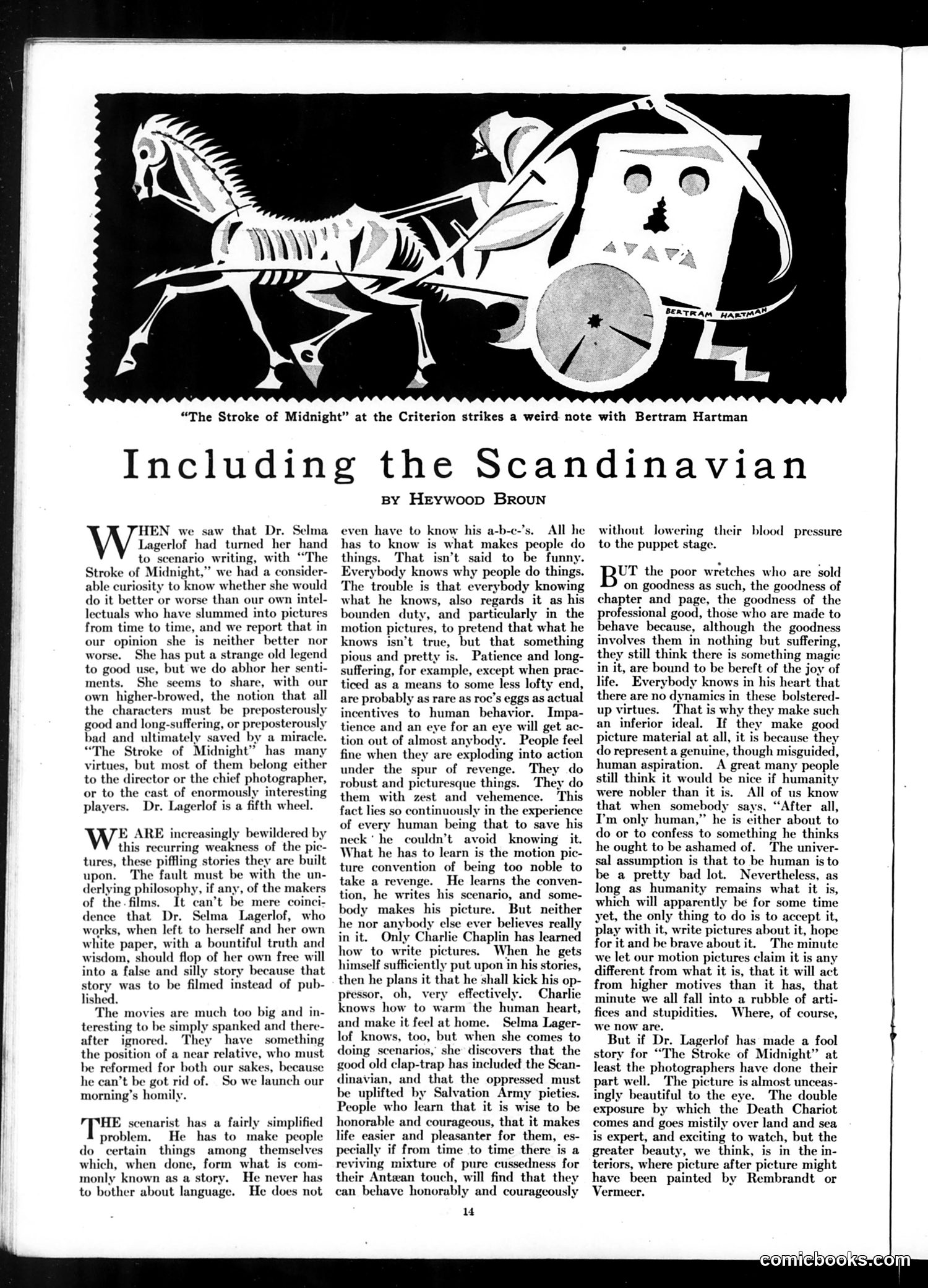
This page critiques Swedish author Selma Lagerlöf's attempt at screenwriting for the 1914 film "The Stroke of Midnight." The cartoon at top shows a skeletal horse pulling a cart with an abstract figure labeled with Nordic symbols—likely satirizing the film's Scandinavian melodrama aesthetic. Critic Heywood Broun argues that Lagerlöf, despite her literary talent, fails as a screenwriter because she adheres to sentimental movie conventions: characters must be unrealistically noble and patient rather than driven by authentic human impulses like revenge or self-interest. Broun contrasts this with Charlie Chaplin, who understands that audiences connect with characters who act on genuine motivations. The satire targets both Lagerlöf's artistic compromise and the broader Hollywood tendency to impose false morality ("Salvation Army piety") on stories, undermining their human truth.
📄 Transcribed text from this page (OCR, searchable)
Machine-transcribed from the original scan — historical spelling and the odd misread are preserved.
“The Stroke of Midnight” at the Criterion strikes a weird note with Bertram Hartman Including the Scandinavian HEN we saw that Dr. Selma Lagerlof had turned her hand to scenario writing, with ‘The Stroke of Midnight,” we had a consider- able curiosity to know whether she would do it better or worse than our own intel- lectuals who have slummed into pictures from time to time, and we report that in our opinion she is neither better nor She has put a strange old legend worse. to good use, but we do abhor her senti- ments. She seems to share, with our own higher-browed, the notion that all the characters must be preposterously good and long-suffering, or prepostero' bad and ultimately saved by a miracl “The Stroke of Midnight” has many virtues, but most of them belong either to the director or the chief photographer, or to the cast of enormously interesting players. Dr. Lagerlof is a fifth wheel. WE ARE increasingly bewildered by this recurring weakness of the pic- tures, these piffling stories they are built upon, The fault must be with the un- derlying philosophy, if any, of the makers of the-films, It can’t be mere coinci- dence that Dr. Selma Lagerlof, who works, when left to herself and her own white paper, with a bountiful truth and wisdom, should flop of her own free will into a false and silly story because that story was to be filmed instead of pub- lished. The movies teresting to be after ignored. something the position of a near relative, who must be reformed for both our sakes, because he can’t be got rid of. So we launch our morning’s homily. re much too big and in- ked and there- HE scenarist has a fairly simplified problem. He has to make people do certain things among themselves which, when done, form what is com- monly known as a story. He never has to bother about language. He does not By Hreywoop Broun even have to know his a-b-c-’s. All he has to know is what makes people do things. That t said to be funny. Everybody knows why people do things. The trouble is that everybody knowing what he knows, also regards it as his bounden duty, and particularly in the motion pictures, to pretend that what he knows isn’t true, but that something pious and pretty is. Patience and long- suffering, for example, except when prac- ticed as a means to some less lofty end, are probably as rare as roc’s eggs as actual incentives to human behavior. Impa- tience and an eye for an eye will get ac- tion out of almost anybody. People feel fine when they are exploding into action under the spur of revenge. They do robust and picturesque things. They do them with zest and vehemence. This continuously in the experience of every human being that to save his neck ‘he couldn’t avoid knowing it. What he has to learn is the motion pic- ture convention of being too noble to ake a revenge. He learns the conven- tion, he writes his scenario, and some- body makes his picture. But neither he nor anybody else ever believes really in it. Only Charlie Chaplin has learned how to write pictures. When he gets himself sufficiently put upon in his stories, then he plans it that he shall kick his op- pressor, oh, very effectively. Charlie knows how to warm the human heart, and make it feel at home. Selma Lager- lof knows, too, but when she comes to doing scenarios, she discovers that the good old clap-trap has included the Scan- dinavian, and that the oppressed must be uplifted by Salvation Army pie’ People who learn that it is wise to be honorable and courageous, that it makes life easier and pleasanter for them, e pecially if from time to time there is a ing mixture of pure cussedness for ir Antwan touch, will find that they can behave honorably and courageously 14 without lowering their blood pressure to the puppet stage. UT the poor wretches who are sold on goodness as such, the goodness of chapter and page, the goodness of the professional good, those who are made to behave because, although the goodness involves them in nothing but suffering, they still think there is something magic in it, are bound to be beref: the joy of life. Everybody knows in his heart that there are no dynamics in these bolstered- up virtues. That is why they make such an inferior ideal. If they make good picture material at all, it is because they do represent a genuine, though misguided, human aspiration. A great many people still think it would be nice if humanity were nobler than it All of us know that when somebody says, “After all, I'm only human,” he ther about to do or to confess to something he thinks he ought to be ashamed of. The univer- sal assumption is that to be human is to be a pretty bad lot. Nevertheless, as long as humanity remains what is, which will apparently be for some time yet, the only thing to do is to accept it, play with it, write pictures about it, hope for it and be brave about it. The minute we let our motion pictures claim it is any different from what it is, that it will act from higher motives than it has, that minute we all fall into a rubble of arti- fices and stupidities. Where, of course, we now are. But if Dr. Lagerlof has made a fool story for “The Stroke of Midnight” at least the photographers have done their part well. The picture is almost unceas- ingly beautiful to the eye. The double exposure by which the Death Chariot comes and goes mistily over land and sea is expert, and exciting to watch, but the greater beauty, we think, is in the in- teriors, where picture after picture might have been painted by Rembrandt or Vermeer.