
Judge, 1922-07-15 · page 10 of 36
Judge — July 15, 1922 — page 10: what you’re looking at
What you’re looking at
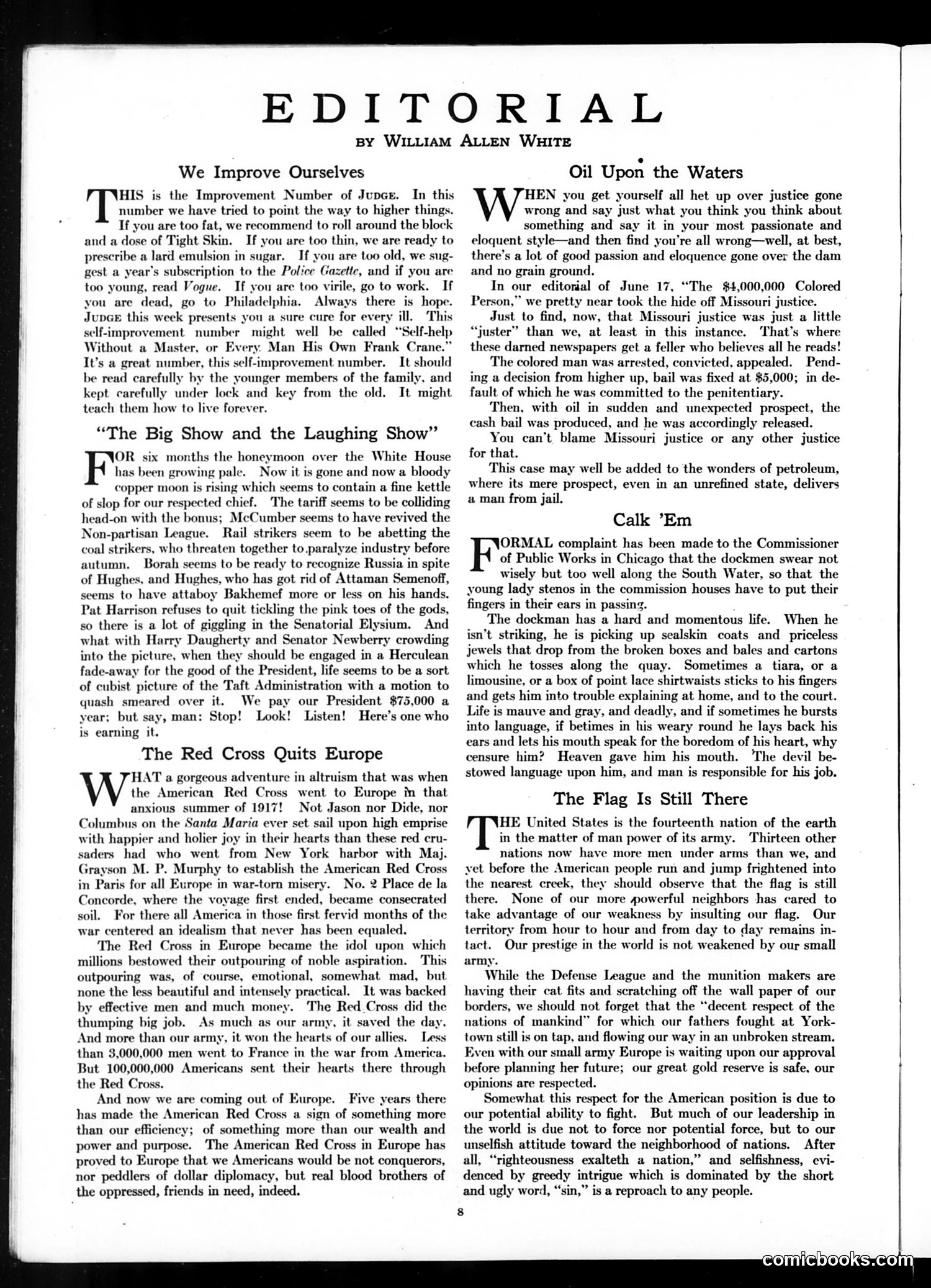
This is a political editorial page (no cartoons visible) by William Allen White from what appears to be the early 1920s. The editorials critique the Harding administration's domestic chaos—the tariff colliding with war bonuses, rail and coal strikes threatening autumn paralysis, scandals involving Harry Daugherty and Senator Newberry, and Secretary of State Hughes's Russian policy disputes with Senator Borah. The piece mocks how the presidential "honeymoon" has ended after six months, describing governance as a "cubist picture of the Taft Administration." White sardonically praises the president for "earning" his $75,000 salary amid this disorder. The Red Cross editorial celebrates American altruism in post-WWI Europe (1917-1922), contrasting noble humanitarian idealism with the messy politics now visible at home. The tone suggests disillusionment with how quickly wartime unity dissolved into partisan bickering.
📄 Transcribed text from this page (OCR, searchable)
Machine-transcribed from the original scan — historical spelling and the odd misread are preserved.
We Improve Ourselves HIS is the Improvement Number of Jupce. In this number we have tried to point the way to higher things. If you are too fat, we recommend to roll around the block and a dose of Tight Skin. If you are too thin, we are ready to prescribe a lard emulsion in sugar. If you are too old, we sug- gest a year's subscription to the Police Gazette, and if you are too young, read Vogue. If you are too virile, go to work. If you are dead, go to Philadelphia. Always there is hope. p this week presents you a sure cure for every ill. This self-improvement number might well be called :lf-help Without a Master, or Every. Man His Own Frank Crane.” It’s a great number, t If-improvement number. It should be read carefully by the younger members of the family, and kept carefully under lock and key from the old. It might teach them how to live forever. “The Big Show and the Laughing Show” OR six months the honeymoon over the White House has been growing pale. Now it is gone and now a bloody copper moon is rising which seems to contain a fine kettle of slop for our respected chief. The tariff seems to be colliding head-on with the bonus; McCumber seems to have revived the Non-partisan League. Rail strikers seem to be abetting the coal strikers, who threaten together to.paralyze industry before autumn. Borah seems to be ready to recognize Russia in spite of Hughes, and Hughes, who has got rid of Attaman Semenoff, seems to have attaboy Bakhemef more or less on his hands. Pat Harrison refuses to quit tickling the pink toes of the gods, so there is a lot of giggling in the Senatorial Elysium. And what with Harry Daugherty and Senator Newberry crowding into the picture, when they should be engaged in a Herculean fade-away for the good of the President, life seems to be a sort of cubist picture of the Taft Administration with a motion to quash smeared over it. We pay our President $75,000 a year; but say, man: Stop! Look! Listen! Here’s one who is earning it. The Red Cross Quits Europe ‘ X Y HAT a gorgeous adventure in altruism that was when the American Red Cross went to Europe in that anxious summer of 1917! Not Jason nor Dide, nor Columbus on the Santa Maria ever set sail upon high emprise with happier and holier joy in their hearts than these red cru- saders had who went from New York harbor with Maj. Grayson M. P. Murphy to establish the American Red Cross in Paris for all Europe in war-torn misery. No. 2 Place de la Concorde, where the voyage first ended, became consecrated soil. For there all America in those first fervid months of the war centered an idealism that never has been equaled. ‘The Red Cross in Europe became the idol upon which millions bestowed their outpouring of noble aspiration. This outpouring was, of course, emotional, somewhat mad, but none the less beautiful and intensely practical. It was backed by effective men and much money. The Red Cross did the thumping big job. As much as our army, it saved the day. And more than our army, it won the hearts of our allies. Less than 3,000,000 men went to France in the war from America. But 100,000,000 Americans sent their hearts there through the Red Cross. And now we are coming out of Europe. Five years there has made the American Red Cross a sign of something more than our efficiency; of something more than our wealth and power and purpose. The American Red Cross in Europe has proved to Europe that we Americans would be not conquerors, nor peddlers of dollar diplomacy, but real blood brothers of the oppressed, friends in need, indeed. EDITORIAL By WILLIAM ALLEN WHITE Oil Upon the Waters HEN you get yourself all het up over justice gone wrong and say just what you think you think about something and say it in your most passionate and eloquent style—and then find you're all wrong—well, at best, there’s a lot of good passion and eloquence gone over the dam and no grain ground. In our editorial of June 17, “The $4,000,000 Colored Person,” we pretty near took the hide off M j Just to find, now, that Missouri justice was just a little “juster” than we, at least in this instance. That's where these darned newspapers get a feller who believes all he reads! The colored man was arrested, convicted, appealed. Pend- ing a decision from higher up, bail was fixed at $5,000; in de- fault of which he was committed to the penitentiary. Then, with oil in sudden and unexpected prospect, the cash bail was produced, and he was accordingly released. You can’t blame Missouri justice or any other justice for that. This case may well be added to the wonders of petroleum, where its mere prospect, even in an unrefined state, delivers a man from jail. Calk ’Em ORMAL complaint has been made to the Commissioner of Public Works in Chicago that the dockmen swear not wisely but too well along the South Water, so that the young lady stenos in the commission houses have to put their fingers in their ears in passing. The dockman has a hard and momentous life. When he isn’t striking, he is picking up sealskin coats and priceless jewels that drop from the broken boxes and bales and cartons which he tosses along the quay. Sometimes a tiara, or a limousine, or a box of point lace shirtwaists sticks to his fingers and gets him into trouble explaining at home, and to the court. Life is mauve and gray, and deadly, and if sometimes he bursts into language, if betimes in his weary round he lays back his ears and lets his mouth speak for the boredom of his heart, why censure him? Heaven gave him his mouth. "The devil be- stowed language upon him, and man is responsible for his job. The Flag Is Still There HE United States is the fourteenth nation of the earth in the matter of man power of its army. Thirteen other nations now have more men under arms than we, and yet before the American people run and jump frightened into the nearest creek, they should observe that the flag is still there. None of our more powerful neighbors has cared to take advantage of our weakness by insulting our flag. Our territory from hour to hour and from day to day remains in- tact. Our prestige in the world is not weakened by our small army. While the Defense League and the munition makers are having their cat fits and scratching off the wall paper of our borders, we should not forget that the “decent respect of the nations of mankind” for which our fathers fought at York- town still is on tap, and flowing our way in an unbroken stream. Even with our small army Europe is waiting upon our approval before planning her future; our great gold reserve is safe, our opinions are respected. Somewhat this respect for the American position is due to our potential ability to fight. But much of our leadership in the world is due not to force nor potential force, but to our unselfish attitude toward the neighborhood of nations. After all, “righteousness exalteth a nation,” and selfishness, evi- denced by greedy intrigue which is dominated by the short and ugly word, “sin,” is a reproach to any people. 8