
A complete issue · 38 pages · 1922
Judge — March 4, 1922
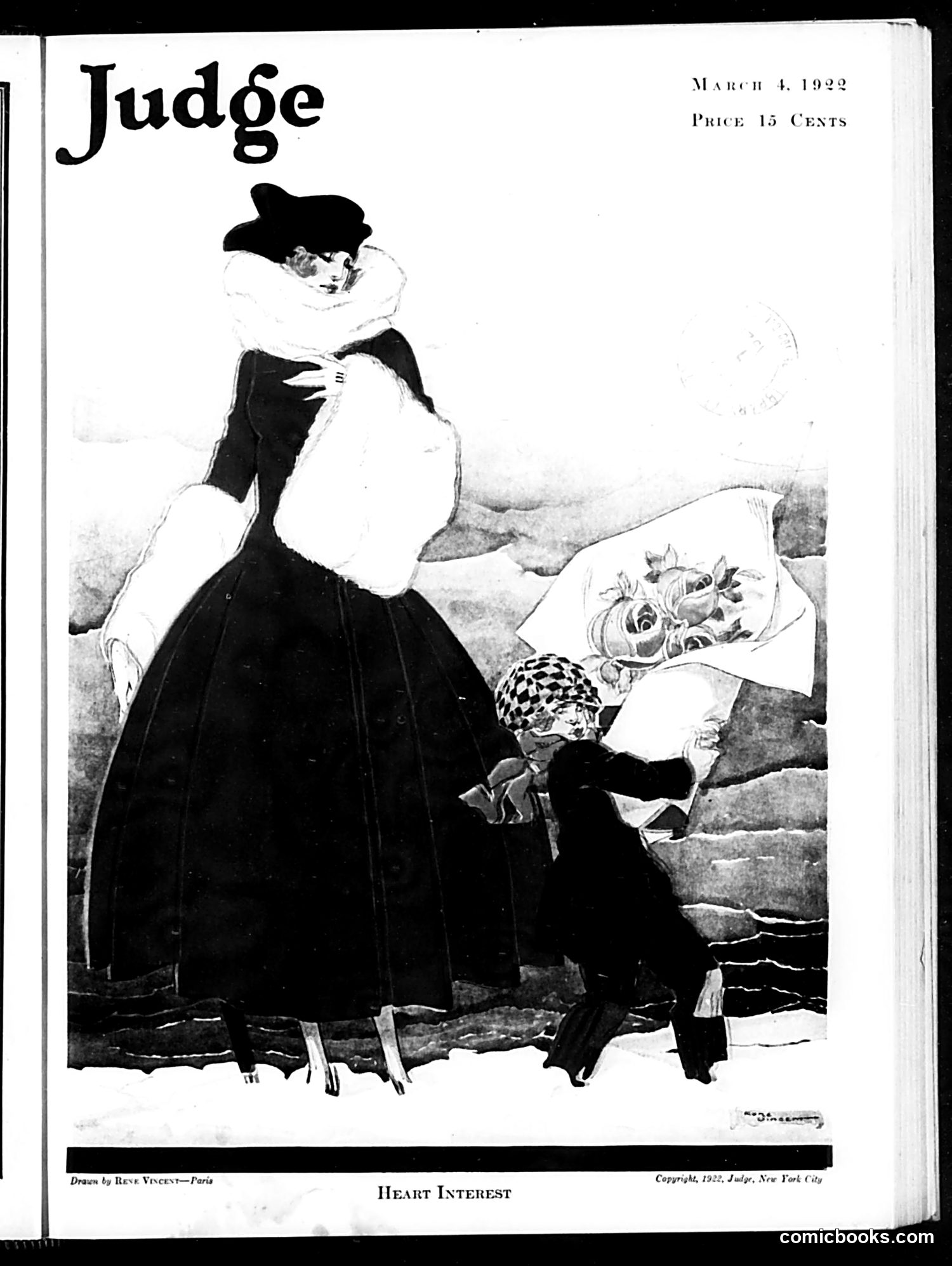
This illustration by René Vincent depicts a flirtatious scene between a woman and man. The woman, elegantly dressed in 1920s fashion with a fur stole and decorative hat, leans toward a seated man holding flowers. The title "Heart Interest" suggests romantic attraction or courtship. The cartoon appears to satirize 1920s dating customs and social interactions between the sexes during this era of changing gender relations—a period when women's roles were shifting following women's suffrage (1920). The intimate body language and the man's apparent eagerness to present flowers plays on conventional romantic gestures and courtship rituals of the period. The work exemplifies Judge's focus on social commentary through humorous illustration of contemporary domestic life and relationships.
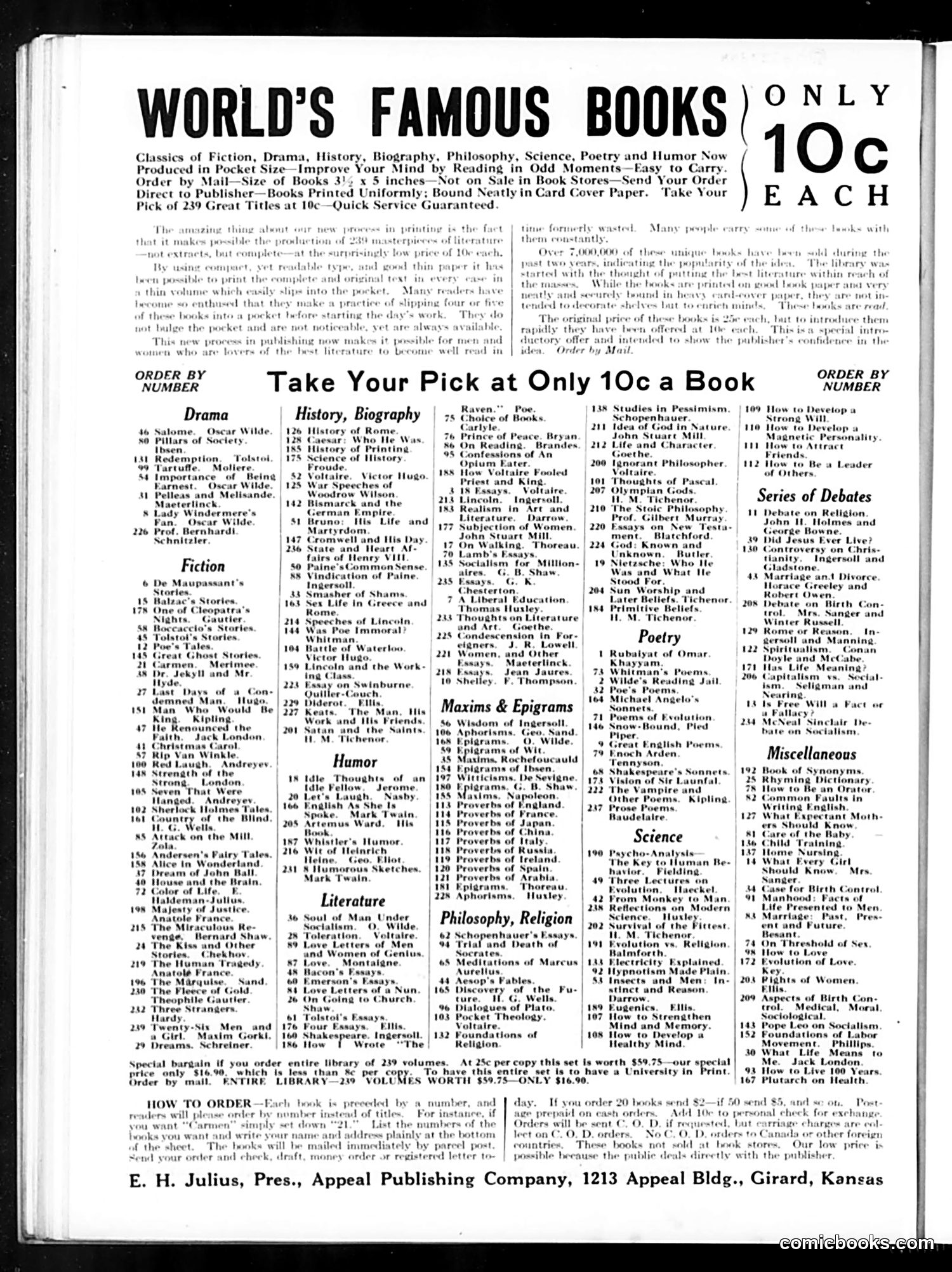
This page is primarily **advertising content**, not editorial cartoon or satirical material. It's a catalog listing for "World's Famous Books" offered by the Appeal Publishing Company of Girard, Kansas, at 10 cents each. The page displays an extensive mail-order book list organized by category (Drama, Fiction, History, Literature, Philosophy, Science, Poetry, Humor, etc.), along with ordering instructions. The books appear to be cheap reprints or condensed editions designed for working-class readers who couldn't afford full volumes—marketed as "pocket size" for portability. This reflects early 20th-century American publishing practices making literature accessible to ordinary people, though whether Judge magazine's readers would find book-selling advertisements satirical is unclear from the image alone.
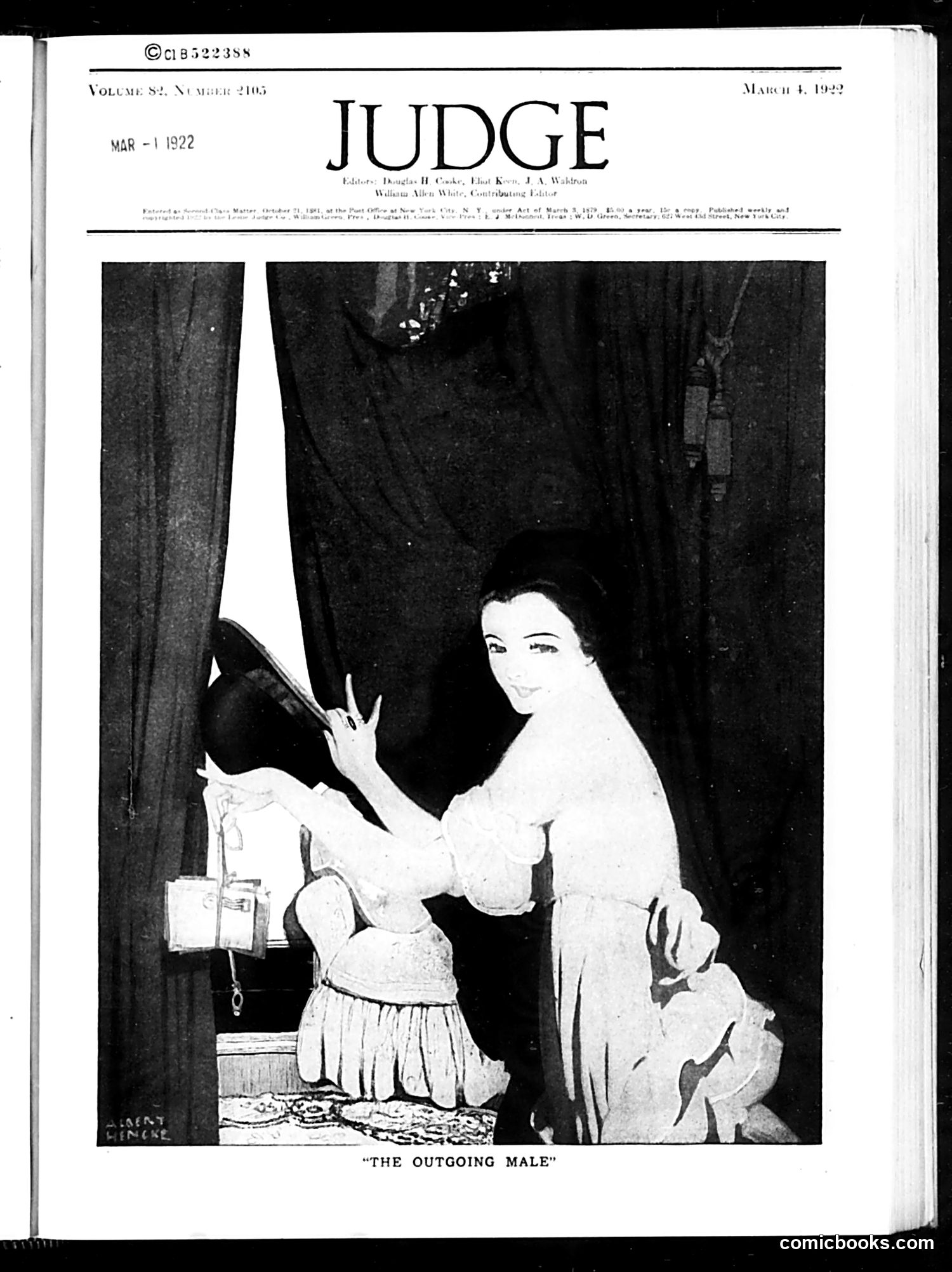
This cartoon satirizes changing gender dynamics in the early 1920s. The illustration shows a woman in fashionable attire examining or discarding a man's hat and clothing, suggesting the literal and figurative disposal of traditional male authority. The title "The Outgoing Male" plays on the phrase "outgoing" (departing/leaving) to mock the perceived decline of masculine dominance during this era. This reflects post-WWI anxieties about women's expanding rights—women had just gained voting rights (19th Amendment, 1920)—and their increasing economic and social independence. The woman's confident posture and the man's absent or diminished presence symbolize Judge magazine's satirical commentary on the "New Woman" and male anxiety about shifting power dynamics in American society.
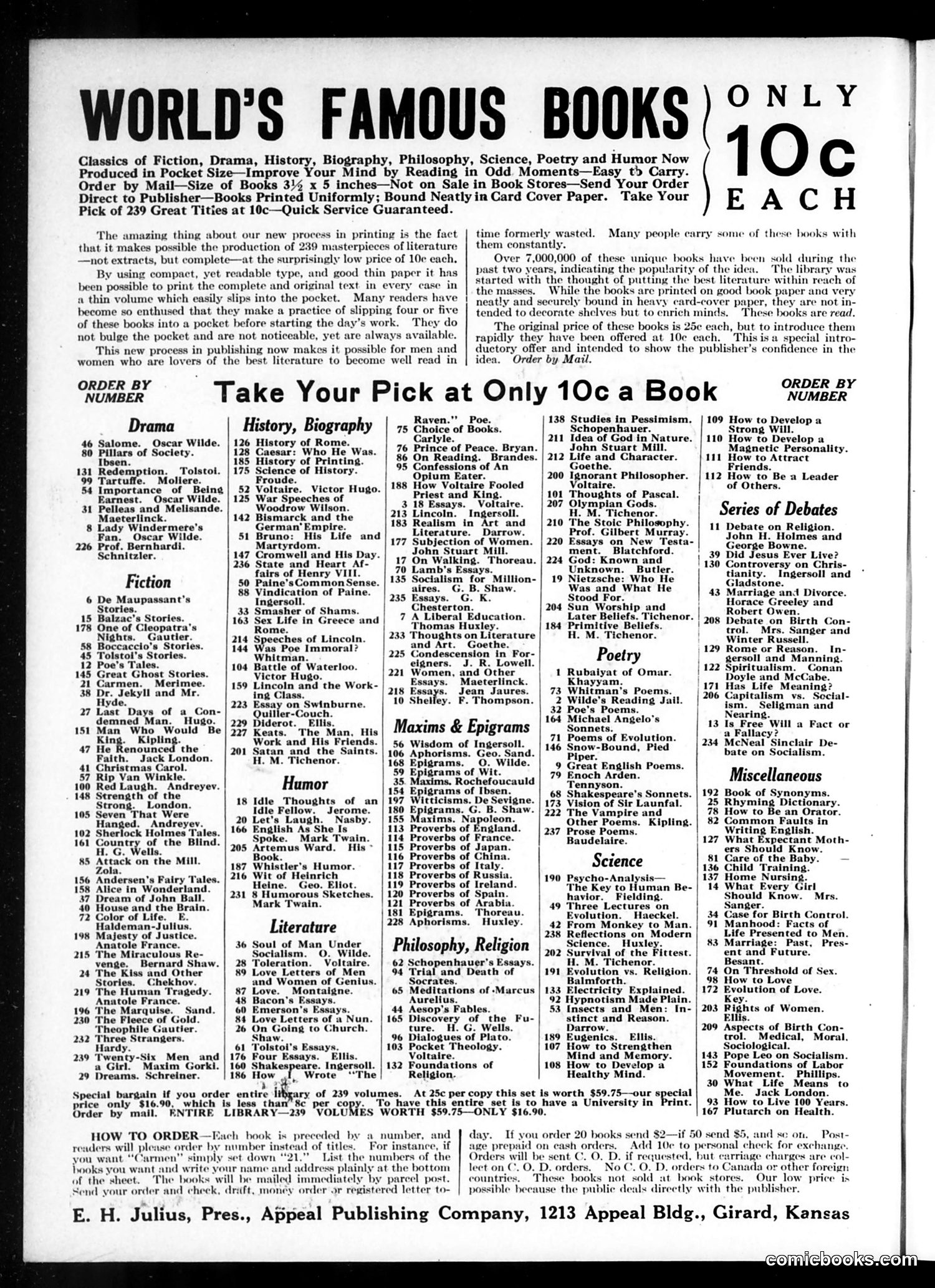
This page is **entirely advertising**, not editorial content or cartoons. It's a full-page advertisement for "World's Famous Books" published by the Appeal Publishing Company in Girard, Kansas. The ad promotes classic literature available in pocket-sized editions for 10 cents each. Categories include Fiction, Drama, History/Biography, Literature, Philosophy/Religion, Humor, Maxims & Epigrams, Poetry, and Science. The copy emphasizes affordability, portability ("Easy to Carry"), and quality production ("Bound Neatly in Card Cover Paper"). Claims state over 7,000,000 copies sold and that these are complete, unabridged texts. The advertisement includes ordering instructions and notes about shipping and payment options. No political satire, cartoons, or social commentary appear on this page.
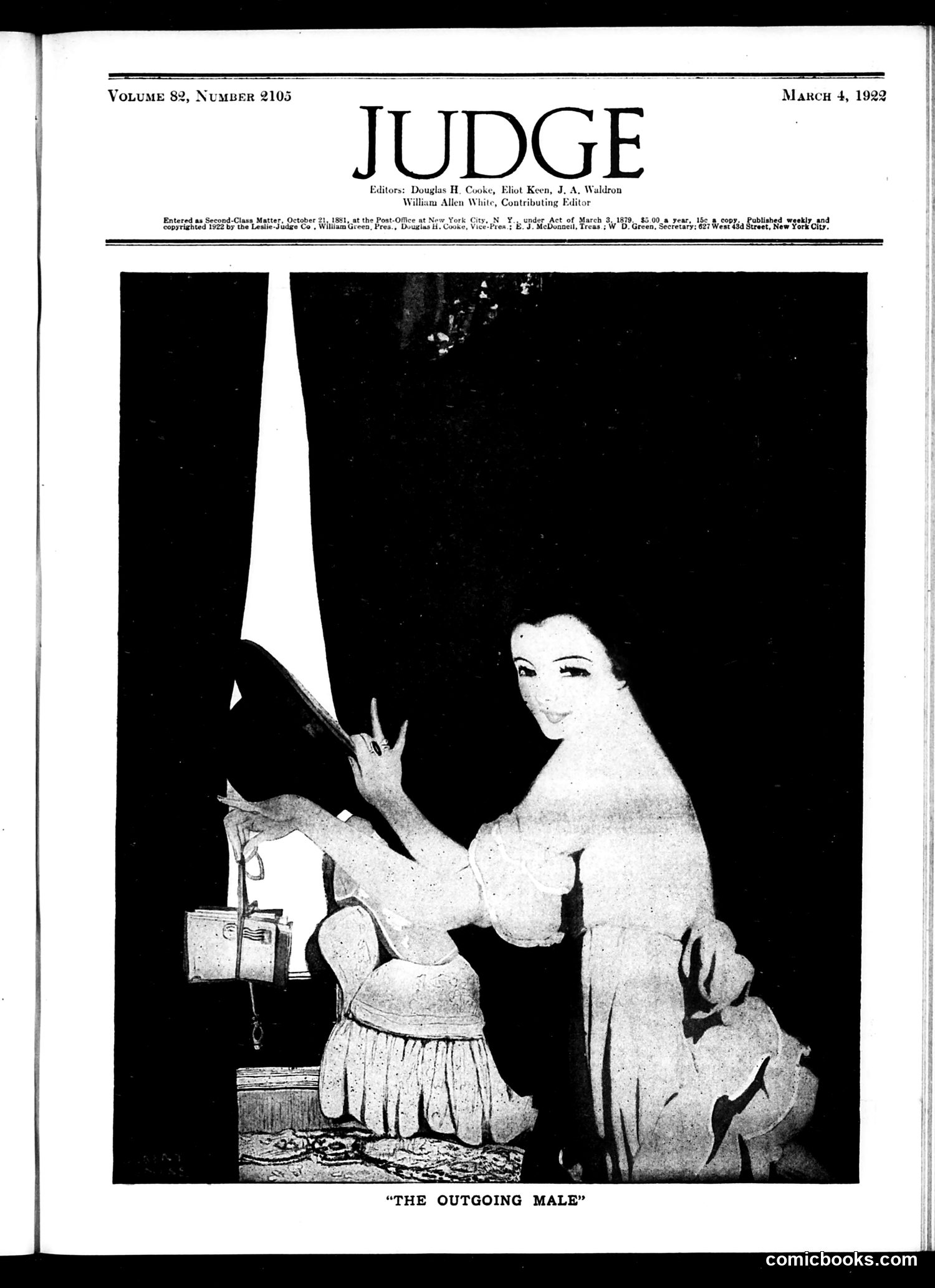
This cartoon satirizes changing gender dynamics in the early 1920s. The title "The Outgoing Male" appears to mock men's declining social dominance during this era. The image depicts a woman in classical or allegorical dress, confidently gesturing while a man (shown only partially, in dark silhouette) appears subordinate or diminished beside her. The satire likely references the post-WWI period when women gained the vote (1920), entered the workforce more broadly, and challenged traditional gender roles. The "outgoing" male—departing from his former position of authority—contrasts with the woman's prominent, commanding presence. Judge's satirical tone suggests the magazine viewed these social shifts with skepticism or humor, representing anxieties some held about women's expanding independence and influence.
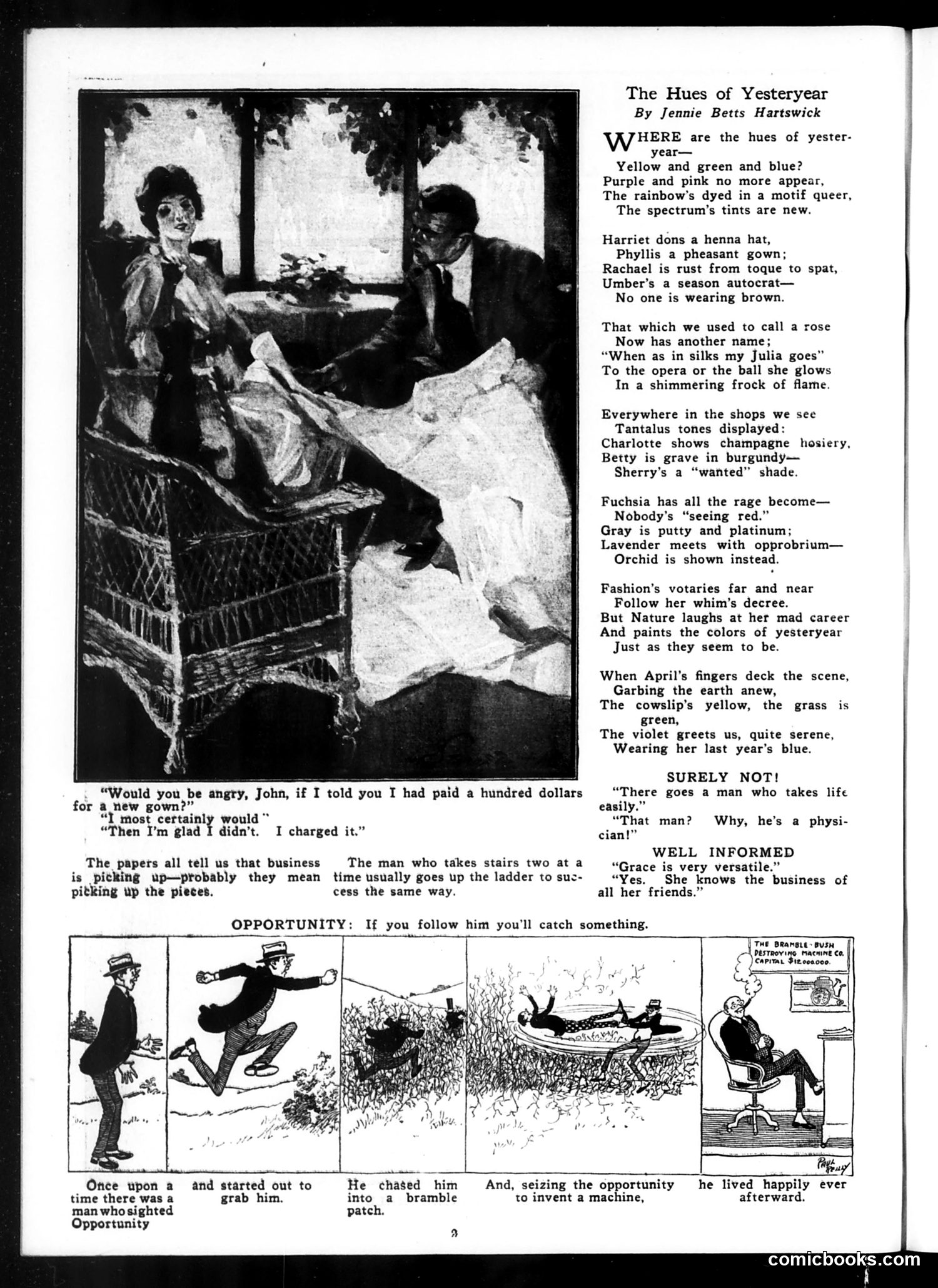
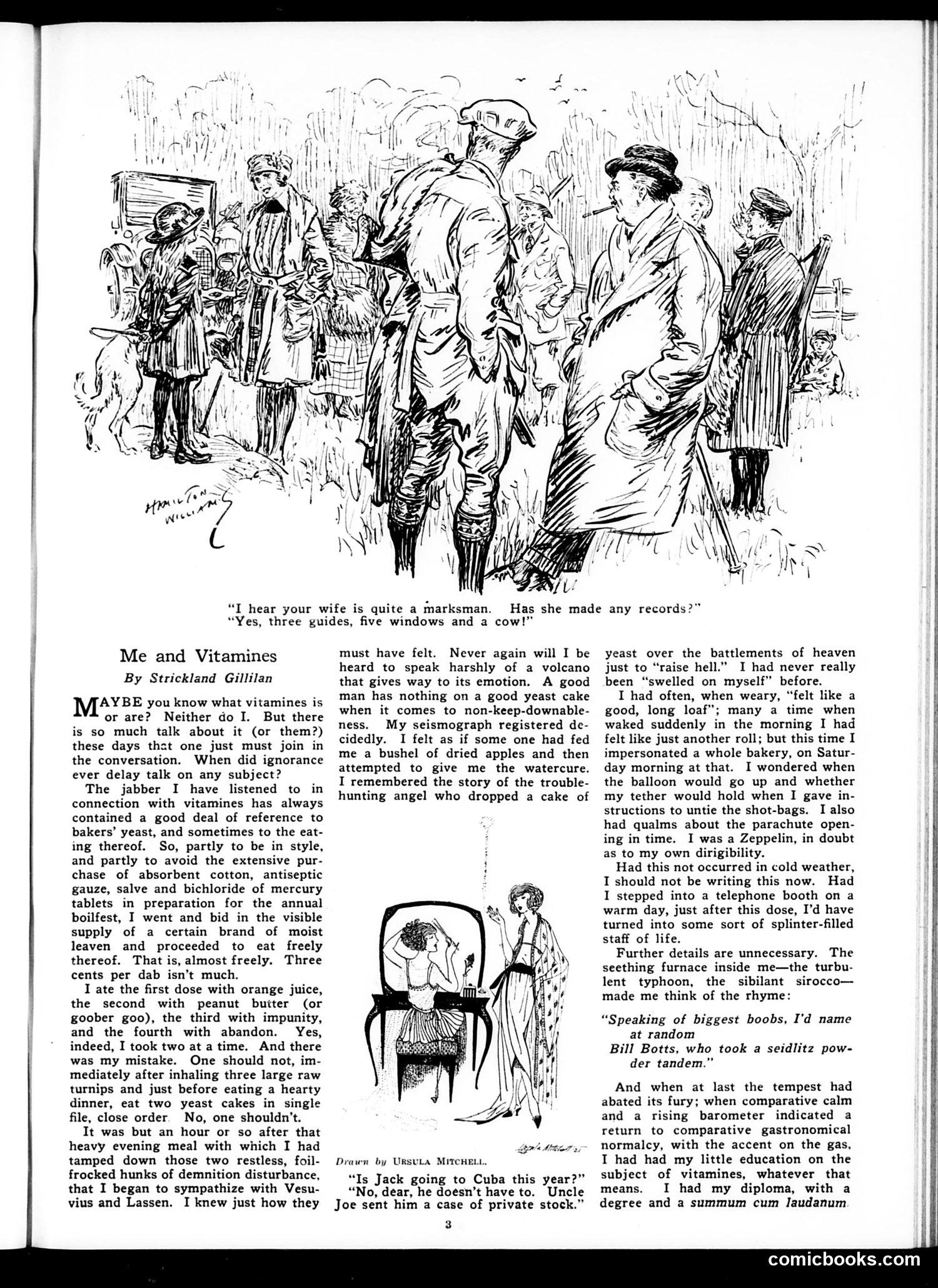
This page contains two satirical pieces from *Judge* magazine: **Top Cartoon:** A joke about marksmanship. A man's wife is praised as an excellent shot, but the punchline reveals she's a *terrible* marksman—she's accidentally shot three hunting guides, five windows, and a cow. The humor mocks both poor shooting accuracy and the absurdity of calling such destruction "marksmanship." **Main Article ("Me and Vitamines"):** Strickland Gillilan humorously describes his experience eating baker's yeast (then promoted as containing vitamins) to appear fashionable. After eating yeast cakes before dinner, he suffers severe digestive distress, comparing himself to volcanoes (Vesuvius, Lassen) and a Zeppelin. The satire mocks both the faddish health craze around "vitamines" (newly discovered, poorly understood) and people who pretend knowledge about trendy topics while remaining ignorant. The tone is lighthearted mockery of contemporary health fads and social pretension.
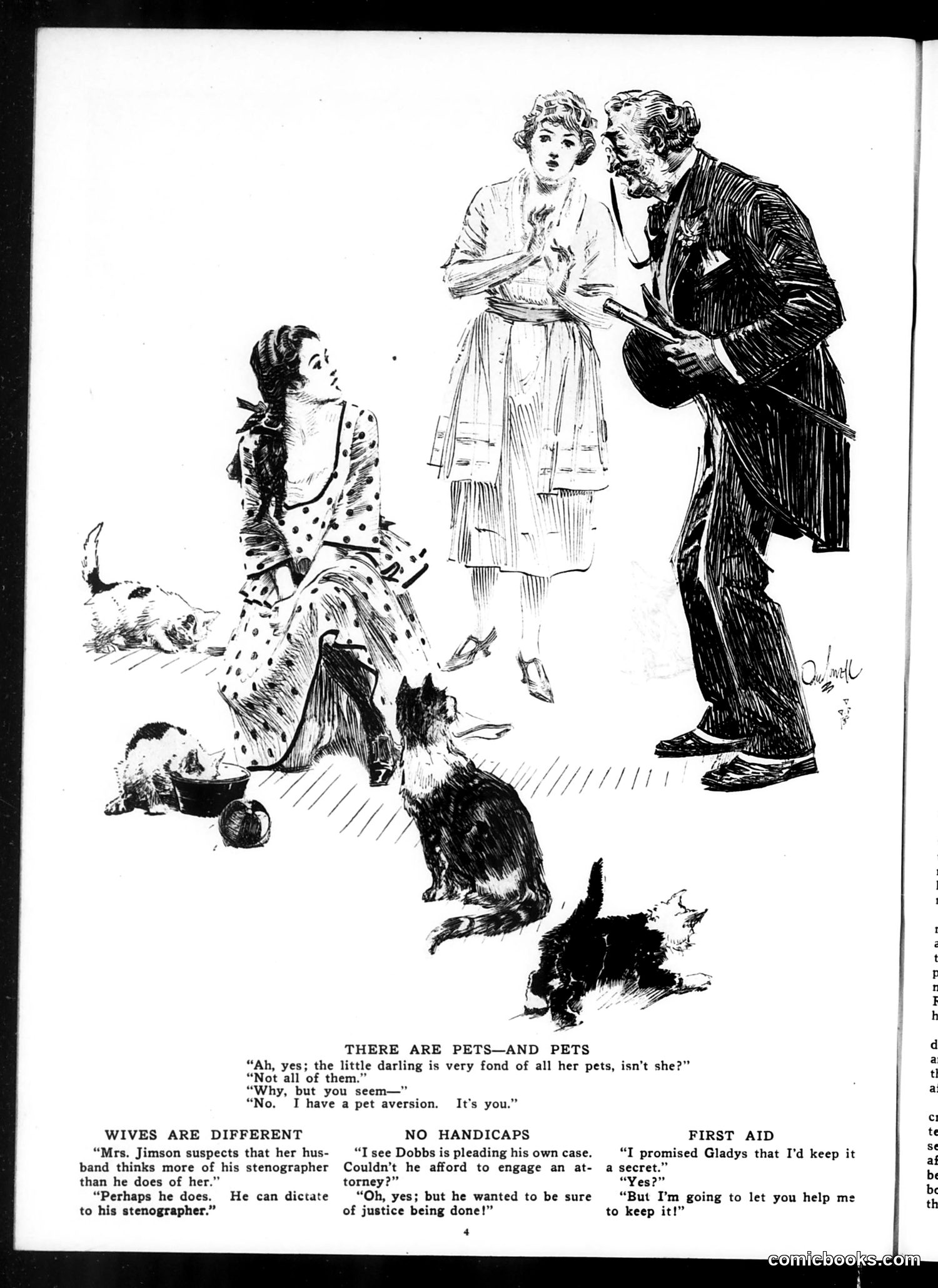
This page contains three separate joke illustrations satirizing early 20th-century social attitudes: **"There Are Pets—and Pets"**: A woman surrounded by lap dogs claims to have "a pet aversion"—the man addressing her. The joke plays on calling people "pets" as terms of endearment while suggesting this particular person is detestable. **"Wives Are Different"**: Mocks the era's workplace dynamics where a husband can "dictate" to his stenographer (implying an affair or at least closer relationship) while neglecting his wife. The satire critiques husbands' priorities and the vulnerability of wives. **"No Handicaps"** and **"First Aid"**: Brief jokes about legal incompetence and broken confidentiality—a man pleads his own case poorly, and someone promises to "help keep" a secret by immediately telling it. The overall theme satirizes domestic relationships, workplace impropriety, and human weakness. The artwork style and subjects reflect Judge's target audience: educated, upper-class readers amused by marital discord and social pretension.
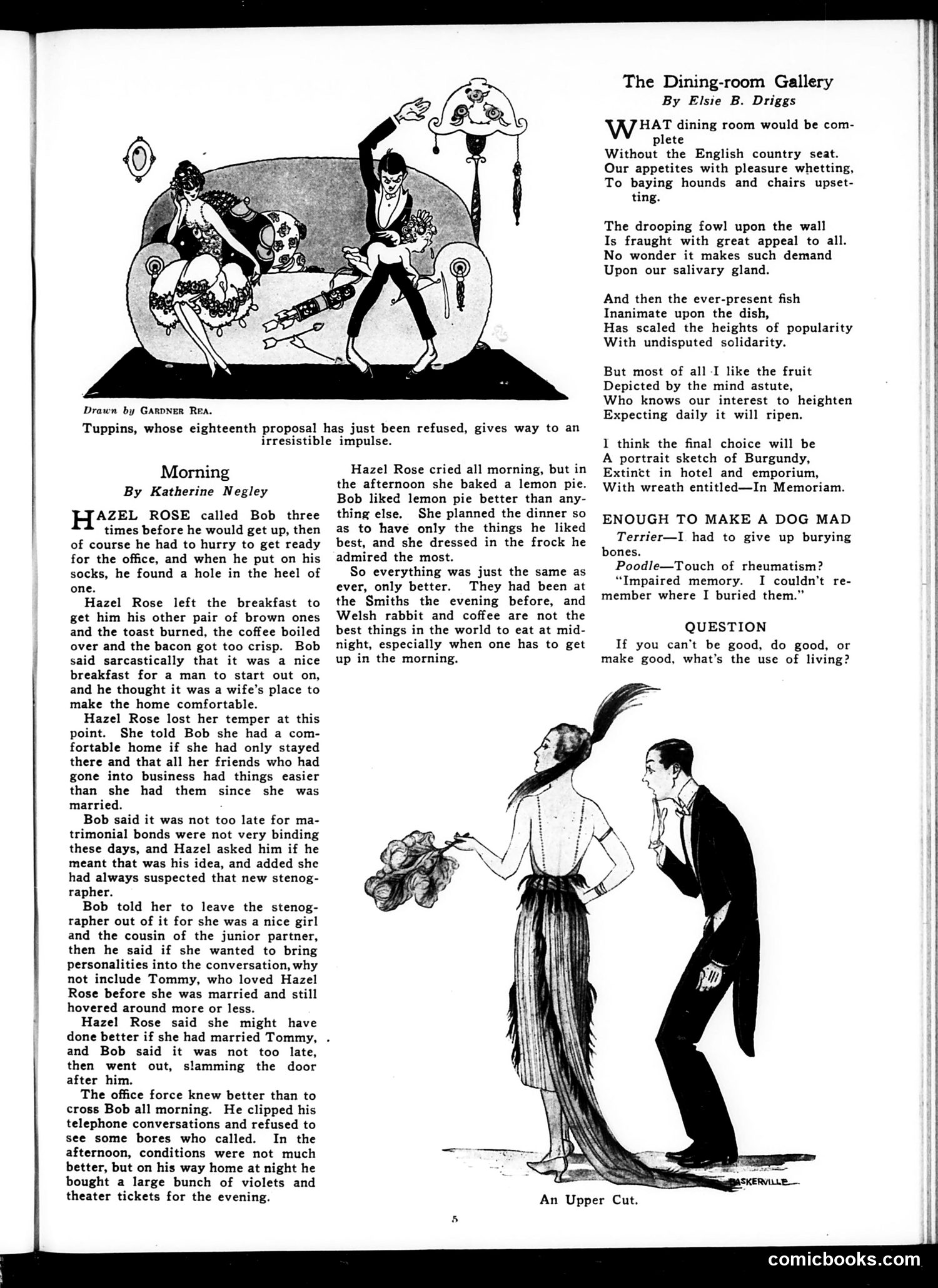
This page contains three separate satirical pieces typical of early 20th-century American humor: **"Morning"** depicts a married couple's domestic quarrel. Bob complains about breakfast quality; Hazel Rose, frustrated by housework, snaps that unmarried working friends have easier lives. The argument escalates with jealous accusations (a new stenographer, her old suitor Tommy) before Bob angrily leaves. However, both reconcile through traditional gestures—he buys flowers and theater tickets; she bakes his favorite pie—suggesting marital discord resolves through such appeasement. **"The Dining-room Gallery"** satirizes pretentious dining aesthetics: wealthy homes display English hunting scenes and dead game to appear cultured, when really these décor choices just stimulate appetite. The poem mocks artificial sophistication, ending with ironic nostalgia for extinct Burgundy wine. **"Enough to Make a Dog Mad"** is a simple joke: a terrier abandoned bone-burying because it forgot where it buried them—blaming "impaired memory" rather than admitting canine forgetfulness. The "Upper Cut" cartoon likely contains social commentary, though details are unclear from the image alone.
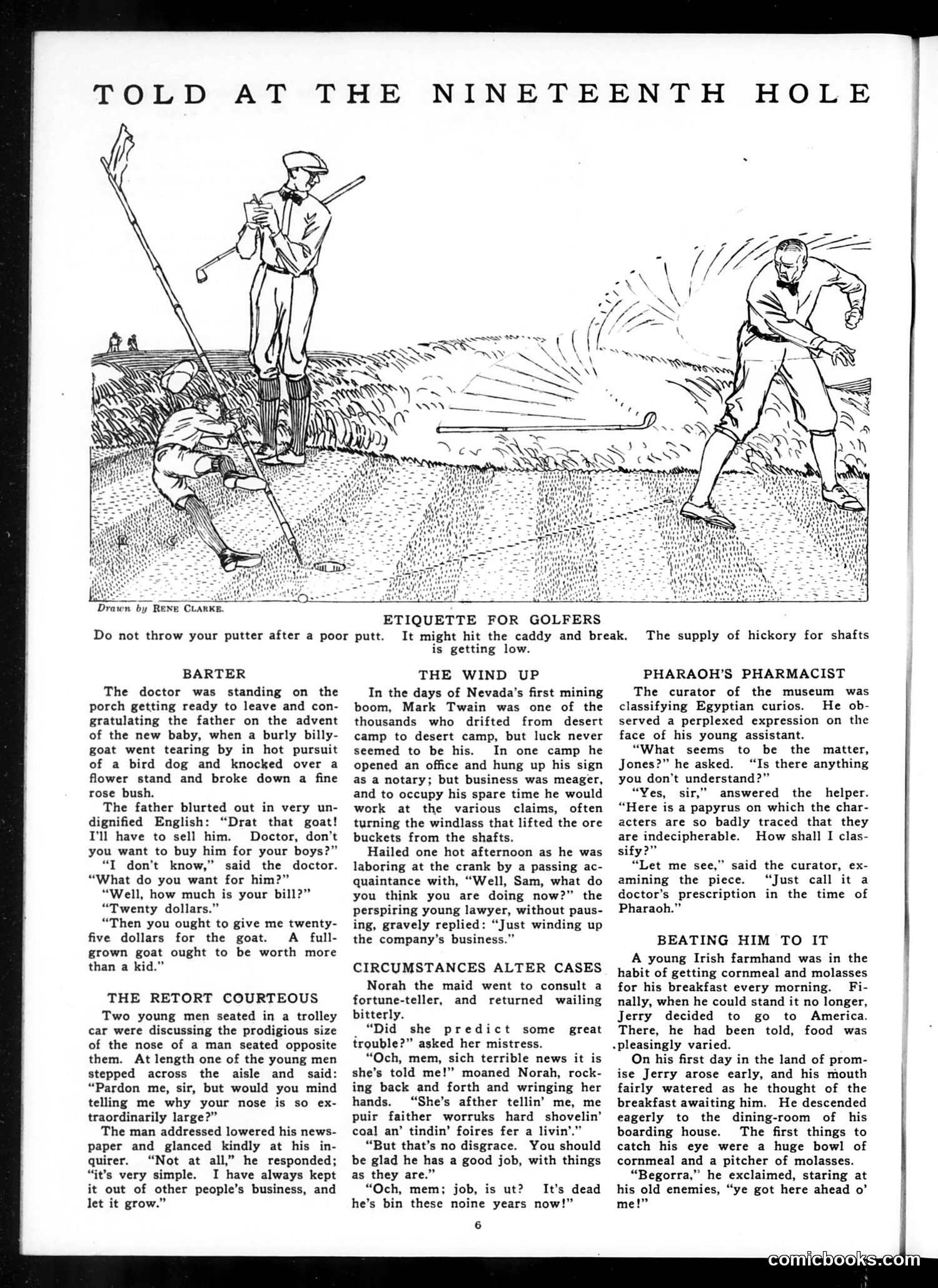
This page presents humorous short stories framed as golf-club banter (the "nineteenth hole" being the bar). The cartoon shows golfers at play. **Key stories:** - **"Barter"**: A father trades a troublesome goat to a doctor, claiming it's worth more than the $20 medical bill because "a full-grown goat ought to be worth more than a kid"—a pun on "kid" (child/young goat). - **"The Retort Courteous"**: A man with an enormous nose explains he kept it large by minding his own business—satirizing nosy people. - **"The Wind Up"**: A Mark Twain anecdote where he jokes about "winding up the company's business" while literally operating a mining windlass. - **"Circumstances Alter Cases"**: An Irish maid's fortune-teller reveals her father "works hard shoveling coal"—but he's been dead nine years, a darkly comic misunderstanding. These are gentle, non-political humor pieces typical of Judge's lighter content, relying on wordplay and Irish-immigrant stereotypes (the maid's dialect).
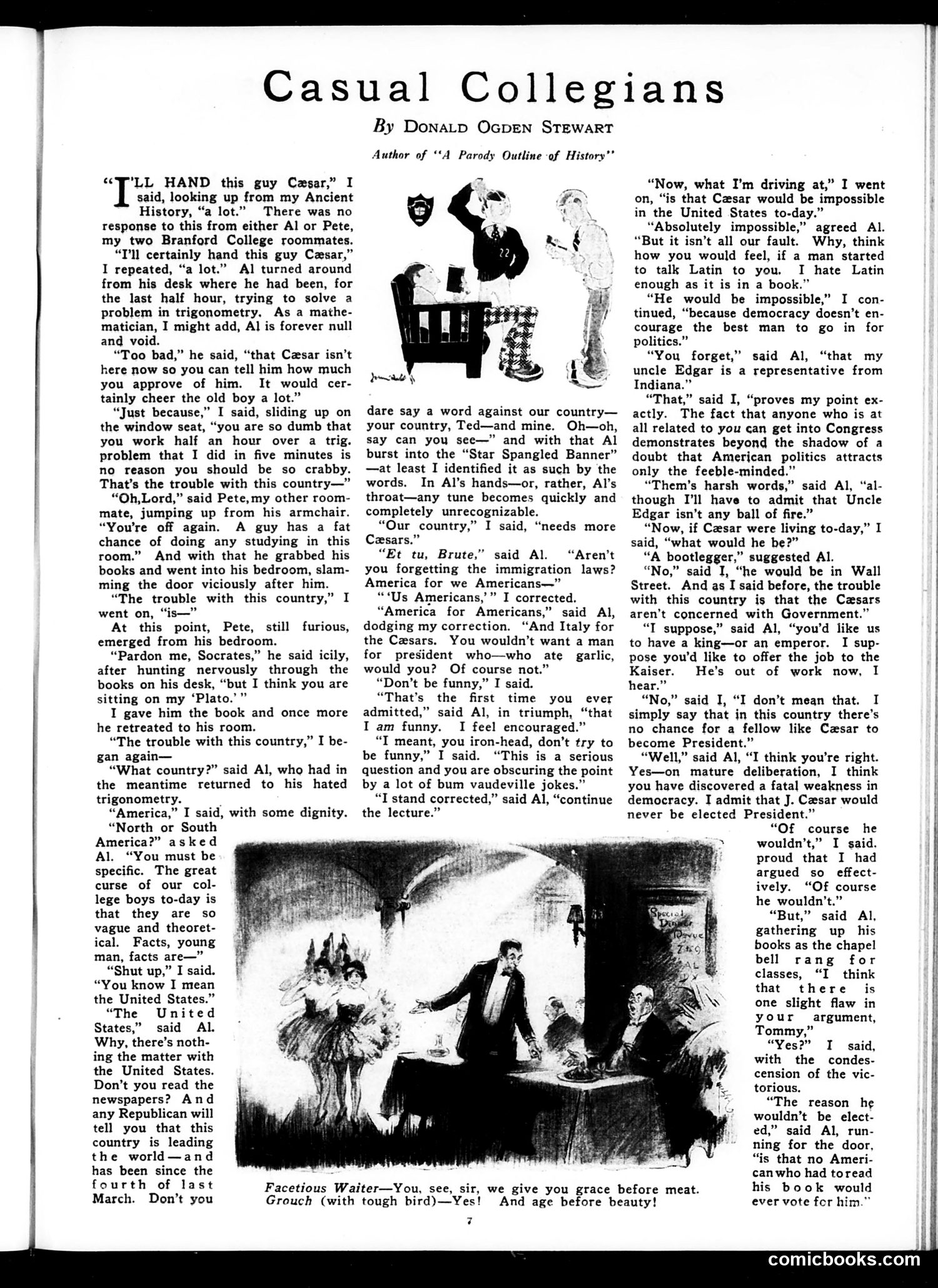
This is a satirical dialogue between college roommates debating whether a Caesar-like dictator could rise in America. The unnamed narrator argues that American democracy prevents such tyranny; his roommate Al counters with practical objections—immigrants, language barriers, garlic-eating prejudice—rather than ideological ones. The satire targets both figures: the narrator for pontificating about serious politics while his friends try to study, and Al for reducing political theory to vaudeville jokes and petty nationalism ("America for we Americans"). The cartoon below shows a waiter serving tough food, a visual pun on the "tough" intellectual debate above. The piece, by Donald Ogden Stewart, satirizes college intellectualism generally—young men pontificating confidently about governance while barely understanding actual civics. Written after March 1921 (per the text), it reflects post-WWI American anxiety about foreign influences and democratic resilience.
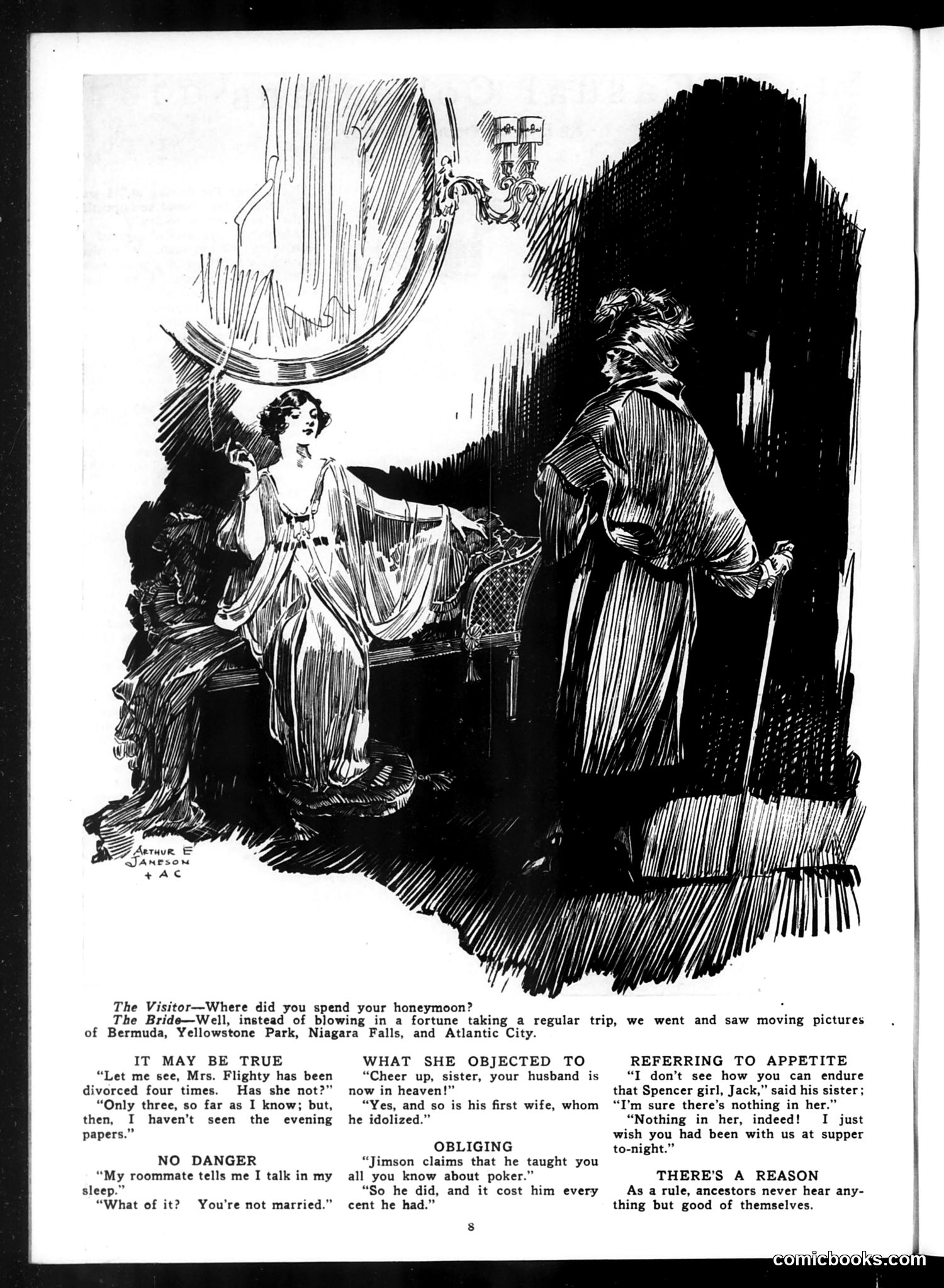
This page contains six brief satirical vignettes typical of early 20th-century humor magazines, each mocking contemporary social attitudes and behaviors. The main cartoon depicts a newlywed couple discussing their economical honeymoon—rather than traveling to actual destinations (Bermuda, Yellowstone, Niagara Falls, Atlantic City), they watched moving pictures of these places, satirizing both the new cinema technology and middle-class frugality. The surrounding joke captions target: women's serial divorces ("Mrs. Flighty"), sleep-talking in unmarried women (no marital confidentiality issues), infidelity in the afterlife, poker-induced financial loss, female appetites/consumption, and ancestor worship. The humor relies on period assumptions about marriage, divorce stigma, and gender roles. The "Spencer girl" joke particularly suggests satirizing women perceived as having no intellectual substance but considerable appetite—likely a dig at a specific contemporary figure, though unclear which. Overall, this reflects Judge's satirical focus on domestic life, courtship, and social pretension among the urban middle class.
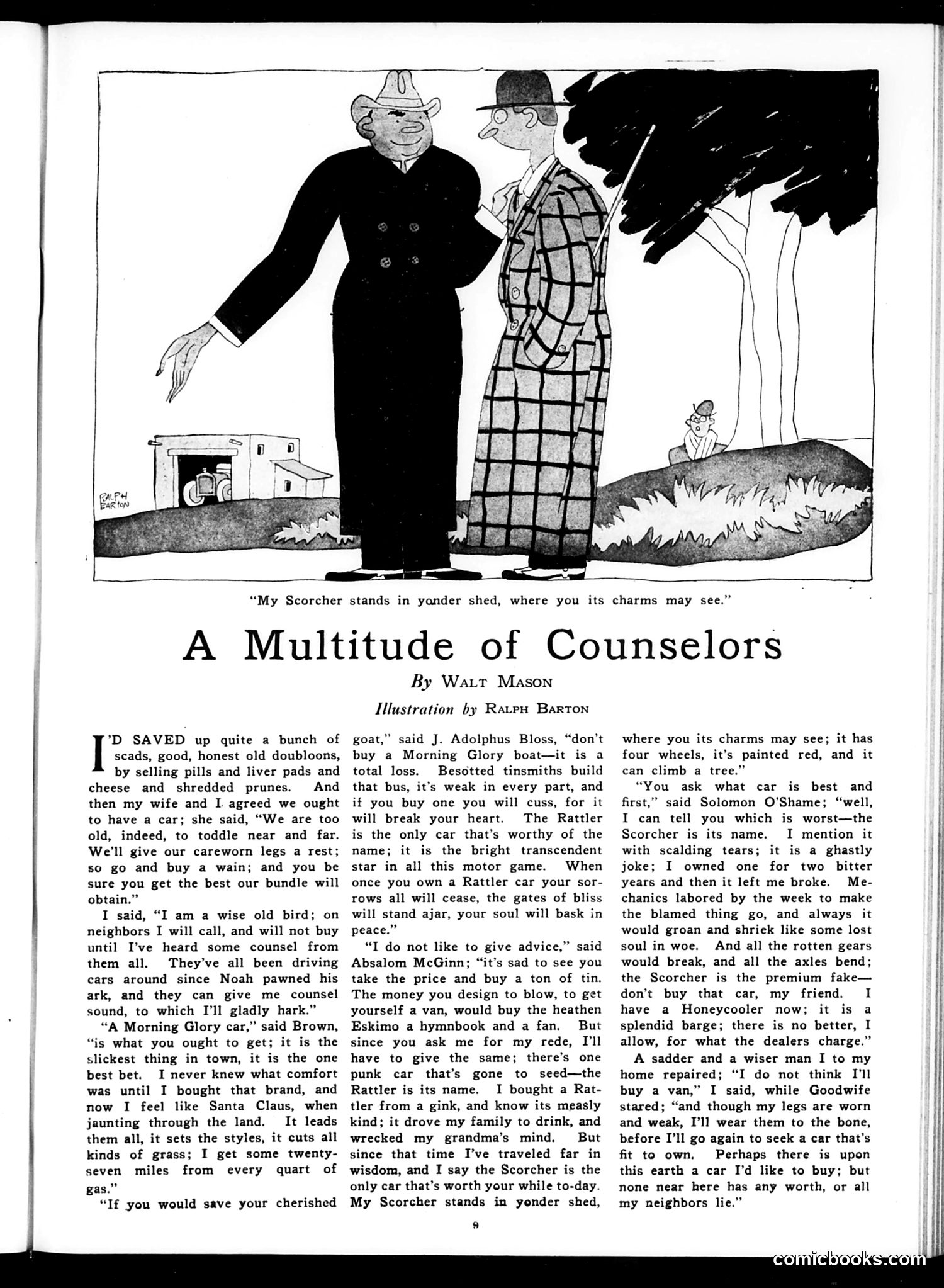
This satirical story mocks the unreliability of neighborly advice during the early automobile era. An elderly couple decides to buy a car and solicits recommendations from neighbors, each championing a different brand: Brown praises the "Morning Glory," Bloss pushes the "Rattler," McGinn endorses the "Scorcher," and O'Shame condemns the Scorcher while promoting the "Honeycooler." The joke is that these advisors contradict each other completely—the same car praised by one is savagely criticized by another. The protagonist, overwhelmed by conflicting counsel, abandons the plan entirely, deciding to keep walking rather than trust any of them. The satire targets both the proliferation of untested automobile brands of that era and the human tendency to give confident, contradictory advice based on personal bias rather than objective facts. The title references the biblical proverb about "multitude of counselors," implying that more opinions don't guarantee better decisions.
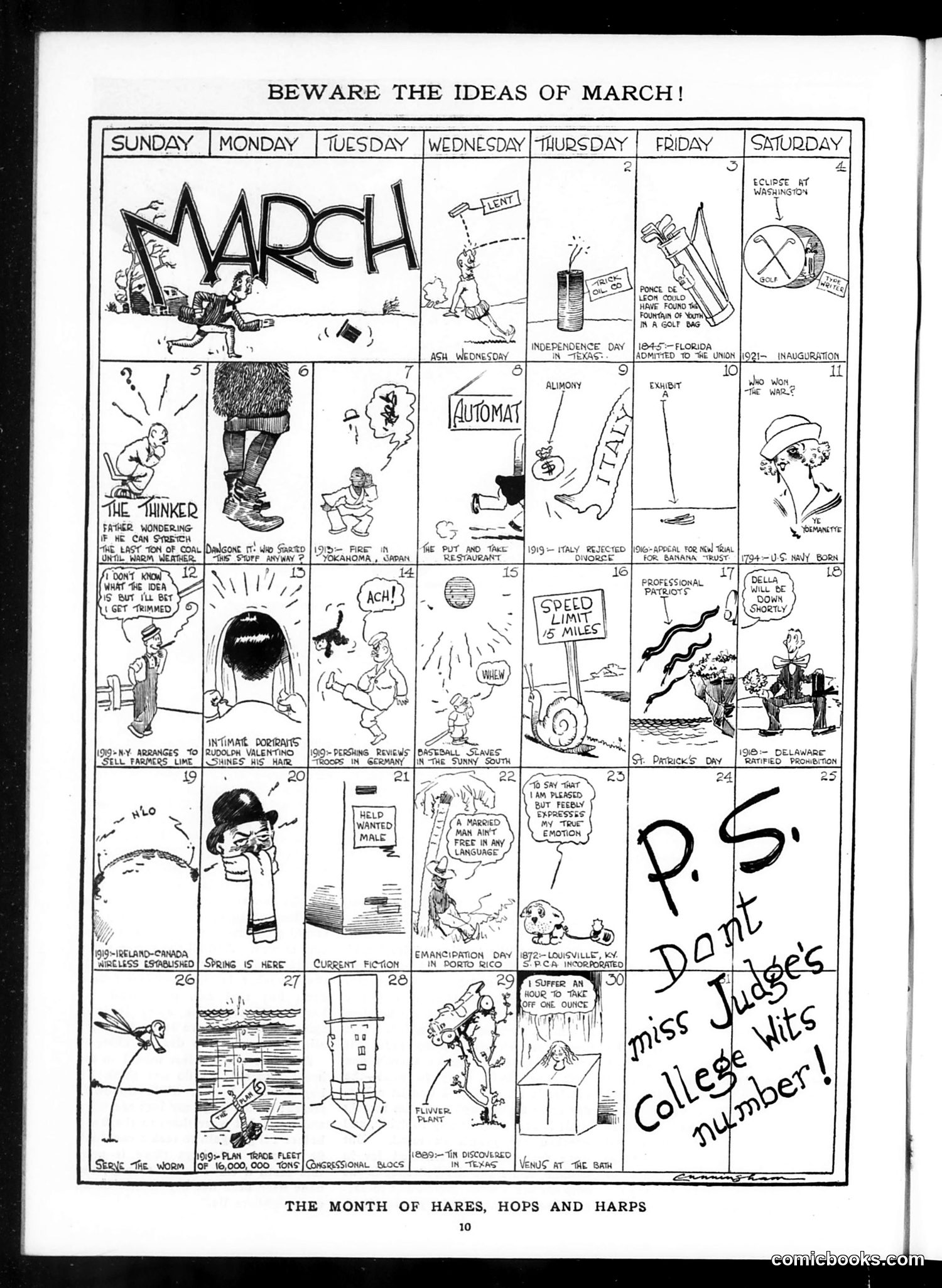
This is a satirical daily calendar for March 1919, presented as a grid of comic vignettes. The page's title plays on Shakespeare's "Beware the Ides of March," reframing March as a month of chaotic "ideas" rather than danger. The cartoons reference contemporary 1919 events: Woodrow Wilson's inauguration (March 4), Italy's rejection of territorial claims at the Paris Peace Conference, Prohibition's ratification, naval history, and various social absurdities. Character types include politicians, soldiers, and everyday people engaged in ridiculous scenarios—a thinker stretching to reach ideas, figures dealing with coal shortages, and references to Rudolph Valentino. The satire targets post-WWI America's political confusion, resource scarcities, and social upheaval. The side note "P.S. Don't miss Judge's College Wits number!" indicates this was a promotional page for the magazine. The overall tone is absurdist humor about an unstable, transitional historical moment.
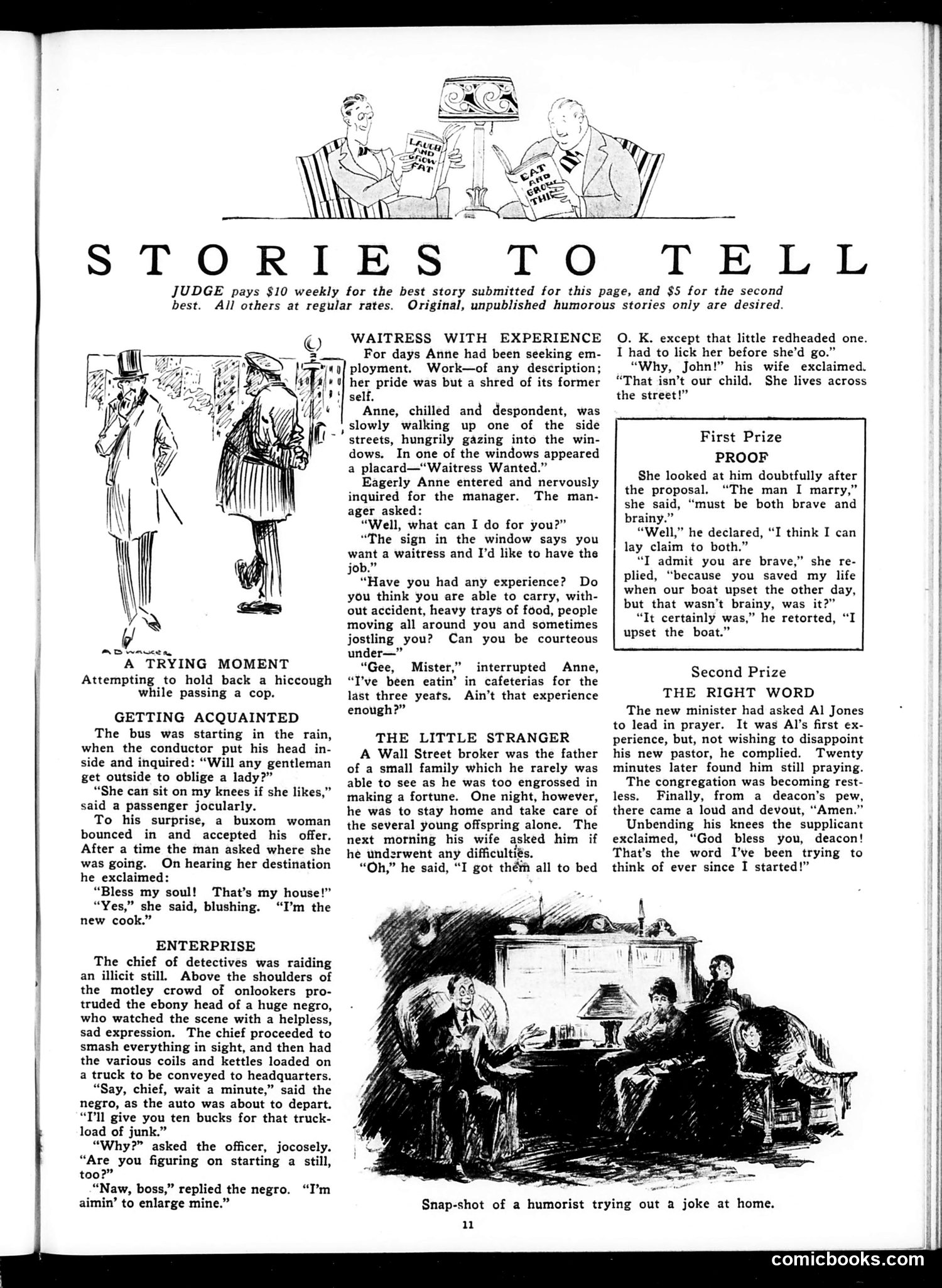
This is a humor submission page from *Judge*, offering payment for original funny stories. The page contains several short anecdotes satirizing everyday social situations: **"Getting Acquainted"** jokes about class awkwardness when a passenger's flirtation with a woman backfires—she's his new domestic servant. **"Enterprise"** uses a racist caricature of a Black man attempting to purchase confiscated moonshine equipment, playing on stereotypes about illegal alcohol production in the Prohibition era. **"Waitress with Experience"** mocks working-class desperation: an unemployed woman claims cafeteria *patronage* constitutes job experience. **"The Little Stranger"** offers dark humor about an inattentive Wall Street father who disciplines the wrong child. The humor relies on class distinctions, period-specific references (Prohibition, domestic service hierarchies), and casual racial caricature typical of 1920s-30s American satirical magazines. Modern readers would find the racial content offensive and the class mockery dated.
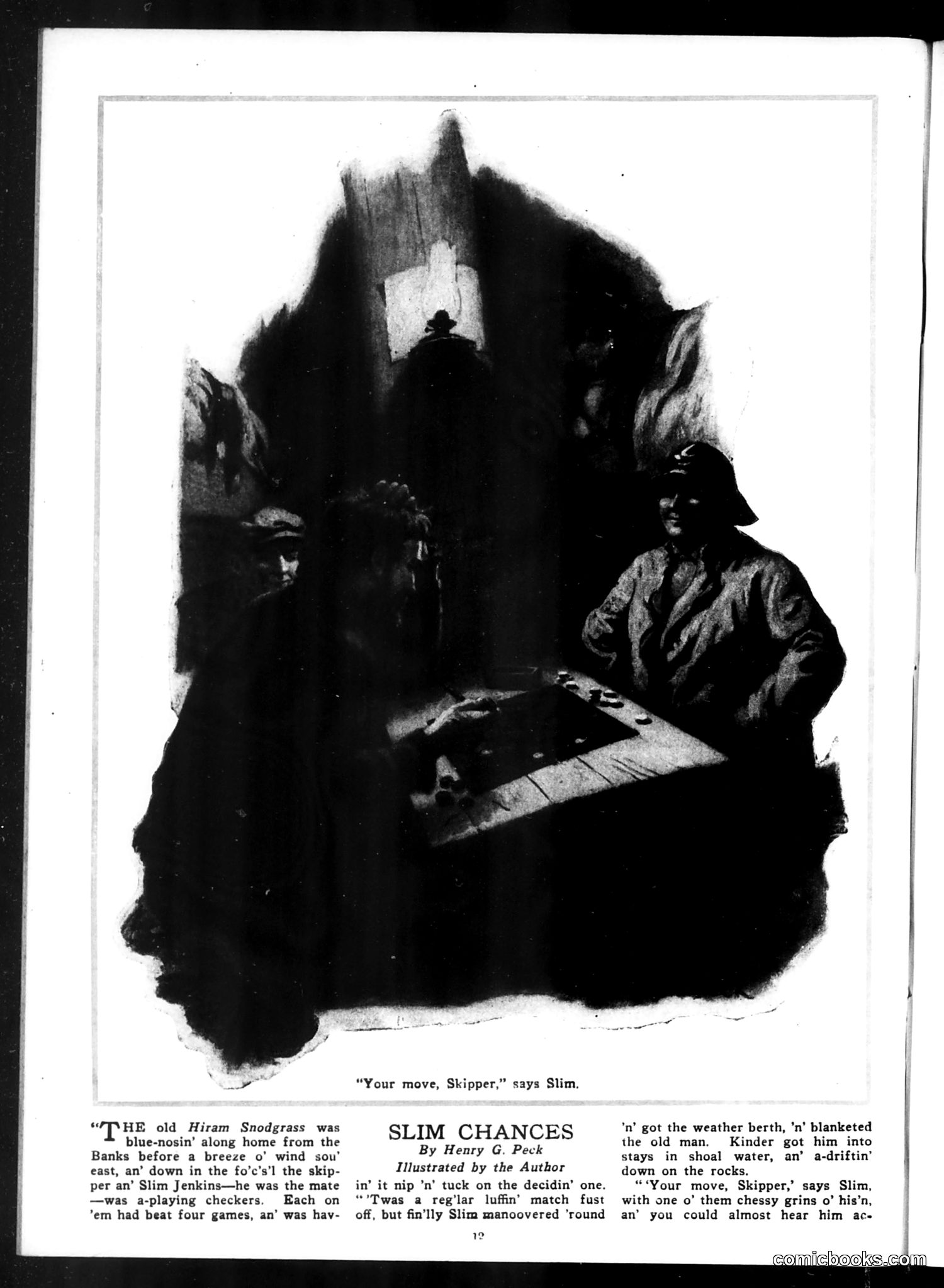
This is a narrative illustration accompanying a short story about two sailors—a skipper (captain) and his mate Slim Jenkins—playing checkers aboard the ship *Hiram Snodgrass* while sailing near the Banks. The story uses nautical metaphors to describe their game: Slim has maneuvered into a winning position, "getting the weather berth" and "blanketing" the skipper, trapping him like a ship forced onto rocks in shallow water. The illustration depicts the scene in the ship's fo'c's'l (forecastle), showing the two men at their game with a lantern illuminating the cramped space. The humor lies in the double meaning—the checkers match is described entirely in sailing terminology, making the mundane board game sound like a dramatic maritime battle. This wordplay exemplifies the witty, working-class maritime humor Judge's readers enjoyed.
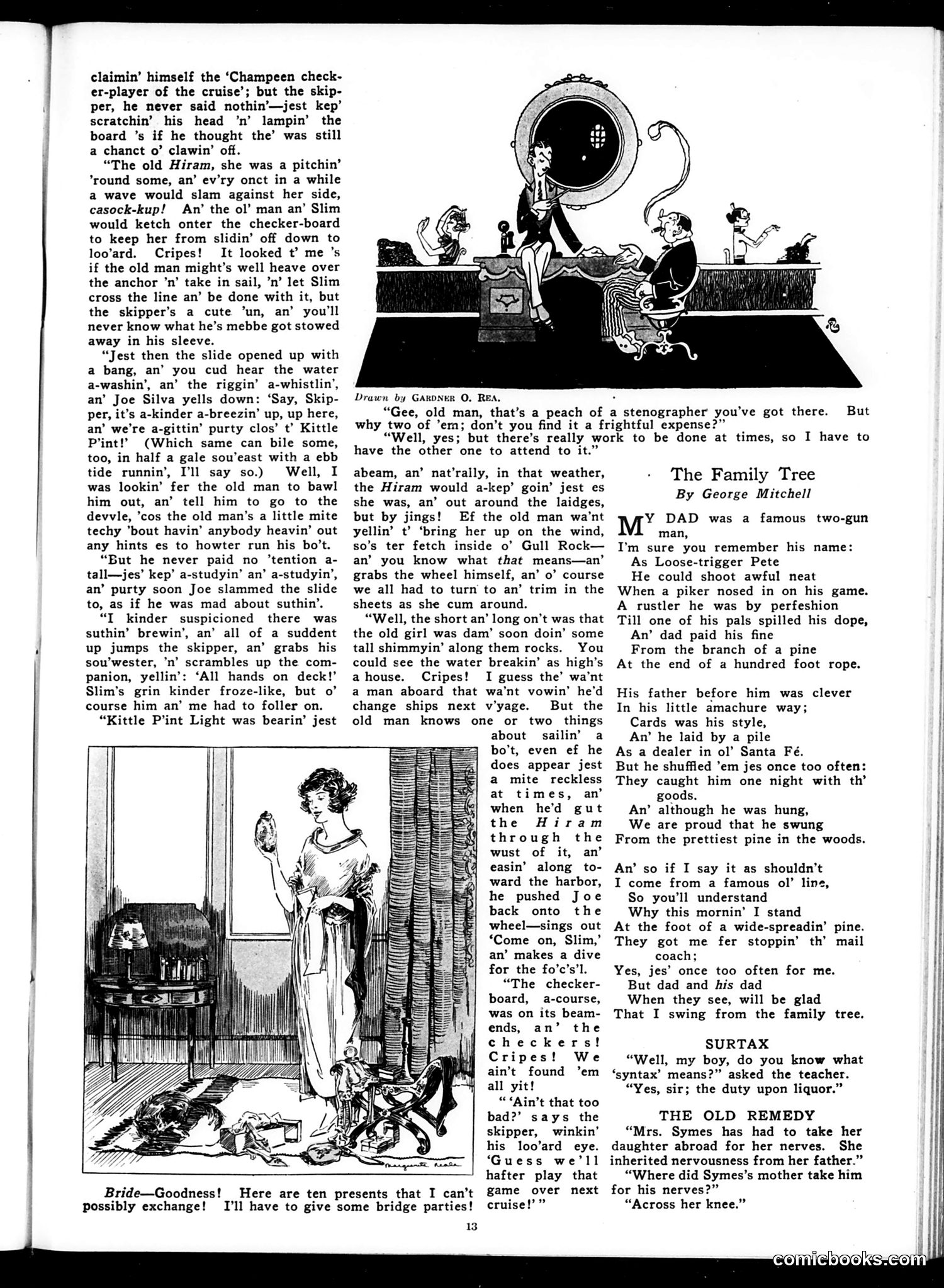
This page contains two distinct pieces: **Top Section - Maritime Narrative with Cartoon:** The illustrated story depicts a ship captain (the "old man") playing checkers during rough seas. The satire mocks nautical hierarchy and working-class maritime culture—the skipper maintains composure and superior knowledge while his crew (Joe Silva, Slim) anxiously warn of danger. The joke: the captain deliberately navigates treacherous rocks to teach a lesson about respecting his authority, then nonchalantly loses the checkers pieces in the chaos. It satirizes masculine bravado and class dynamics aboard ship. **Bottom Section - Two Unrelated Items:** 1. **"The Family Tree"** - A humorous poem about the speaker's father, "Loose-trigger Pete," a famous gunslinger executed by lynching ("the branch of a pine"). It's dark frontier humor typical of early 1900s American comics. 2. **"Surtax" and **"The Old Remedy"** - Brief joke snippets about taxes and a woman taking her daughter abroad—standard domestic humor filler. The page represents typical Judge magazine content: nautical tall tales, Western gunslinger mythology, and domestic comedy for early 20th-century readers.
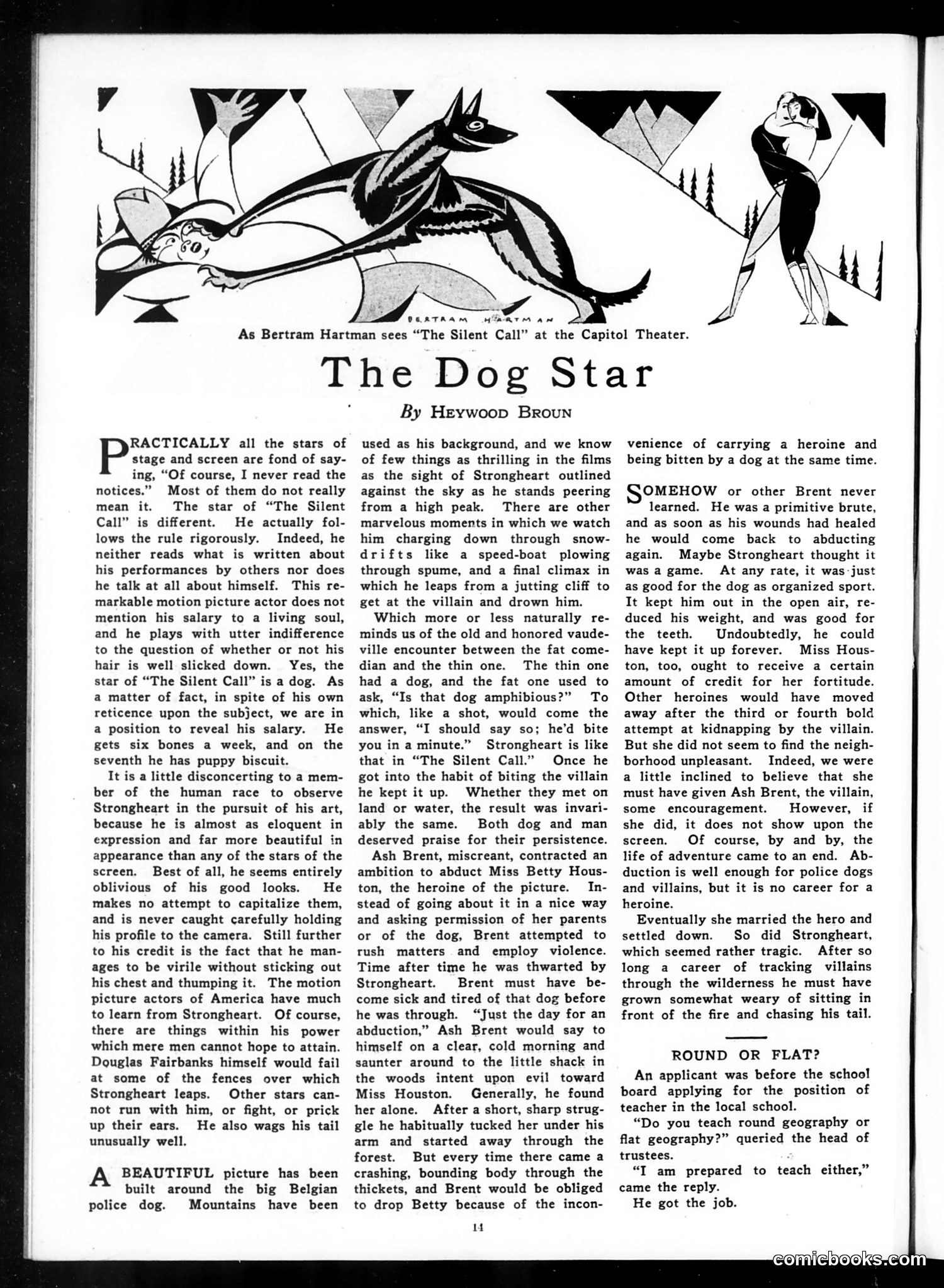
This article praises **Strongheart**, a Belgian police dog who is the star of the film "The Silent Call" (shown at Capitol Theater). The illustration depicts a scene from the movie. The satire works by treating Strongheart as a professional actor superior to human movie stars. Broun mocks Hollywood vanity—actors who claim they "never read notices" while obsessing over salary and appearance—by contrasting them with a dog who is genuinely indifferent to such concerns. The humor lies in Strongheart's apparent professionalism: he doesn't mention his salary ("six bones a week"), doesn't angle his profile to camera, and performs remarkable physical feats that even Douglas Fairbanks couldn't match. The plot summary shows Strongheart heroically preventing villain Ash Brent from abducting heroine Betty Houston, repeatedly thwarting him whether "on land or water." The joke is that Strongheart demonstrates more integrity and dedication than human actors typically display.
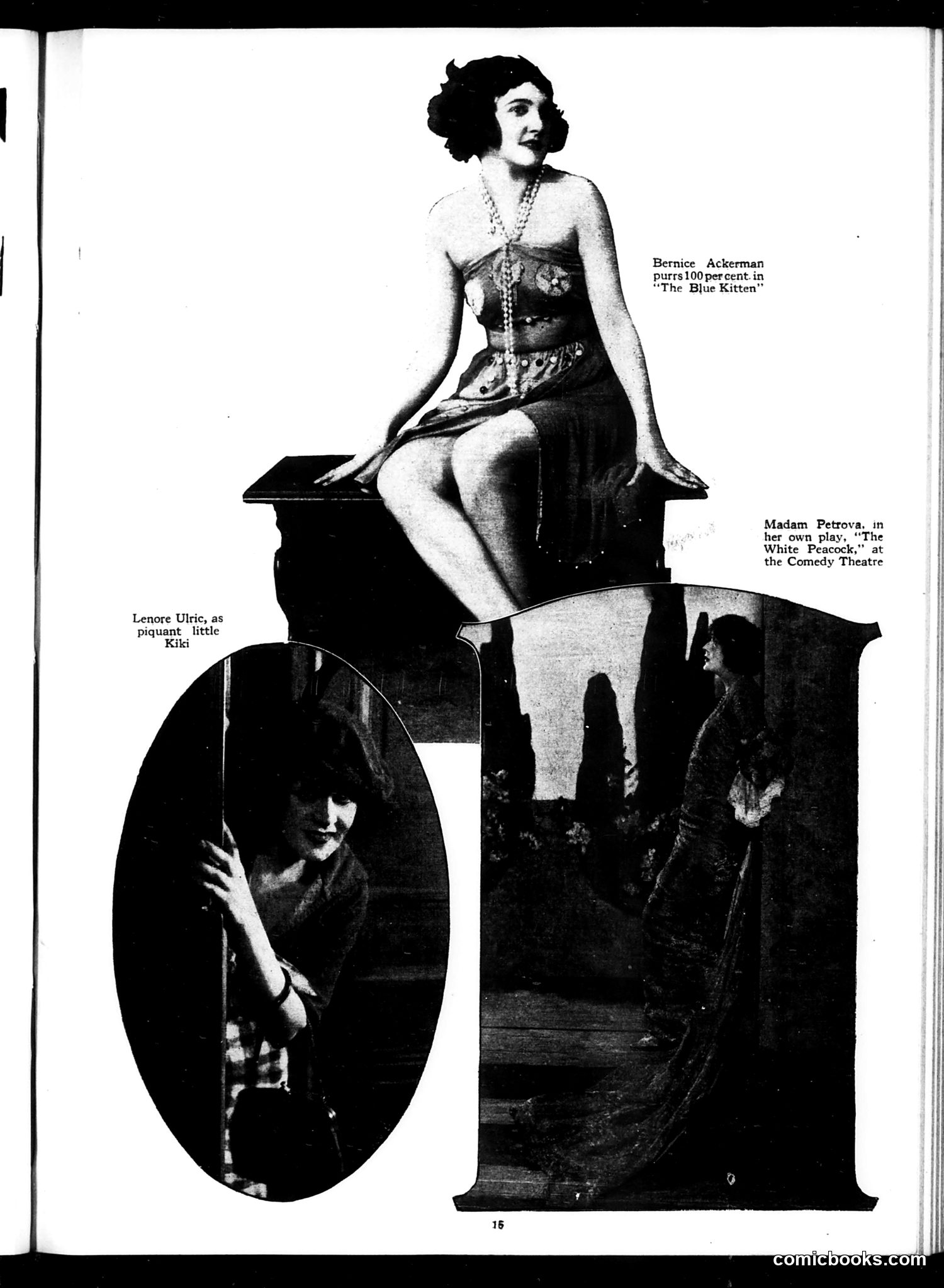
This page showcases theatrical actresses from contemporary Broadway productions. The layout presents three actresses: Bernice Ackerman in "The Blue Kitten," Madam Petrova in "The White Peacock" at the Comedy Theatre, and Lenore Ulric as "piquant little Kiki." Rather than political satire, this appears to be entertainment coverage typical of Judge magazine's theatrical section. The photographs highlight popular stage actresses and their roles, likely appealing to readers interested in New York theater. The descriptive language—"purrs 100 percent," "piquant"—suggests lighthearted commentary on the actresses' performances and appeal. This represents Judge's function as a general-interest magazine covering arts and entertainment alongside political satire.
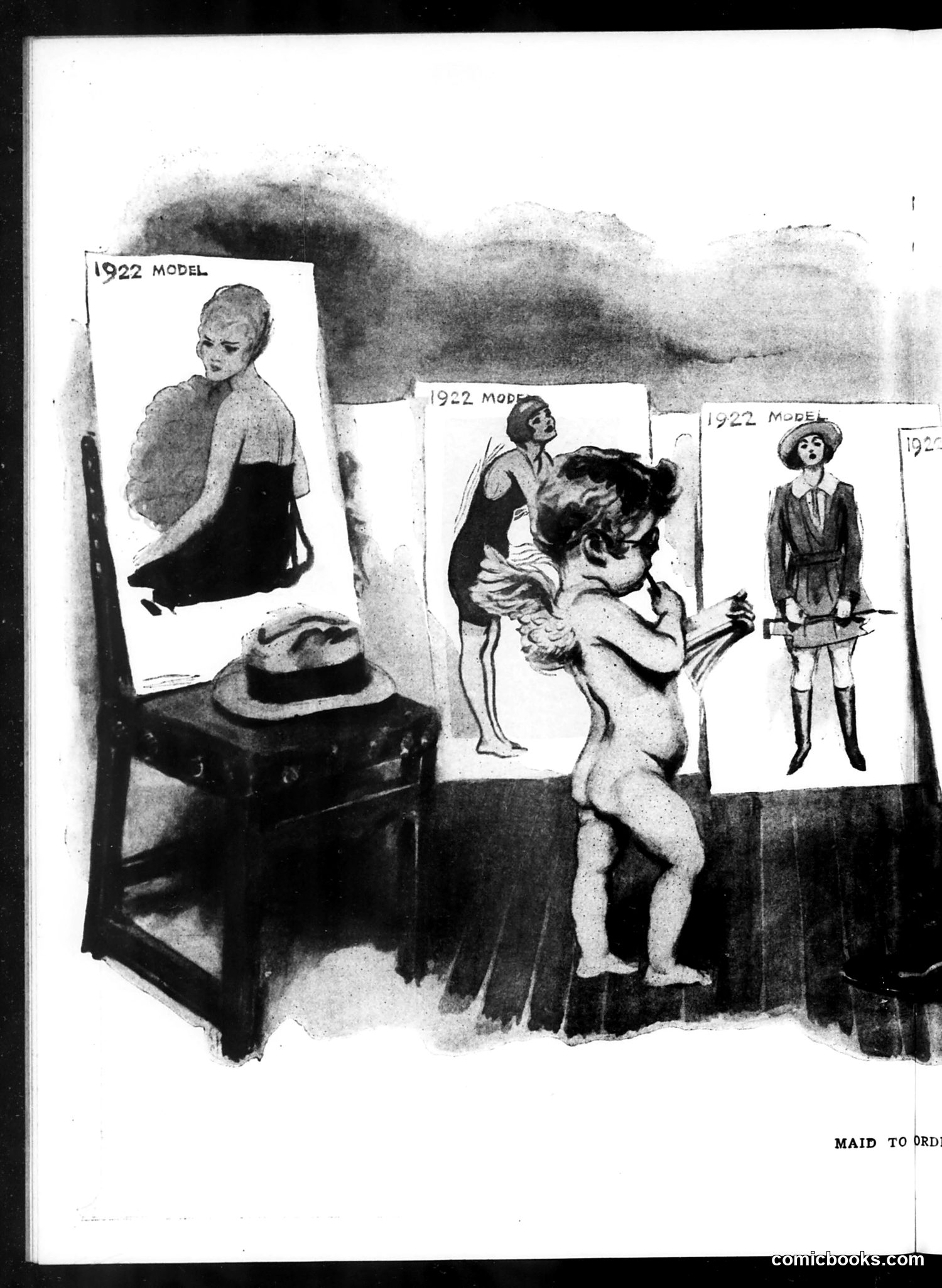
This appears to be a satirical illustration from Judge magazine featuring a humorous scene about fashion modeling or tailoring in 1922. A cherub or cupid figure is shown displaying or modeling three different "1922 MODEL" fashion designs to a seated observer. The satire likely mocks: - Contemporary women's fashion trends of the early 1920s (the "flapper era") - The absurdity of presenting clothing models in exaggerated or ridiculous poses - Possibly the commodification of female beauty and fashion marketing The title "MAID TO ORD[ER]" (made to order) reinforces the commercial aspect—suggesting women's fashions (or perhaps women themselves) are being manufactured and presented as standardized products. The winged cherub figure adds playful irony to the otherwise commercial transaction being depicted.
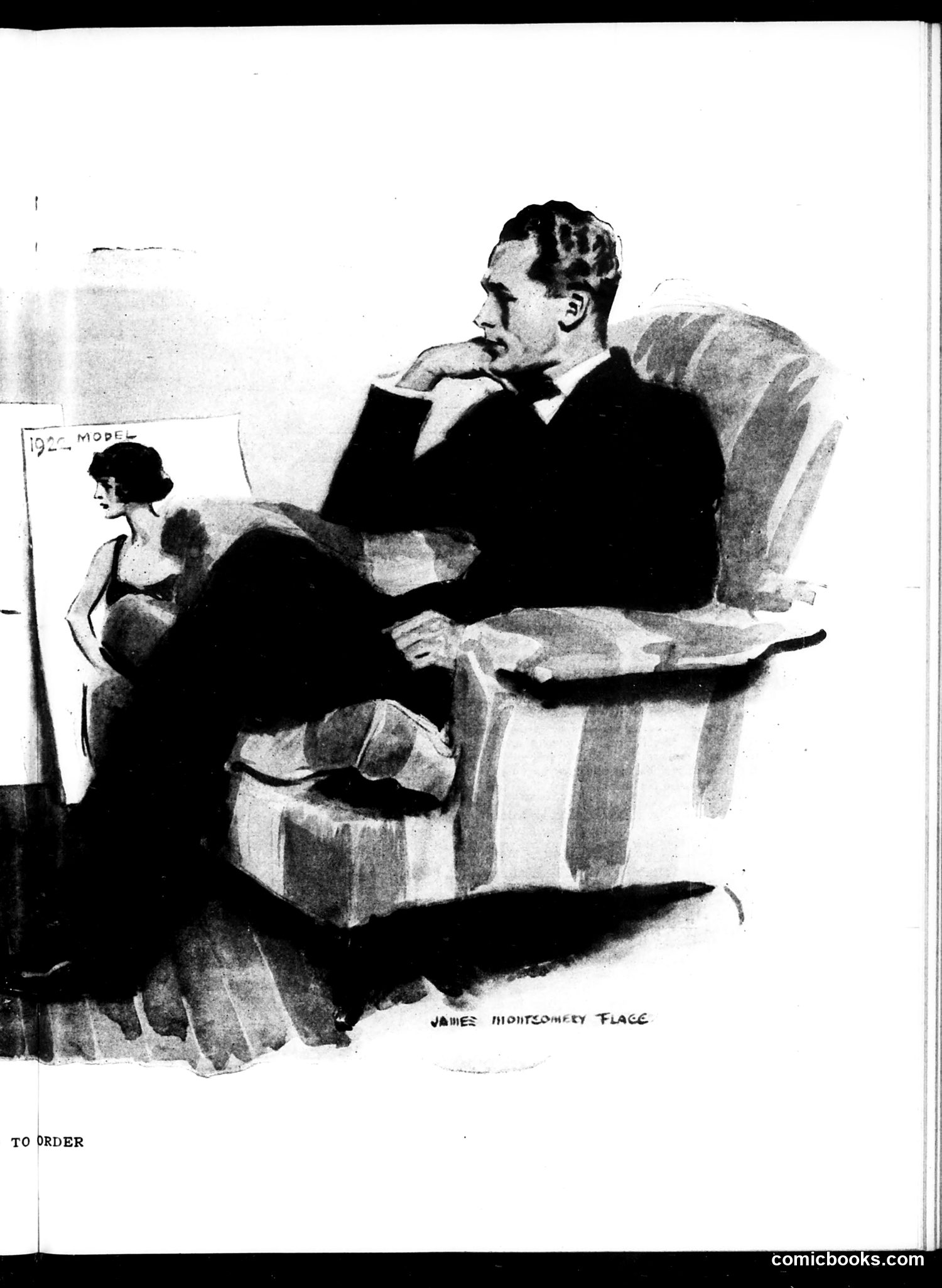
This appears to be a cartoon by James Montgomery Flagg depicting a well-dressed man reclining in a striped armchair, his hand to his chin in a contemplative pose. A woman in 1920s attire stands in the background near what's labeled "1922 MODEL." The satire likely comments on masculine leisure and comfort—the man's relaxed posture and fashionable setting suggest wealth and ease. The "1922 Model" reference to the woman implies she's being treated as a commodity or fashion item, much like an automobile model year. This reflects period satire about consumerism and the objectification of women in the 1920s. The specific political or social commentary remains unclear without additional context about Judge magazine's publication date and the particular issues it addressed.
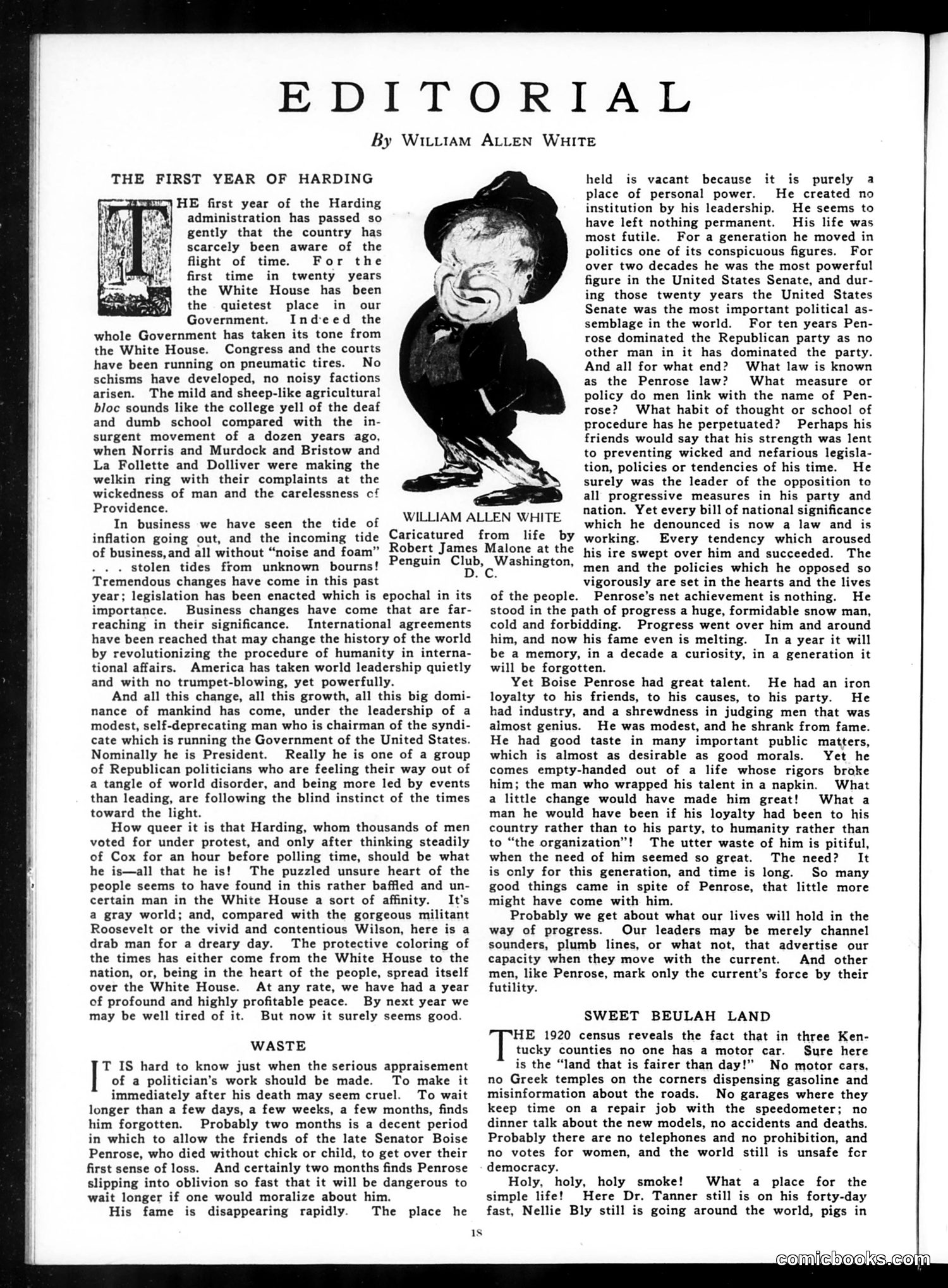
**The Cartoon:** The caricature depicts **William Allen White**, the famous journalist and editor, drawn by Robert James Malone. The exaggerated features—prominent nose, gnarled expression—are typical of Judge's satirical style. **The Content:** White's editorial praises President **Warren G. Harding's** first year (1921-1922) as remarkably quiet and peaceful compared to the turbulent Progressive Era politics of Theodore Roosevelt and Woodrow Wilson. White celebrates the lack of conflict, the smooth functioning of government, and major legislative/international achievements accomplished without fanfare. **The Satire:** The second piece, "Waste," critiques the recently deceased Senator **Boise Penrose**, a powerful Republican machine politician. White argues that despite Penrose's influence, he left no lasting institutional legacy—his power was purely personal and dies with him, making his career ultimately "waste." **The Point:** Together, these editorials suggest changing American politics: valuing quiet, effective governance over bombastic leadership; questioning whether political power without institutional achievement has real value.
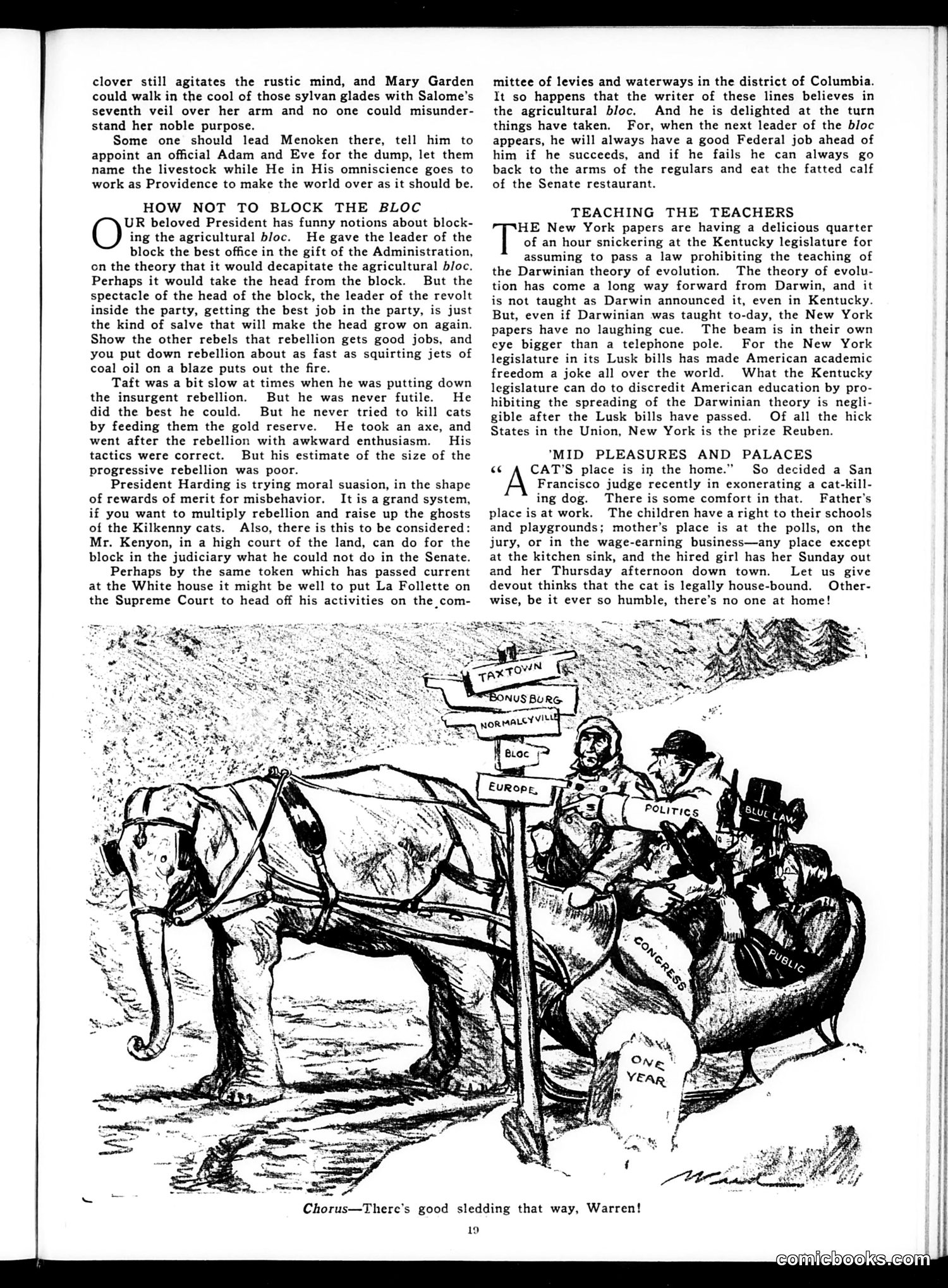
## Main Cartoon: "There's Good Sledding That Way, Warren!" This editorial cartoon criticizes President Harding's strategy for managing the "agricultural bloc"—a rebellious faction within his own Republican party. The image depicts an elephant (symbol of the Republican Party) being driven by figures labeled with political concerns (taxes, Europe, politics, bloc law, public opinion) while sledding toward destinations marked "Tax Town," "Musburg," "Normalville," and "Bloc." **The Satire:** The text explains Harding appointed agricultural bloc leader Henry Cantwell Wallace to a Cabinet position, hoping to neutralize the rebellion by co-opting its leader. Judge argues this backfires—by rewarding rebellion with prestigious office, Harding encourages further dissent rather than suppressing it. The cartoonist suggests Taft's harsher approach was more effective. The additional articles critique Kentucky's attempt to ban teaching evolution (while New York's Lusk bills are worse censorship) and discuss minor social issues.
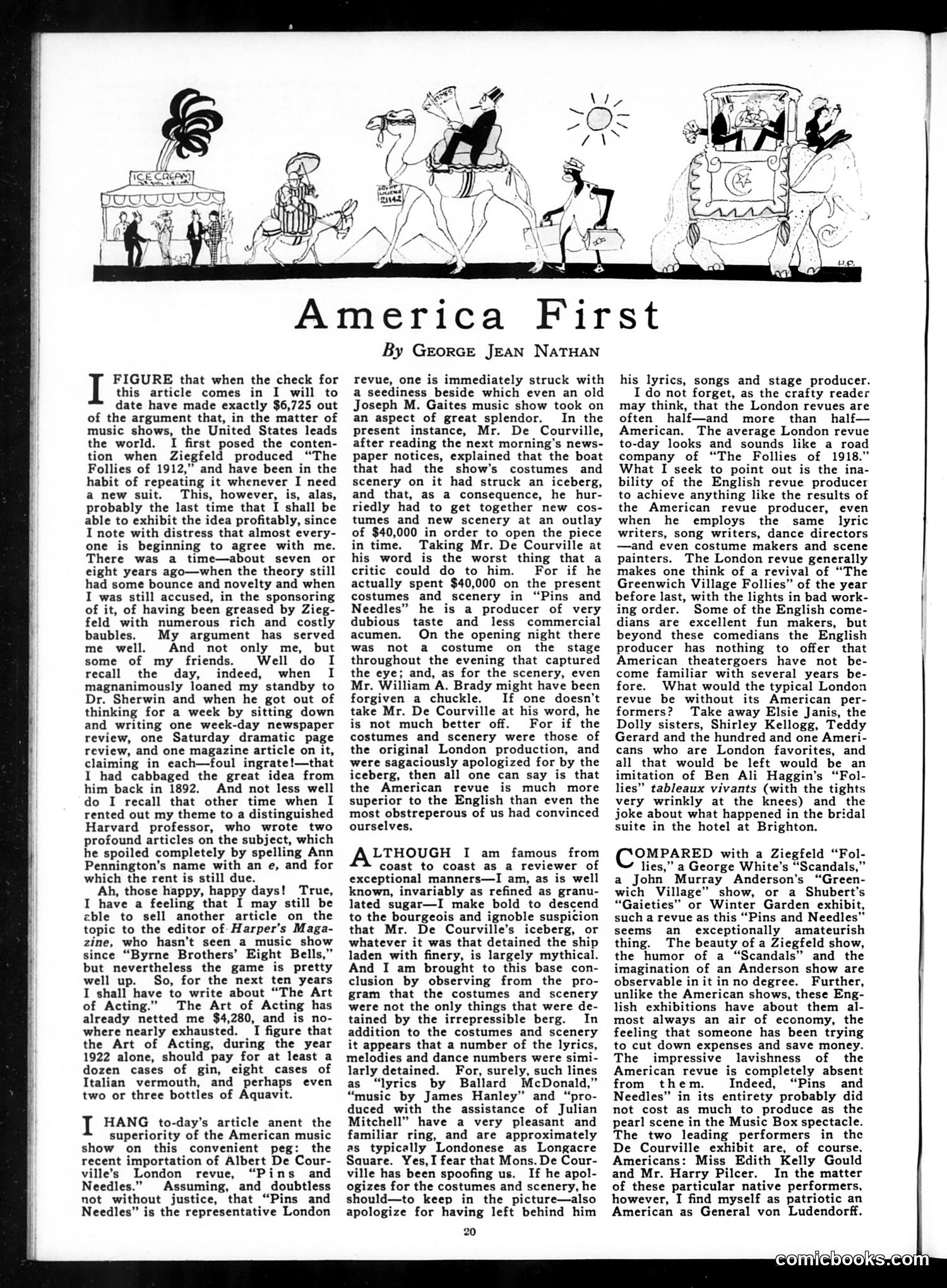
This is a theater critic's essay using a London revue's failure as a peg for arguing American musical theater's superiority. Nathan discusses "Pins and Needles," a recent British import by producer Albert De Courville, which he finds aesthetically mediocre. De Courville claimed an iceberg destroyed the original costumes and scenery, forcing $40,000 in replacements—but Nathan suspects this excuse masks the production's fundamental cheapness and poor taste. The essay's humor derives from Nathan's sardonic suggestion that either De Courville genuinely wasted $40,000 (proving incompetence) or he's lying (proving dishonesty). Nathan uses this imported failure to support his longstanding argument that American revues—particularly Ziegfeld's "Follies"—outshine English productions in ambition and execution. The piece reflects 1920s cultural nationalism and inter-Atlantic theatrical competition.
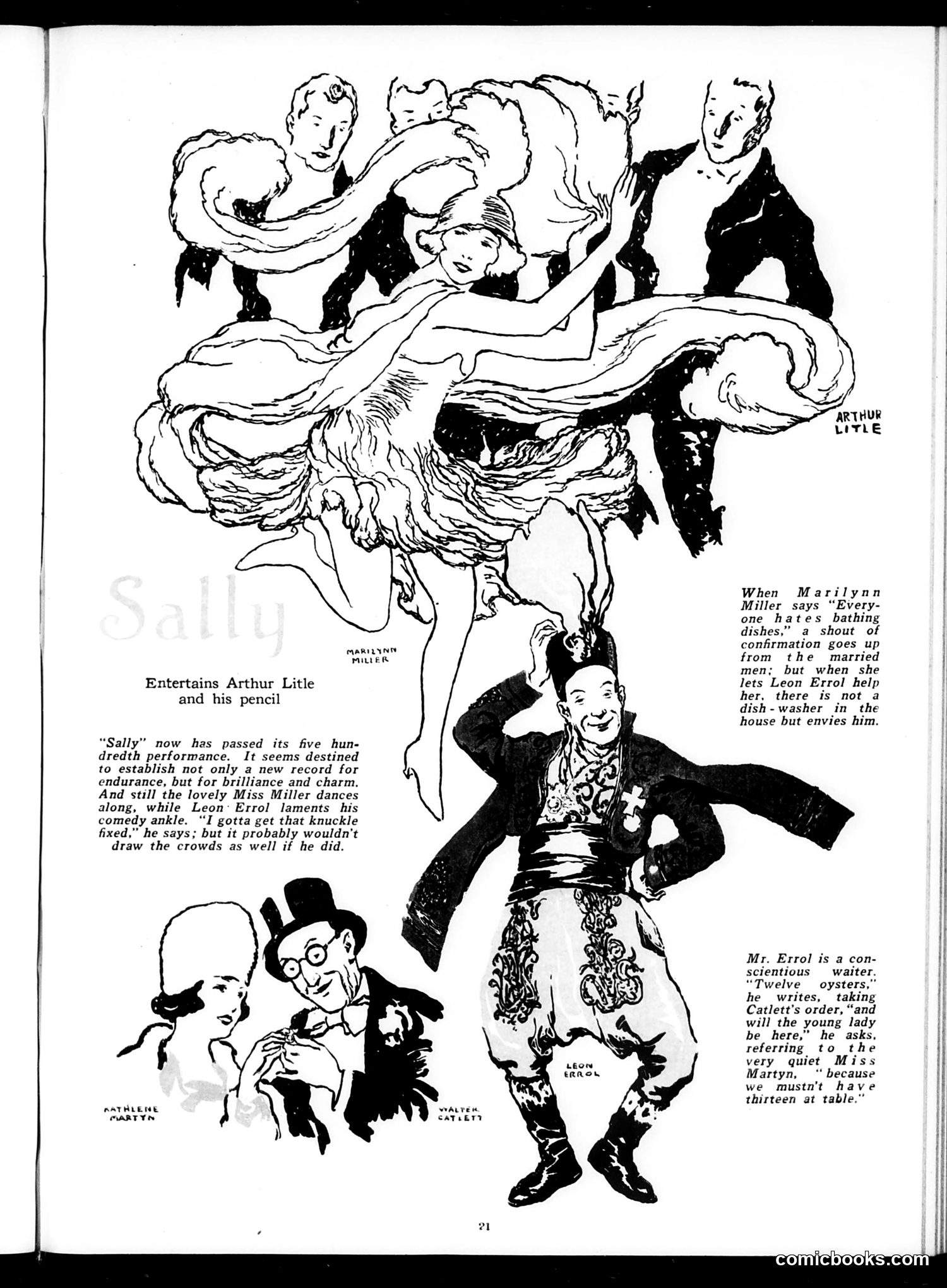
This page celebrates the Broadway musical "Sally," which has reached its 500th performance. The main figures are **Marilyn Miller** (the star dancer) and **Leon Errol** (comedian), shown in sketches by artist Arthur Little. The satire plays on gender dynamics and marriage: Miller's complaint that "everyone hates bathing dishes" gets sympathetic nods from married men—until Errol offers to help wash, at which point every unmarried dish-washer in town envies him. The joke mocks how women's domestic drudgery becomes suddenly appealing when a charming man participates. A secondary bit jokes about Errol's conscientiousness as a waiter: he carefully counts oysters to avoid the superstition of thirteen at table, particularly concerned about whether a quiet actress (Miss Martyn) will attend dinner. The overall tone is lighthearted theatrical gossip mixed with gentle ribbing about the show's romantic appeal and its stars' personalities.
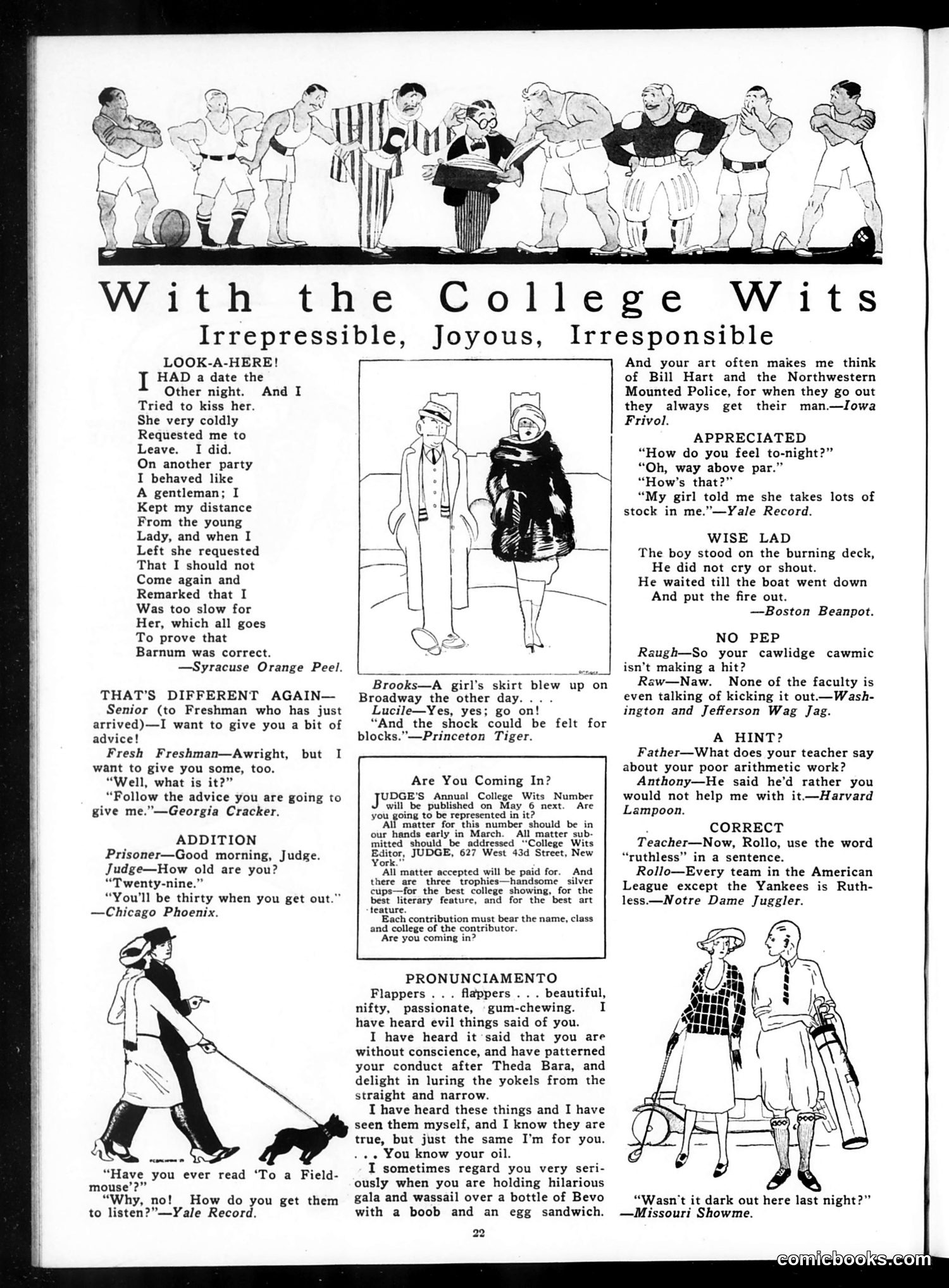
This page collects humorous anecdotes and jokes from college publications, reflecting 1920s campus culture. The header illustration shows various college types (athletes, dandies, etc.) in caricatured poses. **Key content:** The jokes satirize college student behavior and romantic mishaps. One recurring theme mocks dating etiquette—a senior advises a freshman to "follow the advice you are going to give me," suggesting college wisdom is contradictory and useless. The "Pronunciamento" section defends "flappers"—the modern young women of the era—against moral criticism, comparing their boldness to film actress Theda Bara and Western hero Bill Hart. This was timely social commentary; 1920s flappers scandalized conservative society with their dress, behavior, and independence. **References:** - "Bevo" (a non-alcoholic beer, relevant during Prohibition) - "Theda Bara" (silent film vamp actress) - Bill Hart (Western film star) - Ruth/Yankees baseball joke (contemporary sports reference) The page primarily showcases witty one-liners from various college humor magazines, treating dating, authority figures, and generational attitudes as comedy subjects.
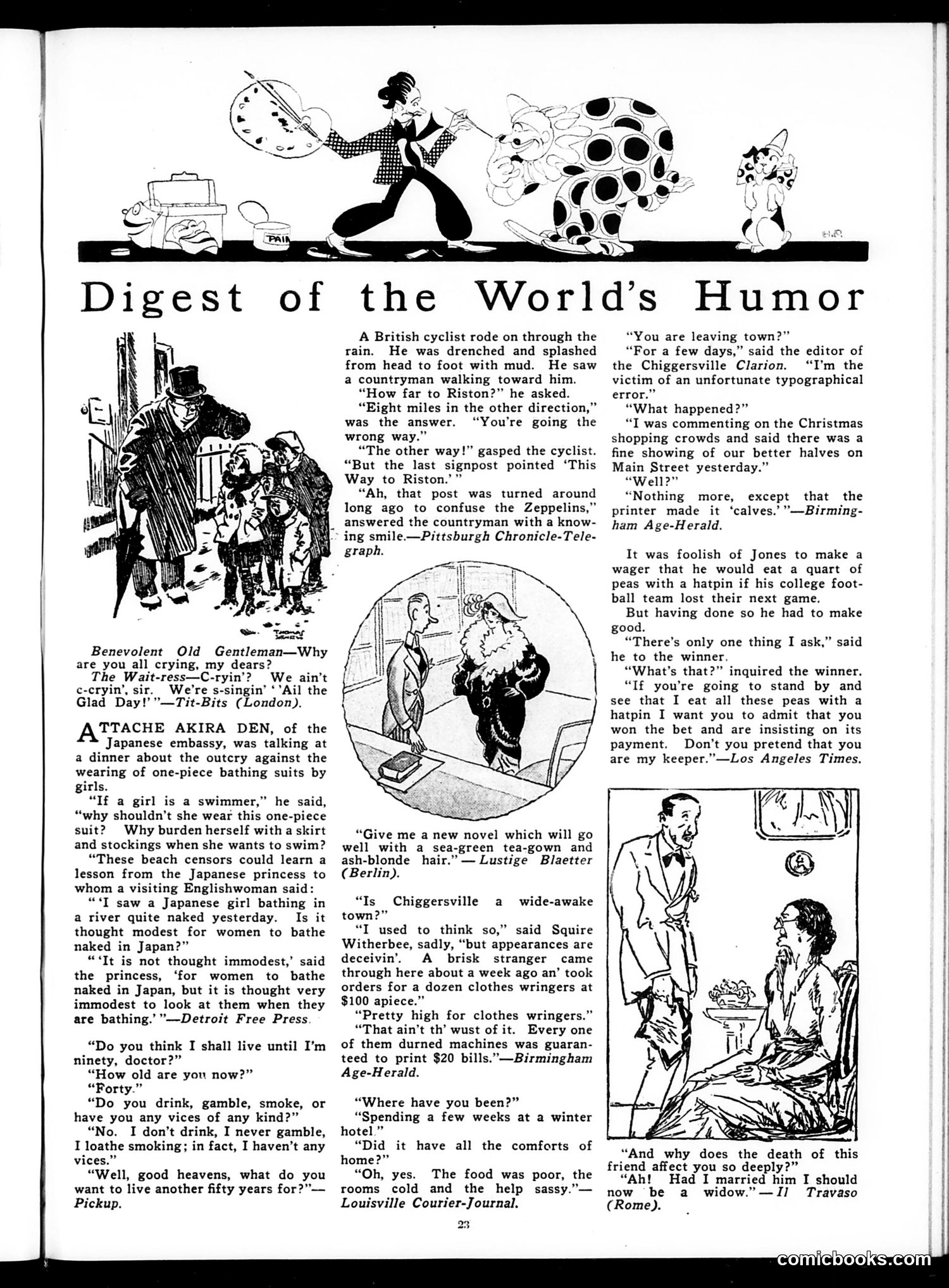
This page collects humorous anecdotes from newspapers worldwide, showcasing early 20th-century satirical sensibilities. Key recurring themes: **Social Commentary:** The bathing suit debate reflects genuine tension over women's modesty standards; the Japanese diplomat's story uses cultural comparison to mock prudish Western censorship. **WWI Context:** A signpost turned to "confuse the Zeppelins" references German airship raids, treating wartime anxiety with dark humor. **Small-town Americana:** Rural characters (Squire Witherbee, the editor) embody provincial life—gullible townspeople and local newspaper mishaps ("halves" vs. "calves" typo). **Class & Courtship:** Multiple jokes about marriage, gender relations, and romantic fortune-hunting typical of 1920s humor. The page demonstrates *Judge* magazine's function: reprinting international jokes to position American readers as cosmopolitan, while confirming stereotypes about backwards rural Americans and foreign eccentricity.
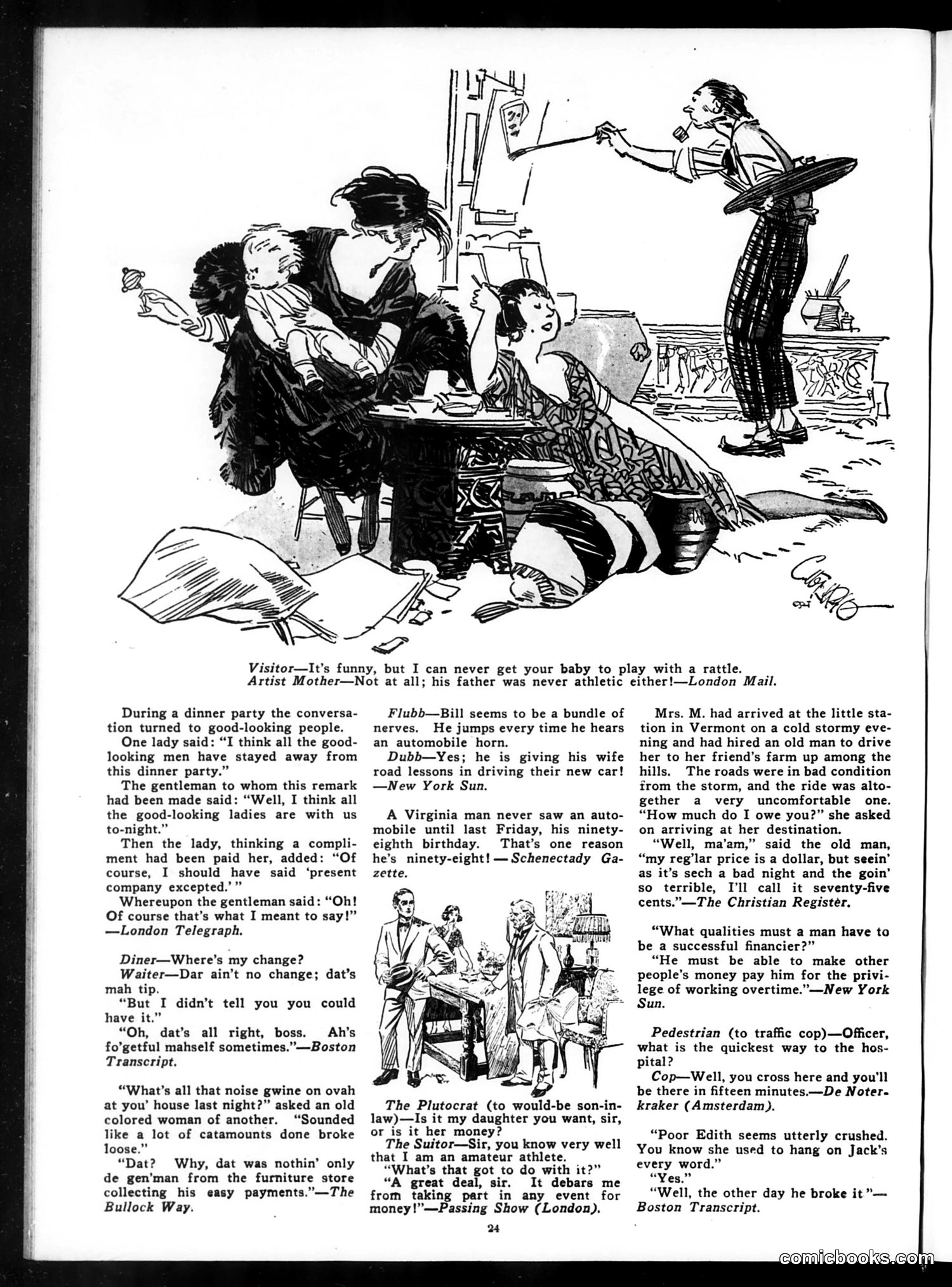
This page collects brief humorous anecdotes and jokes typical of early 20th-century satirical magazines. The main cartoon depicts a chaotic artist's studio where a visitor comments that the artist's baby won't play with a rattle. The artist's mother replies the child takes after his father, who was "never athletic either"—a gentle jab at artistic men's perceived lack of athleticism and masculinity. The surrounding text comprises short jokes on various social topics: awkward dinner party banter, tipping etiquette (with racial dialect humor common to the era), automobile anxiety, and marital dynamics. Several anecdotes mock the wealthy ("the Plutocrat"), automobile culture (still novel), and financial chicanery. The humor relies on wordplay, class observation, and social commentary typical of Judge's audience—educated, urban readers amused by middle and upper-class foibles. The racial dialect jokes reflect period attitudes now recognized as offensive stereotyping.
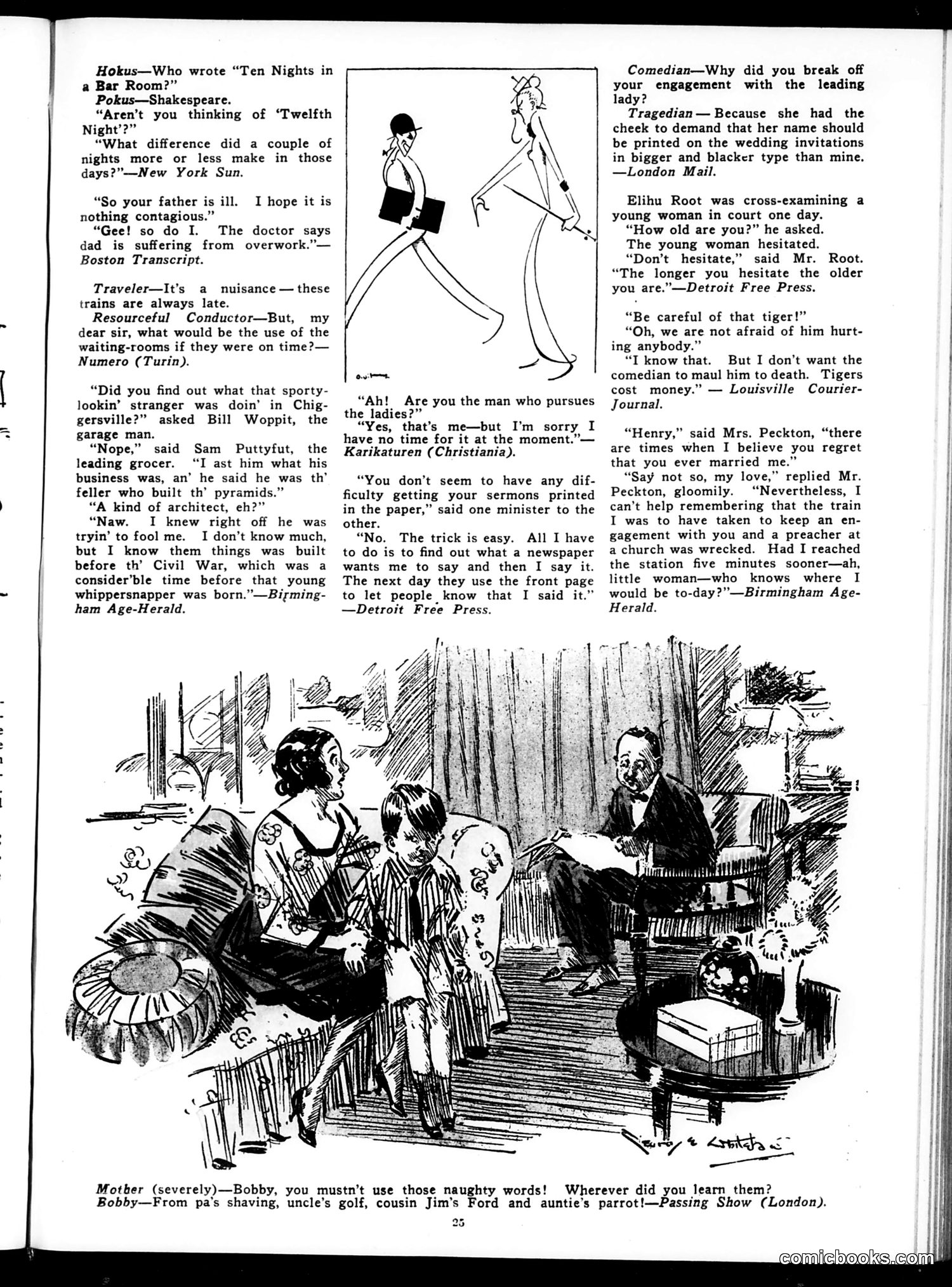
This page collects brief humorous anecdotes from various sources, primarily satirizing early 20th-century social conventions and human nature. **Key jokes:** - **Literary confusion**: A character confuses "Ten Nights in a Bar Room" with Shakespeare's "Twelfth Night"—mocking pretentious fake knowledge. - **Railroad logic**: A conductor justifies late trains by noting waiting rooms would be pointless if trains ran on time—absurdist corporate reasoning. - **Pyramid con**: Rural characters discuss a stranger claiming to have built the pyramids, humbling themselves by noting the pyramids predate the Civil War. - **Ministerial hypocrisy**: A minister admits he simply tells newspapers what they want to hear, then they publicize his words—satirizing clergy and press collusion. - **Bobby's language**: A child learns profanity from adult activities (shaving frustration, golf, Ford car troubles, parrots)—commentary on how modern life corrupts innocence. The final illustration shows a domestic scene. These are satirical observations on vanity, hypocrisy, and social absurdity typical of Judge's humor.
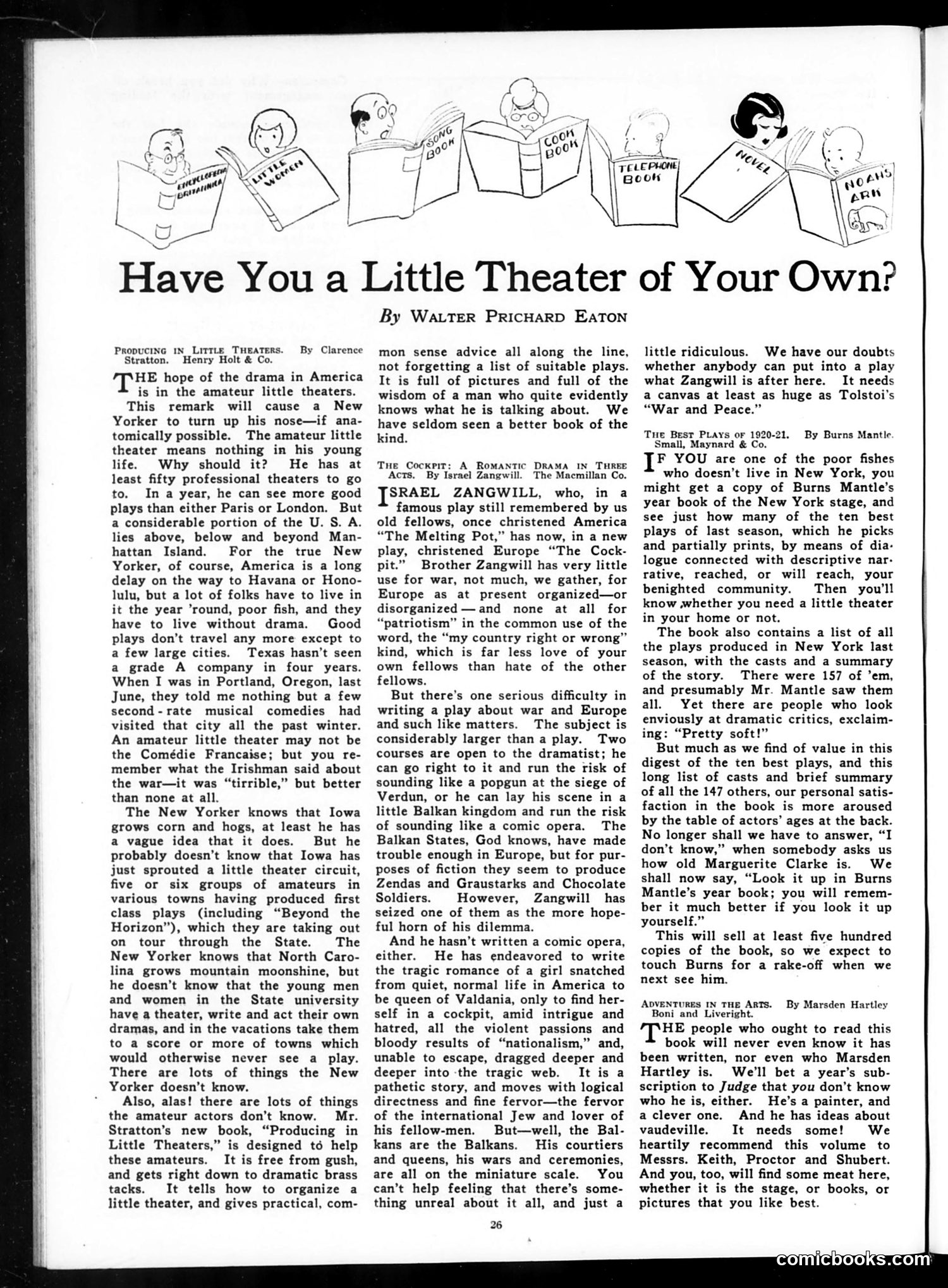
The header illustration depicts seven figures reading various books and publications, representing different demographics engaging with theatrical literature and drama criticism. The page consists primarily of two book reviews by Walter Prichard Eaton: 1. **"Producing in Little Theaters"** by Clarence Stratton — a practical guide for amateur theater organizations outside major cities. Eaton praises it as sensible and useful, noting that while New York has professional theaters, most Americans lack access to quality drama. He cites examples of amateur circuits in Iowa and North Carolina as evidence of theater's importance beyond Manhattan. 2. **"The Cockpit"** by Israel Zangwill — a three-act play about war and European politics. Eaton critiques Zangwill's ambitious anti-war theme, noting the dramatic challenge: depicting large-scale European conflict risks sounding ineffectual, while setting it in a fictional Balkan kingdom invites comic-opera comparisons—a problematic approach given the Balkans' real historical troubles. The content reflects early 20th-century cultural anxiety about arts access and America's geographic divide between cosmopolitan centers and provincial towns.
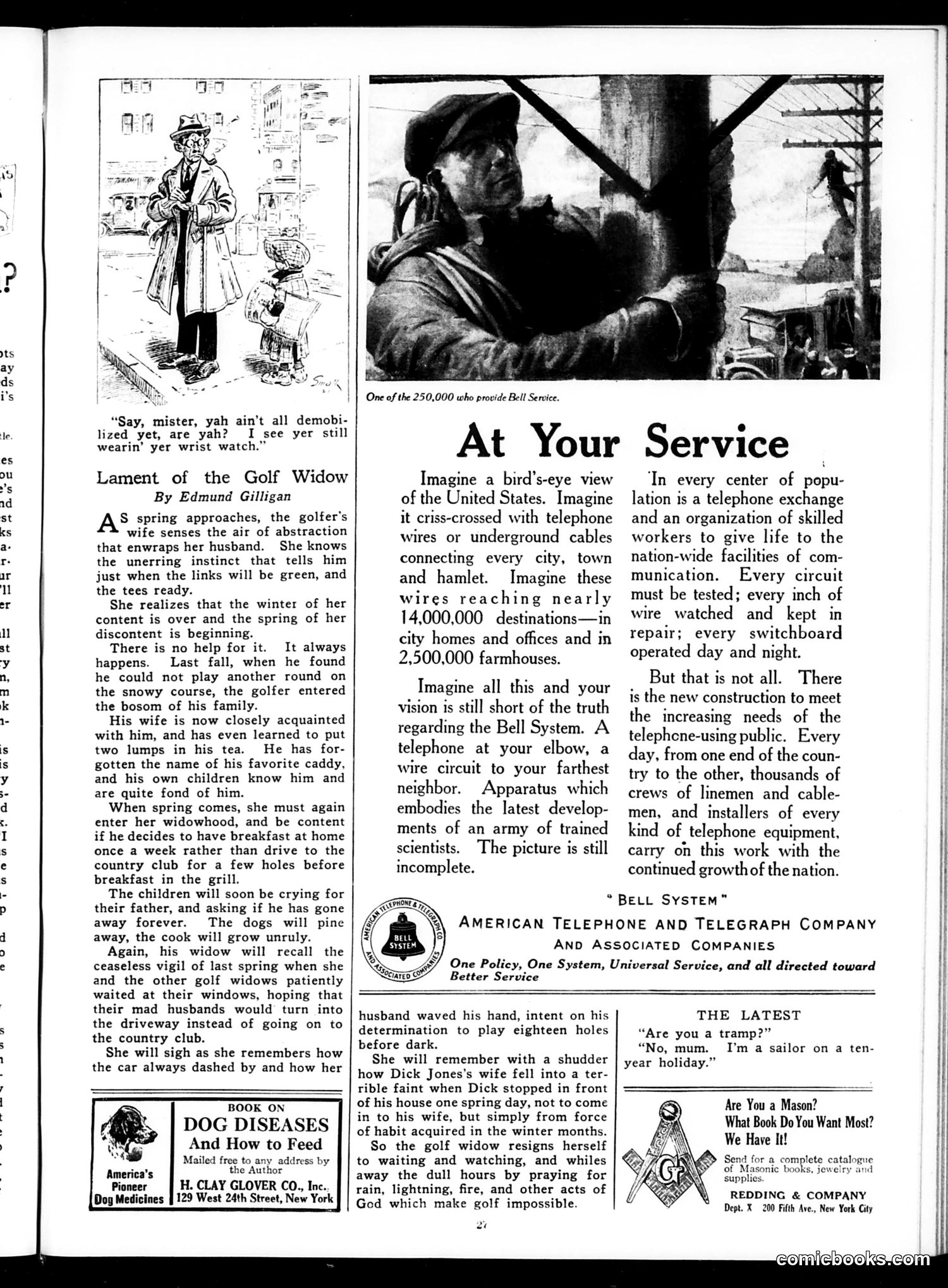
This page contains two distinct pieces: **Left: "Lament of the Golf Widow"** — A humorous short story satirizing the seasonal neglect wives suffered when spring golf season arrived. The joke is that husbands, indifferent to their families during winter, abandon domestic life to play golf. The opening cartoon shows a demobilized soldier still wearing his wrist watch—a joke about soldiers reluctant to shed military habits after WWI. **Right: "At Your Service"** — A Bell System (AT&T) advertisement celebrating the telephone network's scale and the workers maintaining it. This appears designed to boost public confidence in telephone infrastructure and the skilled labor workforce, likely appealing to post-WWI American pride in technological progress and employment. The page juxtaposes satirical social commentary with corporate messaging typical of Judge magazine's mix of humor and advertising revenue.
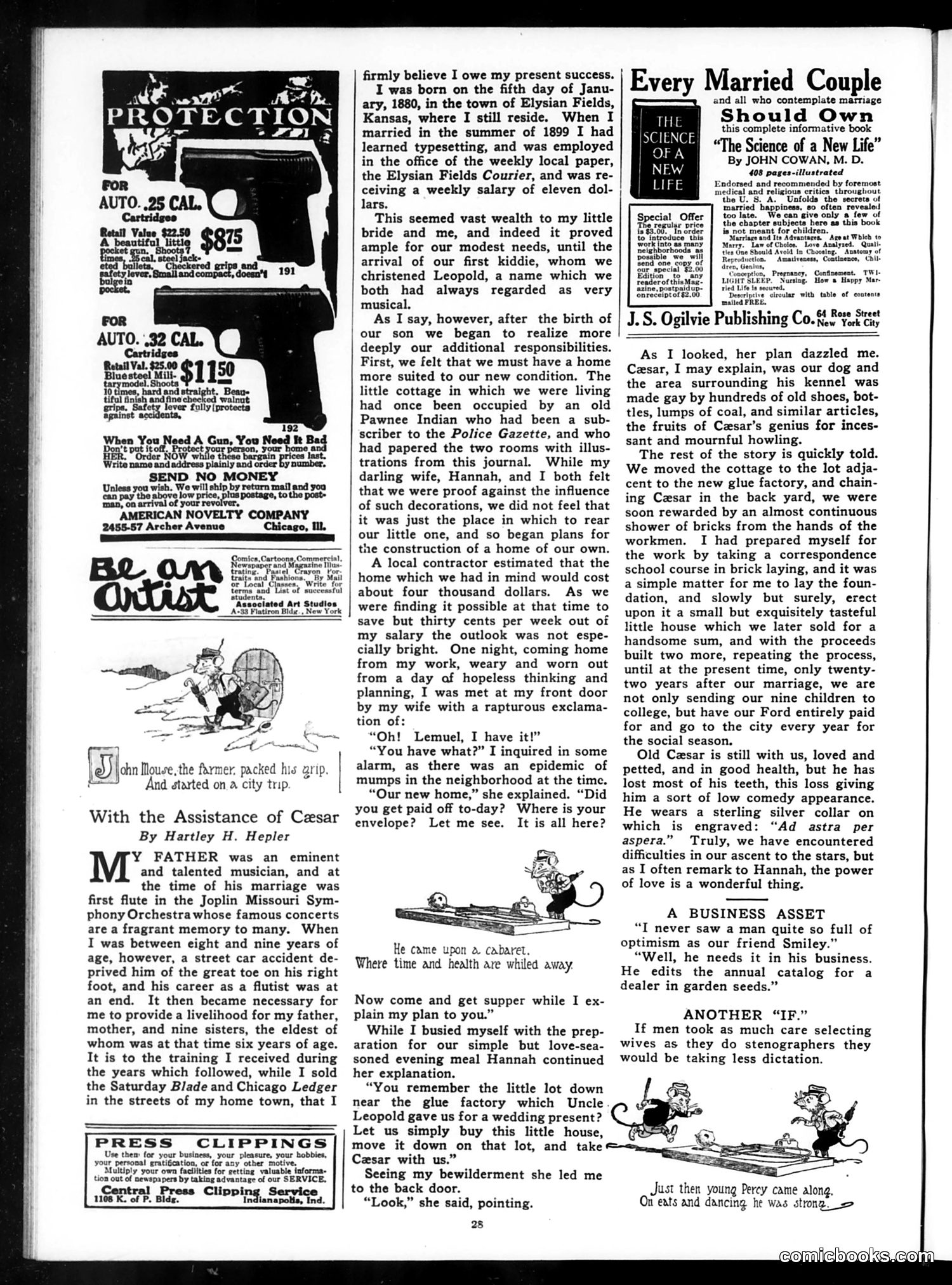
This page contains a serialized story by Hartley H. Hepler about a working-class man named Lemuel who must support his family after his musician father loses his foot in a streetcar accident. The narrative describes Lemuel's modest life: selling newspapers as a child, earning eleven dollars weekly as a typesetter, and later struggling to afford a home for his wife Hannah and son Leopold. The story illustrates early 20th-century American working-class hardship and resourcefulness. Hannah's sudden exclamation—"Oh! Lemuel, I have it!"—suggests she's devised a financial solution, likely involving the undeveloped lot near a glue factory they received as a wedding gift. The accompanying advertisements (for guns, art instruction, and press clipping services) and illustrations are typical Judge magazine filler. The story's title reference to "Cesar" (their dog, mentioned later) suggests humor derived from humble circumstances and domestic life rather than political satire.
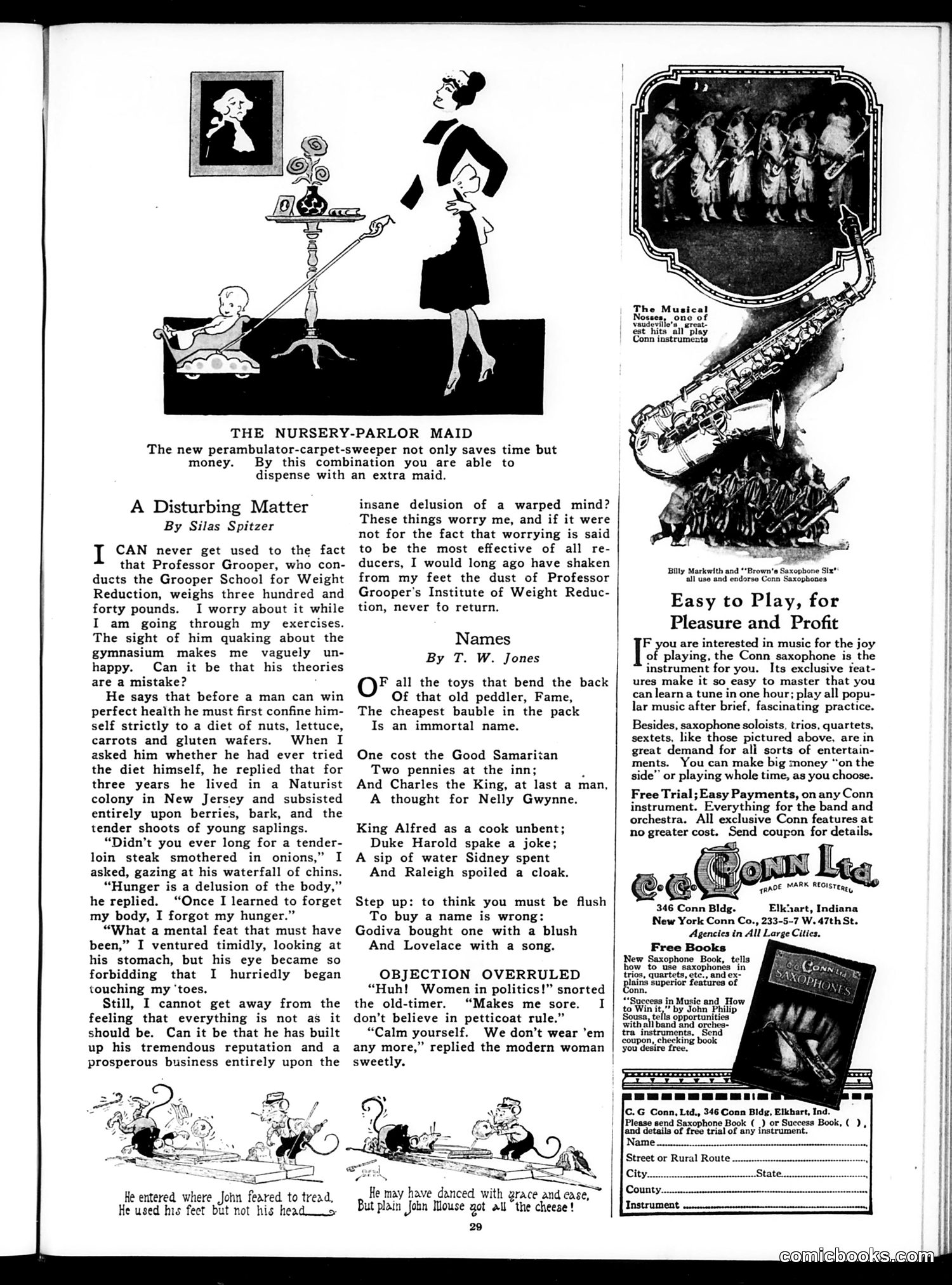
**The Top Cartoon: "The Nursery-Parlor Maid"** This satirizes labor-saving inventions marketed to middle-class households. A woman demonstrates a combination perambulator-carpet-sweeper device, implying it eliminates the need to hire an extra servant. The joke targets both the absurdity of the "invention" and anxieties about domestic labor costs—suggesting wealthy households could replace workers with gadgets. **"A Disturbing Matter"** A humorous essay mocking fad dieting and fitness culture. Professor Grooper runs a weight-reduction institute but weighs 340 pounds himself, having previously lived on berries and tree shoots. The satire questions whether his authority is legitimate or based on "insane delusion," poking fun at unqualified health gurus. **"Names" & "Objection Overruled"** Brief poetry and dialogue satirizing fame and women's rights. The latter features a dismissive old man objecting to "women in politics," countered by a modern woman noting women no longer wear petticoats—a sharp comeback suggesting outdated gender attitudes. The page also contains advertisements for Conn saxophones and musical instruments.
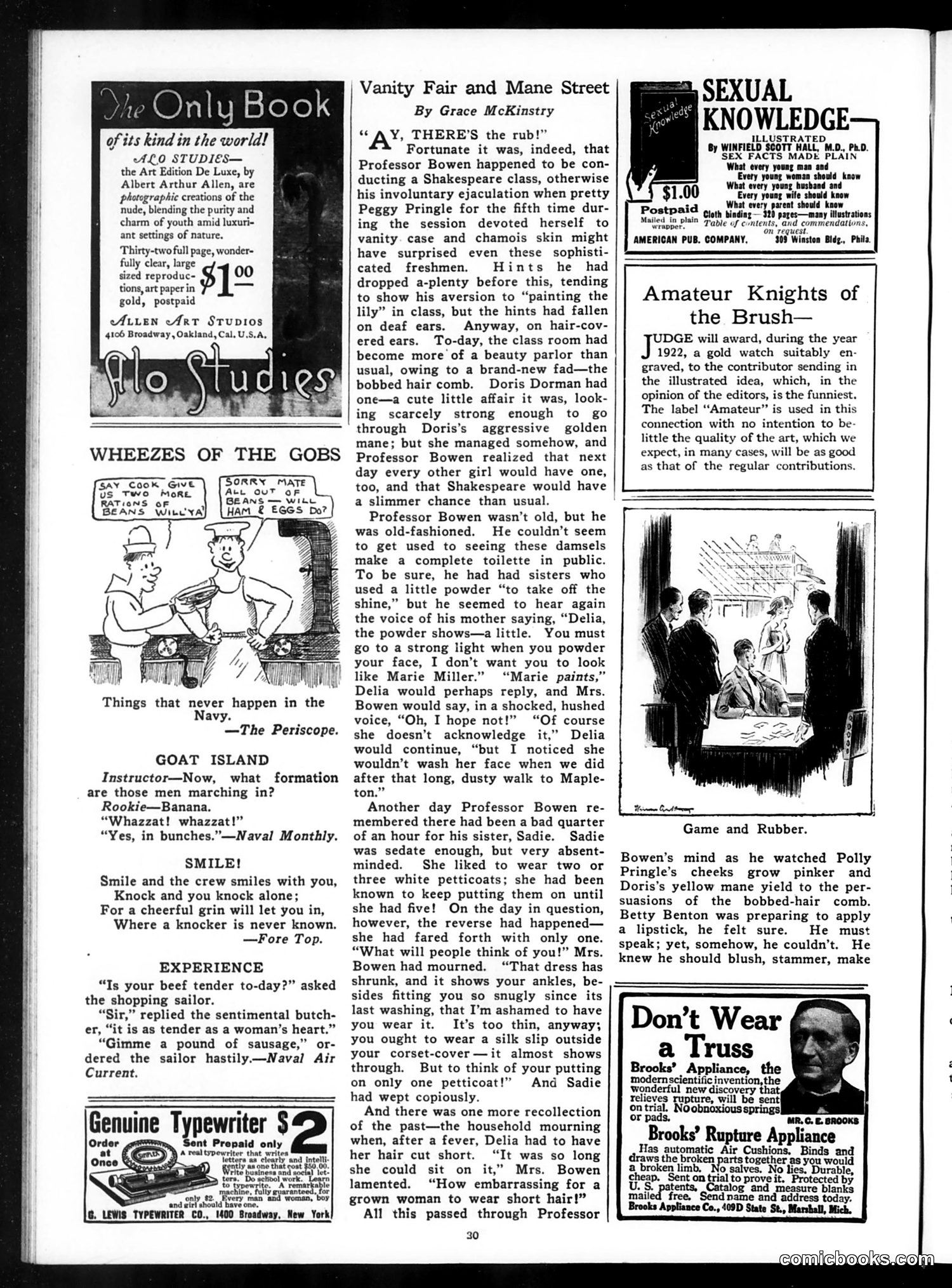
This is a satirical short story rather than a political cartoon, appearing in *Judge* magazine's humor section. It mocks early 1920s women's vanity and changing social norms, specifically the "bobbed hair" trend and public makeup application. **The Setup:** Professor Bowen, an old-fashioned Shakespeare instructor, is exasperated when his female students—particularly Peggy Pringle and Doris Dorman—openly use compact mirrors and hair combs during class, treating the classroom like a beauty parlor. **The Satire:** The humor targets both the women's frivolous behavior and the Professor's prudish disapproval. Through nostalgic anecdotes about his mother scolding his sister for powder use and overly tight dresses, McKinstry contrasts Victorian-era propriety with 1920s casualness about appearance and grooming. **Social Context:** The "bobbed hair comb" reference reflects actual 1920s anxieties about women's increasing independence, fashion freedom, and public self-presentation—coded as moral decline by conservative readers. The piece gently mocks both generations: the modern girls' narcissism and the older generation's prudishness.
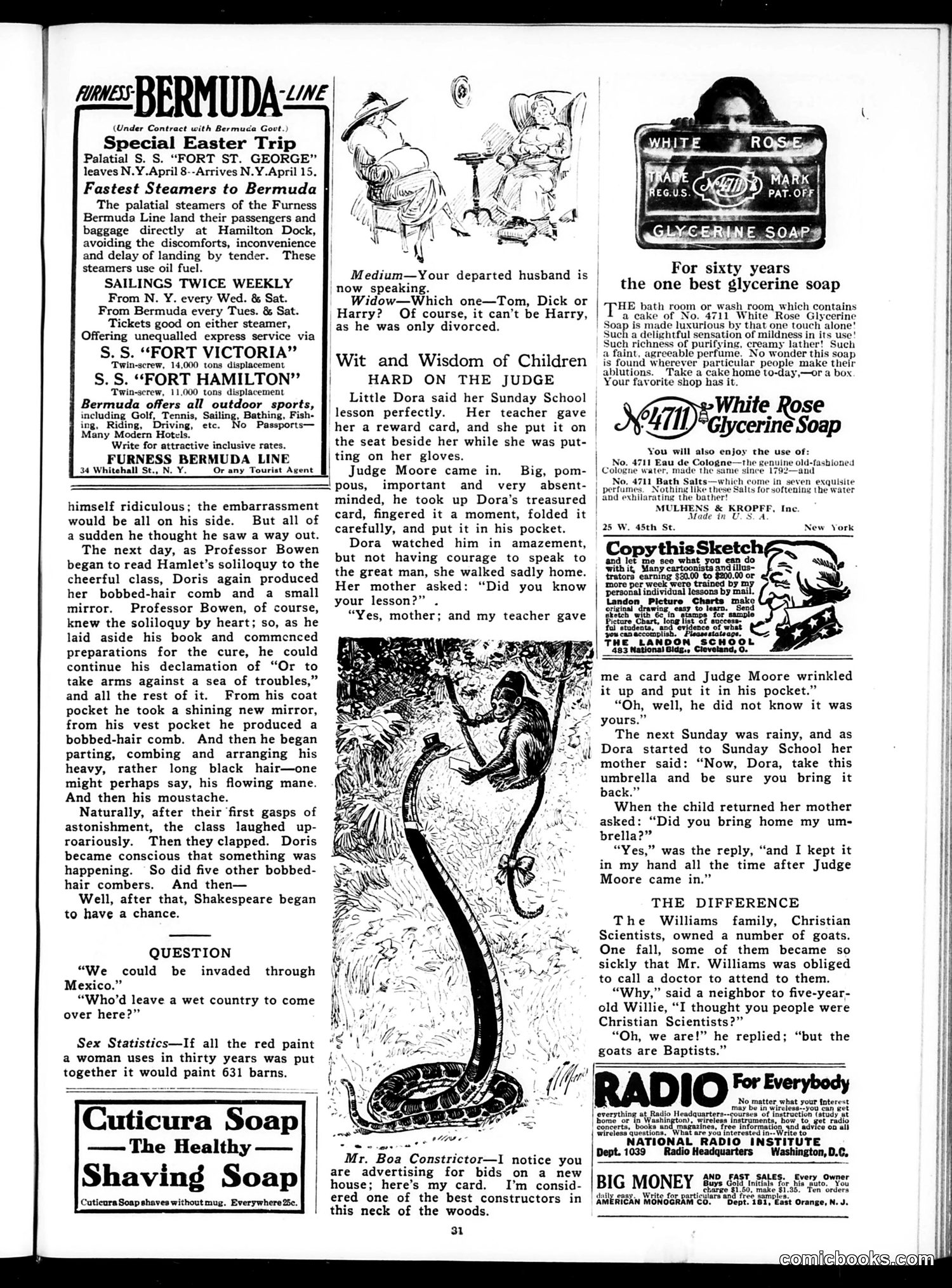
This page from *Judge* contains mostly **advertising and light humor** rather than political satire. The main content includes: - **Shipping advertisements** for Bermuda cruises (Furness Line) - **Product ads** for White Rose Glycerine Soap and Cuticura Shaving Soap - **Humorous anecdotes** with gentle social commentary: - A story about a student (Dora) disrupting Hamlet class with a bobbed-hair comb; the professor outwits her by grooming himself during the soliloquy, shaming the disruptive students into silence. This satirizes both **1920s flapper fashion** (bobbed hair) and classroom discipline. - A joke about a widow with multiple ex-husbands - A story where a pompous judge steals a child's reward card, making him look foolish - A quip about a boa constrictor advertising construction services The cartoons and humor target **vanity, pretension, and social awkwardness** rather than specific political figures. The page reflects 1920s concerns about changing youth culture and modern manners.
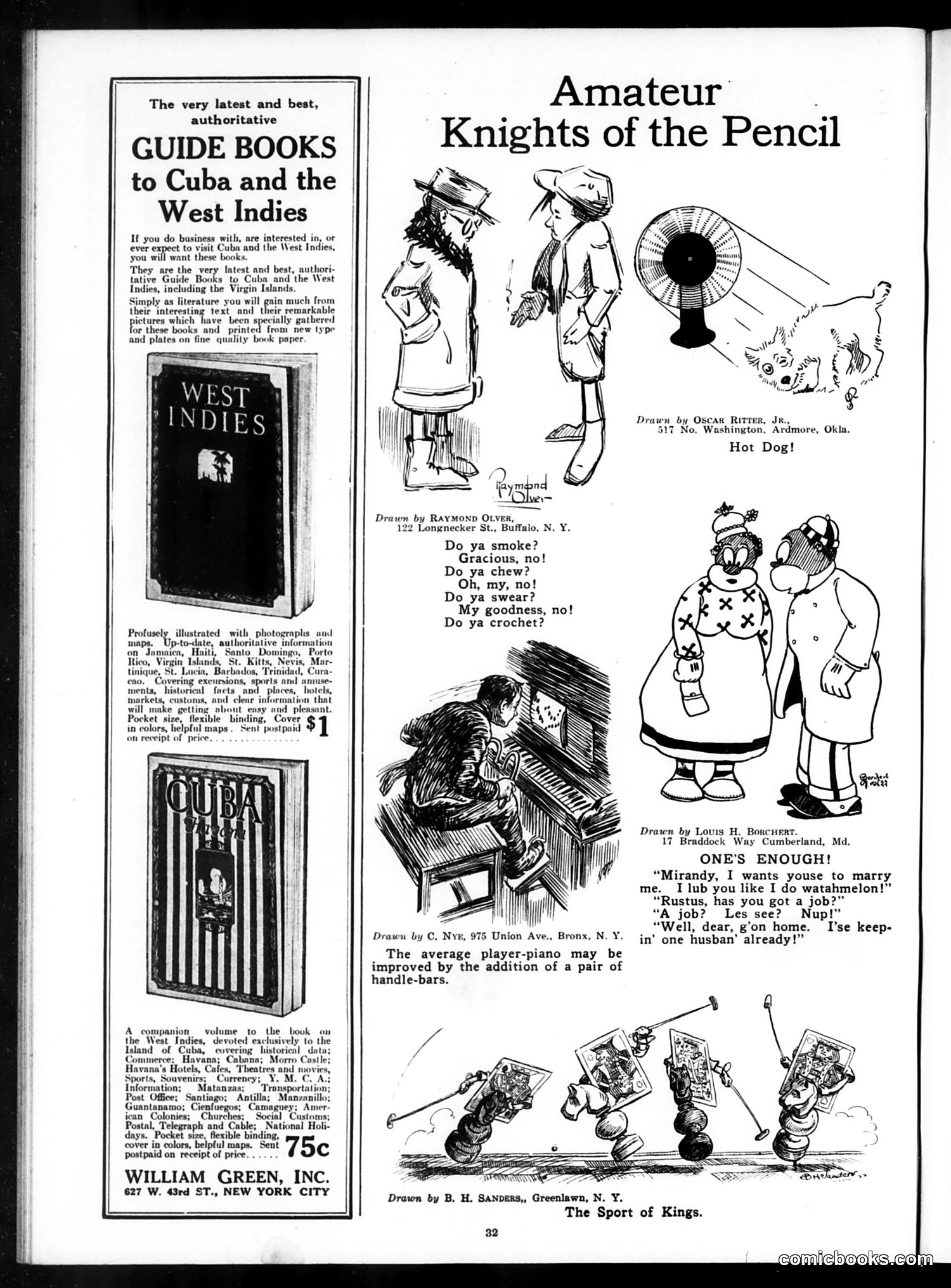
This page showcases humorous cartoons submitted by amateur artists to *Judge* magazine. The sketches employ period stereotypes and comedic tropes: **"Hot Dog!"** depicts two figures discussing food—likely commentary on casual dining culture. **"One's Enough!"** uses dialect humor (African American vernacular) in a comedic courtship scene where a man proposes to "Mirandy," emphasizing poverty and lack of employment as obstacles to marriage. **"The Sport of Kings"** shows figures playing croquet, a leisure activity associated with upper-class recreation—the title sarcastically elevates a genteel sport. The cartoons reflect early-20th-century *Judge* sensibilities: reliance on ethnic/class-based humor, slapstick situations, and gentle social observation. The "Amateur Knights of the Pencil" title celebrates reader-submitted cartoons, a common magazine practice. Modern readers would note the casual prejudices embedded in the humor and the limited diversity of comedic subjects.
This page is **advertising for Leslie's Weekly magazine**, not a political cartoon. It promotes the March 4 issue through a melodramatic advertisement for a serialized story called "If Pearls Could Speak" by Atreus von Schrader. The ad uses sensationalist language typical of early 20th-century pulp fiction—exotic South Sea settings, romance, jealousy, and passion—to entice readers. The pearl serves as a cursed MacGuffin connecting a "bronzed native youth" and "golden-bodied girl" across worlds from tropical island to "civilized" society. The page also highlights other magazine content: "The Baseball Draft" about league competition for players, and Theodore Waters' series "The Disabiliteers" about insurance fraud schemes. The pricing ($0.10 per copy; $5/year subscription) reflects early-1900s magazine economics. This is fundamentally **commercial promotion** using melodrama and serialization as hooks—no satire or political commentary appears present.
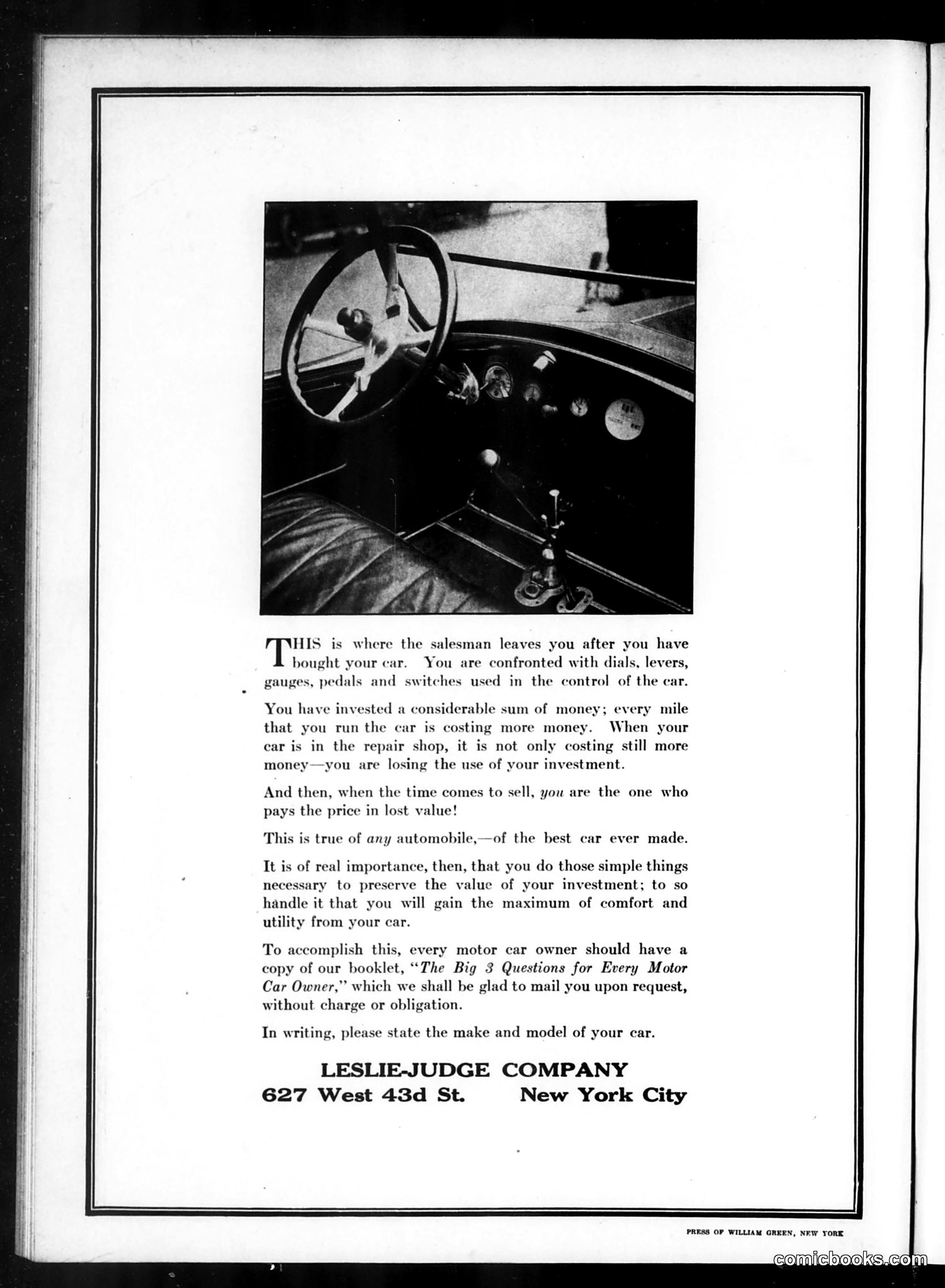
This is a **product advertisement**, not a satirical cartoon. The Leslie-Judge Company uses a photograph of a car's interior dashboard to market a free booklet titled "The Big 3 Questions for Every Motor Car Owner." The appeal targets car owners' anxieties about their automotive investment. The ad emphasizes that cars constantly depreciate ("every mile that you run the car is costing more money") and lose value during repairs. The booklet supposedly teaches owners how to preserve their car's condition and resale value through proper maintenance and handling. This represents early automotive consumer culture—when car ownership was still relatively new and consumers needed guidance on vehicle upkeep. The Leslie-Judge Company (publishers of *Judge* magazine) leveraged their satirical platform to offer practical advice, positioning themselves as helpful authorities to anxious middle-class car owners concerned about protecting their investment.