
Judge, 1922-03-04 · page 13 of 38
Judge — March 4, 1922 — page 13: what you’re looking at
What you’re looking at
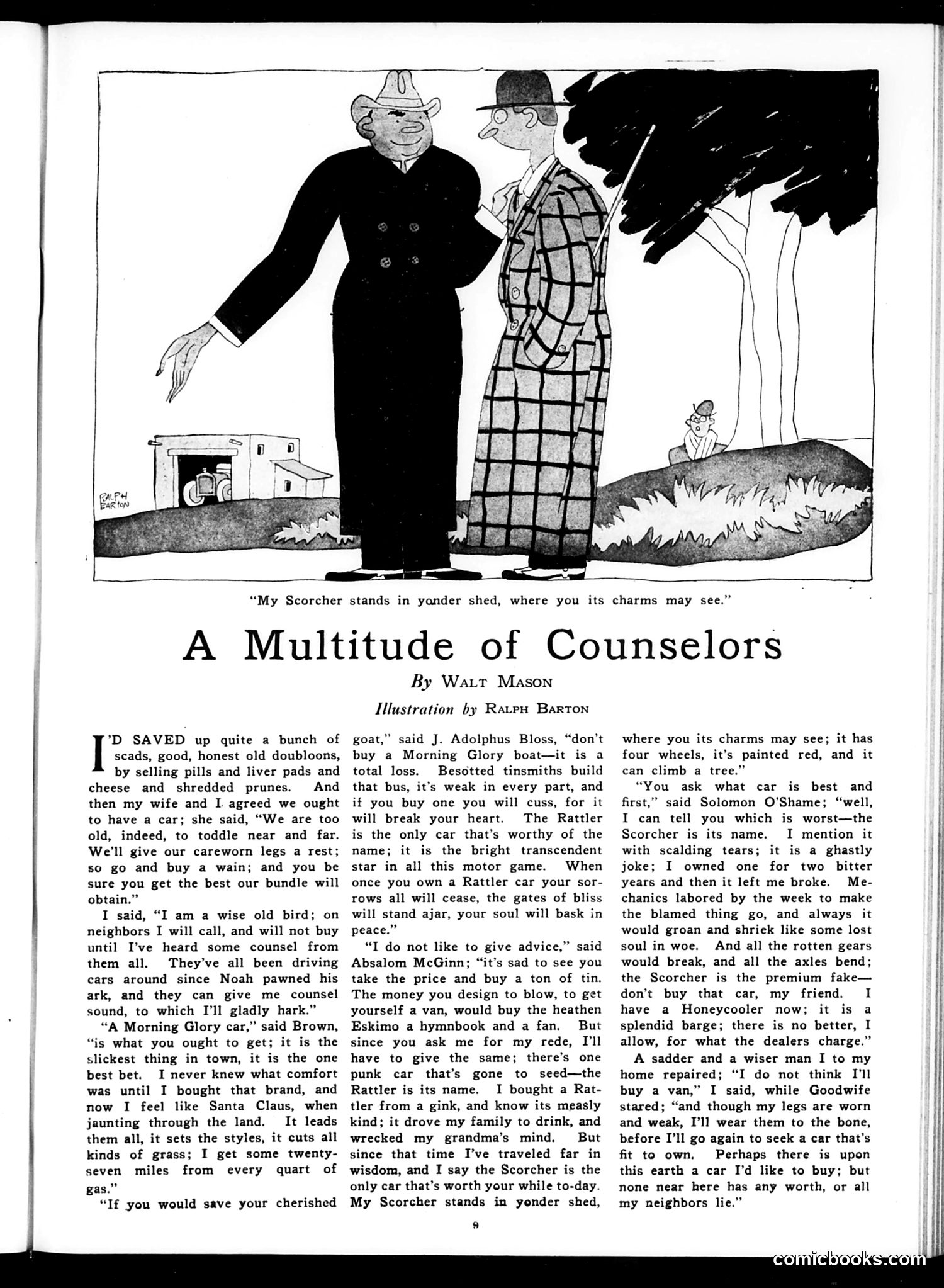
This satirical story mocks the unreliability of neighborly advice during the early automobile era. An elderly couple decides to buy a car and solicits recommendations from neighbors, each championing a different brand: Brown praises the "Morning Glory," Bloss pushes the "Rattler," McGinn endorses the "Scorcher," and O'Shame condemns the Scorcher while promoting the "Honeycooler." The joke is that these advisors contradict each other completely—the same car praised by one is savagely criticized by another. The protagonist, overwhelmed by conflicting counsel, abandons the plan entirely, deciding to keep walking rather than trust any of them. The satire targets both the proliferation of untested automobile brands of that era and the human tendency to give confident, contradictory advice based on personal bias rather than objective facts. The title references the biblical proverb about "multitude of counselors," implying that more opinions don't guarantee better decisions.
📄 Transcribed text from this page (OCR, searchable)
Machine-transcribed from the original scan — historical spelling and the odd misread are preserved.
“My Scorcher stands in yander shed, where you its charms may see.” scads, good, honest old doubloons, by selling pills and liver pads and cheese and shredded prunes. And then my wife and I. agreed we ought to have a car; she said, “We are too old, indeed, to toddle near and far. We'll give our careworn legs a rest; so go and buy a wain; and you be sure you get the best our bundle will obtain.” I said, “I am a wise old bird; on neighbors I will call, and will not buy until I’ve heard some counsel from them all. They’ve all been driving cars around since Noah pawned his ark, and they can give me counsel sound, to which I’ll gladly hark.” “A Morning Glory car,” said Brown, “is what you ought to get; it is the slickest thing in town, it is the one best bet. I never knew what comfort was until I bought that brand, and now I feel like Santa Claus, when jaunting through the land. It leads them all, it sets the styles, it cuts all kinds of grass; I get some twenty- seven miles from every quart of gas. “If you would save your cherished |: SAVED up quite a bunch of By Wart Mason Illustration by RatpH Barton goat,” said J. Adolphus Bloss, “don't buy a Morning Glory boat—it is a total loss. Besotted tinsmiths build that bus, it’s weak in every part, and if you buy one you will cuss, for it will break your heart. The Rattler is the only car that’s worthy of the name; it is the bright transcendent star in all this motor game. When once you own a Rattler car your sor- rows all will cease, the gates of bliss will stand ajar, your soul will bask in peace.” “I do not like to give advice,” said Absalom McGinn; “it’s sad to see you take the price and buy a ton of tin. The money you design to blow, to get yourself a van, would buy the heathen Eskimo a hymnbook and a fan. But since you ask me for my rede, I'll have to give the same; there’s one punk car that’s gone to seed—the Rattler is its name. I bought a Rat- tler from a gink, and know its measly kind; it drove my family to drink, and wrecked my grandma’s mind. But since that time I’ve traveled far in wisdom, and I say the Scorcher is the only car that’s worth your while to-day. My Scorcher stands in yonder shed, 9 Multitude of Counselors where you its charms may see; it has four wheels, it’s painted red, and it can climb a tree.” “You ask what car is best and first,” said Solomon O’Shame; “well, I can tell you which is worst—the Scorcher is its name. I mention it with scalding tears; it is a ghastly joke; I owned one for two bitter years and then it left me broke. Me- chanics labored by the week to make the blamed thing go, and always it would groan and shriek like some lost soul in woe. And all the rotten gears would break, and all the axles bend; the Scorcher is the premium fake— don’t buy that car, my friend. I have a Honeycooler now; it is a splendid barge; there is no better, I allow, for what the dealers charge.” A sadder and a wiser man I to my home repaired; “I do not think I'll buy a van,” I said, while Goodwife stared; “and though my legs are worn and weak, I’ll wear them to the bone, before I’ll go again to seek a car that's fit to own. Perhaps there is upon this earth a car I'd like to buy; but none near here has any worth, or all my neighbors lie.”