
Judge, 1922-03-04 · page 28 of 38
Judge — March 4, 1922 — page 28: what you’re looking at
What you’re looking at
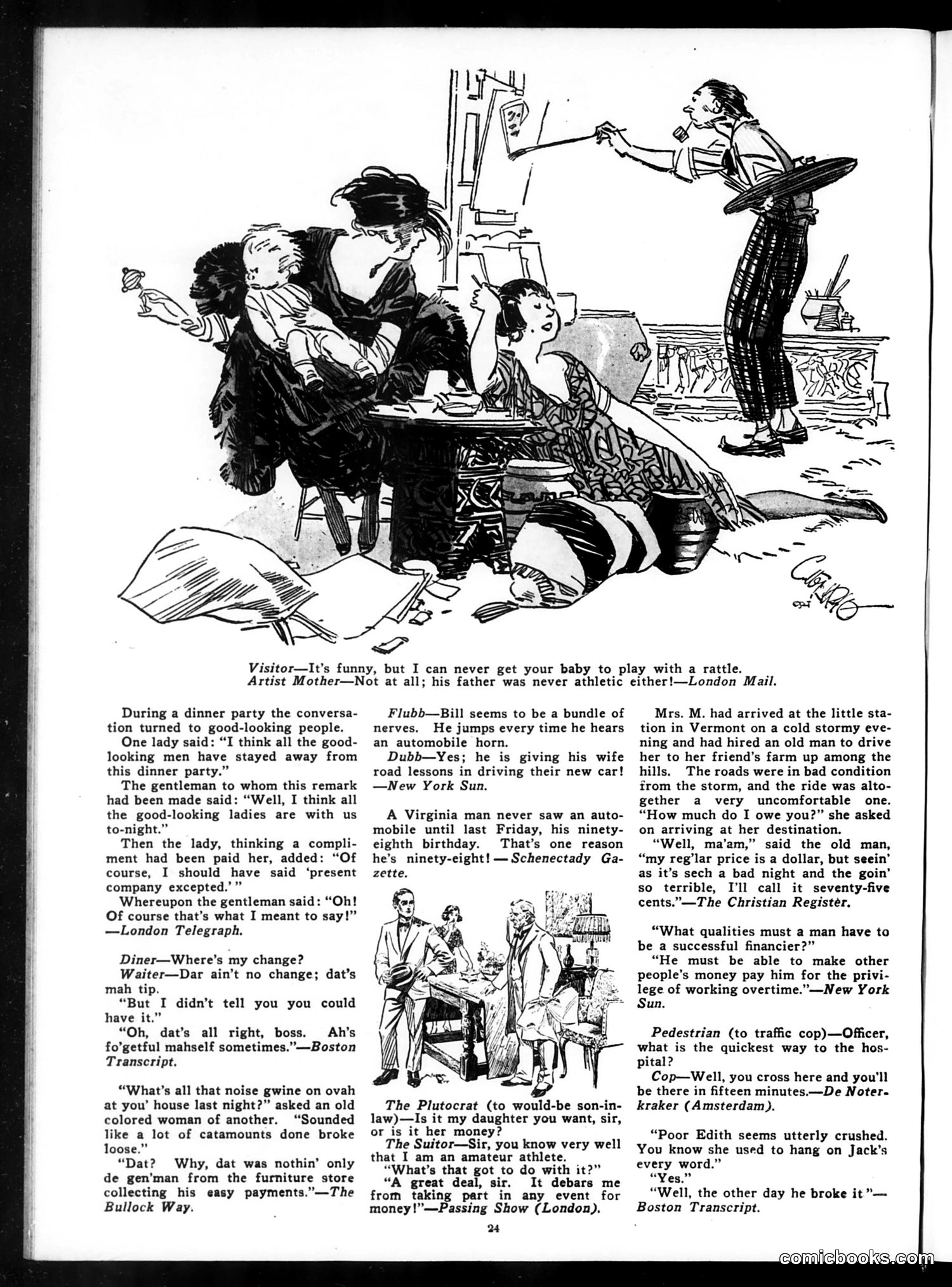
This page collects brief humorous anecdotes and jokes typical of early 20th-century satirical magazines. The main cartoon depicts a chaotic artist's studio where a visitor comments that the artist's baby won't play with a rattle. The artist's mother replies the child takes after his father, who was "never athletic either"—a gentle jab at artistic men's perceived lack of athleticism and masculinity. The surrounding text comprises short jokes on various social topics: awkward dinner party banter, tipping etiquette (with racial dialect humor common to the era), automobile anxiety, and marital dynamics. Several anecdotes mock the wealthy ("the Plutocrat"), automobile culture (still novel), and financial chicanery. The humor relies on wordplay, class observation, and social commentary typical of Judge's audience—educated, urban readers amused by middle and upper-class foibles. The racial dialect jokes reflect period attitudes now recognized as offensive stereotyping.
📄 Transcribed text from this page (OCR, searchable)
Machine-transcribed from the original scan — historical spelling and the odd misread are preserved.
oa vy y Bi Z\\ os Visitor—It’s funny, but I can never get your baby to play with a rattle. Artist Mother—Not at all; his father was never athletic either!—London Mail. During a dinner party the conversa- tion turned to good-looking people. One lady said: “I think all the good- looking men have stayed away from this dinner party.” The gentleman to whom this remark had been made said: “Well, I think all the good-looking ladies are with us to-night.” Then the lady, thinking a compli- ment had been paid her, added: “Of course, I should have said ‘present company excepted.’” Whereupon the gentleman said: “Oh! Of course that’s what I meant to say!” —London Telegraph. Diner—Where’s my change? Waiter—Dar ain’t no change; dat’s mah tip. “But I didn’t tell you you could have it.” “Oh, dat’s all right, boss. Ah’s fo’getful mahself sometimes.”—Boston Transcript. “What's all that noise gwine on ovah at you’ house last night?” asked an old colored woman of another. “Sounded like a lot of catamounts done broke loose.” “Dat? Why, dat was nothin’ only de gen’man from the furniture store collecting his easy payments.”—The Bullock Way. Flubb—Bill seems to be a bundle of nerves. He jumps every time he hears an automobile horn. Dubb—Yes; he is giving his wife road lessons in driving their new car! —WNew York Sun. A Virginia man never saw an auto- mobile until last Friday, his ninety- eighth birthday. That’s one reason he’s ninety-eight! — Schenectady Ga- The Plutocrat (to would-be son-in- law)—Is it my daughter you want, sir, or is it her money? The Suitor—Sir, you know very well that I am an amateur athlete. “What’s that got to do with it?” “A great deal, sir. It debars me from taking part in any event for money!”—Passing Show (London), Pad Mrs. M. had arrived at the little sta- tion in Vermont on a cold stormy eve- ning and had hired an old man to drive her to her friend’s farm up among the hills. The roads were in bad condition from the storm, and the ride was alto- gether a very uncomfortable one. “How much do I owe you?” she asked on arriving at her destination. “Well, ma’am,” said the old man, “my reg’lar price is a dollar, but seein’ as it’s sech a bad night and the goin’ so terrible, I'll call it seventy-five cents.”—The Christian Register. “What qualities must a man have to be a successful financier?” “He must be able to make other people’s money pay him for the privi- lege of working overtime.”—New York Sun. Pedestrian (to traffic cop)—Officer, what is the quickest way to the hos- pital? Cop—Well, you cross here and you'll be there in fifteen minutes.—De Noter- kraker (Amsterdam). “Poor Edith seems utterly crushed. You know she used to hang on Jack’s every word.” “Yes.” “Well, the other day he broke it »— Boston Transcript.