
Judge, 1922-03-04 · page 10 of 38
Judge — March 4, 1922 — page 10: what you’re looking at
What you’re looking at
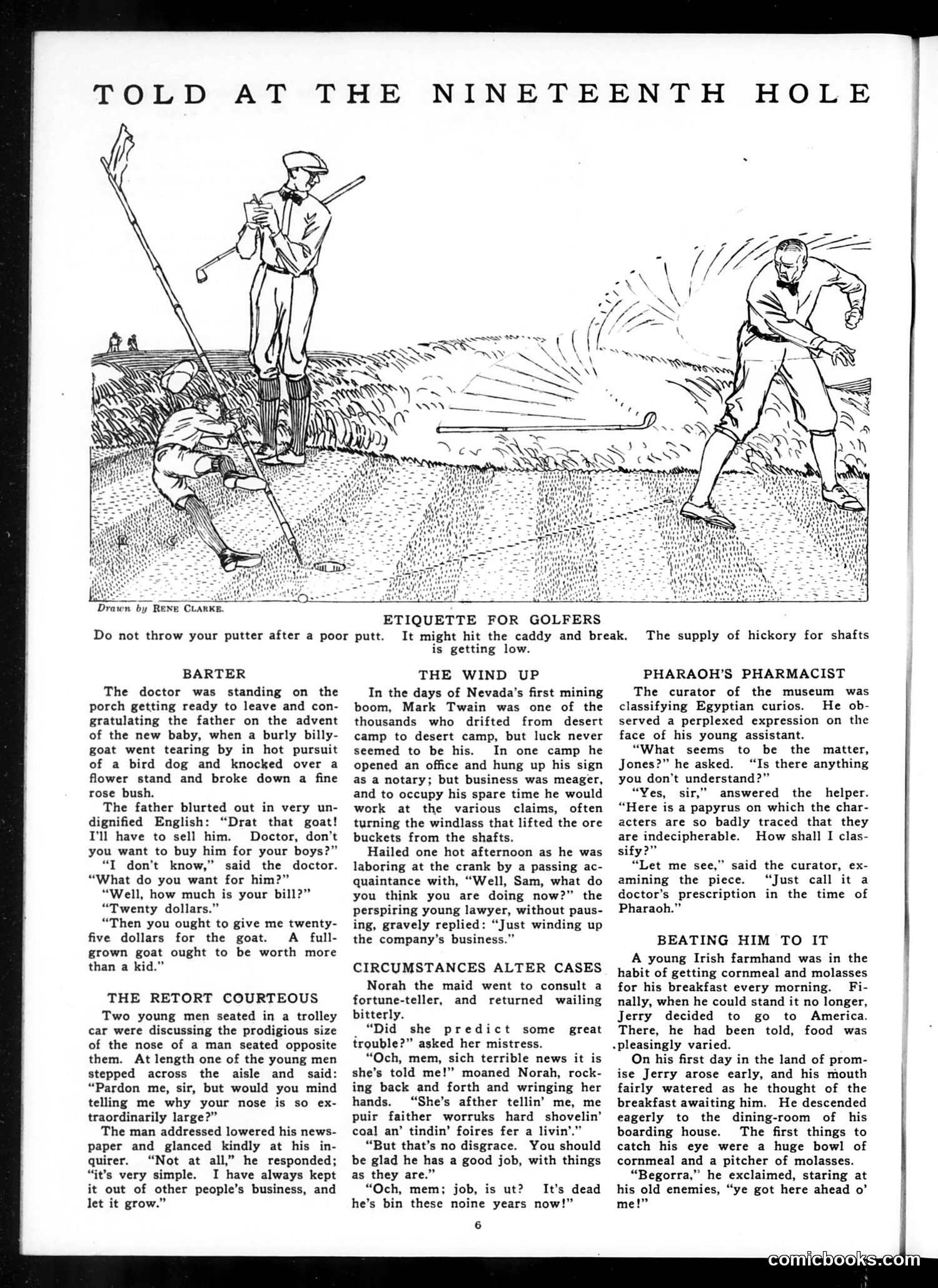
This page presents humorous short stories framed as golf-club banter (the "nineteenth hole" being the bar). The cartoon shows golfers at play. **Key stories:** - **"Barter"**: A father trades a troublesome goat to a doctor, claiming it's worth more than the $20 medical bill because "a full-grown goat ought to be worth more than a kid"—a pun on "kid" (child/young goat). - **"The Retort Courteous"**: A man with an enormous nose explains he kept it large by minding his own business—satirizing nosy people. - **"The Wind Up"**: A Mark Twain anecdote where he jokes about "winding up the company's business" while literally operating a mining windlass. - **"Circumstances Alter Cases"**: An Irish maid's fortune-teller reveals her father "works hard shoveling coal"—but he's been dead nine years, a darkly comic misunderstanding. These are gentle, non-political humor pieces typical of Judge's lighter content, relying on wordplay and Irish-immigrant stereotypes (the maid's dialect).
📄 Transcribed text from this page (OCR, searchable)
Machine-transcribed from the original scan — historical spelling and the odd misread are preserved.
TOLD AT THE NINETEENTH HOLE Drawn by ReENe CLARKE. Do not throw your putter after a poor putt. BARTER The doctor was standing on the porch getting ready to leave and con- gratulating the father on the advent of the new baby, when a burly billy- goat went tearing by in hot pursuit of a bird dog and knocked over a flower stand and broke down a fine rose bush. The father blurted out in very un- dignified English: “Drat that goat! I'll have to sell him. Doctor, don’t you want to buy him for your boys?” “I don’t know,” said the doctor. “What do you want for him?” “Well, how much is your bill?” “Twenty dollars.” “Then you ought to give me twenty- five dollars for the goat. A full- grown goat ought to be worth more than a kid.” THE RETORT COURTEOUS Two young men seated in a trolley car were discussing the prodigious size of the nose of a man seated opposite them. At length one of the young men stepped across the aisle and said: “Pardon me, sir, but would you mind telling me why your nose is so ex- traordinarily large?” The man addressed lowered his news- paper and glanced kindly at his in- quirer. “Not at all,” he responded; “it’s very simple. I have always kept it out of other people’s business, and let it grow.” ETIQUETTE FOR GOLFERS It might hit the caddy and break, is getting low. THE WIND UP In the days of Nevada’s first mining boom, Mark Twain was one of the thousands who drifted from desert camp to desert camp, but luck never seemed to be his. In one camp he opened an office and hung up his sign as a notary; but business was meager, and to occupy his spare time he would work at the various claims, often turning the windlass that lifted the ore buckets from the shafts. Hailed one hot afternoon as he was laboring at the crank by a passing ac- quaintance with, “Well, Sam, what do you think you are doing now?” the perspiring young lawyer, without paus- ing, gravely replied: “Just winding up the company’s business.” CIRCUMSTANCES ALTER CASES Norah the maid went to consult a fortune-teller, and returned wailing bitterly. _ “Did she predict some trouble?” asked her mistress. “Och, mem, sich terrible news it is she’s told me!” moaned Norah, rock- ing back and forth and wringing her hands. “She’s afther tellin’ me, me puir faither worruks hard shovelin’ coal an’ tindin’ foires fer a livin’.” “But that’s no disgrace. You should be glad he has a good job, with things as they are.” “Och, mem; job, is ut? It’s dead he’s bin these noine years now!” 6 great The supply of hickory for shafts PHARAOH’S PHARMACIST The curator of the museum was classifying Egyptian curios. He ob- served a perplexed expression on the face of his young assistant. “What seems to be the matter, Jones?” he asked. “Is there anything you don’t understand?” “Yes, sir,” answered the helper. “Here is a papyrus on which the char- acters are so badly traced that they are indecipherable. How shall I clas- sify?” “Let me see,” said the curator, ex- amining the piece. “Just call it a doctor’s prescription in the time of Pharaoh.” BEATING HIM TO IT A young Irish farmhand was in the habit of getting cornmeal and molasses for his breakfast every morning. Fi- nally, when he could stand it no longer, Jerry decided to go to America. There, he had been told, food was «pleasingly varied. On his first day in the land of prom- ise Jerry arose early, and his mouth fairly watered as he thought of the breakfast awaiting him. He descended eagerly to the dining-room of his boarding house. The first things to catch his eye were a huge bowl of cornmeal and a pitcher of molasses. “Begorra,” he exclaimed, staring at his old enemies, “ye got here ahead 0” me!”