
Judge, 1922-03-04 · page 11 of 38
Judge — March 4, 1922 — page 11: what you’re looking at
What you’re looking at
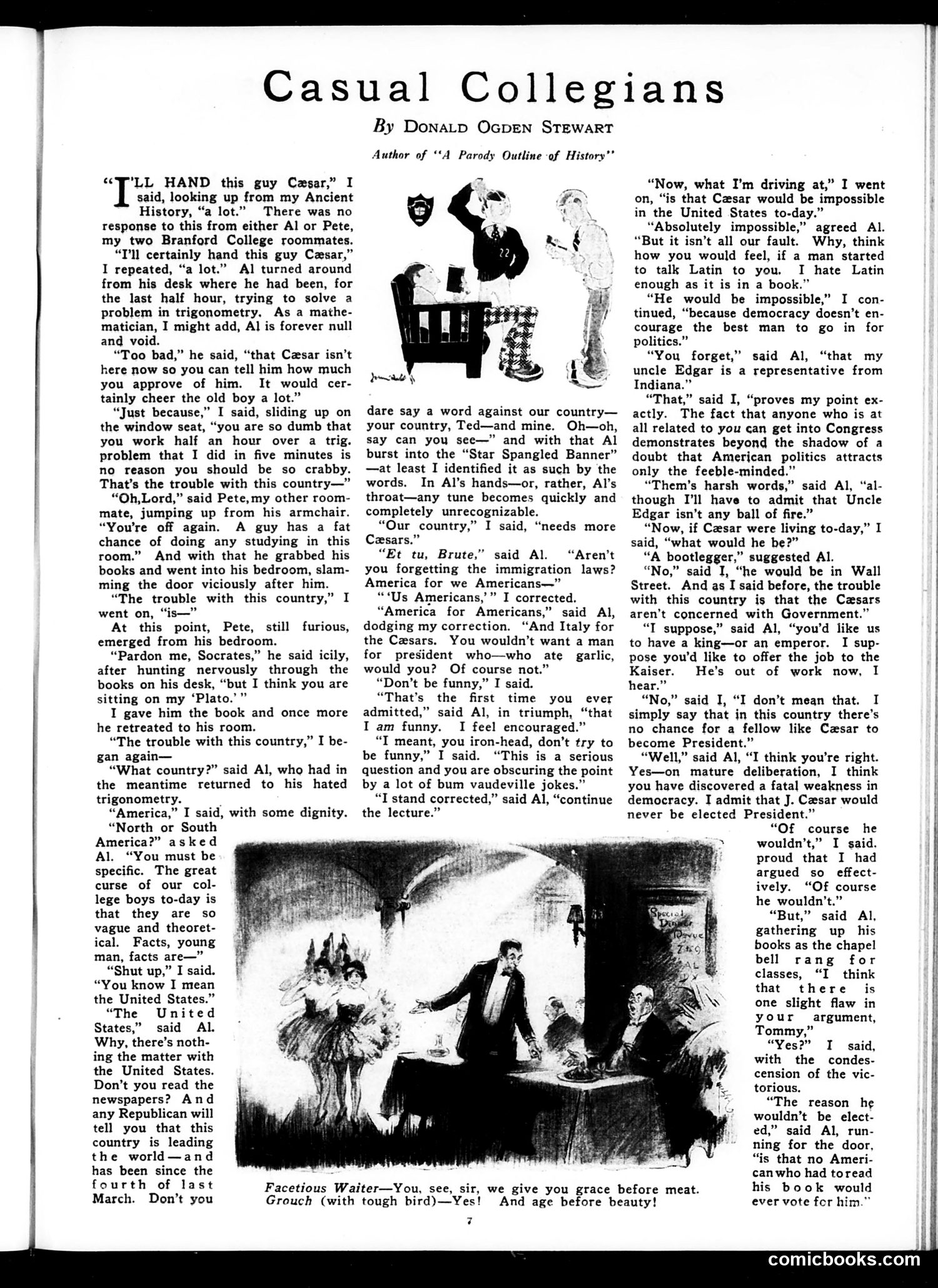
This is a satirical dialogue between college roommates debating whether a Caesar-like dictator could rise in America. The unnamed narrator argues that American democracy prevents such tyranny; his roommate Al counters with practical objections—immigrants, language barriers, garlic-eating prejudice—rather than ideological ones. The satire targets both figures: the narrator for pontificating about serious politics while his friends try to study, and Al for reducing political theory to vaudeville jokes and petty nationalism ("America for we Americans"). The cartoon below shows a waiter serving tough food, a visual pun on the "tough" intellectual debate above. The piece, by Donald Ogden Stewart, satirizes college intellectualism generally—young men pontificating confidently about governance while barely understanding actual civics. Written after March 1921 (per the text), it reflects post-WWI American anxiety about foreign influences and democratic resilience.
📄 Transcribed text from this page (OCR, searchable)
Machine-transcribed from the original scan — historical spelling and the odd misread are preserved.
Casual Collegians <W'LL HAND this guy Ceasar,” I ] said, looking up from my Ancient History, “a lot.” There was no response to this from either Al or Pete, my two Branford College roommates. “Tl certainly hand this guy Cesar,” I repeated, “a lot.” Al turned around from his desk where he had been, for the last half hour, trying to solve a problem in trigonometry. As a mathe- matician, I might add, Al is forever null and void. “Too bad,” he said, “that Cesar isn’t here now so you can tell him how much you approve of him. It would cer- tainly cheer the old boy a lot.” “Just because,” I said, sliding up on the window seat, “you are so dumb that you work half an hour over a trig. problem that I did in five minutes is no reason you should be so crabby. That’s the trouble with this country—” “Oh,Lord,” said Pete,my other room- mate, jumping up from his armchair. “You're off again. A guy has a fat chance of doing any studying in this room.” And with that he grabbed his books and went into his bedroom, slam- ming the door viciously after him. “The trouble with this country,” I went on, “is—” At this point, Pete, still emerged from his bedroom. “Pardon me, Socrates,” he said icily, after hunting nervously through the books on his desk, “but I think you are sitting on my ‘Plato.’” I gave him the book and once more he retreated to his room. “The trouble with this country,” I be- gan again— “What country?” said Al, who had in the meantime returned to his hated trigonometry. “America,” I said, with some dignity. “North or South America?” asked Al. “You must be specific. The great curse of our col- lege boys to-day is that they are so vague and theoret- ical. Facts, young man, facts are—” “Shut up,” I said. “You know I mean the United States.” “The United States,” said Al. Why, there’s noth- ing the matter with the United States. Don’t you read the newspapers? And any Republican will tell you that this country is leading the world—and has been since the fourth of last March. Don’t you furious, By DonaLp Ocpen STEWART Author of ‘‘A Parody Outline ‘of History’’ peerw) ‘s dare say a word against our country— your country, Ted—and mine. Oh—oh, say can you see—” and with that Al burst into the “Star Spangled Banner” —at least I identified it as such by the words. In Al’s hands—or, rather, Al’s throat—any tune becomes quickly and completely unrecognizable. “Our country,” I said, “needs more Cesars.” “Et tu, Brute,” said Al. “Aren't you forgetting the immigration laws? America for we Americans—” “‘Us Americans,’” I corrected. “America for Americans,” said Al, dodging my correction. “And Italy for the Caesars. You wouldn’t want a man for president who—who ate garlic, would you? Of course not.” “Don’t be funny,” I said. “That’s the first time you ever admitted,” said Al, in triumph, “that I am funny. I feel encouraged.” “I meant, you iron-head, don’t try to be funny,” I said. “This is a serious question and you are obscuring the point by a lot of bum vaudeville jokes.” “I stand corrected,” said Al, “continue the lecture.” Facetious Waiter—You, see, sir, we give you grace before meat. Grouch (with tough bird) —Yes! 7 And age before beauty! “Now, what I’m driving at,” I went on, “is that Cesar would be impossible in the United States to-day.” “Absolutely impossible,” agreed Al. “But it isn’t all our fault. Why, think how you would feel, if a man started to talk Latin to you. I hate Latin enough as it is in a book.” “He would be impossible,” I con- tinued, “because democracy doesn’t en- courage the best man to go in for politics.” “You forget,” said Al, “that my uncle Edgar is a representative from Indiana.” “That,” said I, “proves my point ex- actly. The fact that anyone who is at all related to you can get into Congress demonstrates beyond the shadow of a doubt that American politics attracts only the feeble-minded.” “Them’s harsh words,” said Al, “al- though I’ll have to admit that Uncle Edgar isn’t any ball of fire.” “Now, if Cesar were living to-day,” I said, “what would he be?” “A bootlegger,” suggested Al. “No,” said I, “he would be in Wall Street. And as I said before, the trouble with this country is that the Casars aren’t concerned with Government.” “T suppose,” said Al, “you'd like us to have a king—or an emperor. I sup- pose you'd like to offer the job to the Kaiser. He’s out of work now, I hear.” “No,” said I, “I don’t mean that. I simply say that in this country there’s no chance for a fellow like Cesar to become President.” “Well,” said Al, “I think you're right. Yes—on mature deliberation, I think you have discovered a fatal weakness in democracy. I admit that J. Cesar would never be elected President.” “Of course he wouldn’t,” I said. proud that I had argued so effect- ively. “Of course he wouldn't.” “But,” said Al, gathering up his books as the chapel bell rang for classes, “I think that there is one slight flaw in your argument, Tommy,” “Yes?” I said, with the condes- cension of the vic- torious. “The reason he wouldn’t be elect- ed,” said Al, run- ning for the door, “is that no Ameri- canwho had toread his book would ever vote for him.” comicbooks.com