
Judge, 1922-03-04 · page 30 of 38
Judge — March 4, 1922 — page 30: what you’re looking at
What you’re looking at
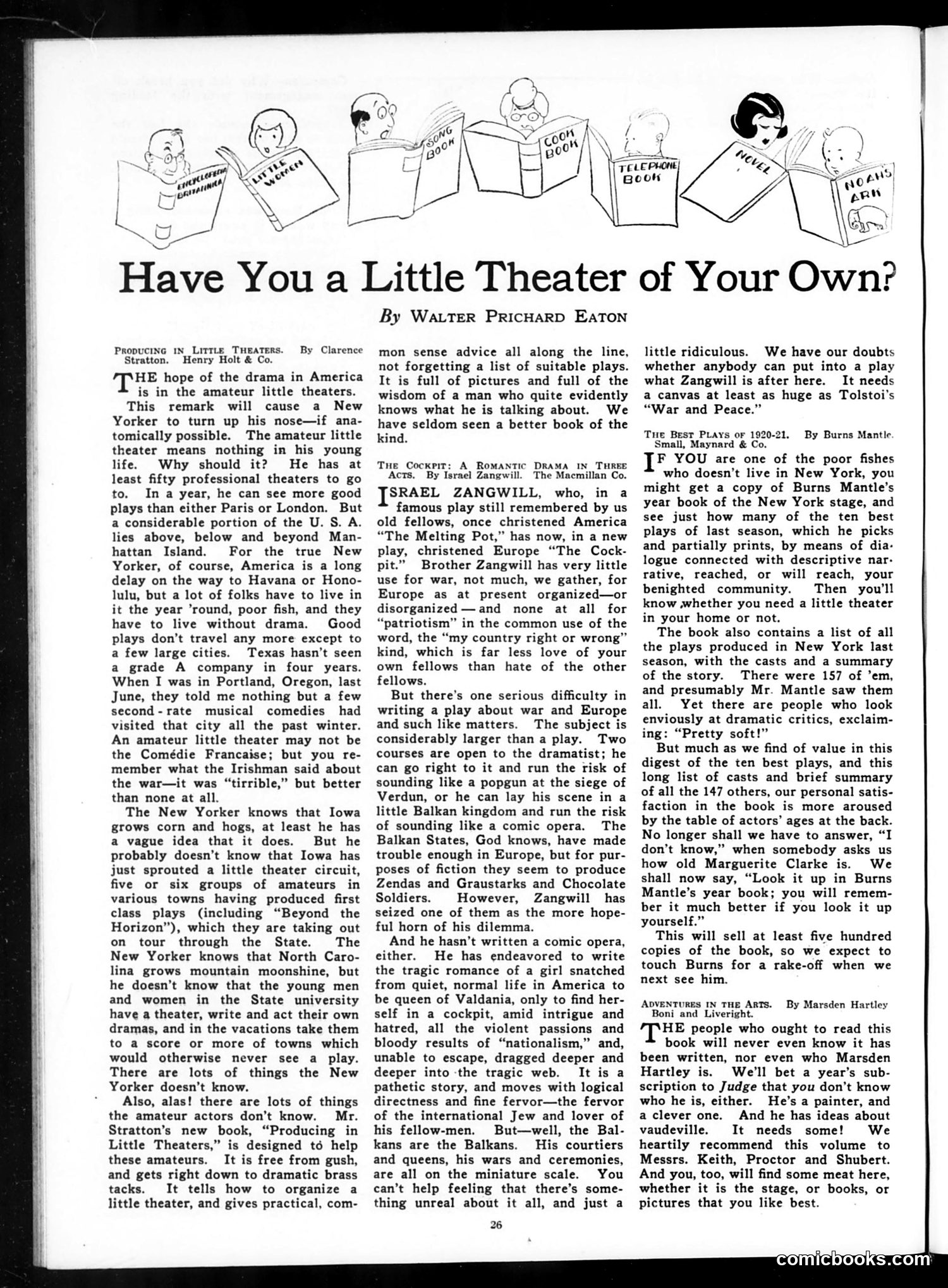
The header illustration depicts seven figures reading various books and publications, representing different demographics engaging with theatrical literature and drama criticism. The page consists primarily of two book reviews by Walter Prichard Eaton: 1. **"Producing in Little Theaters"** by Clarence Stratton — a practical guide for amateur theater organizations outside major cities. Eaton praises it as sensible and useful, noting that while New York has professional theaters, most Americans lack access to quality drama. He cites examples of amateur circuits in Iowa and North Carolina as evidence of theater's importance beyond Manhattan. 2. **"The Cockpit"** by Israel Zangwill — a three-act play about war and European politics. Eaton critiques Zangwill's ambitious anti-war theme, noting the dramatic challenge: depicting large-scale European conflict risks sounding ineffectual, while setting it in a fictional Balkan kingdom invites comic-opera comparisons—a problematic approach given the Balkans' real historical troubles. The content reflects early 20th-century cultural anxiety about arts access and America's geographic divide between cosmopolitan centers and provincial towns.
📄 Transcribed text from this page (OCR, searchable)
Machine-transcribed from the original scan — historical spelling and the odd misread are preserved.
geen pe eg Have You a Little Theater of Your Own? PropucinG IN Little THEATERS. By Clarence Stratton. Henry Holt & Co. THE hope of the drama in America is in the amateur little theaters. This remark will cause a New Yorker to turn up his nose—if ana- tomically possible. The amateur little theater means nothing in his young life. Why should it? He has at least fifty professional theaters to go to. In a year, he can see more good plays than either Paris or London. But a considerable portion of the U. S. A. lies above, below and beyond Man- hattan Island. For the true New Yorker, of course, America is a long delay on the way to Havana or Hono- lulu, but a lot of folks have to live in it the year ’round, poor fish, and they have to live without drama. Good plays don’t travel any more except to a few large cities. Texas hasn’t seen a grade A company in four years. When I was in Portland, Oregon, last June, they told me nothing but a few second-rate musical comedies had visited that city all the past winter. An amateur little theater may not be the Comédie Francaise; but you re- member what the Irishman said about the war—it was “tirrible,” but better than none at all. The New Yorker knows that Iowa grows corn and hogs, at least he has a vague idea that it does. But he probably doesn’t know that Iowa has just sprouted a little theater circuit, five or six groups of amateurs in various towns having produced first class plays (including “Beyond the Horizon”), which they are taking out on tour through the State. The New Yorker knows that North Caro- lina grows mountain moonshine, but he doesn’t know that the young men and women in the State university have a theater, write and act their own dramas, and in the vacations take them to a score or more of towns which would otherwise never see a play. There are lots of things the New Yorker doesn’t know. Also, alas! there are lots of things the amateur actors don’t know. Mr. Stratton’s new book, “Producing in Little Theaters,” is designed té help these amateurs. It is free from gush, and gets right down to dramatic brass tacks. It tells how to organize a little theater, and gives practical, com- By Water PRICHARD EATON mon sense advice all along the line, not forgetting a list of suitable plays. It is full of pictures and full of the wisdom of a man who quite evidently knows what he is talking about. We have seldom seen a better book of the kind. Tue Cockrrr: A RoMANTIC DRAMA IN THREE Acts. By Israel Zangwill. The Macmillan Co. JSRAEL ZANGWILL, who, in a famous play still remembered by us old fellows, once christened America “The Melting Pot,” has now, in a new play, christened Europe “The Cock- pit.” Brother Zangwill has very little use for war, not much, we gather, for Europe as at present organized—or disorganized—and none at all for “patriotism” in the common use of the word, the “my country right or wrong” kind, which is far less love of your own fellows than hate of the other fellows. But there’s one serious difficulty in writing a play about war and Europe and such like matters. The subject is considerably larger than a play. Two courses are open to the dramatist; he can go right to it and run the risk of sounding like a popgun at the siege of Verdun, or he can lay his scene in a little Balkan kingdom and run the risk of sounding like a comic opera. The Balkan States, God knows, have made trouble enough in Europe, but for pur- poses of fiction they seem to produce Zendas and Graustarks and Chocolate Soldiers. However, Zangwill has seized one of them as the more hope- ful horn of his dilemma. And he hasn’t written a comic opera, either. He has endeavored to write the tragic romance of a girl snatched from quiet, normal life in America to be queen of Valdania, only to find her- self in a cockpit, amid intrigue and hatred, all the violent passions and bloody results of “nationalism,” and, unable to escape, dragged deeper and deeper into the tragic web. It is a pathetic story, and moves with logical directness and fine fervor—the fervor of the international Jew and lover of his fellow-men. But—well, the Bal- kans are the Balkans. His courtiers and queens, his wars and ceremonies, are all on the miniature scale. You can’t help feeling that there’s some- thing unreal about it all, and just a 26 little ridiculous. We have our doubts whether anybody can put into a play what Zangwill is after here. It needs a canvas at least as huge as Tolstoi’s “War and Peace.” Tue Best PLays oF 1920-21. Small, Maynard & Co. IF YOU are one of the poor fishes who doesn’t live in New York, you might get a copy of Burns Mantle’s year book of the New York stage, and see just how many of the ten best plays of last season, which he picks and partially prints, by means of dia- logue connected with descriptive nar- rative, reached, or will reach, your benighted community. Then you'll know whether you need a little theater in your home or not. The book also contains a list of all the plays produced in New York last season, with the casts and a summary of the story. There were 157 of ’em, and presumably Mr. Mantle saw them all. Yet there are people who look enviously at dramatic critics, exclaim- ing: “Pretty soft!” But much as we find of value in this digest of the ten best plays, and this long list of casts and brief summary of all the 147 others, our personal satis- faction in the book is more aroused by the table of actors’ ages at the back. No longer shall we have to answer, “I don’t know,” when somebody asks us how old Marguerite Clarke is. We shall now say, “Look it up in Burns Mantle’s year book; you will remem- ber it much better if you look it up yourself.” This will sell at least five hundred copies of the book, so we expect to touch Burns for a rake-off when we next see him. By Burns Mantle. ADVENTURES IN THE ARTS. By Marsden Hartley Boni and Liveright. “PRE people who ought to read this book will never even know it has been written, nor even who Marsden Hartley is. We'll bet a year’s sub- scription to Judge that you don’t know who he is, either. He’s a painter, and aclever one. And he has ideas about vaudeville. It needs some! We heartily recommend this volume to Messrs. Keith, Proctor and Shubert. And you, too, will find some meat here, whether it is the stage, or books, or pictures that you like best.