
Judge, 1922-03-04 · page 22 of 38
Judge — March 4, 1922 — page 22: what you’re looking at
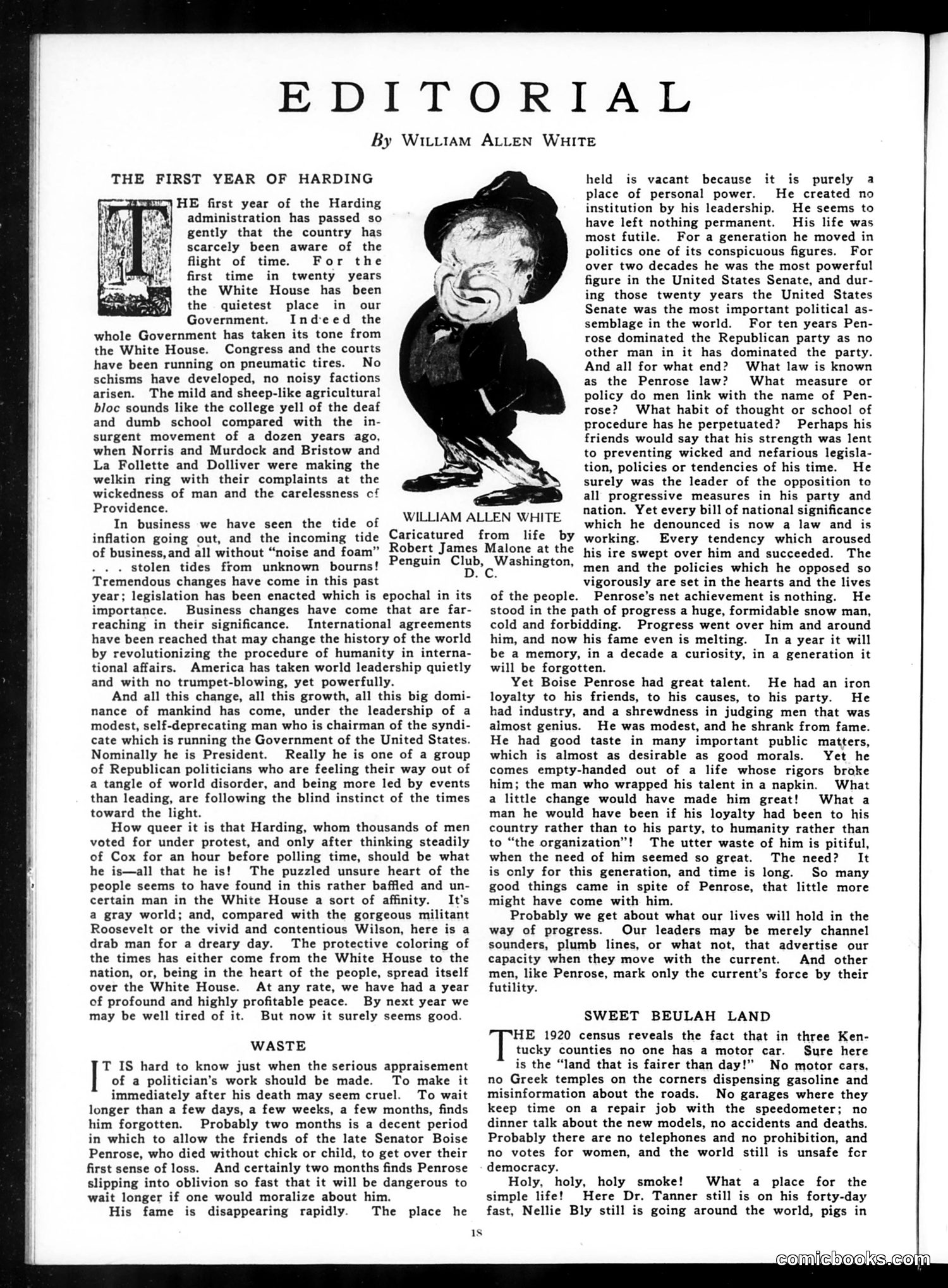
What you’re looking at
**The Cartoon:** The caricature depicts **William Allen White**, the famous journalist and editor, drawn by Robert James Malone. The exaggerated features—prominent nose, gnarled expression—are typical of Judge's satirical style. **The Content:** White's editorial praises President **Warren G. Harding's** first year (1921-1922) as remarkably quiet and peaceful compared to the turbulent Progressive Era politics of Theodore Roosevelt and Woodrow Wilson. White celebrates the lack of conflict, the smooth functioning of government, and major legislative/international achievements accomplished without fanfare. **The Satire:** The second piece, "Waste," critiques the recently deceased Senator **Boise Penrose**, a powerful Republican machine politician. White argues that despite Penrose's influence, he left no lasting institutional legacy—his power was purely personal and dies with him, making his career ultimately "waste." **The Point:** Together, these editorials suggest changing American politics: valuing quiet, effective governance over bombastic leadership; questioning whether political power without institutional achievement has real value.
📄 Transcribed text from this page (OCR, searchable)
Machine-transcribed from the original scan — historical spelling and the odd misread are preserved.
EDITORIAL By Wititam ALLEN WHITE THE FIRST YEAR OF HARDING HE first year of the Harding administration has passed so gently that the country has scarcely been aware of the flight of time. For the first time in twenty years the White House has been the quietest place in our Government. Indeed the whole Government has taken its tone from the White House. Congress and the courts have been running on pneumatic tires. No schisms have developed, no noisy factions arisen. The mild and sheep-like agricultural bloc sounds like the college yell of the deaf and dumb school compared with the in- surgent movement of a dozen years ago, when Norris and Murdock and Bristow and La Follette and Dolliver were making the welkin ring with their complaints at the wickedness of man and the carelessness cf Providence. In business we have seen the tide of inflation going out, and the incoming tide of business, and all without “noise and foam” . stolen tides from unknown bourns! Tremendous changes have come in this past year; legislation has been enacted which is epochal in its importance. Business changes have come that are far- reaching in their significance. International agreements have been reached that may change the history of the world by revolutionizing the procedure of humanity in interna- tional affairs. America has taken world leadership quietly and with no trumpet-blowing, yet powerfully. And all this change, all this growth, all this big domi- nance of mankind has come, under the leadership of a modest, self-deprecating man who is chairman of the syndi- cate which is running the Government of the United States. Nominally he is President. Really he is one of a group of Republican politicians who are feeling their way out of a tangle of world disorder, and being more led by events than leading, are following the blind instinct of the times toward the light. How queer it is that Harding, whom thousands of men voted for under protest, and only after thinking steadily of Cox for an hour before polling time, should be what he is—all that he is! The puzzled unsure heart of the people seems to have found in this rather baffled and un- certain man in the White House a sort of affinity. It's a gray world; and, compared with the gorgeous militant Roosevelt or the vivid and contentious Wilson, here is a drab man for a dreary day. The protective coloring of the times has either come from the White House to the nation, or, being in the heart of the people, spread itself over the White House. At any rate, we have had a year of profound and highly profitable peace. By next year we may be well tired of it. But now it surely seems good. WASTE T IS hard to know just when the serious appraisement of a politician's work should be made. To make it immediately after his death may seem cruel. To wait longer than a few days, a few weeks, a few months, finds him forgotten. Probably two months is a decent period in which to allow the friends of the late Senator Boise Penrose, who died without chick or child, to get over their first sense of loss. And certainly two months finds Penrose slipping into oblivion so fast that it will be dangerous to wait longer if one would moralize about him. His fame is disappearing rapidly. The place he WILLIAM ALLEN WHITE Caricatured from Robert James Malone at the Penguin Clnb; | Washington, is purely a He created no held is vacant because it place of personal power. institution by his leadership. He seems to have left nothing permanent. His life was most futile. For a generation he moved in politics one of its conspicuous figures. For over two decades he was the most powerful figure in the United States Senate, and dur- ing those twenty years the United States Senate was the most important political as- semblage in the world. For ten years Pen- rose dominated the Republican party as no other man in it has dominated the party. And all for what end? What law is known as the Penrose law? What measure or policy do men link with the name of Pen- rose? What habit of thought or school of procedure has he perpetuated? Perhaps his friends would say that his strength was lent to preventing wicked and nefarious legisla- tion, policies or tendencies of his time. He surely was the leader of the opposition to all progressive measures in his party and nation. Yet every bill of national significance which he denounced is now a law and is working. Every tendency which aroused his ire swept over him and succeeded. The men and the policies which he opposed so vigorously are set in the hearts and the lives of the people. Penrose’s net achievement is nothing. He stood in the path of progress a huge, formidable snow man, cold and forbidding. Progress went over him and around him, and now his fame even is melting. In a year it will be a memory, in a decade a curiosity, in a generation it will be forgotten. Yet Boise Penrose had great talent. He had an iron loyalty to his friends, to his causes, to his party. He had industry, and a shrewdness in judging men that was almost genius. He was modest, and he shrank from fame. He had good taste in many important public matters, which is almost as desirable as good morals. Yet he comes empty-handed out of a life whose rigors broke him; the man who wrapped his talent in a napkin. What a little change would have made him great! What a man he would have been if his loyalty had been to his country rather than to his party, to humanity rather than to “the organization”! The utter waste of him is pitiful, when the need of him seemed so great. The need? It is only for this generation, and time is long. So many good things came in spite of Penrose, that little more might have come with him. Probably we get about what our lives will hold in the way of progress. Our leaders may be merely channel sounders, plumb lines, or what not, that advertise our capacity when they move with the current. And other men, like Penrose, mark only the current’s force by their futility. life by SWEET BEULAH LAND HE 1920 census reveals the fact that in three Ken- tucky counties no one has a motor car. Sure here is the “land that is fairer than day!” No motor cars, no Greek temples on the corners dispensing gasoline and misinformation about the roads. No garages where they keep time on a repair job with the speedometer; no dinner talk about the new models, no accidents and deaths. Probably there are no telephones and no prohibition, and no votes for women, and the world still is unsafe for democracy. Holy, holy, holy smoke! What a place for the simple life! Here Dr. Tanner still is on his forty-day fast, Nellie Bly still is going around the world, pigs in