
A complete issue · 36 pages · 1922
Judge — February 4, 1922
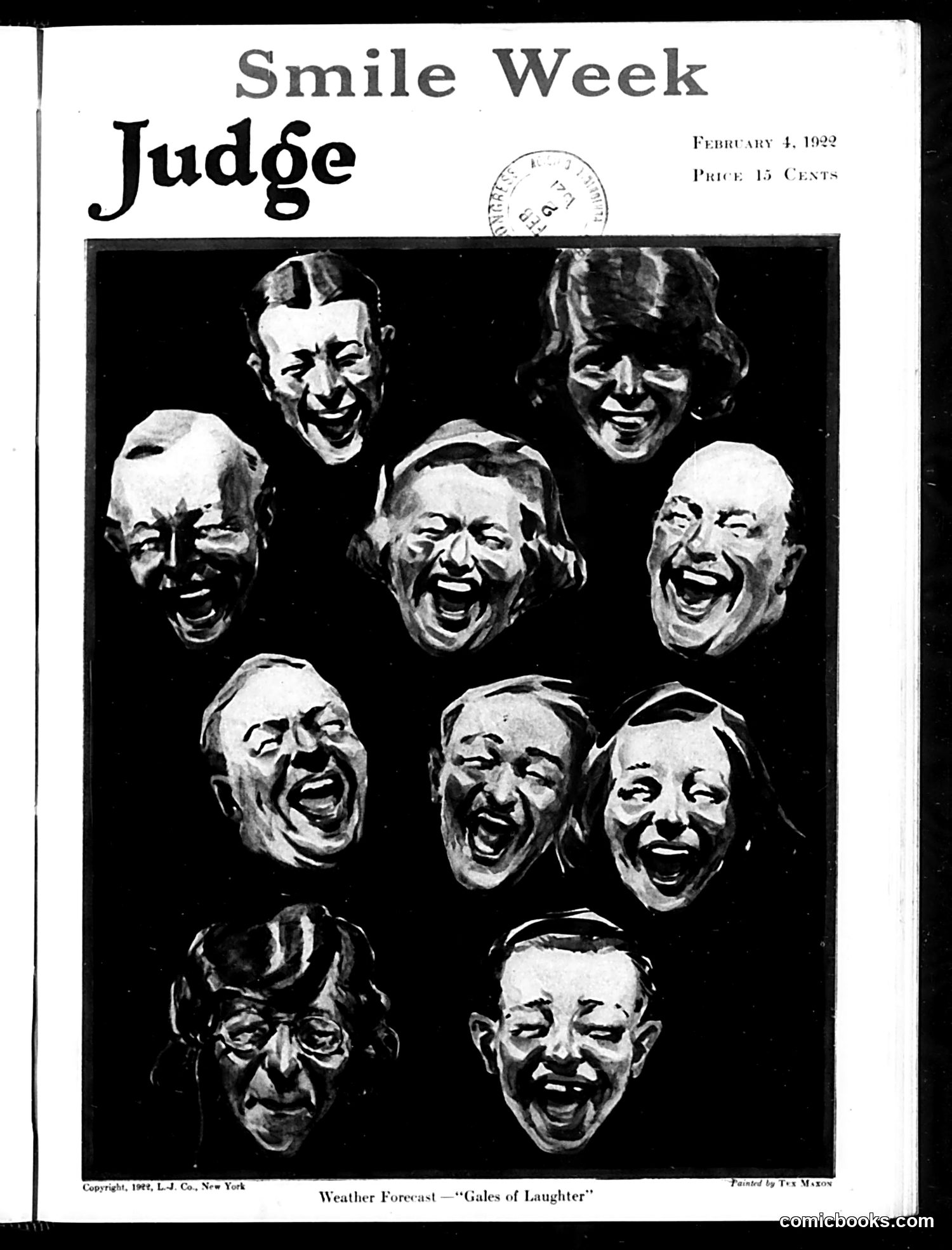
This page features a "Weather Forecast—'Gales of Laughter'" comprising ten exaggerated facial caricatures displaying broad, theatrical smiles and laughs. The image appears to be a humorous weather prediction using smiling faces as a visual metaphor—replacing traditional weather symbols with expressions of mirth. Published during the 1920s by Judge magazine (a prominent American satirical publication), this reflects the era's interest in physiognomy and visual humor. The grotesque, expressive faces are rendered in high-contrast black and white, typical of the magazine's comedic illustration style. Without identifying specific individuals, the piece seems designed simply to amuse readers with exaggerated expressions during a "Smile Week" celebration—straightforward comedy rather than pointed political satire.
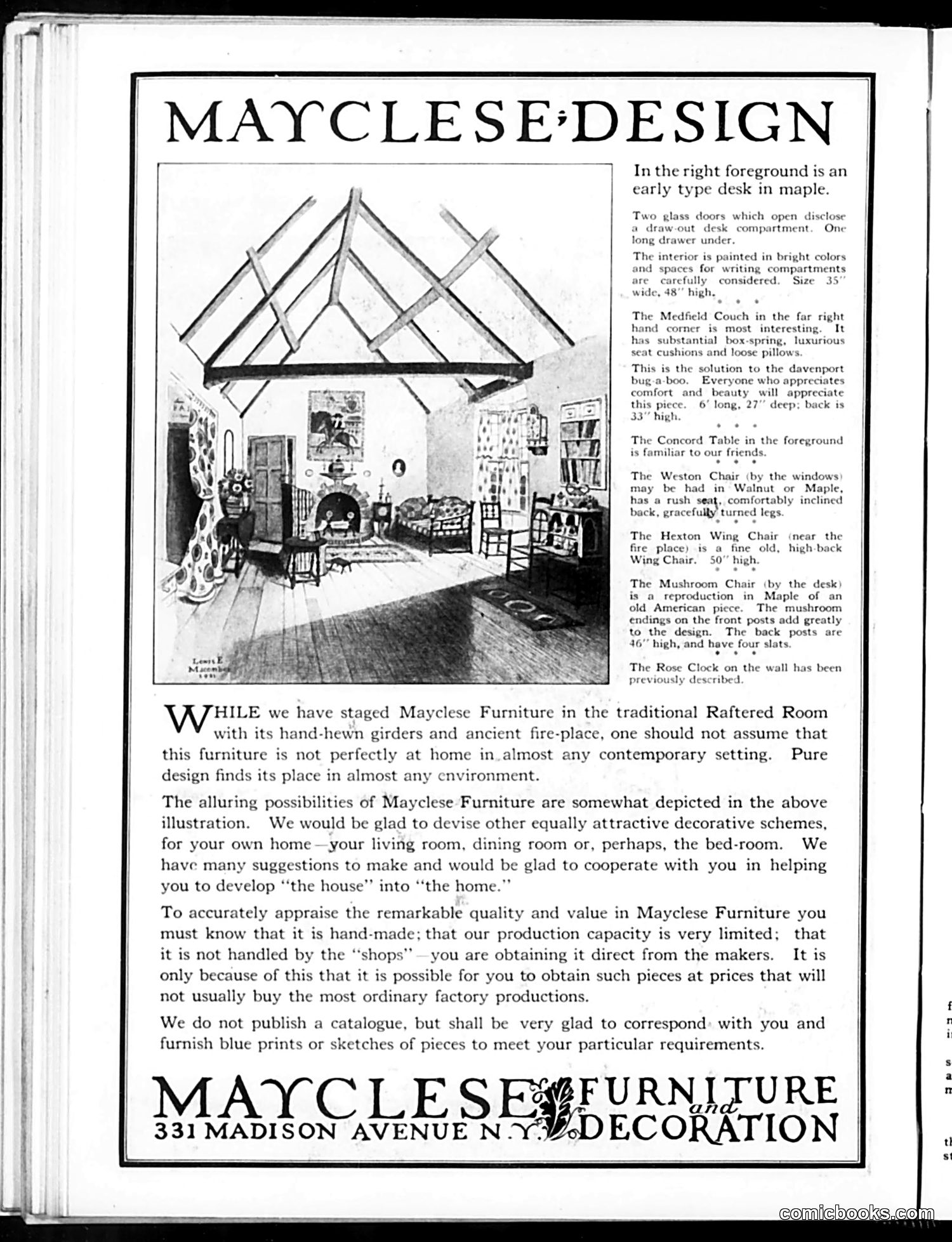
This page is **not a political cartoon or satire**—it's a furniture advertisement, not editorial content. The image shows an interior design sketch of a room furnished with "Mayclese Furniture," featuring a distinctive ceiling, fireplace, period chairs, a desk, and a couch. The accompanying text describes specific furniture pieces (a maple desk, Medfield couch, various chairs, a Concord table, and a Rose clock) and emphasizes that Mayclese produces handmade, limited-quantity furniture sold directly by makers rather than through retail shops. The company solicits customers to write for design suggestions and blueprints. This is purely **commercial advertising** with no satirical content or political commentary.
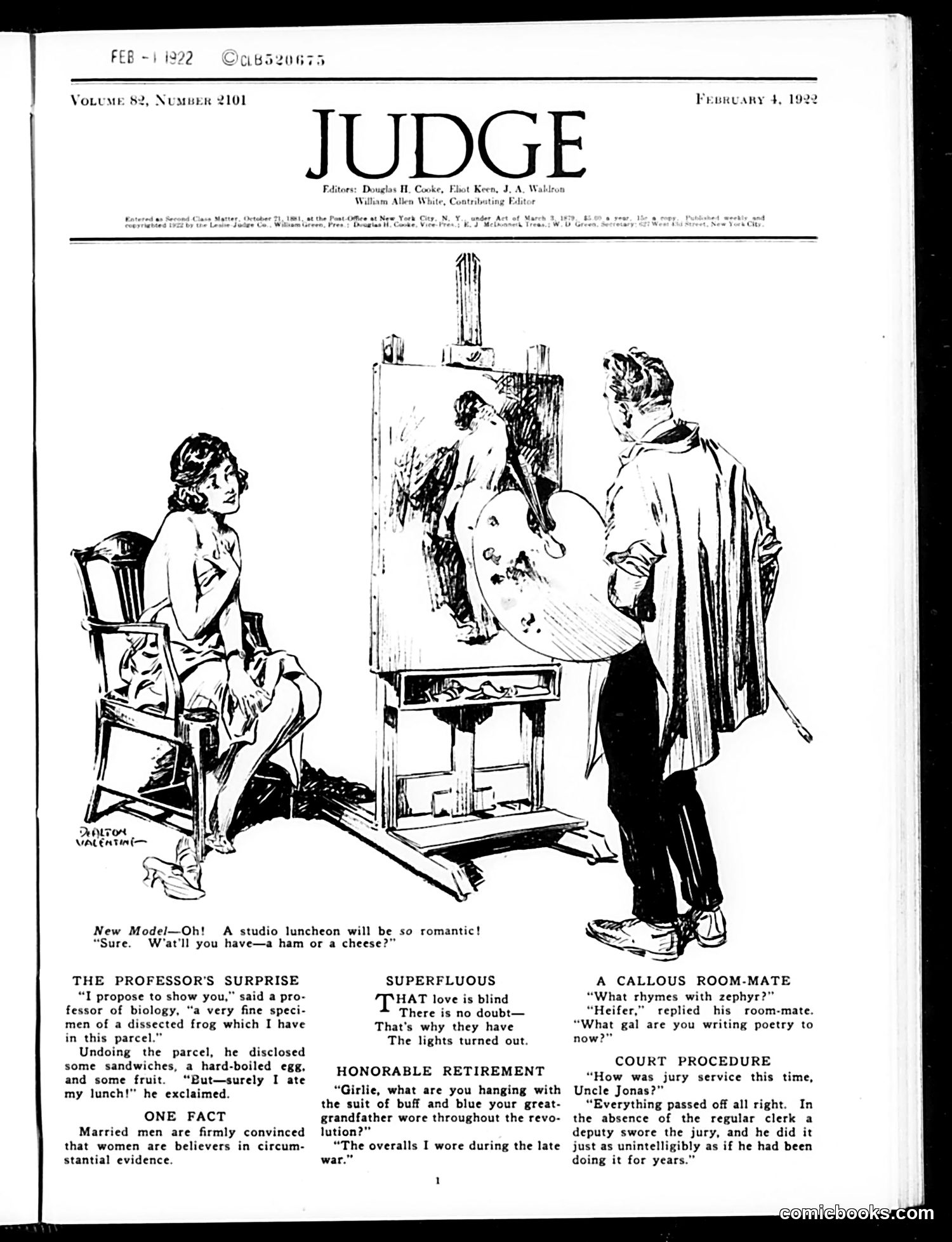
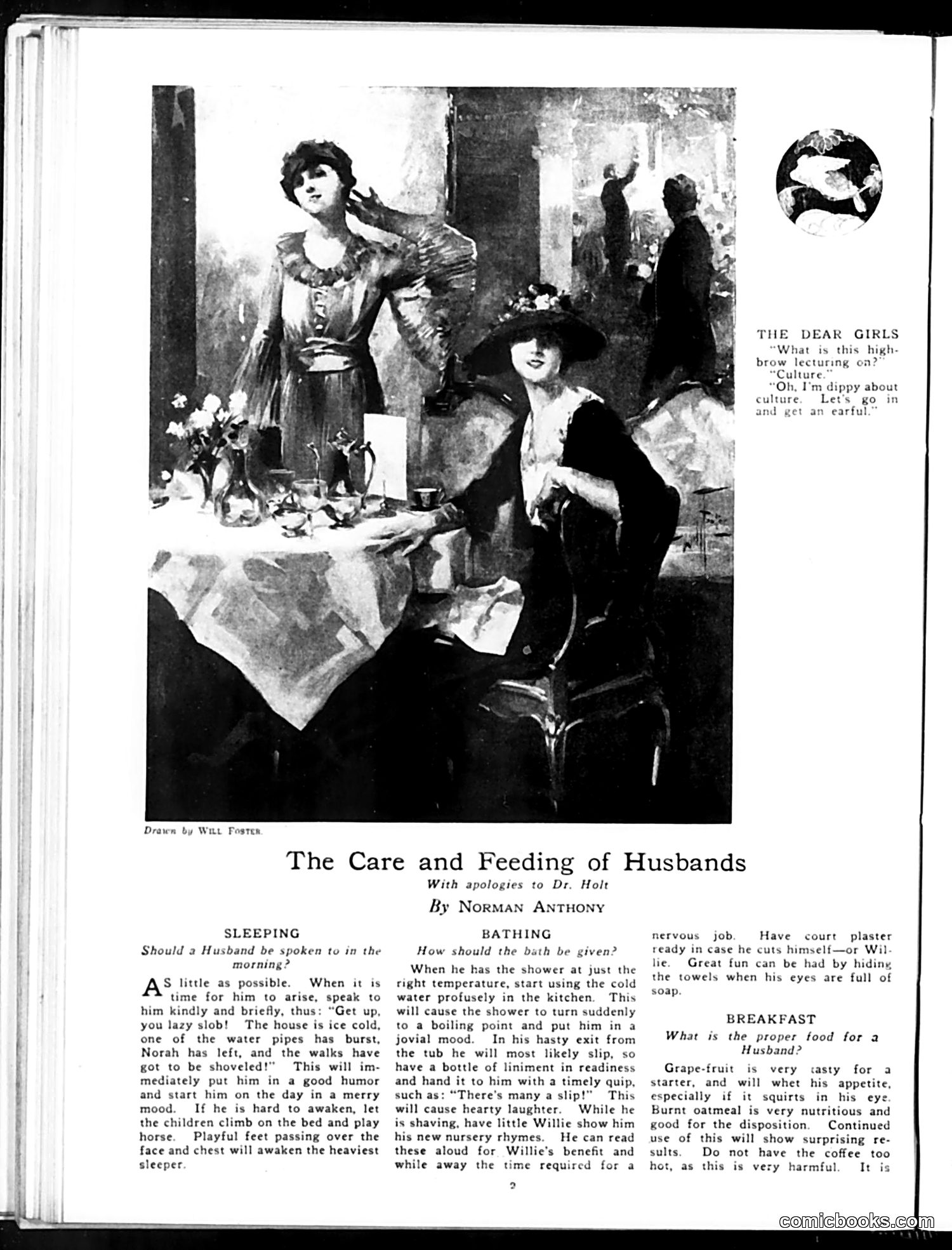
This satirical article by Norman Anthony mocks domestic advice literature popular in the early 20th century. The illustration by Will Foster depicts two well-dressed women discussing "culture," with one saying she's "dippy about culture" and wants to "get an earful"—suggesting wives prioritized fashionable socializing over household management. The article's sections (Sleeping, Bathing, Breakfast) parody patronizing advice manuals that treated husbands like children requiring careful management. The satire targets both the condescending tone of such guides and wives' stereotypical preoccupation with social pursuits rather than practical homemaking. The humor lies in inverting gender roles: women are depicted as frivolous while husbands need constant supervision and gentle handling—mocking both marital dynamics and advice-giving conventions of the era.
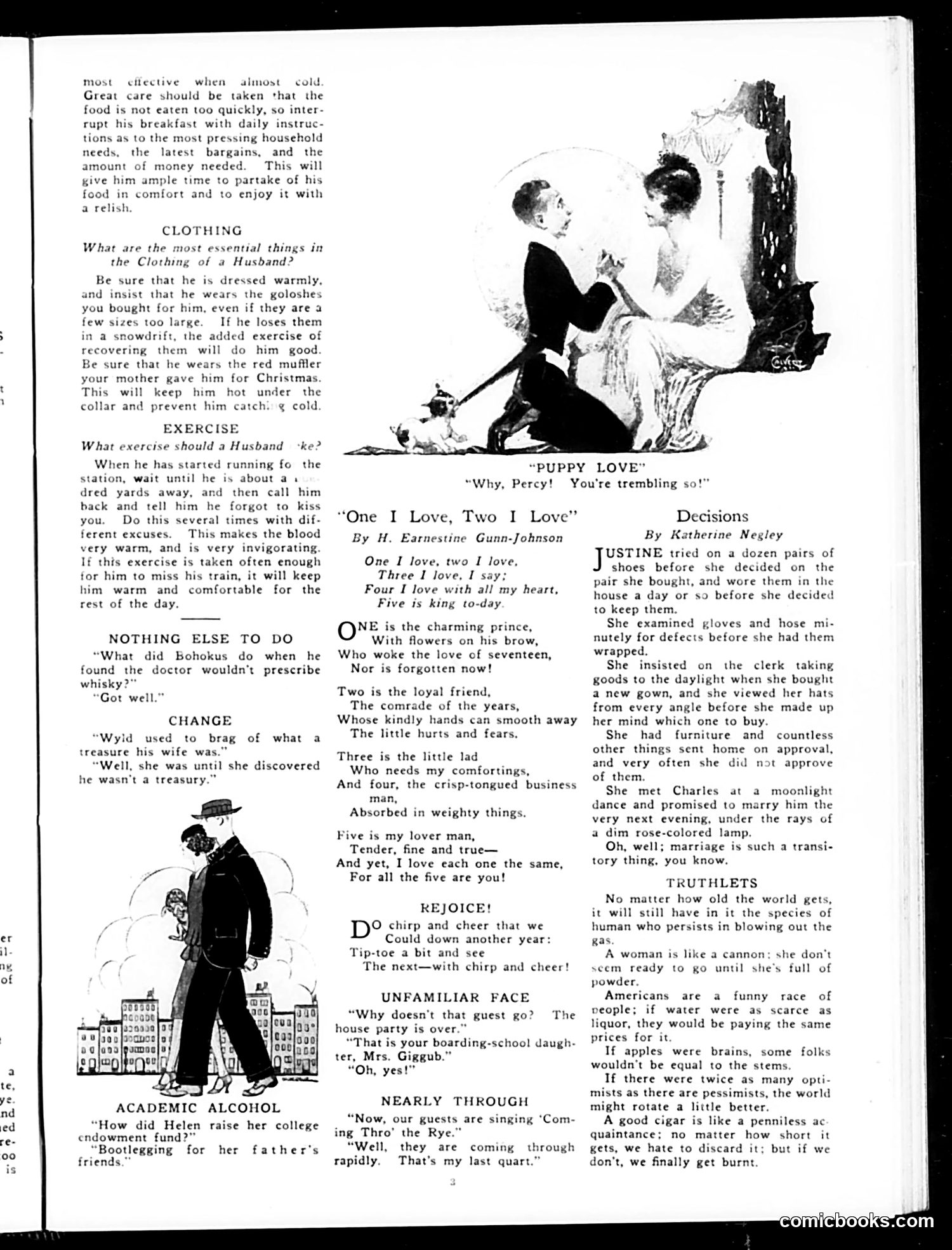
This page from *Judge* magazine contains a romantic illustration titled "Puppy Love" showing a young couple on a bench—the man appears to be trembling while the woman asks "Why, Percy? You're trembling so!" The cartoon satirizes youthful romantic anxiety and nervous courtship behavior. "Percy" represents the stereotypical timid young suitor, while the woman embodies confidence. The humor lies in exposing male vulnerability during romantic encounters—a reversal of era expectations where men were supposed to be composed and commanding. The surrounding text includes domestic advice columns about husbands' clothing and exercise, poetry about love, and various humorous anecdotes, all reflecting early 20th-century *Judge* magazine's mix of social satire, romance, and household guidance.
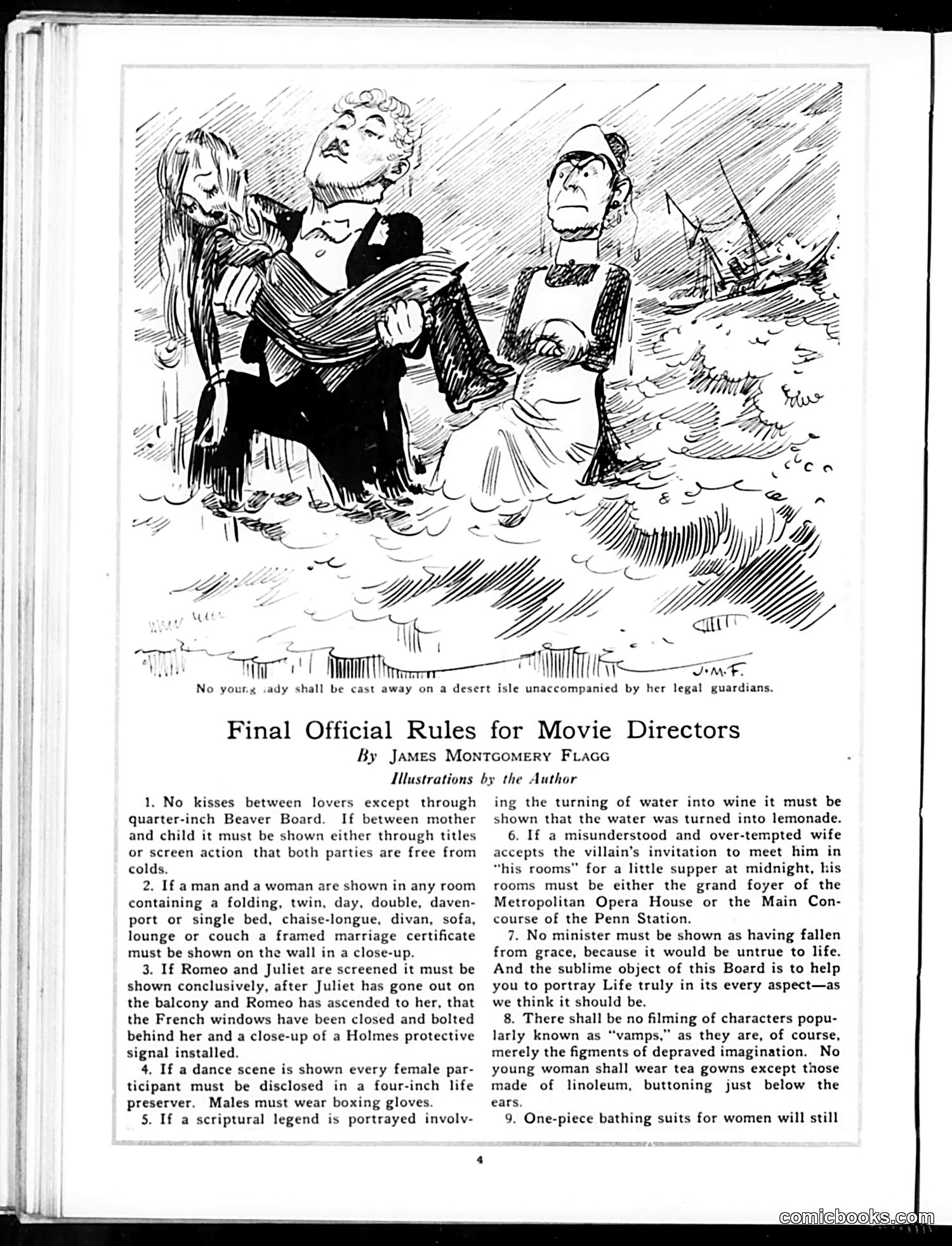
This page satirizes Hollywood film censorship regulations, likely from the 1920s-30s era when moral oversight boards heavily restricted movie content. The cartoon illustration shows a man in formal wear being cast away on a desert island by two women—a visual joke accompanying the headline "Final Official Rules for Movie Directors." The nine numbered rules mock actual censorship restrictions by presenting absurdly specific prohibitions: kisses must use quarter-inch beaver board, married couples can't share beds, dance scenes require four-inch life preservers, ministers can't fall from grace, no "vamps," and bathing suits must be one-piece. The satire critiques how invasive and ridiculous these moral codes had become, particularly their puritanical control over romantic and bodily representation. The castaway image reinforces how filmmakers felt exiled by these restrictions.
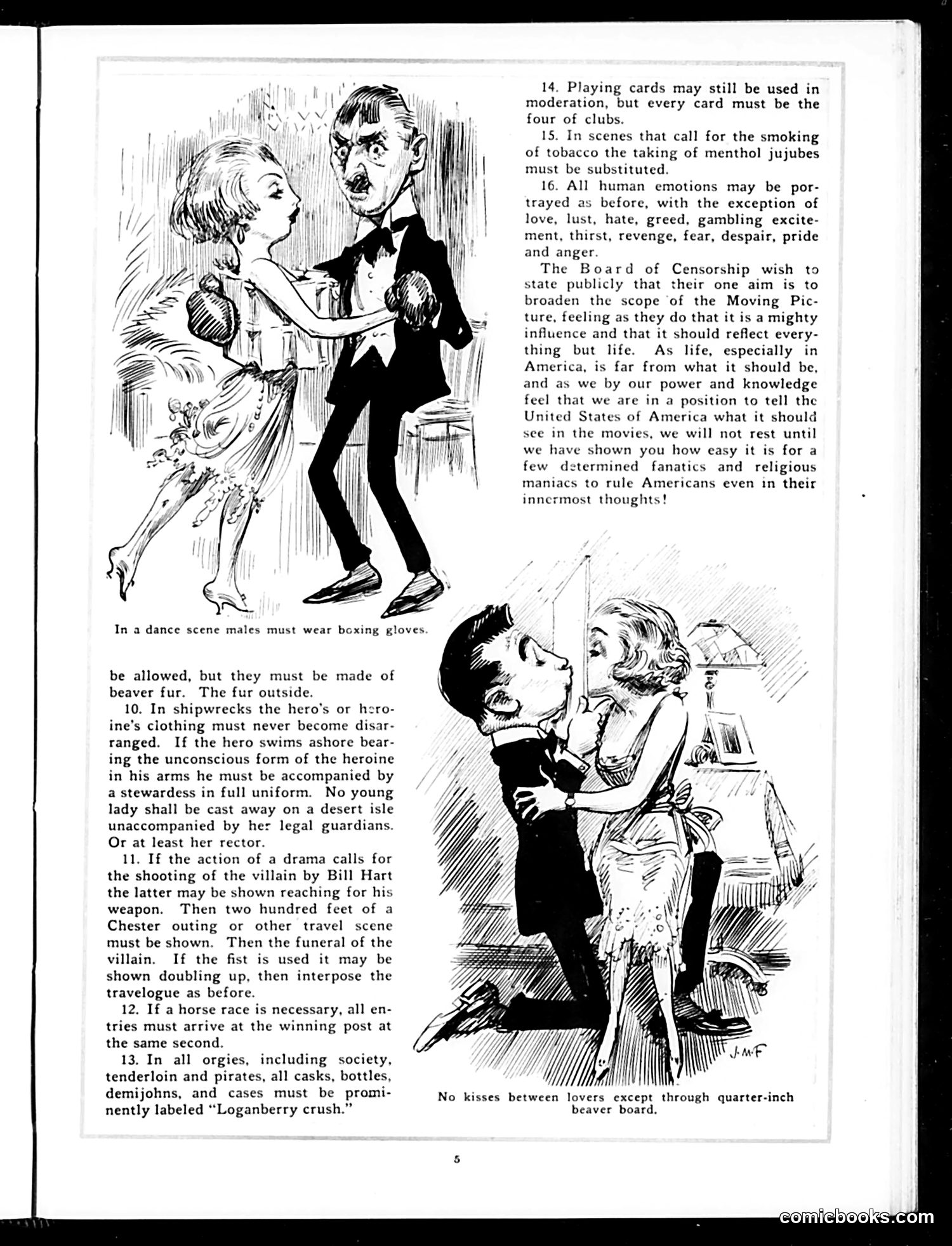
This page satirizes the Motion Picture Board of Censorship (established 1909), which imposed strict moral guidelines on American films. The text mockingly lists absurd censorship rules: cards must be four of clubs only, tobacco replaced with menthol jujubes, kisses separated by "quarter-inch beaver board," and emotions like love and anger prohibited. The cartoons illustrate these ridiculous restrictions—the top shows a dance scene (heavily censored), the bottom depicts the bizarre "beaver board" kiss barrier. Judge's satire targets censorship's hypocrisy: the Board claims to "broaden" cinema while actually reflecting "everything but life," and boasts of controlling Americans' thoughts. The final paragraph's tone shifts to bitter irony, suggesting that zealous "fanatics and religious maniacs" can manipulate the public through censorship. This critiques moral crusaders' paternalistic control over entertainment and public thought during the Progressive Era.
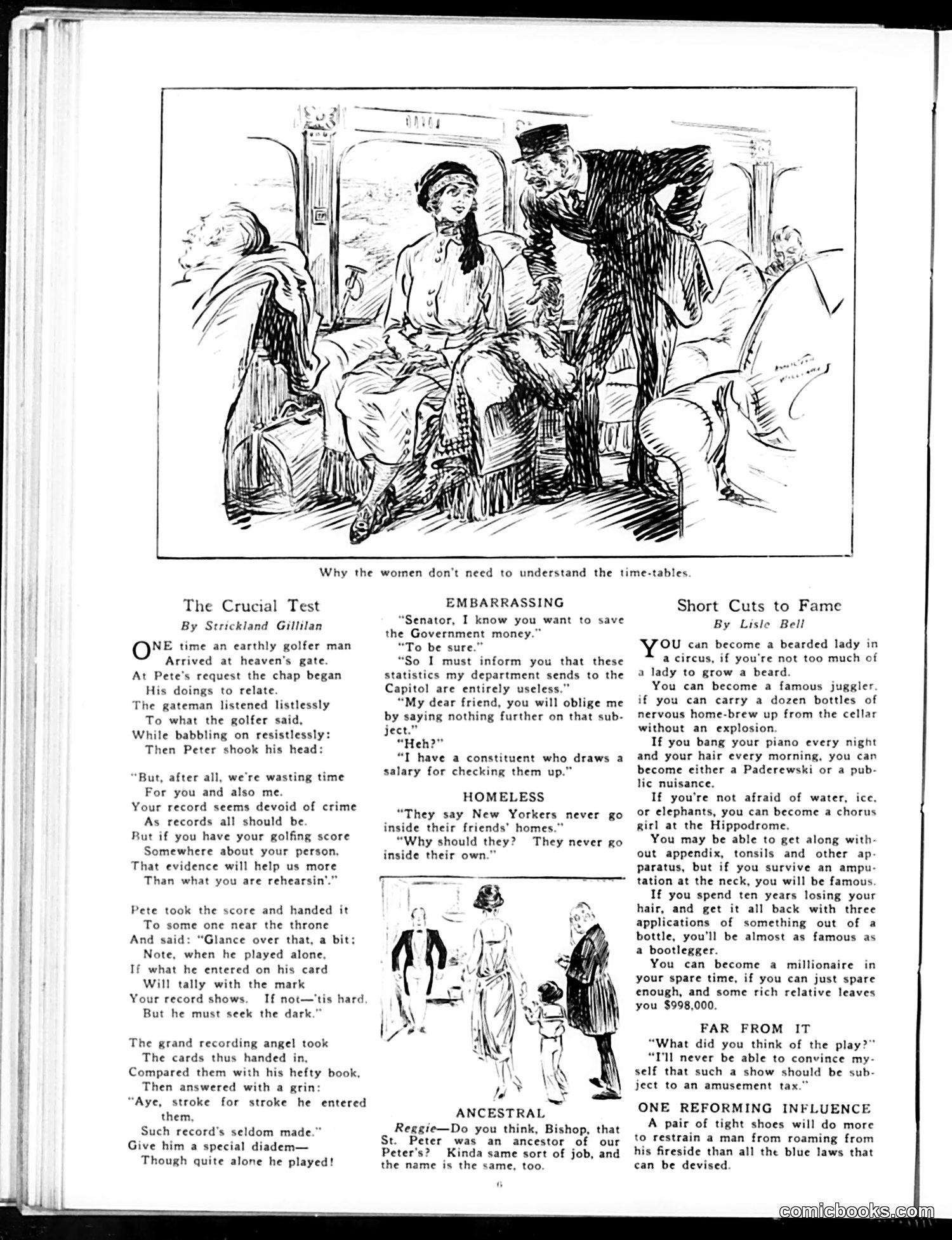
This page contains three distinct satirical pieces: **"The Crucial Test"** (poem by Strickland Gillian): A golfer enters heaven and St. Peter checks his golf scorecard against divine records. The satire mocks golfers' honesty—the man is admitted to heaven only because he honestly reported his scores when playing alone, a rarity. The joke suggests golfers routinely cheat and lie about their scores, making simple honesty extraordinary. **"Embarrassing"**: A senator wants to cut government spending, but a bureaucrat reveals he employs a constituent to "check" useless statistics. The satire exposes political patronage and wasteful government jobs created for constituents, not actual need. **"Short Cuts to Fame"** and other brief items mock get-rich-quick schemes and absurd celebrity paths—becoming a bearded lady, surviving amputation, or relying on inherited wealth—satirizing superficial American success culture. The top cartoon illustrates women on public transportation, captioned about not understanding timetables, likely mocking contemporary gender stereotypes about female incompetence with practical matters.
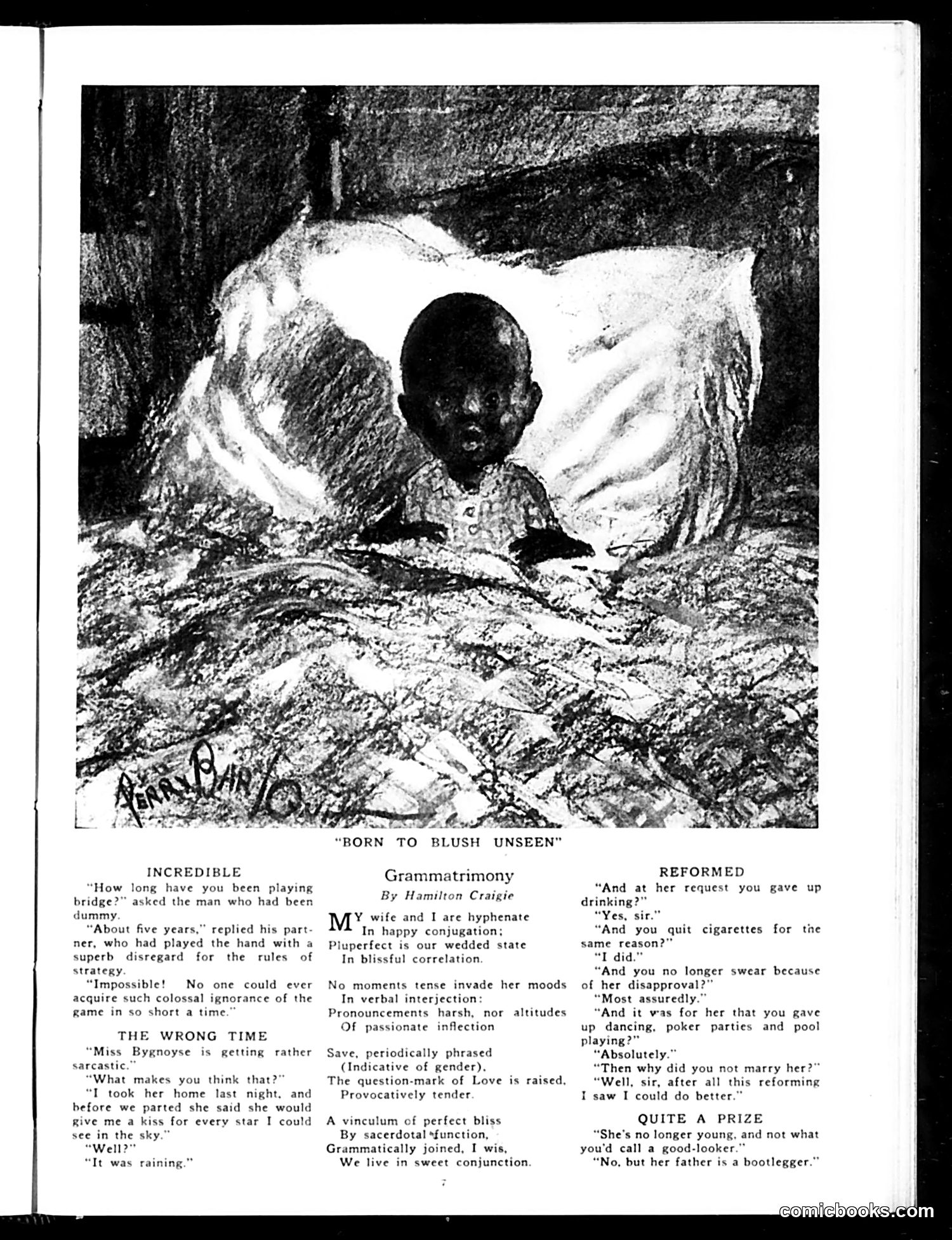
This page contains three separate humorous pieces satirizing social conventions of the era (likely 1920s-30s). **"The Incredible"** and **"The Wrong Time"** are brief jokes mocking bridge players and romantic miscalculation respectively—standard magazine humor requiring no special context. **"Grammatrimony"** is a poem by Hamilton Craigie satirizing overly intellectual, pretentious speech in marriage. The narrator describes his wife using absurdly formal grammatical terminology ("hyphenate," "pluperfect," "vinculum") rather than genuine emotion, mocking educated affectation. **"Reformed"** satirizes a cynical bachelor. A woman reformed him—he quit drinking, smoking, and gambling at her request. When asked why he didn't marry her, he reveals he "could do better," suggesting her reforming power made him respectable enough to pursue someone else. **"Quite a Prize"** is Prohibition-era satire: a man acknowledges his girlfriend is plain and aging, but he's marrying her because her father is a bootlegger (illegal alcohol distributor)—a darkly comic commentary on Prohibition's economic incentives and moral compromises.
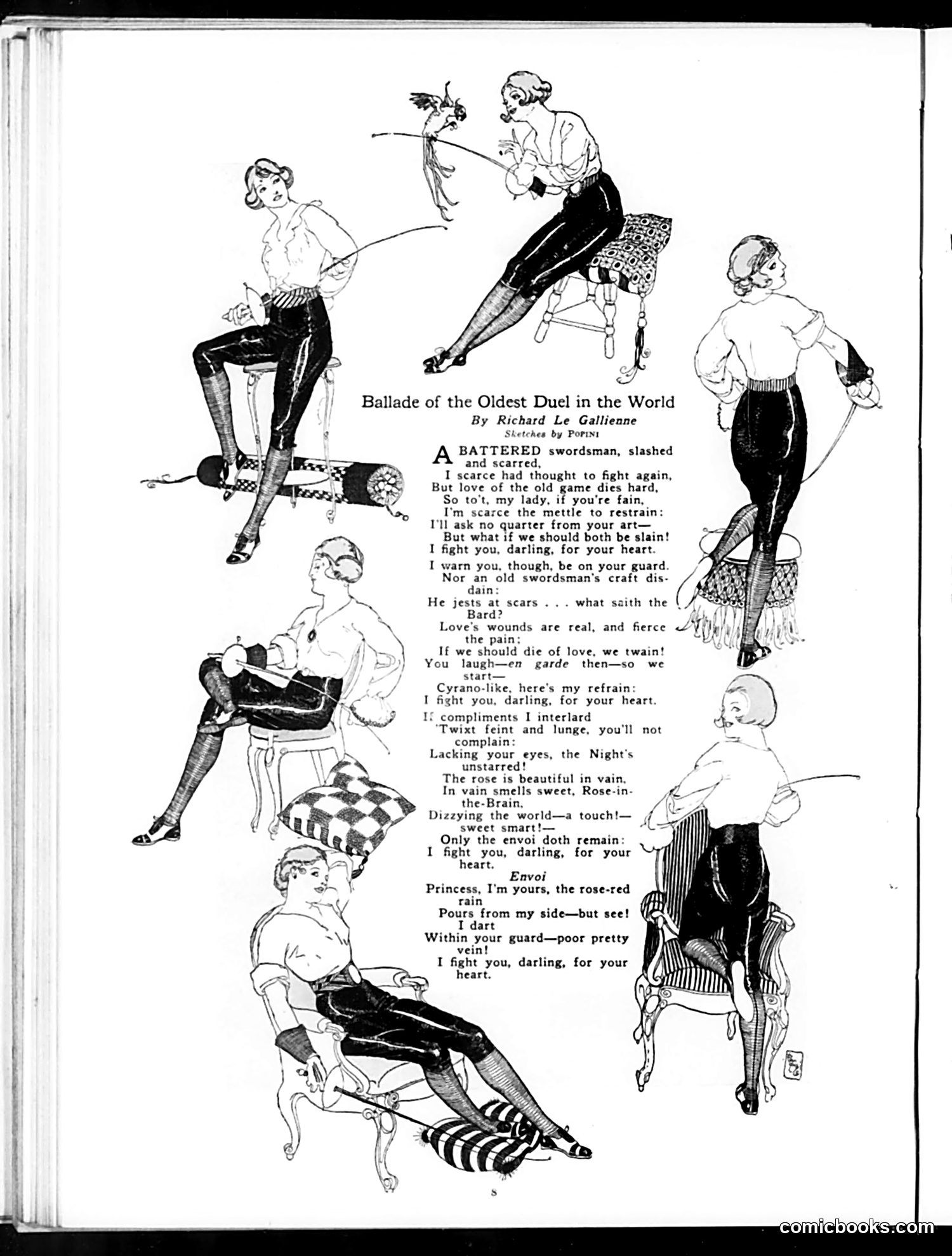
This is a romantic poem by Richard Le Gallienne illustrated by Poirot, presenting a witty metaphor: a sword duel as courtship. The "fight" is between lovers, with swordplay representing flirtation and romantic combat. The poem references **Cyrano de Bergerac**—the famous fictional swordsman-poet who fought while composing elaborate compliments. Here, the speaker similarly mingles dueling technique with romantic declarations ("I fight you, darling, for your heart"). The illustrations show figures in various fencing poses, emphasizing both martial skill and sensual elegance. The conceit is that love, like swordplay, involves risk, wit, vulnerability ("Love's wounds are real"), and playful danger. The "oldest duel" is love itself—timeless and universal. This represents *fin de siècle* aesthetic sensibility: blending literature, art, and romance into sophisticated entertainment for Judge's educated readership.
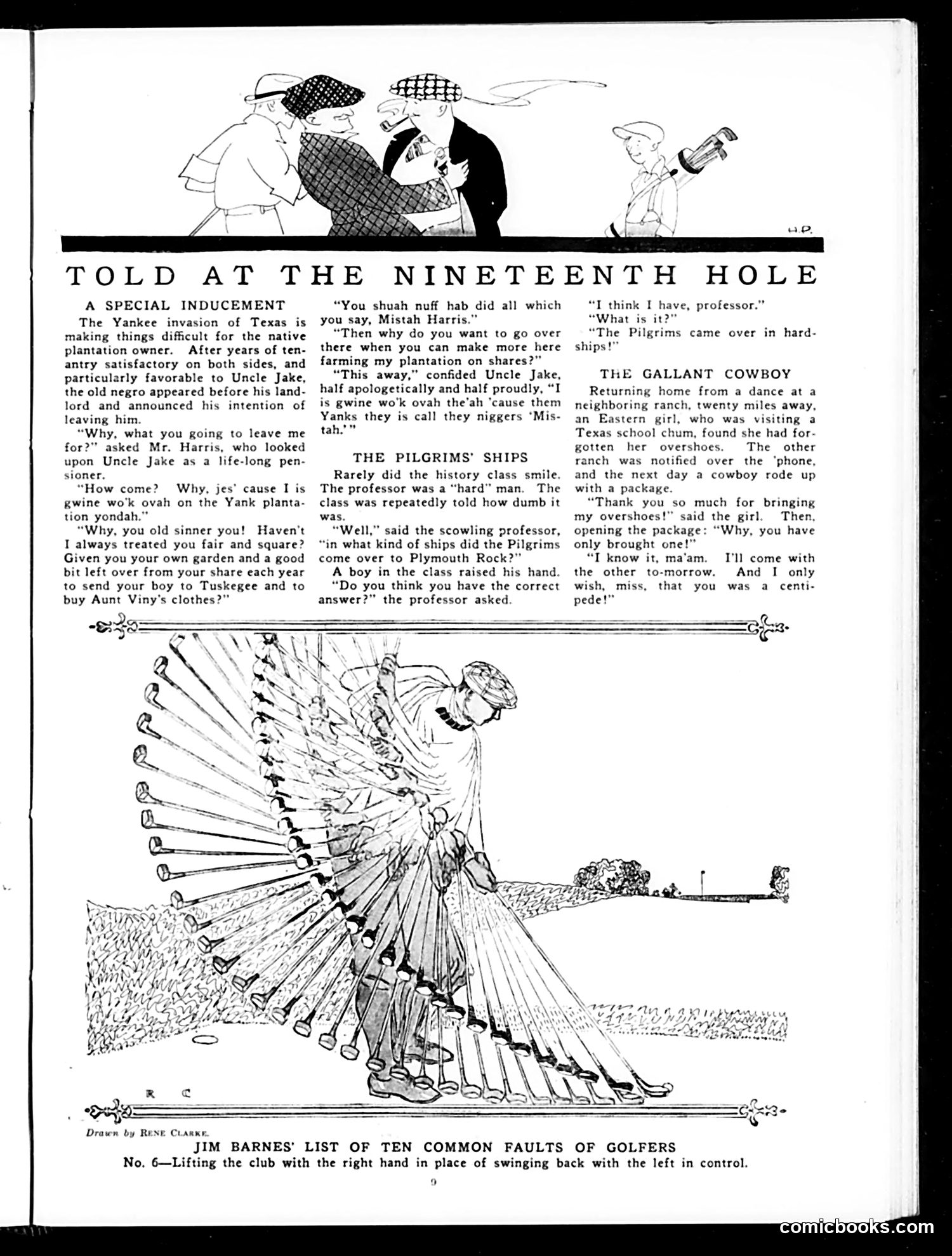
This Judge magazine page contains three satirical stories typical of early 20th-century American humor: 1. **"Told at the Nineteenth Hole"** — Three brief jokes: - A Southern plantation owner is losing workers to Northern ("Yankee") employers because they use the respectful title "Mister" when addressing Black laborers, unlike the South. - A "hard" history professor is outsmarted by a student's pun: Pilgrims came in "hardships" (wordplay on difficulty and ships). - A cowboy courting an Eastern visitor brings only one overshoe, planning to return tomorrow with the other—a pretext to see her again. 2. **Bottom illustration** — A golf instruction comic showing a golfer's swing fault, part of a series on golfing errors. The page reflects period attitudes: patronizing treatment of Black workers, stereotypical "dumb student" classroom dynamics, and flirtation humor. The Yankee-South contrast references post-Civil War labor tensions and Northern industrial expansion into Southern agriculture.
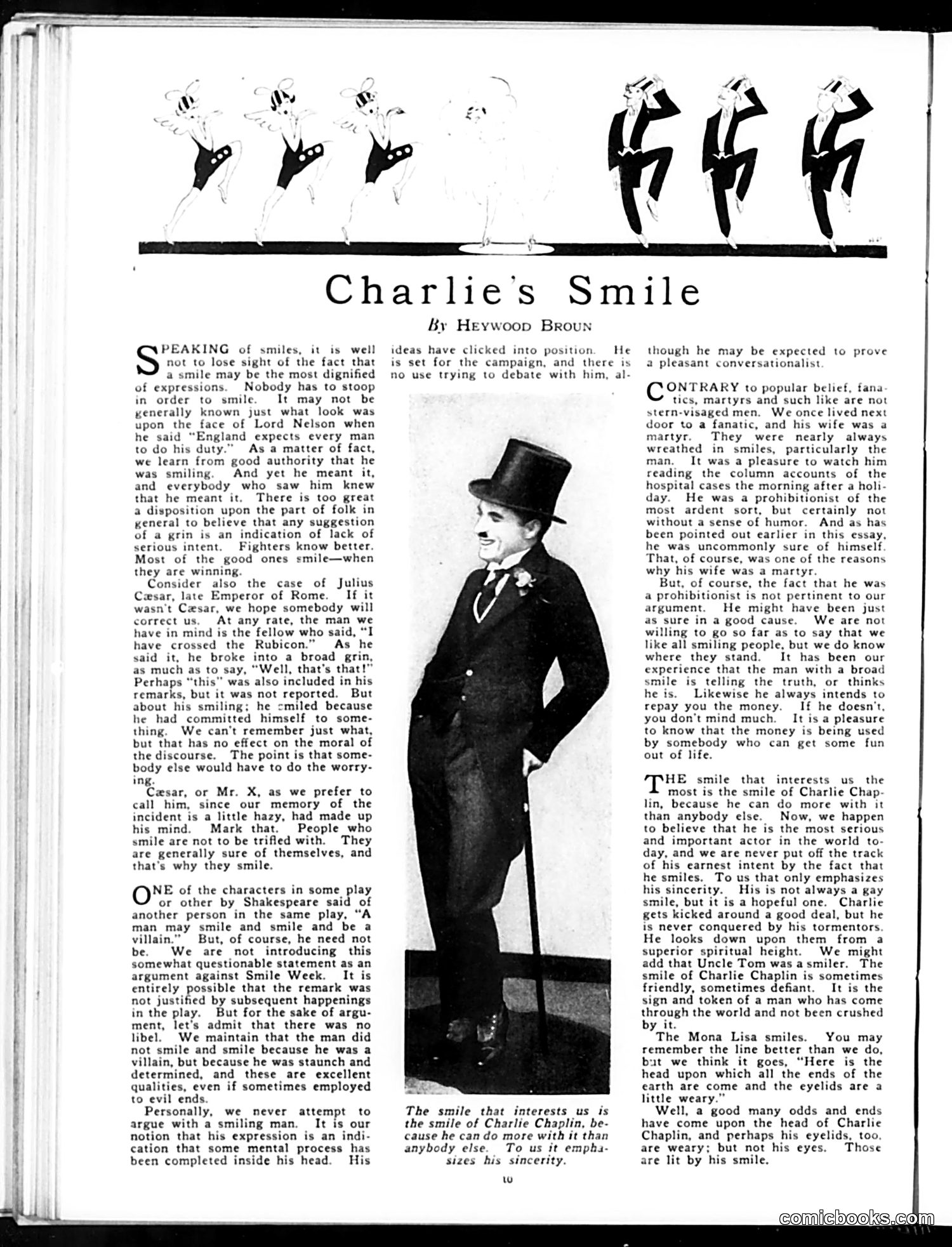
This is a lengthy opinion essay by Heywood Broun praising smiles as signs of sincerity and determination, not weakness. The small illustrations show figures in various poses—likely representing different expressions or attitudes. The essay's main argument: confident people smile because they've made decisions and committed themselves. Historical examples (Lord Nelson, Julius Caesar) allegedly smiled while undertaking serious duties. The piece dismisses the Shakespeare quote about villainous smiles as irrelevant. **The key reference**: The essay culminates in praising Charlie Chaplin's smile specifically, calling it the most interesting smile because "he can do more with it than anybody else" and it "emphasizes his sincerity." This reflects Chaplin's 1920s fame as a silent-film comedian whose expressive face—particularly his smile—conveyed deep emotion and humanity, especially in his "Tramp" character. The context: This appears to be part of a "Smile Week" campaign, likely a 1920s civic promotion encouraging optimism and positive social attitudes.
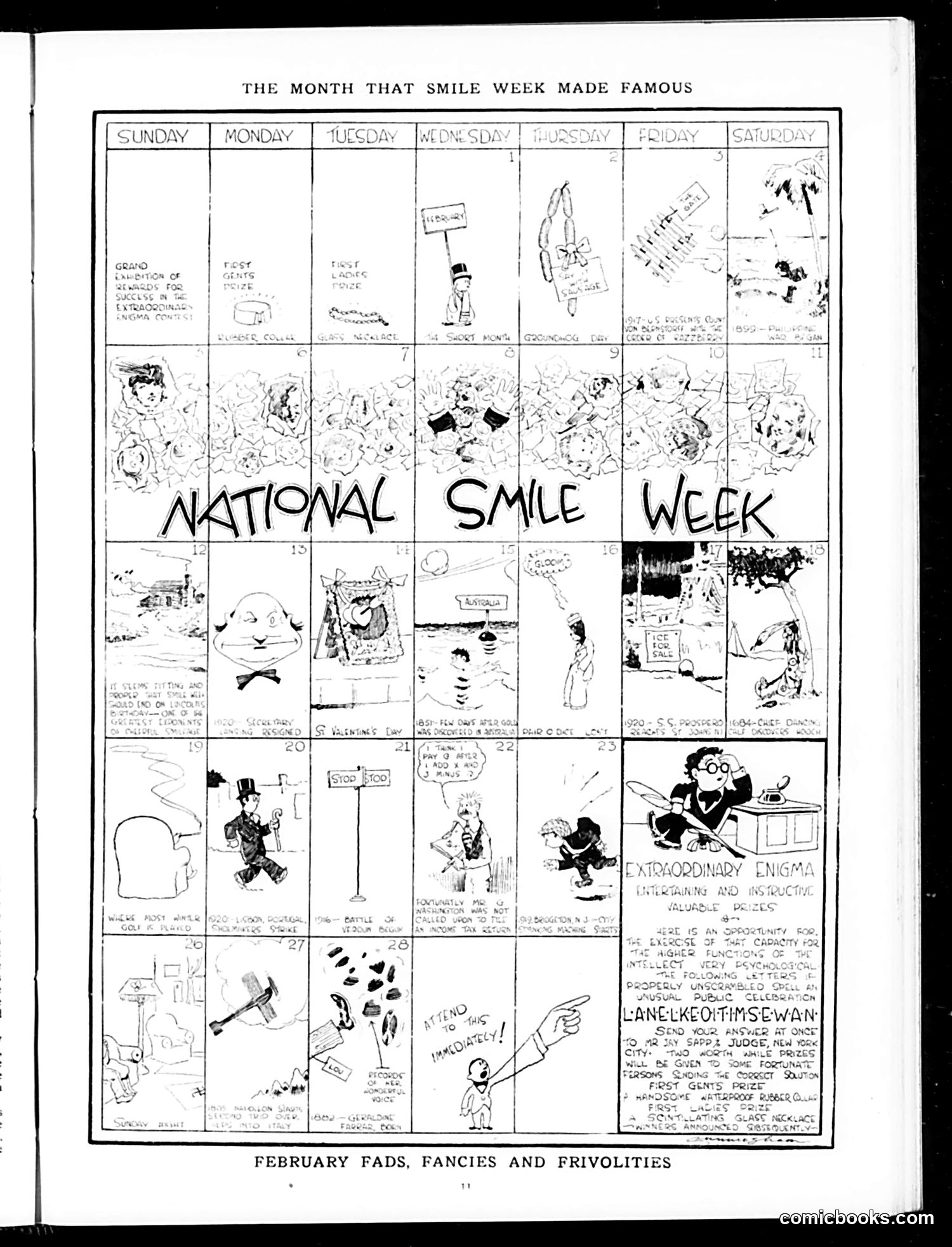
This is a seven-day comic strip documenting "National Smile Week," a February observance that apparently became notable enough to merit satirical coverage in *Judge* magazine. The strip depicts various humorous scenarios across the week where people attempt to smile or engage in smile-related activities, with increasingly absurd situations shown in the daily panels. The bottom caption labels it "February Fads, Fancies and Frivolities," positioning Smile Week as one of many passing social trends the magazine found amusing enough to mock. The specific jokes in individual panels are difficult to read clearly in this reproduction, but the overall satire targets the somewhat arbitrary nature of designated "weeks" and Americans' enthusiasm for participating in trendy civic observances. The strip treats Smile Week as a fad worthy of gentle ridicule.
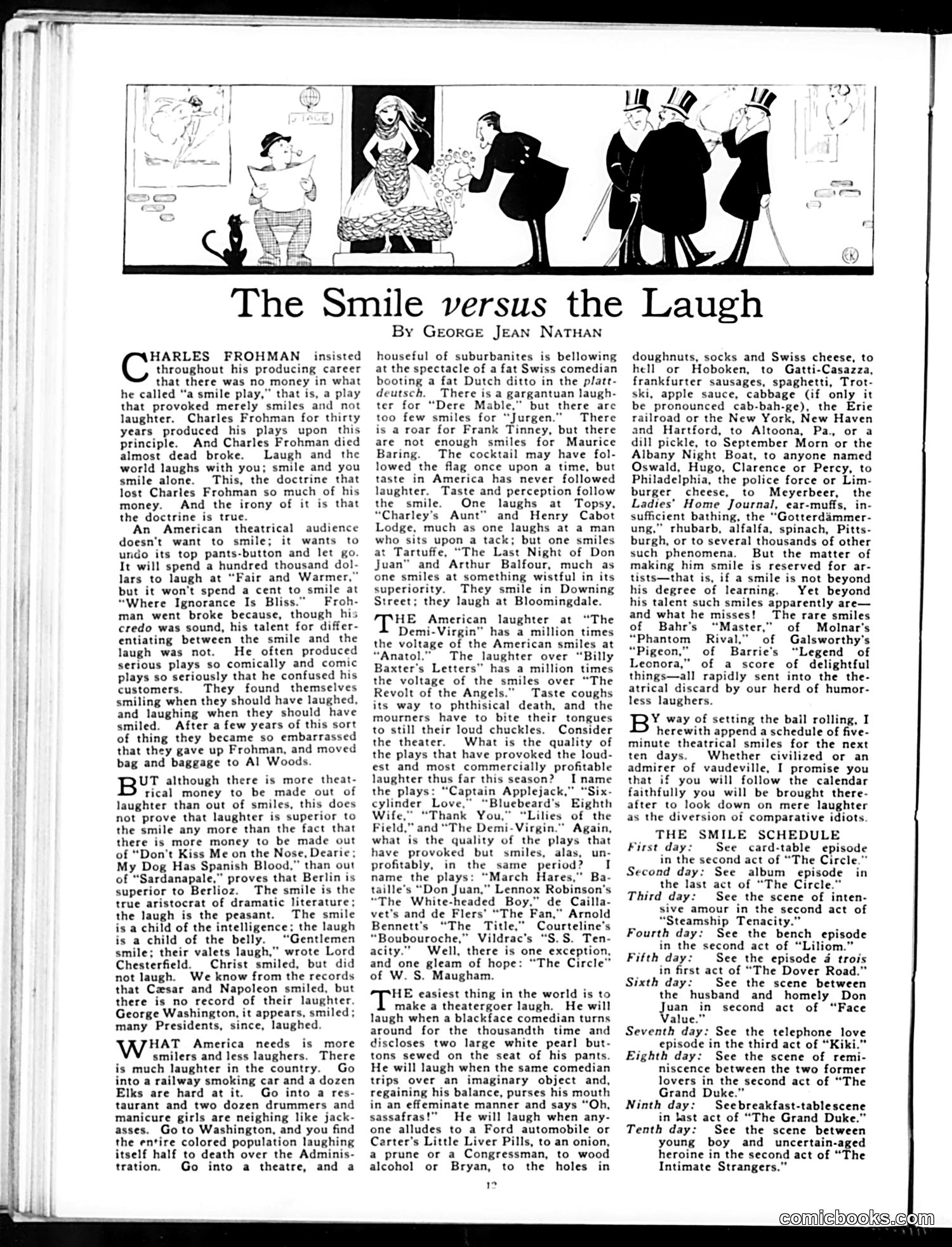
This is a theatrical criticism essay by George Jean Nathan, not a political cartoon. The small comic strip at the top illustrates the article's theme about American theatrical taste. Nathan argues that American audiences prefer broad laughter to refined smiles—they'll pay for slapstick comedies but not sophisticated plays. He cites producer Charles Frohman's financial failure despite his artistic doctrine that "smile plays" were worthier than laugh-getters. Nathan uses class commentary throughout: laughs are "peasant" and "of the belly," while smiles are "aristocratic" and "of intelligence." He invokes Caesar, Napoleon, Christ, and Lord Chesterfield as evidence that refined people smile rather than laugh. The article criticizes American popular taste as vulgar, contrasting lowbrow comedies ("Dere Mable," Frank Tinney) with sophisticated fare ("Jurgen," Maurice Baring). This reflects 1920s cultural anxiety about mass entertainment and democratic taste versus elite aesthetics.
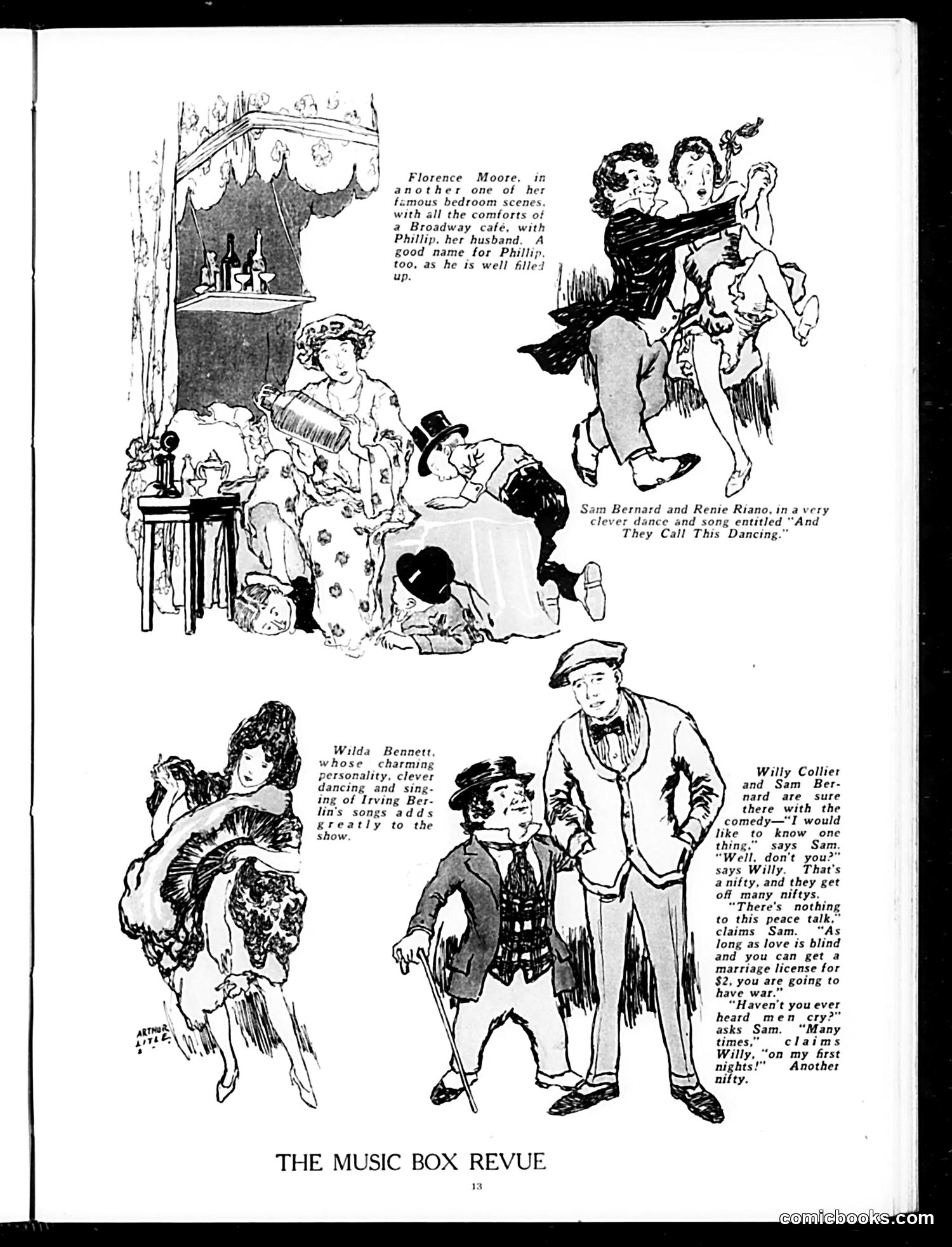
This page features theatrical reviews from what appears to be a Broadway show called "The Music Box Revue." The satirical sketches mock various performers and their acts: **Florence Moore** is shown in a bedroom scene described as typical of her comedic performances, presented with Broadway-style luxury (the ornate bed canopy). **Sam Bernard and Renie Riano** are depicted performing a dance and song number. **Wilda Bennett** is noted for her charming personality and singing performances. **Willy Collier and Sam Bernard** are shown in a comedic dialogue about marriage and war—the humor appears to revolve around their witty banter about domestic life costs versus actual warfare expenses. The page satirizes early 1920s Broadway entertainment conventions and performer personalities through caricature and comedic commentary.
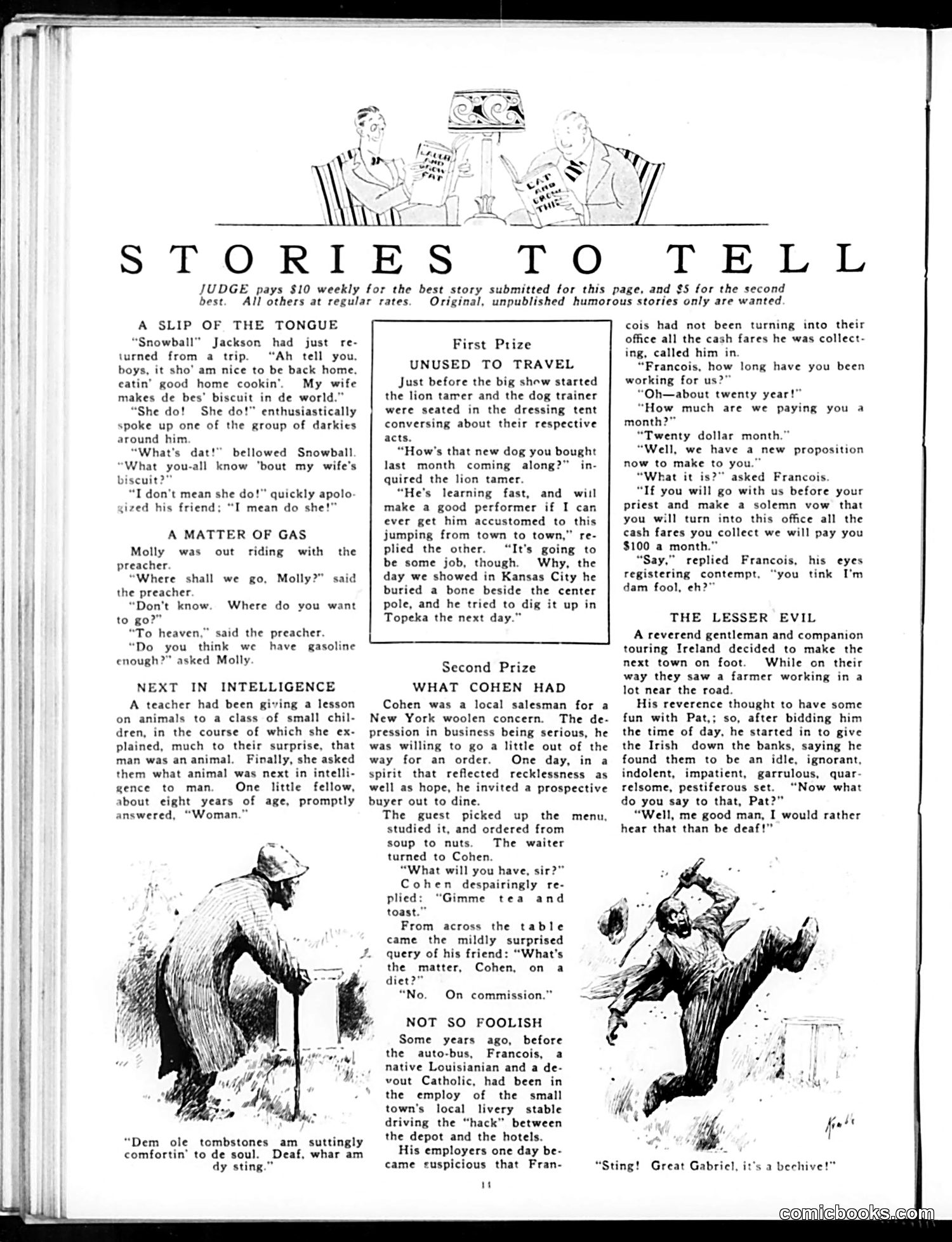
This page from *Judge* magazine presents humorous short stories competing for prize money ($10 for first place, $5 for second). **The cartoons use period stereotypes**: "A Slip of the Tongue" features racist dialect humor about African Americans; "A Matter of Gas" makes a joke about a woman's supposed lack of intelligence (the preacher implies heaven; she worries about gasoline—suggesting she doesn't understand spiritual concepts). "Next in Intelligence" presents the punchline that "Woman" is the animal next in intelligence to man—a sexist joke claiming women are barely more intelligent than animals. **"What Cohen Had"** mocks Jewish businessmen during Depression hardship, with Cohen so poor he orders only tea and toast while entertaining a customer. **"Not So Foolish"** portrays a Louisianian (presumably with Cajun dialect) as intellectually honest—turning down a bribe offer because taking a religious vow while stealing would be genuinely foolish. These stories reflect *Judge*'s casual use of ethnic caricature and gender stereotyping as humor vehicles typical of early 20th-century American publications.
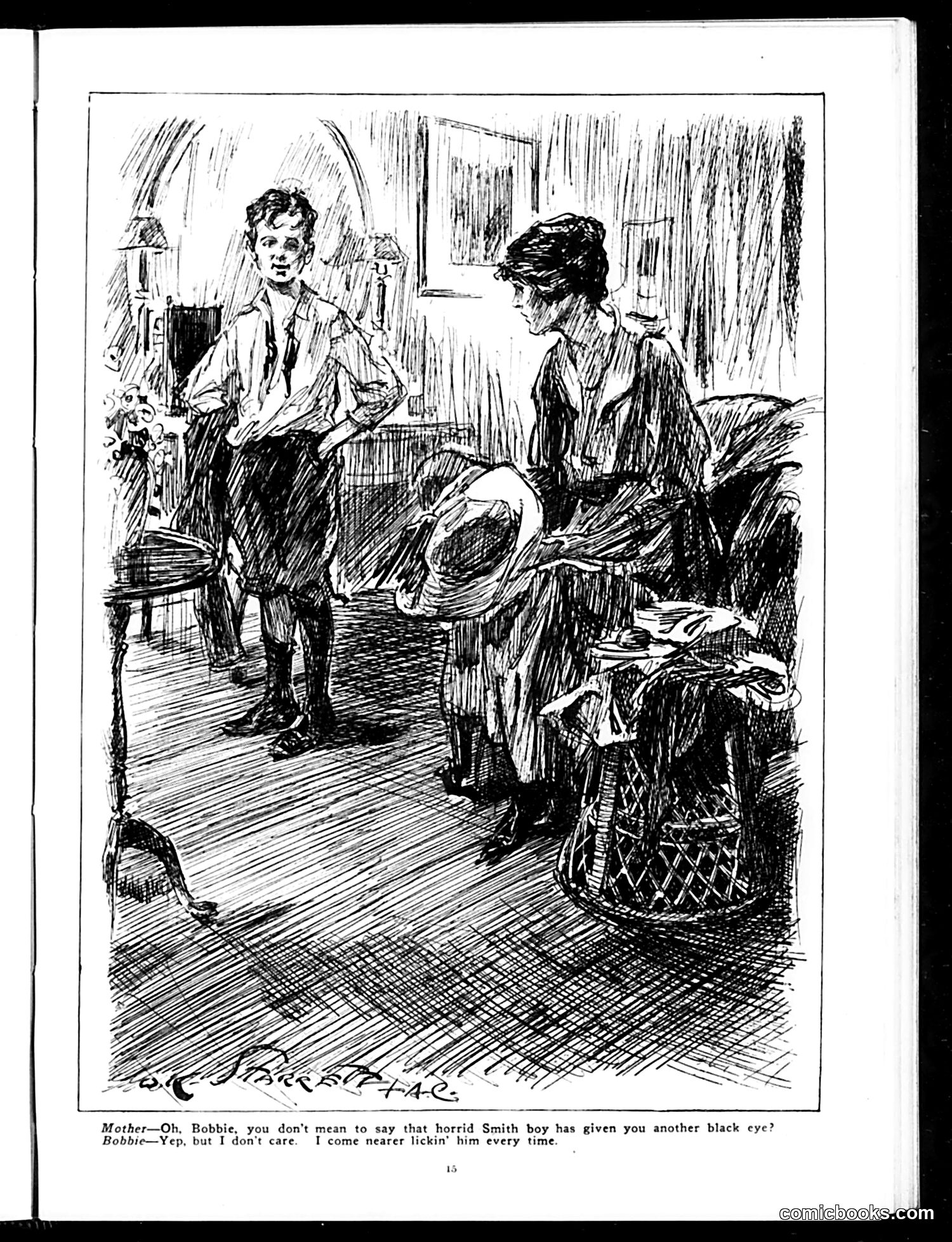
This is a domestic humor cartoon depicting a mother scolding her son Bobbie about receiving another black eye from fighting with a neighbor boy named Smith. The joke hinges on Bobbie's defiant response: while he's losing the fights (getting black eyes), he claims he's improving—coming "nearer lickin' him every time." The satire targets working-class or lower-middle-class parenting and boyhood culture. The mother's concern and Bobbie's dismissive attitude toward injury reflects period attitudes about masculine toughness and fighting as normal childhood behavior. The humor derives from the boy's optimistic spin on repeated defeat, suggesting gradual improvement despite visible evidence otherwise. This reflects Judge magazine's typical comedic focus on domestic life and class-based social observations.
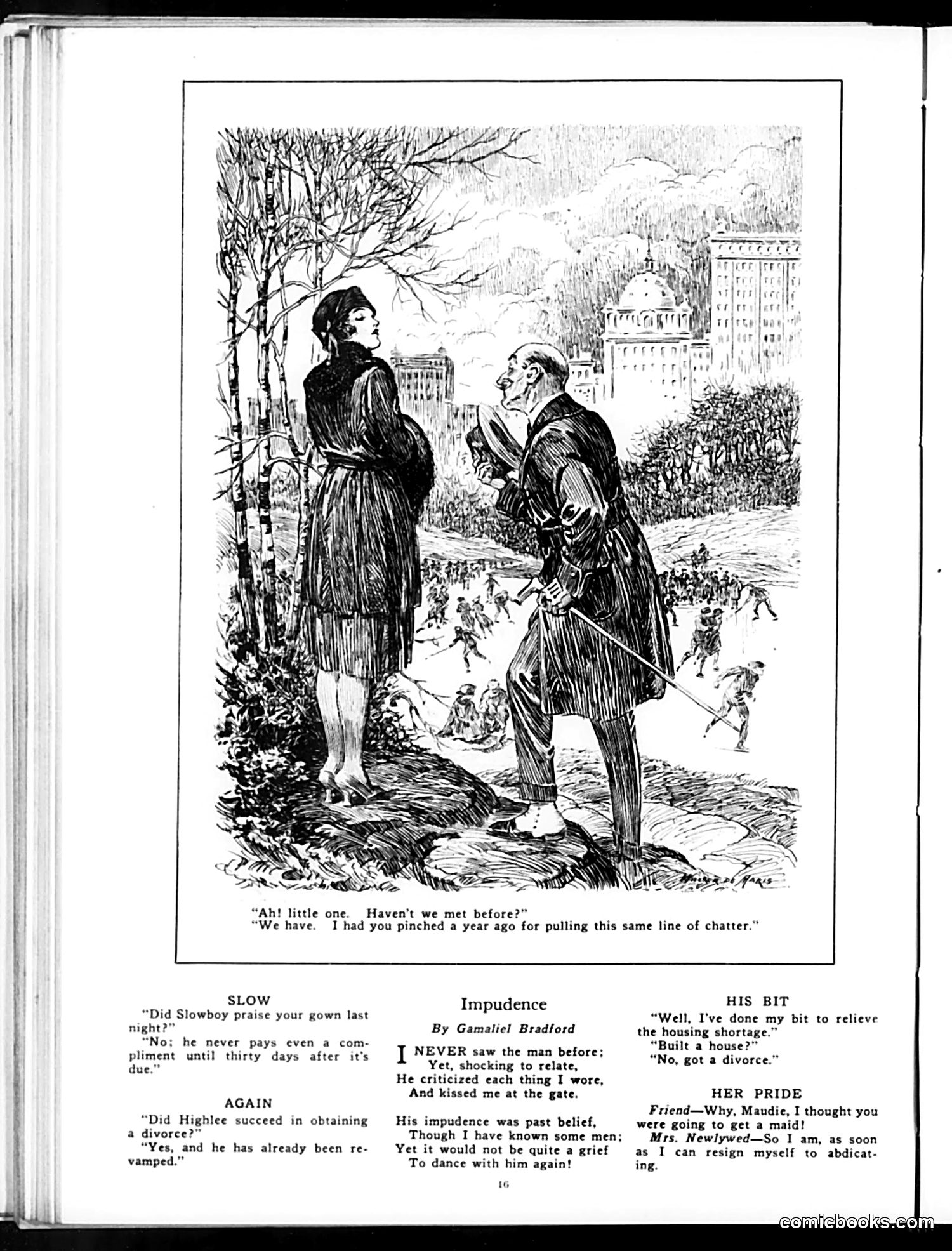
This page from *Judge* contains four separate humor pieces about courtship and marriage, typical of early-20th-century American satirical magazine content. The main cartoon depicts a man and woman meeting in a park; the woman reveals she previously had him arrested for the same romantic line. The satire targets men's predictable, recycled seduction tactics and their shamelessness in reusing them. The four text pieces below mock various relationship behaviors: a stingy man who withholds compliments, a recently divorced man who immediately remarries (suggesting shallow commitment), a woman claiming divorce relief "relieves the housing shortage," and another woman who divorced specifically to remarry herself off as a maid—satirizing women's limited economic independence and the desperation that marriage represents. The overall theme ridicules both genders' marriage behaviors while highlighting the era's social attitudes toward divorce (still scandalous), courtship etiquette, and women's economic dependence on matrimony.
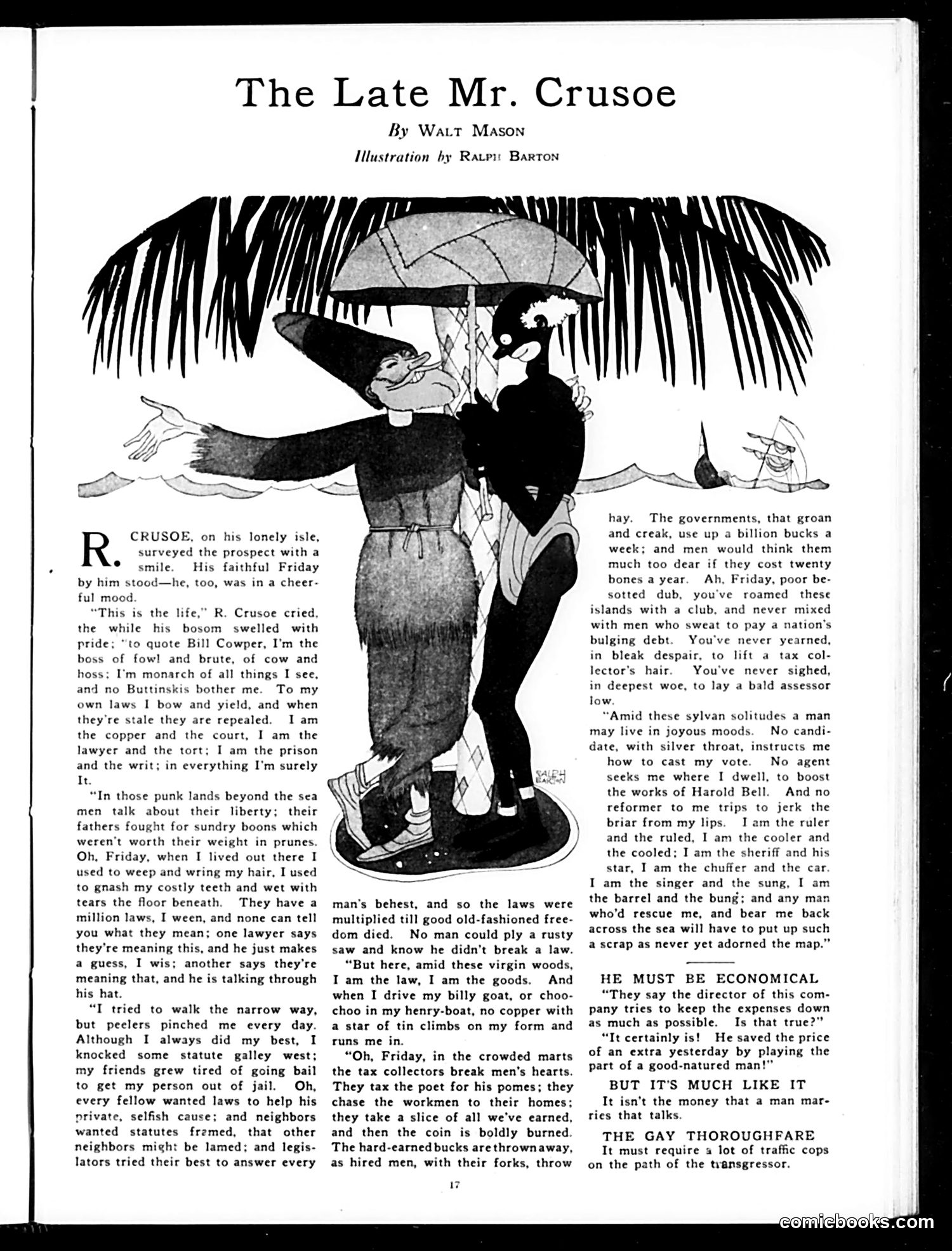
This Walt Mason satire uses Robinson Crusoe as a stand-in for the independent American, contrasting his island freedom with civilized society's bureaucratic entanglement. Crusoe celebrates having "no Buttinskis" bothering him—no police ("peelers"), lawyers, or government interference—versus the mainland where citizens are trapped by contradictory laws, taxation, and political reform campaigns. The joke targets progressive-era government expansion: multiple conflicting laws, tax collectors, and political operatives seeking votes. Crusoe's contentment on his isolated isle—where he is "law, goods, ruler, ruled, sheriff, and star"—satirizes Americans' loss of independence to government overreach. The cartoon mocks how modern civilization has become so regulated that simple freedoms (driving a cart, sawing wood) risk legal violation. The small jokes below continue this theme of reduced freedom and government inefficiency.
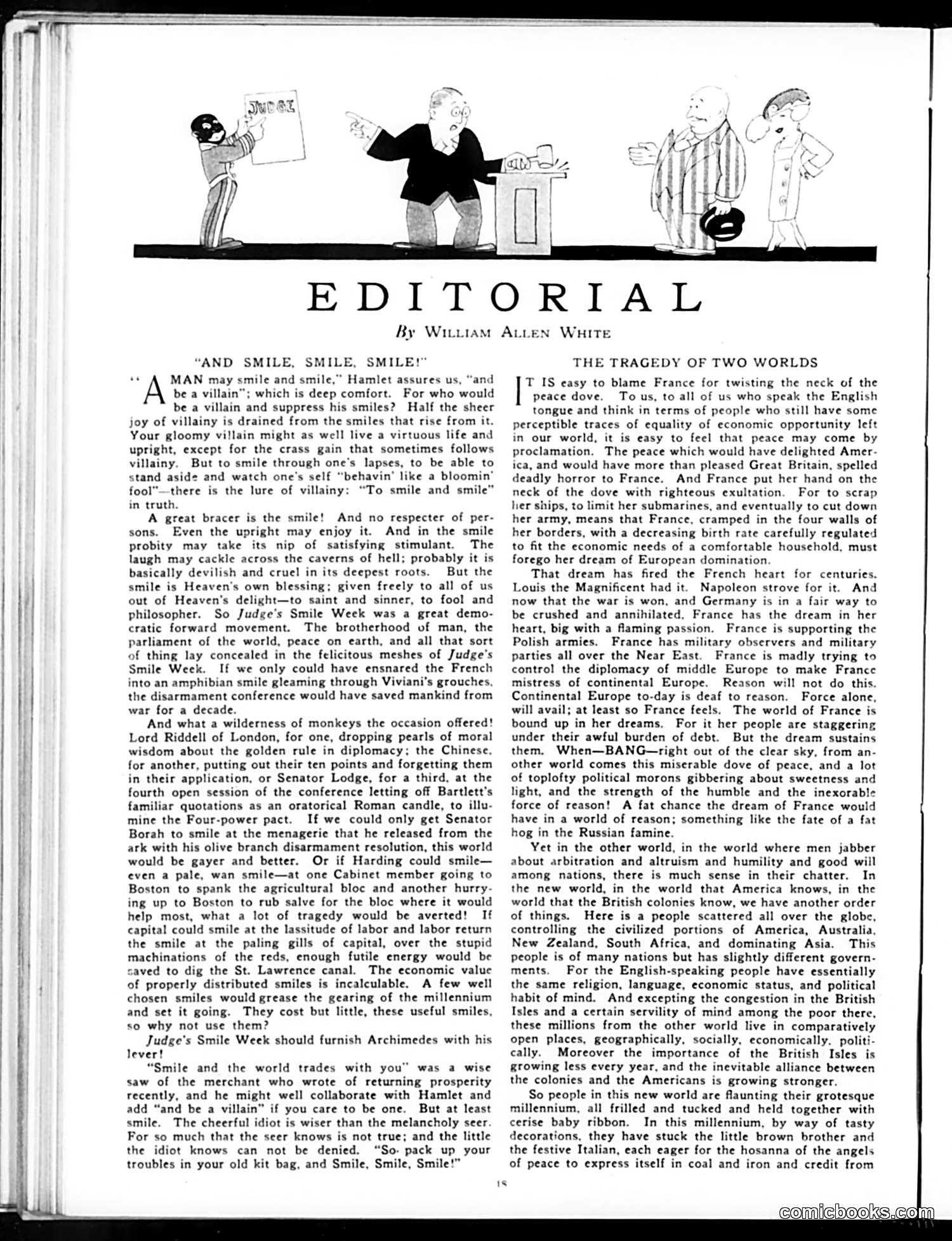
This editorial page from Judge magazine contains two pieces by William Allen White satirizing post-WWI politics and diplomacy. **Top cartoon (unillustrated text):** "Judge's Smile Week" mocks a naive campaign promoting smiling as a solution to international conflict. White sarcastically suggests that if world leaders—including Senator Lodge, Senator Borah, President Harding, and French diplomat Viviani—could simply smile at each other, disarmament conferences and labor disputes would resolve themselves. The piece ridicules the idealistic notion that goodwill gestures alone can overcome fundamental political disagreements. **Bottom article:** White criticizes France for obstructing peace negotiations (the "tragedy of two worlds"). He contrasts English-speaking nations' relative economic equality with European power struggles, particularly France's efforts to militarily dominate Central Europe and weaken Germany. White argues France pursues imperial ambitions rather than genuine peace, and that British colonies operate more equitably than Continental Europe. Both pieces reflect 1920s American skepticism toward European diplomacy and isolationist sentiment.
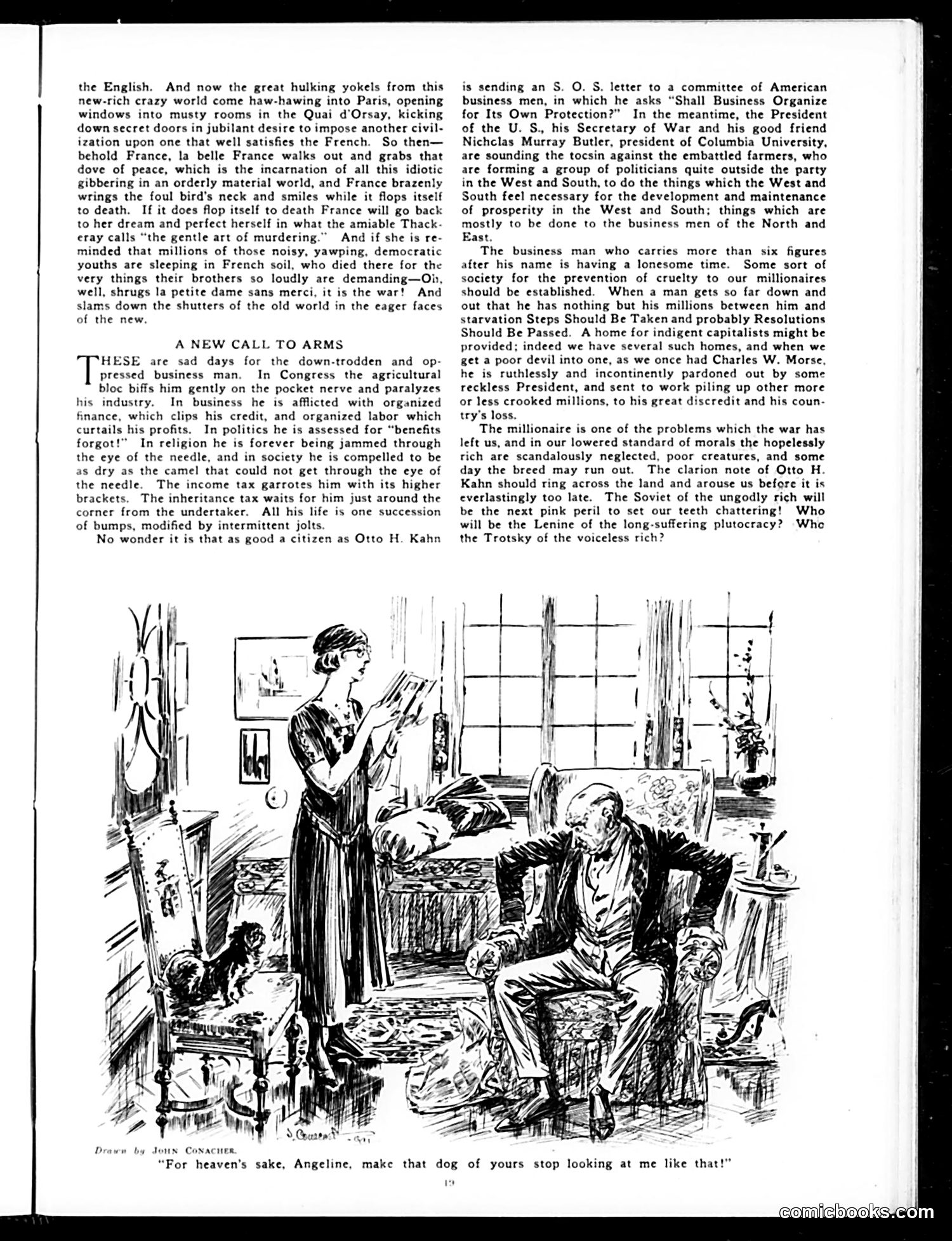
This page contains two distinct satirical pieces attacking different targets in post-WWI America. **"A New Call to Arms"** mocks wealthy businessmen, particularly Otto H. Kahn (a prominent banker), who claim persecution. The text sardonically sympathizes with millionaires facing taxes, organized labor, and agricultural interests in Congress—suggesting their complaints about hardship are absurd given their wealth. It criticizes President Wilson, War Secretary, and Columbia University president Nicholas Murray Butler for siding with western farmers organizing politically, implying the wealthy elite expect government protection. **The cartoon below**, drawn by John Coblacher, depicts a domestic scene where a woman shows her husband a dog. His irritated response—"For heaven's sake, Angeline, make that dog of yours stop looking at me like that!"—appears to be unrelated domestic humor, typical of Judge's mixed content. The page's main satirical thrust targets wealthy industrialists' perceived victimhood and entitlement during an economically turbulent post-war period when labor and agricultural movements challenged business interests.
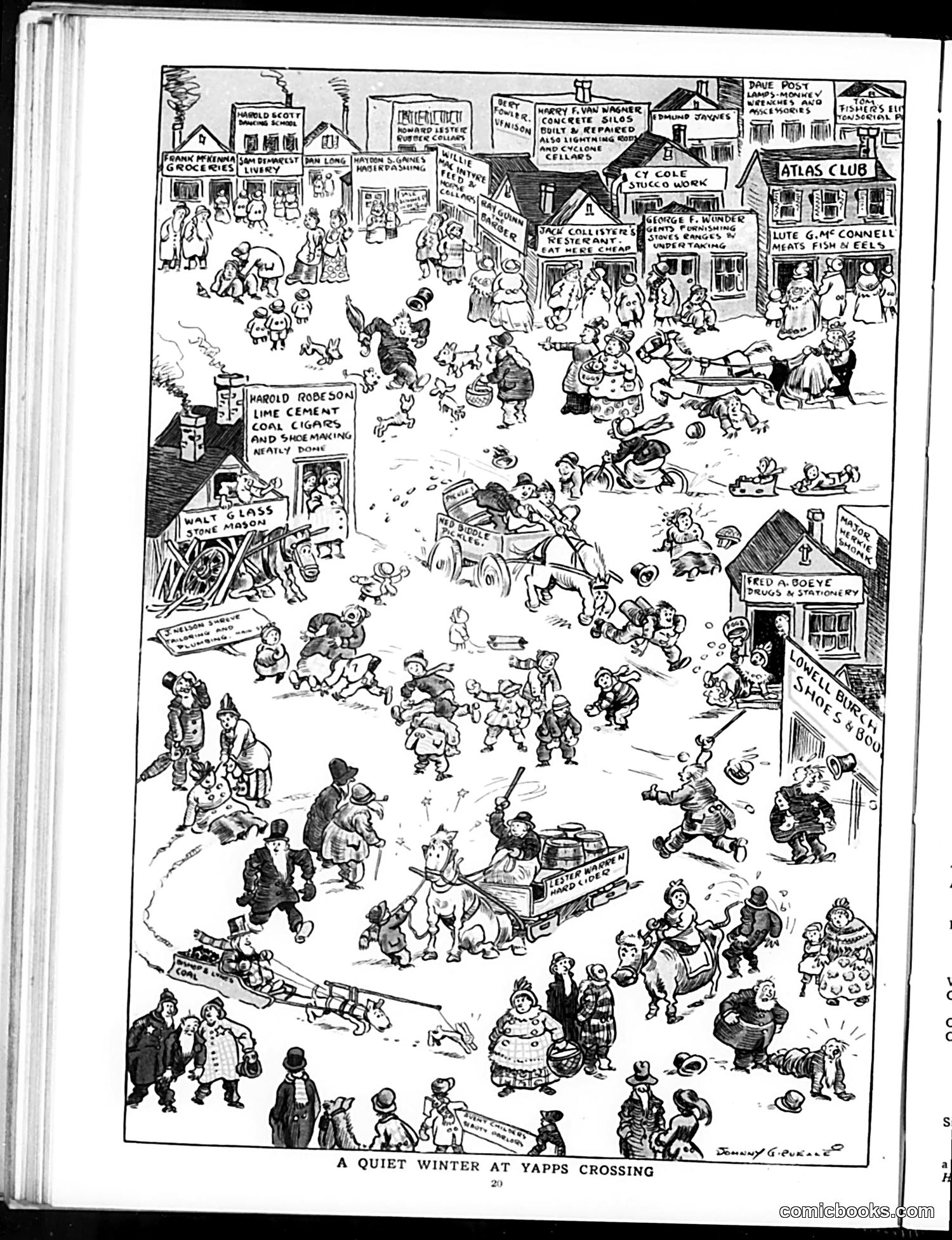
This is a charming satirical illustration depicting small-town American life, likely early 20th century. The title's irony is the joke: the scene shows anything *but* quiet—a chaotic winter street filled with numerous townspeople, children sledding and playing, horse-drawn wagons, and general bustle. The humor derives from the contrast between the promised "quiet" and the bustling reality. Surrounding storefronts advertise local businesses (groceries, livery, restaurants, coal, cigars, drugs, undertaking services), creating a detailed portrait of a small commercial district. The cartoon gently mocks small-town life—simultaneously cramped, busy, and humble—through exaggerated activity and crowded composition. The various figures engaged in winter activities suggest community life: children playing, adults socializing, commerce continuing despite cold weather. This appears to be gentle, nostalgic satire celebrating rather than mocking provincial American towns.
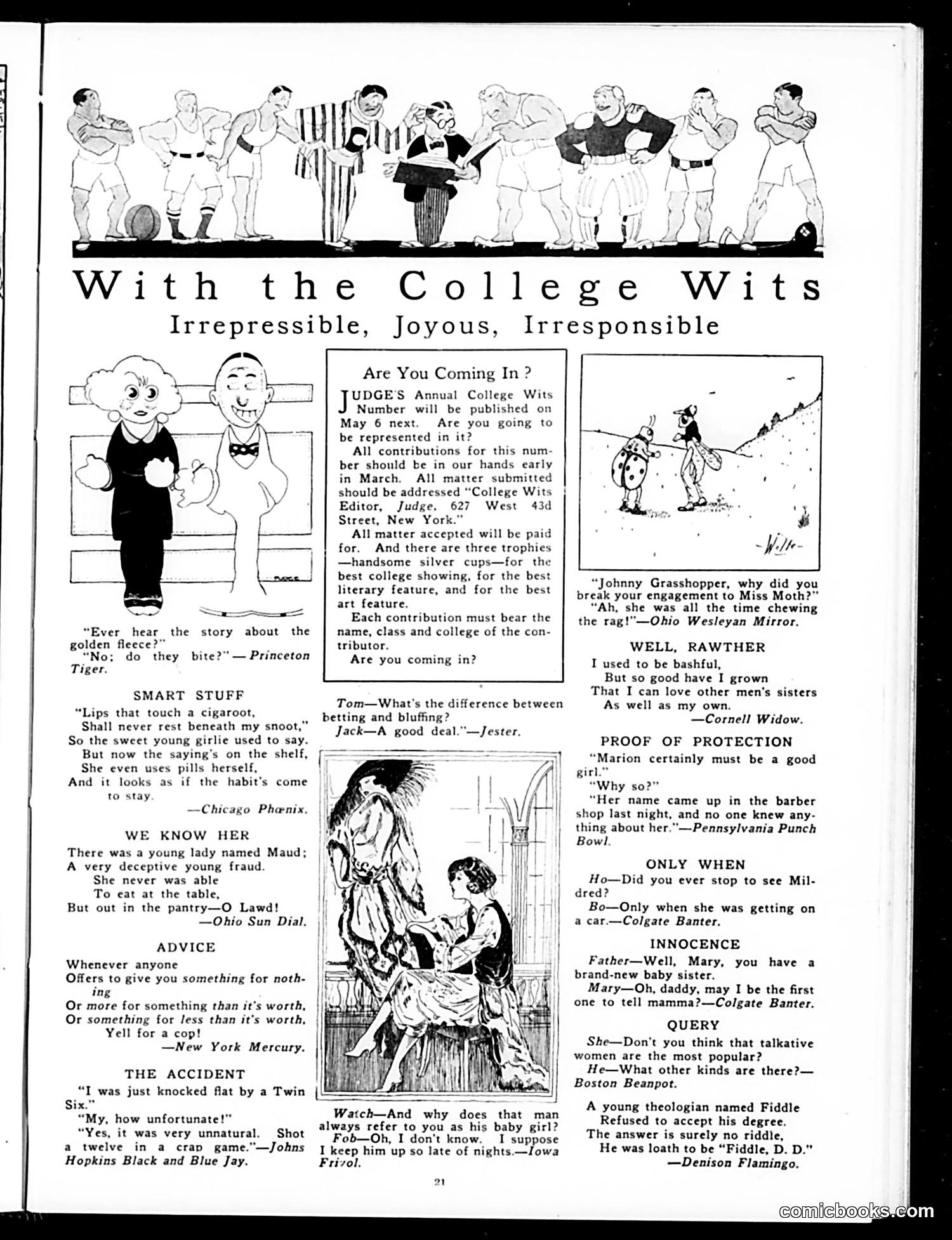
This is a humor compilation page from Judge's college-focused issue, featuring jokes sourced from campus publications (Princeton Tiger, Cornell Widow, Ohio Wesleyan Mirror, etc.). The content reflects early 20th-century collegiate attitudes. **Key themes:** - **Gender and morality**: Multiple jokes mock young women's changing social behavior—smoking ("cigaroot"), eating in pantries secretly, and engaging in casual relationships. "Proof of Protection" jokes about a girl's reputation based on barber-shop gossip. - **Dating and courtship**: Humor around engagements, calling on girls, and romantic entanglements reflects rigid dating conventions of the era. - **Automobiles**: References to "Twin Six" cars and getting rides reflect the novelty and social significance of motor vehicles. - **Wordplay and puns**: The "Fiddle, D.D." joke relies on degree abbreviations; other jokes play on double meanings ("betting vs. bluffing"). The cartoons above show baseball players and collegiate types, establishing the "college wits" framework. The call for submissions promotes Judge's May 6 special college issue with prize cups for best contributions.
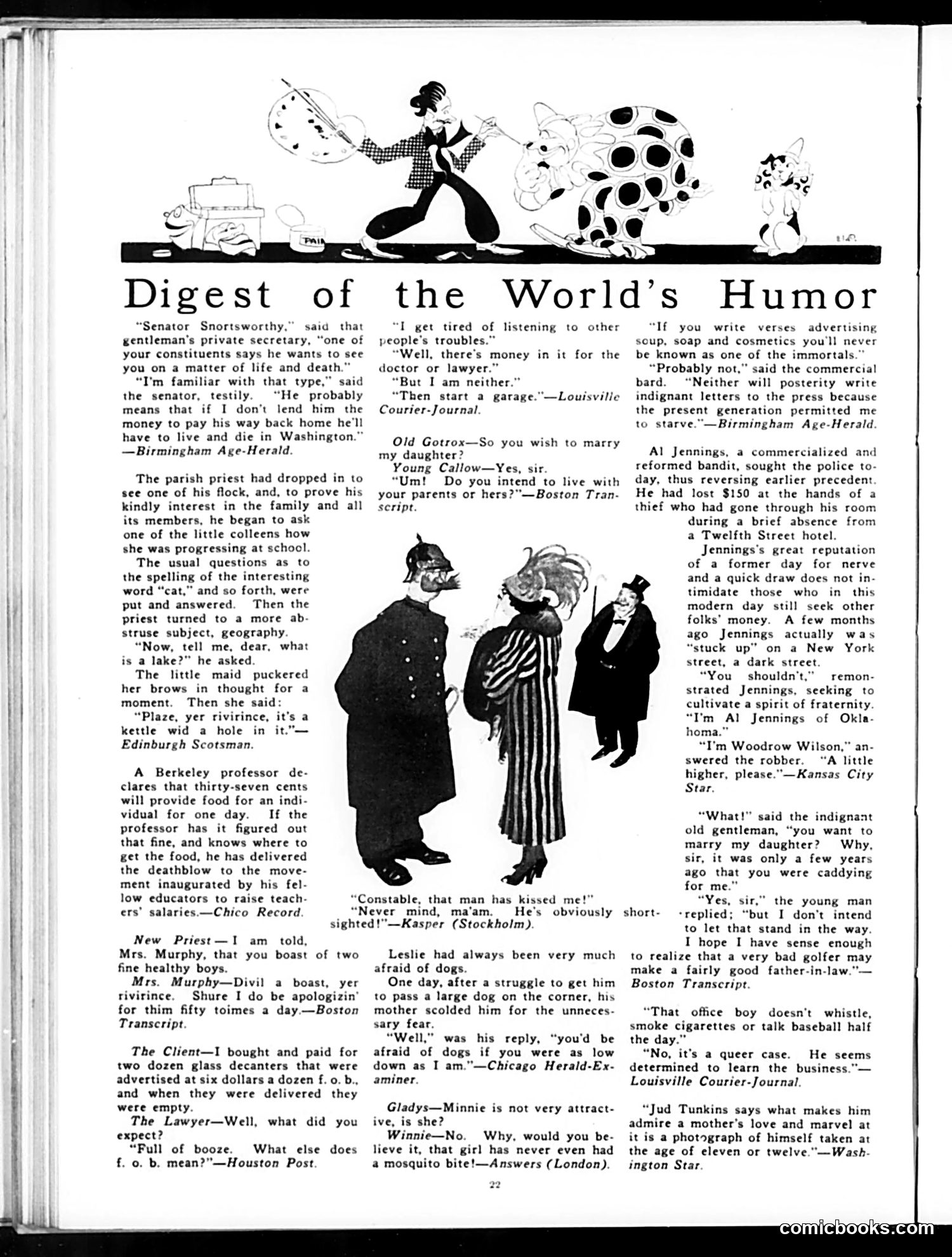
This page is a humor digest—a collection of short satirical anecdotes and jokes from various newspapers, typical of Judge magazine's format. The illustration shows a figure chasing money while dealing with various characters. **Key themes:** 1. **Political satire**: A senator dismisses constituents' pleas as predictable requests for travel money home—mocking politicians' indifference to constituents. 2. **Irish immigrant humor**: Several jokes feature phonetic Irish dialect ("yer rivirince," "Divil a boast"), reflecting early 20th-century American attitudes toward Irish immigrants. 3. **Social commentary**: A Berkeley professor's claim that 37 cents feeds someone daily is used to mock educators demanding higher salaries—suggesting their math is impractical. 4. **Al Jennings reference**: The most pointed satire concerns Jennings, a reformed outlaw robbed in New York. When he claims his identity to deter the thief, the robber responds "I'm Woodrow Wilson"—sarcastically dismissing Jennings's reputation as meaningless in modern times. The page satirizes politicians, class pretension, immigrant stereotypes, and the decline of frontier mythology.
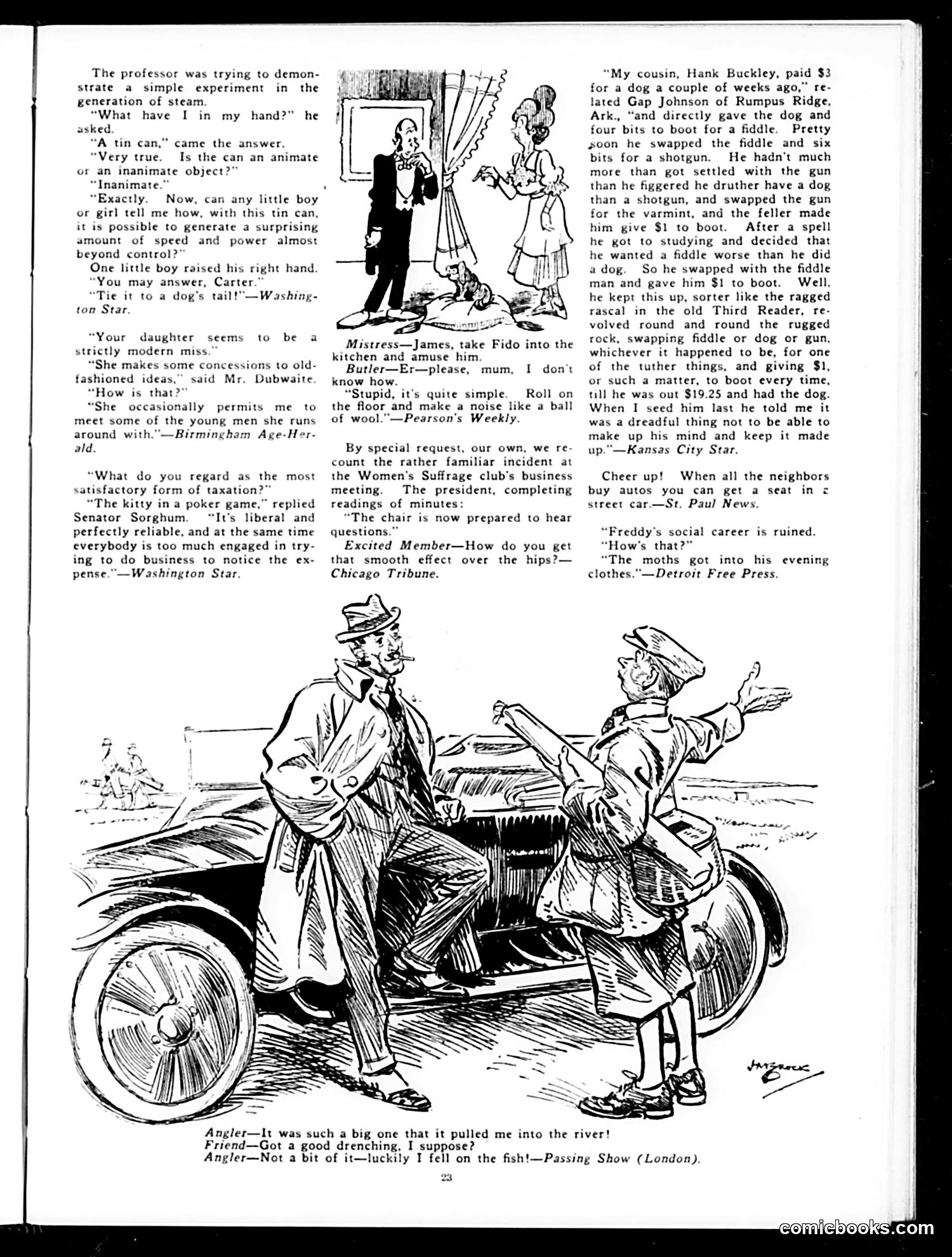
This page from the satirical magazine **Judge** collects humorous anecdotes and cartoons mocking early 20th-century American social life. The top cartoon depicts a **classroom lesson on steam generation** where a boy cheekily answers that tying a tin can to a dog's tail would create "surprising" speed and power—satirizing both childhood mischief and mechanical naïveté. The middle cartoon shows a butler refusing to amuse a dog, illustrating the absurdity of servant hierarchies and animal care in affluent households. A notable anecdote mocks the **Women's Suffrage movement** by showing a club member asking about fashion ("smooth effect over the hips") instead of serious political questions—a common anti-suffrage jab suggesting women weren't serious political actors. The "Rumpus Ridge" story satirizes rural, backwoods characters through endless, pointless trading (dog for fiddle for shotgun, etc.), a common Judge stereotype. The bottom cartoon depicts an **angler's tall tale**—claiming he fell *on* rather than *in* the river—typical fishing humor. Overall, these pieces reflect Judge's satirical approach to American social pretensions, gender roles, and rural stereotypes.
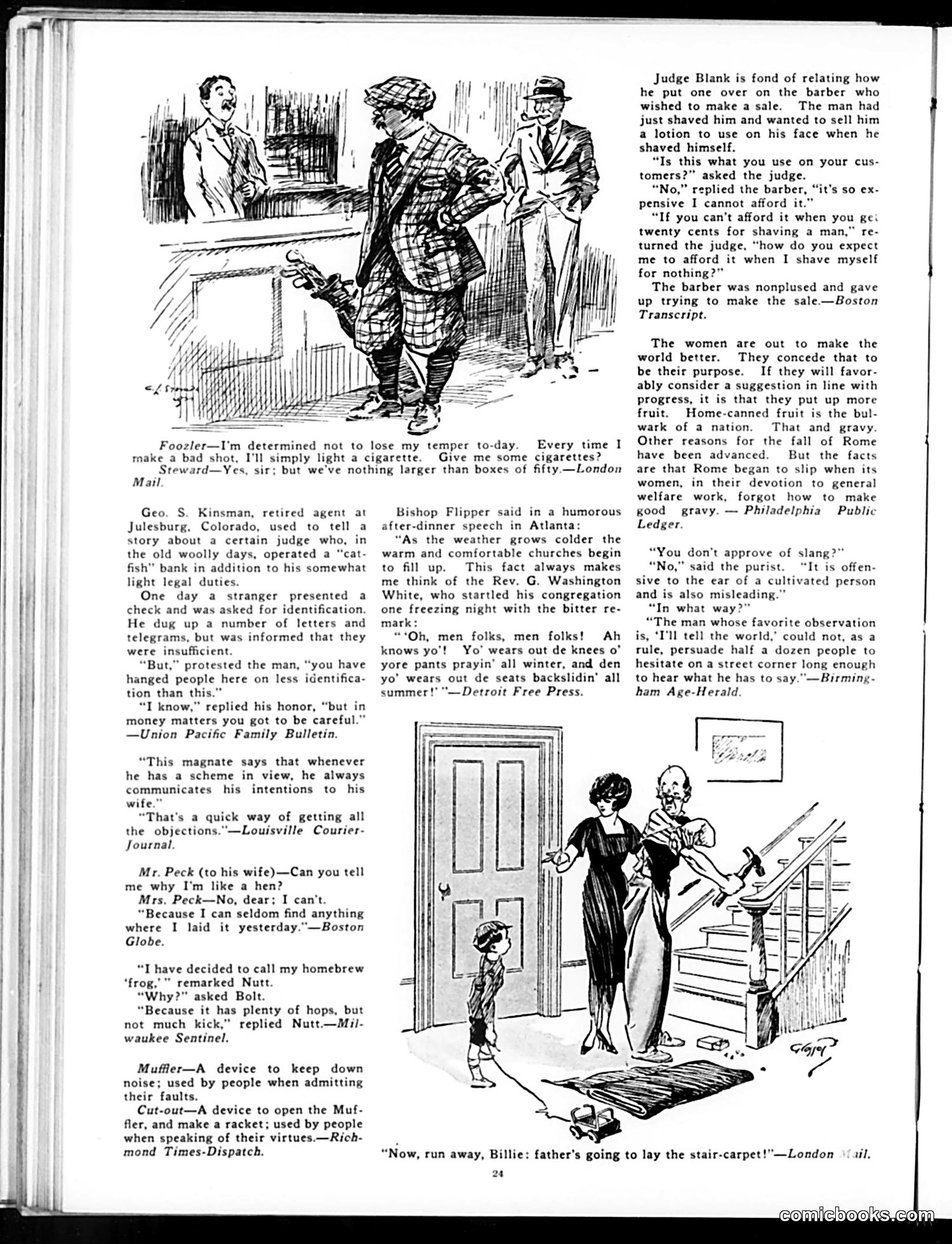
This page from *Judge* (a satirical weekly) contains multiple humor pieces reflecting early 20th-century social attitudes: **Top cartoon**: A barber attempts to upsell a customer on face lotion. Judge Blank outsmarts him by noting the barber can't afford to use his own product despite charging twenty cents per shave—exposing the sales pitch's dishonesty through logic. **Other anecdotes** mock various subjects: a golfer so temperamental he needs fifty cigarettes per round; frontier justice prioritizing caution over precedent; marital dynamics where wives torpedo husbands' schemes; Prohibition-era homebrew; and sermon humor about Black churchgoers' seasonal attendance (presented in period dialect). **Bottom sections** satirize women's domestic role (criticizing their neglect of home-canning for "welfare work"), linguistic pretension (a "purist" mocking colloquialisms), and competitive social posturing. The humor reflects 1920s-era attitudes: gender roles, class anxieties, racial caricature, and suspicion of both modern consumer culture and progressive social movements.
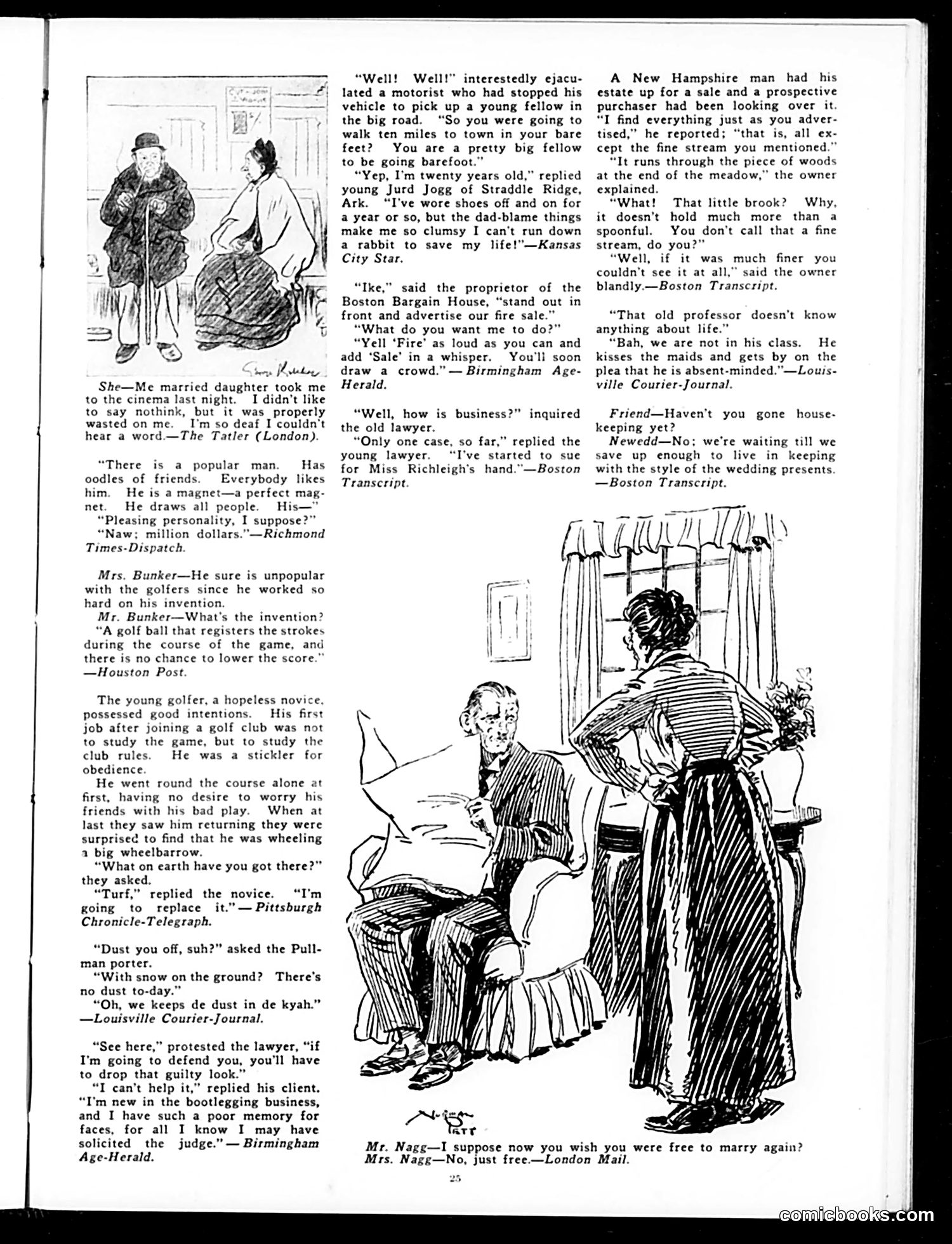
This page collects humorous one-liners and anecdotes from newspapers across America, a typical Judge format. The two illustrated cartoons bracket the text: **Top cartoon**: A woman complains to a man about taking her daughter to a cinema—she couldn't hear the dialogue due to deafness, rendering the experience pointless. **Bottom cartoon**: A domestic scene where Mr. Nagg asks his wife if she wishes to be free to remarry, and she responds she'd prefer simply to be "free"—a jab at marriage as constraint. The reprinted jokes satirize American life circa 1920s: deaf patrons at theaters, men valued only for wealth, golf enthusiasts, bootleggers nervous about their crimes, false advertising, and struggling young lawyers. The humor is gentle, relying on wordplay and observation of everyday social absurdities rather than political commentary. This represents Judge's populist, middle-class sensibility.
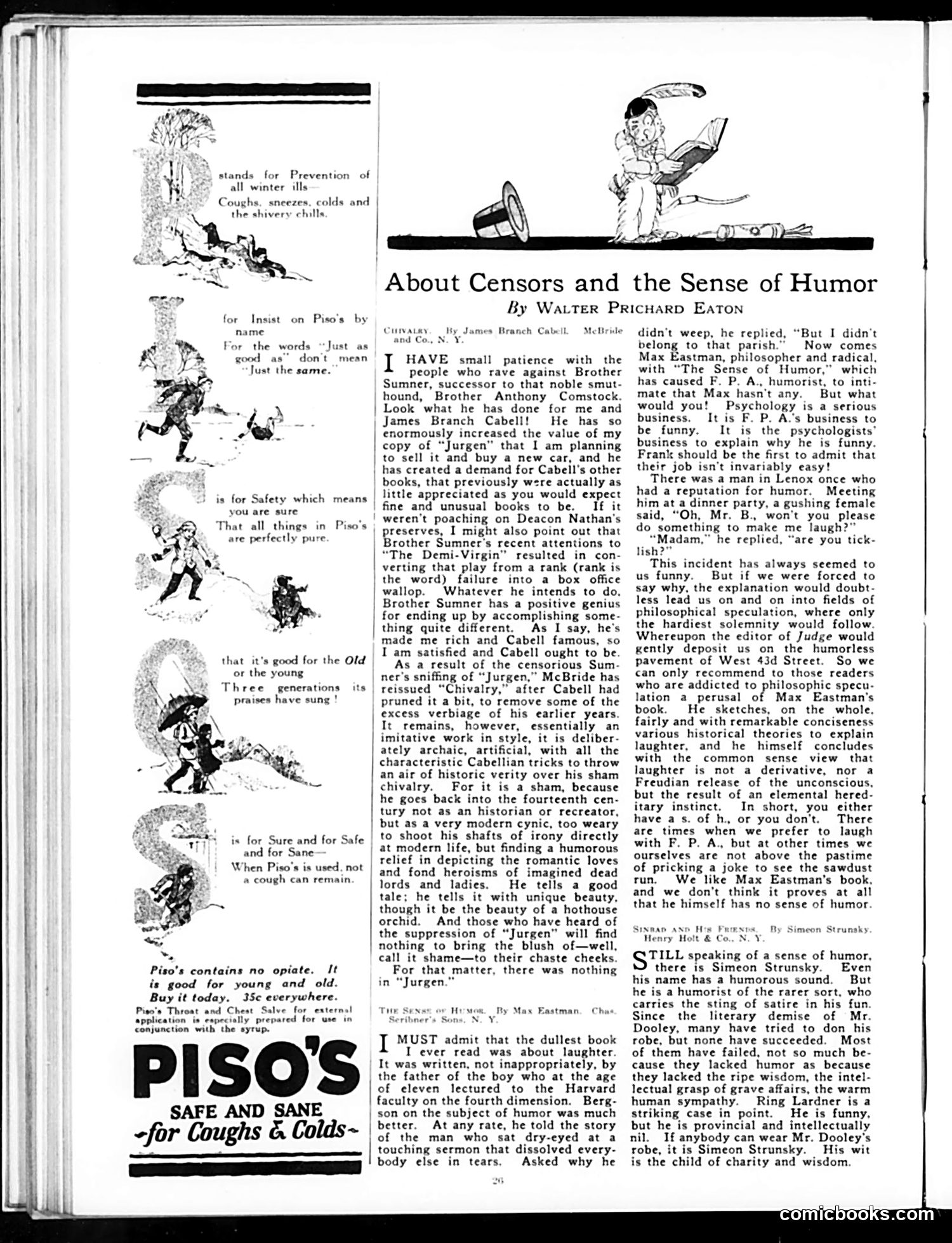
This page contains a **Piso's cough medicine advertisement** and two literary essays about censorship and humor. The main content discusses **John S. Sumner**, successor to famous censor Anthony Comstock, who was suppressing books like James Branch Cabell's *"Jurgen."* The author ironically praises Sumner for accidentally making suppressed books valuable and famous—the censorship created demand. Cabell's reissued *"Chivalry"* is critiqued as deliberately archaic, imitative cynic's work dressed in medieval romance. The second essay reviews Max Eastman's philosophical book *"The Sense of Humor,"* contrasting it with Bergson's treatment of laughter. It playfully suggests that explaining humor psychologically destroys it—F.P.A. (humorist) versus Eastman (psychologist) represent the tension between doing humor and analyzing it. The left-margin cartoon panels illustrate Piso's benefits using the "P-I-S-O's" acrostic format, typical period advertising design.
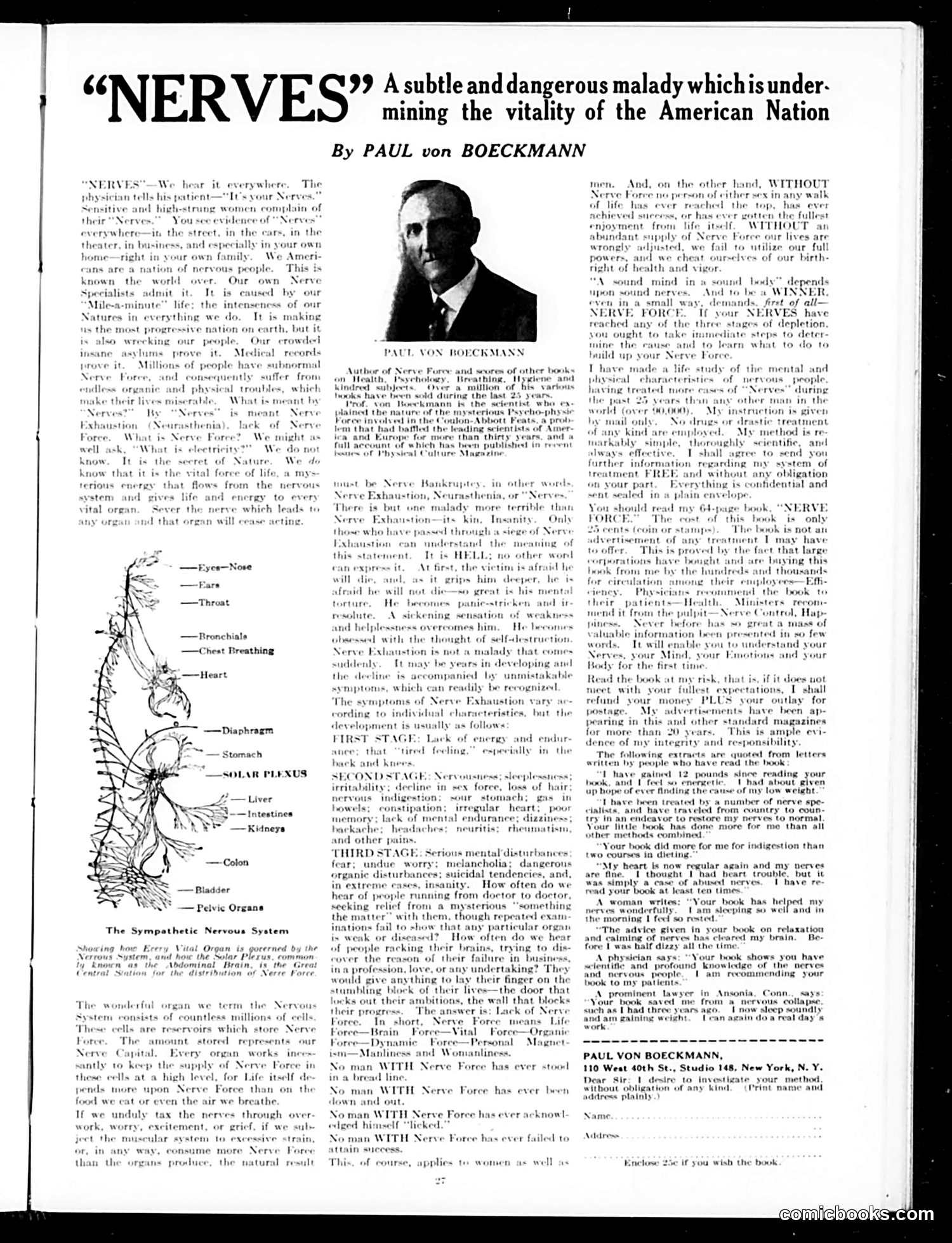
This is an advertisement disguised as an article by Paul von Boeckmann promoting a book called "Nerve Force." The piece warns that "nerves"—a catch-all term for what we'd now call anxiety, exhaustion, or neurasthenia—is weakening America. The anatomical diagram shows the sympathetic nervous system, lending pseudo-scientific authority to the sales pitch. Boeckmann claims his method can restore "Nerve Force" (mental vitality) through simple techniques. He presents testimonials and emphasizes that physicians, ministers, and employers recommend his work. This represents early 20th-century medical quackery: vague psychological ailments were blamed on "bad nerves," and self-help books promised miraculous cures. The aggressive marketing (offering money-back guarantees, claiming 20+ years of success) and appeals to authority were typical of this era's dubious health publishing.
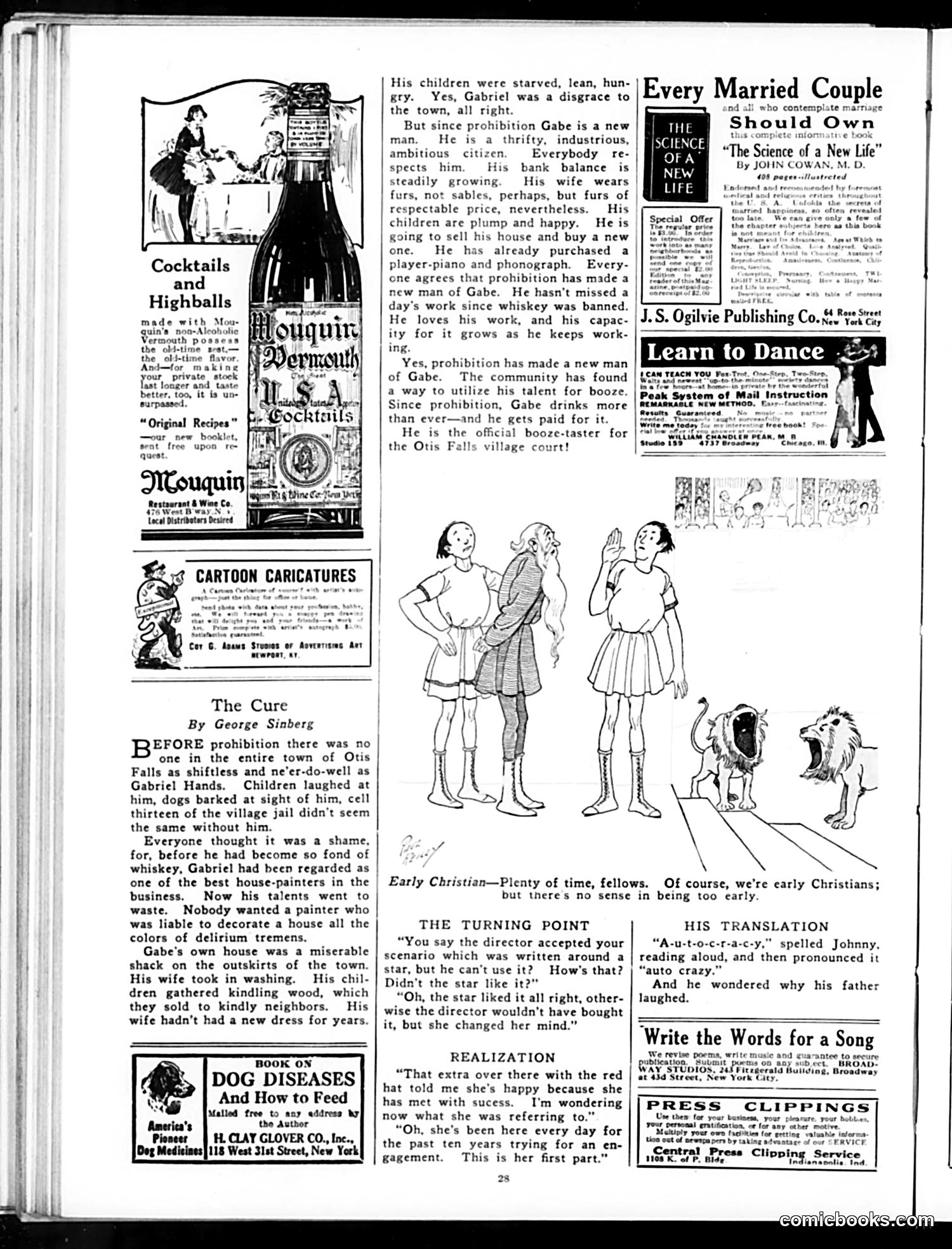
This page satirizes **Prohibition's unintended consequences**. "The Cure," the main story by George Sinberg, tells of Gabriel Hands, a chronic drunk in Otis Falls who was society's disgrace—unemployable, impoverished, his family starving. After Prohibition begins, Gabriel transforms: he becomes industrious, respectable, wealthy enough to buy a new house and piano. The satirical twist: Gabriel now thrives as the village's official "booze-taster for the Otis Falls village court"—meaning he's employed *tasting alcohol seized during Prohibition enforcement*. He drinks *more* than before but gets paid for it, making him a respected citizen. The joke exposes Prohibition's hypocrisy: the law intended to eliminate alcohol consumption instead created government-sanctioned alcohol tasting positions, allowing a drunk to prosper while technically enforcing temperance. Judge mocks both Prohibition's naive idealism and its corrupt reality. The page also contains unrelated advertisements and humor pieces typical of 1920s magazines.
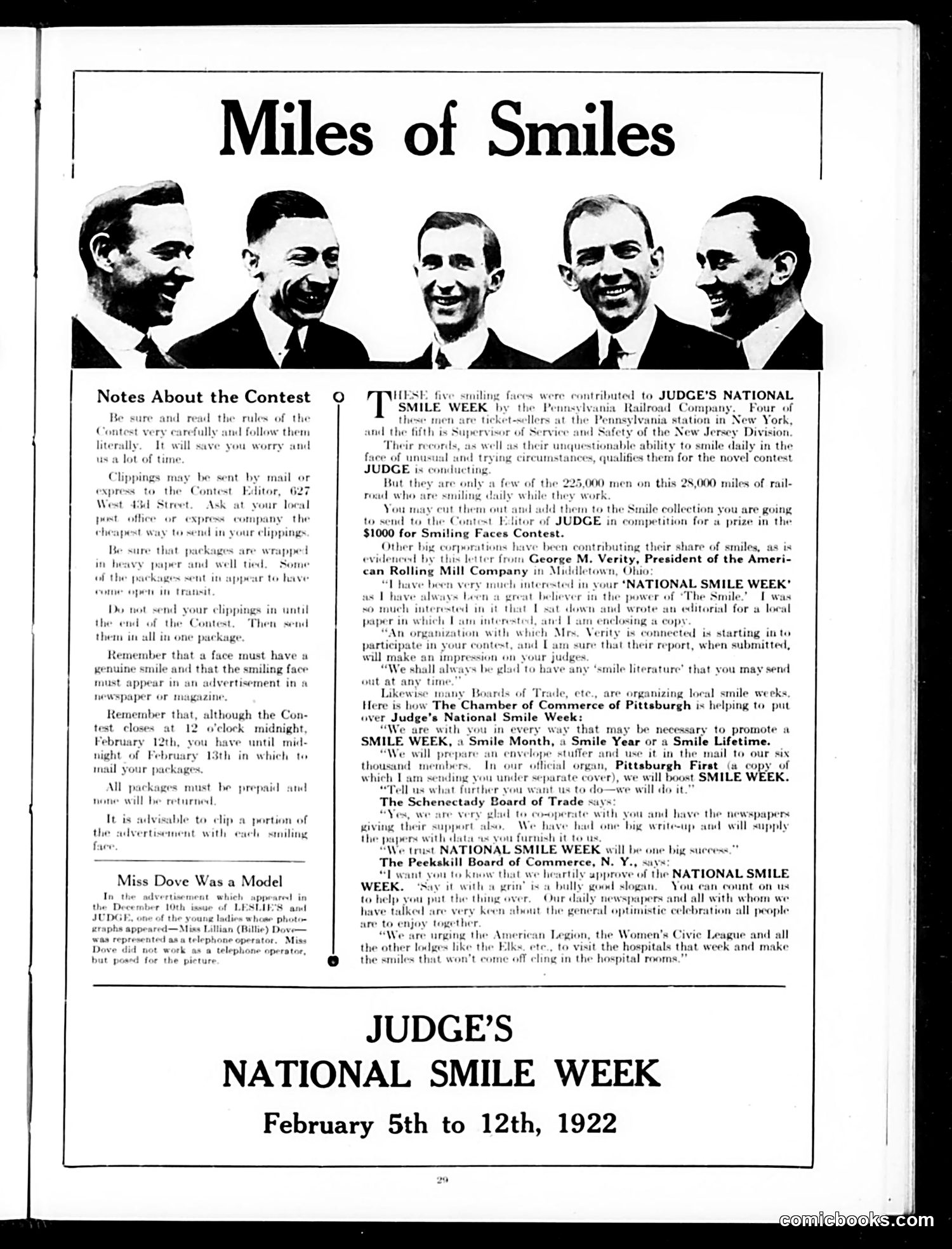
This page promotes Judge's "National Smile Week" (February 5-12, 1922), a contest encouraging readers to submit photographs of smiling faces from newspaper and magazine advertisements. The top illustration shows five smiling men—employees of the Pennsylvania Railroad Company—as examples. The contest offered a $1000 prize for the best collection of smiling faces submitted. The satire reflects early 20th-century optimism and corporate enthusiasm for promoting positivity as a business virtue. Major corporations like the American Rolling Mill Company and various Chambers of Commerce endorsed the campaign, suggesting that widespread smiling—both by workers and the public—represented progress and commercial success. For modern readers, this represents a quaint, pre-Depression era faith that manufactured cheerfulness could solve social problems. The contest implicitly praised workers who maintained pleasant demeanors despite difficult conditions, reflecting period attitudes about labor and corporate values.
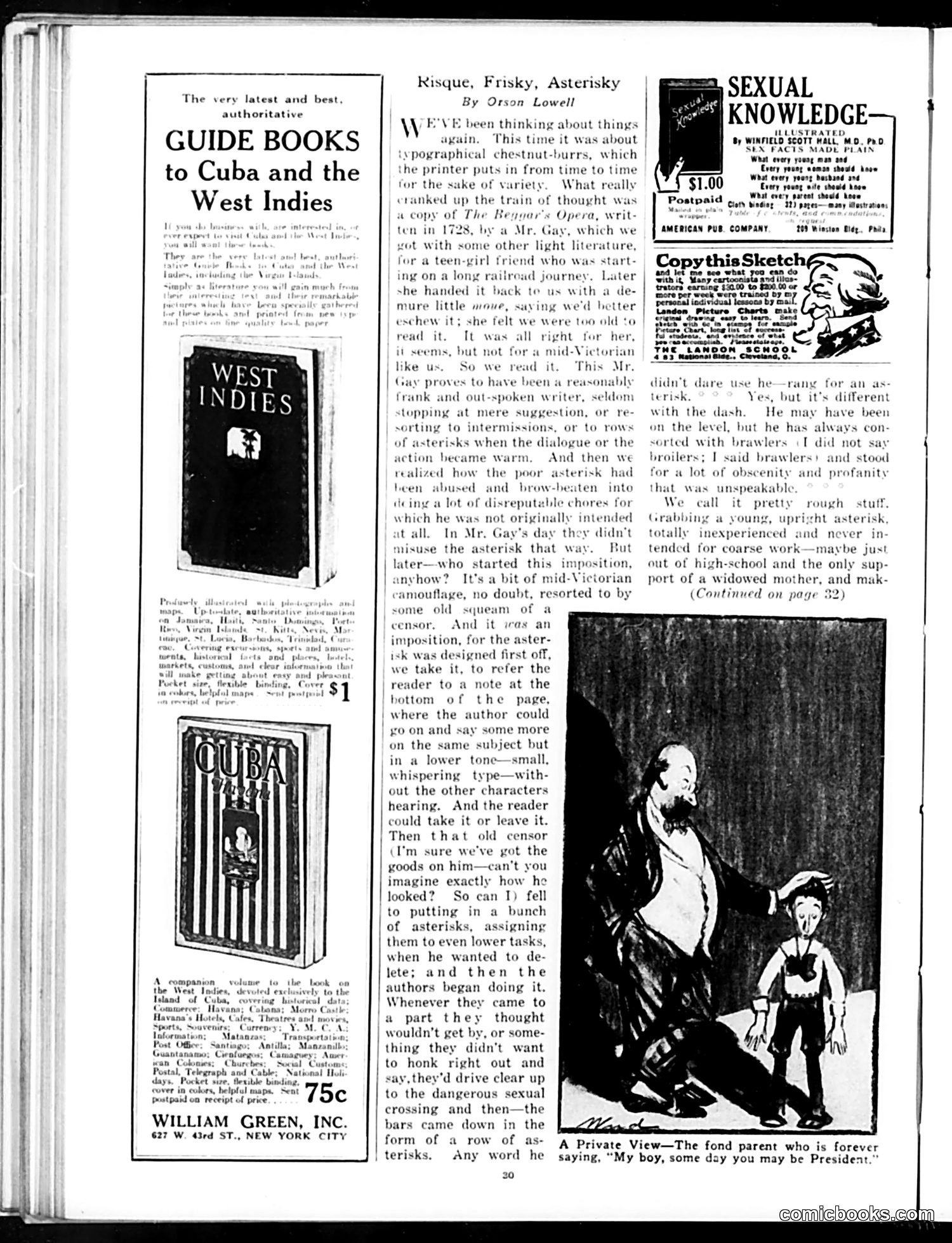
This page contains a satirical essay about censorship and the misuse of asterisks (*) in literature. **The Main Argument:** Author Orson Lowell critiques how Victorian-era censors abused the asterisk symbol. Originally designed to reference footnotes, asterisks became a tool for hiding "indecent" content—particularly sexual or profane language—by replacing offensive words entirely. Lowell argues this was an imposition on both authors and the asterisk itself, which was "grabbed" from its proper function by prudish censors unwilling to acknowledge mature content directly. **The Satire:** The piece mocks Victorian prudishness by personifying the asterisk as an innocent character forced into disreputable work. The tone is gently sardonic—Lowell suggests these censors were hypocritical enforcers of morality. **The Cartoon Below:** "A Private View" depicts a father telling his young son, "My boy, some day you may be President"—likely satirizing parental naiveté about what children should or shouldn't understand. The page also advertises guide books and a sexual education manual, reinforcing the essay's theme about repressed discussion of adult topics.
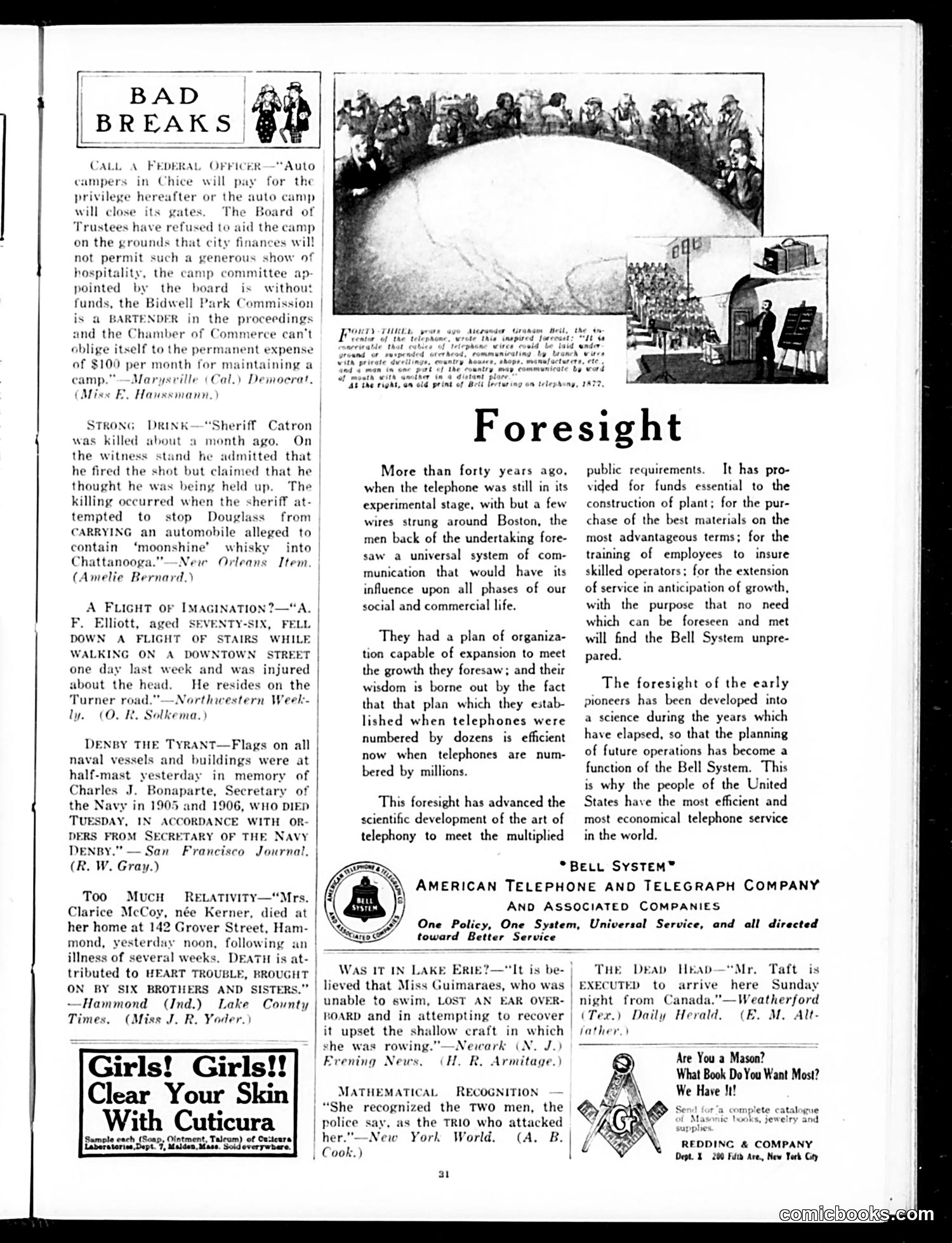
This page from *Judge* magazine contains a **"Bad Breaks"** satirical column mocking unfortunate news snippets, alongside a **Bell System advertisement** disguised as editorial content. The "Bad Breaks" items ridicule public figures and institutions through ironic headlines: - An auto camp in California faces closure due to budget disputes between city departments - A sheriff kills a man while supposedly stopping "moonshine" smuggling but claims self-defense - An elderly man falls downstairs - A woman's death is absurdly attributed to having six siblings - Navy flags lowered for a deceased Secretary (likely poking fun at official mourning protocol) The column's humor relies on highlighting **bureaucratic incompetence, contradictions, and absurd causal explanations** in news reports. The lengthy **"Foresight" article** praises Bell System's early planning—a paid advertisement presented as editorial commentary, promoting the telephone company's efficiency and forward-thinking to readers.
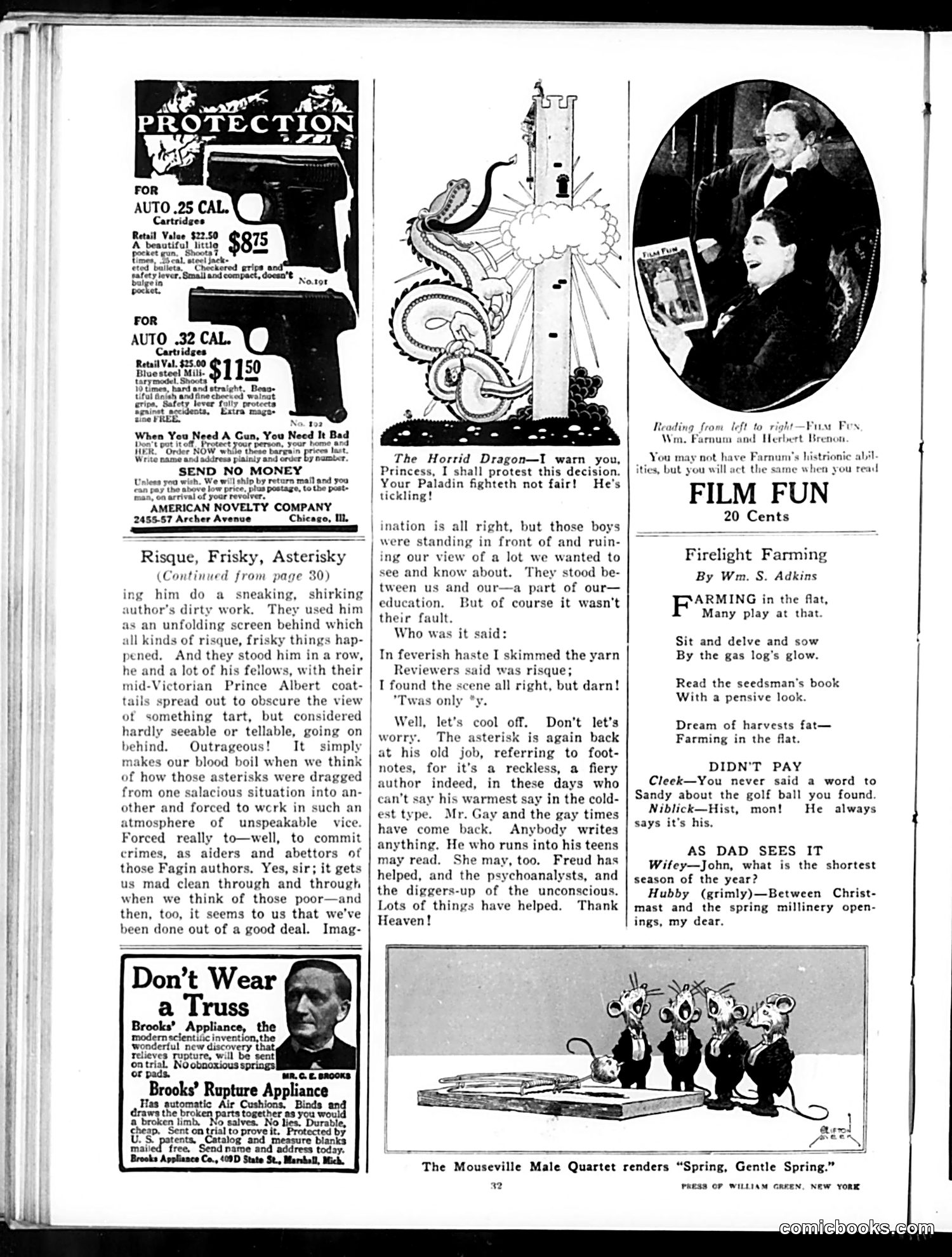
This page from Judge (circa 1920s-30s) contains satirical commentary on censorship disguised as an essay about asterisks (*). "Risque, Frisky, Asterisky" mocks Victorian-era publishing practices where asterisks replaced "indecent" words in literature. The author humorously complains that asterisks—visually spread across the page like "Prince Albert coat-tails"—obscured readers' view of suggestive content, effectively "censoring" their education. The satire targets outdated moral restrictions loosening in modern times ("Mr. Gay and the gay times have come back"). The piece celebrates contemporary freedoms, mentioning Freud and psychoanalysis as forces liberating expression. The page also features advertisements for controversial products (pistols, rupture appliances) and lighter entertainment content—humor pieces about "firelight farming" and a father's joke about millinery season's brevity (implying expensive wife shopping).
This is a **house advertisement**, not a cartoon. It promotes editorial writing in *Judge* and *Leslie's Weekly* magazines, specifically highlighting contributions by **William Allen White** (a prominent Progressive Era journalist and editor). The text appeals to readers' intellectual vanity, suggesting that reading serious editorials will stimulate thought on "important topics." It compares editorial taste to acquiring a taste for luxuries like olives or caviar—an acquired but worthwhile sophistication. References to **Greeley, Dana, and Watterson** invoke earlier celebrated American newspaper editors, positioning White and an anonymous *Leslie's* contributor as their equals. The phrase "broad, liberal, progressive" reflects Progressive Era values that *Judge* marketed to its audience. The advertisement essentially encourages subscriptions by positioning editorial reading as a mark of intellectual cultivation and modern progressive thinking.
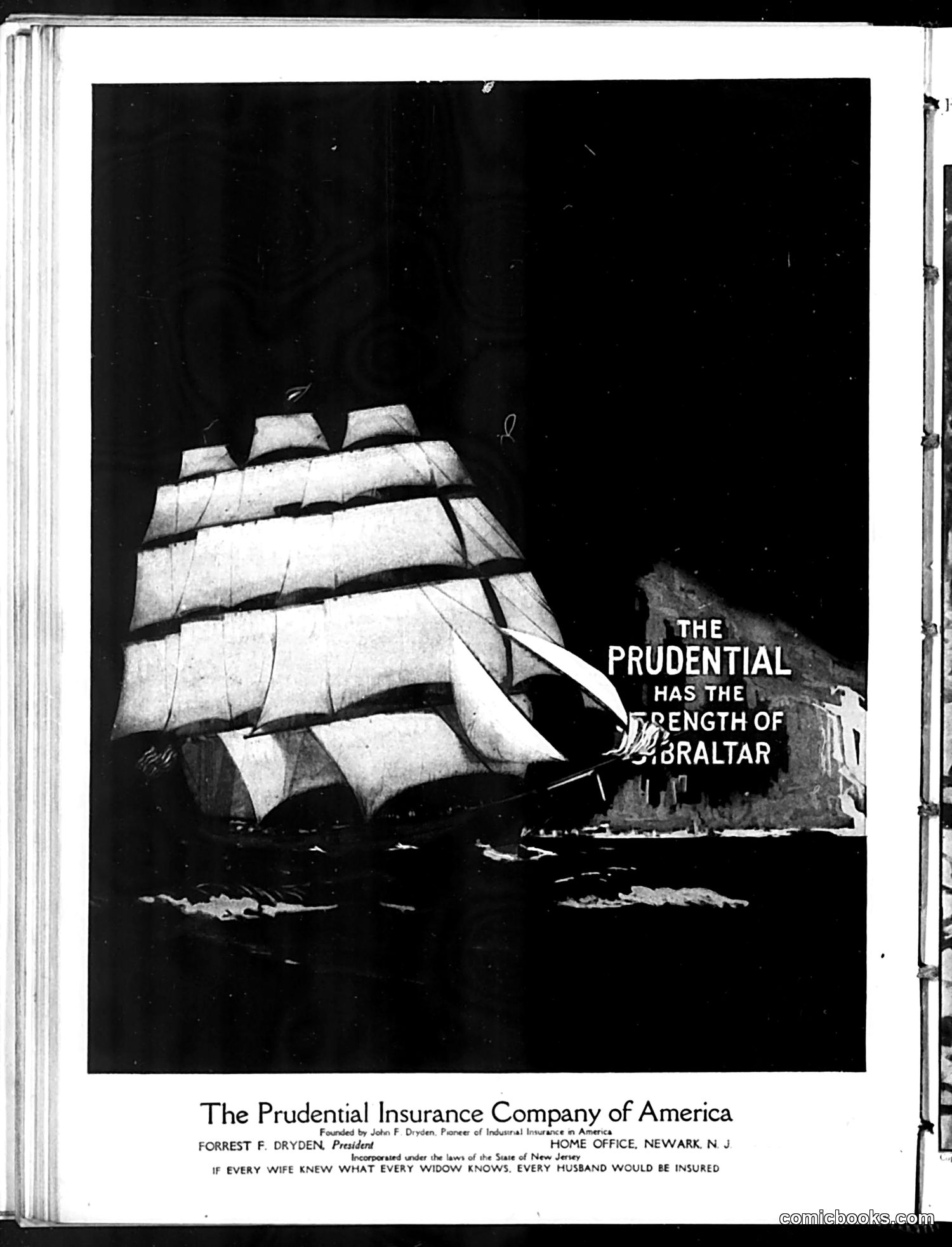
This is a Prudential Insurance Company advertisement, not a political cartoon. The image shows a tall ship with full sails passing through the Strait of Gibraltar, illustrating the company's strength and reliability through nautical metaphor. The headline states "THE PRUDENTIAL HAS THE STRENGTH OF GIBRALTAR"—using the famous Rock of Gibraltar as a symbol of stability and permanence. The tagline below reads: "IF EVERY WIFE KNEW WHAT EVERY HUSBAND WOULD BE INSURED," appealing to wives' concerns about family financial security after their husbands' deaths. This ad targets middle-class anxieties about widowhood and financial vulnerability, positioning Prudential insurance as essential protection. The company's president, Forrest F. Dryden, is credited. The advertisement combines maritime imagery (strength, voyage, reliability) with domestic concerns (widow protection) to market life insurance.