
Judge, 1922-02-04 · page 12 of 36
Judge — February 4, 1922 — page 12: what you’re looking at
What you’re looking at
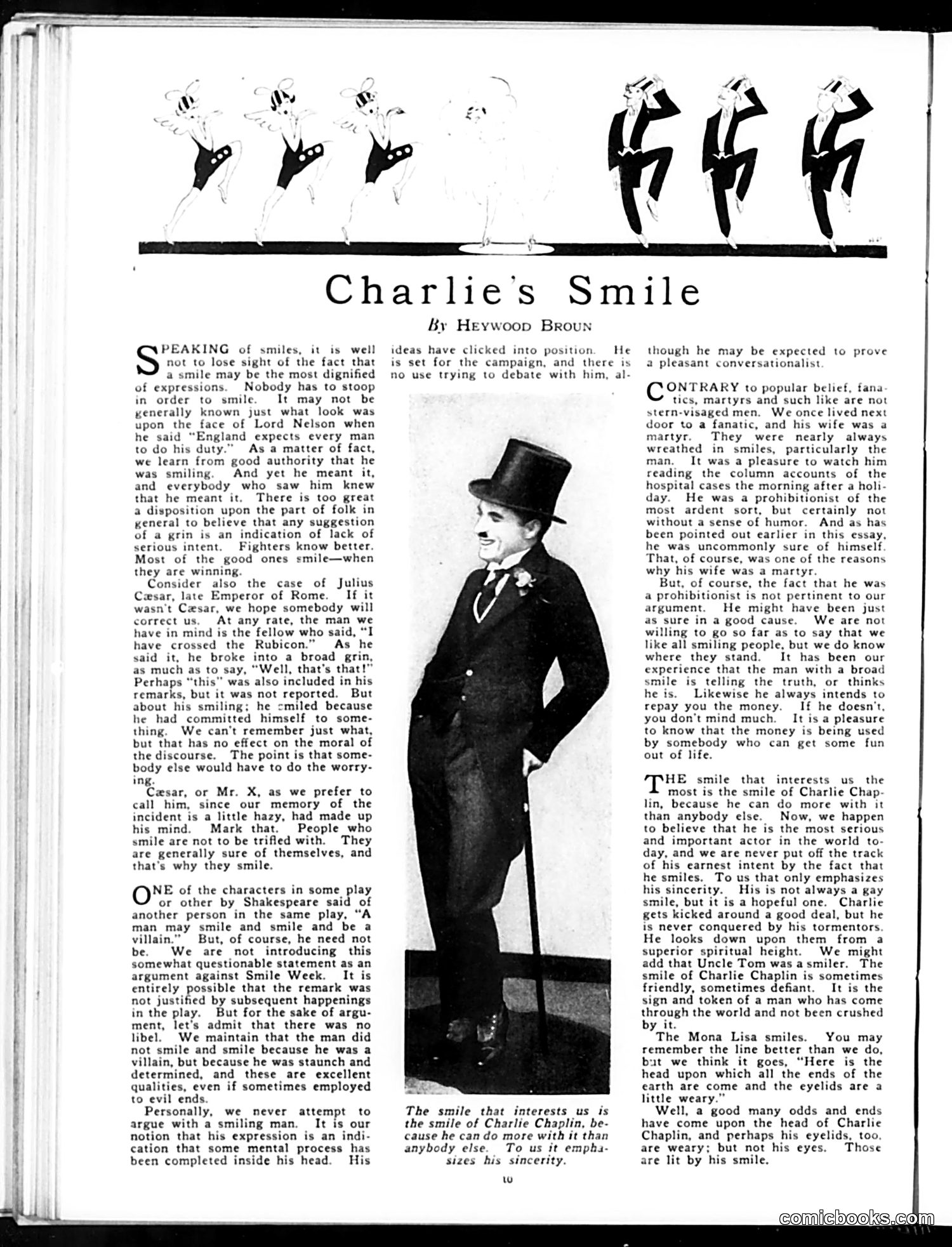
This is a lengthy opinion essay by Heywood Broun praising smiles as signs of sincerity and determination, not weakness. The small illustrations show figures in various poses—likely representing different expressions or attitudes. The essay's main argument: confident people smile because they've made decisions and committed themselves. Historical examples (Lord Nelson, Julius Caesar) allegedly smiled while undertaking serious duties. The piece dismisses the Shakespeare quote about villainous smiles as irrelevant. **The key reference**: The essay culminates in praising Charlie Chaplin's smile specifically, calling it the most interesting smile because "he can do more with it than anybody else" and it "emphasizes his sincerity." This reflects Chaplin's 1920s fame as a silent-film comedian whose expressive face—particularly his smile—conveyed deep emotion and humanity, especially in his "Tramp" character. The context: This appears to be part of a "Smile Week" campaign, likely a 1920s civic promotion encouraging optimism and positive social attitudes.
📄 Transcribed text from this page (OCR, searchable)
Machine-transcribed from the original scan — historical spelling and the odd misread are preserved.
, Charlies Smile PEAKING of smiles, it is well S not to lose sight of the fact that a smile may be the most dignified of expressions. Nobody has to stoop in order to smile It may not be generally known just what look was upon the face of Lord Nelson when he said “England expects every man to do his duty.” As a matter of fact, we learn from good authority that he was smiling. And yet he meant it, and everybody who saw him knew that he meant it. There is too great a disposition upon the part of folk in general to believe that any suggestion of a grin is an indication of lack of serious intent. Fighters know better. Most of the good ones smile—when they are winning. Consider also the case of Julius Cwsar, late Emperor of Rome. If it wasn't Cesar, we hope somebody will correct us. At any rate, the man we have in mind is the fellow who said, “I have crossed the Rubicon.” As he said it, he broke into a broad grin, as much as to say, “Well, that's that!” Perhaps “this” was also included in his remarks, but it was not reported. But about his smiling; he smiled because he had committed himself to some- thing. We can’t remember just what, but that has no effect on the moral of the discourse. The point is that some- body else would have to do the worry- ing. Czxsar, or Mr. X, as we prefer to call him, since our memory of the incident is a little hazy, had made up his mind. Mark that. People who smile are not to be trifled with. They are generally sure of themselves, and that’s why they smile. ONE of the characters in some play or other by Shakespeare said of another person in the same play, “A man may smile and smile and be a villain.” But, of course, he need not be. We are not introducing this somewhat questionable statement as an argument against Smile Week. It is entirely possible that the remark was not justified by subsequent happenings in the play. But for the sake of argu- ment, let's admit that there was no libel. We maintain that the man did not smile and smile because he was a villain, but because he was staunch and determined, and these are excellent qualities, even if sometimes employed to evil ends. Personally, we never attempt to argue with a smiling man. It is our notion that his expression is an indi- cation that some mental process has been completed inside his head. His By Heywoop Broun ideas have clicked into position. He is set for the campaign, and there is no use trying to debate with him, al- The smile that interests us is the smile of Charlie Chaplin, be- cause he can do more with it than anybody else. To us it empha- sizes his sincerity. w though he may be expected to prove a pleasant conversationalist CONTRARY to popular belief, fana tics, martyrs and such like are not stern-visaged men, We once lived next door to a fanatic, and his wife was a martyr. They were nearly always wreathed in smiles, particularly the man. It was a pleasure to watch him reading the column accounts of the hospital cases the morning after a holi- day. He was a prohibitionist of the most ardent sort, but certainly not without a sense of humor. And as has been pointed out earlier in this essay, he was uncommonly sure of himself That, of course, was one of the reasons why his wife was a martyr. But, of course, the fact that he was a prohibitionist is not pertinent to our argument. He might have been just as sure in a good cause. We are not willing to go so far as to say that we like all smiling people, but we do know where they stand. It has been our experience that the man with a broad smile is telling the truth, or thinks he is. Likewise he always intends to repay you the money. If he doesn't, you don’t mind much. It is a pleasure to know that the money is being used by somebody who can get some fun out of life. HE smile that interests us_ the most is the smile of Charlie Chap lin, because he can do more with it than anybody else. Now, we happen to believe that he is the most serious and important actor in the world to- day, and we are never put off the track of his earnest intent by the fact that he smiles. To us that only emphasizes his sincerity. His is not always a gay smile, but it is a hopeful one. Charlie gets kicked around a good deal, but he is never conquered by his tormentors. He looks down upon them from a superior spiritual height. We might add that Uncle Tom was asmiler. The smile of Charlie Chaplin is sometimes friendly, sometimes defiant. It is the sign and token of a man who has come through the world and not been crushed by it. The Mona Lisa smiles. You may remember the line better than we do, but we think it goes, “Here is the head upon which all the ends of the earth are come and the eyelids are a little weary.” Well, a good many odds and ends have come upon the head of Charlie Chaplin, and perhaps his eyelids, too, are weary; but not his eyes. Those are lit by his smile.