
Judge, 1922-02-04 · page 26 of 36
Judge — February 4, 1922 — page 26: what you’re looking at
What you’re looking at
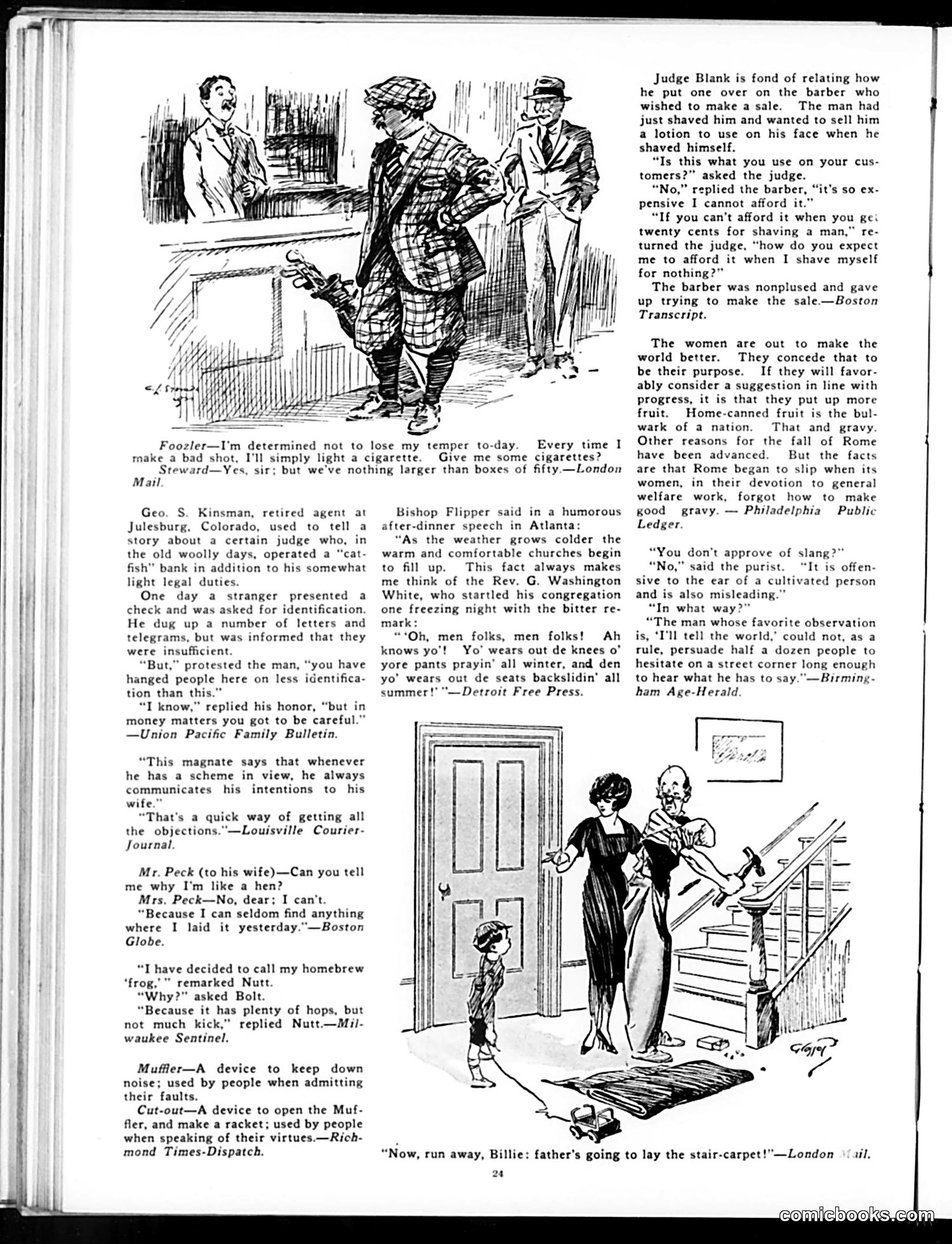
This page from *Judge* (a satirical weekly) contains multiple humor pieces reflecting early 20th-century social attitudes: **Top cartoon**: A barber attempts to upsell a customer on face lotion. Judge Blank outsmarts him by noting the barber can't afford to use his own product despite charging twenty cents per shave—exposing the sales pitch's dishonesty through logic. **Other anecdotes** mock various subjects: a golfer so temperamental he needs fifty cigarettes per round; frontier justice prioritizing caution over precedent; marital dynamics where wives torpedo husbands' schemes; Prohibition-era homebrew; and sermon humor about Black churchgoers' seasonal attendance (presented in period dialect). **Bottom sections** satirize women's domestic role (criticizing their neglect of home-canning for "welfare work"), linguistic pretension (a "purist" mocking colloquialisms), and competitive social posturing. The humor reflects 1920s-era attitudes: gender roles, class anxieties, racial caricature, and suspicion of both modern consumer culture and progressive social movements.
📄 Transcribed text from this page (OCR, searchable)
Machine-transcribed from the original scan — historical spelling and the odd misread are preserved.
Foozler—I'm determined not to lose my temper to-day. make a bad shot, I'll simply light a cigarette. Every time I Give me some cigarettes? Steward—Yes, sir; but we've nothing larger than boxes of fifty —London Mail. Geo. S. Kinsman, retired agent at Julesburg, Colorado, used to tell a story about a certain judge who, in the old woolly days, operated a “cat- fish” bank in addition to his somewhat light legal duties. One day a stranger presented a check and was asked for identification. He dug up a number of letters and telegrams, but was informed that they were insufficient. “But,” protested the man, “you have hanged people here on less identifica- tion than this.” “I know,” replied his honor, “but in money matters you got to be careful.” —Union Pacific Family Bulletin. “This magnate says that whenever he has a scheme in view, he always communicates his intentions to his wife.” “That's a quick way of getting all the objections."—Louisville Courier- Journal. Mr. Peck (to his wife)—Can you tell me why I'm like a hen? Mrs, Peck—No, dear; I can't. “Because I can seldom find anything where I laid it yesterday.”—Boston Globe. “I have decided to call my homebrew ‘frog,’ remarked Nutt. “Why?” asked Bolt. “Because it has plenty of hops, but not much kick,” replied Nutt—Mil- waukee Sentinel. Muffer—A device to keep down noise; used by people when admitting their faults. Cut-out—A device to open the Muf- fler, and make a racket; used by people when speaking of their virtues.—Rich- mond Times-Dispatch. Bishop Flipper said in a humorous after-dinner speech in Atlanta: “As the weather grows colder the warm and comfortable churches begin to fill up. This fact always makes me think of the Rev. G. Washington White, who startled his congregation one freezing night with the bitter re- mark: “Oh, men folks, men folks! Ah knows yo’! Yo’ wears out de knees 0’ yore pants prayin’ all winter, and den yo’ wears out de seats backslidin’ all summer!’ ""—Detroit Free Press. 24 Judge Blank is fond of relating how he put one over on the barber who wished to make a sale. The man had just shaved him and wanted to sell him a lotion to use on his face when he shaved himself. “Is this what you use on your cus- tomers?” asked the judge. “No,” replied the barber, “it’s so ex- pensive I cannot afford it.” “If you can't afford it when you gei twenty cents for shaving a man,” re- turned the judge, “how do you expect me to afford it when I shave myself for nothing?” The barber was nonplused and gave up trying to make the sale—Boston Transcript. The women are out to make the world better. They concede that to be their purpose. If they will favor- ably consider a suggestion in line with progress, is that they put up more fruit. Home-canned fruit is the bul- wark of a nation. That and gravy. Other reasons for the fall of Rome have been advanced. But the facts are that Rome began to slip when its women, in their devotion to general welfare work, forgot how to make good gravy. — Philadelphia Public Ledger. “You don’t approve of slang?” “No,” said the purist. “It is offen- sive to the ear of a cultivated person and is also misleading.” “In what way?” “The man whose favorite observation is, ‘I'll tell the world,’ could not, as a rule, persuade half a dozen people to hesitate on a street corner long enough to hear what he has to say."—Birming- ham Age-Herald. ul,