
Judge, 1922-02-04 · page 24 of 36
Judge — February 4, 1922 — page 24: what you’re looking at
What you’re looking at
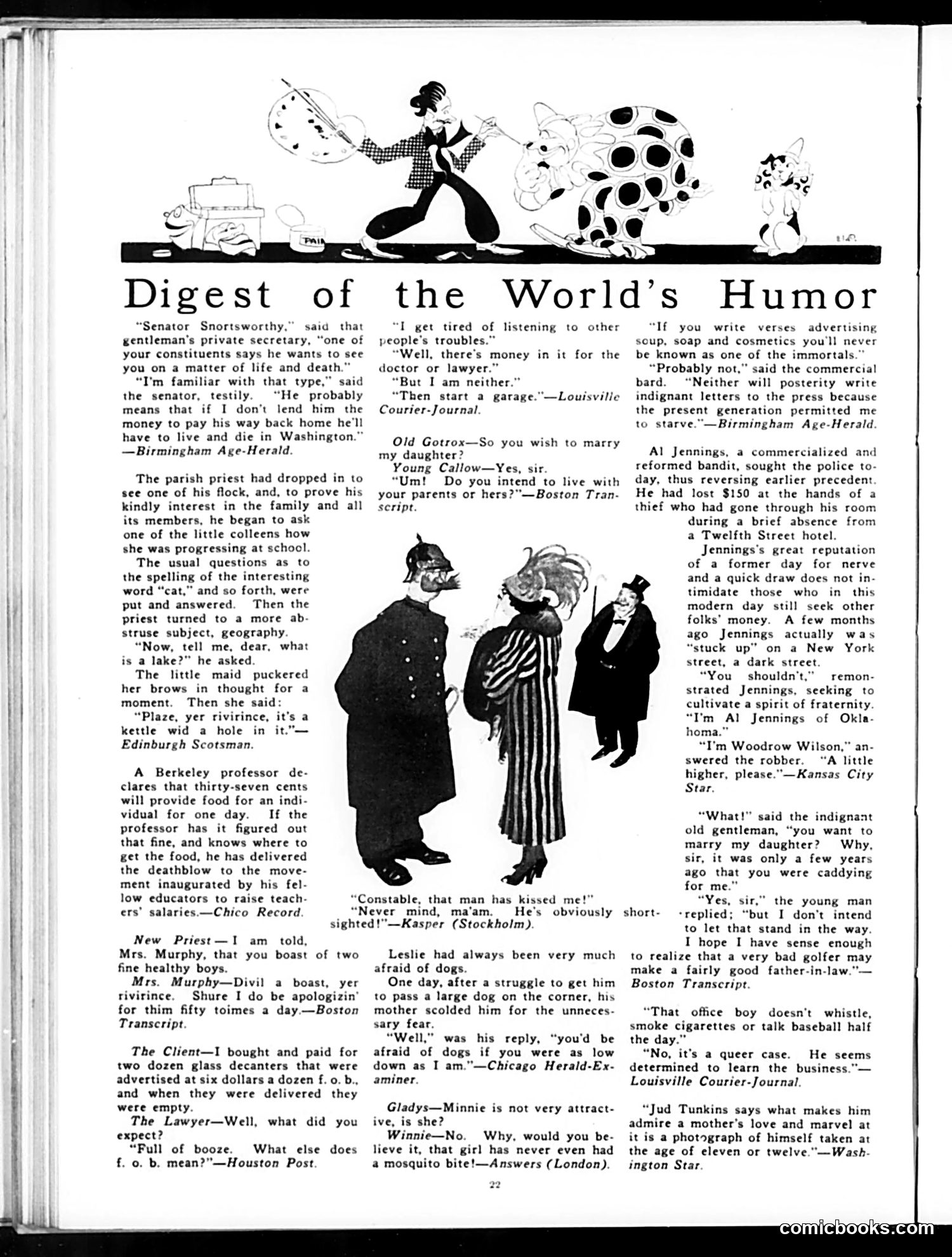
This page is a humor digest—a collection of short satirical anecdotes and jokes from various newspapers, typical of Judge magazine's format. The illustration shows a figure chasing money while dealing with various characters. **Key themes:** 1. **Political satire**: A senator dismisses constituents' pleas as predictable requests for travel money home—mocking politicians' indifference to constituents. 2. **Irish immigrant humor**: Several jokes feature phonetic Irish dialect ("yer rivirince," "Divil a boast"), reflecting early 20th-century American attitudes toward Irish immigrants. 3. **Social commentary**: A Berkeley professor's claim that 37 cents feeds someone daily is used to mock educators demanding higher salaries—suggesting their math is impractical. 4. **Al Jennings reference**: The most pointed satire concerns Jennings, a reformed outlaw robbed in New York. When he claims his identity to deter the thief, the robber responds "I'm Woodrow Wilson"—sarcastically dismissing Jennings's reputation as meaningless in modern times. The page satirizes politicians, class pretension, immigrant stereotypes, and the decline of frontier mythology.
📄 Transcribed text from this page (OCR, searchable)
Machine-transcribed from the original scan — historical spelling and the odd misread are preserved.
“Senator Snortsworthy,” said that gentleman's private secretary, “one of your constituents says he wants to see you on a matter of life and death.” “I'm familiar with that type,” said the senator, testily. “He probably means that if I don’t lend him the money to pay his way back home he'll have to live and die in Washington.” —Birmingham Age-Herald. The parish priest had dropped in to see one of his flock, and, to prove his kindly interest in the family and all its members, he began to ask one of the little colleens how she was progressing at school. The usual questions as to the spelling of the interesting word “cat,” and so forth, were put and answered. Then the priest turned to a more ab- struse subject, geography. “Now, tell me, dear, what is a lake?” he asked. The little maid puckered her brows in thought for a moment. Then she said: “Plaze, yer rivirince, it’s a kettle wid a hole in it."— Edinburgh Scotsman. A Berkeley professor de- clares that thirty-seven cents will provide food for an indi- vidual for one day. If the professor has it figured out that fine, and knows where to get the food, he has delivered the deathblow to the move- ment inaugurated by his fel- low educators to raise teach- ers’ salaries.—Chico Record. New Priest—I am told, Mrs. Murphy, that you boast of two fine healthy boys. Mrs. Murphy—Divil a boast, yer rivirince. Shure I do be apologizin’ for thim fifty toimes a day.—Boston Transcript. The Client—I bought and paid for two dozen glass decanters that were advertised at six dollars a dozen f. 0. b., and when they were delivered they were empty. The Lawyer—Well, what did you expect? “Full of booze. What else does f. o. b. mean?”—Houston Post get tired of listening to other pects troubles.” “Well, there’s money in it for the doctor or lawyer.” “But I am neither.” “Then start a garage."—Louisville Courier-Journal Old Gotrox—So you wish to marry my daughter? Young Callow—Yes, sir “Um! Do you intend to live with your parents or hers?"—Boston Tran- script. “Constable, that man has kissed me!” “Never mind, ma'am. He's obviously short- sighted!"—Kasper (Stockholm). Leslie had always been very much afraid of dogs. One day, after a struggle to get him to pass a large dog on the corner, his mother scolded him for the unneces- sary fear. “Well,” was his reply, “you'd be afraid of dogs if you were as low down as I am."—Chicago Herald-Ex- aminer. Gladys—Minnie is not very attract- ive, is she? Winnie—No. Why, would you be- lieve it, that girl has never even had a mosquito bite!—Answers (London). Digest of the World’s Humor “If you write verses advertising soup, soap and cosmetics you'll never be known as one of the immortals.” “Probably not,” said the commercial bard. “Neither will posterity write indignant letters to the press because the present generation permitted me to starve.”"—Birmingham Age-Herald. Al Jennings, a commercialized and reformed bandit, sought the police to- day, thus reversing earlier precedent He had lost $150 at the hands of a thief who had gone through his room during a brief absence from a Twelfth Street hotel. Jennings’s great reputation of a former day for nerve and a quick draw does not in- timidate those who in this modern day still seek other folks’ money. A few months ago Jennings actually was “stuck up” on a New York street, a dark street “You shouldn't,” remon- strated Jennings, seeking to cultivate a spirit of fraternity. “I'm Al Jennings of Okla- homa.” “I'm Woodrow Wilson,” an- swered the robber. “A little higher, please."—Kansas City Star, “What!” said the indignant old gentleman, “you want to marry my daughter? Why, sir, it was only a few years ago that you were caddying for me.” “Yes, sir,” the young man ‘replied; “but I don’t intend to let that stand in the way. I hope I have sense enough to realize that a very bad golfer may make a fairly good father-in-law.”— Boston Transcript. “That office boy doesn't whistle, smoke cigarettes or talk baseball half the day.” “No, it’s a queer case. He seems determined to learn the business.”"— Louisville Courier-Journal. “Jud Tunkins says what makes him admire a mother's love and marvel at it is a photograph of himself taken at the age of eleven or twelve."—Wash- ington Star