
Judge, 1922-02-04 · page 28 of 36
Judge — February 4, 1922 — page 28: what you’re looking at
What you’re looking at
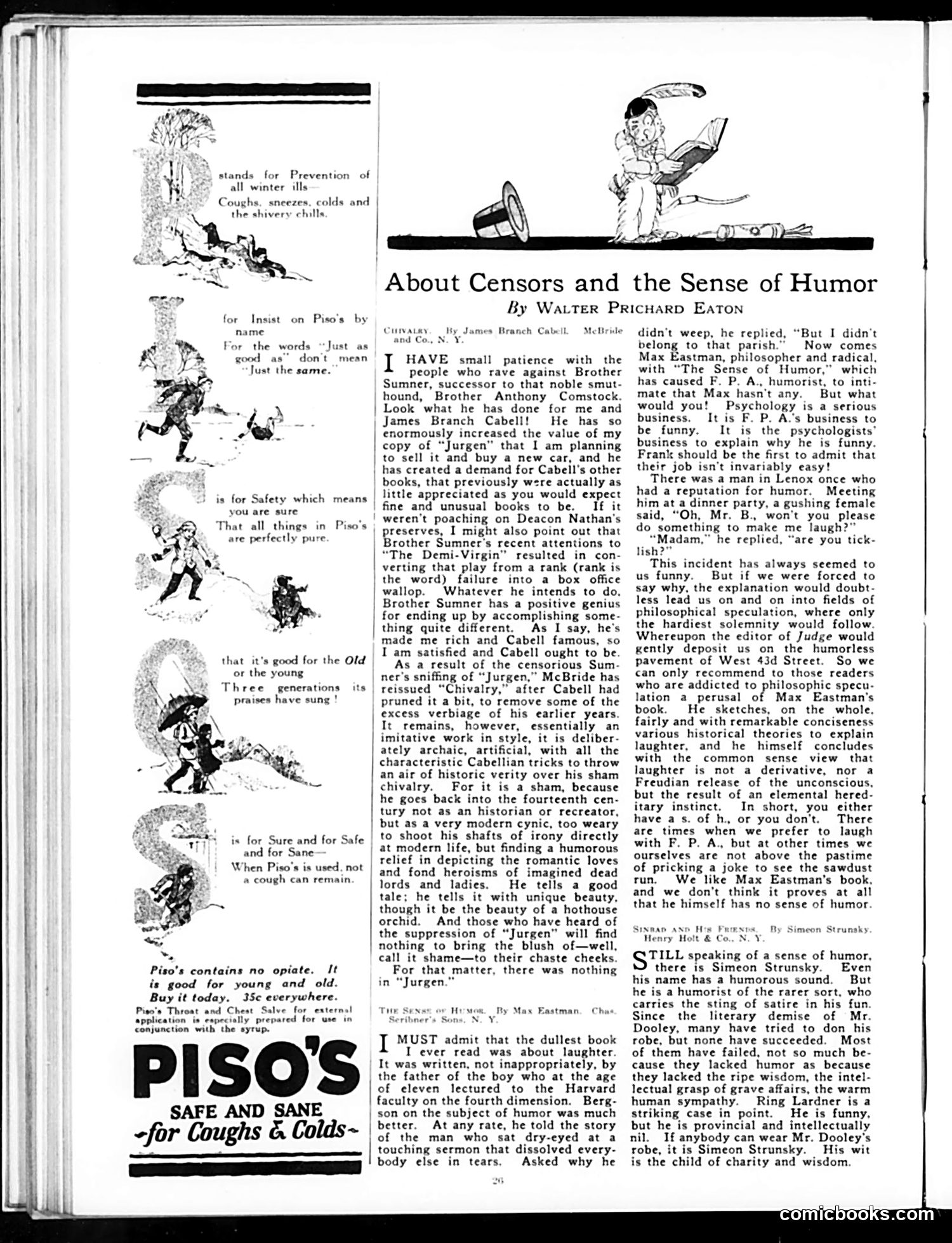
This page contains a **Piso's cough medicine advertisement** and two literary essays about censorship and humor. The main content discusses **John S. Sumner**, successor to famous censor Anthony Comstock, who was suppressing books like James Branch Cabell's *"Jurgen."* The author ironically praises Sumner for accidentally making suppressed books valuable and famous—the censorship created demand. Cabell's reissued *"Chivalry"* is critiqued as deliberately archaic, imitative cynic's work dressed in medieval romance. The second essay reviews Max Eastman's philosophical book *"The Sense of Humor,"* contrasting it with Bergson's treatment of laughter. It playfully suggests that explaining humor psychologically destroys it—F.P.A. (humorist) versus Eastman (psychologist) represent the tension between doing humor and analyzing it. The left-margin cartoon panels illustrate Piso's benefits using the "P-I-S-O's" acrostic format, typical period advertising design.
📄 Transcribed text from this page (OCR, searchable)
Machine-transcribed from the original scan — historical spelling and the odd misread are preserved.
-for Coughs &.Colds~ stands for Prevention of all winter ills Coughs. sneezes. colds and | ‘we shivery chills. for Insist on Piso’s by name For the words “Just as good don't mean Just the same. is for Safety which means you are sure That all things in Piso’s are perfectly pure that it's good for the Old or the young Three generations its praises have sung ! is for Sure and for Safe and for Sane When Piso’s is used. not a cough can remain iso's contains no opiate, It is good for young and old. Buy it today. 35c¢ everywhere. Piso’s Throat and Chest Salve for externs! application is especially prepared for use in conjunction with the syrup. PISO'S SAFE AND SANE | About Censors and the Sense of Humor By Water PricHAarD EATon Cunvatay. Hy James Branch Cabell, MeBride N.Y, and Cy HAVE small patience with the people who rave against Brother Sumner, successor to that noble smut- hound, Brother Anthony Comstock. Look what he has done for me and James Branch Cabell! He has so enormously increased the value of my copy of “Jurgen” that I am planning to sell it and buy a new car, and he has created a demand for Cabeil’s other books, that previously were actually as little appreciated as you would expect fine and unusual books to be. If it weren't poaching on Deacon Nathan's preserves, I might also point out that Brother Sumner’s recent attentions to “The Demi-Virgin” resulted in con- verting that play from a rank (rank is the word) failure into a box office wallop. Whatever he intends to do, Brother Sumner has a positive genius for ending up by accomplishing some- thing quite different. As I say, he's made me rich and Cabell famous, so I am satisfied and Cabell ought to be. As a result of the censorious Sum- ner's sniffing of “Jurgen,” McBride has reissued “Chivalry,” after Cabell had pruned it a bit, to remove some of the | excess verbiage of his earlier years. It remains, however, essentially an | imitative work in style, it is deliber- ately archaic, artificial, with all the characteristic Cabellian tricks to throw an air of historic verity over his sham chivalry. For it is a sham, because he goes back into the fourteenth cen- tury not as an historian or recreator, but as a very modern cynic, too weary to shoot his shafts of irony directly at modern life, but finding a humorous relief in depicting the romantic loves and fond heroisms of imagined dead lords and ladies. He tells a good tale; he tells it with unique beauty, though it be the beauty of a hothouse orchid. And those who have heard of the suppression of “Jurgen” will find nothing to bring the blush of—well, call it shame—to their chaste cheeks. For that matter, there was nothing n “Jurgen.” THe Sena or Hrwoe. My Max Eastman. Chas N MUST admit that the dullest book I ever read was about laughter. It was written, not inappropriately, by the father of the boy who at the age of eleven lectured to the Harvard leet on the fourth dimension. Berg- son on the subject of humor was much better. At any rate, he told the story of the man who sat dry-eyed at a touching sermon that dissolved every- body else in tears. Asked why he didn't weep, he replied, “But I didn’t belong to that parish.” Now comes Max Eastman, philosopher and radical, with “The Sense of Humor,” which has caused F. P. A., humorist, to inti- mate that Max hasn't any. But what would you! Psychology is a serious business. It is F. P. A.’s business to be funny. It is the psychologists’ business to explain why he is funny. Frank should be the first to admit that their job isn’t invariably easy! There was a man in Lenox once who had a reputation for humor. Meeting him at a dinner party, a gushing female said, “Oh, Mr. B., won't you please do something to make me laugh?” “Madam,” he replied, “are you tick- lish?” This incident has always seemed to us funny. But if we were forced to say why, the explanation would doubt- less lead us on and on into fields of philosophical speculation, where only the hardiest solemnity would follow. Whereupon the editor of Judge would gently deposit us on the humorless pavement of West 43d Street. So we can only recommend to those readers who are addicted to 2 pbilosophic specu- lation a_ perusal Max Eastman’s book. He sketches, on the whole, fairly and with remarkable conciseness various historical theories to explain laughter, and he himself concludes with the common sense view that laughter is not a derivative, nor a Freudian release of the unconscious, but the result of an elemental hered- itary instinct. In short, you either have a s. of h. or you don't. There are times when we prefer to laugh with F. P. A., but at other times we ourselves are not above the pastime of pricking a joke to see the sawdust run. We like Max Eastman’s book, and we don’t think it proves at all that he himself has no sense of humor SiNMap AND His Prinses. By Simeon Strunsky y Holt & Co. N.Y STILL speaking of a sense of humor, there is Simeon Strunsky. Even his name has a humorous sound. But he is a humorist of the rarer sort, who carries the sting of satire in his fun. Since the literary demise of Mr. Dooley, many have tried to don his robe, but none have succeeded. Most of them have failed, not so much be- cause they lacked humor as because they lacked the ripe wisdom, the intel- lectual grasp of grave affairs, the warm human sympathy. Ring Lardner is a striking case in point. He is funny, but he is provincial and intellectually nil. If anybody can wear Mr. Dooley’s robe, is Simeon Strunsky. His wit is the child of charity and wisdom.