
Judge, 1922-02-04 · page 14 of 36
Judge — February 4, 1922 — page 14: what you’re looking at
What you’re looking at
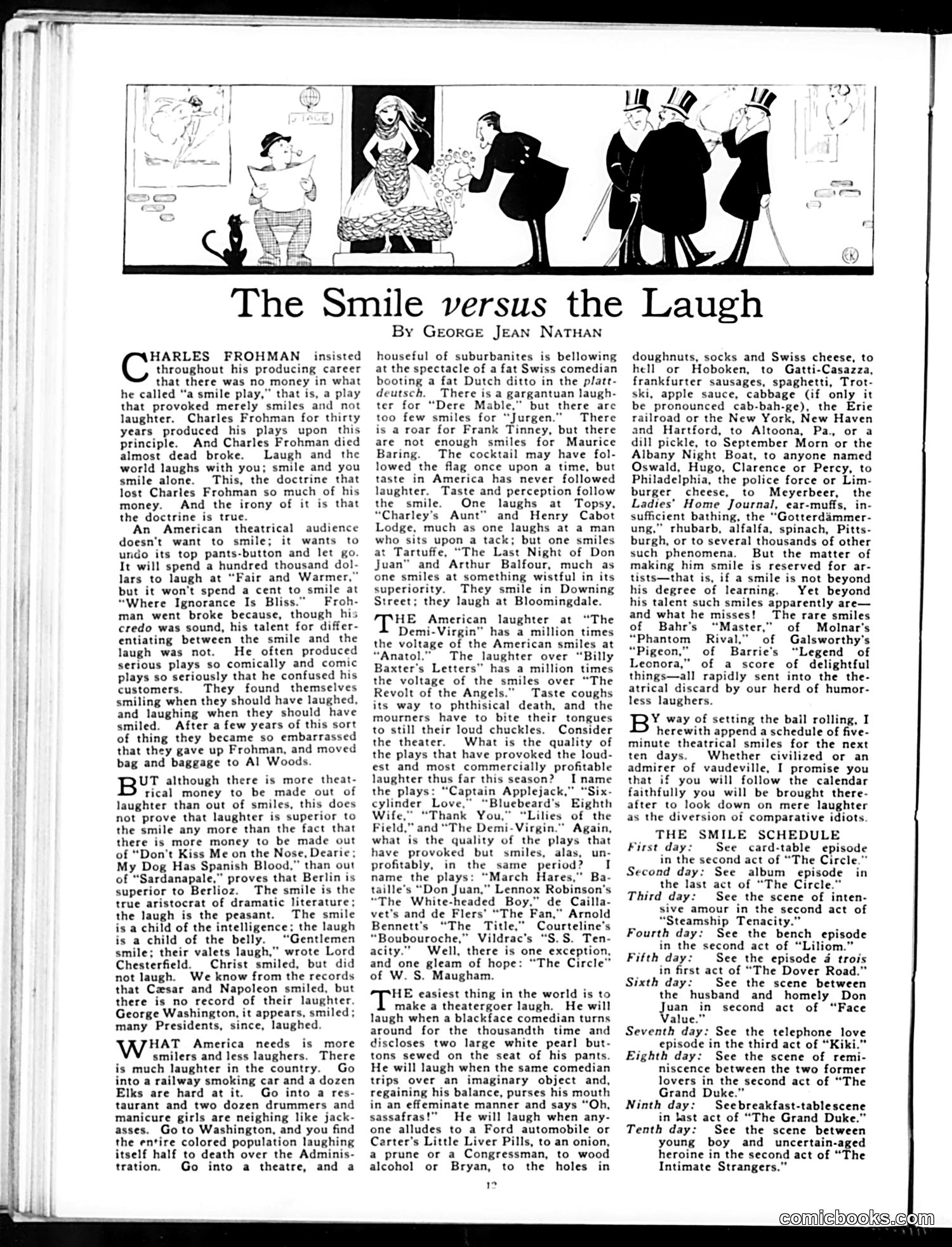
This is a theatrical criticism essay by George Jean Nathan, not a political cartoon. The small comic strip at the top illustrates the article's theme about American theatrical taste. Nathan argues that American audiences prefer broad laughter to refined smiles—they'll pay for slapstick comedies but not sophisticated plays. He cites producer Charles Frohman's financial failure despite his artistic doctrine that "smile plays" were worthier than laugh-getters. Nathan uses class commentary throughout: laughs are "peasant" and "of the belly," while smiles are "aristocratic" and "of intelligence." He invokes Caesar, Napoleon, Christ, and Lord Chesterfield as evidence that refined people smile rather than laugh. The article criticizes American popular taste as vulgar, contrasting lowbrow comedies ("Dere Mable," Frank Tinney) with sophisticated fare ("Jurgen," Maurice Baring). This reflects 1920s cultural anxiety about mass entertainment and democratic taste versus elite aesthetics.
📄 Transcribed text from this page (OCR, searchable)
Machine-transcribed from the original scan — historical spelling and the odd misread are preserved.
throughout his producing career that there was no money in what he called “a smile play,” that is, a play that provoked merely smiles and not laughter. Charles Frohman for thirty years produced his plays upon this principle. And Charles Frohman died almost dead broke. Laugh and the world laughs with you; smile and you smile alone. This, the doctrine that lost Charles Frohman so much of his money. And the irony of it is that the doctrine is true. An American theatrical audience doesn't want to smile; it wants to undo its top pants-button and let go. It will spend a hundred thousand dol- lars to laugh at “Fair and Warmer,” but it won't spend a cent to smile at “Where Ignorance Is Bliss.” Froh- man went broke because, though his credo was sound, his talent for differ- entiating between the smile and the laugh was not. He often produced serious plays so comically and comic plays so seriously that he confused his customers. They found themselves smiling when they should have laughed, and laughing when they should have smiled. After a few years of this sort of thing they became so embarrassed that they gave up Frohman, and moved bag and baggage to Al Woods. Bur although there is more theat- rical money to be made out of laughter than out of smiles, this does not prove that laughter is superior to the smile any more than the fact that there is more money to be made out of “Don’t Kiss Me on the Nose, Dearie; My Dog Has Spanish Blood,” than out of “Sardanapale,” proves that Berlin is superior to Berlioz. The smile is the true aristocrat of dramatic literature; the laugh is the peasant. The smile is a child of the intelligence; the laugh is a child of the belly. “Gentlemen smile; their valets laugh,” wrote Lord Chesterfield. Christ smiled, but did not laugh. We know from the records that Casar and Napoleon smiled, but there is no record of their laughter. George Washington, it appears, smiled; many Presidents, since, laughed HAT America needs is more smilers and less laughers. There is much laughter in the country. Go into a railway smoking car and a dozen Elks are hard at it. Go into a res- taurant and two dozen drummers and manicure girls are neighing like jack- asses. Go to Washington, and you find the entire colored population laughing itself half to death over the Adminis- tration. Go into a theatre, and a C ‘througte FROHMAN insisted The Smile versus the Laugh By Georce Jean NaTHAN houseful of suburbanites is bellowing at the spectacle of a fat Swiss comedian booting a fat Dutch ditto in the platt- deutsch, There is a gargantuan laugh- ter for “Dere Mable,” but there are too few smiles for “Jurgen.” There is a roar for Frank Tinney, but there are not enough smiles for Maurice Baring. The cocktail may have fol- lowed the flag once upon a time, but taste in America has never followed laughter. Taste and perception follow the smile. One laughs at Topsy, “Charley's Aunt” and Henry Cabot Lodge, much as one laughs at a man who sits upon a tack; but one smiles at Tartuffe, “The Last Night of Don juan” and Arthur Balfour, much as one smiles at something wistful in its superiority. They smile in Downing Street; they laugh at Bloomingdale. HE American laughter at “The Demi-Virgin” has a million times the voltage of the American smiles at “Anatol.” The laughter over “Billy Baxter's Letters” has a million times the voltage of the smiles over “The Revolt of the Angels.” Taste coughs its way to phthisical death, and the mourners have to bite their tongues to still their loud chuckles. Consider the theater. What is the quality of the plays that have provoked the loud- est and most commercially profitable laughter thus far this season? I name the plays: “Captain Applejack,” “Six- cylinder Love,” “Bluebeard’s Eighth e,” “Thank You,” “Lilies of the |. and “The Demi-Virgin.” Again, what is the quality of the plays that have provoked but smiles, alas, un- profitably, in the same period? I name the plays: “March Hares,” Ba- taille’s “Don Juan,” Lennox Robinson's “The White-headed Boy,” de Cailla- vet's and de Flers’ “The Fan,” Arnold Bennett's “The Title,” Courteline’s “Boubouroche,” Vildrac’s “S.S. Ten- acity.” Well, there is one exception, and one gleam of hope: “The Circle” of W. S. Maugham. HE easiest thing in the world is to make a theatergoer laugh. He will laugh when a blackface comedian turns around for the thousandth time and discloses two large white pearl but- tons sewed on the seat of his pants. He will laugh when the same comedian trips over an imaginary object and, regaining his balance, purses his mouth in an effeminate manner and says “Oh, sassafras!" He will laugh when any- one alludes to a Ford automobile or Carter's Little Liver Pills, to an onion, a prune or a Congressman, to wood alcohol or Bryan, to the holes in doughnuts, socks and Swiss cheese, to hell or Hoboken, to Gatti-Casazza, frankfurter sausages, spaghetti, Trot- ski, apple sauce, cabbage (if only it be pronounced cab-bah-ge), the Erie railroad or the New York, New Haven and Hartford, to Altoona, Pa. or a dill pickle, to September Morn or the Albany Night Boat, to anyone named Oswald, Hugo, Clarence or Percy, to Philadelphia, the police force or Lim- burger cheese, to Meyerbeer, the Ladies’ Home Journal, ear-muffs, in- sufficient bathing, the “Gotterdammer- ung,” rhubarb, alfalfa, spinach, Pitts- burgh, or to several thousands of other such phenomena. But the matter of making him smile is reserved for ar- tists—that is, if a smile is not beyond his degree of learning. Yet beyond his talent such smiles apparently are— and what he misses! The rare smiles of Bahr’s “Master,” of Molnar's “Phantom Rival,” of Galsworthy’s “Pigeon,” of Barrie's “Legend of Leonora,” of a score of delightful things—all rapidly sent into the the- atrical discard by our herd of humor- less laughers. BY way of setting the bail rolling, I herewith append a schedule of five- minute theatrical smiles for the next ten days. Whether civilized or an admirer of vaudeville, I promise you that if you will follow the calendar faithfully you will be brought there- after to look down on mere laughter as the diversion of comparative idiots. THE SMILE SCHEDULE First day: See card-table episode in the second act of “The Circle.” Second day: See album episode in _ the last act of “The Circle.” Third day: See the scene of inten- sive amour in the second act of “Steamship Tenacity.” Fourth day: See the bench episode in the second act of “Liliom.” Fifth day: See the episode 4 trois in first act of “The Dover Road.” Sixth day: See the scene between the husband and homely Don qean in second act of “Face ‘alue.” Seventh day: See the telephone love episode in the third act of “Kiki.” Eighth day: See the scene of remi- niscence between the two former lovers in the second act of “The Grand Duke.” Ninth day: Seebreakfast-tablescene in last act of “The Grand Duke.” Tenth day: See the scene between young boy and uncertain-aged heroine in the second act of “The Intimate Strangers.” comichooks.