
Judge, 1922-02-04 · page 20 of 36
Judge — February 4, 1922 — page 20: what you’re looking at
What you’re looking at
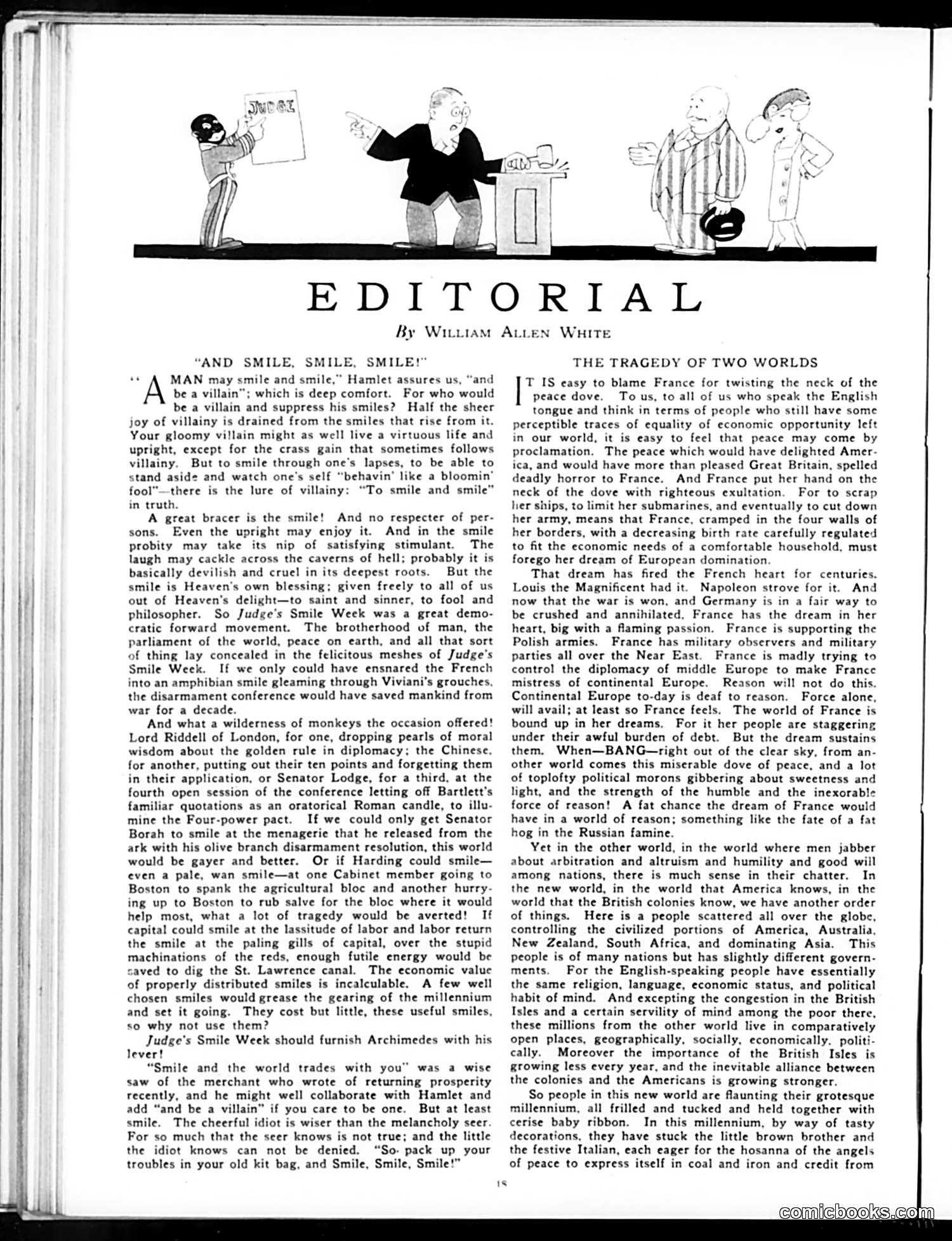
This editorial page from Judge magazine contains two pieces by William Allen White satirizing post-WWI politics and diplomacy. **Top cartoon (unillustrated text):** "Judge's Smile Week" mocks a naive campaign promoting smiling as a solution to international conflict. White sarcastically suggests that if world leaders—including Senator Lodge, Senator Borah, President Harding, and French diplomat Viviani—could simply smile at each other, disarmament conferences and labor disputes would resolve themselves. The piece ridicules the idealistic notion that goodwill gestures alone can overcome fundamental political disagreements. **Bottom article:** White criticizes France for obstructing peace negotiations (the "tragedy of two worlds"). He contrasts English-speaking nations' relative economic equality with European power struggles, particularly France's efforts to militarily dominate Central Europe and weaken Germany. White argues France pursues imperial ambitions rather than genuine peace, and that British colonies operate more equitably than Continental Europe. Both pieces reflect 1920s American skepticism toward European diplomacy and isolationist sentiment.
📄 Transcribed text from this page (OCR, searchable)
Machine-transcribed from the original scan — historical spelling and the odd misread are preserved.
“AND SMILE, SMILE, SMILE!” MAN may smile and smile,” Hamlet assures us, “and be a villain"; which is deep comfort. For who would be a villain and suppress his smiles? Half the sheer joy of villainy is drained from the smiles that rise from it. Your gloomy villain might as well live a virtuous life and upright, except for the crass gain that sometimes follows villainy. But to smile through one’s lapses, to be able to stand aside and watch one's self “behavin’ like a bloomin’ fool"—there is the lure of villainy: “To smile and smile” in truth. A great bracer is the smile! And no respecter of per- sons. Even the upright may enjoy it. And in the smile probity may take its nip of satisfying stimulant. The laugh may cackle across the caverns of hell; probably it is basically devilish and cruel in its deepest roots. But the smile is Heaven's own blessing; given freely to all of us out of Heaven's delight—to saint and sinner, to fool and philosopher. So Judge's Smile Week was a great demo- cratic forward movement. The brotherhood of man, the parliament of the world, peace on earth, and all that sort of thing lay concealed in the felicitous meshes of Judge's Smile Week. If we only could have ensnared the French into an amphibian smile gleaming through Viviani's grouches, the disarmament conference would have saved mankind from war for a decade. And what a wilderness of monkeys the occasion offered! Lord Riddell of London, for one, dropping pearls of moral wisdom about the golden rule in diplomacy; the Chinese, for another, putting out their ten points and forgetting them in their application, or Senator Lodge, for a third, at the fourth open session of the conference letting off Bartlett's familiar quotations as an oratorical Roman candle, to illu- mine the Four-power pact. If we could only get Senator Borah to smile at the menagerie that he released from the ark with his olive branch disarmament resolution, this world would be gayer and better. Or if Harding could smile— even a pale, wan smile—at one Cabinet member going to Boston to spank the agricultural bloc and another hurry- ing up to Boston to rub salve for the bloc where it would help most, what a lot of tragedy would be averted! If capital could smile at the lassitude of labor and labor return the smile at the paling gills of capital, over the stupid machinations of the reds, enough futile energy would be saved to dig the St. Lawrence canal. The economic value of properly distributed smiles is incalculable. A few well chosen smiles would grease the gearing of the millennium and set it going. They cost but little, these useful smiles, so why not use them? Judge's Smile Week should furnish Archimedes with his lever! “Smile and the world trades with you” was a wise saw of the merchant who wrote of returning prosperity recently, and he might well collaborate with Hamlet and add “and be a villain” if you care to be one. But at least smile. The cheerful idiot is wiser than the melancholy seer. For so much that the seer knows is not true; and the little the idiot knows can not be denied. “So. pack up your troubles in your old kit bag, and Smile, Smile, Smile!” EDITORIAL By Wituiam Att WHITE THE TRAGEDY OF TWO WORLDS F; IS easy to blame France for twisting the neck of the peace dove. To us, to all of us who speak the English tongue and think in terms of people who still have some perceptible traces of equality of economic opportunity left in our world, it is easy to feel that peace may come by proclamation. The peace which would have delighted Amer- ica, and would have more than pleased Great Britain, spelled deadly horror to France. And France put her hand on the neck of the dove with righteous exultation. For to scrap her ships, to limit her submarines, and eventually to cut down her army, means that France, cramped in the four walls of her borders, with a decreasing birth rate carefully regulated to fit the economic needs of a comfortable household, must forego her dream of European domination. That dream has fired the French heart for centuries. Louis the Magnificent had it. Napoleon strove for it. And now that the war is won, and Germany is in a fair way to be crushed and annihilated, France has the dream in her heart, big with a flaming passion. France is supporting the Polish armies. France has military observers and military parties all over the Near East. France is madly trying to control the diplomacy of middle Europe to make France mistress of continental Europe. Reason will not do this. Continental Europe to-day is deaf to reason. Force alone, will avail; at least so France feels. The world of France is bound up in her dreams. For it her people are staggering under their awful burden of debt. But the dream sustains them. When—BANG—right out of the clear sky, from an- other world comes this miserable dove of peace, and a lot of toplofty political morons gibbering about sweetness and light, and the strength of the humble and the inexorable force of reason! A fat chance the dream of France would have in a world of reason; something like the fate of a fat hog in the Russian famine. Yet in the other world, in the world where men jabber about arbitration and altruism and humility and good will among nations, there is much sense in their chatter. In the new world, in the world that America knows, in the world that the British colonies know, we have another order of things. Here is a people scattered all over the globe, controlling the civilized portions of America, Australia, New Zealand, South Africa, and dominating Asia. This people is of many nations but has slightly different govern- ments. For the English-speaking people have essentially the same religion, language, economic status, and political habit of mind. And excepting the congestion in the British Isles and a certain servility of mind among the poor there, these millions from the other world live in comparatively open places, geographically, socially, economically, politi- cally. Moreover the importance of the British Isles is growing less every year, and the inevitable alliance between the colonies and the Americans is growing stronger. So people in this new world are flaunting their grotesque millennium, all frilled and tucked and held together with cerise baby ribbon. In this millennium, by way of tasty decorations, they have stuck the little brown brother and the festive Italian, each eager for the hosanna of the angels of peace to express itself in coal and iron and credit from comichooks,