
A complete issue · 36 pages · 1921
Judge — December 3, 1921
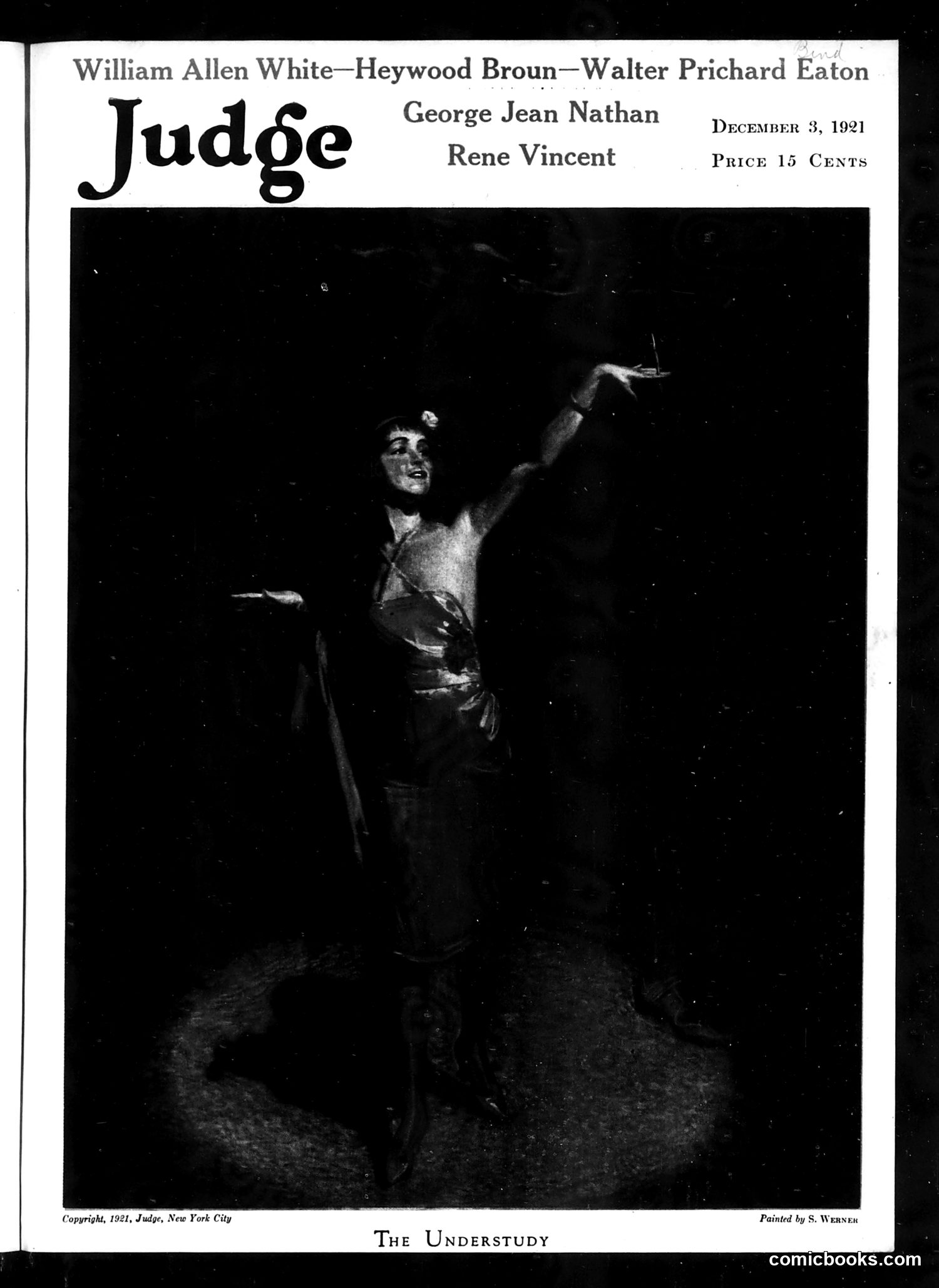
This appears to be a cover or feature page for Judge magazine, a prominent American satirical publication. The image shows a dramatic black-and-white photograph of a figure in classical or theatrical pose, arm raised skyward against a dark background, painted by S. Werner according to the credit line. The page is titled "The Understudy" and lists cast members including William Allen White, Heywood Broun, Walter Prichard Eaton, George Jean Nathan, and René Vincent. This suggests the content relates to theater criticism or satire about theatrical understudy roles—likely commenting on contemporary theatrical figures or productions. The specific political or social commentary remains unclear without additional context from the article text itself.
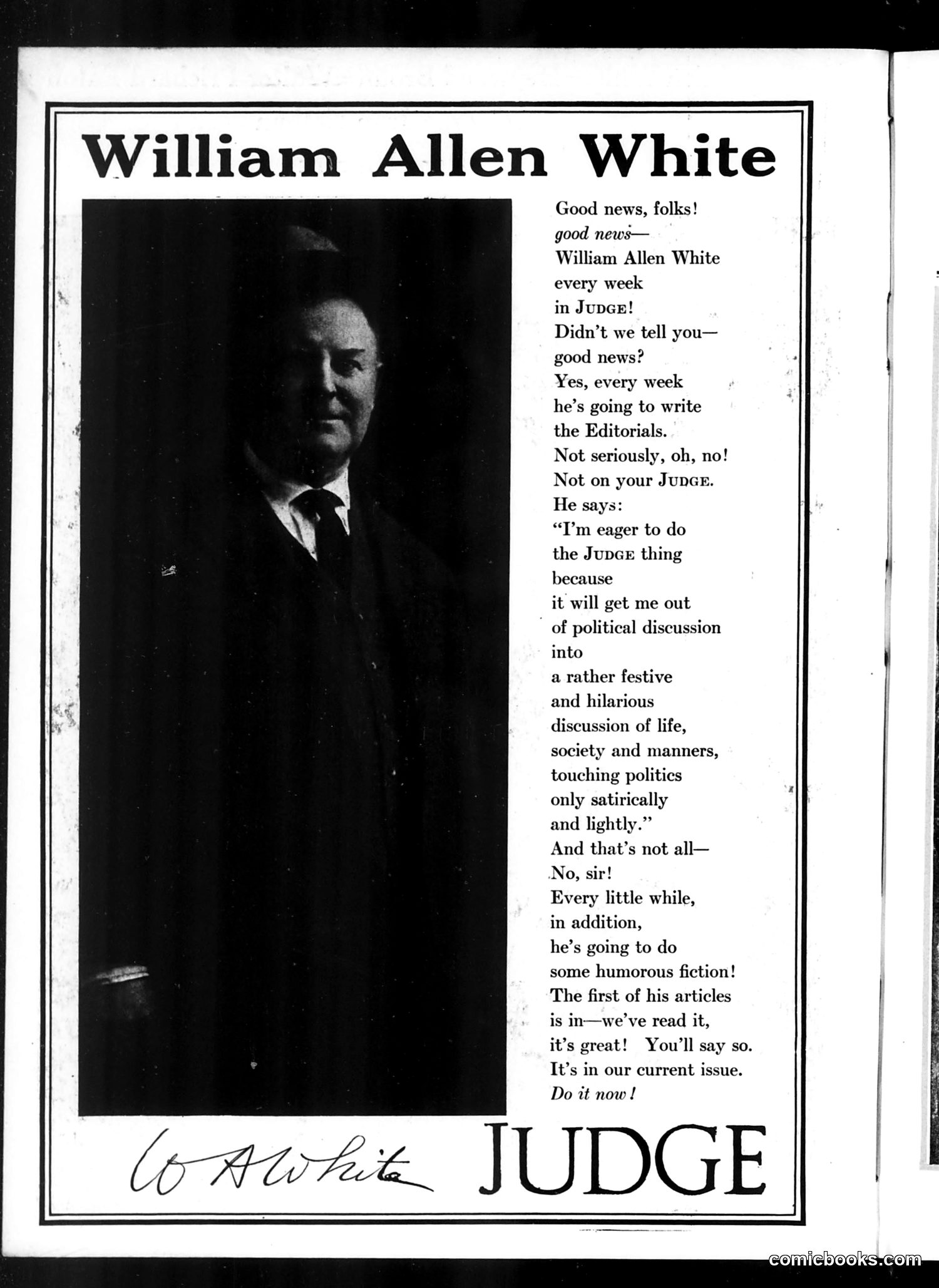
This is a **promotional advertisement**, not satire or political commentary. Judge magazine is announcing that **William Allen White**—a prominent American journalist and editor—will become a regular contributor. The ad promises readers: 1. Weekly **editorials** by White 2. **Humorous fiction** pieces 3. Content covering "life, society and manners" with only light, satirical treatment of politics The tone is celebratory ("Good news, folks!") and the message emphasizes White's appeal: his writing will provide intelligent discussion without heavy-handed political sermonizing. The photograph shows a formal, dignified gentleman in suit and tie, positioning him as a respectable literary figure. This is essentially **magazine promotion** leveraging White's reputation to attract subscribers.
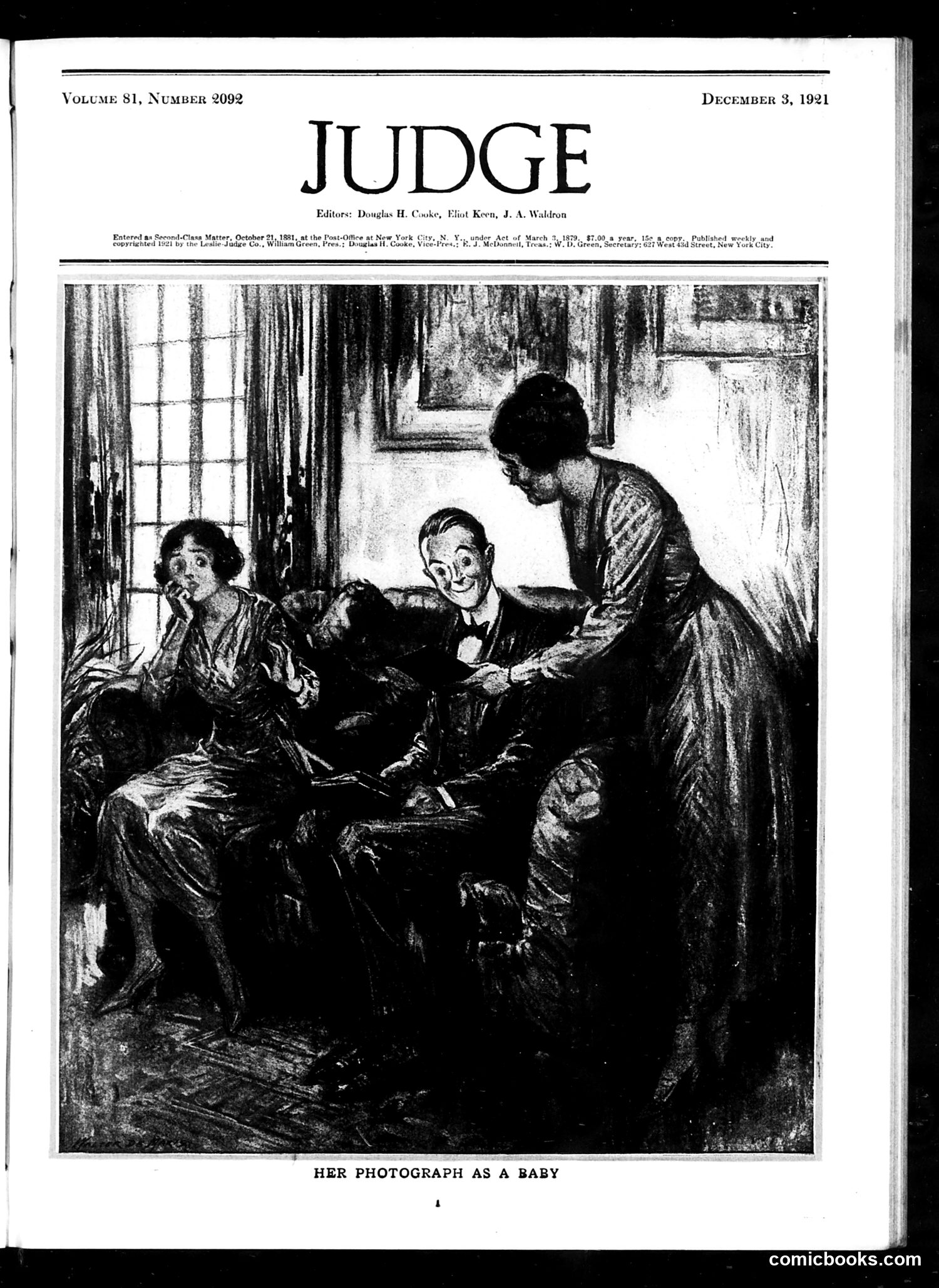
This cartoon from *Judge* magazine (December 3, 1921) appears to satirize a woman's vanity or dishonesty about her age. The image shows three figures examining what is labeled "her photograph as a baby"—but the photograph depicts a fully grown adult woman rather than an infant. The joke mocks the common social pretense of women misrepresenting their age, particularly in early 20th-century society where youthfulness held significant social value. The men's exaggerated expressions of surprise or skepticism emphasize the absurdity of the claim. The satire targets both female vanity and the broader cultural anxiety about aging and appearance that characterized the era.
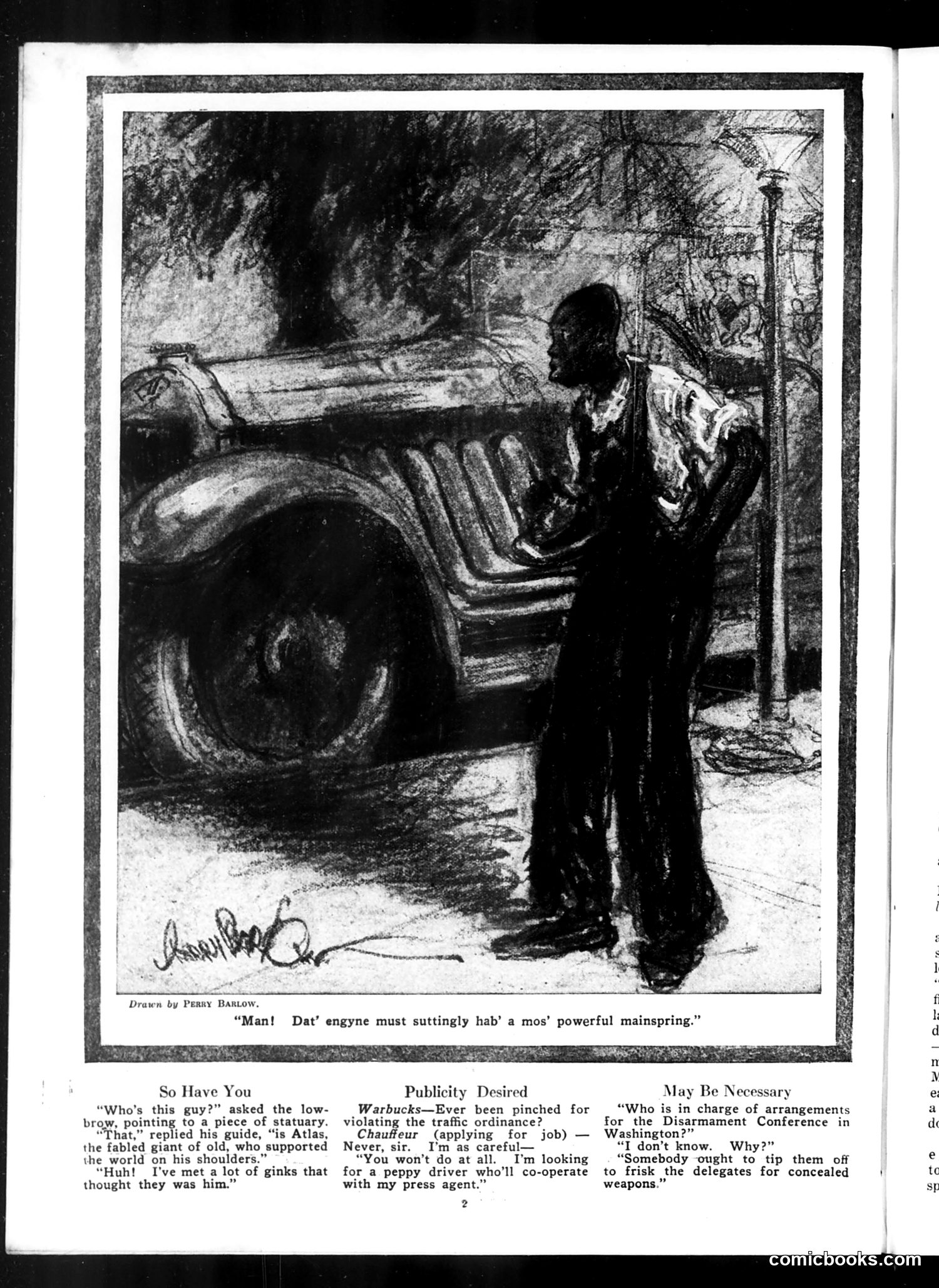
This page contains three separate satirical pieces drawn by Perry Barlow: **Main Cartoon**: Shows a man examining a large automobile engine, commenting that it needs "a mos' powerful mainspring"—satirizing early car engines as overly complex or unreliable. **"So Have You"**: Mocks someone claiming an "Atlas" supported the world, suggesting the person himself is similarly burdened. **"Publicity Desired"**: A chauffeur is arrested for traffic violations; he seeks favorable press coverage rather than legal help—satirizing how people prioritize public image over accountability. **"May Be Necessary"**: References a "Disarmament Conference in Washington," likely satirizing diplomatic efforts regarding weapons reduction, suggesting delegates need "tips" to succeed. The page satirizes contemporary concerns: automotive technology, public relations manipulation, and international diplomacy.
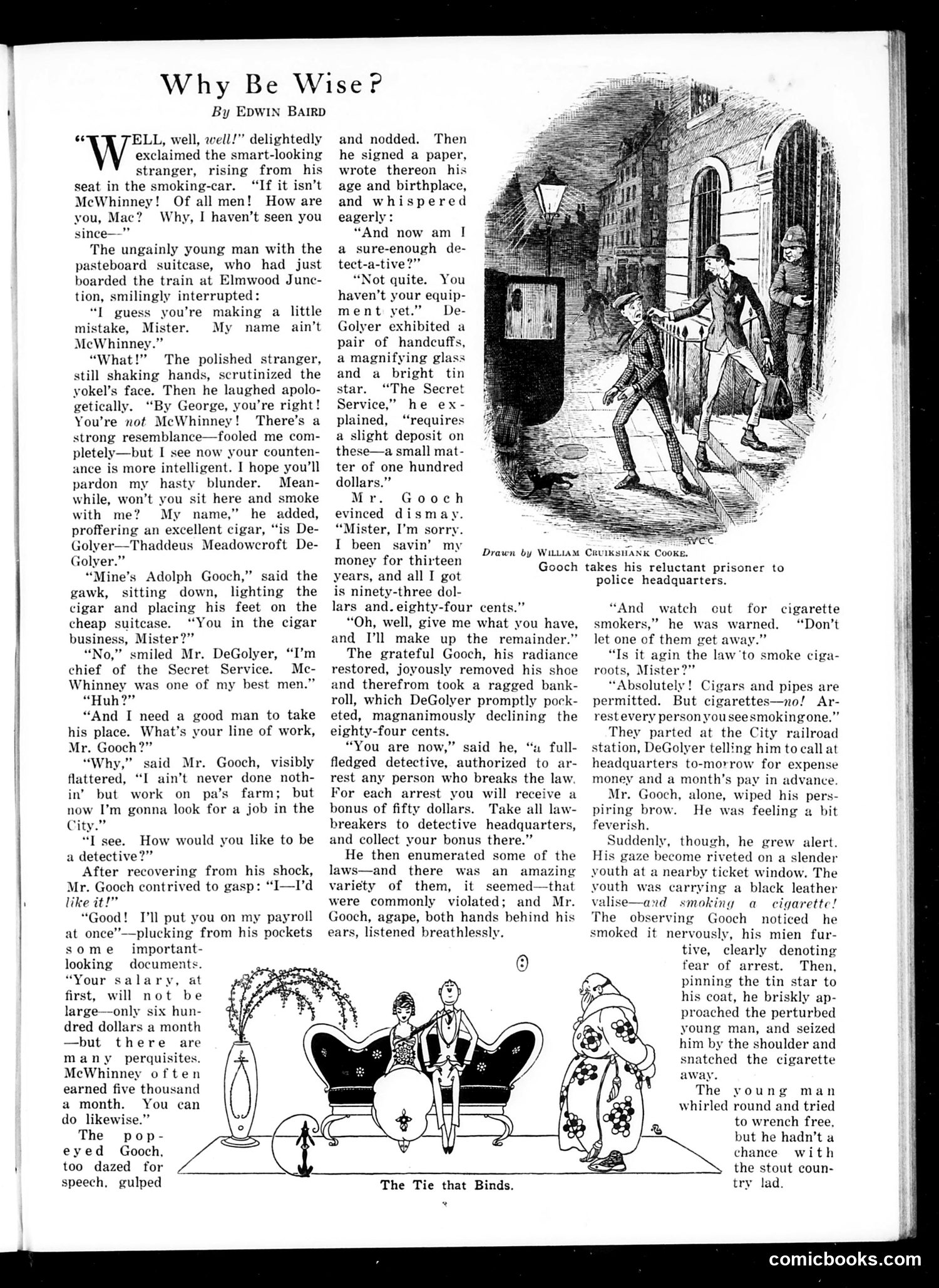
This story by Edwin Baird satirizes the Secret Service and law enforcement recruitment. The protagonist, Mr. DeGolyer, a polished stranger on a train, recruits a naive young man named McWhinney to become a detective by flattering his intelligence and offering financial incentives (a $100 deposit, $50 bonus per arrest). The satire targets how detective agencies recruit—appealing to vanity and greed rather than genuine qualification. The cartoon "The Tie that Binds" (bottom) appears to illustrate romantic entanglement, contrasting with the story's theme of questionable institutional bindings. The story's conclusion suggests the young man falls into trouble when observed smoking a cigarette—highlighting how arbitrary enforcement and bureaucratic rules entrap ordinary people into criminal situations.
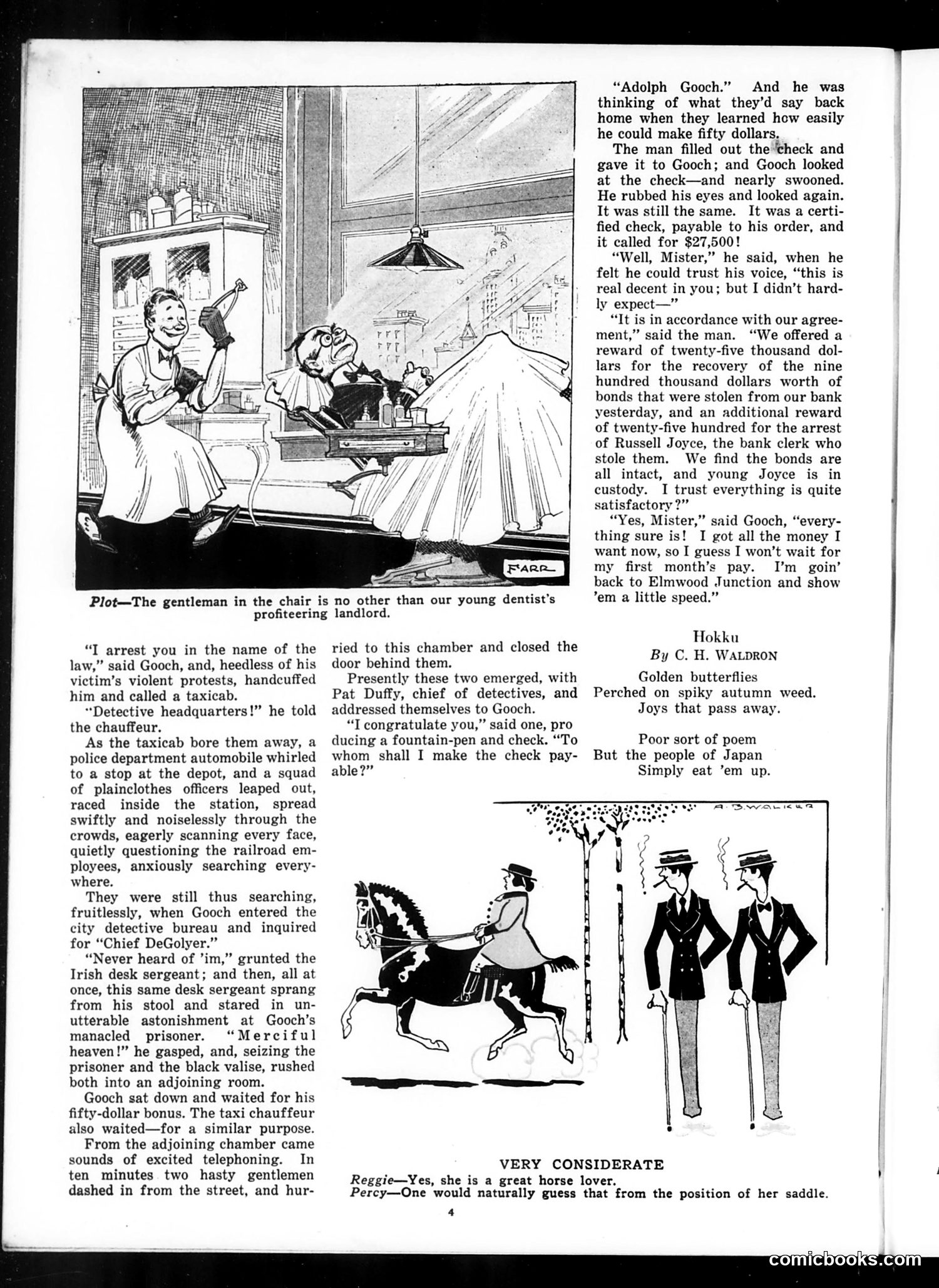
**Main Story Illustration**: The cartoon depicts a dental office scene where a man sits in a dentist's chair receiving what appears to be an arrest. The caption identifies "the gentleman in the chair is no other than our young dentist's profiteering landlord." **The Satire**: The story mocks a landlord who exploits tenants by demanding excessive rent. He's arrested for receiving a check for $27,500—apparently related to stolen bank bonds worth $900,000. The irony is that this profiteering landlord, who extracts money from desperate renters, faces consequences for his own financial crimes. **Secondary Content**: Below are brief poems and a small cartoon about horses ("Very Considerate"), typical of Judge's mixed satirical content. **Social Context**: This reflects post-WWI concerns about profiteering and exploitation of working people by landlords and property owners.
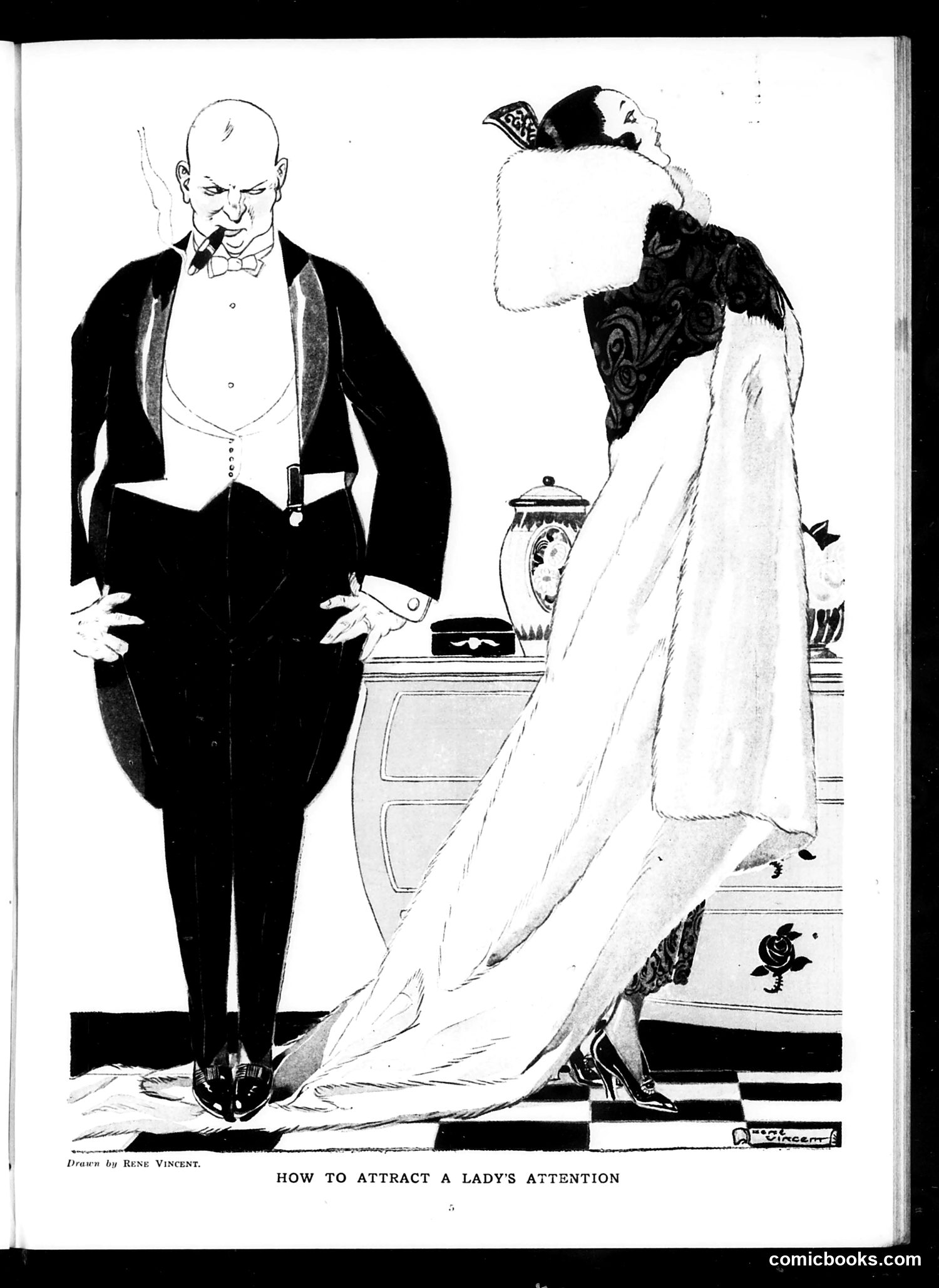
This is a humor cartoon titled "How to Attract a Lady's Attention," drawn by René Vincent for Judge magazine. The cartoon presents two contrasting approaches: On the left, a bald man in formal evening wear (tuxedo) stands stiffly, appearing anxious or uncomfortable. On the right, a woman in an elaborate white gown with fur stole and feathered hat dramatically sweeps past him, ignoring his presence entirely. The satire suggests that a man's conventional formal attire and proper etiquette—the expected "gentleman's" approach—fails to capture a woman's interest. Instead, the woman's attention is drawn to her own elaborate costume and appearance. The joke targets early 20th-century courtship rituals, implying that women are primarily concerned with fashion and display rather than the man's efforts to impress her through formality.
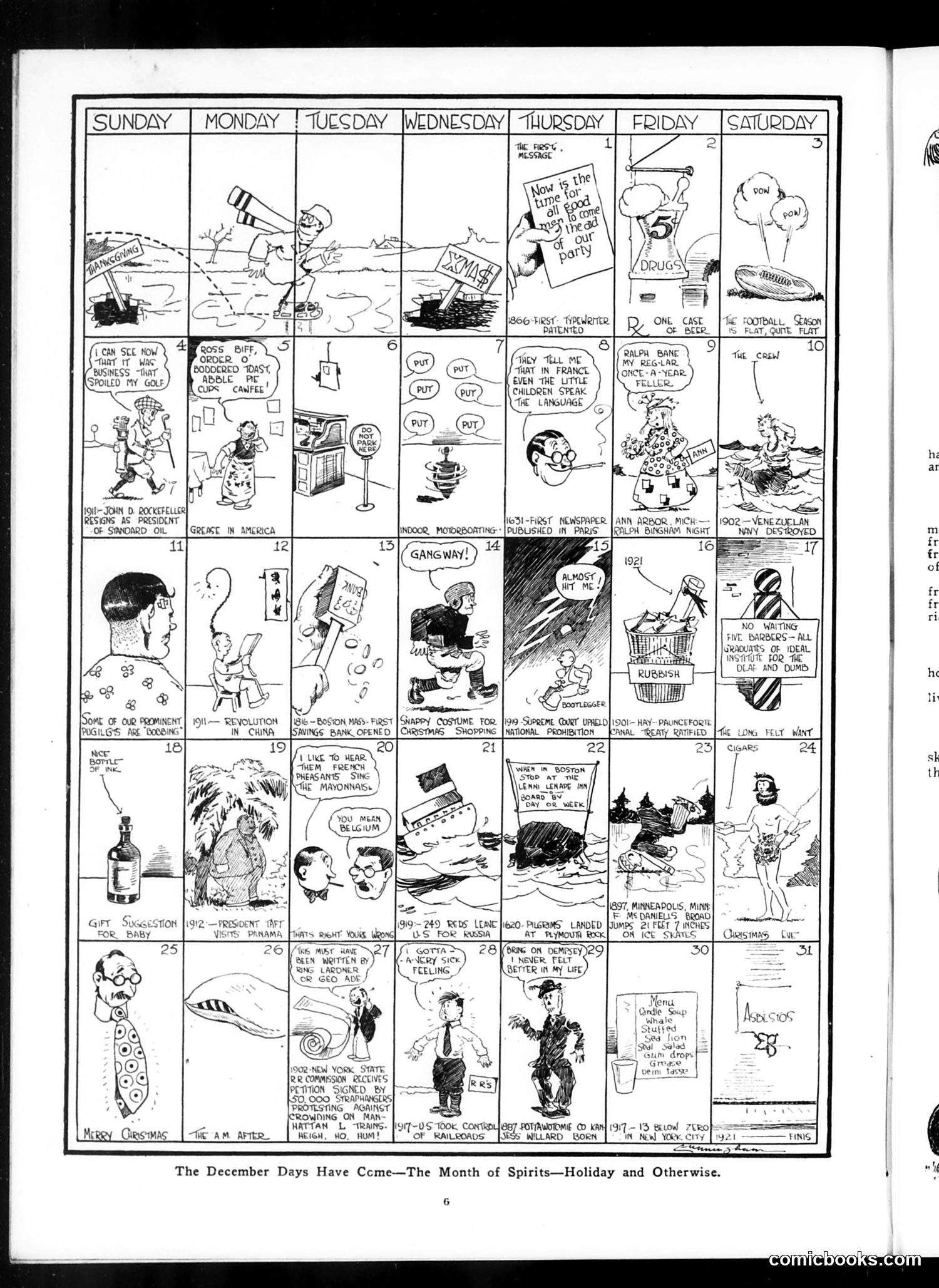
This Judge magazine calendar page presents a satirical month of December events mixing holidays, historical anniversaries, and contemporary scandals. **Key References:** - **John D. Rockefeller resigning from Standard Oil** (panel 11): A major 1911 business event, satirized as typical of wealthy industrialists - **Dempsey boxing** (panels 29-30): Likely Jack Dempsey, prominent heavyweight boxer of the era - **Pilgrims landing at Plymouth Rock** (panel 23): Historical reference used for holiday context - **French language/cuisine jokes** (panels 7, 20): Common American stereotypes about French culture - **Revolution in China** (panel 5): References the 1911 Xinhai Revolution **The satire's point**: The calendar juxtaposes serious historical/political events with frivolous holiday observations and drinking culture ("Month of Spirits"), mocking American society's conflation of significant moments with superficial celebration. The crude caricatures and broad humor reflect early 20th-century Judge's irreverent style toward politics and social pretension.
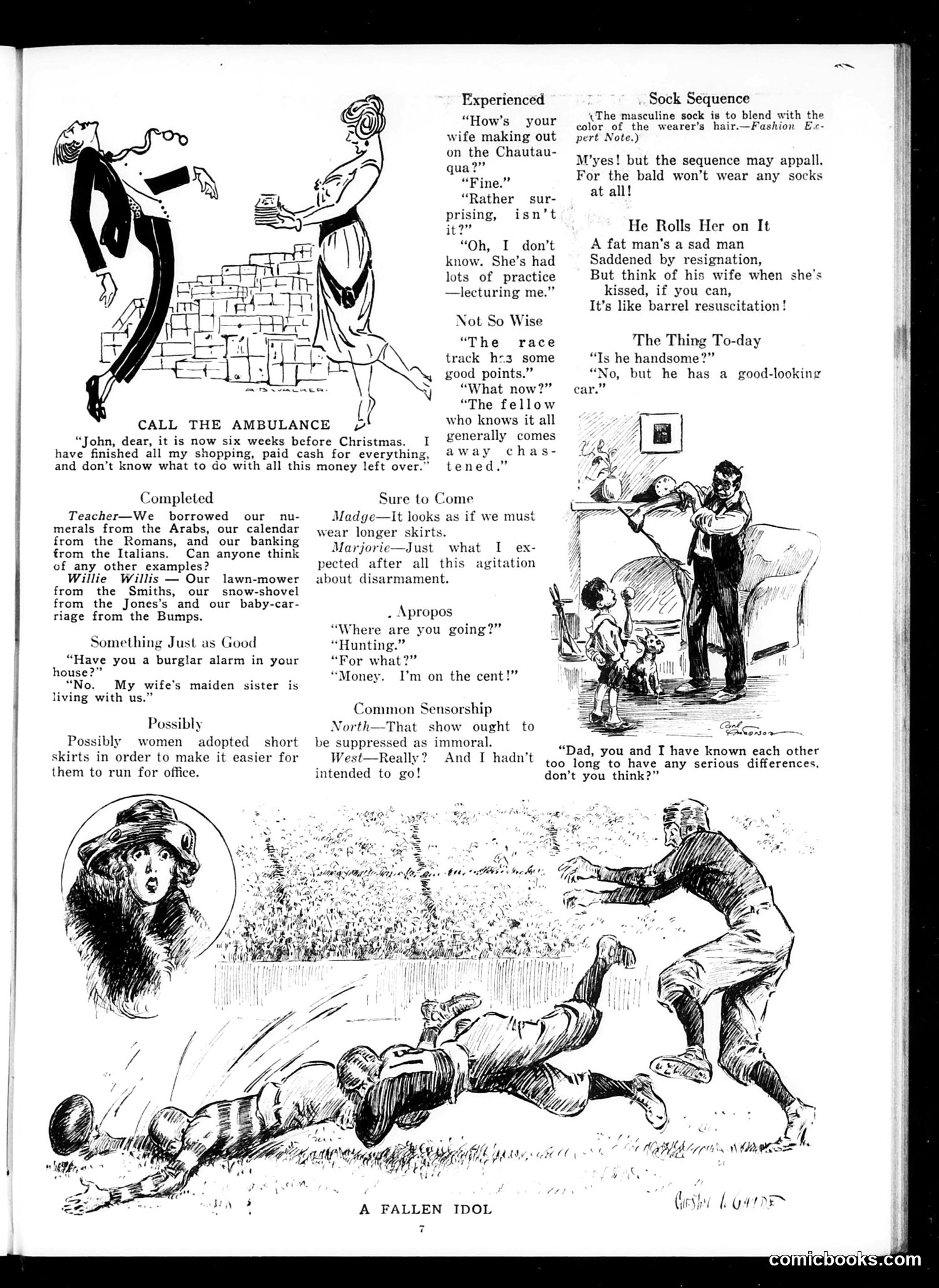
This page from *Judge* (a satirical weekly) contains a collection of brief humorous sketches and jokes typical of early 20th-century American humor. Key content includes: **The main cartoon** ("A Fallen Idol," bottom) depicts a man being thrown from a horse, satirizing disappointment or exposure of a once-respected figure—the specific reference is unclear without dating. **The jokes** mock contemporary social situations: a teacher's ironic observation about borrowing cultural practices; a wife's maiden sister as a "burglar alarm"; women adopting short skirts to "run for office" (likely referencing women's suffrage activism); references to "disarmament" suggesting post-WWI era concerns about military spending and fashion. **Other sketches** include domestic humor (husbands lecturing wives, unfaithful relationships) and wordplay ("I'm on the cent" for hunting money). The overall tone is genteel, middle-class satire focused on manners, marriage dynamics, and contemporary fads rather than hard political commentary—typical of *Judge*'s target audience of educated urban readers.
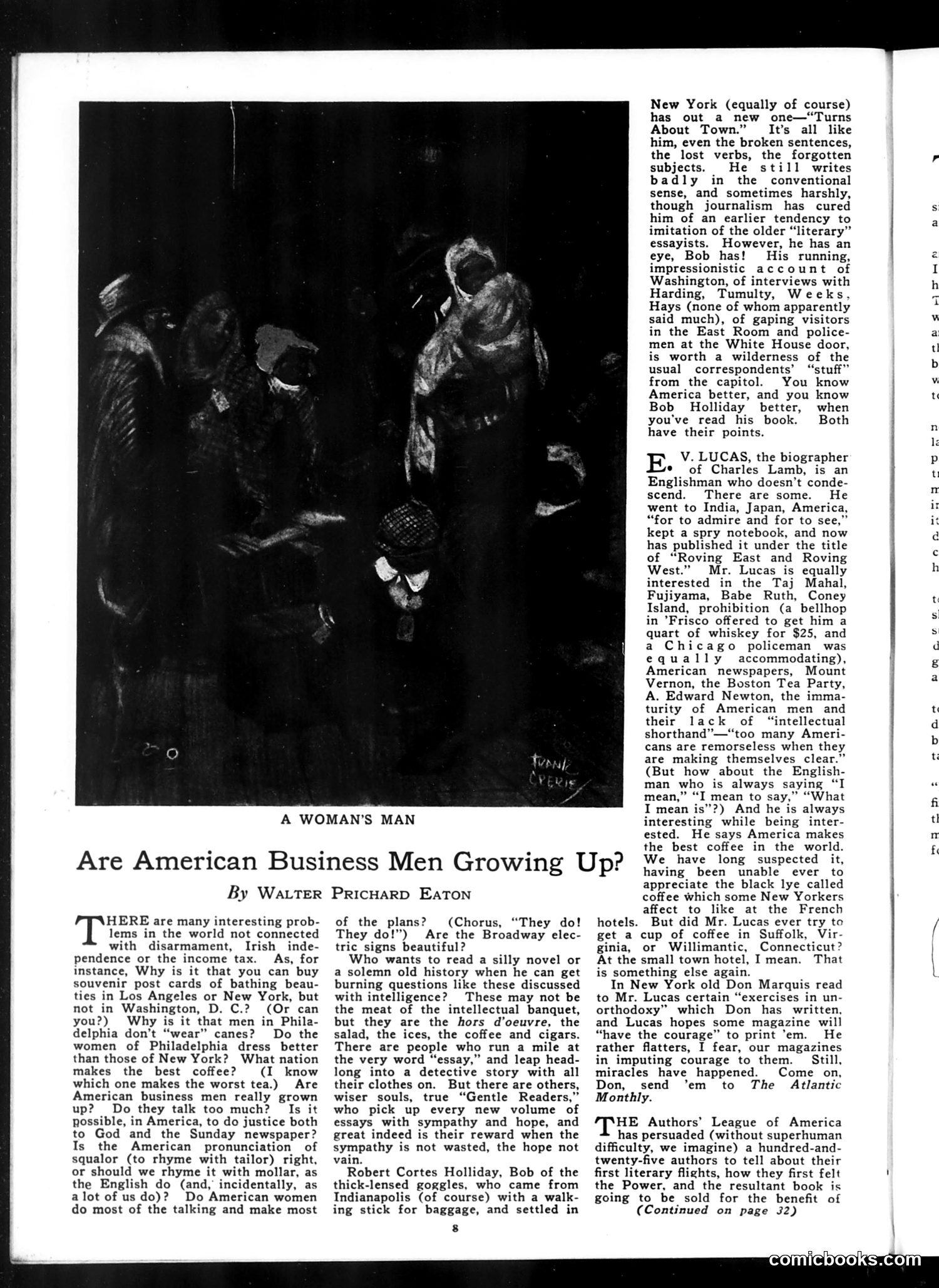
**The Main Cartoon:** The illustration titled "A Woman's Man" shows a figure (appears to be a businessman or gentleman) in an intimate or compromising position with a woman. The image is rendered in dark, sketchy tones typical of period satirical art. **The Article's Point:** Walter Prichard Eaton's essay humorously questions whether American businessmen are "growing up"—suggesting they remain immature or overly focused on trivial matters. He discusses Robert Cortes Holliday's new essay collection "Turns About Town," praising Holliday's observational writing about Washington politics and notable figures (Harding, Tumulty, etc.). **The Satire:** The pairing of the suggestive illustration with an essay questioning American male maturity appears deliberate—the cartoon reinforces Eaton's implicit criticism that American businessmen remain preoccupied with romantic/sexual pursuits rather than intellectual development. The contrast between sophisticated essay criticism and the risqué illustration exemplifies Judge's typical approach: pairing social commentary with cheeky visual humor about masculine behavior.
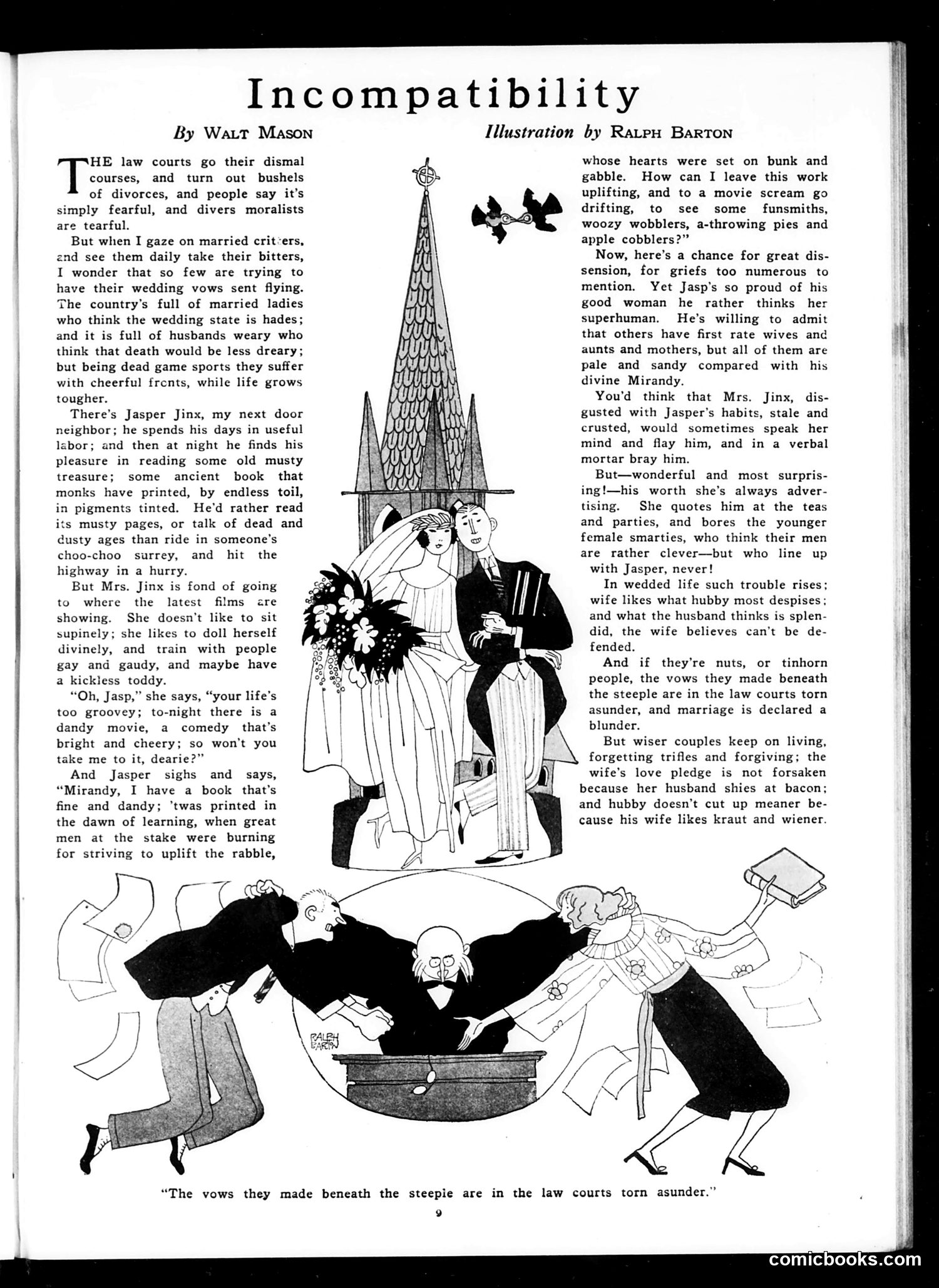
This story satirizes marital discord by depicting the Jinx couple as hopelessly mismatched: Jasper prefers dusty scholarly books while his wife craves movies and social gaiety. The satire's point is subtle—rather than mock their incompatibility, Mason praises Mrs. Jinx for loyally promoting her husband's interests despite their opposing desires. The lower illustration shows a judge presiding over divorcing couples being pulled apart, visualizing Mason's opening complaint about courts producing "bushels of divorces." The moral: some couples divorce over trivial incompatibilities, while "wiser couples" (like the Jinxes) survive by tolerating differences—the husband accepting his wife's love of entertainment, the wife forgiving his disdain for bacon and acceptance of sauerkraut. The satire critiques both divorce culture and the expectation that spouses must share identical interests to maintain marriage.
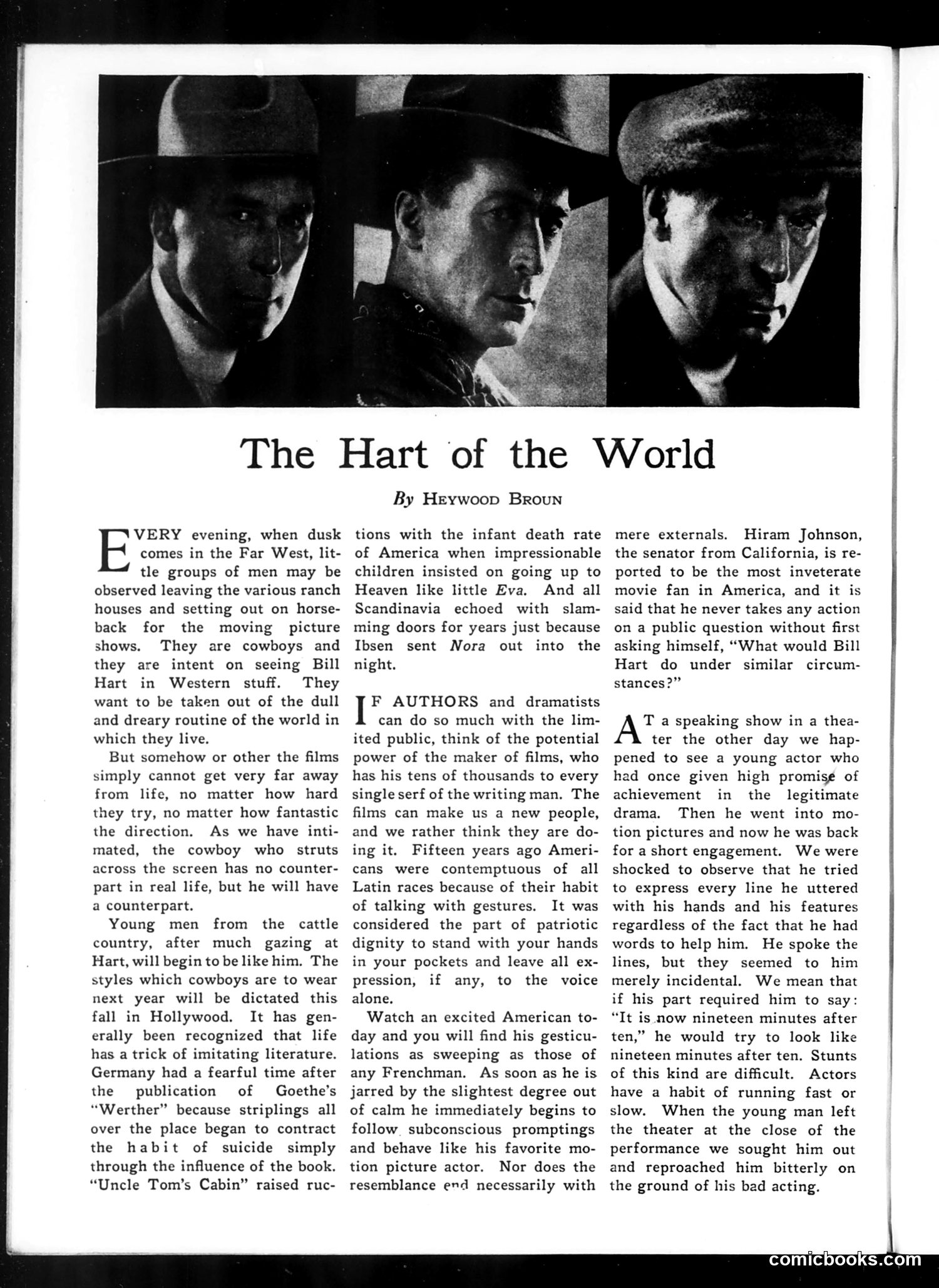
This article discusses actor William S. Hart (visible in the three portrait photographs), a major Western film star of the era. Broun argues that motion pictures—particularly Hart's films—possess unprecedented power to shape public behavior and values. The piece uses historical examples to support this claim: Goethe's *Werther* inspired suicides, *Uncle Tom's Cabin* affected infant mortality rates, and Ibsen's *Nora* influenced Scandinavian culture. Broun contends cinema's influence vastly exceeds literature's because it reaches millions. His evidence: Americans adopted Latin gestural expressiveness from watching film actors, and Senator Hiram Johnson allegedly makes political decisions by asking "What would Bill Hart do?" Broun concludes with anecdotal proof—a legitimate stage actor who failed at theater by unconsciously mimicking silent film acting techniques, using exaggerated physical gestures instead of relying on spoken dialogue. The satire critiques both cinema's manipulative power and society's susceptibility to entertainment-driven conformity.
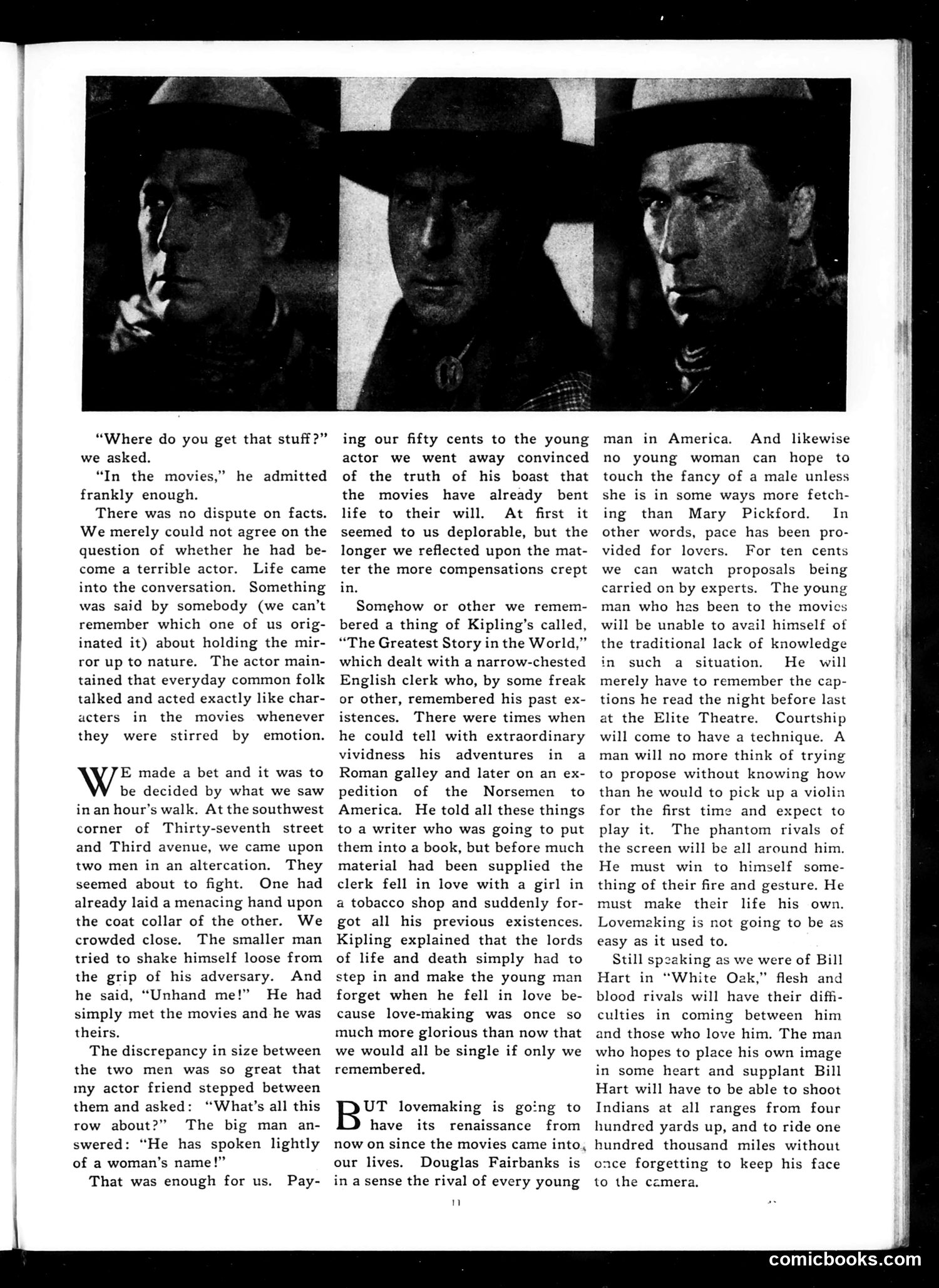
This article satirizes how movies are reshaping American behavior and romance. The author describes witnessing a street fight where one man exclaimed "Unhand me!"—theatrical language clearly copied from cinema rather than authentic speech. An actor friend uses this as proof that movies have already "bent life to their will." The piece critiques how films, particularly those starring **Douglas Fairbanks** and **Mary Pickford** (major silent film stars), have become the template for real-world courtship and masculine behavior. The satire suggests young men now feel they must emulate these screen idols' romantic techniques to compete, and that actual courtship has become impossibly difficult—one cannot propose without having studied film proposals first. The underlying joke: movies have created such idealized versions of romance and heroism that ordinary life cannot compete. Reality now imitates cinema rather than vice versa, with problematic consequences for actual human relationships.
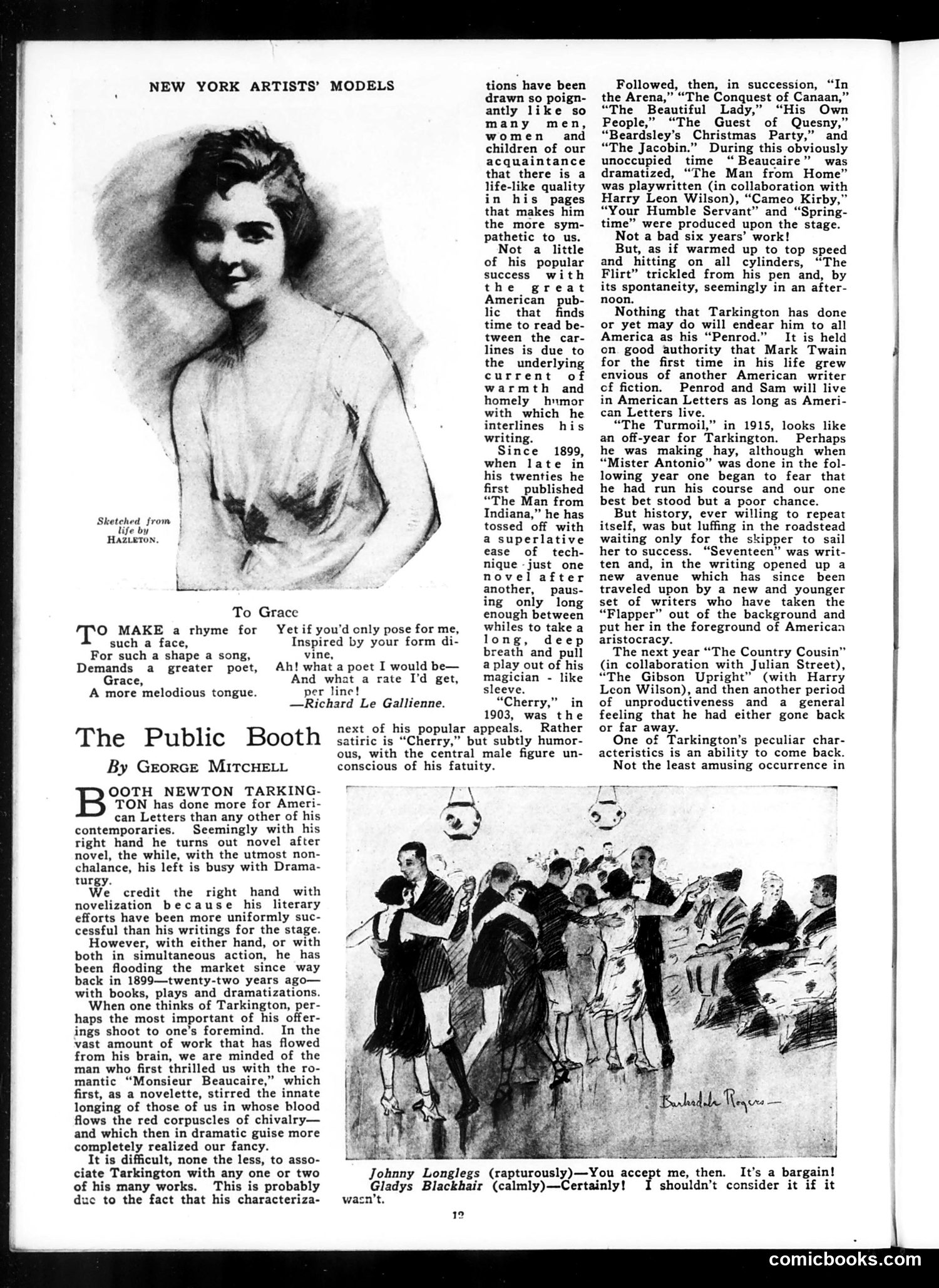
This article by George Mitchell celebrates American author Booth Tarkington's prolific literary output. The piece praises Tarkington for producing more American literature than his contemporaries since 1899—novels, plays, and dramatizations flowing with equal ease from both hands, so to speak. Mitchell argues Tarkington's greatest strength is his lifelike characterizations of recognizable Americans, which gives his work warmth and homely humor appealing to the general public. The article catalogs his major works ("Monsieur Beaucaire," "The Man from Home," "Penrod," "The Turmoil") while noting that "Penrod" achieved such excellence that even Mark Twain grew envious. The accompanying sketch portrait (by Hazelton) shows Tarkington himself. The cartoon below appears unrelated—a social scene with dialogue about a romantic proposal, illustrating typical Judge satirical humor about courtship and materialism.
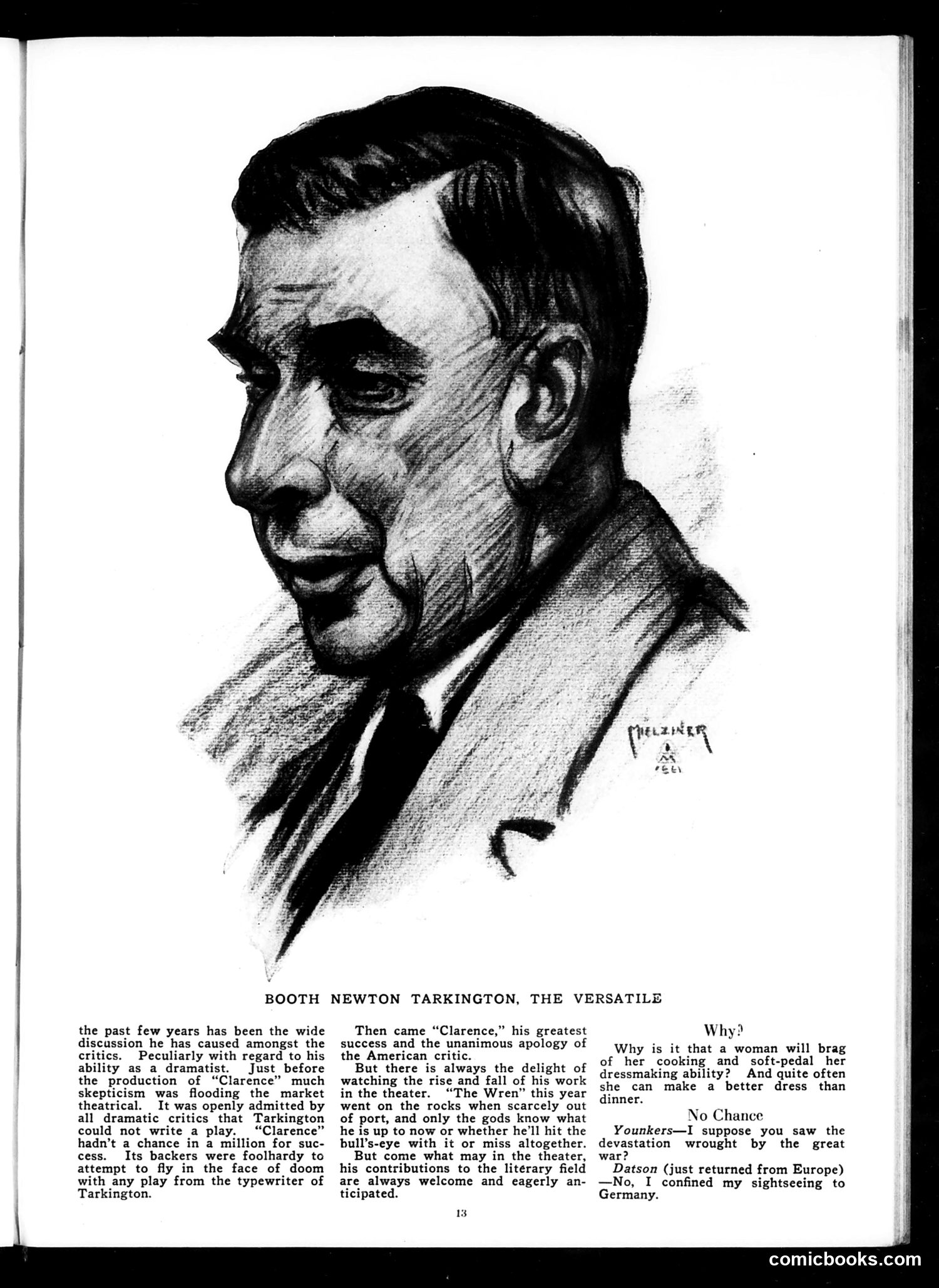
This page profiles playwright and novelist **Booth Tarkington**, a major American literary figure. The sketch portrait shows him in profile, signed by the artist. The text chronicles Tarkington's volatile reputation among theater critics. His play *"Clarence"* initially faced widespread skepticism—critics openly doubted he could write drama—but became a major success, forcing critics to apologize. However, his subsequent play *"The Wren"* failed quickly, illustrating his unpredictable theatrical fortunes. The page celebrates his literary contributions as consistently valued despite theatrical ups-and-downs. Below is an unrelated humor section with two jokes: one mocking women's cooking versus sewing skills, and another—likely post-WWI—about a tourist who confined German sightseeing to devastated areas rather than natural attractions, implying Germany bore war's visible destruction.
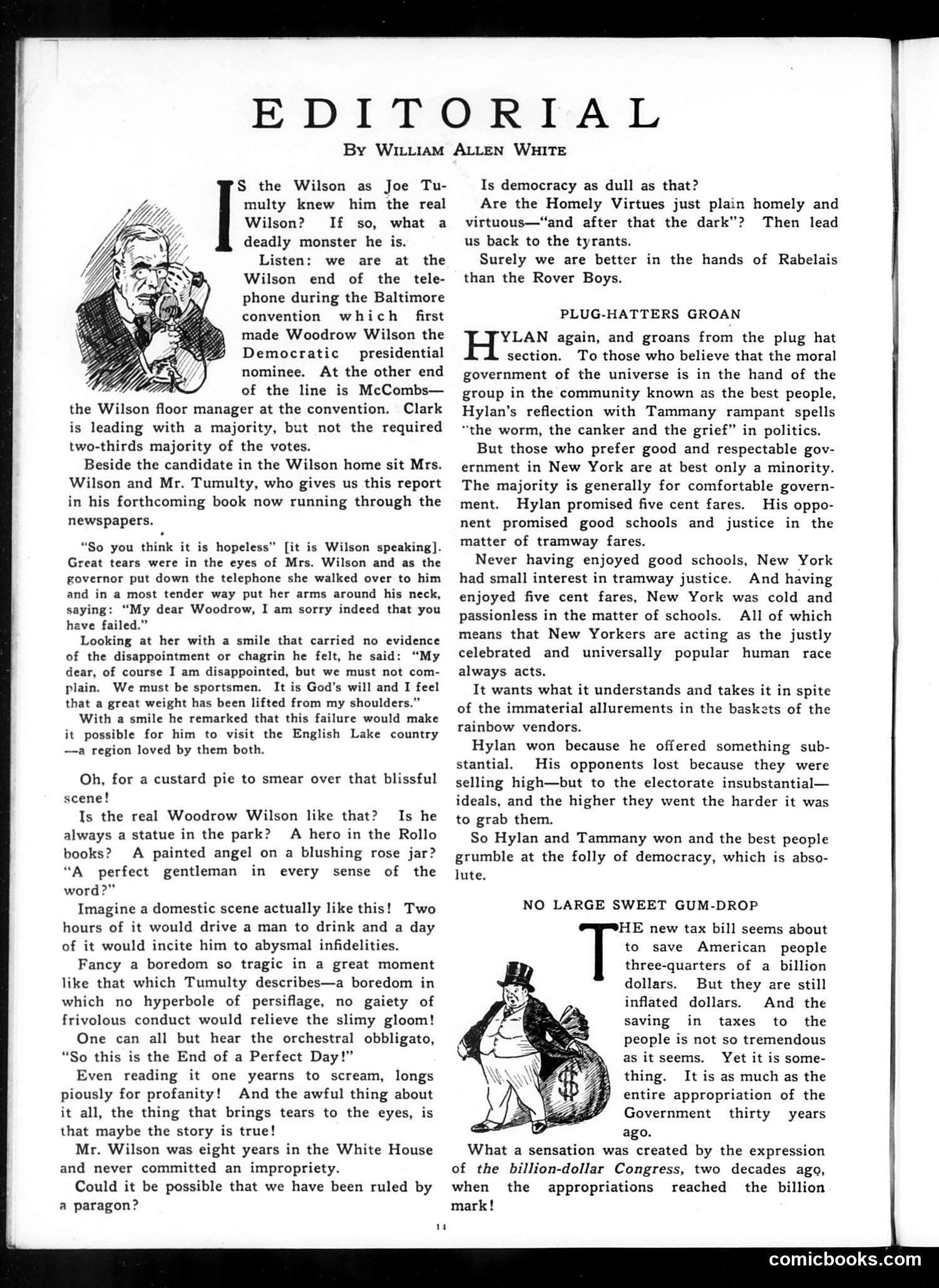
This editorial by William Allen White critiques President Woodrow Wilson's alleged emotional restraint and moral perfection, as reported in Joe Tumulty's forthcoming memoir. White sarcastically describes an anecdote where Wilson, facing convention defeat in 1912, responds with stoic composure—disappointing his wife by refusing to despair. White finds this implausibly virtuous and boring, suggesting genuine humanity requires passion, even anger. He cynically questions whether democracy can survive when leaders are "perfect gentlemen" rather than dynamic figures, concluding Americans actually prefer tyrants to the dull virtue of "Rover Boys." The second section mocks New York mayor Hylan's election victory, attributing it to voters prioritizing cheap subway fares over quality schools—proving ordinary people want tangible benefits, not moral ideals. Both pieces express White's skepticism toward sanctimonious leadership and democratic voters alike. The illustration appears to depict a well-dressed, corpulent figure—likely representing Hylan or a corrupt politician—embodying the "plug-hat" establishment.
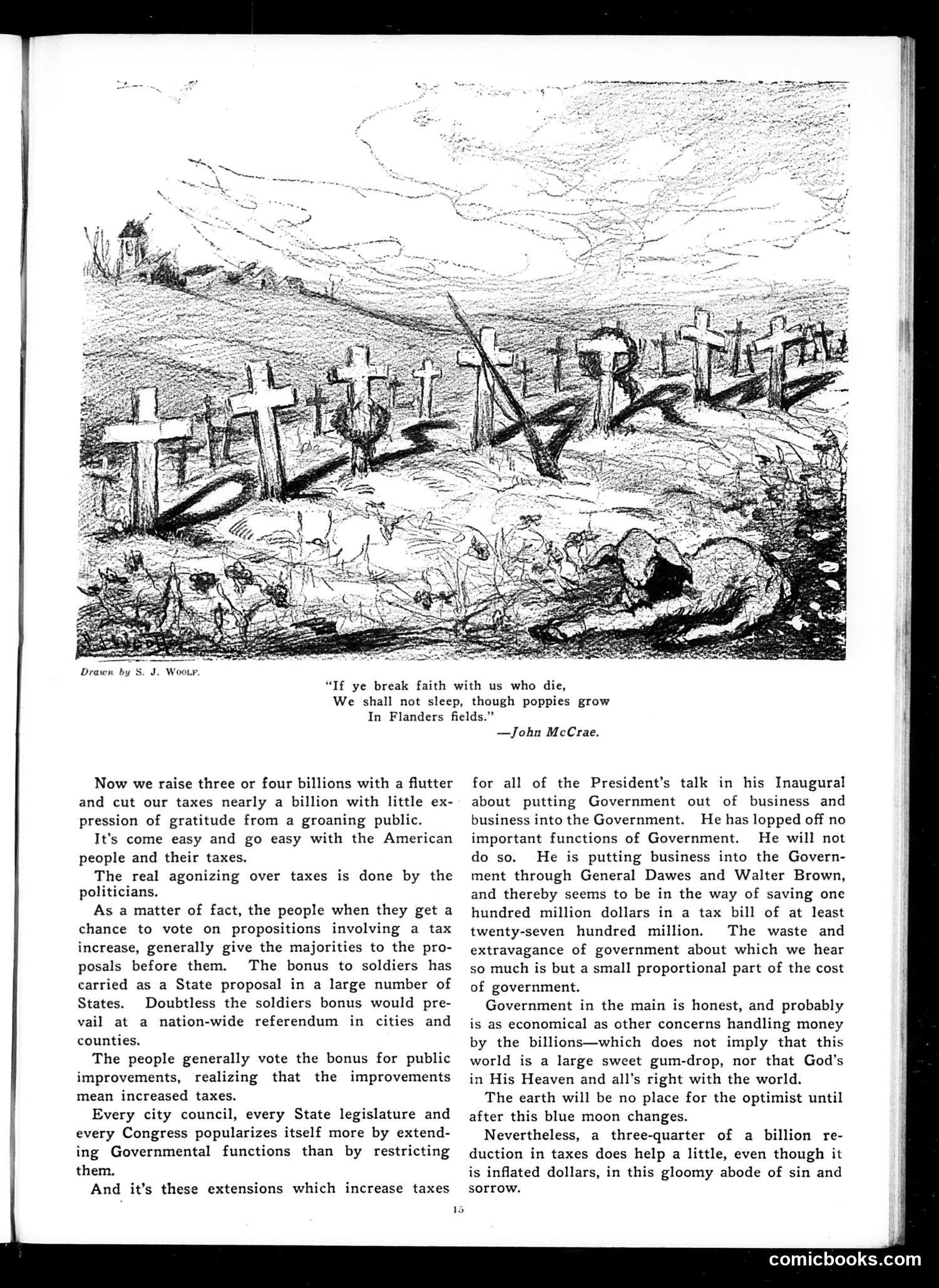
This Judge page satirizes post-WWI American attitudes toward taxation and government spending. The illustration depicts a World War I battlefield cemetery in Flanders (referencing the famous poem by John McCrae quoted above), invoking soldiers' sacrifice to contrast with domestic financial irresponsibility. The accompanying text argues that Americans, despite groaning about taxes, actually vote *for* tax increases when funding public improvements and veterans' bonuses. The satire targets politicians and government expansion: each legislative body seeks popularity by expanding governmental functions rather than restraining them, thereby increasing taxes. The piece appears critical of the newly-inaugurated President's (likely Harding, given the reference to General Dawes and Walter Brown in his administration) rhetoric about reducing government and business waste. The writer claims the promised savings are negligible compared to total expenditure, dismissing both optimism about reform and pessimism about the nation's prospects as equally unfounded.
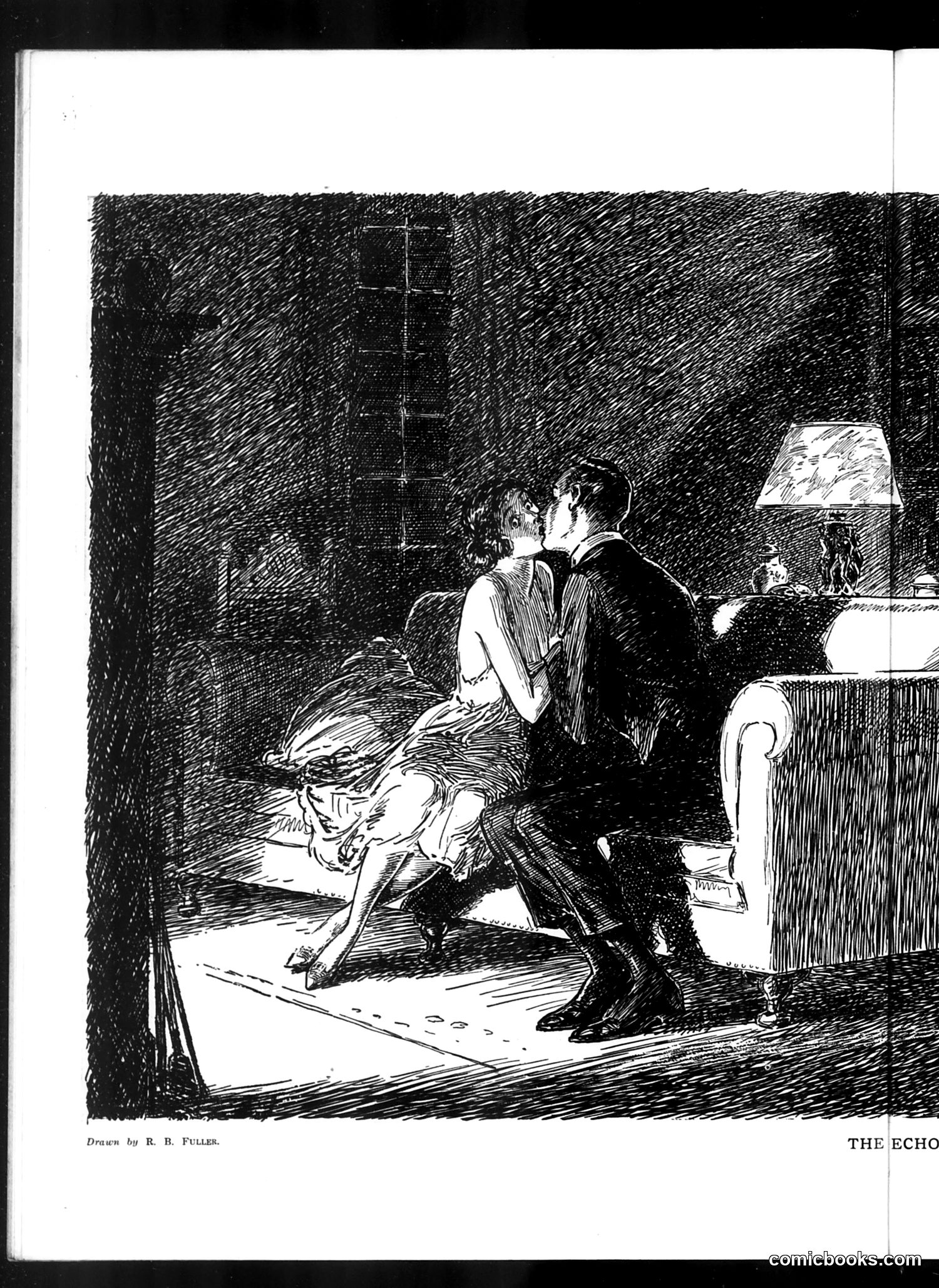
This is an ink drawing by R.B. Fuller depicting an intimate scene between a man and woman in what appears to be a bedroom or private room. The woman reclines on a bed or couch while the man leans toward her; a lamp and furniture are visible in the background. However, **the OCR text is incomplete and largely illegible**, providing only a fragment ("Pa") and partial credits. Without the accompanying caption, title, or article text that would normally explain the satirical or political point, **I cannot reliably identify the specific figures, historical context, or intended satire** this illustration references. To accurately explain this cartoon's meaning for modern readers, the full caption and surrounding text would be essential.
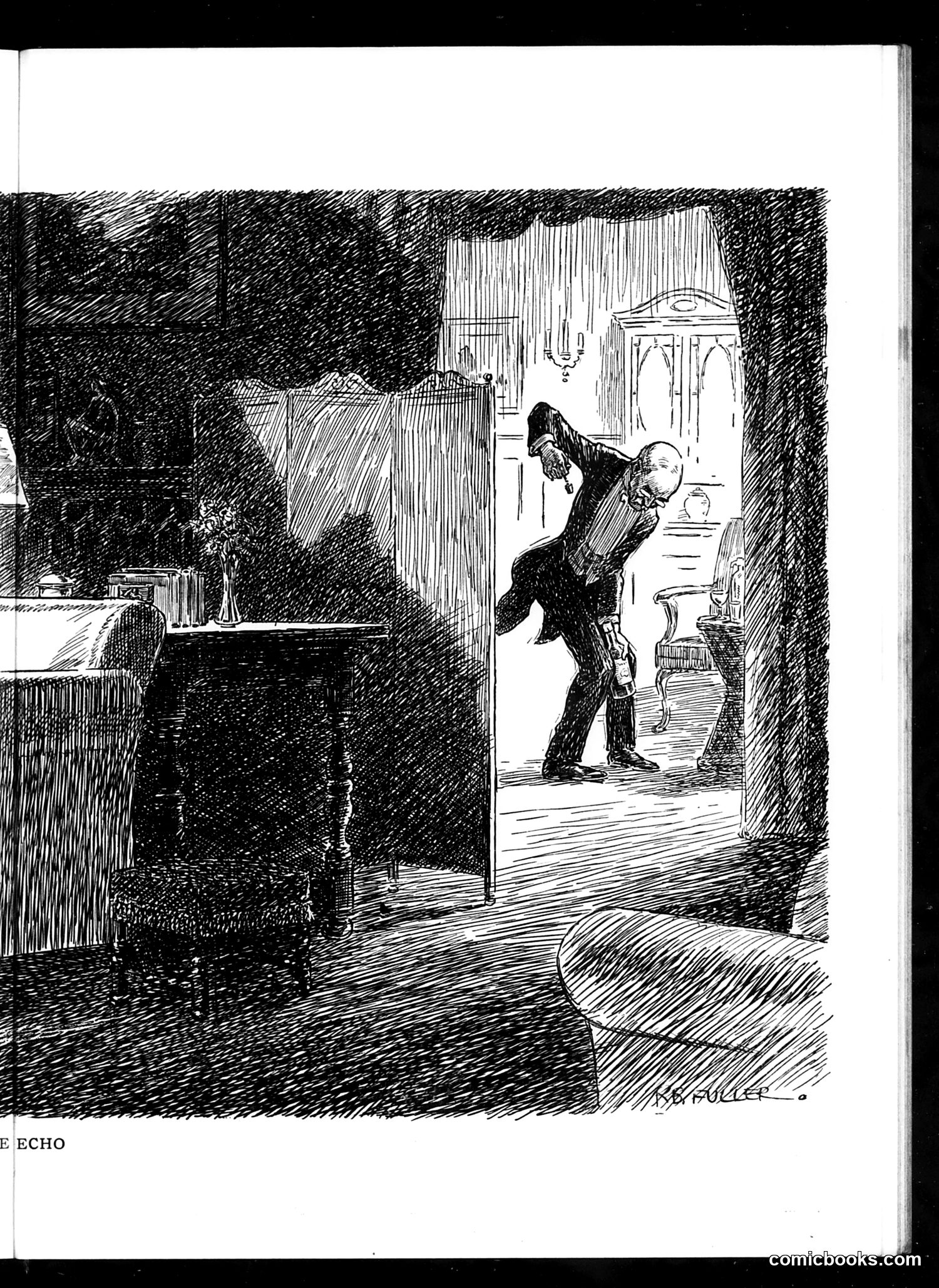
This black-and-white illustration depicts a formal interior scene where a well-dressed man in a dark suit appears to be sneaking or moving stealthily through a doorway, with his finger raised to his lips in a "shush" gesture. The setting suggests an upper-class home or office with period furniture visible in the background. The signature reads "Roy Fuller" (the cartoonist). Without visible caption text or clearer context, the specific political or social satire is difficult to determine with certainty. The image appears to comment on some form of secretive behavior or impropriety among the wealthy or powerful, likely mocking deception or clandestine activity. The "shush" gesture suggests a commentary on silence-keeping or cover-ups, but the precise target remains unclear from the image alone.
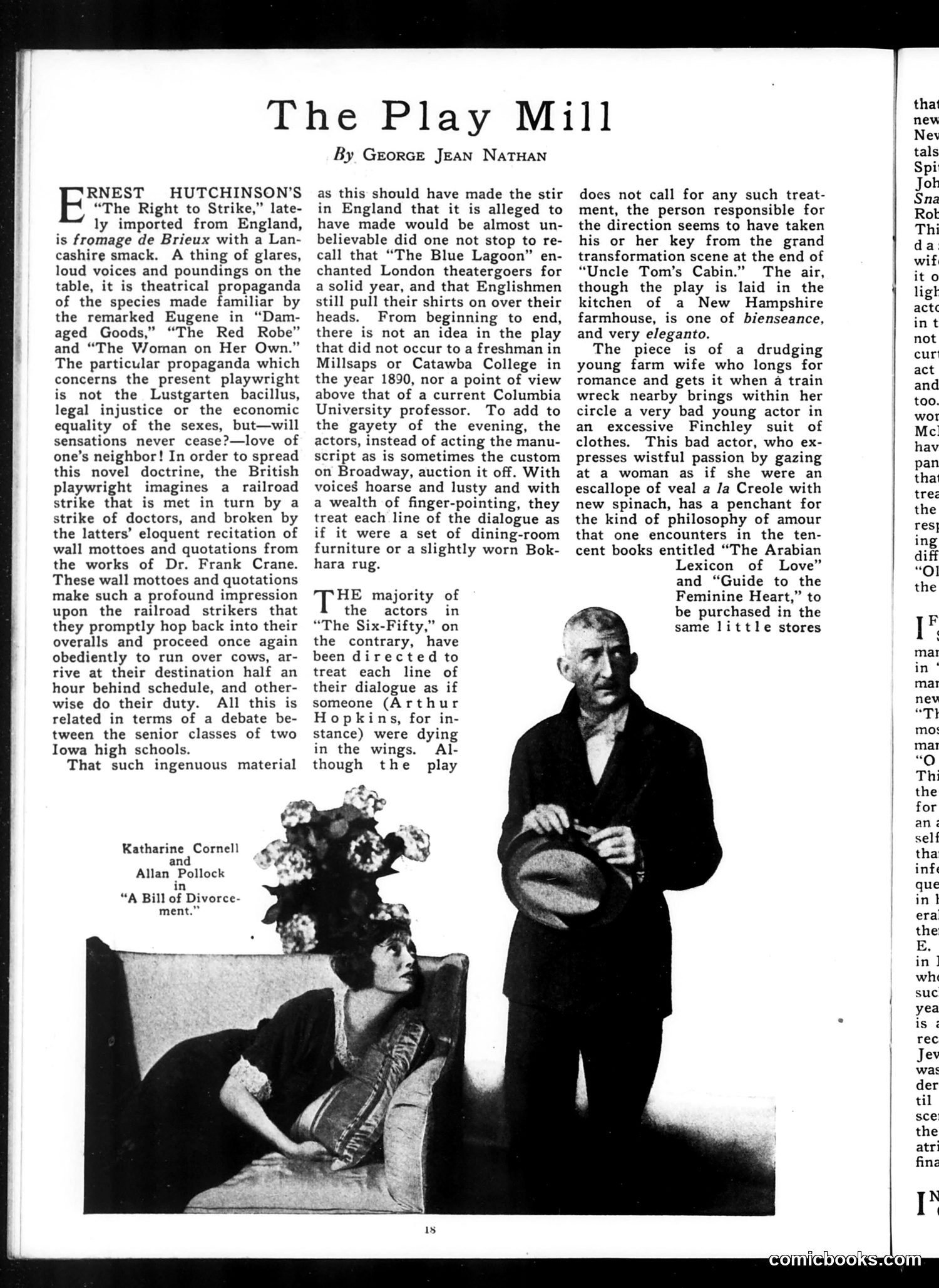
This is theater criticism by George Jean Nathan reviewing three Broadway plays. The page mocks British playwright Ernest Hutchinson's "The Right to Strike"—an import about a railroad strike resolved when doctors recite inspirational quotes. Nathan finds the plot simplistic (ideas a 1890 college freshman might have) and the acting overwrought, with actors treating dialogue like auctioned furniture. The accompanying photograph shows Katharine Cornell and Allan Pollock in "A Bill of Divorcement," appearing as an example of better dramatic work. Nathan also critiques "The Six-Fifty," directed by Arthur Hopkins, for its absurdly melodramatic tone—treating a simple farmhouse kitchen story with the gravitas of "Uncle Tom's Cabin's" transformation scene. The play concerns a bored farm wife tempted by a vain actor spouting cheap romance-novel philosophy. Nathan's satire targets overwrought theatrical conventions and imported British sentimentality.
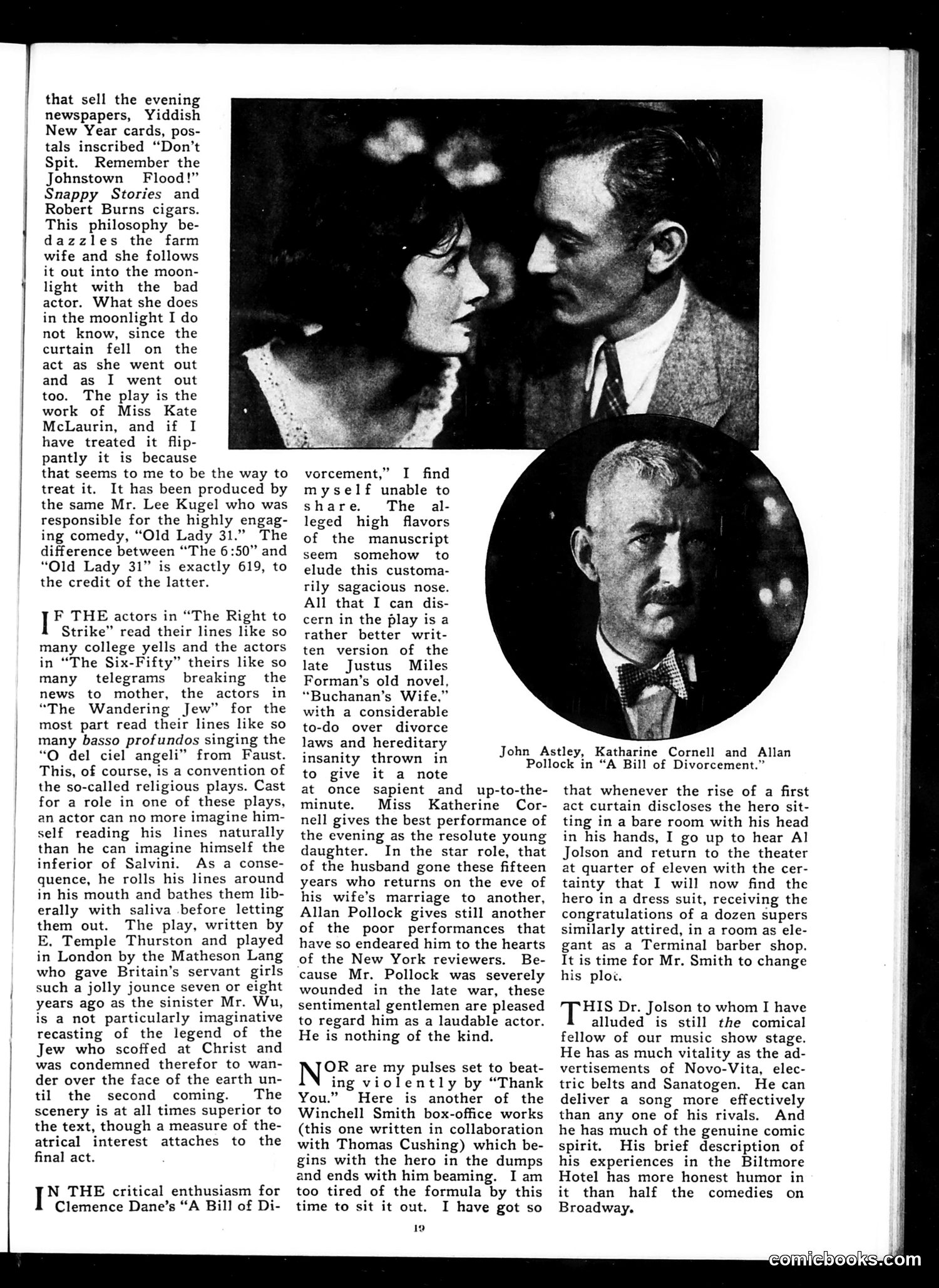
This page contains theater reviews from Judge magazine, a satirical publication. The main image shows three actors from "A Bill of Divorcement"—John Astley, Katharine Cornell, and Allan Pollock. The reviews critique contemporary Broadway productions. The critic praises Cornell's performance but harshly judges Allan Pollock, dismissing his acting ability while noting that reviewers treat him favorably due to his war wounds—a cutting satirical jab suggesting sentiment has replaced merit in critical assessment. The page also reviews other plays including "The Right to Strike," "The Wandering Jew," and "Thank You," with the critic expressing fatigue at predictable theatrical formulas and affected acting styles, particularly the overwrought delivery in religious dramas. The text references period-specific details like Yiddish New Year cards and the Johnstown Flood, grounding the reviews in early 20th-century American context.
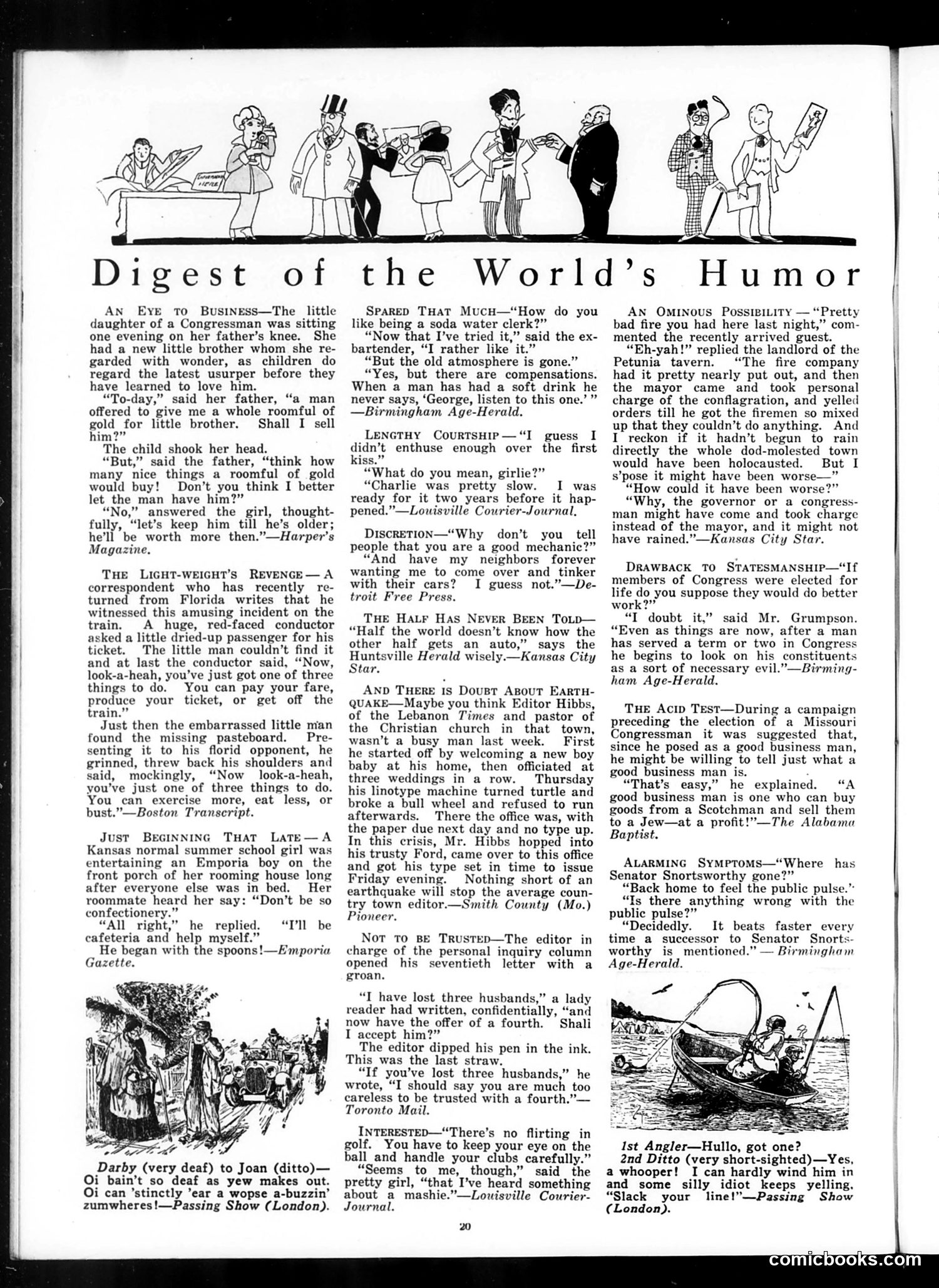
This page collects brief humorous anecdotes from various American newspapers and publications, presented as a "digest." The cartoons at top and bottom are simple line drawings illustrating specific jokes rather than political commentary. **Key content:** The top illustration shows various figures (businessman, clergy, professionals) representing the diversity of humor sources cited. **Notable jokes** include satire on: - A congressman's daughter showing capitalist thinking (wanting to age her brother before "selling" him) - A small man's witty comeback to a conductor, reversing the power dynamic through mimicry - A rural editor's heroic efforts to publish despite personal and mechanical crises—representing small-town determination The bottom illustration depicts two deaf rural characters still able to hear buzzing sounds—gentle stereotyping of country folk. **The satire is gentle**, targeting social pretension, gender relations, and rural/urban contrasts rather than specific political figures. This reflects Judge's mid-level satirical approach—amusing rather than biting social commentary.
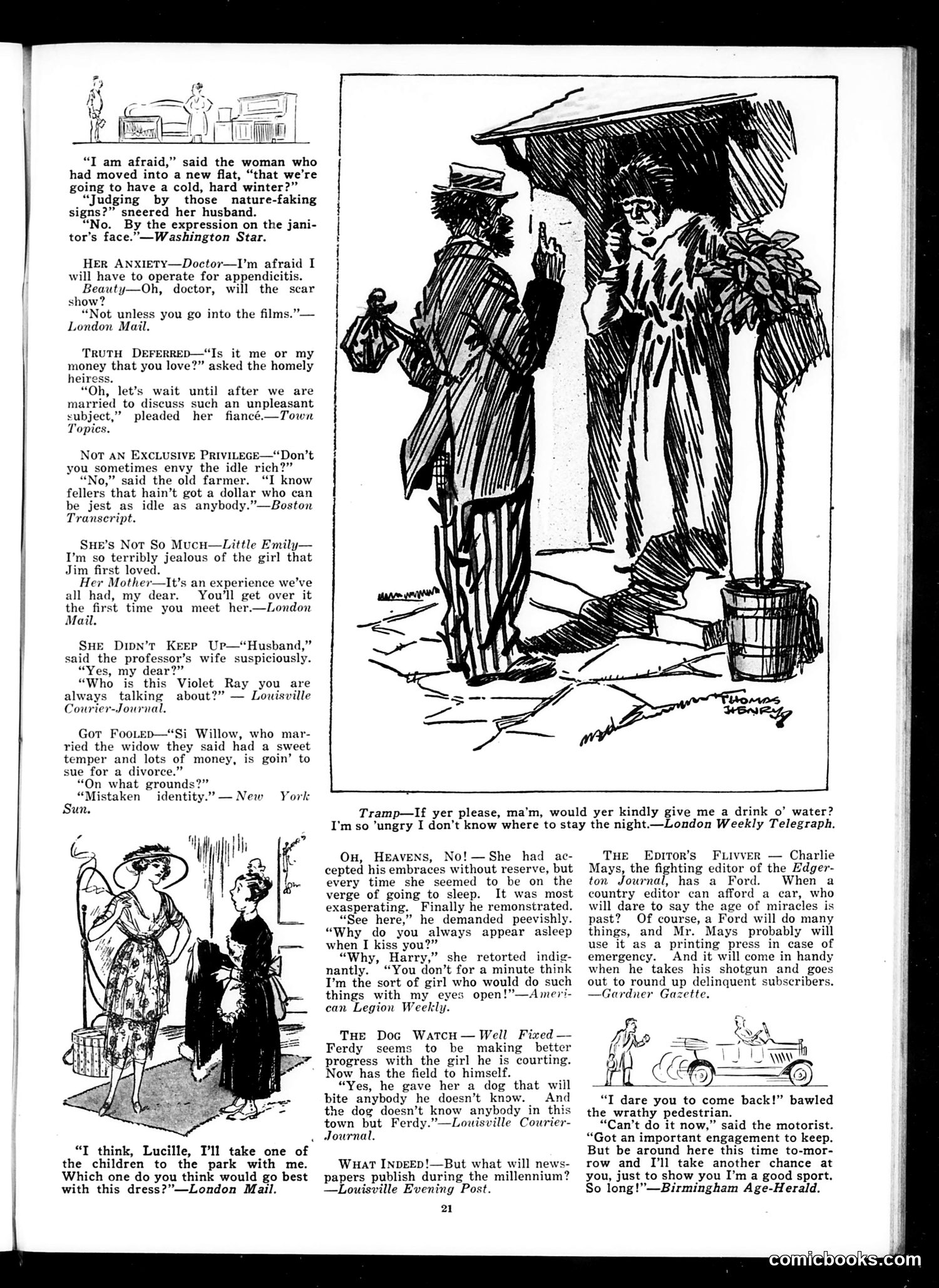
This page contains brief satirical anecdotes mocking early 20th-century social attitudes and relationships. The humor targets: **Domestic life**: A wife's anxiety about winter based on the janitor's demeanor; a professor's wife suspiciously questioning him about "Violet Ray" (likely a medical device, misheard as a woman's name). **Romance and marriage**: An ugly heiress and her fiancé delaying discussion of whether he loves her or her money; a jealous bride meeting her husband's ex; a woman feigning sleep during kisses to maintain propriety. **Class commentary**: A farmer claiming the idle poor are as lazy as the idle rich; a country editor owning a Ford (presented as miraculous). **General absurdity**: A woman choosing which child to take to the park based on outfit coordination; a tramp's complaint about hunger and homelessness; a man using a dog to monopolize a girl's attention. The cartoon illustrates a tramp requesting water while appearing destitute. The humor relies on period-specific anxieties about propriety, gender roles, class, and courtship customs now largely obsolete.
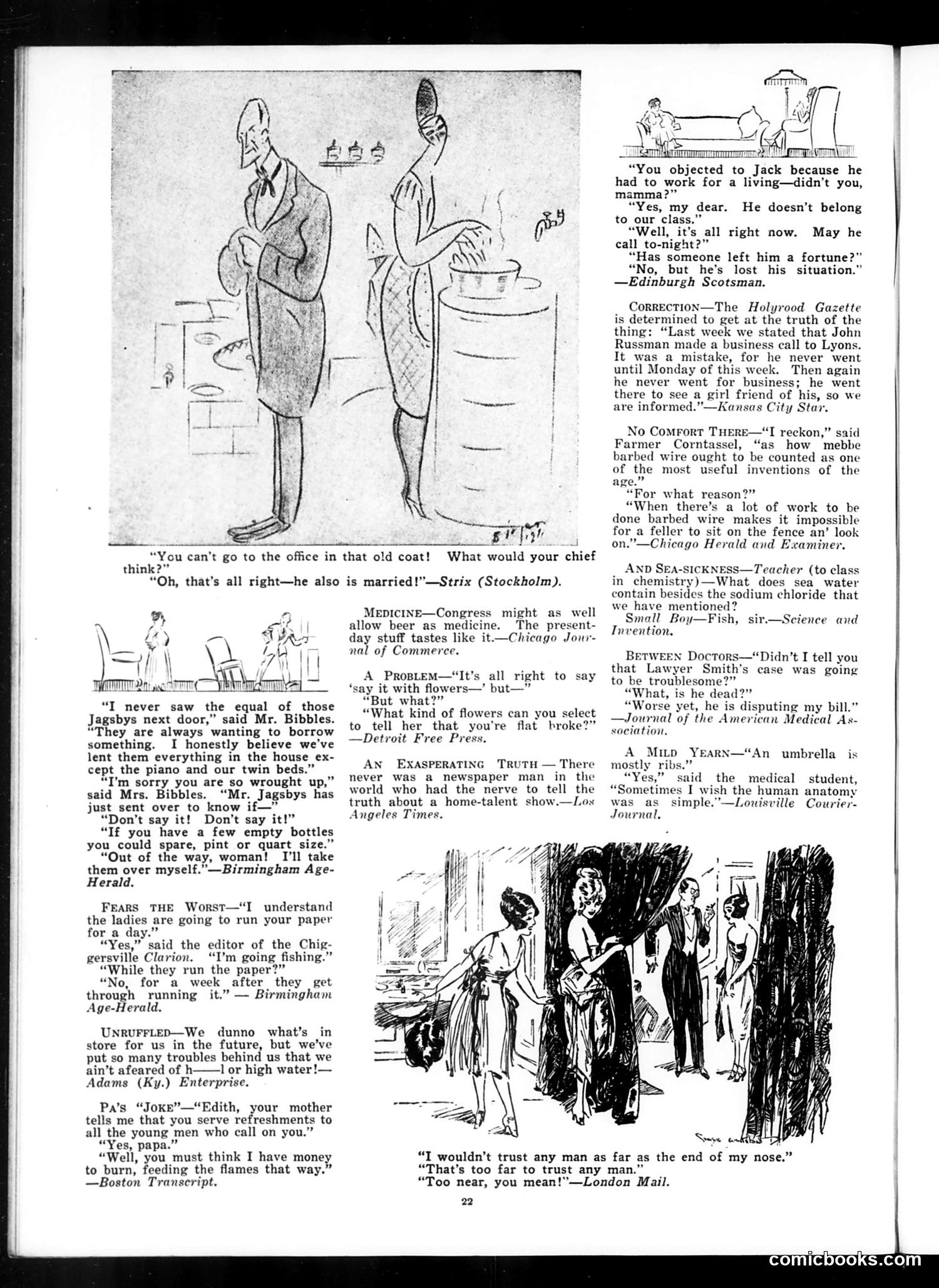
This page from *Judge* (a major American satirical weekly) collects brief comic anecdotes and jokes about marriage, work, social class, and gender relations—typical early-20th-century humor. **Key themes:** - **Marriage complaints**: Husbands grumble about wives borrowing from neighbors, wives spending money on refreshments for suitors, and the absurdity of class-based courtship objections. - **Gender role satire**: A newspaper editor flees when women will briefly run his paper; a woman's mother objects to a boyfriend who "works for a living" until he inherits money—mocking both working-class prejudice and its mercenary reversal. - **Workplace/social commentary**: Jokes about politicians, journalists' dishonesty, and economic anxiety (a "broke" suitor becomes acceptable only after losing his job). - **Newspaper humor**: One joke satirizes a local paper's laughably transparent "corrections," typical of small-town journalism's unreliability. The cartoons depict domestic and courtship scenes. The overall tone reflects period anxieties about class mobility, women's expanding roles, and marital discord—presented as safely comedic rather than threatening.
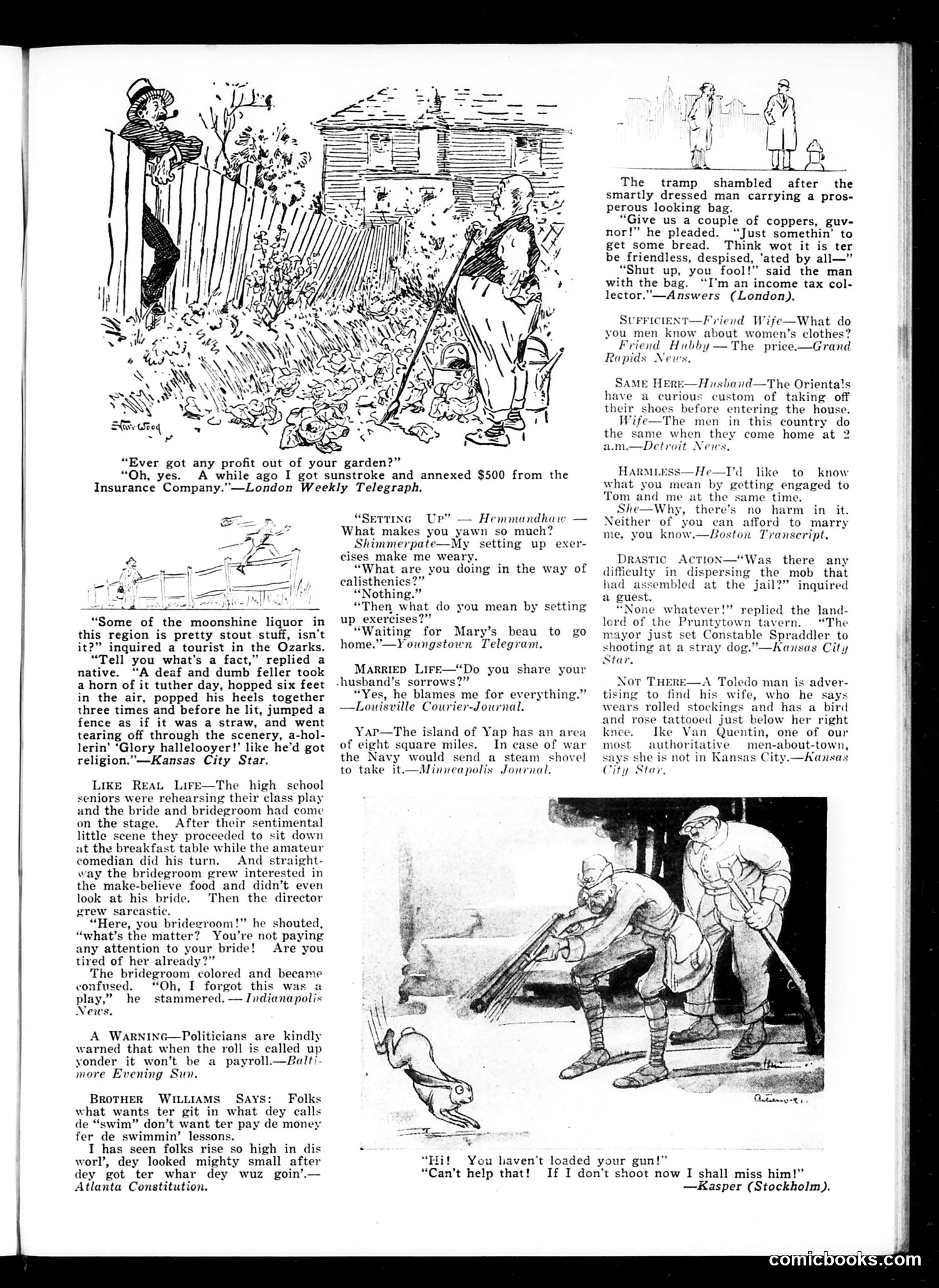
This page contains humor shorts and two cartoons typical of Judge's satirical style, circa early 20th century. **Top cartoon**: A well-dressed man with a prosperous bag confronts a beggar. The joke: the beggar's plea for charity ("friendless, despised") is cut short when the man reveals he's an *income tax collector*—positioning tax collectors as so universally despised they silence even beggars' sympathy appeals. **Bottom cartoon**: Depicts a hunter and dog. The caption's dark humor: a man will miss shooting a duck because he hasn't loaded his gun—suggesting incompetence or carelessness with firearms. **Text items** are brief jokes about: garden insurance fraud, moonshine liquor's potency, a theater rehearsal where an actor forgets he's acting, political payroll corruption, marriage dynamics, and wartime naval strategy toward tiny Yap Island. The overall tone reflects early 20th-century American attitudes toward taxes, rural life, marital tensions, and petty corruption.
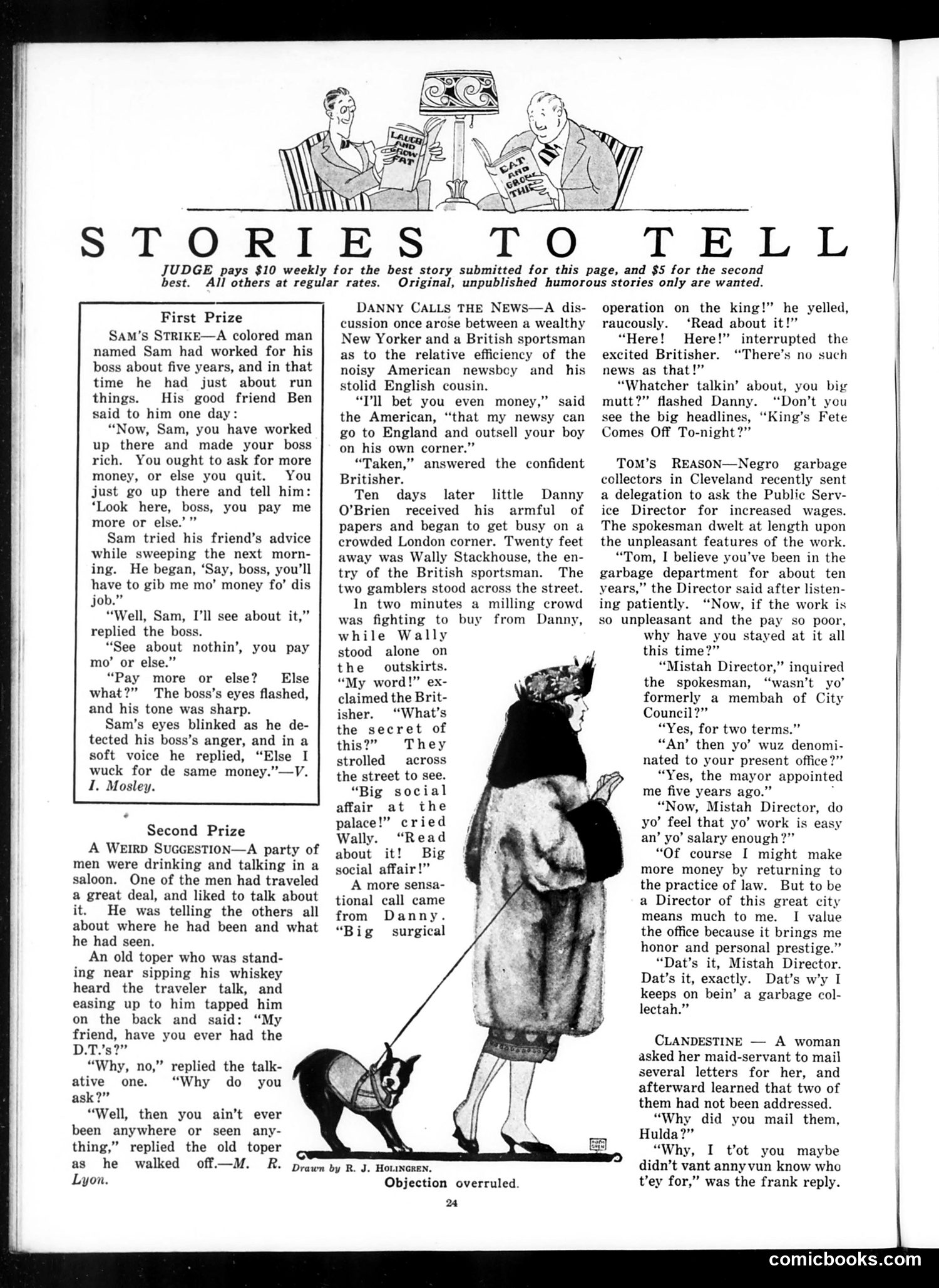
This page from Judge magazine presents three humorous short stories competing for publication prizes ($10 for first place, $5 for second). **"Sam's Strike"** uses racial stereotyping common to the era, depicting a Black worker attempting to demand a raise. The humor relies on dialect and the protagonist's loss of nerve when confronted. **"A Weird Suggestion"** features a drunk making fun of a talkative traveler, suggesting that unless someone has experienced delirium tremens (D.T.'s—alcohol withdrawal hallucinations), they haven't truly traveled anywhere. **"Danny Calls the News"** compares American and British newspaper boys. An American newsboy named Danny outsells his British competitor in London by using sensationalist headlines—fabricating a "big surgical operation on the king" from a mundane palace social event. The satire mocks American journalism's tendency toward exaggeration and yellow journalism over factual reporting. The cartoon below depicts the newsboy's success, showing him with papers and pleased expression. These stories reflect early 20th-century American attitudes toward class, labor, drinking culture, and press sensationalism.
This is a title-page advertisement, not a political cartoon. Leslie's Weekly announces it's reducing its cover price from post-war inflation back to the pre-war price of 10¢, effective December 3rd. The appeal is patriotic and economic: the publishers present this price cut as leading by example in restoring "normalcy" and prosperity after World War I. By voluntarily reducing prices themselves, they position Leslie's among businesses genuinely committed to economic recovery rather than merely talking about it. The copy emphasizes the magazine's established reputation—"oldest illustrated weekly newspaper in the United States"—and promises maintained quality despite the lower price. Content includes news, fiction, serials, and color illustrations by prominent American artists. The message targets "live Americans" willing to support businesses demonstrating faith in post-war economic restoration.
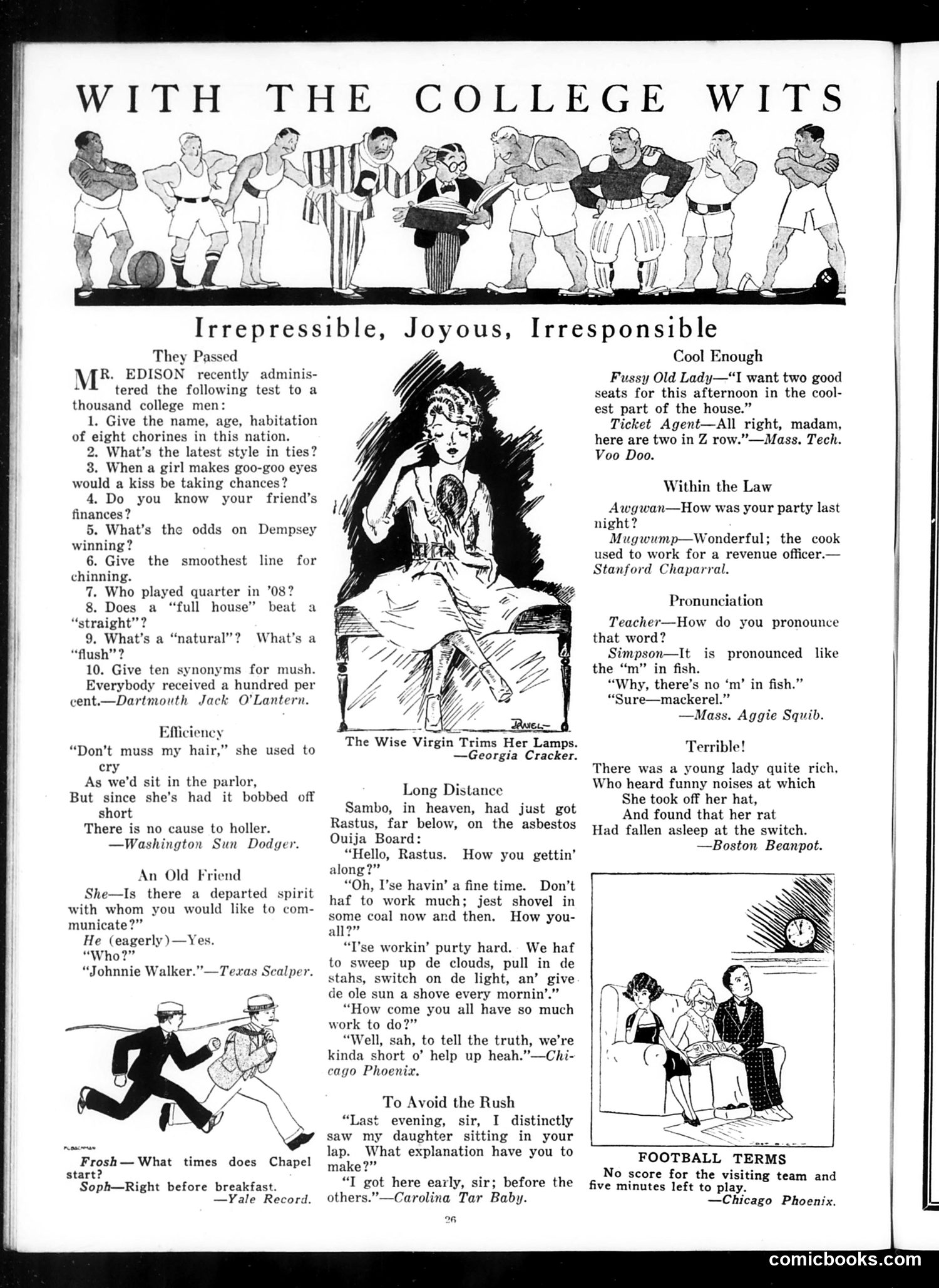
This page collects humorous college jokes and cartoons satirizing student culture of the era (appears to be 1920s based on references to bobbed hair and Prohibition-era humor). **Key satirical points:** The opening cartoon mocks college men as "Irrepressible, Joyous, Irresponsible"—the Edison "test" reveals students care only about trivial matters (chorus girls, ties, gambling odds, drinking) while completely ignoring serious knowledge. **Running themes:** - **Racial stereotypes**: Multiple "dialect" jokes featuring Black characters (Sambo/Rastus in heaven, Sambo). These reflect period prejudices normalized in mainstream publications. - **Prohibition mockery**: References to "Johnnie Walker" (whiskey) and a cook who "worked for a revenue officer" joke about illegal liquor. - **Dating/courtship**: Flirtation humor and the shock value of bobbed hair (modern women). - **Campus life**: References to specific colleges (Yale, Stanford, MIT) with their student magazines credited. The overall message: college students are frivolous, more interested in entertainment and breaking rules than education.
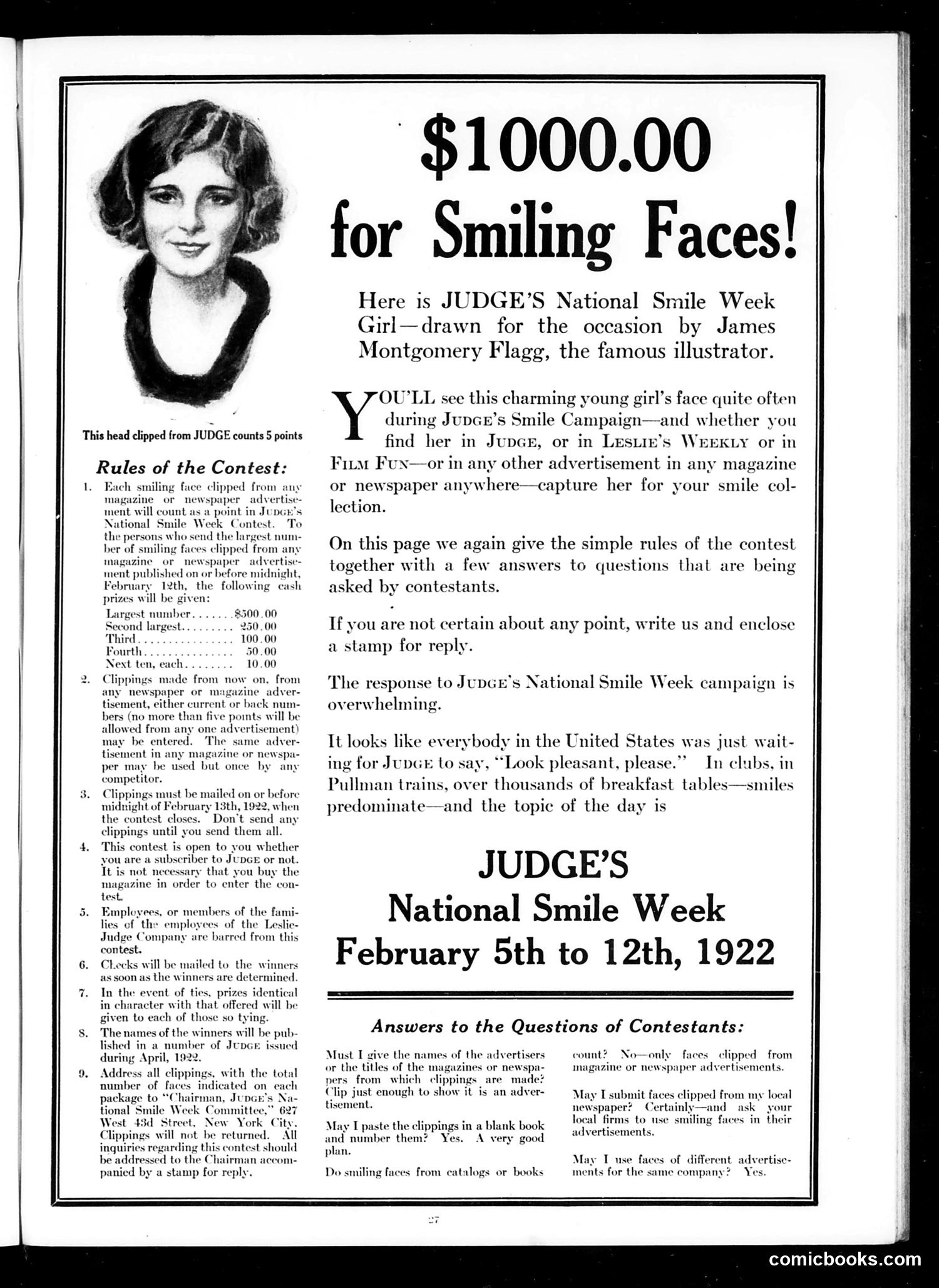
This is primarily a **contest advertisement**, not a political cartoon. Judge magazine is running a "National Smile Week" campaign (February 5-12, 1922), offering cash prizes—up to $500—for readers who clip the most smiling faces from advertisements in magazines and newspapers. The contest's mascot is a generic "Smile Week Girl" illustrated by James Montgomery Flagg, a famous commercial illustrator. Participants collect clipped smiling faces from any advertisements and mail them in by February 13th. The underlying appeal reflects 1920s **consumer culture and corporate feel-good messaging**: Judge is encouraging readers to hunt through advertisements while promoting the idea that smiling and optimism are culturally desirable. The "overwhelming" response suggests Americans embraced this lighthearted activity. There's no political satire here—it's straightforward advertising promotion dressed as a game.
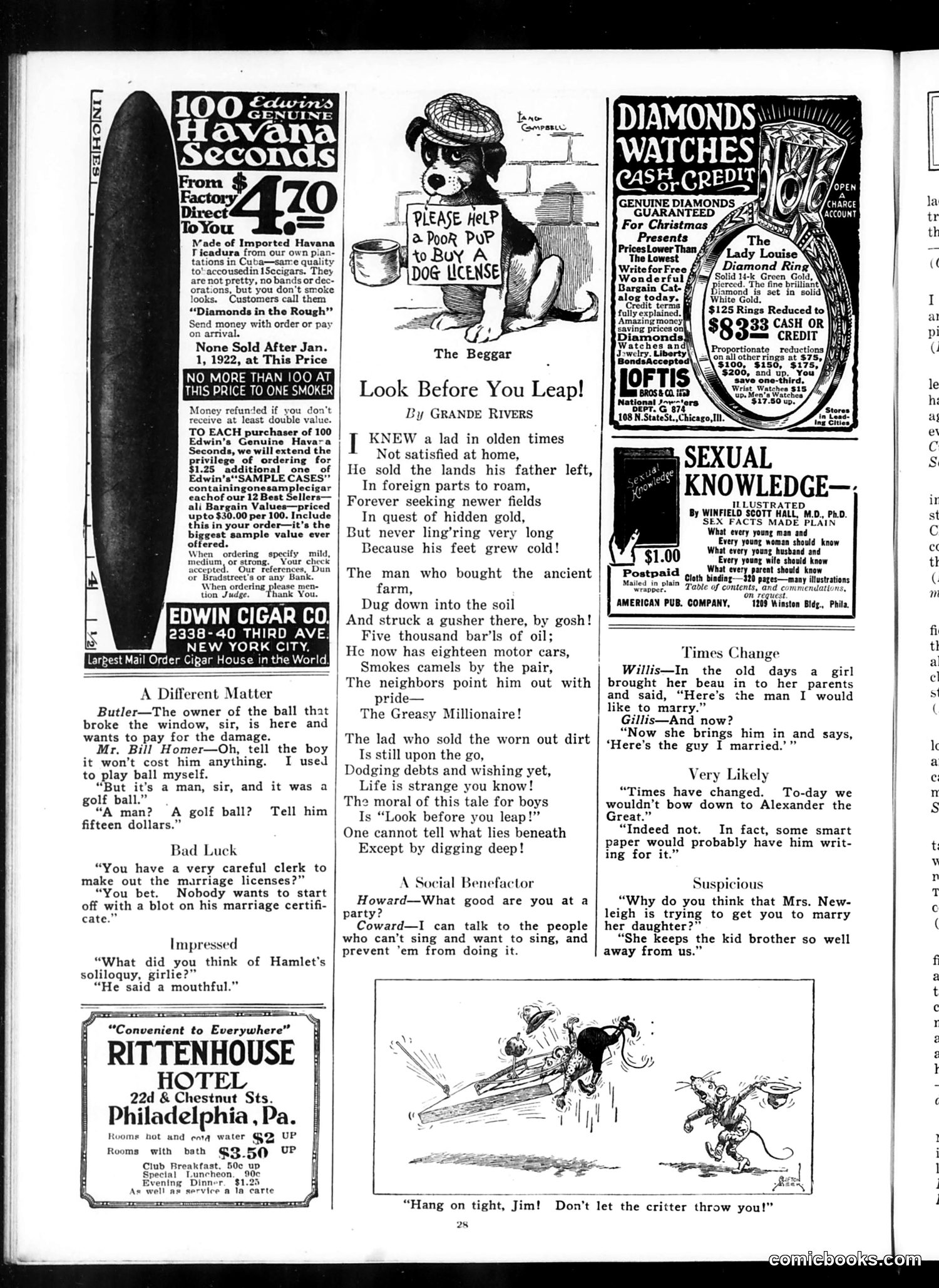
This page mixes advertisements with humorous short pieces typical of Judge magazine's satirical format. **The main cartoon** ("Hang on tight, Jim!") depicts a man being thrown by a bucking horse or mule—a simple slapstick joke about riding mishaps, with no apparent political content. **The prose pieces** are light social humor: "A Different Matter" contrasts class attitudes toward property damage; "Bad Luck" jokes about marriage license clerks; "Times Change" satirizes how courtship customs have shifted (women now openly admit to choosing their husbands rather than presenting them as romantic discoveries); "Suspicious" humorously suggests a mother-in-law's ulterior motives. **"Look Before You Leap!"** is a moral fable contrasting a restless young man who sells his inherited farm for adventure with the shrewd buyer who strikes oil—cautioning against abandoning stable assets for wanderlust. The page is primarily **advertisement-heavy**, featuring Edwin cigars, diamond watches, a hotel, and a sex education book. There is no significant political satire visible here—mainly period humor and commercial promotion.
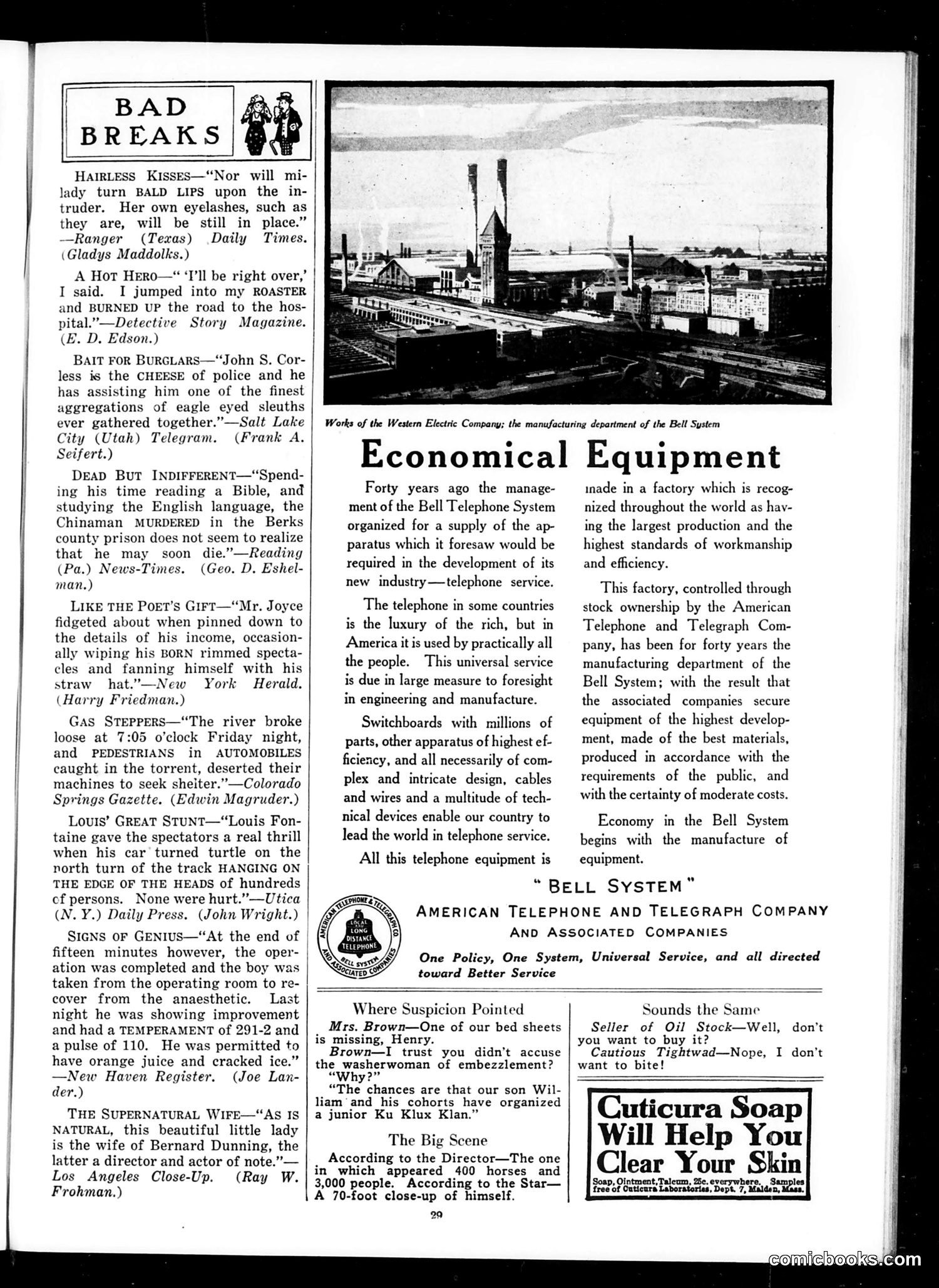
This page contains two distinct sections: **"Bad Breaks" Column (Left Side):** A humor section highlighting unintentionally absurd or ironic statements from newspapers. Examples include wordplay on potentially offensive phrases (e.g., "bald lips," "burned up the road") and logically nonsensical reporting (describing a murdered prisoner as "indifferent" because he doesn't realize he'll die soon). The comedy targets careless newspaper writing and the accidental humor that results from poor word choice or illogical statements. **"Economical Equipment" (Right Side):** An advertisement for Bell System/American Telephone and Telegraph Company, celebrating forty years of manufacturing telephone equipment. It emphasizes American technological superiority, the accessibility of telephones to ordinary Americans (unlike in other countries where they're luxury items), and the manufacturing efficiency of Western Electric factories. This promotional content illustrates early-20th-century corporate messaging about industrial progress and American industrial dominance.
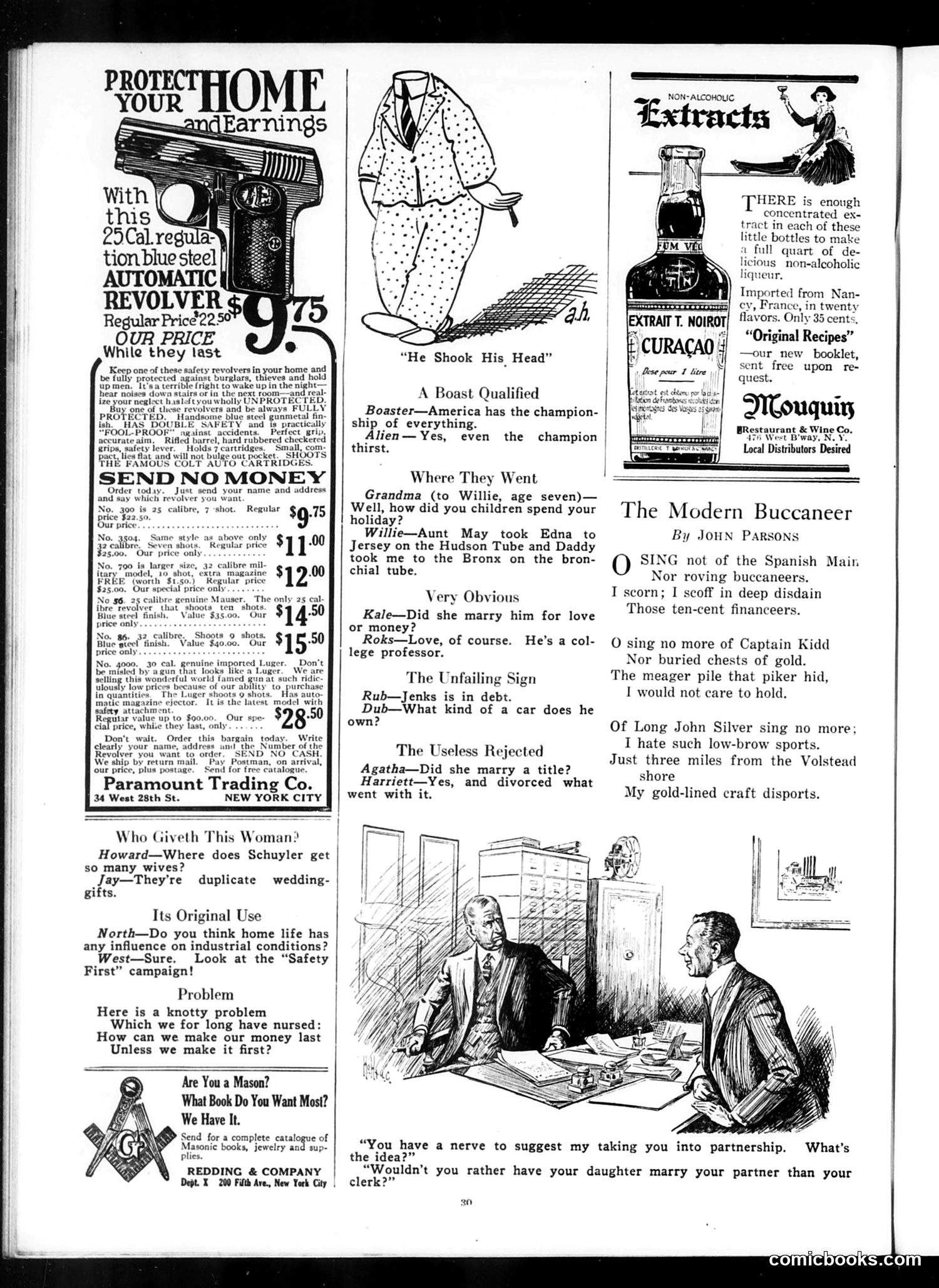
This page from the satirical magazine *Judge* contains multiple unrelated humor pieces and advertisements typical of early 20th-century American magazines. **Main Cartoon:** The bottom illustration depicts a business negotiation where a man proposes a partnership to another, but then awkwardly suggests the proposer's daughter marry him instead of becoming a clerk. The satire targets social climbing and mercenary marriage—suggesting that gaining family connections through marriage is preferable to honest business partnership. **Humor Pieces:** The scattered jokes mock predictable social behaviors: a woman collecting "duplicate" wedding gifts, industrial working conditions affecting home life, and Americans' supposed excessive drinking habits ("championship of everything...thirst"). **Poetry ("The Modern Buccaneer"):** This mocks Prohibition-era smugglers, contrasting romanticized pirates with contemporary criminals operating near the "Volstead shore" (reference to Prohibition legislation) with "gold-lined craft." **Advertisements:** The page is dominated by ads for firearms, mail-order revolvers, and non-alcoholic extracts—the latter humorously sold as ingredients "to make...full quart of...liqueur," clearly circumventing Prohibition's spirit.
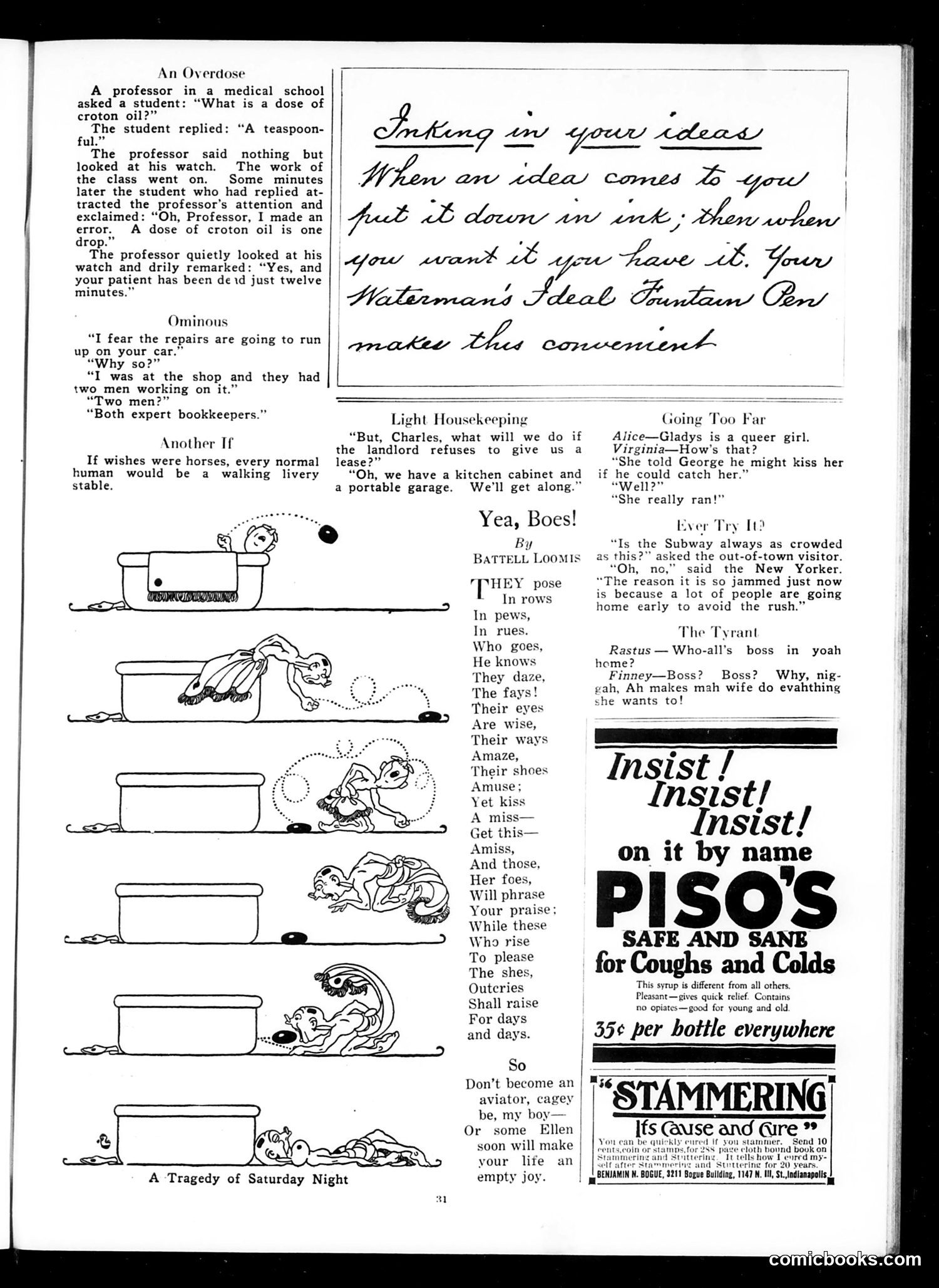
This page contains multiple short humorous pieces typical of early-20th-century satirical magazines: **"An Overdose"** mocks medical student incompetence—a student gives wildly wrong dosages of croton oil (a powerful laxative), killing an imaginary patient within twelve minutes. The humor relies on the professor's dry observation of this fatal error. **"A Tragedy of Saturday Night"** uses sequential cartoon panels showing a man progressively drowning in a bathtub, apparently depicting weekend drinking culture and its consequences. **Other pieces** include gentle domestic humor ("Light Housekeeping," "Going Too Far") and social commentary. "The Tyrant" uses period-inappropriate racial dialect to joke about marital dynamics. "Ever Try It?" satirizes crowded subway conditions and commuter behavior. The page is heavily advertising-laden, promoting Piso's cough syrup and stammering treatments—products common to this era. Overall, the content reflects early-1900s American humor: medical mishaps, domestic situations, and urban modern life, with racial caricature considered acceptable comedy.
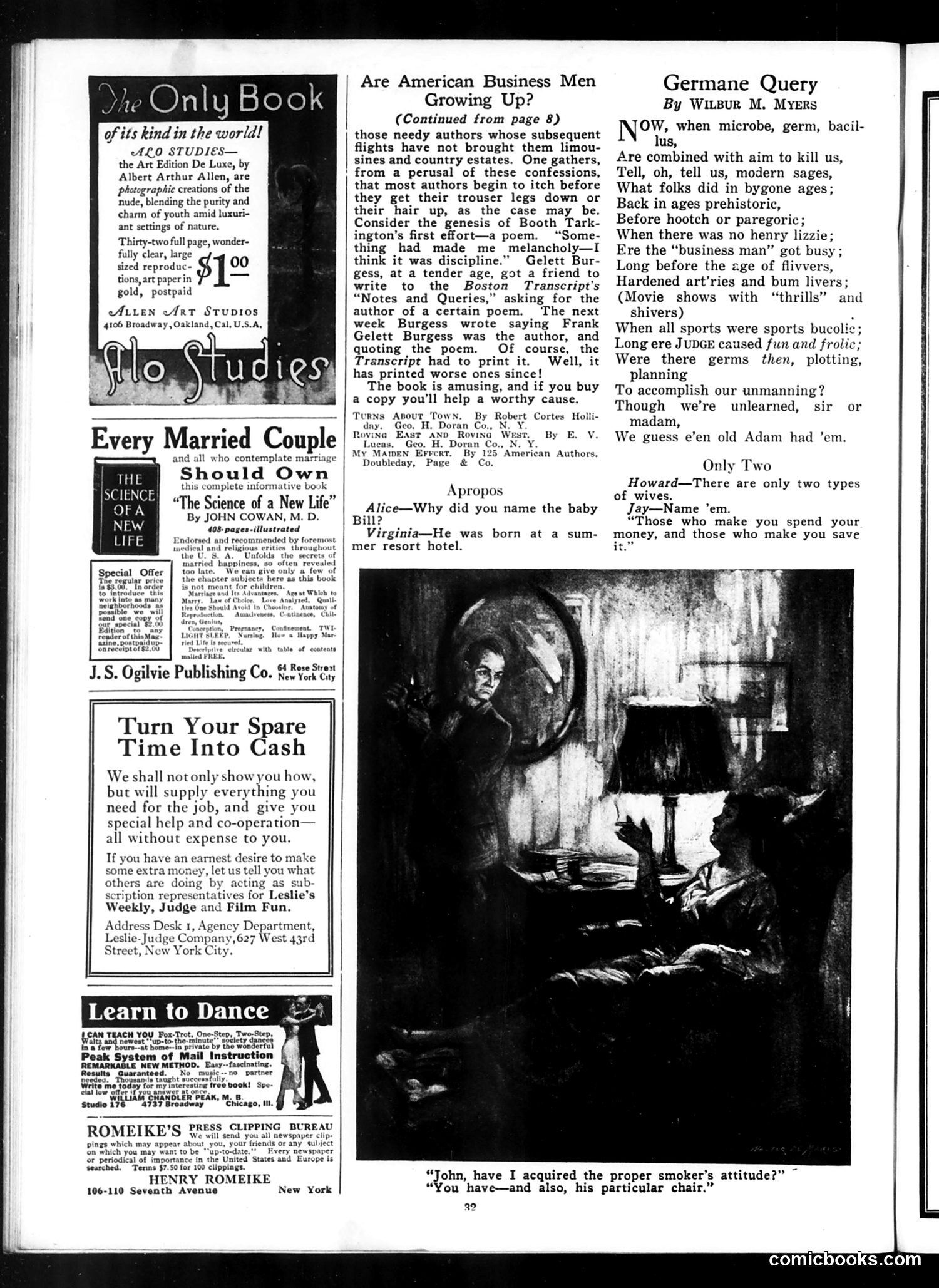
This page is primarily **advertising and filler content** rather than political satire. The main elements are: **Advertisements** dominate: art books, marriage advice manuals, dance instruction, and subscription opportunities for the magazine itself and competitors (Leslie's Weekly, Film Fun). **"Germane Query"** by Wilbur M. Myers is light verse asking a humorous question: given that modern germs and microbes threaten us, what did prehistoric humans and even Adam do without modern medicine, hygiene products, or entertainment distractions? The answer implied is they had germs too—suggesting human vulnerability to disease is timeless, not modern. **"Only Two"** is a brief marriage joke: Howard claims there are only two types of wives; Jay asks him to name them. The punchline—those who make you spend money versus those who make you save—reflects early 20th-century gender economics and marital stereotypes. **The photograph** shows a man in formal attire acquiring a smoker's "attitude" and chair—likely illustrating masculine domesticity or lifestyle aspirations advertised elsewhere on the page. The content reflects Judge's mix of humor, self-promotion, and commercial advertising typical of period magazines.
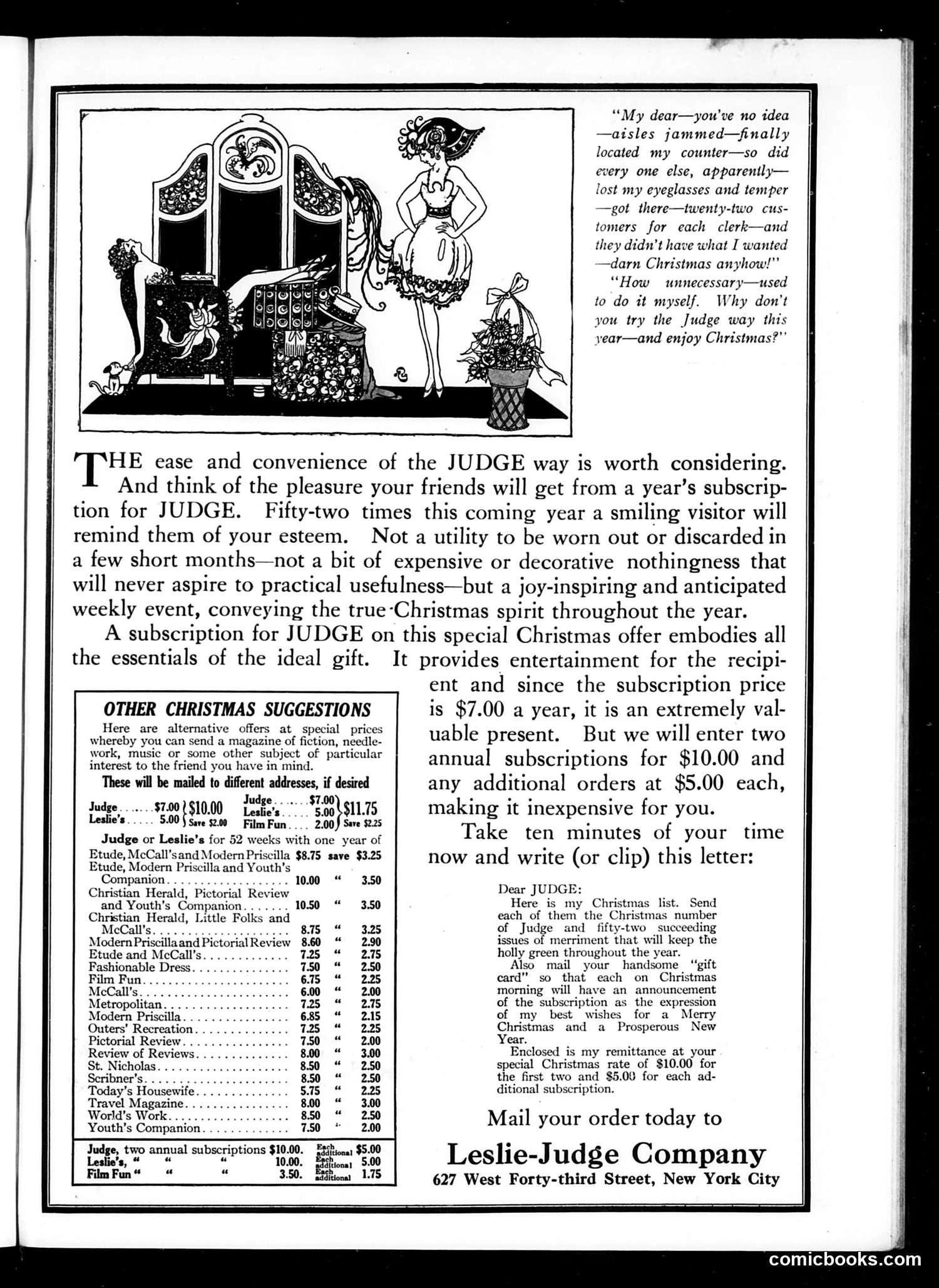
This page is primarily **advertising for magazine subscriptions**, not political satire. The cartoon illustrates a frustrated Christmas shopper's complaint about crowded department stores—a relatable holiday problem. The "Judge way" solution promotes giving a year-long magazine subscription as a practical gift alternative to consumer goods. The dialogue captures early 20th-century shopping frustrations: "aisles jammed," lost eyeglasses, insufficient clerks, and unavailable merchandise. The advertisement argues that a magazine subscription avoids the waste of temporary gifts while providing year-round enjoyment—52 "smiling visitor" deliveries reminding recipients of the giver's esteem. The page offers competing magazine options (Judge, Leslie's, McCall's, Etude, etc.) at special Christmas pricing, suggesting subscriptions were fashionable gift-giving solutions for the era. Rather than satire, this represents period consumer culture and advertising strategy targeting holiday gift-givers seeking "practical usefulness."
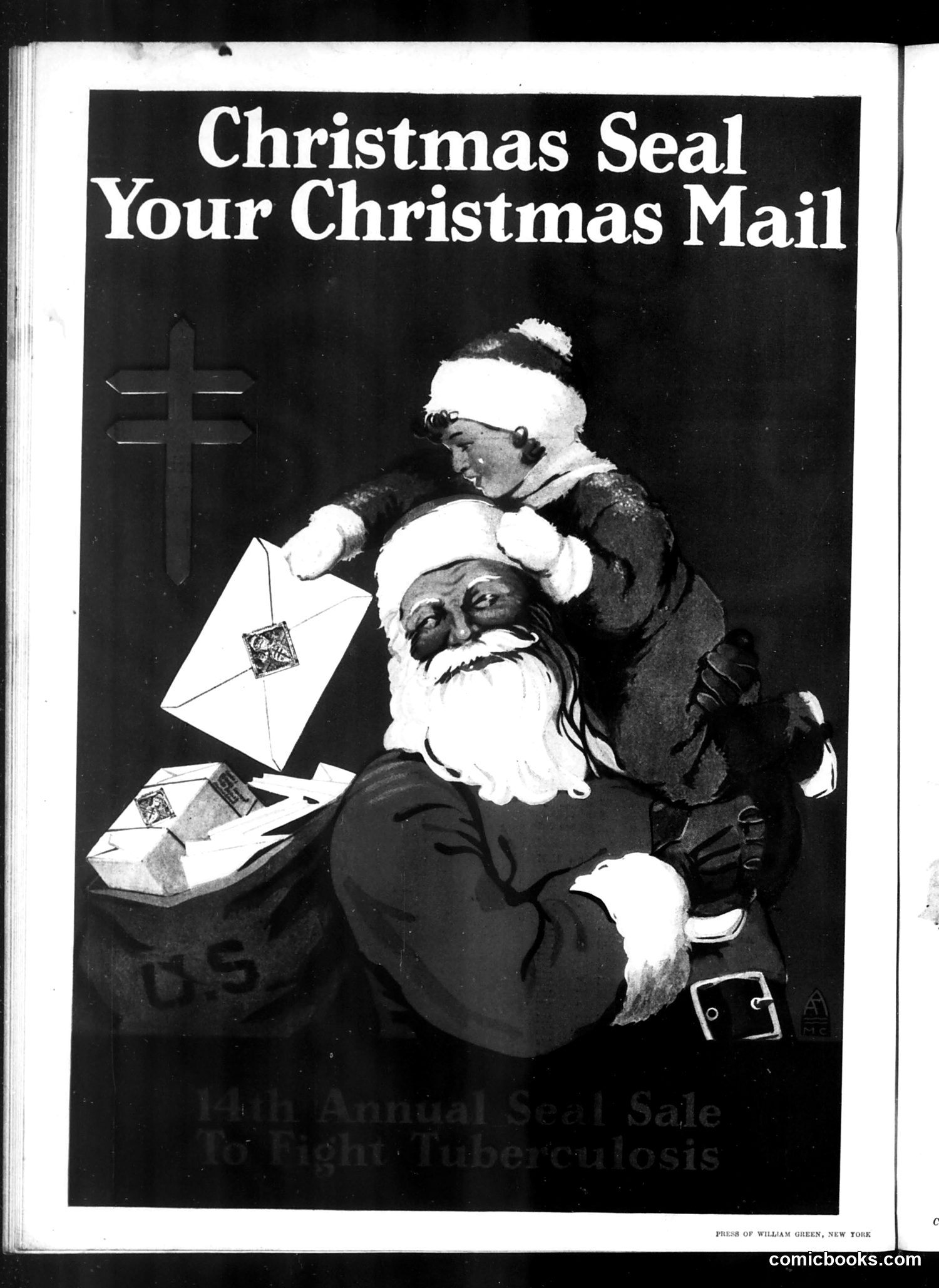
This is a public service advertisement promoting Christmas Seals for fighting tuberculosis. The image depicts Santa Claus (identifiable by his characteristic beard, hat, and red suit) holding envelopes sealed with Christmas Seals while a child places a seal on the mail. The advertisement's message is straightforward: citizens should purchase and use Christmas Seals on their holiday correspondence. The seals served a dual purpose—decorative stamps that made mail festive while generating funds for tuberculosis prevention and treatment, a major public health concern of that era. The cross visible in the background emphasizes the charitable/health mission. This represents the type of charitable fundraising campaign that was common in early-to-mid 20th century America, where seasonal campaigns leveraged holidays for public health causes.