
Judge, 1921-12-03 · page 12 of 36
Judge — December 3, 1921 — page 12: what you’re looking at
What you’re looking at
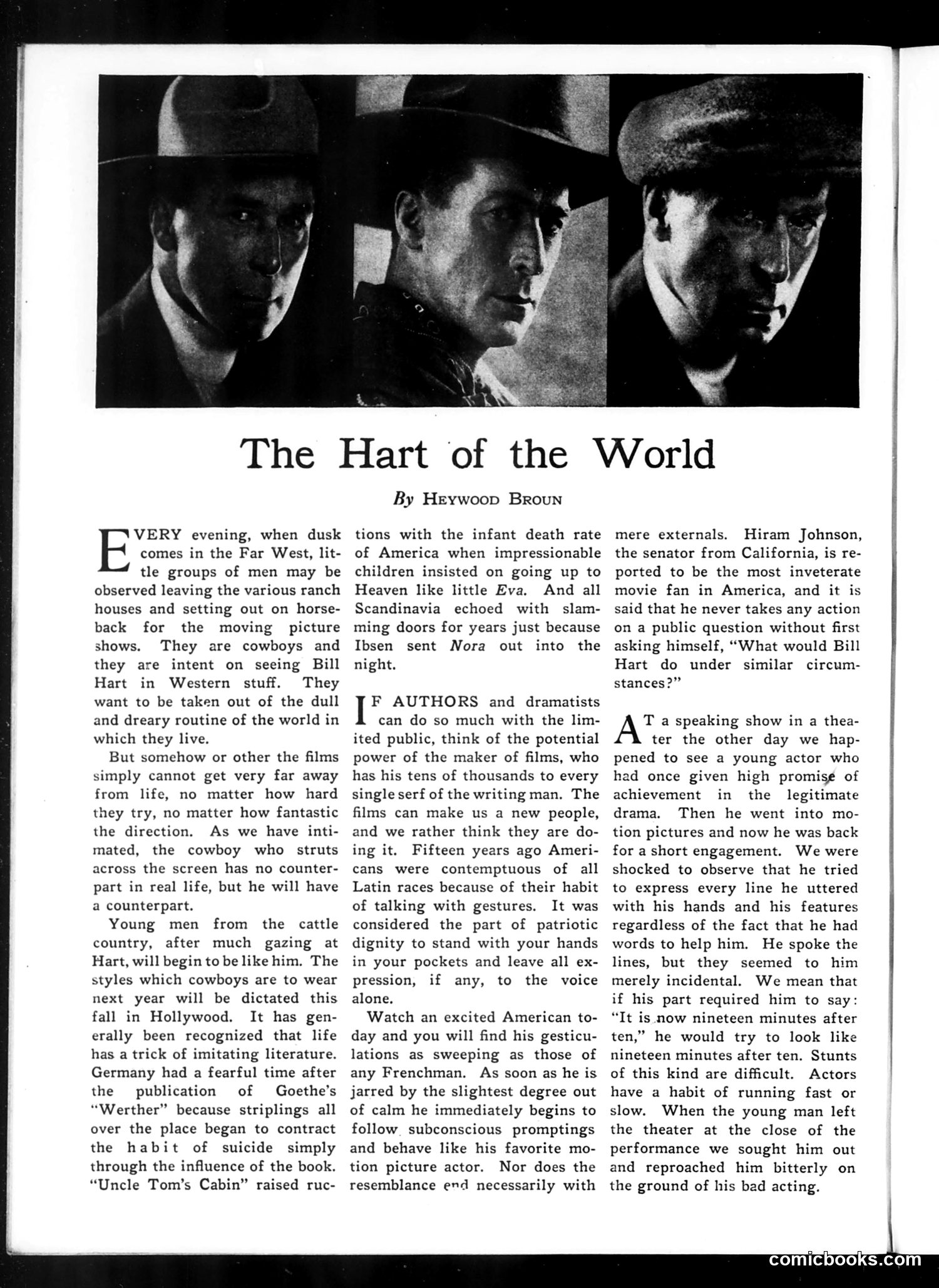
This article discusses actor William S. Hart (visible in the three portrait photographs), a major Western film star of the era. Broun argues that motion pictures—particularly Hart's films—possess unprecedented power to shape public behavior and values. The piece uses historical examples to support this claim: Goethe's *Werther* inspired suicides, *Uncle Tom's Cabin* affected infant mortality rates, and Ibsen's *Nora* influenced Scandinavian culture. Broun contends cinema's influence vastly exceeds literature's because it reaches millions. His evidence: Americans adopted Latin gestural expressiveness from watching film actors, and Senator Hiram Johnson allegedly makes political decisions by asking "What would Bill Hart do?" Broun concludes with anecdotal proof—a legitimate stage actor who failed at theater by unconsciously mimicking silent film acting techniques, using exaggerated physical gestures instead of relying on spoken dialogue. The satire critiques both cinema's manipulative power and society's susceptibility to entertainment-driven conformity.
📄 Transcribed text from this page (OCR, searchable)
Machine-transcribed from the original scan — historical spelling and the odd misread are preserved.
VERY evening, when dusk E comes in the Far West, lit- tle groups of men may be observed leaving the various ranch houses and setting out on horse- back for the moving picture shows. They are cowboys and they are intent on seeing Bill Hart in Western stuff. They want to be taken out of the dull and dreary routine of the world in which they live. But somehow or other the films simply cannot get very far away from life, no matter how hard they try, no matter how fantastic the direction. As we have inti- mated, the cowboy who struts across the screen has no counter- part in real life, but he will have a counterpart. Young men from the cattle country, after much gazing at Mart, will begin to be like him. The styles which cowboys are to wear next year will be dictated this fall in Hollywood. It has gen- erally been recognized that life has a trick of imitating literature. Germany had a fearful time after the publication of Goethe’s “Werther” because striplings all over the place began to contract the habit of suicide simply through the influence of the book. “Uncle Tom’s Cabin” raised ruc- The Hart of the World By Heywoop Broun tions with the infant death rate of America when impressionable children insisted on going up to Heaven like little Eva. And all Scandinavia echoed with slam- ming doors for years just because Ibsen sent Nora out into the night, F AUTHORS and dramatists can do so much with the lim- ited public, think of the potential power of the maker of films, who has his tens of thousands to every single serf of the writing man. The films can make us a new people, and we rather think they are do- ing it. Fifteen years ago Ameri- cans were contemptuous of all Latin races because of their habit of talking with gestures. It was considered the part of patriotic dignity to stand with your hands in your pockets and leave all ex- pression, if any, to the voice alone. Watch an excited American to- day and you will find his gesticu- lations as sweeping as those of any Frenchman. As soon as he is jarred by the slightest degree out of calm he immediately begins to follow. subconscious promptings and behave like his favorite mo- tion picture actor. Nor does the resemblance end necessarily with mere externals. Hiram Johnson, the senator from California, is re- ported to be the most inveterate movie fan in America, and it is said that he never takes any action on a public question without first asking himself, “What would Bill Hart do under similar circum- stances?” T a speaking show in a thea- ter the other day we hap- pened to see a young actor who had once given high promise of achievement in the legitimate drama. Then he went into mo- tion pictures and now he was back for a short engagement. We were shocked to observe that he tried to express every line he uttered with his hands and his features regardless of the fact that he had words to help him. He spoke the lines, but they seemed to him merely incidental. We mean that if his part required him to say: “It is now nineteen minutes after ten,” he would try to look like nineteen minutes after ten. Stunts of this kind are difficult. Actors have a habit of running fast or slow. When the young man left the theater at the close of the performance we sought him out and reproached him bitterly on the ground of his bad acting. | |