
Judge, 1921-12-03 · page 14 of 36
Judge — December 3, 1921 — page 14: what you’re looking at
What you’re looking at
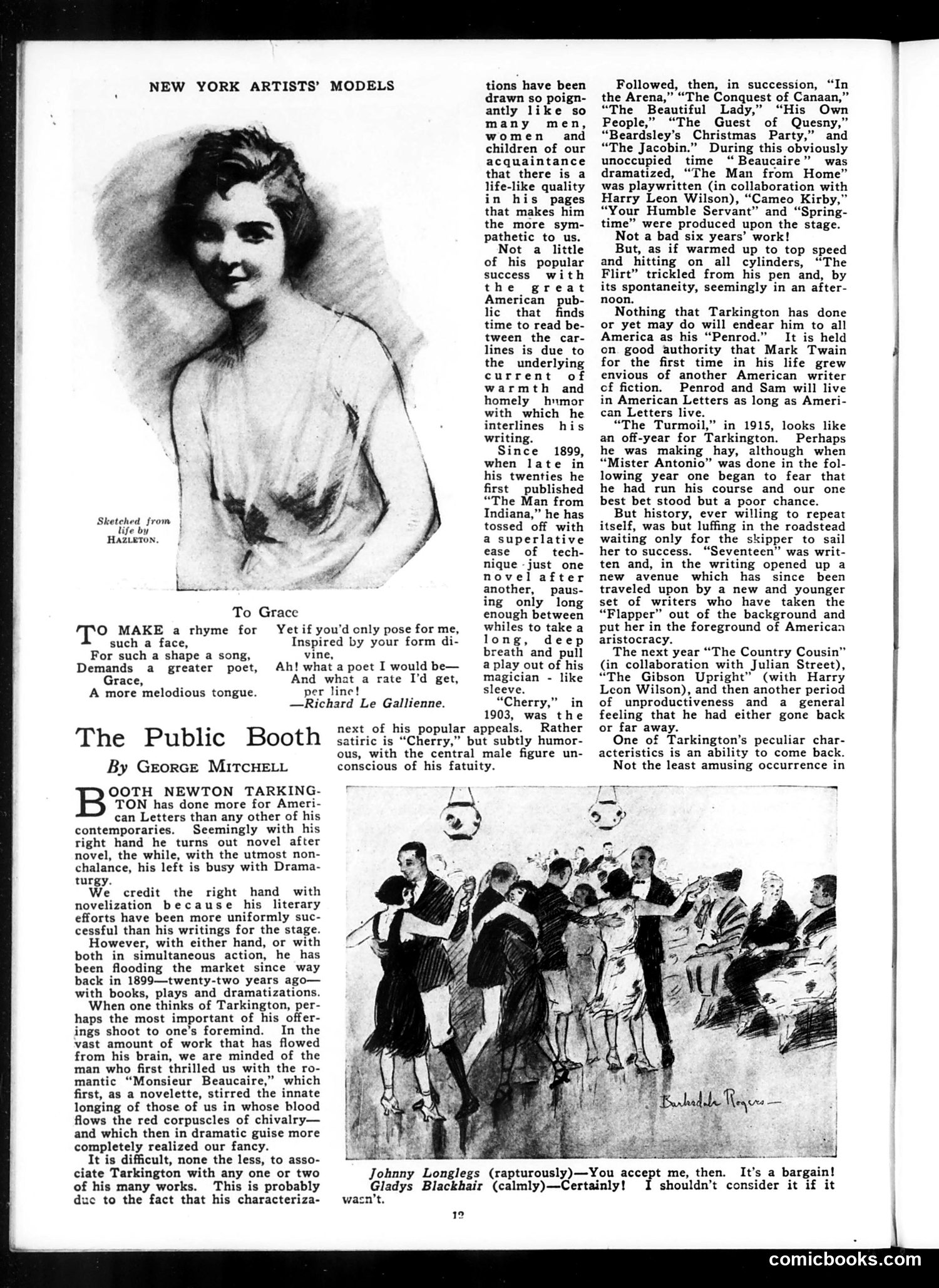
This article by George Mitchell celebrates American author Booth Tarkington's prolific literary output. The piece praises Tarkington for producing more American literature than his contemporaries since 1899—novels, plays, and dramatizations flowing with equal ease from both hands, so to speak. Mitchell argues Tarkington's greatest strength is his lifelike characterizations of recognizable Americans, which gives his work warmth and homely humor appealing to the general public. The article catalogs his major works ("Monsieur Beaucaire," "The Man from Home," "Penrod," "The Turmoil") while noting that "Penrod" achieved such excellence that even Mark Twain grew envious. The accompanying sketch portrait (by Hazelton) shows Tarkington himself. The cartoon below appears unrelated—a social scene with dialogue about a romantic proposal, illustrating typical Judge satirical humor about courtship and materialism.
📄 Transcribed text from this page (OCR, searchable)
Machine-transcribed from the original scan — historical spelling and the odd misread are preserved.
NEW YORK ARTISTS’ Sketched from } life by f HAZLeToN. To Grace O MAKE a rhyme for such a face, For such a shape a song, Demands a greater poet, Grace, A more melodious tongue. The Public Booth By Grorce MitcHELL OOTH NEWTON TARKING- TON has done more for Ameri- can Letters than any other of his contemporaries. Seemingly with his right hand he turns out novel after novel, the while, with the utmost non- chalance, his left is busy with Drama- turgy. We credit the right hand with novelization because his literary efforts have been more uniformly suc- cessful than his writings for the stage. However, with either hand, or with both in simultaneous action, he has been flooding the market since way back in 1899—twenty-two years ago— with books, plays and dramatizations. When one thinks of Tarkington, per- haps the most important of his offer- ings shoot to one’s foremind. In the vast amount of work that has flowed from his brain, we are minded of the man who first thrilled us with the ro- mantic “Monsieur Beaucaire,” which first, as a novelette, stirred the innate longing of those of us in whose blood flows the red corpuscles of chivalry— and which then in dramatic guise more completely realized our fancy. It is difficult, none the less, to asso- ciate Tarkington with any one or two of his many works. This is probably duc to the fact that his characteriza- MODELS Yet if you'd only pose for me, Inspired by your form di- vine, Ah! what a poet I would be— And what a rate I'd get, per line! —Richard Le Gallienne. tions have been drawn so poign- antly like so many men, women and children of our acquaintance that there is a life-like quality in his pages that makes him the more sym- pathetic to us. Not a little of his popular success with the great American pub- lic that finds time to read be- tween the car- lines is due to the underlying current of warmth and homely humor \ with which he \ . interlines his writing. Since 1899, when late in his twenties he first published “The Man from Indiana,” he has tossed off with a superlative ease of tech- v nique -just one novel after another, paus- ing only long enough between whiles to take a long, deep breath and pull a play out of his magician - like sleeve. “Cherry,” in 1903, was the next of his popular appeals. Rather satiric is “Cherry,” but subtly humor- ous, with the central male figure un- conscious of his fatuity. FS ry igh UE wasn’t. 19 Followed, then, in succession, “In the Arena,” “The Conquest of Canaan,” “The Beautiful Lady,” “His Own People,” “The Guest of Quesny,” “Beardsley’s Christmas Party,” and “The Jacobin.” During this obviously unoccupied time “Beaucaire” was dramatized, “The Man from Home” was playwritten (in collaboration with Harry Leon Wilson), “Cameo Kirby,” “Your Humble Servant” and “Spring- time” were produced upon the stage. Not a bad six years’ work! But, as if warmed up to top speed and hitting on all cylinders, “The Flirt” trickled from his pen and, by its spontaneity, seemingly in an after- noon. Nothing that Tarkington has done or yet may do will endear him to all America as his “Penrod.” It is held on good authority that Mark Twain for the first time in his life grew envious of another American writer ef fiction. Penrod and Sam will live in American Letters as long as Ameri- can Letters live. “The Turmoil,” in 1915, looks like an off-year for Tarkington. Perhaps he was making hay, although when “Mister Antonio” was done in the fol- lowing year one began to fear that he had run his course and our one best bet stood but a poor chance. But history, ever willing to repeat itself, was but luffing in the roadstead waiting only for the skipper to sail her to success. “Seventeen” was writ- ten and, in the writing opened up a new avenue which has since been traveled upon by a new and younger set of writers who have taken the “Flapper” out of the background and put her in the foreground of American aristocracy. The next year “The Country Cousin” (in collaboration with Julian Street), “The Gibson Upright” (with Harry Leon Wilson), and then another period of unproductiveness and a_ general feeling that he had either gone back or far away. One of Tarkington’s peculiar char- acteristics is an ability to come back. Not the least amusing occurrence in pr a Johnny Longlegs (rapturously)—You accept me, then. It’s a bargain! Gladys Blackhair (calmly)—Certainly! shouldn’t consider it if it j j comicbooks.com