
Judge, 1921-12-03 · page 17 of 36
Judge — December 3, 1921 — page 17: what you’re looking at
What you’re looking at
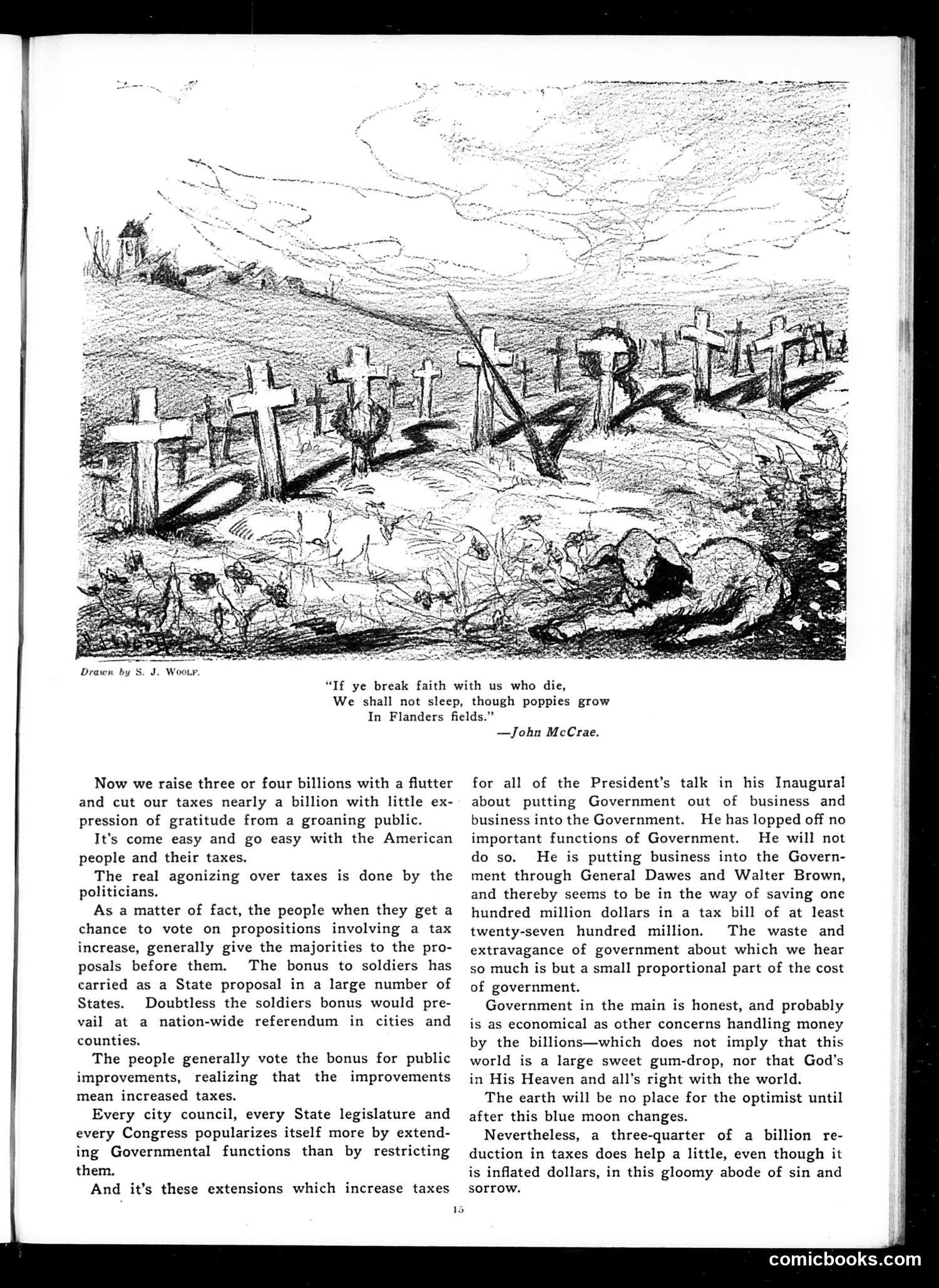
This Judge page satirizes post-WWI American attitudes toward taxation and government spending. The illustration depicts a World War I battlefield cemetery in Flanders (referencing the famous poem by John McCrae quoted above), invoking soldiers' sacrifice to contrast with domestic financial irresponsibility. The accompanying text argues that Americans, despite groaning about taxes, actually vote *for* tax increases when funding public improvements and veterans' bonuses. The satire targets politicians and government expansion: each legislative body seeks popularity by expanding governmental functions rather than restraining them, thereby increasing taxes. The piece appears critical of the newly-inaugurated President's (likely Harding, given the reference to General Dawes and Walter Brown in his administration) rhetoric about reducing government and business waste. The writer claims the promised savings are negligible compared to total expenditure, dismissing both optimism about reform and pessimism about the nation's prospects as equally unfounded.
📄 Transcribed text from this page (OCR, searchable)
Machine-transcribed from the original scan — historical spelling and the odd misread are preserved.
| Drawn by S. J. Woour, “If ye break faith with us who die, We shall not sleep, though poppies grow In Flanders fields.” Now we raise three or four billions with a flutter and cut our taxes nearly a billion with little ex- pression of gratitude from a groaning public. It's come easy and go easy with the American people and their taxes. The real agonizing over taxes is done by the politicians. As a matter of fact, the people when they get a chance to vote on propositions involving a tax increase, generally give the majorities to the pro- posals before them. The bonus to soldiers has carried as a State proposal in a large number of States. Doubtless the soldiers bonus would pre- vail at a nation-wide referendum in cities and counties. The people generally vote the bonus for public improvements, realizing that the improvements mean increased taxes. Every city council, every State legislature and every Congress popularizes itself more by extend- ing Governmental functions than by restricting them. And it’s these extensions which increase taxes —John McCrae. for all of the President’s talk in his Inaugural about putting Government out of business and business into the Government. He has lopped off no important functions of Government. He will not do so. He is putting business into the Govern- ment through General Dawes and Walter Brown, and thereby seems to be in the way of saving one hundred million dollars in a tax bill of at least twenty-seven hundred million. The waste and extravagance of government about which we hear so much is but a small proportional part of the cost of government. Government in the main is honest, and probably is as economical as other concerns handling money by the billions—which does not imply that this world is a large sweet gum-drop, nor that God's in His Heaven and all’s right with the world. The earth will be no place for the optimist until after this blue moon changes. Nevertheless, a three-quarter of a billion re- duction in taxes does help a little, even though it is inflated dollars, in this gloomy abode of sin and sorrow. comicbooks.com