
Judge, 1921-12-03 · page 21 of 36
Judge — December 3, 1921 — page 21: what you’re looking at
What you’re looking at
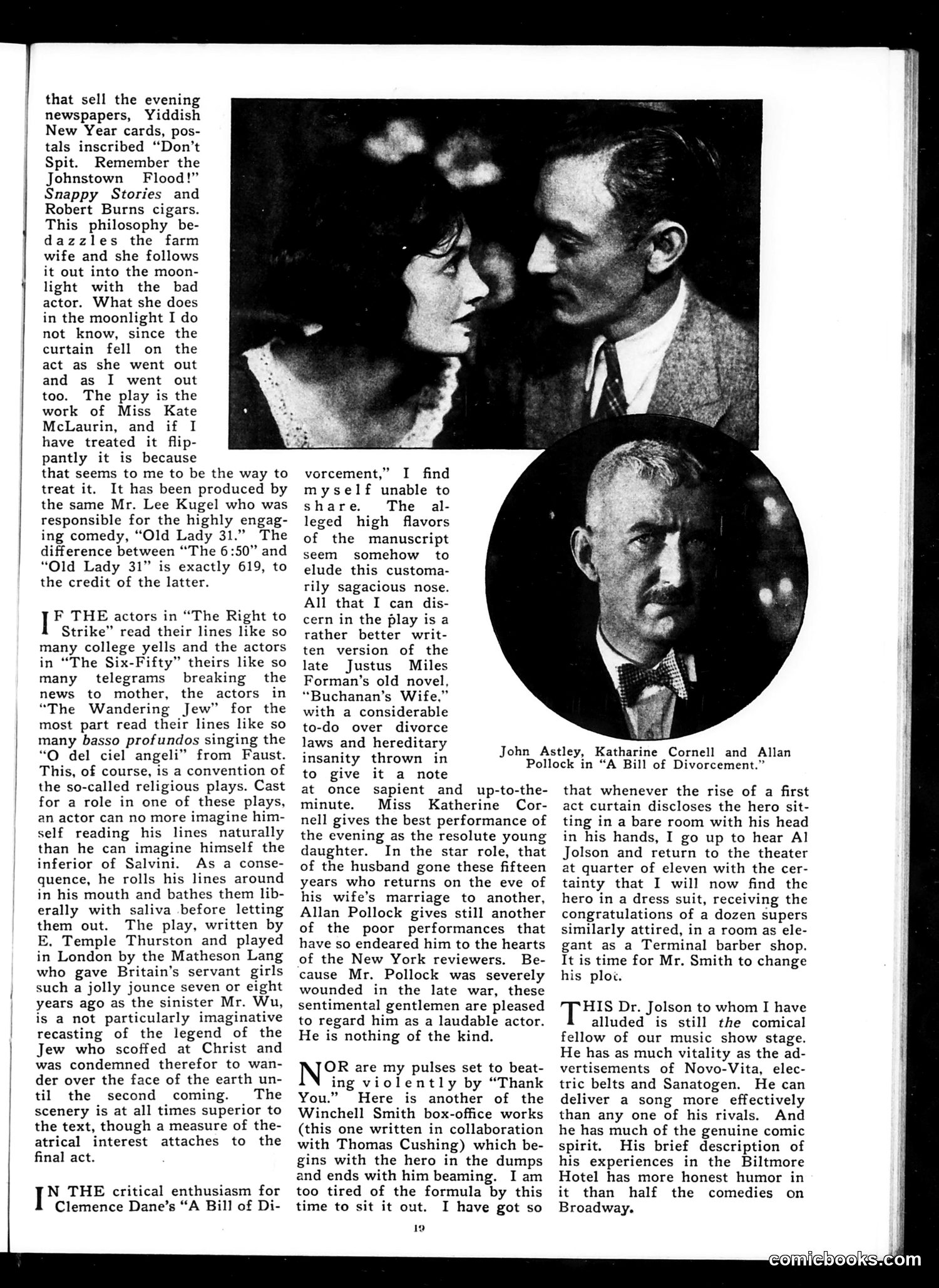
This page contains theater reviews from Judge magazine, a satirical publication. The main image shows three actors from "A Bill of Divorcement"—John Astley, Katharine Cornell, and Allan Pollock. The reviews critique contemporary Broadway productions. The critic praises Cornell's performance but harshly judges Allan Pollock, dismissing his acting ability while noting that reviewers treat him favorably due to his war wounds—a cutting satirical jab suggesting sentiment has replaced merit in critical assessment. The page also reviews other plays including "The Right to Strike," "The Wandering Jew," and "Thank You," with the critic expressing fatigue at predictable theatrical formulas and affected acting styles, particularly the overwrought delivery in religious dramas. The text references period-specific details like Yiddish New Year cards and the Johnstown Flood, grounding the reviews in early 20th-century American context.
📄 Transcribed text from this page (OCR, searchable)
Machine-transcribed from the original scan — historical spelling and the odd misread are preserved.
that sell the evening newspapers, Yiddish New Year cards, pos- tals inscribed “Don’t Spit. Remember the Johnstown Flood!” Snappy Stories and Robert Burns cigars. This philosophy be- dazzles the farm wife and she follows it out into the moon- light with the bad actor. What she does in the moonlight I do not know, since the curtain fell on the act as she went out and as I went out too. The play is the work of Miss Kate McLaurin, and if I have treated it flip- pantly it is because that seems to me to be the way to treat it. It has been produced by the same Mr. Lee Kugel who was responsible for the highly engag- ing comedy, “Old Lady 31.” The difference between “The 6:50” and “Old Lady 31” is exactly 619, to the credit of the latter. If. THE actors in “The Right to Strike” read their lines like so many college yells and the actors in “The Six-Fifty” theirs like so many telegrams breaking the news to mother, the actors in “The Wandering Jew” for the most part read their lines like so many basso profundos singing the “O del ciel angeli” from Faust. This, of course, is a convention of the so-called religious plays. Cast for a role in one of these plays, an actor can no more imagine him- self reading his lines naturally than he can imagine himself the inferior of Salvini. As a conse- quence, he rolls his lines around in his mouth and bathes them lib- erally with saliva before letting them out. The play, written by E, Temple Thurston and played in London by the Matheson Lang who gave Britain’s servant girls such a jolly jounce seven or eight years ago as the sinister Mr. Wu, is a not particularly imaginative recasting of the legend of the Jew who scoffed at Christ and was condemned therefor to wan- der over the face of the earth un- til the second coming. The scenery is at all times superior to the text, though a measure of the- atrical interest attaches to the final act. N THE critical enthusiasm for Clemence Dane’s “A Bill of Di- vorcement,” I find myself unable to share. The al- leged high flavors of the manuscript seem somehow to elude this customa- rily sagacious nose. All that I can dis- cern in the play is a tather better writ- ten version of the late Justus Miles Forman’s old novel, “Buchanan’s Wife,” with a considerable to-do over divorce laws and hereditary insanity thrown in to give it a note at once sapient and up-to-the- minute. Miss Katherine Cor- nell gives the best performance of the evening as the resolute young daughter. In the star role, that of the husband gone these fifteen years who returns on the eve of his wife’s marriage to another, Allan Pollock gives still another of the poor performances that have so endeared him to the hearts of the New York reviewers. Be- cause Mr. Pollock was severely wounded in the late war, these sentimental gentlemen are pleased to regard him as a laudable actor. He is nothing of the kind. N°&k are my pulses set to beat- ing violently by “Thank You.” Here is another of the Winchell Smith box-office works (this one written in collaboration with Thomas Cushing) which be- gins with the hero in the dumps and ends with him beaming. I am too tired of the formula by this time to sit it out. I have got so John Astley, Katharine Cornell and Allan Pollock in “A Bill of Divorcement.” that whenever the rise of a first act curtain discloses the hero sit- ting in a bare room with his head in his hands, I go up to hear Al Jolson and return to the theater at quarter of eleven with the cer- tainty that I will now find the hero in a dress suit, receiving the congratulations of a dozen supers similarly attired, in a room as ele- gant as a Terminal barber shop. It is time for Mr. Smith to change his ploc. THs Dr. Jolson to whom I have alluded is still the comical fellow of our music show stage. He has as much vitality as the ad- vertisements of Novo-Vita, elec- tric belts and Sanatogen. He can deliver a song more effectively than any one of his rivals. And he has much of the genuine comic spirit. His brief description of his experiences in the Biltmore Hotel has more honest humor in it than half the comedies on Broadway.