
Judge, 1921-12-03 · page 10 of 36
Judge — December 3, 1921 — page 10: what you’re looking at
What you’re looking at
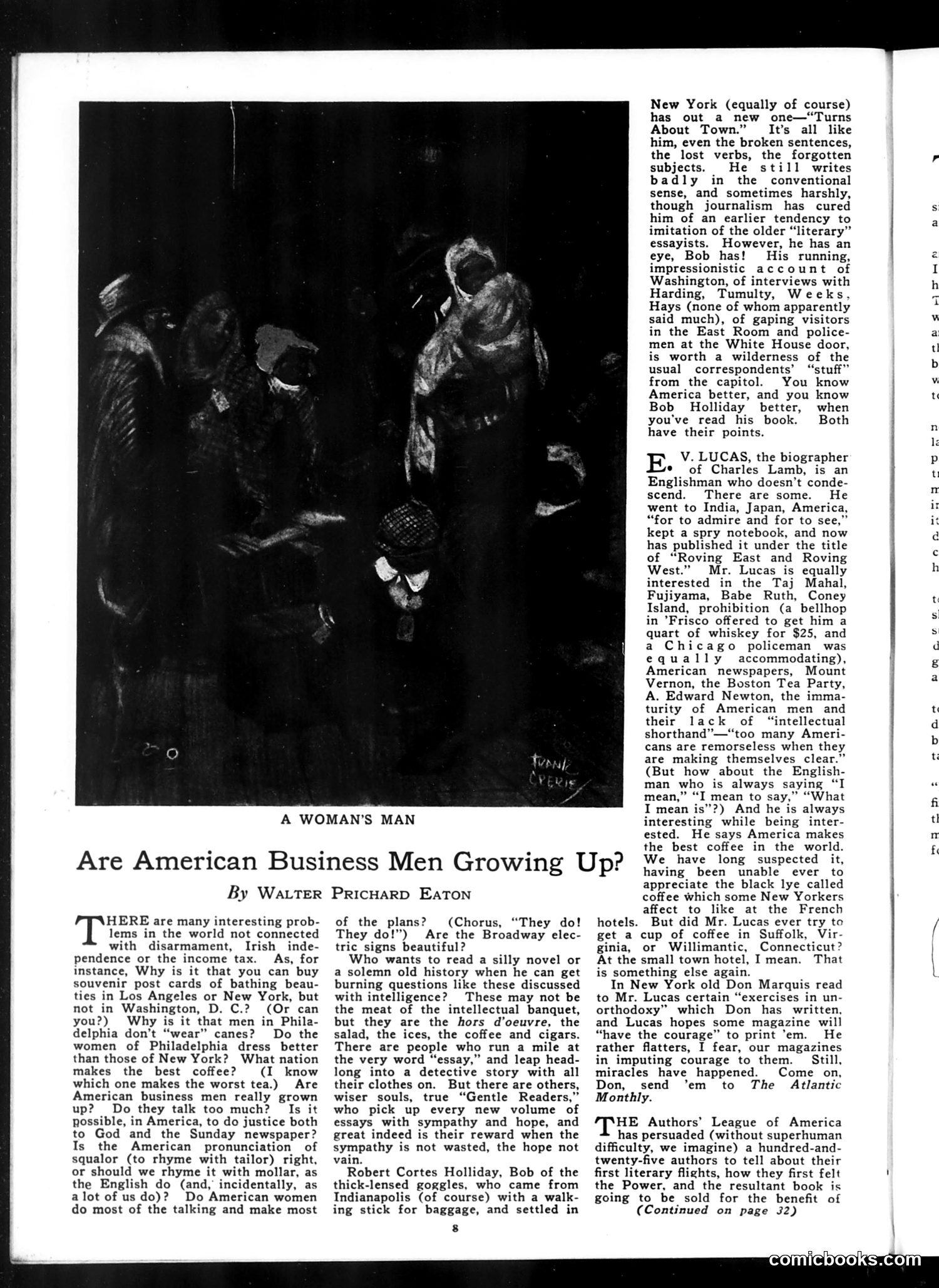
**The Main Cartoon:** The illustration titled "A Woman's Man" shows a figure (appears to be a businessman or gentleman) in an intimate or compromising position with a woman. The image is rendered in dark, sketchy tones typical of period satirical art. **The Article's Point:** Walter Prichard Eaton's essay humorously questions whether American businessmen are "growing up"—suggesting they remain immature or overly focused on trivial matters. He discusses Robert Cortes Holliday's new essay collection "Turns About Town," praising Holliday's observational writing about Washington politics and notable figures (Harding, Tumulty, etc.). **The Satire:** The pairing of the suggestive illustration with an essay questioning American male maturity appears deliberate—the cartoon reinforces Eaton's implicit criticism that American businessmen remain preoccupied with romantic/sexual pursuits rather than intellectual development. The contrast between sophisticated essay criticism and the risqué illustration exemplifies Judge's typical approach: pairing social commentary with cheeky visual humor about masculine behavior.
📄 Transcribed text from this page (OCR, searchable)
Machine-transcribed from the original scan — historical spelling and the odd misread are preserved.
A WOMAN’S MAN Are American Business Men Growing Up? By Water PRICHARD EaToNn HERE are many interesting prob- lems in the world not connected with disarmament, Irish inde- pendence or the income tax. As, for instance, Why is it that you can buy souvenir post cards of bathing beau- ties in Los Angeles or New York, but not in Washington, D. C.? (Or can you?) Why is it that men in Phila- delphia don’t “wear” canes? Do the women of Philadelphia dress better than those of New York? What nation makes the best coffee? (I know which one makes the worst tea.) Are American business men really grown up? Do they talk too much? Is it possible, in America, to do justice both to God and the Sunday newspaper? Is the American pronunciation of squalor (to rhyme with tailor) right, or should we rhyme it with mollar, as the English do (and, incidentally, as alot of usdo)? Do American women do most of the talking and make most of the plans? (Chorus, “They do! They do!”) Are the Broadway elec- tric signs beautiful? Who wants to read a silly novel or a solemn old history when he can get burning questions like these discussed with intelligence? These may not be the meat of the intellectual banquet, but they are the hors d’oeuvre, the salad, the ices, the coffee and cigars. There are people who run a mile at the very word “essay,” and leap head- long into a detective story with all their clothes on. But there are others, wiser souls, true “Gentle Readers,” who pick up every new volume of essays with sympathy and hope, and great indeed is their reward when the sympathy is not wasted, the hope not vain. Robert Cortes Holliday, Bob of the thick-lensed goggles, who came from Indianapolis (of course) with a walk- ing stick for baggage, and settled in 8 New York (equally of course) has out a new one—“Turns About Town.” It’s all like him, even the broken sentences, the lost verbs, the forgotten subjects. He still writes badly in the conventional sense, and sometimes harshly, though journalism has cured him of an earlier tendency to imitation of the older “literary” essayists. However, he has an eye, Bob has! His running, impressionistic account of Washington, of interviews with Harding, Tumulty, Weeks, Hays (none of whom apparently said much), of gaping visitors in the East Room and police- men at the White House door, is worth a wilderness of the usual correspondents’ “stuff” from the capitol. You know America better, and you know Bob Holliday better, when you've read his book. Both have their points. E V. LUCAS, the biographer * of Charles Lamb, is an Englishman who doesn’t conde- scend. There are some. He went to India, Japan, America, “for to admire and for to see,” kept a spry notebook, and now has published it under the title of “Roving East and Roving West.” Mr. Lucas is equally interested in the Taj Mahal, Fujiyama, Babe Ruth, Coney Island, prohibition (a bellhop in ’Frisco offered to get him a quart of whiskey for $25, and a Chicago policeman was equally accommodating), American newspapers, Mount Vernon, the Boston Tea Party, A. Edward Newton, the imma- turity of American men and their lack of “intellectual shorthand”—“too many Ameri- cans are remorseless when they are making themselves clear.” (But how about the English- man who is always saying “I mean,” “I mean to say,” “What I mean is”?) And he is always interesting while being inter- ested. He says America makes the best coffee in the world. We have long suspected it, having been unable ever to appreciate the black lye called coffee which some New Yorkers affect to like at the French hotels. But did Mr. Lucas ever try to get a cup of coffee in Suffolk, Vir- ginia, or Willimantic, Connecticut? At the small town hotel, I mean. That is something else again. In New York old Don Marquis read to Mr. Lucas certain “exercises in un- orthodoxy” which Don has written, and Lucas hopes some magazine will “have the courage” to print "em. He rather flatters, I fear, our magazines in imputing courage to them. Still, miracles have happened. Come on, Don, send ’em to The Atlantic Monthly. HE Authors’ League of America has persuaded (without superhuman difficulty, we imagine) a hundred-and- twenty-five authors to tell about their first literary flights, how they first felt the Power, and the resultant book is going to be sold for the benefit of (Continued on page 32) pw epguyorRenN