
Judge, 1921-12-03 · page 13 of 36
Judge — December 3, 1921 — page 13: what you’re looking at
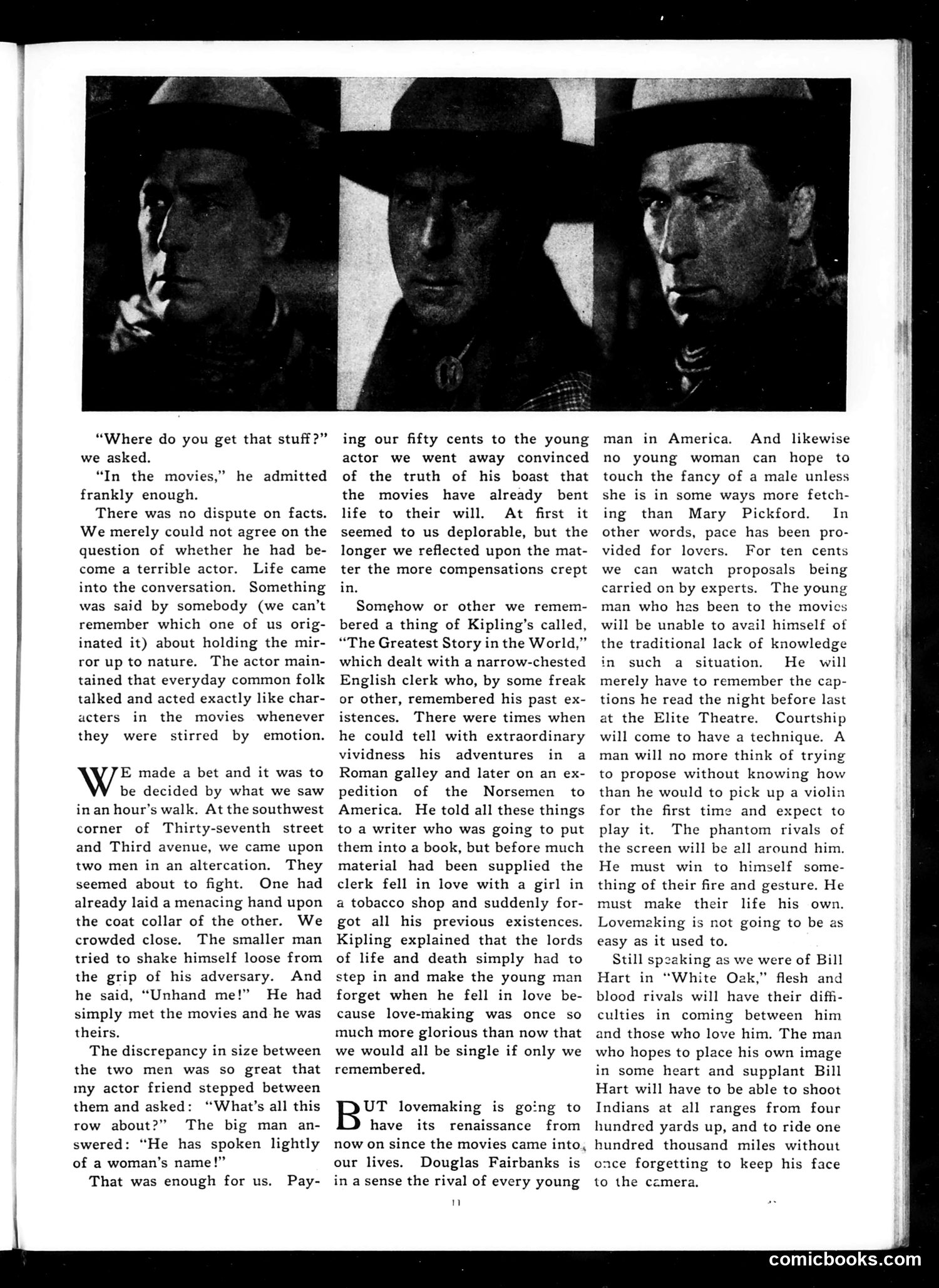
What you’re looking at
This article satirizes how movies are reshaping American behavior and romance. The author describes witnessing a street fight where one man exclaimed "Unhand me!"—theatrical language clearly copied from cinema rather than authentic speech. An actor friend uses this as proof that movies have already "bent life to their will." The piece critiques how films, particularly those starring **Douglas Fairbanks** and **Mary Pickford** (major silent film stars), have become the template for real-world courtship and masculine behavior. The satire suggests young men now feel they must emulate these screen idols' romantic techniques to compete, and that actual courtship has become impossibly difficult—one cannot propose without having studied film proposals first. The underlying joke: movies have created such idealized versions of romance and heroism that ordinary life cannot compete. Reality now imitates cinema rather than vice versa, with problematic consequences for actual human relationships.
📄 Transcribed text from this page (OCR, searchable)
Machine-transcribed from the original scan — historical spelling and the odd misread are preserved.
Og “Where do you get that stuff?” we asked. “In the movies,” he admitted frankly enough. There was no dispute on facts. We merely could not agree on the question of whether he had be- come a terrible actor. Life came into the conversation. Something was said by somebody (we can’t remember which one of us orig- inated it) about holding the mir- ror up to nature. The actor main- tained that everyday common folk talked and acted exactly like char- acters in the movies whenever they were stirred by emotion. E made a bet and it was to be decided by what we saw in an hour’s walk. At the southwest corner of Thirty-seventh street and Third avenue, we came upon two men in an altercation. They seemed about to fight. One had already laid a menacing hand upon the coat collar of the other. We crowded close. The smaller man tried to shake himself loose from the grip of his adversary. And he said, “Unhand me!” He had simply met the movies and he was theirs. The discrepancy in size between the two men was so great that my actor friend stepped between them and asked: ‘“What’s all this row about?” The big man an- swered: “He has spoken lightly of a woman’s name!” That was enough for us. Pay- ing our fifty cents to the young actor we went away convinced of the truth of his boast that the movies have already bent life to their will. At first it seemed to us deplorable, but the longer we reflected upon the mat- ter the more compensations crept in, Somehow or other we remem- bered a thing of Kipling’s called, “The Greatest Story in the World,” which dealt with a narrow-chested English clerk who, by some freak or other, remembered his past ex- istences. There were times when he could tell with extraordinary vividness his adventures in a Roman galley and later on an ex- pedition of the Norsemen to America. He told all these things to a writer who was going to put them into a book, but before much material had been supplied the clerk fell in love with a girl in a tobacco shop and suddenly for- got all his previous existences. Kipling explained that the lords of life and death simply had to step in and make the young man forget when he fell in love be- cause love-making was once so much more glorious than now that we would all be single if only we remembered. UT lovemaking is going to have its renaissance from now on since the movies came into our lives. Douglas Fairbanks is in a sense the rival of every young n And likewise no young woman can hope to touch the fancy of a male unless she is in some ways more fetch- ing than Mary Pickford. In other words, pace has been pro- vided for lovers. For ten cents we can watch proposals being carried on by experts. The young man who has been to the movies will be unable to avail himself of the traditional lack of knowledge in such a situation. He will merely have to remember the cap- tions he read the night before last at the Elite Theatre. Courtship will come to have a technique. A man will no more think of trying to propose without knowing how than he would to pick up a violin for the first time and expect to play it. The phantom rivals of the screen will be all around him. He must win to himself some- thing of their fire and gesture. He must make their life his own. Lovemaking is not going to be as easy as it used to. Still speaking as we were of Bill Hart in “White Oak,” flesh and blood rivals will have their diff- culties in coming between him and those who love him. The man who hopes to place his own image in some heart and supplant Bill Hart will have to be able to shoot Indians at all ranges from four hundred yards up, and to ride one hundred thousand miles without once forgetting to keep his face to the camera. man in America. comicbooks.com