
Judge, 1921-12-03 · page 20 of 36
Judge — December 3, 1921 — page 20: what you’re looking at
What you’re looking at
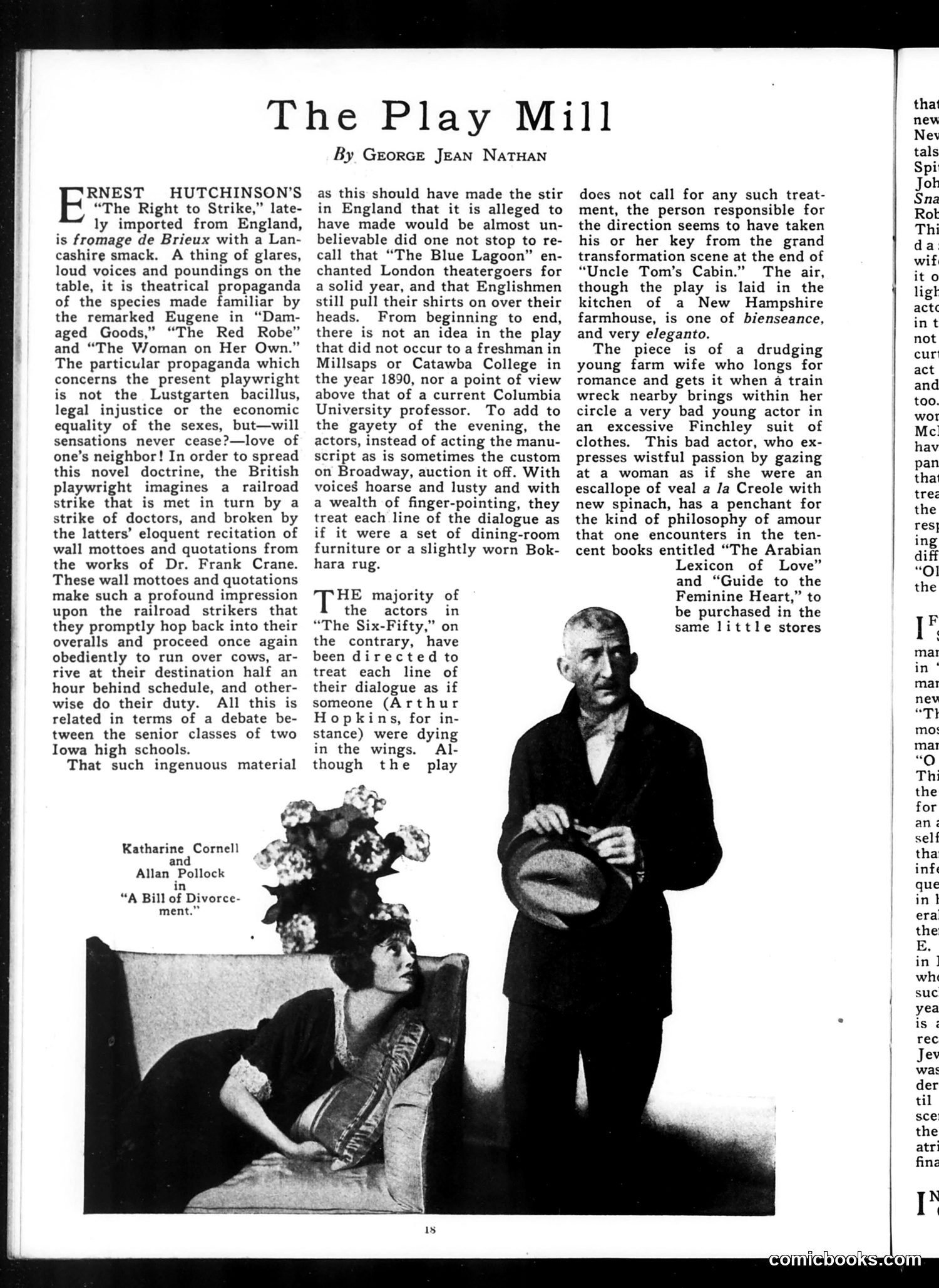
This is theater criticism by George Jean Nathan reviewing three Broadway plays. The page mocks British playwright Ernest Hutchinson's "The Right to Strike"—an import about a railroad strike resolved when doctors recite inspirational quotes. Nathan finds the plot simplistic (ideas a 1890 college freshman might have) and the acting overwrought, with actors treating dialogue like auctioned furniture. The accompanying photograph shows Katharine Cornell and Allan Pollock in "A Bill of Divorcement," appearing as an example of better dramatic work. Nathan also critiques "The Six-Fifty," directed by Arthur Hopkins, for its absurdly melodramatic tone—treating a simple farmhouse kitchen story with the gravitas of "Uncle Tom's Cabin's" transformation scene. The play concerns a bored farm wife tempted by a vain actor spouting cheap romance-novel philosophy. Nathan's satire targets overwrought theatrical conventions and imported British sentimentality.
📄 Transcribed text from this page (OCR, searchable)
Machine-transcribed from the original scan — historical spelling and the odd misread are preserved.
RNEST HUTCHINSON’S E “The Right to Strike,” late- ly imported from England, is fromage de Brieux with a Lan- cashire smack. A thing of glares, loud voices and poundings on the table, it is theatrical propaganda of the species made familiar by the remarked Eugene in “Dam- aged Goods,” “The Red Robe” and “The Wornan on Her Own.” The particular propaganda which concerns the present playwright is not the Lustgarten bacillus, legal injustice or the economic equality of the sexes, but—will sensations never cease?—love of one’s neighbor! In order to spread this novel doctrine, the British playwright imagines a railroad strike that is met in turn by a strike of doctors, and broken by the latters’ eloquent recitation of wall mottoes and quotations from the works of Dr. Frank Crane. These wall mottoes and quotations make such a profound impression upon the railroad strikers that they promptly hop back into their overalls and proceed once again obediently to run over cows, ar- rive at their destination half an hour behind schedule, and other- wise do their duty. All this is related in terms of a debate be- tween the senior classes of two Iowa high schools. That such ingenuous material Katharine Cornell and Allan Pollock In “A Bill of Divorce- ment.” The Play Mill By Grorce Jean NaTHAN as this should have made the stir in England that it is alleged to have made would be almost un- believable did one not stop to re- call that “The Blue Lagoon” en- chanted London theatergoers for a solid year, and that Englishmen still pull their shirts on over their heads. From beginning to end, there is not an idea in the play that did not occur to a freshman in Millsaps or Catawba College in the year 1890, nor a point of view above that of a current Columbia University professor. To add to the gayety of the evening, the actors, instead of acting the manu- script as is sometimes the custom on Broadway, auction it off. With voices hoarse and lusty and with a wealth of finger-pointing, they treat each line of the dialogue as if it were a set of dining-room furniture or a slightly worn Bok- hara rug. TH majority of the actors in “The Six-Fifty,” on the contrary, have been directed to treat each line of fe their dialogue as if someone (Arthur Hopkins, for in- stance) were dying in the wings. Al- though the play does not call for any such treat- ment, the person responsible for the direction seems to have taken his or her key from the grand transformation scene at the end of “Uncle Tom’s Cabin.” The air, though the play is laid in the kitchen of a New Hampshire farmhouse, is one of bienseance, and very eleganto. The piece is of a drudging young farm wife who longs for romance and gets it when a train wreck nearby brings within her circle a very bad young actor in an excessive Finchley suit of clothes. This bad actor, who ex- presses wistful passion by gazing at a woman as if she were an escallope of veal a Ja Creole with new spinach, has a penchant for the kind of philosophy of amour that one encounters in the ten- cent books entitled “The Arabian Lexicon of Love” and “Guide to the Feminine Heart,” to be purchased in the same little stores Spi Jot Sna Rot Thi da. wif it o ligt actc int not cur! act and too. wot hav pan tha tree the res] ing diff “Ol the