
Judge, 1921-12-03 · page 5 of 36
Judge — December 3, 1921 — page 5: what you’re looking at
What you’re looking at
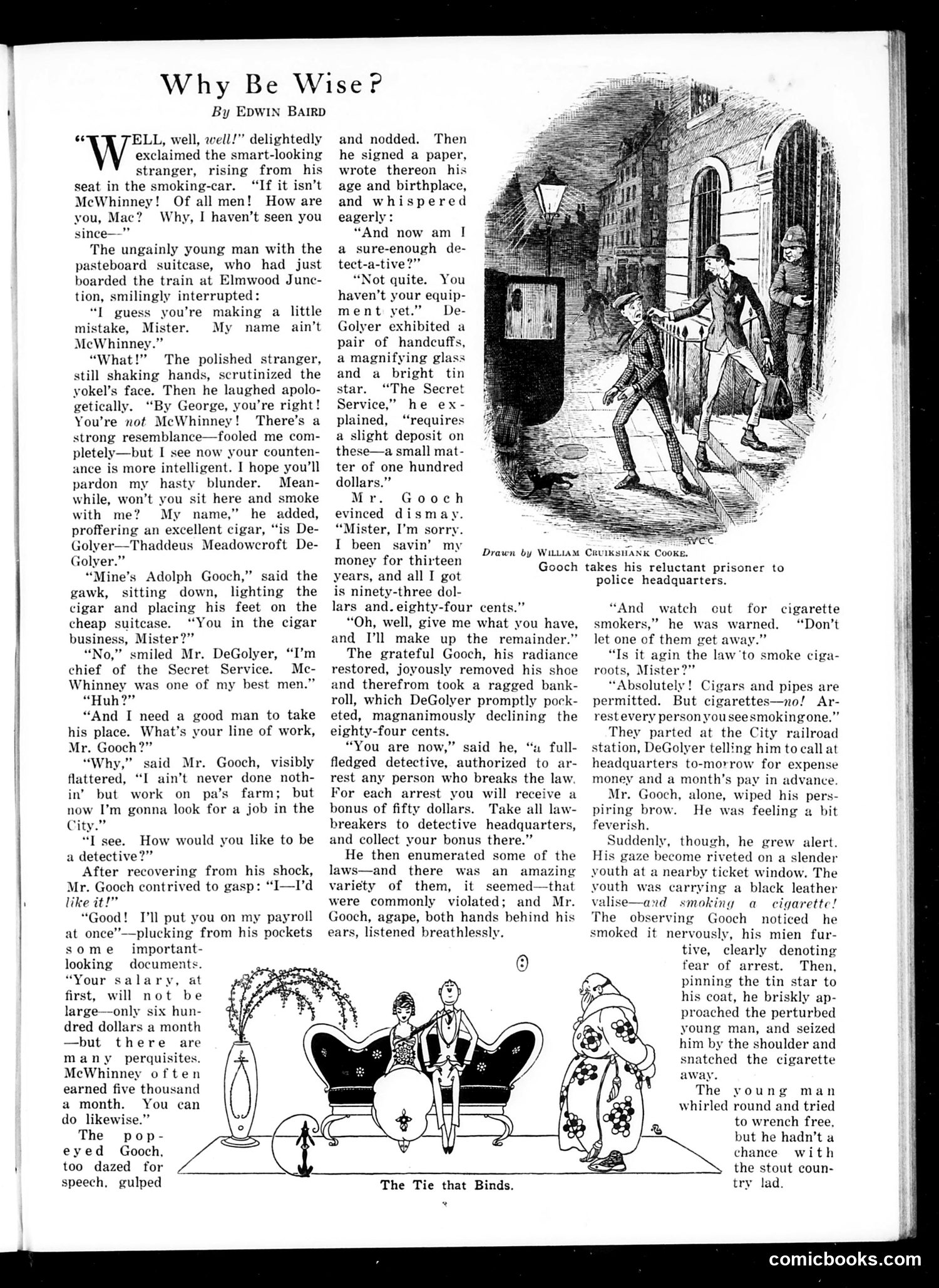
This story by Edwin Baird satirizes the Secret Service and law enforcement recruitment. The protagonist, Mr. DeGolyer, a polished stranger on a train, recruits a naive young man named McWhinney to become a detective by flattering his intelligence and offering financial incentives (a $100 deposit, $50 bonus per arrest). The satire targets how detective agencies recruit—appealing to vanity and greed rather than genuine qualification. The cartoon "The Tie that Binds" (bottom) appears to illustrate romantic entanglement, contrasting with the story's theme of questionable institutional bindings. The story's conclusion suggests the young man falls into trouble when observed smoking a cigarette—highlighting how arbitrary enforcement and bureaucratic rules entrap ordinary people into criminal situations.
📄 Transcribed text from this page (OCR, searchable)
Machine-transcribed from the original scan — historical spelling and the odd misread are preserved.
Why Be Wise? By EDWIN BAIRD se ELL, well, well!” delightedly W exclaimed the smart-looking stranger, rising from his seat in the smoking-car. “If it isn’t MeWhinney! Of all men! How are you, Mac? Why, I haven’t seen you since—" The ungainly young man with the pasteboard suitcase, who had just boarded the train at Elmwood Junc- tion, smilingly interrupted: “I guess you’re making a little mistake, Mister. My name ain’t MeWhinney.” “What!” The polished stranger, still shaking hands, scrutinized the yokel’s face. Then he laughed apolo- getically. “By George, you’re right! You’re not McWhinney! There’s a strong resemblance—fooled me com- pletely—but I see now your counten- ance is more intelligent. I hope you'll pardon my hasty blunder. Mean- while, won’t you sit here and smoke with me? My name,” he added, proffering an excellent cigar, “is De- Golyer—Thaddeus Meadowcroft De- Golyer.” “Mine’s Adolph Gooch,” said the gawk, sitting down, lighting the cigar and placing his feet on the cheap suitcase. “You in the cigar business, Mister?” “No,” smiled Mr. DeGolyer, “I’m chief of the Secret Service. Mc- Whinney was one of my best men.” “Huh?” “And I need a good man to take his place. What’s your line of work, Mr. Gooch?” “Why,” said Mr. Gooch, visibly flattered, “I ain’t never done noth- in’ but work on pa’s farm; but now I’m gonna look for a job in the City.” “I see. How would you like to be a detective?” After recovering from his shock, Mr. Gooch contrived to gasp: “I—I’d like it!” “Good! I’ll put you on my payroll at once”’—plucking from his pockets some_ important- looking documents. “Your salary, at first, will not be large—only six hun- dred dollars a month —but there are many perquisites. MeWhinney often earned five thousand a month. You can do likewise.” The pop- eyed Gooch, too dazed for and nodded. Then he signed a paper, wrote thereon his age and birthplace, and whispered eagerly: “And now am I a sure-enough de- tect-a-tive?” “Not quite. You haven’t your equip- ment yet.” De- Golyer exhibited a pair of handcuffs, a magnifying glass and a bright tin star. “The Secret Service,” he ex- plained, “requires a slight deposit on these—a small mat- ter of one hundred dollars.” Mr. Gooch evinced dismay. “Mister, I’m sorry. I been savin’ my money for thirteen years, and all I got is ninety-three dol- lars and. eighty-four cents “Oh, well, give me what you have, and I’ll make up the remainder.” The grateful Gooch, his radiance restored, joyously removed his shoe and therefrom took a ragged bank- roll, which DeGolyer promptly pock- eted, magnanimously declining the eighty-four cents. “You are now,” said he, “a full- fledged detective, authorized to ar- rest any person who breaks the law. For each arrest you will receive a bonus of fifty dollars. Take all law- breakers to detective headquarters, and collect your bonus there.” He then enumerated some of the vs there was an amazing variety of them, it seemed—that were commonly violated; and Mr. Gooch, agape, both hands behind his ears, listened breathlessly. Drawn by WILLIAM CRUIKSHANK CooKE. Gooch takes his reluctant prisoner to police headquarters. “And watch cut smokers,” he was w: let one of them get aw “Ts it agin the law‘to smoke ciga- Mister?” »solutely ! 's and pipes are permitted. But cigarettes—no! Ar- restevery person youseesmokingone.”” They parted at the City railroad station, DeGolyer telling him to call at headquarters to-morrow for expense money and a month’s pay in ¢ Mr. Gooch, alone, wiped his pers- piring brow. He was feeling a bit feverish. Suddenly, though, he grew alert. His gaze become riveted on a slender youth at a nearby ticket window. The youth was carrying a black leather valise—and smoking a cigarette! The observing Gooch noticed he smoked it nervously, his mien fur- tive, clearly denoting fear of arrest. Then, pinning the tin star to his coat, he briskly ap- proached the perturbed young man, and seized him by the shoulder and snatched the cigarette for cigarette rned. ‘*Don’t whirled round and tried & to wrench free, but he hadn’t a chance with the stout coun- speech, gulped The Tie that Binds. try lad. comicbooks.com