
A complete issue · 36 pages · 1921
Judge — October 1, 1921
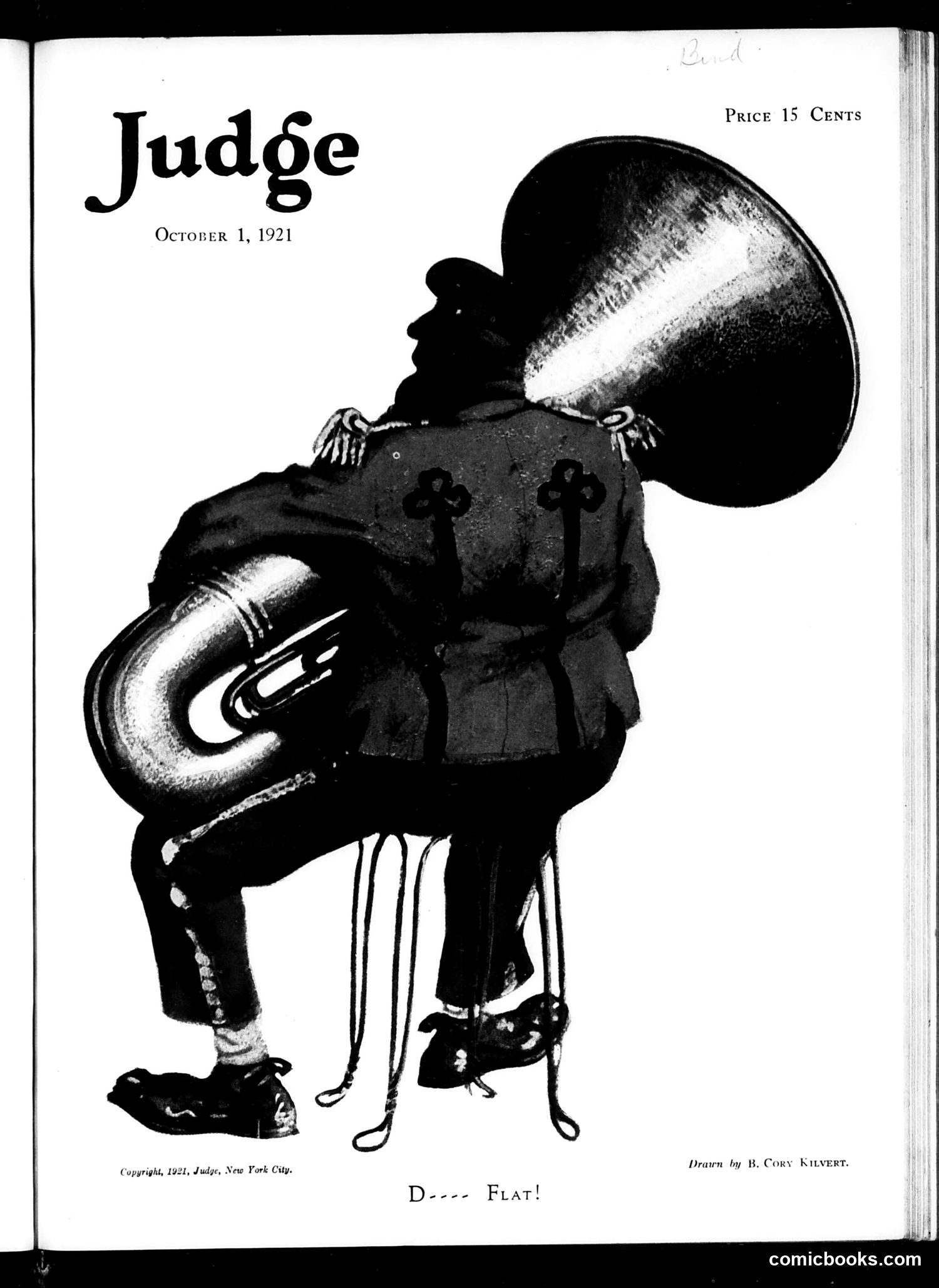
This political cartoon depicts a military figure (identifiable by shoulder epaulettes and decorations) sitting on a chair while holding a large tuba or brass instrument. The caption reads "D---- Flat!" — a pun on both the musical term "D-flat" and the slang expression meaning something has failed or collapsed. The satire likely targets a military leader or policy that has "fallen flat" — failed to achieve its aims. The formal military dress contrasts humorously with the absurd posture of sitting while playing this awkward instrument, suggesting the ridiculous nature of the referenced situation. Without additional context about 1921 military events, the specific target remains unclear, though the work demonstrates Judge magazine's typical approach of mocking political and military authority through visual absurdity.
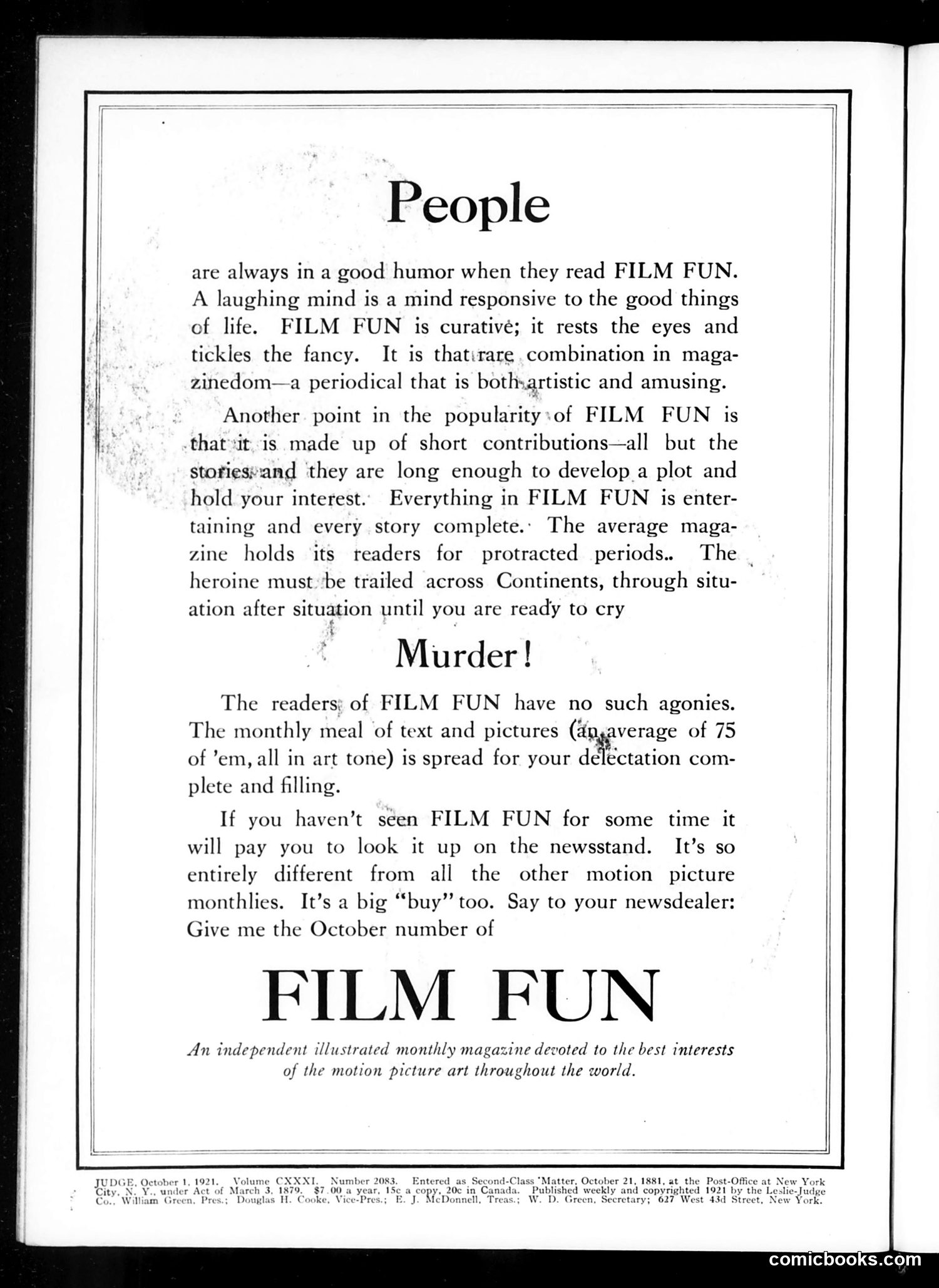
This page is **not a political cartoon or satirical content**—it's a **full-page advertisement** for *Film Fun*, a competing monthly magazine devoted to motion pictures. The ad uses persuasive copy to promote *Film Fun* by describing it as uniquely entertaining: it features short stories with developed plots, approximately 75 pictures per issue in "art tone," and promises complete, satisfying narratives without the cliffhangers of serialized stories in other magazines. The rhetorical device "Murder!" is used playfully—referring to how other magazines' serialized heroines are "trailed across Continents" through suspenseful situations, leaving readers in agony. *Film Fun* offers readers respite: no such dramatic suffering required. The ad encourages newsstand purchase of the October issue, positioning the magazine as distinctly different from other motion picture monthlies of the era.
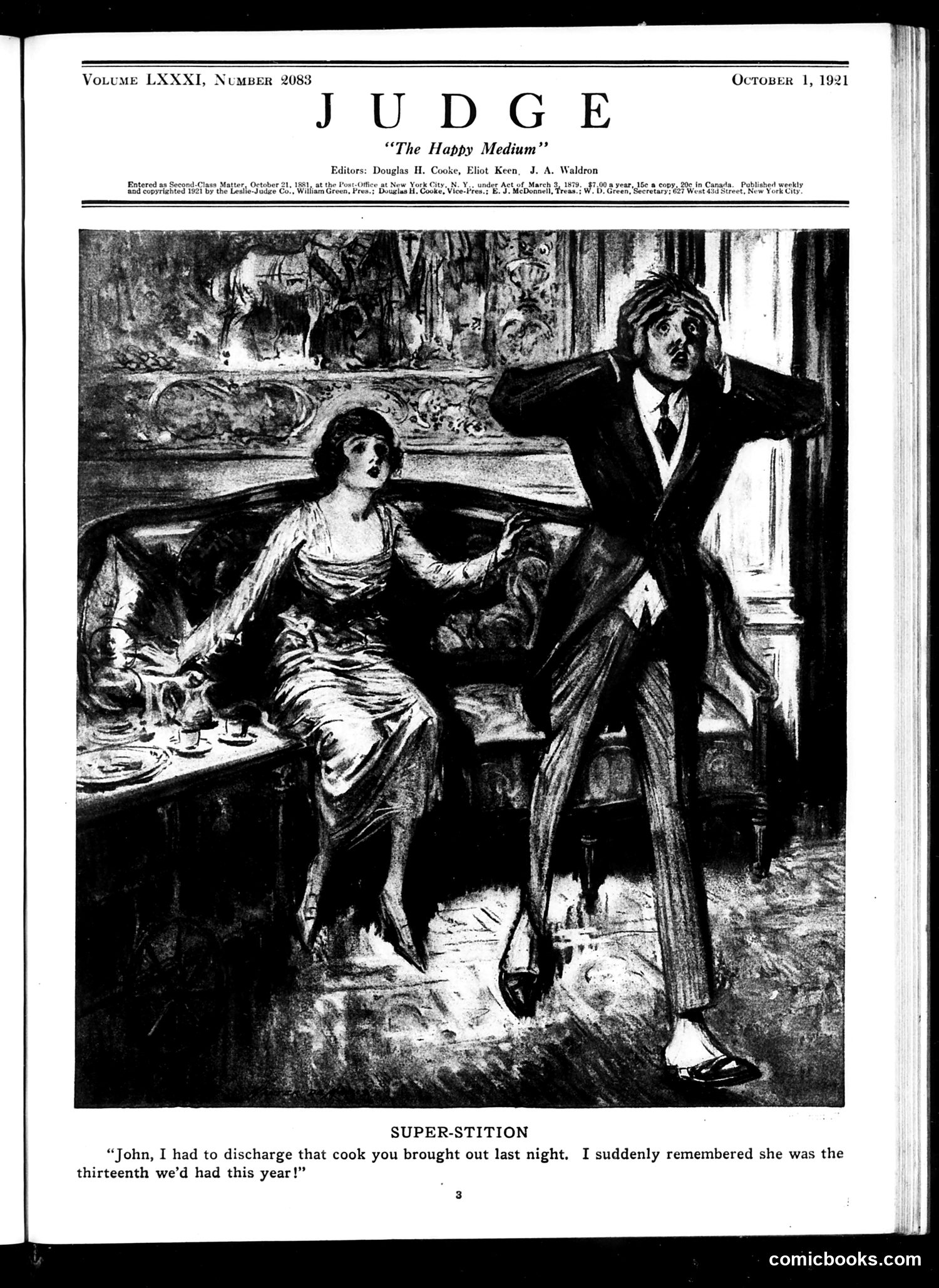
This cartoon satirizes domestic labor turnover in the post-WWI era. A man discharges a cook, claiming he suddenly remembered she was "the thirteenth we'd had this year"—invoking the superstition that the number thirteen brings bad luck. The joke targets two 1920s anxieties: the widespread "servant problem" (difficulty retaining household staff due to better employment options) and persistent superstitious beliefs. By attributing the cook's firing to superstition rather than actual performance issues, the cartoon mocks the arbitrary and irrational excuses employers used to justify frequent worker dismissals. The woman's calm demeanor suggests she's unsurprised—implying this superstitious justification was a common, absurd pretext for employment instability among the working class.
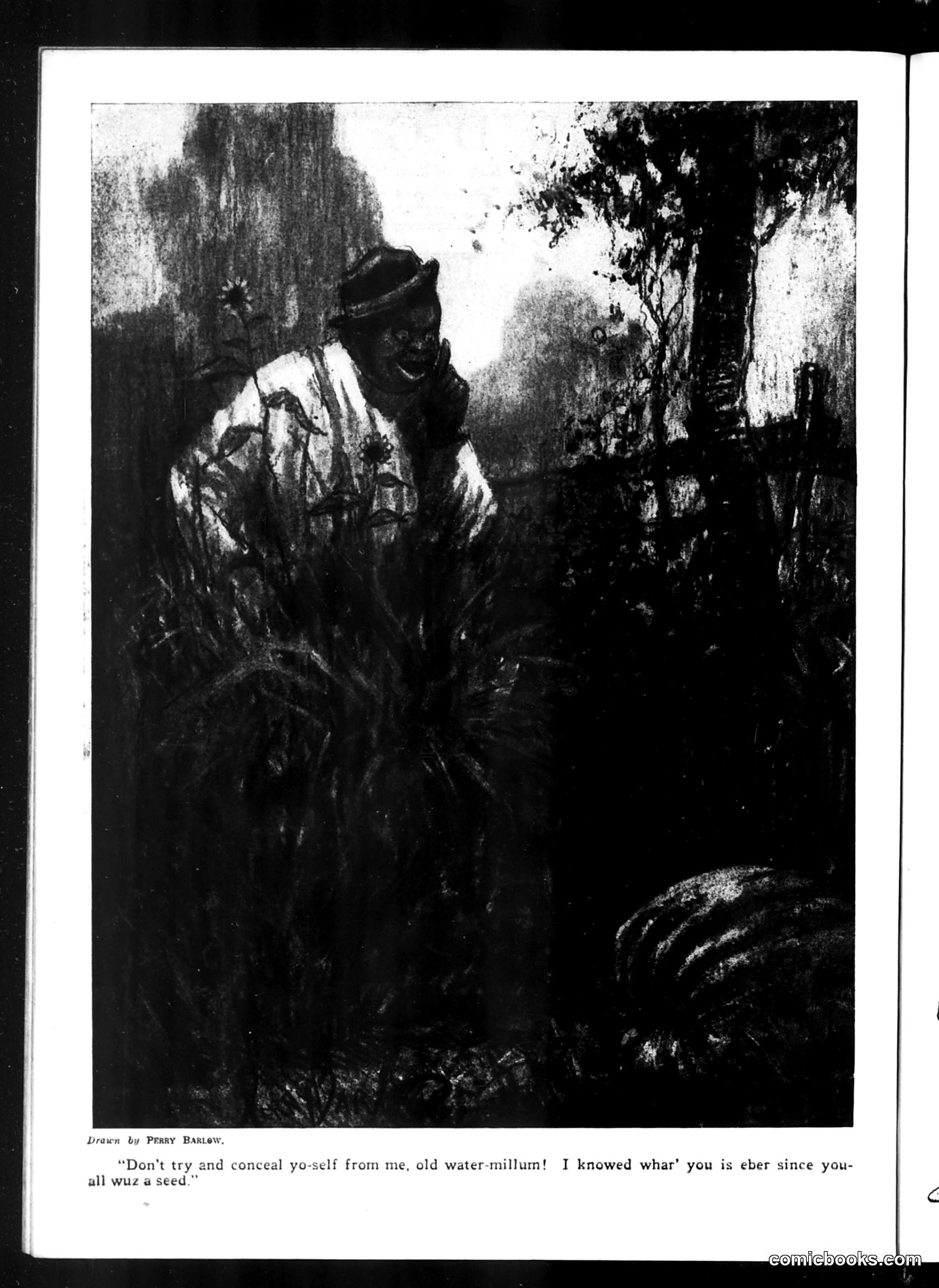
This illustration by Perry Barlow depicts a confrontation in a dark, swampy setting. A figure in period clothing confronts what appears to be a supernatural or grotesque creature emerging from water and vegetation. The caption reads: "Don't try and conceal yo-self from me, old water-millum! I knew whar' you is eber since you-all wuz a seed." The dialect and imagery suggest this is likely a folk tale or supernatural encounter, possibly drawing on American folklore traditions. The "water-millum" (water melon) reference appears to be wordplay or a regional dialect joke, though the specific political or social satire intended remains unclear without additional context about this particular Judge magazine issue. The overall tone suggests rural American themes, but the precise satirical target is uncertain.
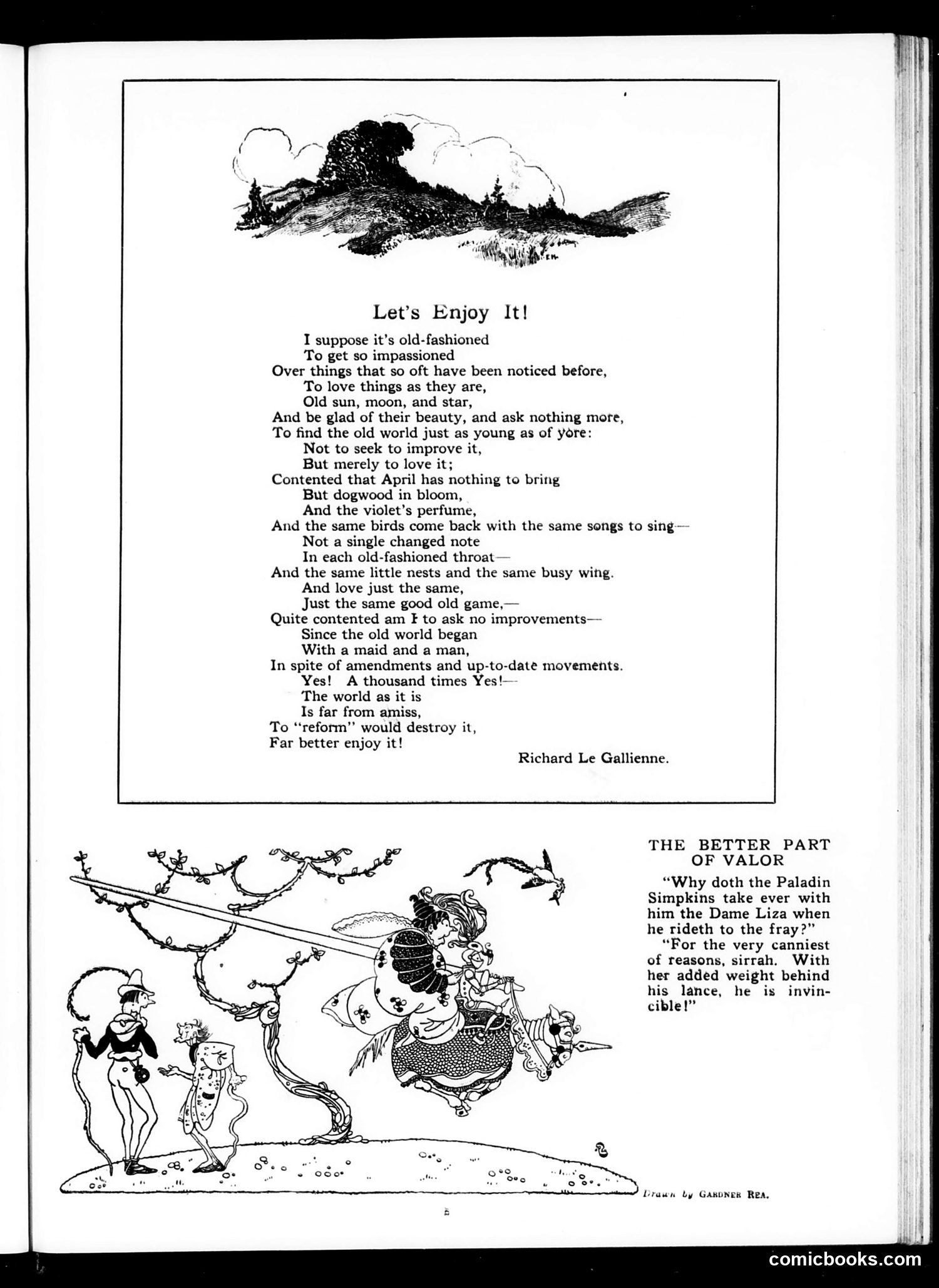
The upper section presents "Let's Enjoy It!" — a poem by Richard Le Gallienne advocating accepting the world as it is rather than constantly seeking reform. The verse celebrates traditional natural beauty (sun, moon, stars, birds, flowers) and opposes progressive "amendments and up-to-date movements." The lower cartoon, titled "The Better Part of Valor," depicts medieval figures with a lance and appears to be a humorous take on chivalric romance tropes. The caption suggests ironic commentary on a "Paladin Simpkins" taking "the Dame Liza" to battle, with the joke playing on the phrase "the better part of valor is discretion" — likely mocking either overly romantic medieval fantasy or contemporary chivalric pretensions. Both elements reflect Judge magazine's conservative satirical stance against progressive reform movements popular in early 20th-century America.
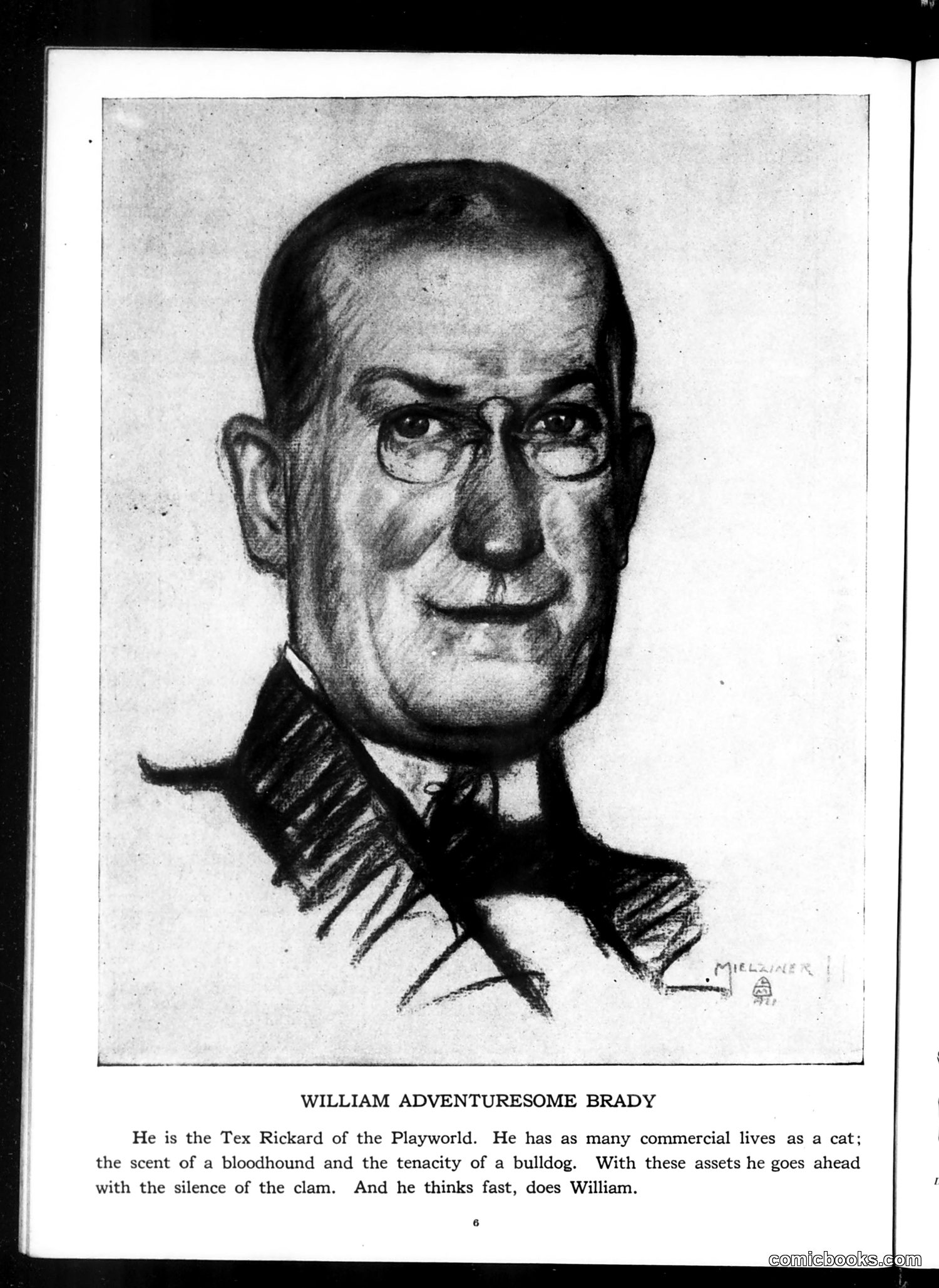
This is a portrait sketch of **William A. Brady**, labeled as "the Tex Rickard of the Playworld." The caption employs colorful language comparing him to a bloodhound and bulldog—suggesting persistence and tenacity in his work. **Context**: Tex Rickard was a famous boxing promoter known for aggressive deal-making. By calling Brady "the Tex Rickard of the Playworld," Judge suggests Brady brings similar ruthless business acumen to theater production. The sketch appears designed to satirize Brady as a relentless theatrical entrepreneur who pursues opportunities with single-minded determination ("thinks fast, does William"). The caricature style—particularly the sharp features and piercing gaze—emphasizes intensity and cunning. The piece functions as a character portrait rather than commenting on a specific event, positioning Brady as a notable figure in early 20th-century American theater.
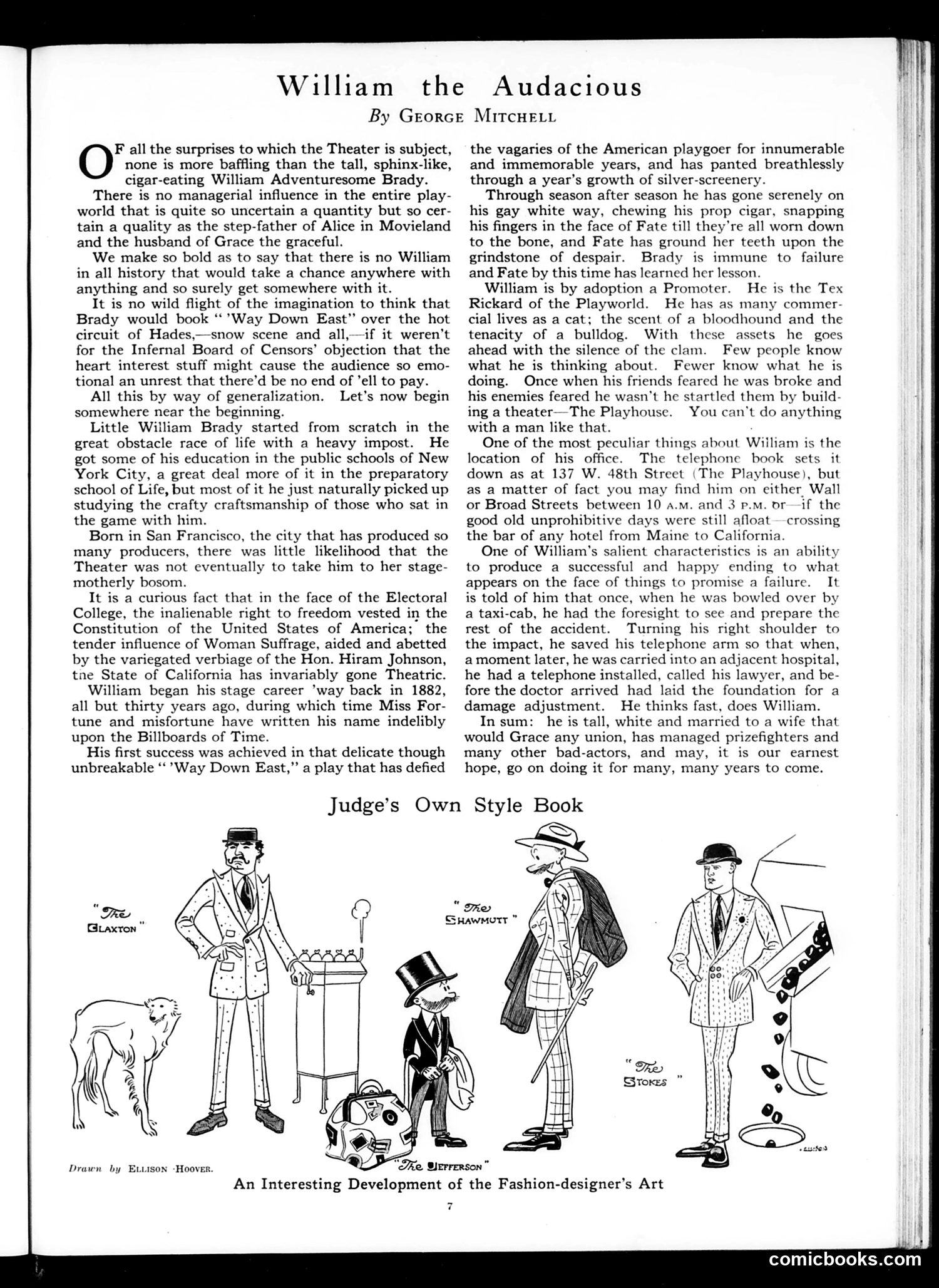
This page profiles William Brady, a prominent American theater producer and promoter active since 1882. The article praises Brady as an audacious, fearless showman who produced successful plays like "Way Down East" and built The Playhouse theater on 48th Street in New York. The satire targets Brady's mysterious business methods—his office location is officially listed but he's perpetually found elsewhere (Wall Street, hotel bars). The cartoons below, titled "Judge's Own Style Book," appear unrelated—they illustrate fashion designer caricatures with exaggerated clothing styles by Ellison Hoover, labeled "The Glaxton," "The Shawmutt," "The Jefferson," and "The Storks." The comedy rests on Brady's reputation as an eccentric risk-taker who defies logic yet consistently succeeds, earning comparison to boxing promoter Tex Rickard.
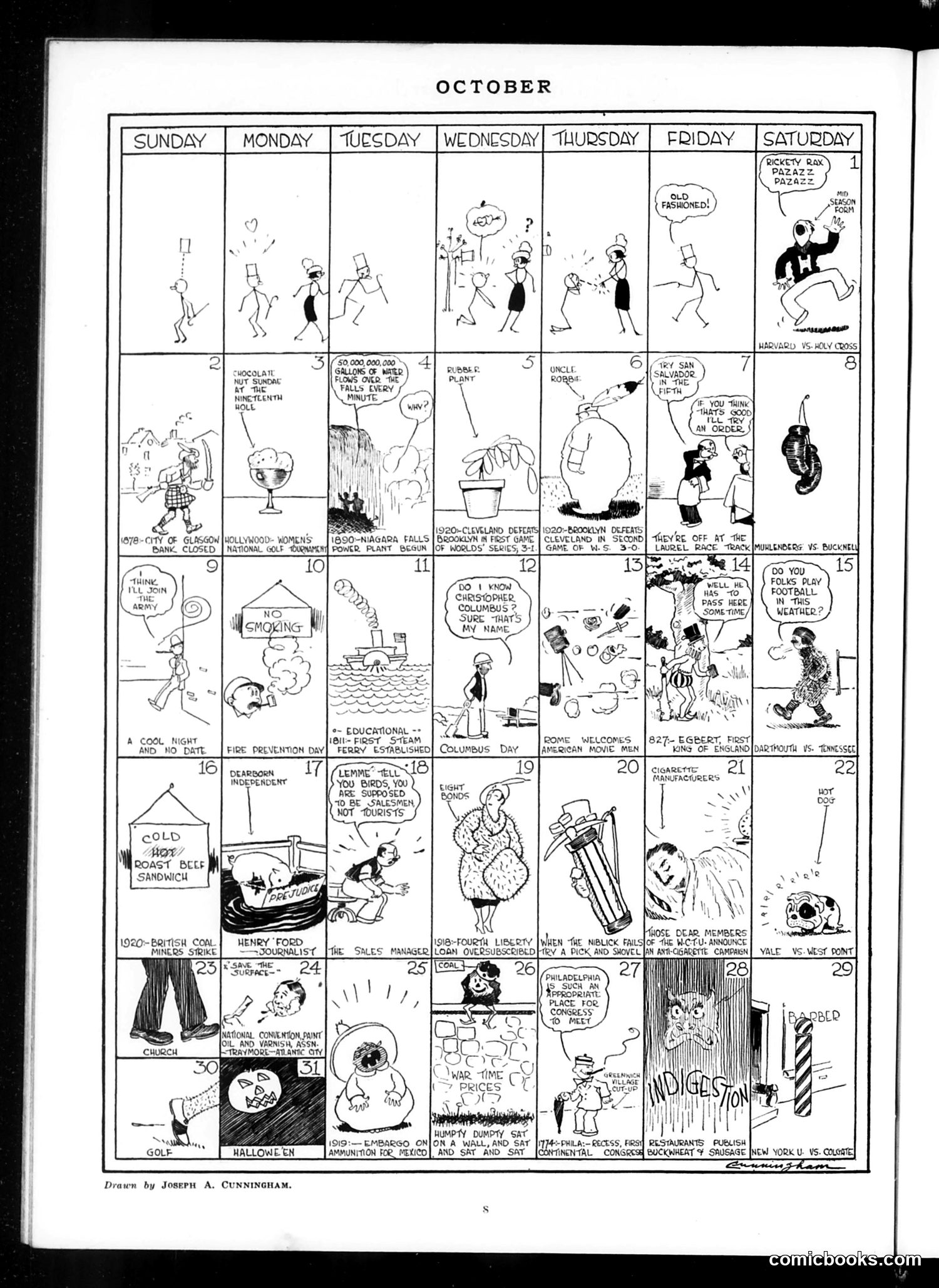
This October 1920 calendar by Joseph A. Cunningham mixes daily comic strips with historical annotations. The cartoons depict mundane domestic situations—juggling, dancing, smoking prevention, cooking—typical of Judge's humor style. The historical notations reveal the page's satirical intent: they reference recent or concurrent 1920 events including the Cleveland-Brooklyn World Series, Columbus Day, British coal miners' strike, and a women's golf championship. Most pointedly, entries note Prohibition-era concerns (chocolate "gallons," cigarette manufacturers), women's suffrage (women's golf tournament), and labor unrest. The humor derives from juxtaposing trivial domestic comics with serious political/social upheaval of 1920—a transformative year involving labor strikes, Prohibition implementation, women's rights expansion, and post-WWI tensions. The calendar suggests American life's absurd disconnection: ordinary people navigate daily trivialities while epochal changes reshape society. This reflects Judge's satirical tradition of highlighting social contradictions through seemingly innocent humor.
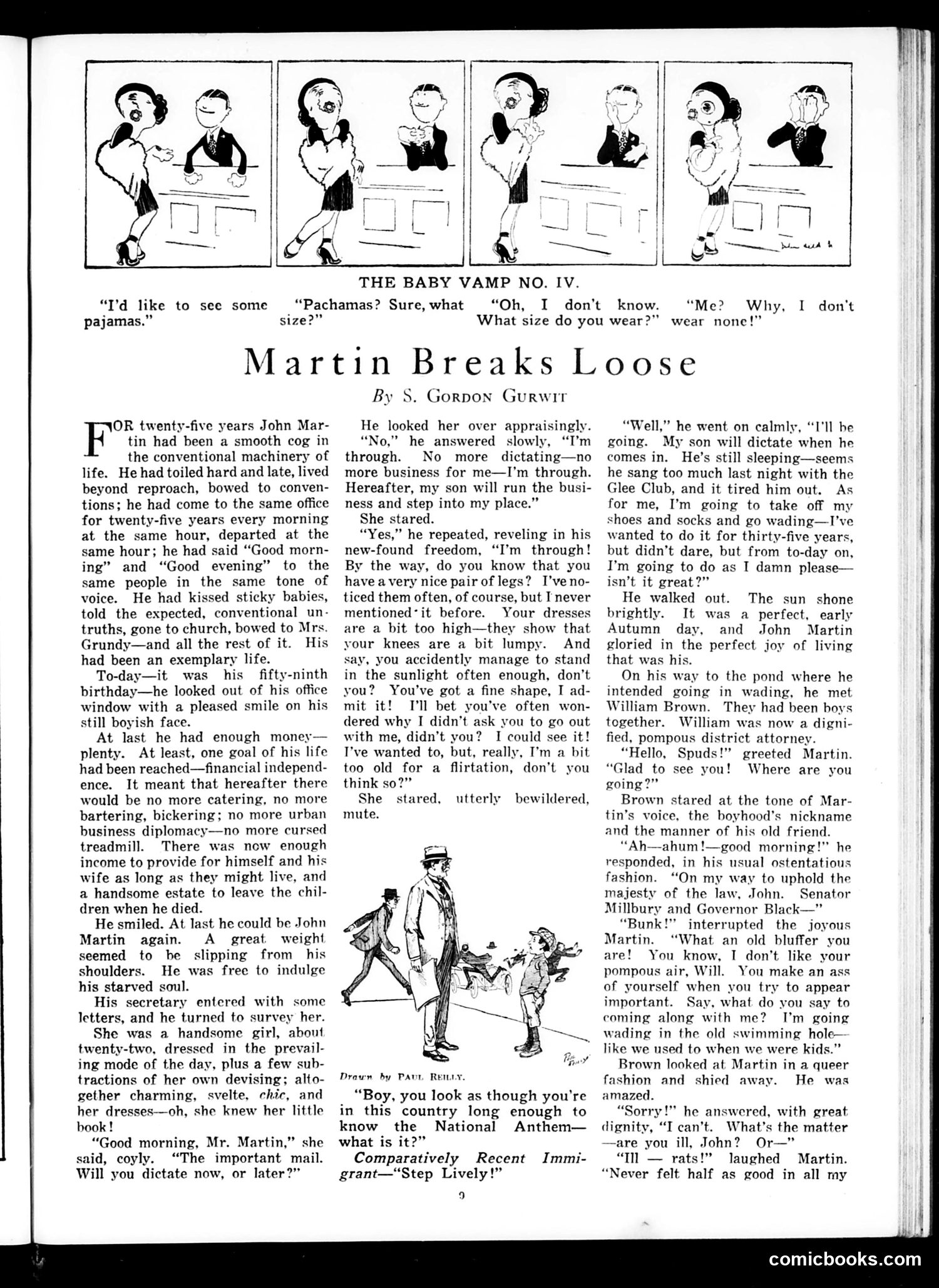
This story satirizes early-20th-century masculinity and conformity. John Martin, a 59-year-old businessman who has spent 25 years in rigid, respectable routines—arriving at the same time daily, maintaining social propriety—finally achieves financial independence and decides to abandon convention. The satire centers on his immediate rebellion: he makes inappropriate sexual comments to his young secretary about her legs and body, calls her "lumpy," and boasts about wanting to flirt with her. He then leaves work early to wade in a pond like a carefree child. The joke critiques how "respectability" is merely performative restraint. Once freed from social obligation, Martin doesn't become wise or noble—he becomes a lecherous fool, suggesting his decades of propriety masked base impulses rather than genuine character. The tone implies this behavior will humiliate him when he encounters his dignified friend, the district attorney. The cartoon at top ("The Baby Vamp No. IV") shows a flirtatious woman shocking a man with her boldness about wearing no pajamas—complementing the main story's theme about repressed desires breaking loose.
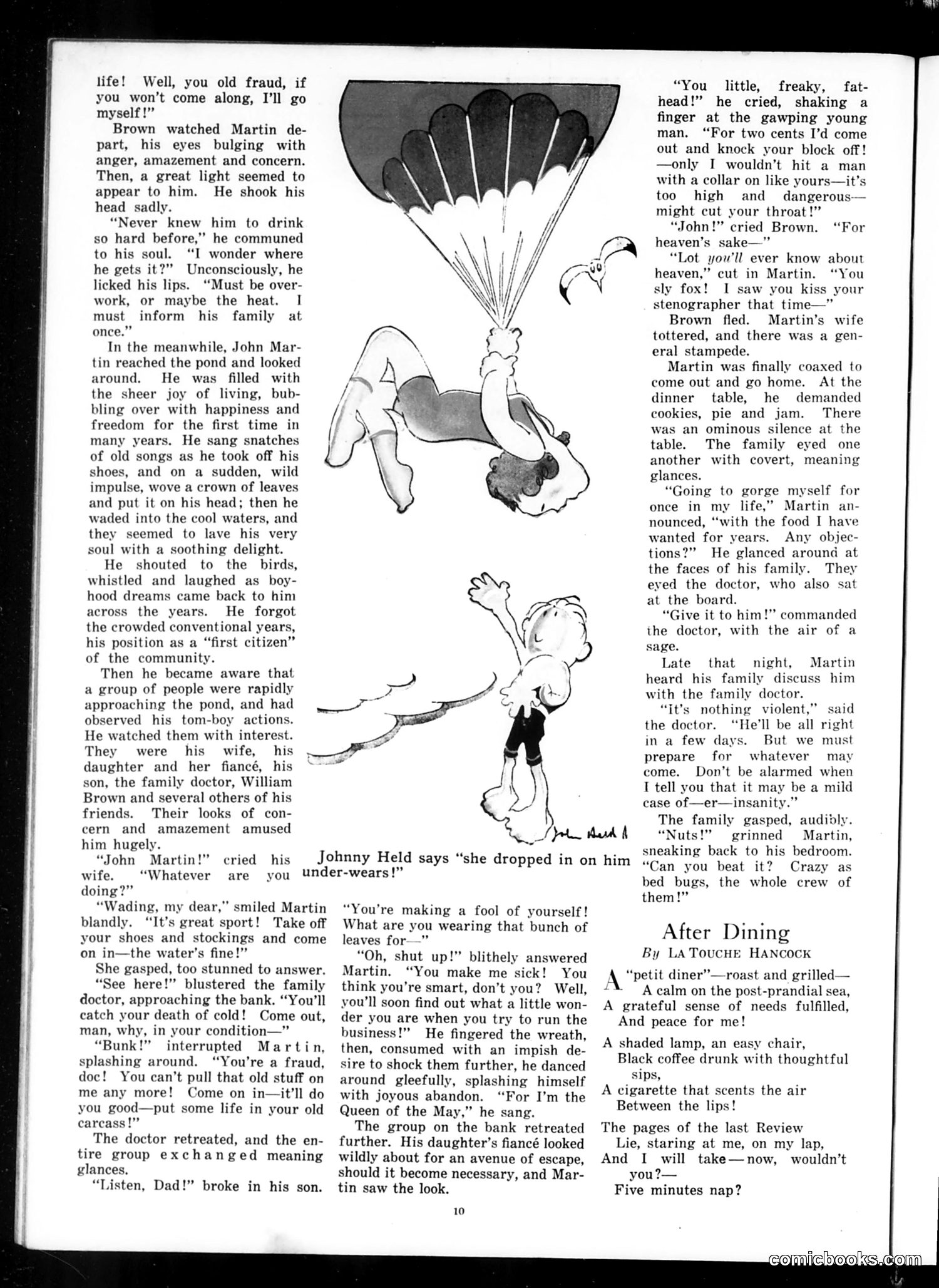
This story satirizes **Victorian repression and social conformity** through John Martin, a respectable "first citizen" who suddenly sheds his staid persona and acts wildly—wading in a pond, wearing a leaf crown, singing, and defying authority figures including his doctor and family. The satire targets: - **Medical authority**: The family doctor dispensing fake health warnings ("catch your death of cold") - **Social hypocrisy**: Brown, the concerned citizen, is revealed as an adulterer kissing his stenographer - **Generational conflict**: Martin mocks his son's business ambitions and the fiancé's prudishness - **Consumer repression**: Martin demands forbidden foods (cookies, jam) his family has denied him The cartoon's message: respectable society imposes arbitrary restrictions on natural human joy and appetite. Martin's "madness" is actually liberation—a rejection of oppressive social norms. The family's horrified reactions reveal how fragile their moral authority really is. This reflects early-20th-century anxieties about Victorian constraint versus modern individual freedom.
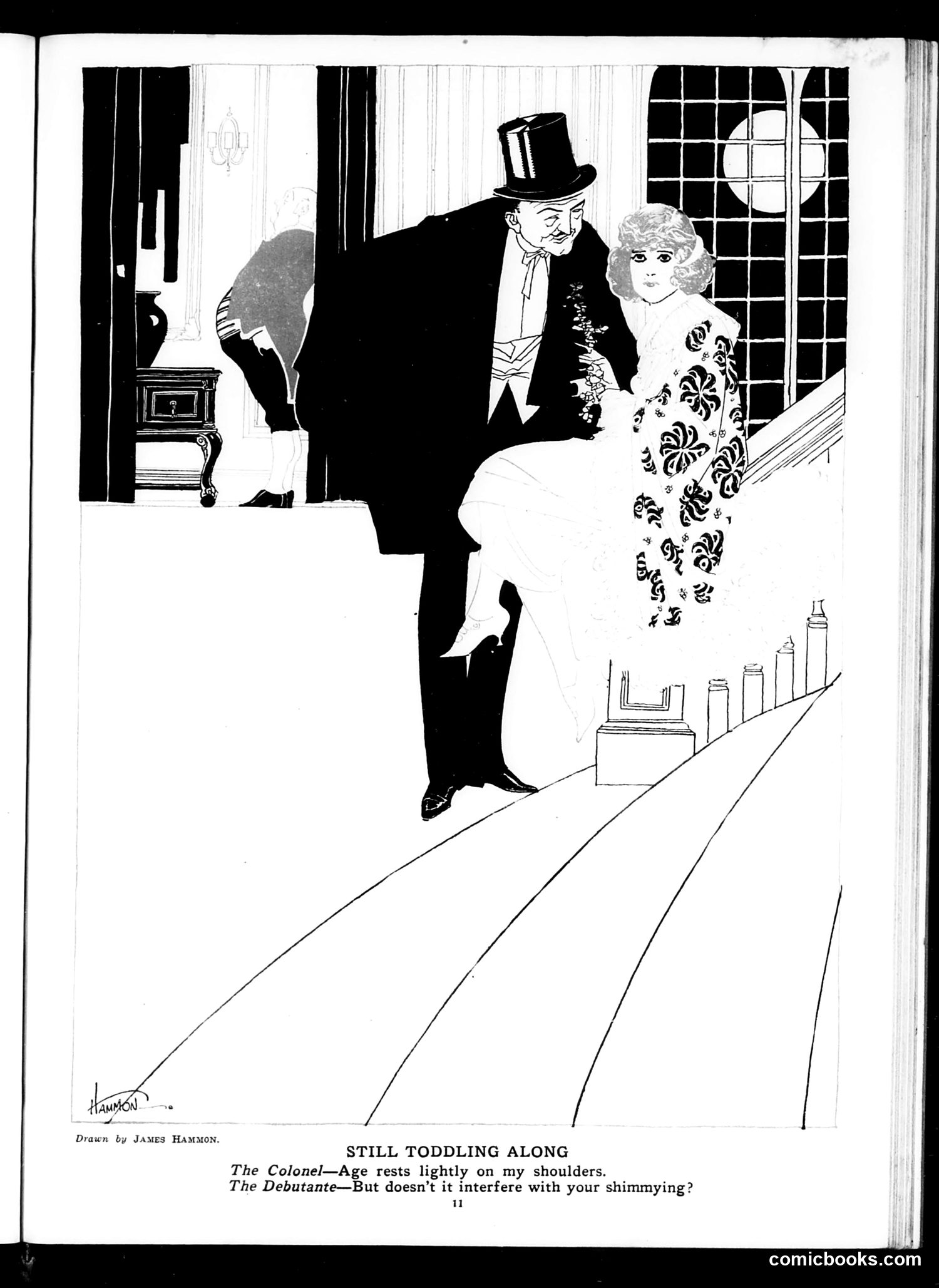
This James Hammon cartoon satirizes the generational clash of the 1920s Jazz Age. An elderly "Colonel" (representing old-fashioned respectability) claims age sits lightly on him, suggesting he's still vigorous. A young "Debutante" retorts sarcastically, asking if his age interferes with "shimmying"—the energetic, hip-swinging dance craze that symbolized 1920s youth rebellion and loose morals in conservative eyes. The joke mocks the Colonel's pretense of youthfulness while simultaneously ribbing the debutante's obsession with modern dancing. The cartoon captures period anxieties about flapper culture, generational values, and whether older society could genuinely participate in or approve of youth's radical new social behaviors.
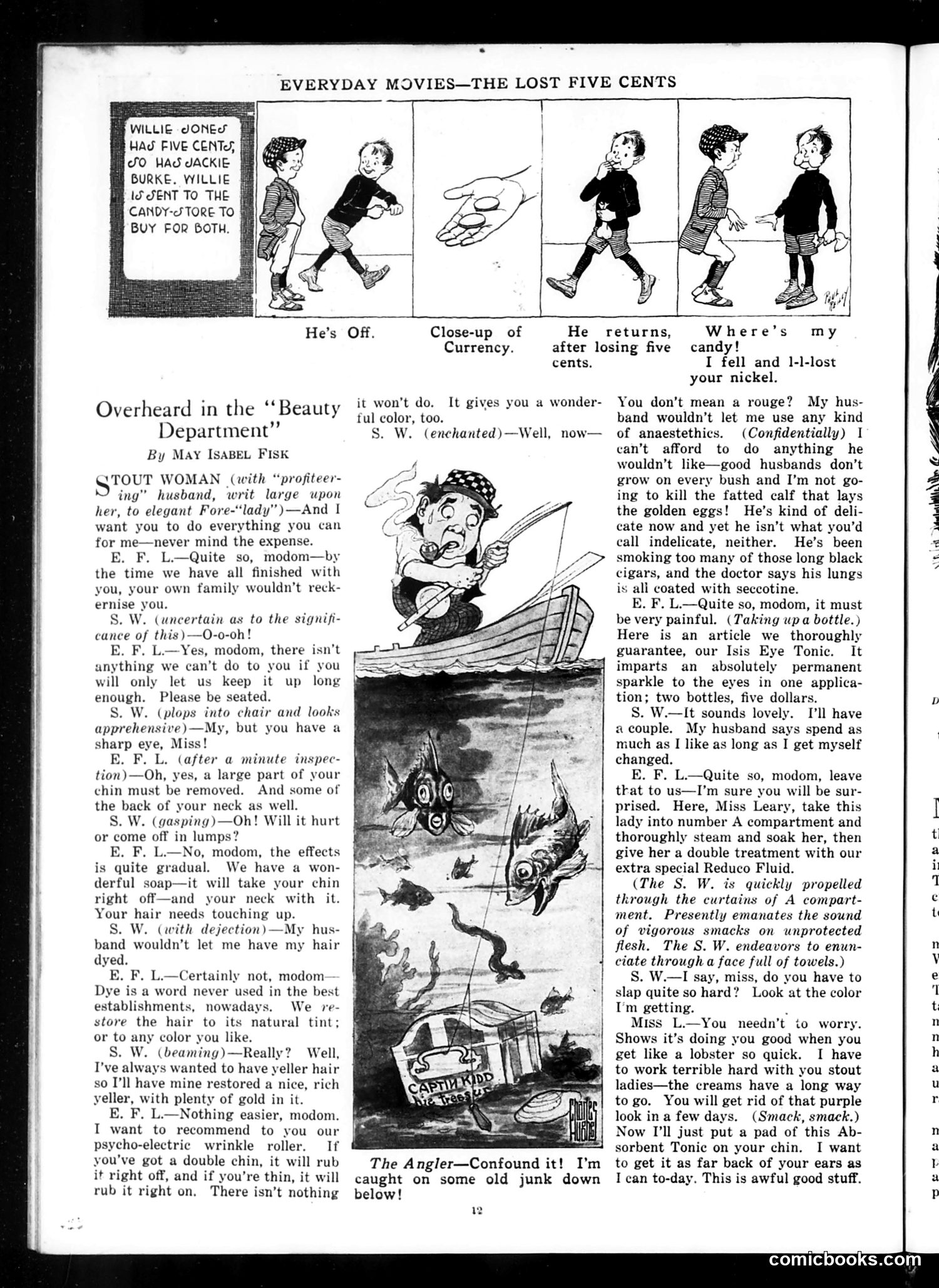
**Top Cartoon: "Everyday Movies—The Lost Five Cents"** A simple comic strip showing two boys, Willie Jones and Jackie Burke, sent to a candy store with combined five cents. Willie loses the money and returns empty-handed. The joke satirizes the mundane disappointments of childhood—the "everyday movie" of ordinary life being more anticlimactic than theatrical entertainment. **Main Feature: "Overheard in the Beauty Department"** By May Isabel Fisk, this satirical dialogue mocks wealthy "profiteering" wives (those profiting from wartime inflation) visiting beauty salons. The salon owner uses deliberately vague, flattering language while describing aggressive treatments (soap that "removes" chins, mysterious "Reduco Fluid," physical slapping). The satire targets both the wealthy woman's vanity and willingness to spend money without question, and the salon's predatory marketing of dubious beauty treatments. The accompanying cartoon illustrates the absurd "angler" struggling with junk—likely representing the beauty industry itself as a trap.
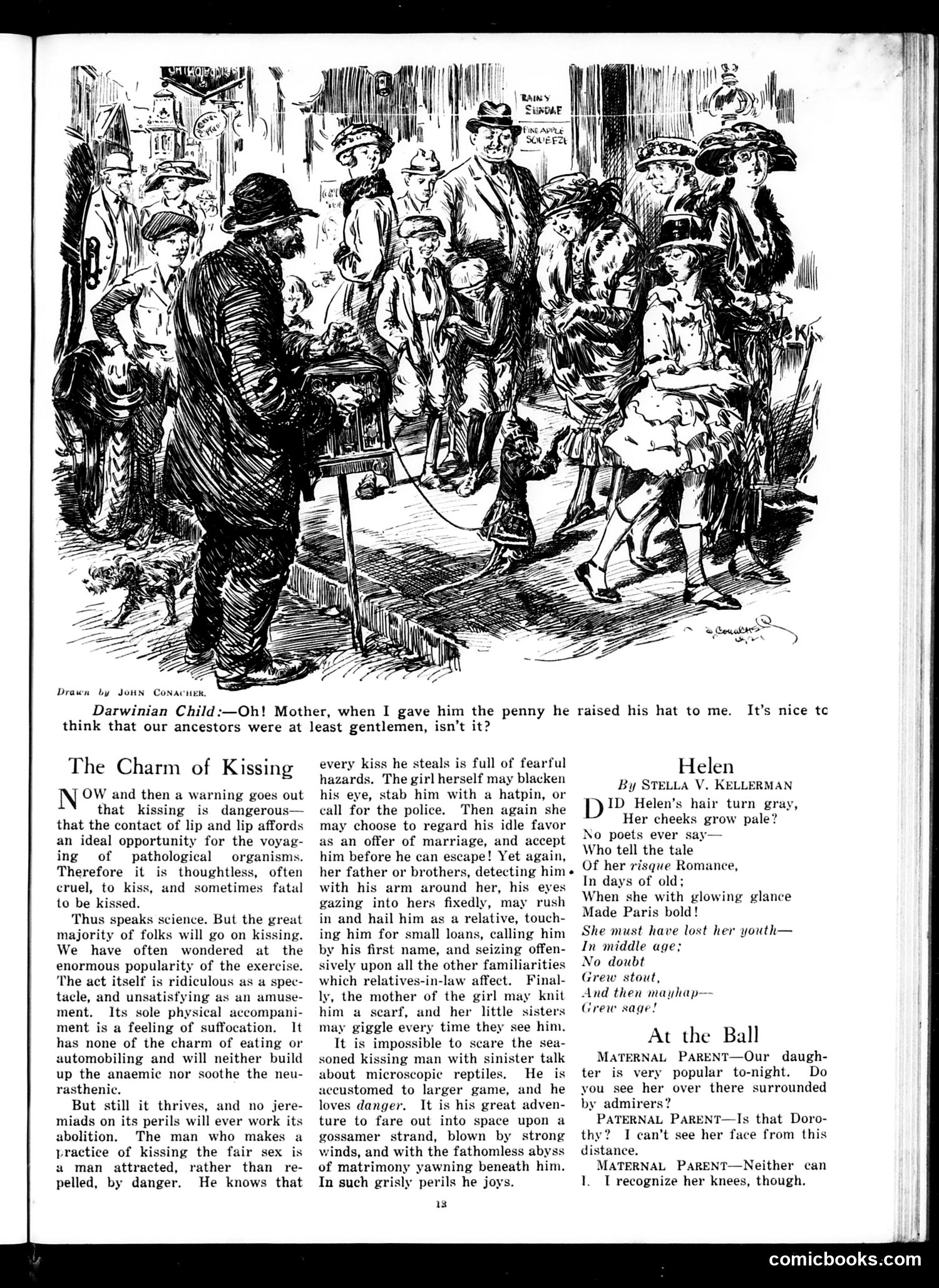
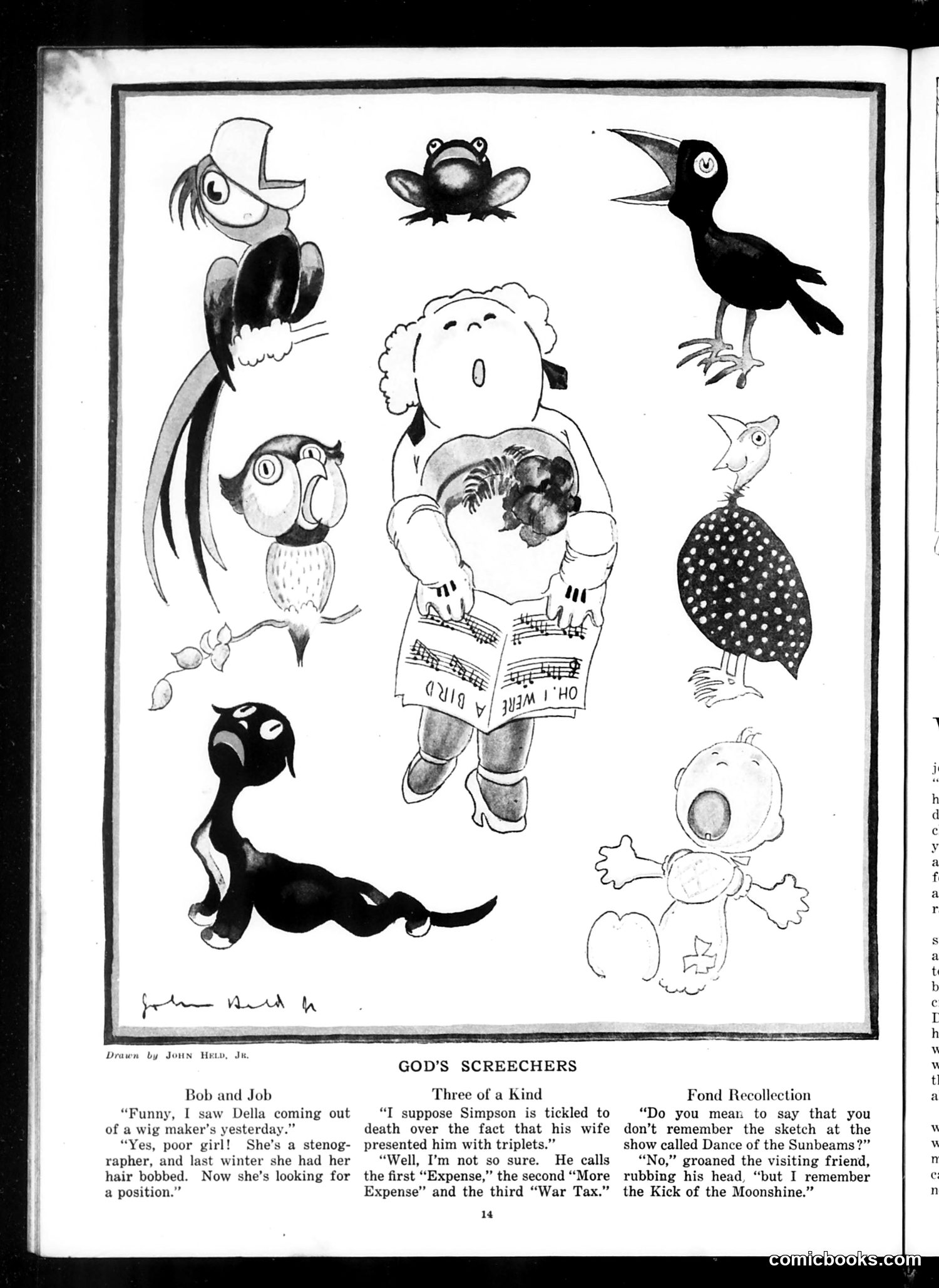
This page contains three separate jokes drawn by John Held Jr., satirizing early 20th-century American life: **"Bob and Job"**: Mocks the "bobbed hair" trend among young women. A stenographer cut her hair fashionably short but couldn't find employment afterward—suggesting employers discriminated against women with modern hairstyles, viewing them as improper or rebellious. **"Three of a Kind"**: Satirizes wartime financial burden. A man with triplets cynically names them after expenses: "Expense," "More Expense," and "War Tax"—reflecting frustration with rising costs during WWI and the new federal income tax (implemented 1913). **"Fond Recollection"**: References Prohibition-era humor. A visitor recalls not a theatrical "Dance of the Sunbeams" sketch, but rather "the Kick of the Moonshine"—moonshine being illegal homemade alcohol, whose effects he literally felt. The whimsical animal and character drawings frame these social commentary jokes about gender discrimination, economic anxiety, and Prohibition culture.
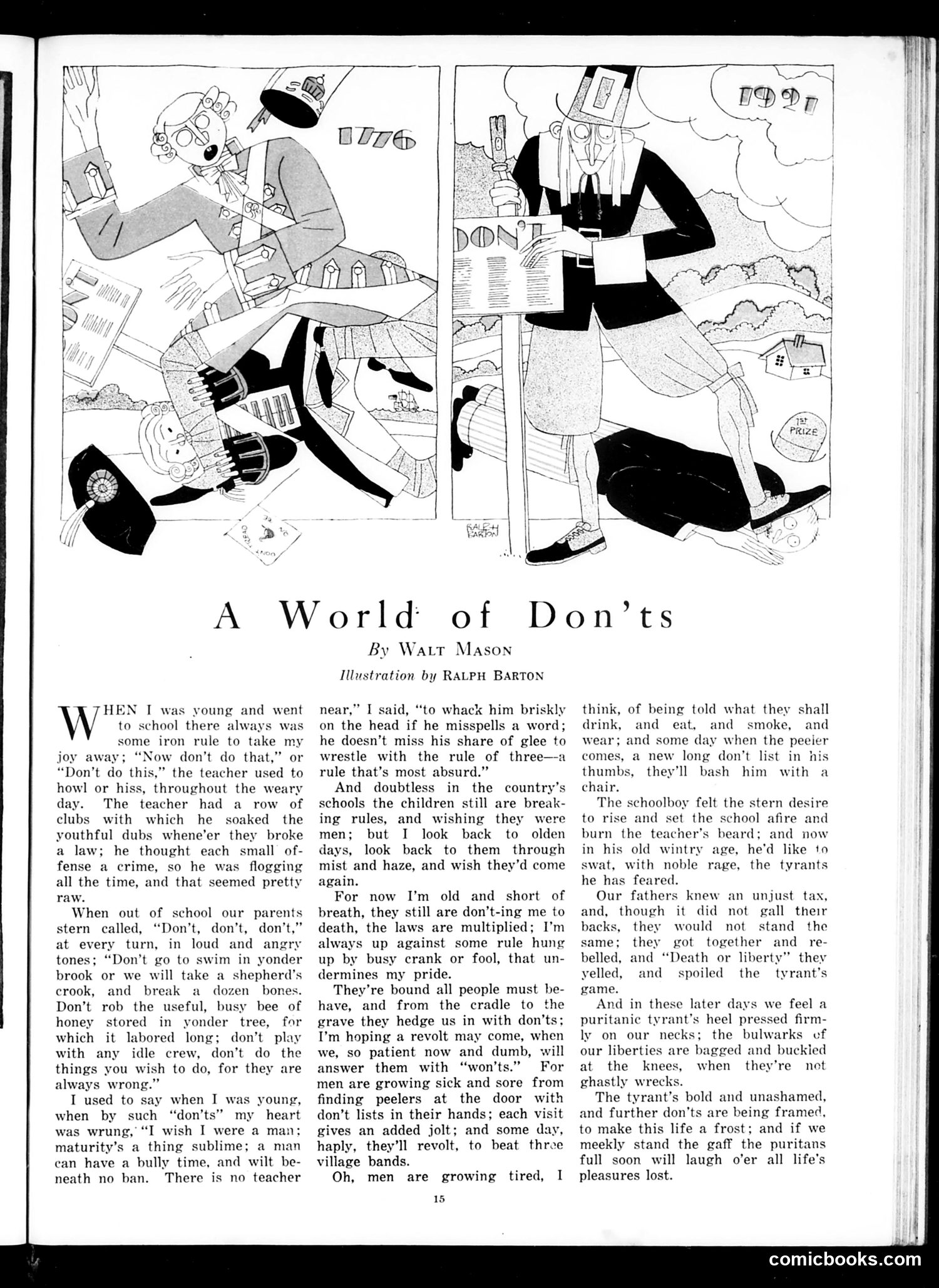
This is a satirical essay with accompanying illustrations by Ralph Barton, criticizing the pervasive restrictions imposed on Americans across their lifespan. **The Satire:** Mason argues that society imposes endless prohibitions—from schoolteachers' strict discipline, to parental rules, to modern government regulations—that undermine personal freedom and dignity. The piece draws a parallel to the American Revolution, suggesting current restrictions rival tyranny the founders rebelled against. **The Target:** The satire addresses what appears to be Prohibition-era moralism and expanding government regulation (people are told what to "drink, and eat, and smoke, and wear"). The cartoon depicts comically exaggerated authority figures (likely representing teachers, parents, and government officials) imposing these restrictions. **The Point:** Mason warns that Americans, grown "tired" of constant "don'ts," may eventually revolt violently ("bash him with a chair"), suggesting that excessive puritanical control breeds dangerous resentment rather than virtue.
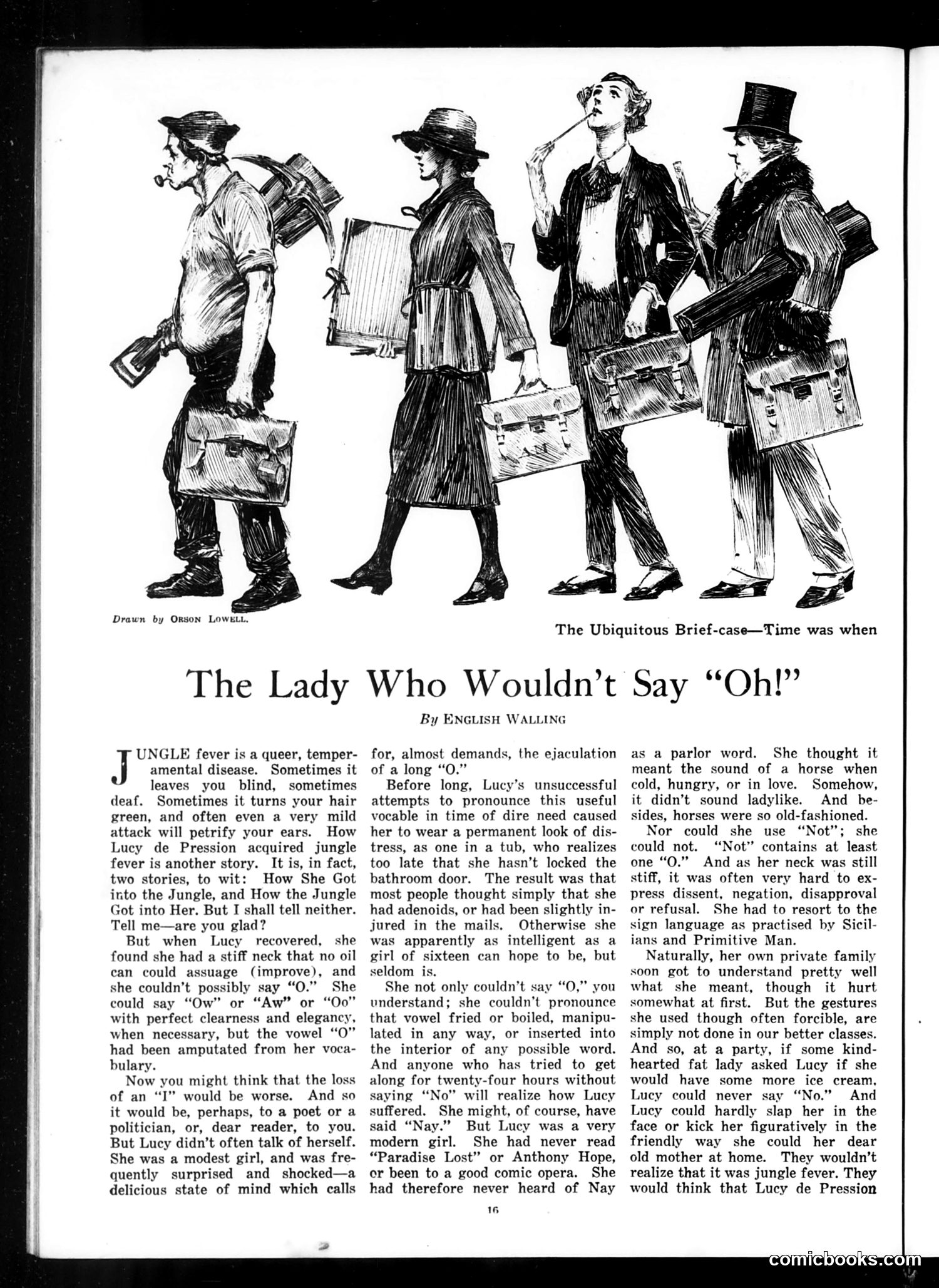
This humorous short story by English Walling satirizes social propriety and the limitations imposed on women in early 20th-century society. The premise: Lucy de Pression, a modest young woman who contracted jungle fever, loses the ability to pronounce the vowel "O"—a seemingly minor affliction that becomes socially catastrophic. She cannot say "No," "Not," or any word containing that sound, leaving her unable to express dissent or refusal in polite company. The satire targets how rigid social conventions trap women: Lucy cannot use alternatives like "Nay" (considered unfeminine and archaic) or resort to expressive gestures (deemed unladylike). The cartoon illustration shows well-dressed professionals carrying briefcases—representing the "modern" world—while Lucy remains confined by expectations of feminine restraint and decorum, unable to voice basic disagreement without violating social norms.
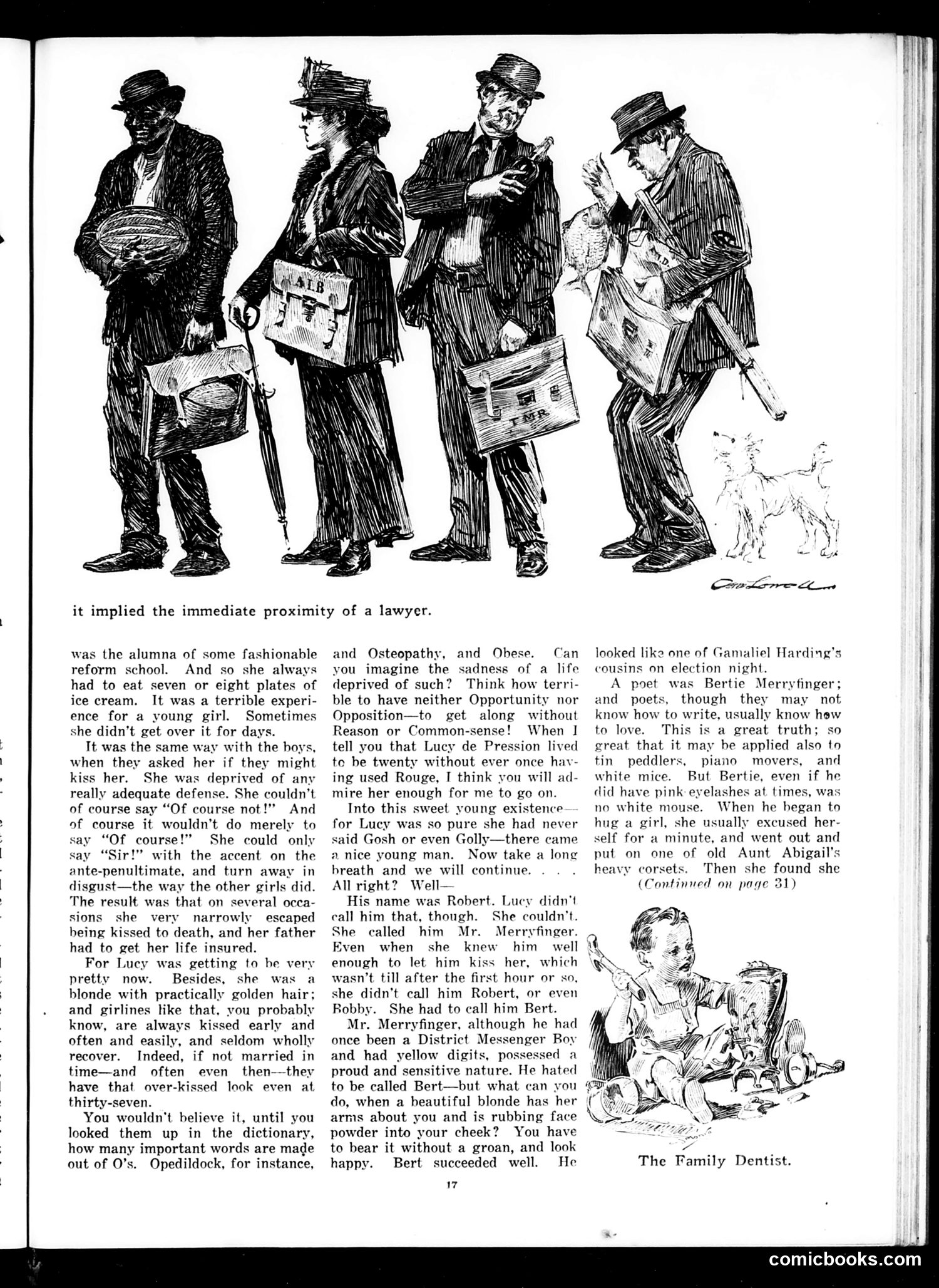
**The Main Cartoon (Top):** Four figures carrying newspapers and baskets represent ordinary citizens or working people. The illustration satirizes public concerns about legal matters—the caption notes "it implied the immediate proximity of a lawyer," suggesting that lawyers were becoming omnipresent or intrusive in everyday life. **The Story Text:** A humorous narrative about "Lucy de Pression," a sheltered young woman from a "fashionable reform school" who is so innocent she avoids saying words beginning with "O" (Opportunity, Opposition, etc.). When a young man named Robert (whom she calls "Mr. Merryfinger" or "Bert") begins courting her, complications ensue. The tone is satirical and mildly risqué for the era. **The Secondary Cartoon ("The Family Dentist"):** A small illustration showing what appears to be a dentist or doctor with a child, likely providing a humorous counterpoint to the main story's themes. The page satirizes early-20th-century courtship customs, female propriety, and social awkwardness through exaggerated character comedy.
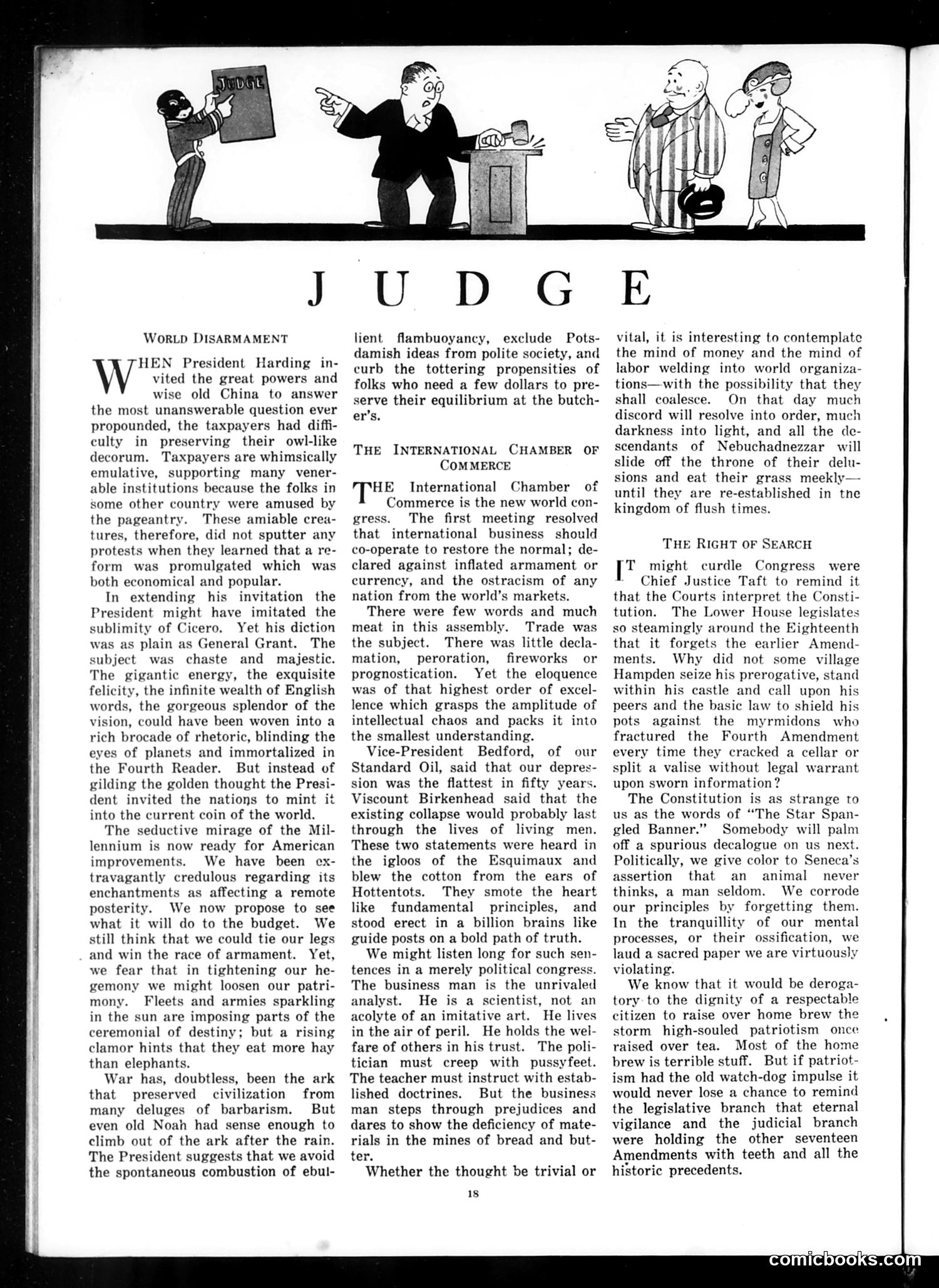
This page contains two distinct editorials from *Judge* magazine, likely from the early 1920s (referenced "President Harding" suggests 1921-1923). **The cartoon** (top) depicts a courtroom scene where a judge points accusingly at figures representing different nations/interests. It illustrates the satirical commentary on world disarmament negotiations that Harding initiated. **"World Disarmament"** praises Harding's invitation to world powers (including China) to discuss reducing military spending. The editorial sarcastically celebrates this as relief for taxpayers burdened by military costs, while mocking the flowery language politicians typically use—saying Harding spoke plainly "as plain as General Grant" instead. **"The International Chamber of Commerce"** praises business leaders as superior to politicians and teachers because they deal in practical facts rather than rhetoric. It contrasts statements from Standard Oil's Bedford and British politician Birkenhead, suggesting businessmen speak truth while politicians use evasive language ("creep with pussyfeet"). Both pieces celebrate pragmatism and cost-consciousness while mocking political ornamentation—typical *Judge* satire of the era.
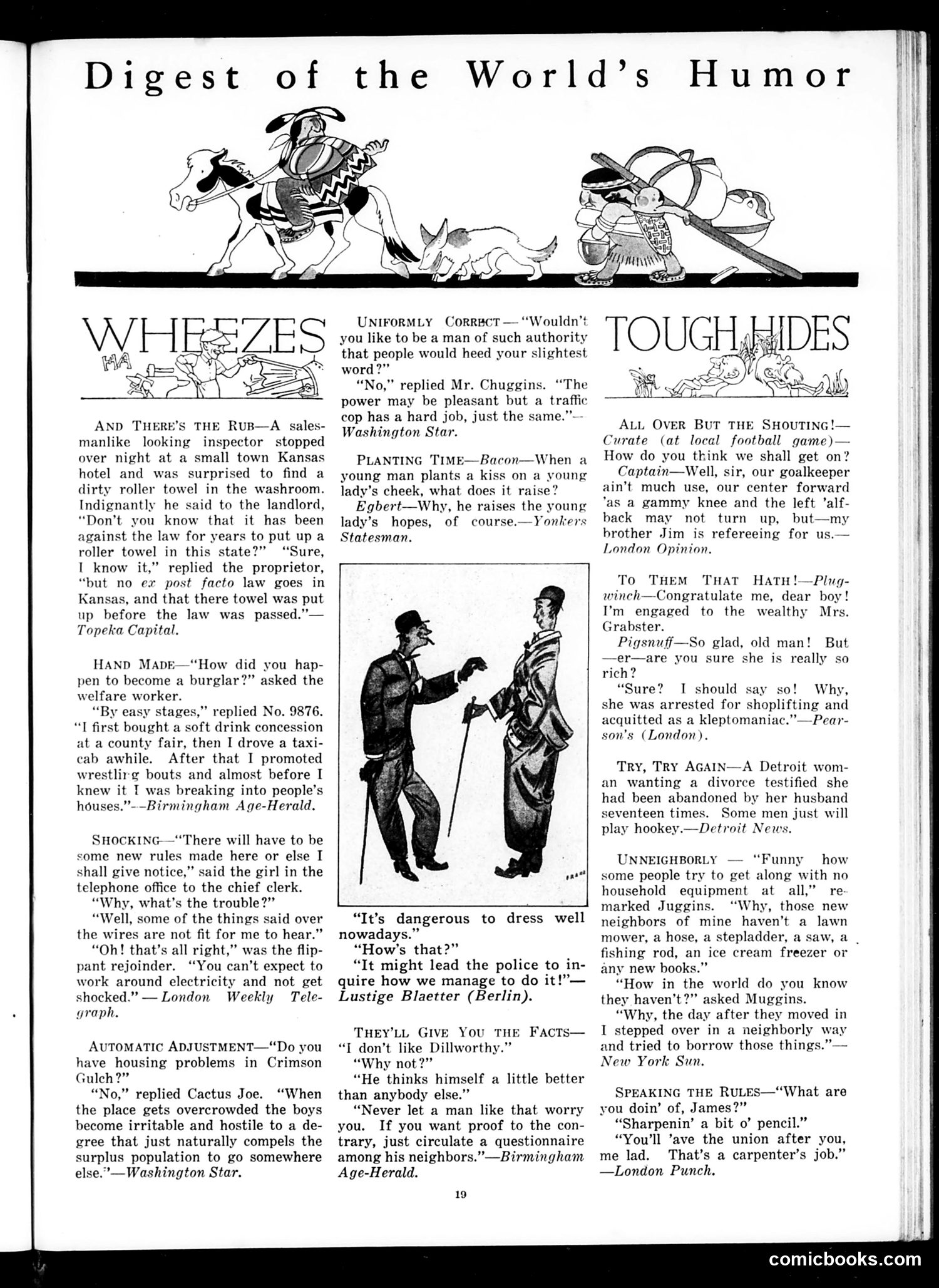
This page collects brief humorous anecdotes from newspapers worldwide, organized under punchy titles. The content reflects early 20th-century social anxieties and preoccupations: **Key themes:** - **Legal/bureaucratic absurdity** ("ex post facto law," old roller towels) - **Class commentary** ("Hand Made" traces a poor man's criminal descent through working-class jobs) - **Gender dynamics** (telephone operators offended by vulgar language; women and shoplifting) - **Police/authority skepticism** ("dress well" jokes about police harassment) - **Neighborly competitiveness** (borrowing tools as social one-upmanship) The central illustration shows two men in formal dress, likely representing the "dangerous to dress well" joke about police suspicion toward well-dressed individuals—a commentary on class profiling and economic anxiety during this era. The humor is gentle and domestic rather than overtly political, reflecting Judge magazine's focus on middle-class social observation rather than hard-hitting satire.
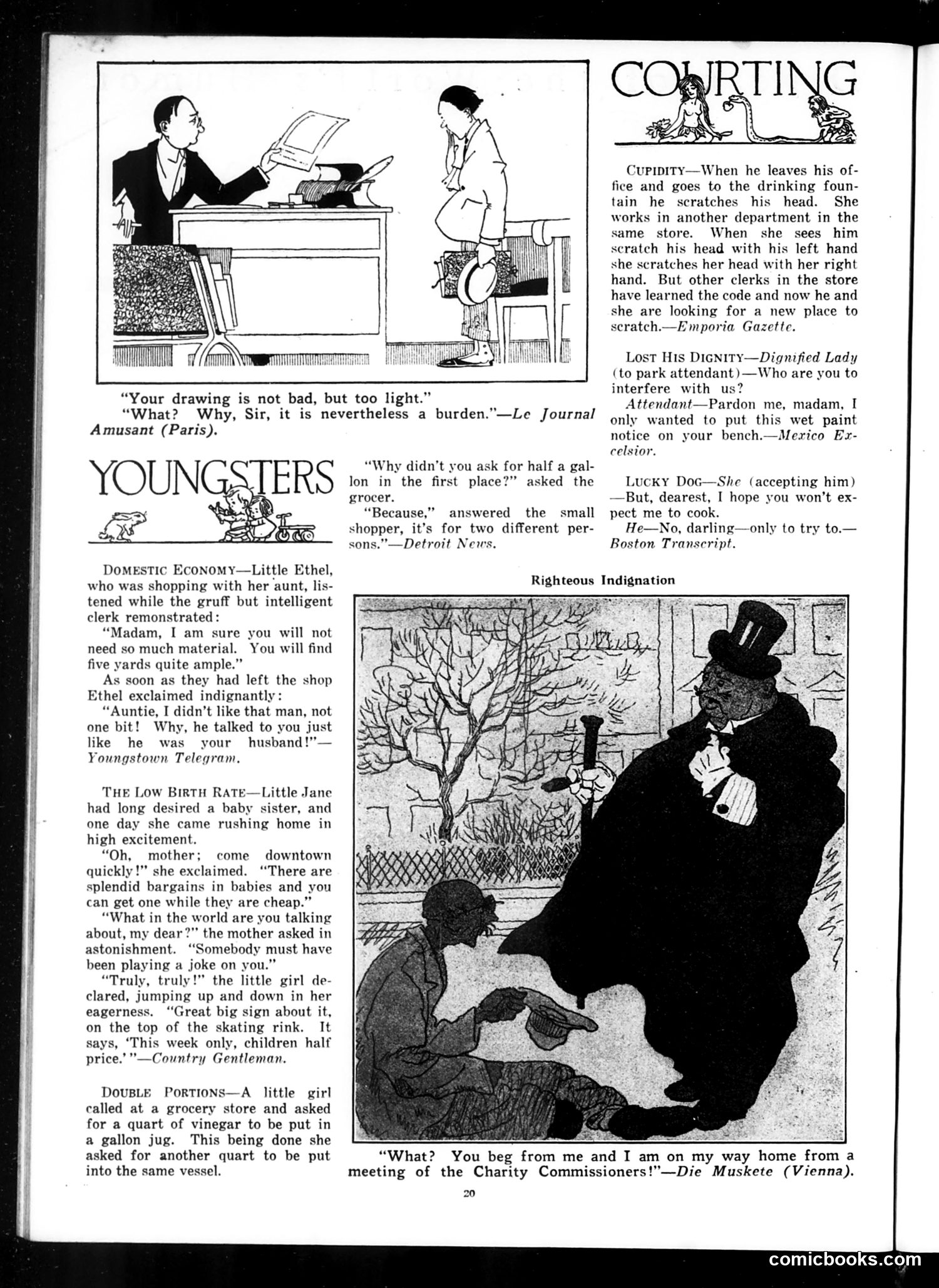
This page collects short humorous anecdotes and cartoons satirizing early 20th-century social behavior and class dynamics. **Top cartoon**: A boss critiques an employee's drawing as "too light"—a visual pun on the French phrase meaning the work lacks substance despite technical competence. **"Courting" section**: Anecdotes about workplace romance, domestic life, and courtship. "Cupidity" describes store clerks using head-scratching as a secret flirtation code. "Lost His Dignity" mocks a woman's pretentious objection to a park attendant's practical warning. **"Youngsters" section**: Child anecdotes about economic naivety—a girl misunderstanding a "half price children's" skating rink sign as a baby sale, and another requesting duplicate vinegar portions without understanding the absurdity. **Bottom cartoon "Righteous Indignation"**: A well-dressed gentleman indignantly refuses a beggar's request, citing his attendance at a Charity Commissioners meeting—satirizing hypocrisy and the disconnect between charitable posturing and actual compassion. The page's humor relies on misunderstandings, class pretension, and Victorian-era social conventions now largely obsolete.
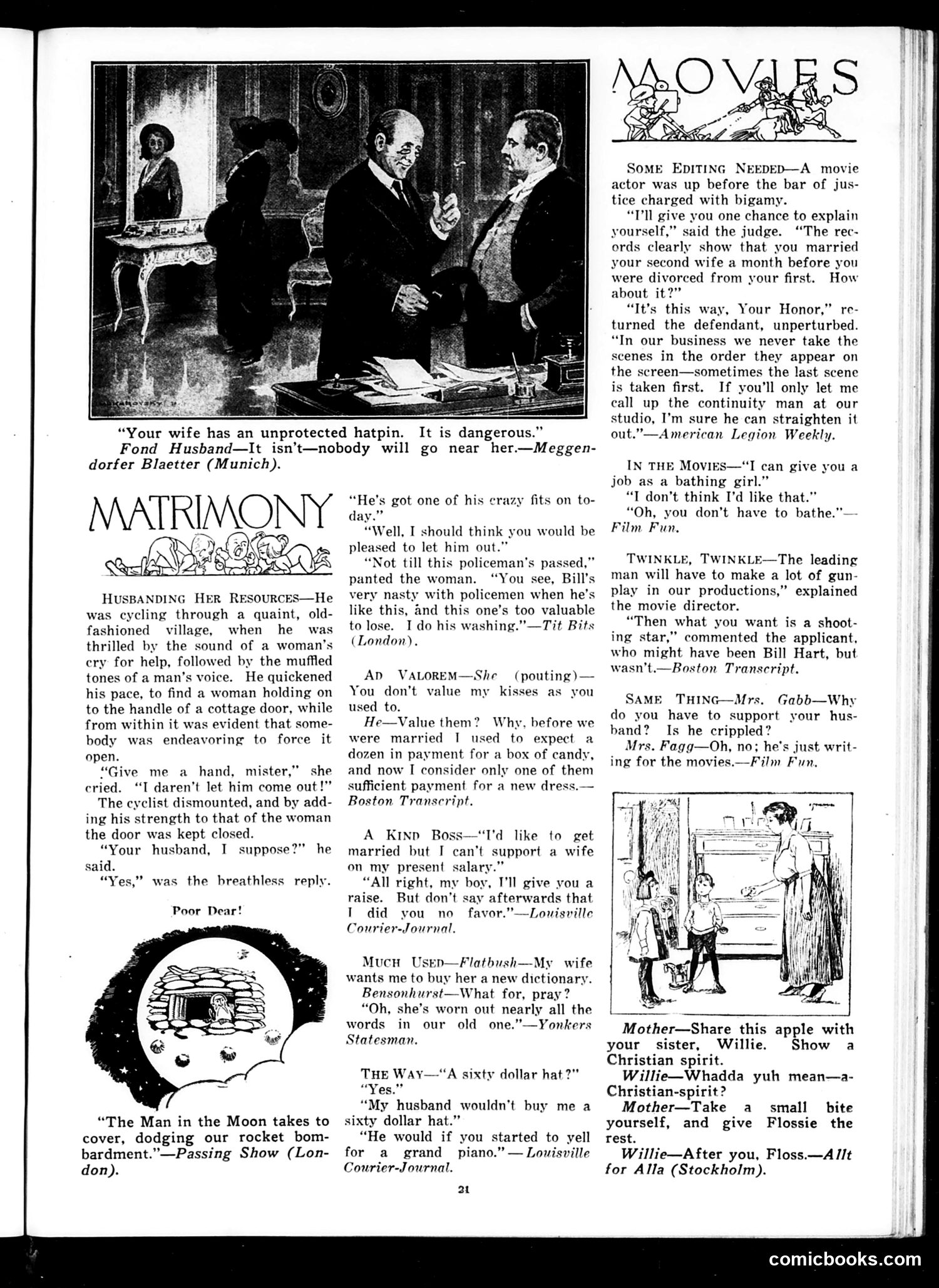
This page collects brief satirical jokes about marriage and early cinema, popular Judge features. The "Matrimony" section mocks married life: a wife restrains her violent husband from a cottage door to protect the policeman she does laundry for; another woman prevents her spouse from leaving until police pass; husbands undervalue wives' affection while wives exploit husbands for expensive gifts. The "Movies" section satirizes the film industry's loose morality and illogical practices. A bigamist actor excuses marrying twice by claiming filmmakers shoot scenes out of order—a joke about Hollywood's chaotic production methods and moral laxity. Other jokes mock bathing-girl roles, stunt casting, and screenwriters' low status. The page reflects 1920s anxieties: marriage as economic struggle, wives as shrewd financial managers, and cinema as morally questionable. The "Christian spirit" joke at bottom gently mocks children mimicking adult selfishness.
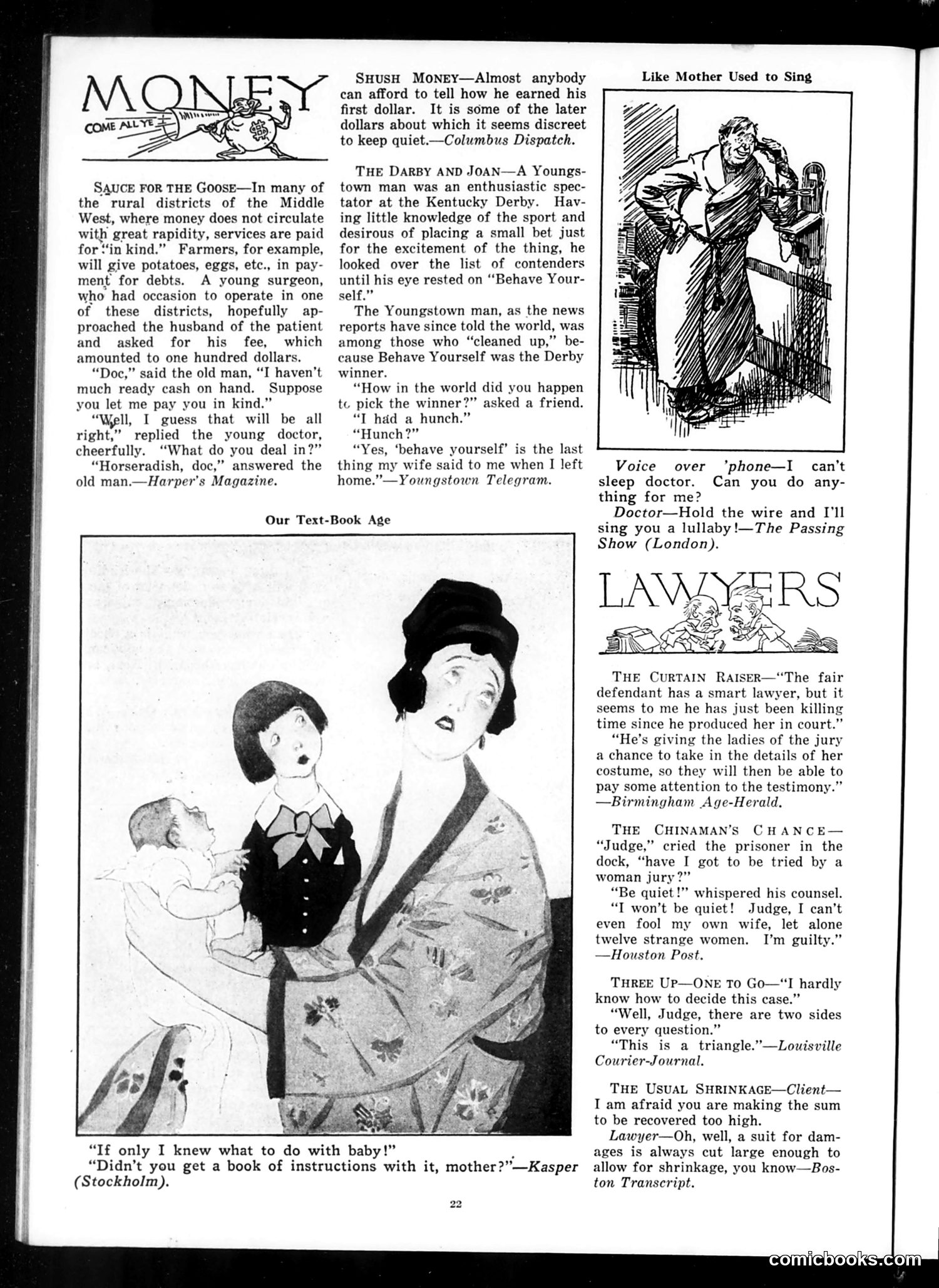
This page from *Judge* magazine contains six brief satirical humor pieces typical of early 20th-century American comedy: **"Sauce for the Goose"**: A rural doctor accepts payment in horseradish instead of cash—reversing the farmer's logic by taking "payment in kind." **"Our Text-Book Age"**: A cartoon mocking modern parenting's reliance on instruction manuals, showing a bewildered mother with babies, suggesting over-dependence on books rather than instinct. **"Shush Money"**: Commentary on financial hypocrisy—people boast about earning their first dollar but stay silent about questionable later earnings. **"The Darby and Joan"**: A man wins at the Kentucky Derby by betting on a horse named "Behave Yourself" because his wife said those parting words—luck based on domestic humor. **"The Chinaman's Chance"**: A prisoner refuses trial by women jurors, claiming he can't even deceive his own wife. References the idiom "Chinaman's chance" (meaning no chance at all), playing on male anxieties about female jurors. **"The Usual Shrinkage"**: A lawyer admits lawsuits are deliberately inflated knowing courts will reduce damages—cynical commentary on legal practice.
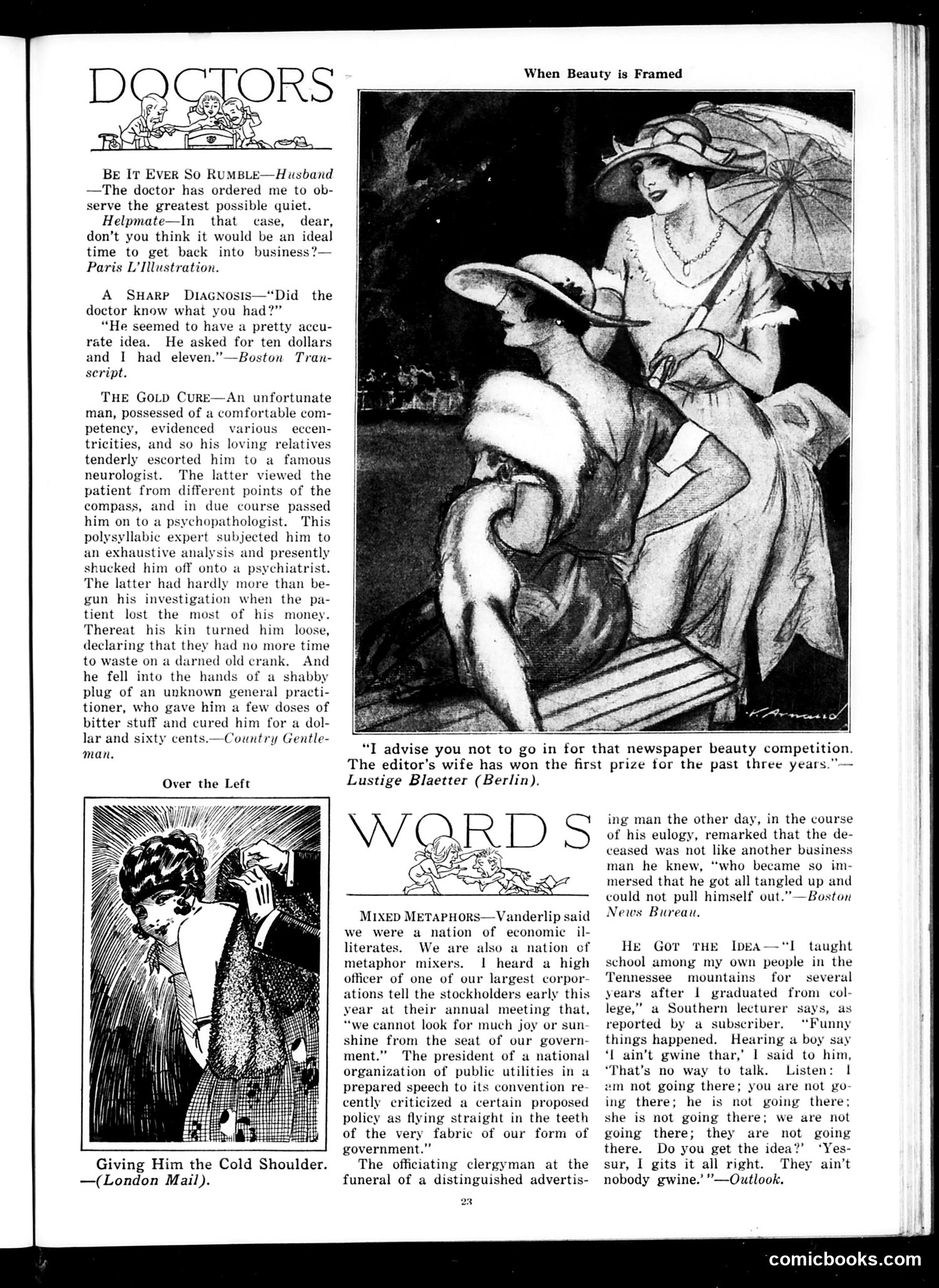
This page contains several humor sections satirizing American society circa early 20th century: **"The Gold Cure"** mocks the medical establishment's over-specialization. A wealthy eccentric is passed from neurologist to psychopathologist to psychiatrist—expensive specialists who accomplish nothing. Only when he loses his money and sees a humble general practitioner does he get cured cheaply. The satire targets the pretension and ineffectiveness of high-fee specialists versus practical medicine. **"Mixed Metaphors"** ridicules business and political leaders for mangled language. Corporate executives and utility officials use contradictory phrases ("joy or sunshine from the seat of our government"; "flying straight in the teeth of the fabric"). This mocks the pompous but incoherent rhetoric of powerful men. **"He Got the Idea"** presents a dialect humor piece about a Southern teacher explaining grammar to a rural student who ultimately rejects it—gentle mockery of both educated condescension and stubborn folk speech. The cartoon "When Beauty is Framed" (top right) warns against newspaper beauty competitions where the editor's wife inevitably wins—satirizing fixed contests and nepotism.
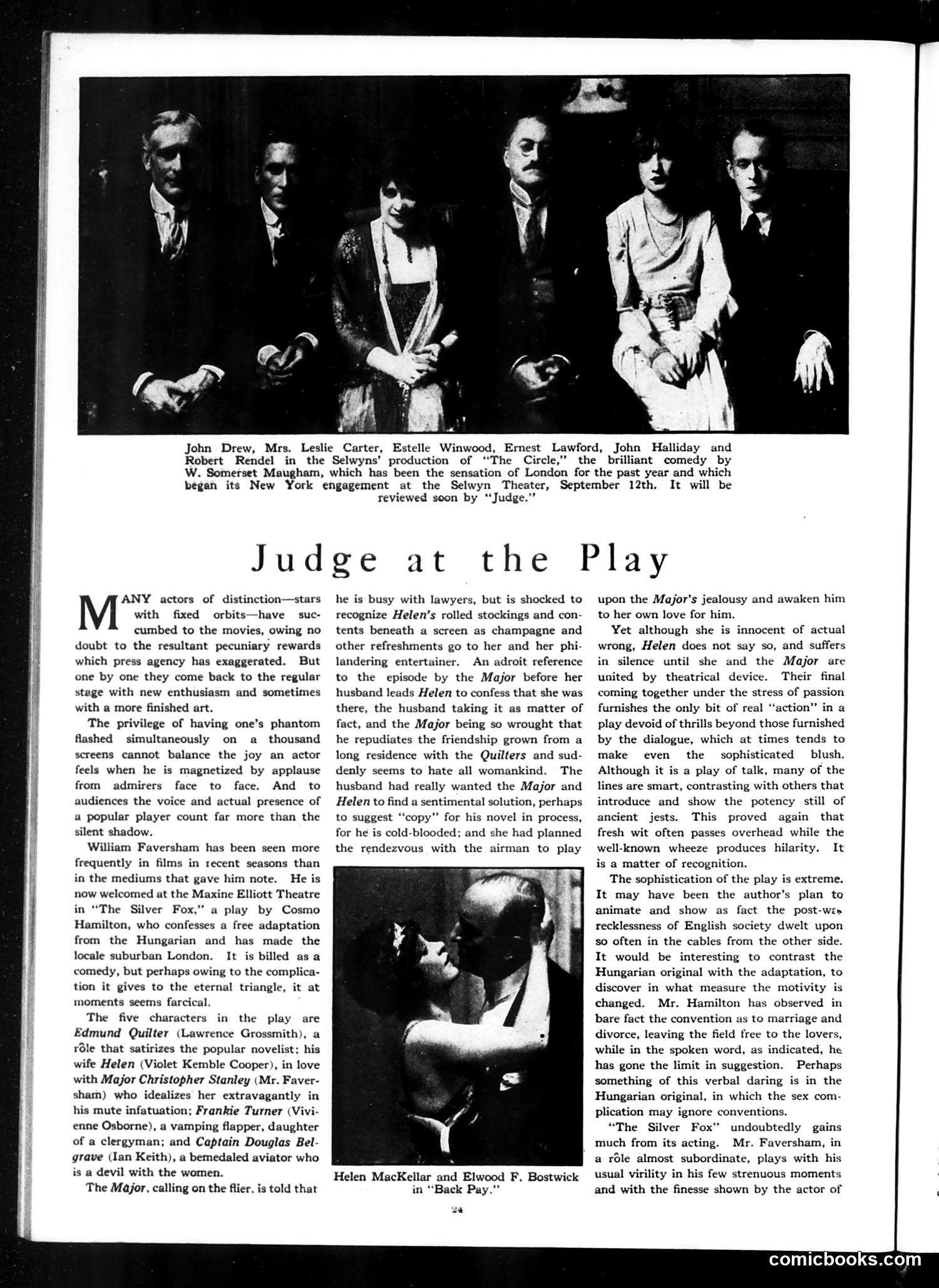
This page reviews two Broadway productions: W. Somerset Maugham's "The Circle" (opening photo) and Cosmo Hamilton's "The Silver Fox" (main review). The critic praises actors returning from Hollywood films to live theater, arguing that stage work requires genuine skill—"the voice and actual presence of a popular player count far more than the silent shadow." William Faversham's return to Broadway exemplifies this trend. "The Silver Fox" is a drawing-room comedy centered on marital infidelity and jealousy. The plot involves misunderstanding: a wife (Helen) meets an aviator; her husband (a novelist seeking "copy") and a major both misinterpret her innocence as guilt. The critic notes the play relies heavily on witty dialogue rather than dramatic action, though acknowledges some lines are clever while others recycle "ancient jests" that still generate laughs through familiarity rather than originality. The overall tone is sophisticated but somewhat thin on substance.
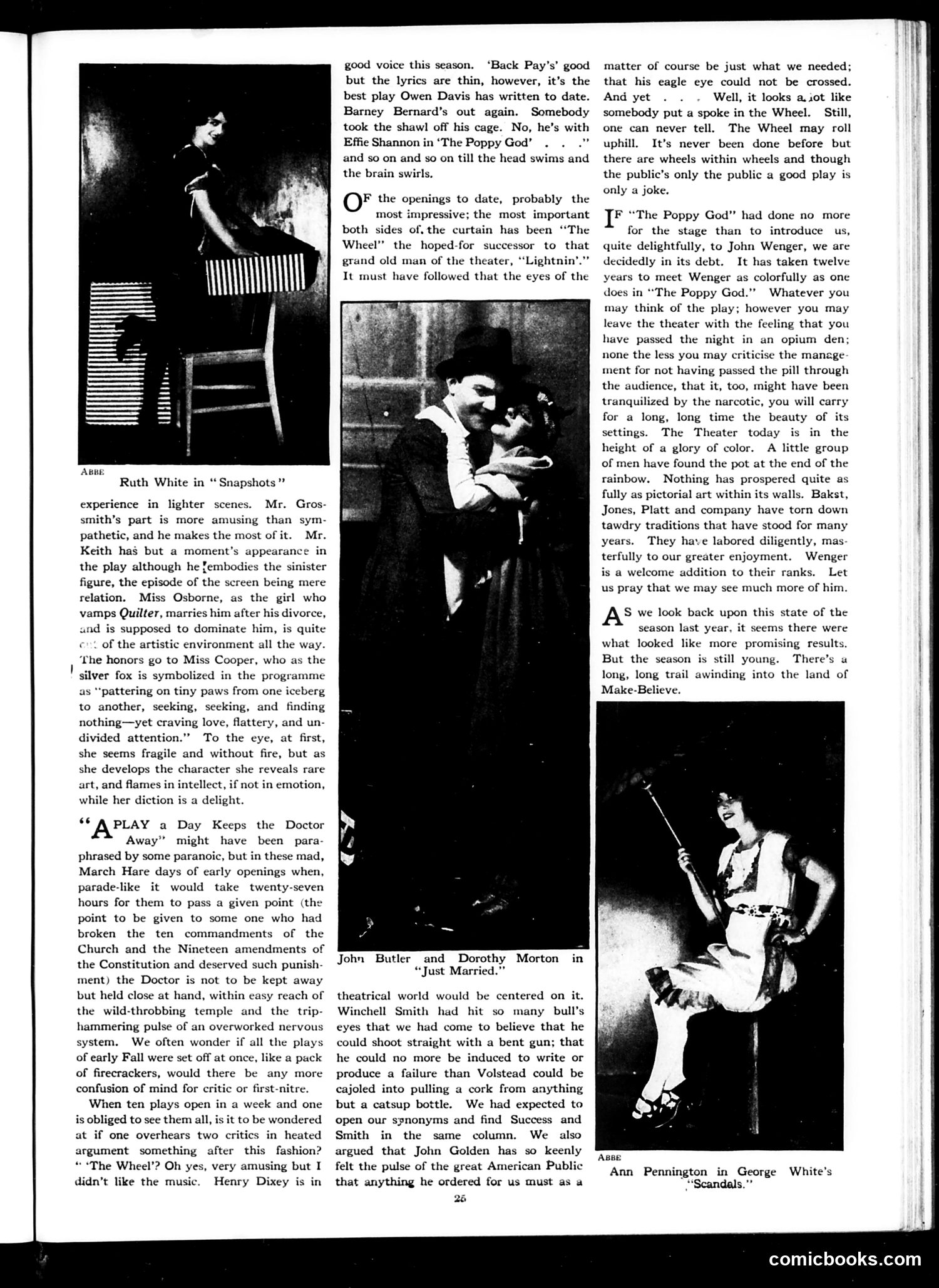
This is a theater criticism page from Judge magazine reviewing Broadway openings. The critic discusses several plays including "The Wheel" (by celebrated playwright Winchell Smith), "The Poppy God," and "Just Married." The main point is satirical commentary on the overwhelming number of theatrical openings—the critic jokes that ten plays opening weekly creates such exhaustion that critics become delirious, arguing nonsensically about shows. The opening phrase "A Play a Day Keeps the Doctor Away" parodies the familiar health adage. The photographs show scenes from productions: Ruth White in "Snapshots," and John Butler with Dorothy Morton in "Just Married." The critic praises performer John Wenger's debut in "The Poppy God" and expresses surprise that "The Wheel," despite being from reliably successful producer Winchell Smith, appears to have "a spoke in" it—meaning it may not succeed despite high expectations.
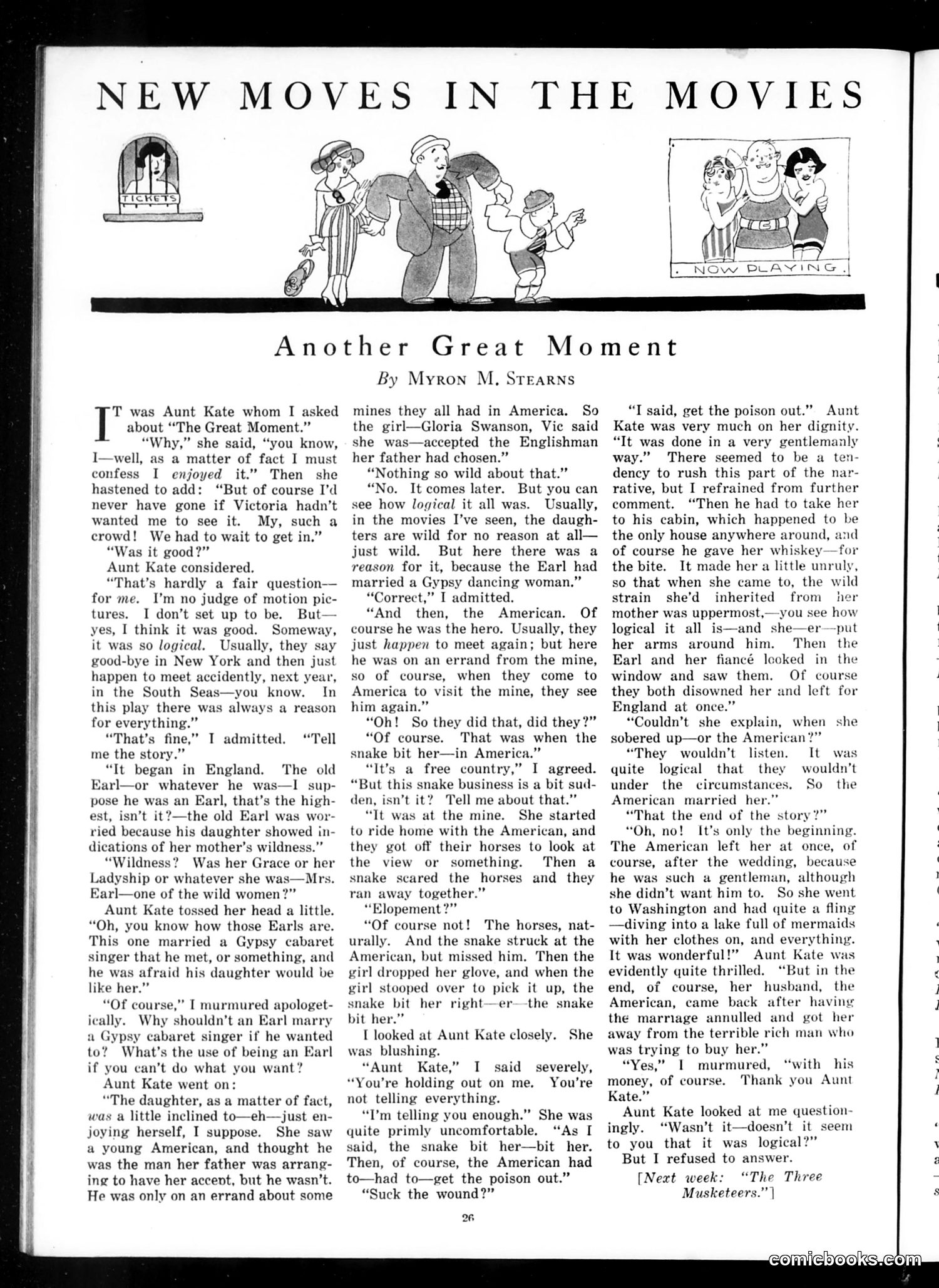
This article is satirical commentary on silent film logic and social propriety. Aunt Kate discusses the plot of what appears to be a Gloria Swanson film involving an English Earl's daughter, an American hero, and improbable plot devices. The satire targets: 1. **Movie plotting**: The author mocks how films justify coincidental meetings through contrived "reasons" (mines, errands) while presenting this as logical improvement over typical cinema. 2. **Class and morality**: The setup of a "wild" daughter with a Gypsy cabaret singer mother reflects period anxieties about hereditary wildness and propriety. 3. **Sexual innuendo**: The lengthy, coy discussion of a snake bite requiring the American to "suck the wound" is clearly double entendre. Aunt Kate's embarrassed evasion ("done in a very gentlemanly way") highlights how Victorian prudishness clashed with increasingly risqué film content. The humor derives from Aunt Kate's earnest defense of the film's logic while unwittingly revealing it's actually absurd—and from her discomfort discussing the thinly-veiled seduction scene.
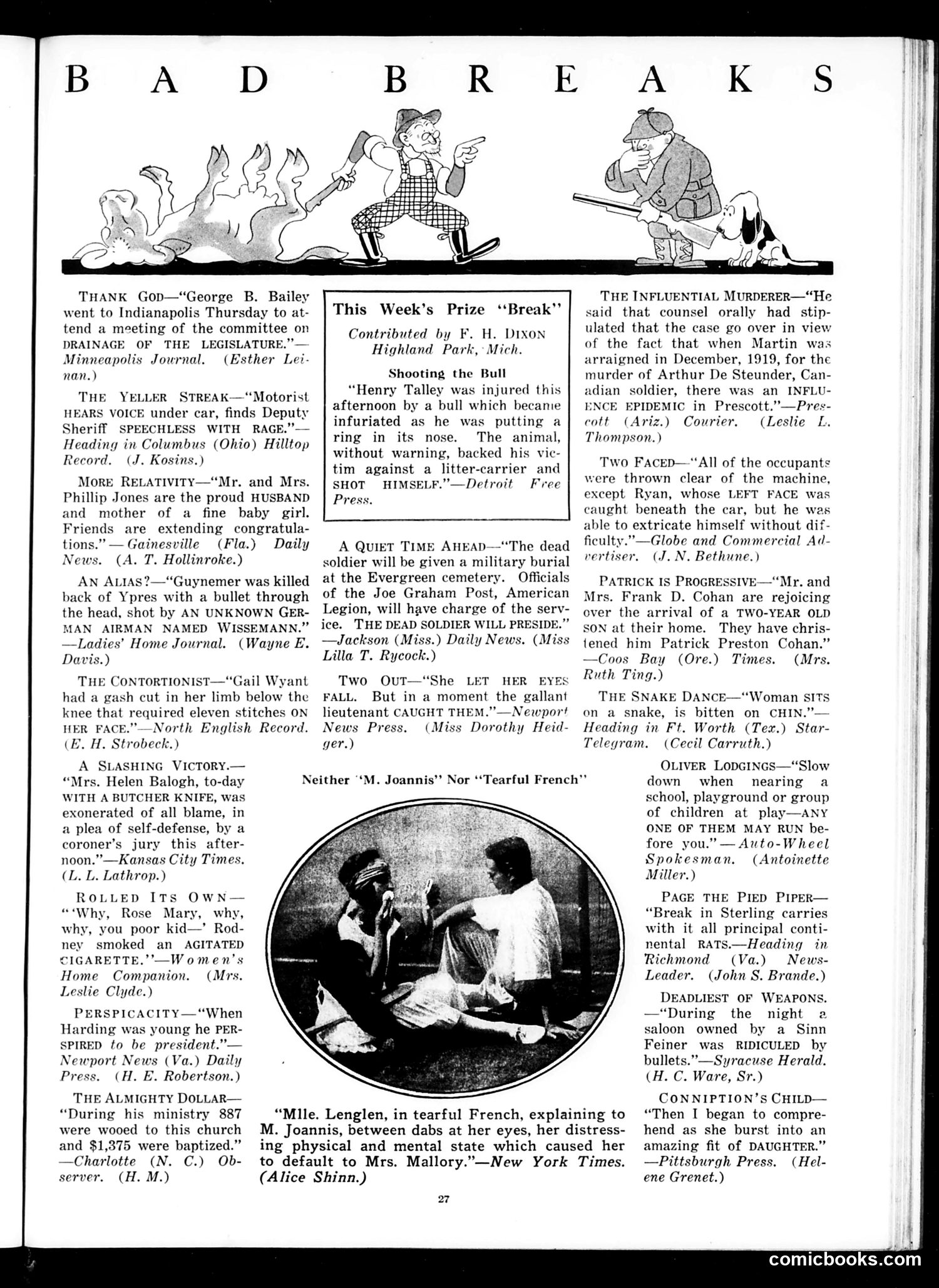
This page collects humorous newspaper typos and editorial errors submitted by readers—Judge's running "Bad Breaks" feature. The cartoon at top shows a figure chasing rabbits (representing the errors themselves), satirizing how these mistakes escape editors' notice. The collected errors are genuinely funny absurdities: a soldier who will "preside" at his own funeral; a woman with a gash on her knee "requiring stitches ON HER FACE"; a bull that "shot himself." The centerpiece photo shows tennis player Mlle. Lenglen (a famous French player of the era) tearfully explaining her default to Mrs. Mallory. The satire isn't political but editorial—mocking the carelessness of newspapers themselves. By publishing these glaring contradictions and logical impossibilities, Judge highlights how even major publications fail basic proofreading. It's gentle mockery of institutional incompetence, appealing to readers' superiority by invitation to spot what professionals missed.
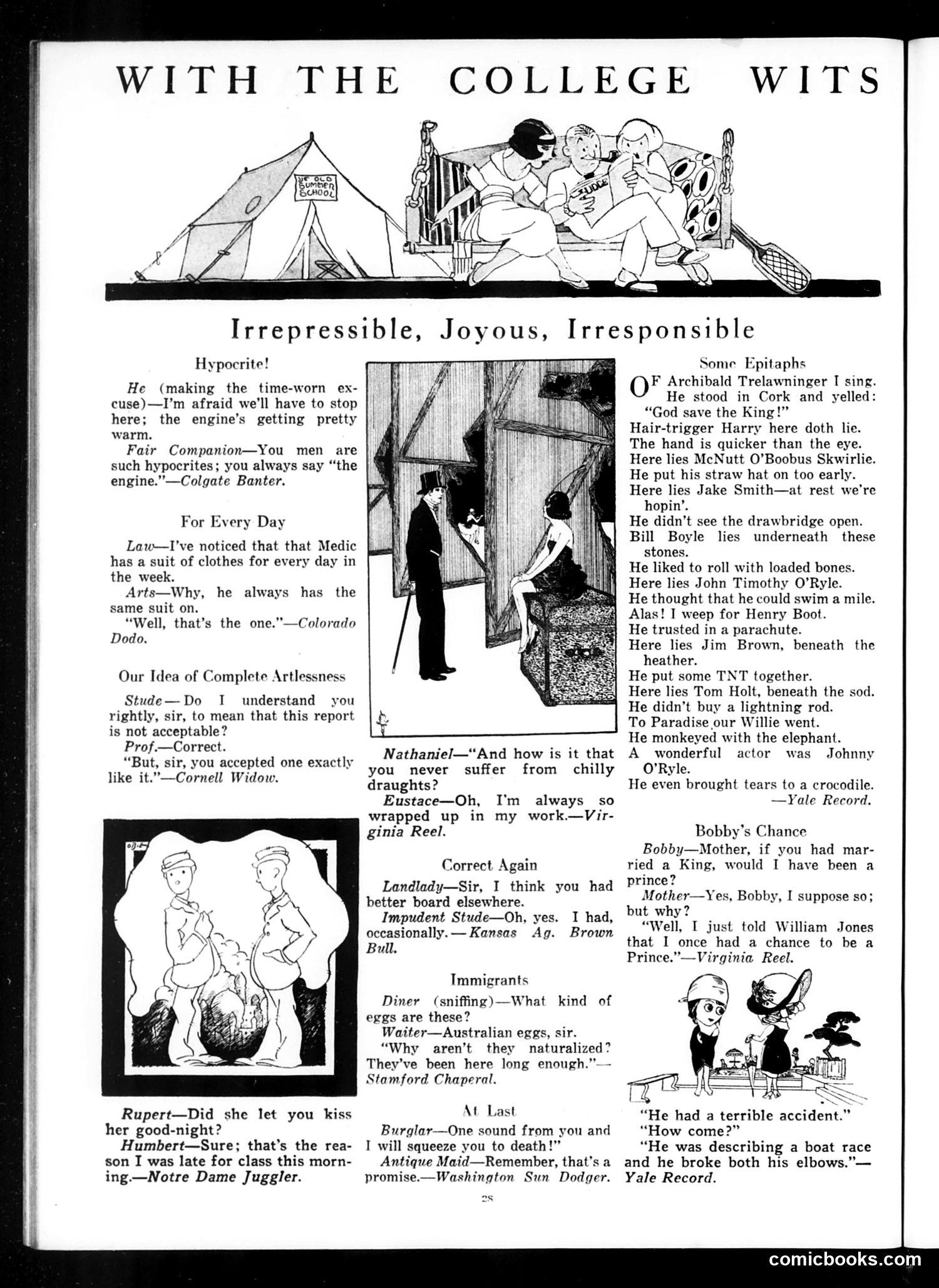
This page collects humorous anecdotes from college newspapers, satirizing undergraduate life and social conventions of the early 20th century. The jokes target: **Dating & Romance**: A couple's car stops; the man blames engine heat. The woman calls out his transparent excuse—suggesting young men used mechanical problems as pretexts to end dates. **Student Hypocrisy**: A professor accepts identical poor work from different students, exposing academic dishonesty. **Class Dynamics**: A landlord evicts a student; the student cheekily admits he'd boarded elsewhere—mocking student irresponsibility. **Immigration**: A diner questions why Australian eggs aren't "naturalized" after long residence—a joke about immigrant assimilation. **Epitaphs Section**: Dark humor listing college students' ridiculous deaths (drawbridge accidents, explosives, elephant mishaps), likely mocking reckless youth behavior. The overall tone is affectionate mockery of college boys' immaturity, romantic bumbling, and dangerous foolishness—standard fare for collegiate humor magazines of this era.
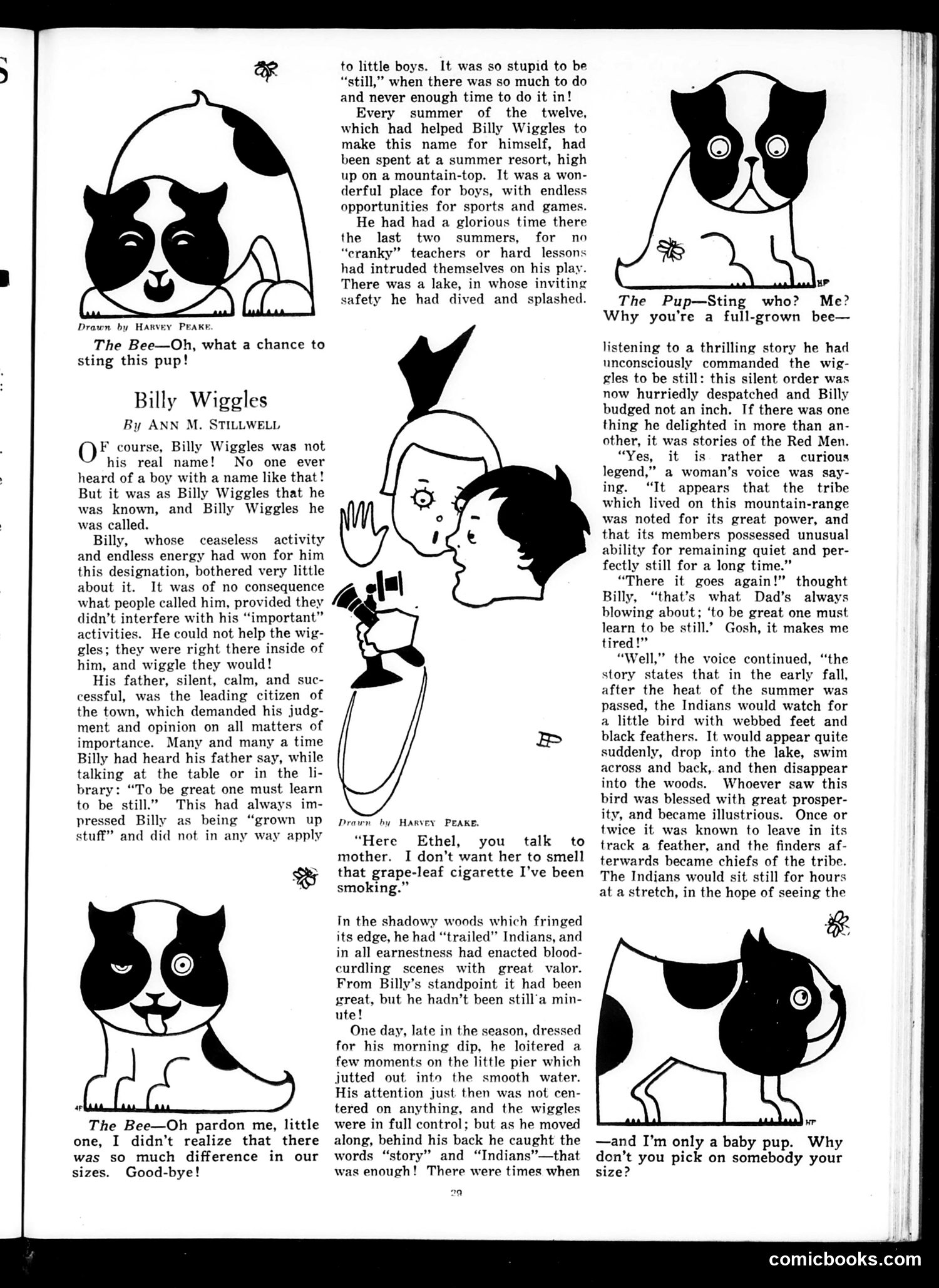
This is a children's story by Ann M. Stillwell featuring illustrations by Harvey Peake. The narrative follows an energetic boy nicknamed "Billy Wiggles" who cannot stay still—a trait that frustrates his successful, composed father, who repeatedly tells him "to be great one must learn to be still." The story appears to be a moral lesson about self-control and discipline, values emphasized in early-20th-century parenting and education. The sidebars with the bee cartoons provide comic relief, anthropomorphizing insects in scenarios with size-based humor. The tale takes an Indian legend angle (using period-typical terminology and "playing Indians" tropes common to the era) where stillness becomes a valued trait—ironically validating the father's philosophy. This is a straightforward didactic story promoting restraint and composure to young readers, reflecting contemporary anxieties about childhood energy and proper deportment.
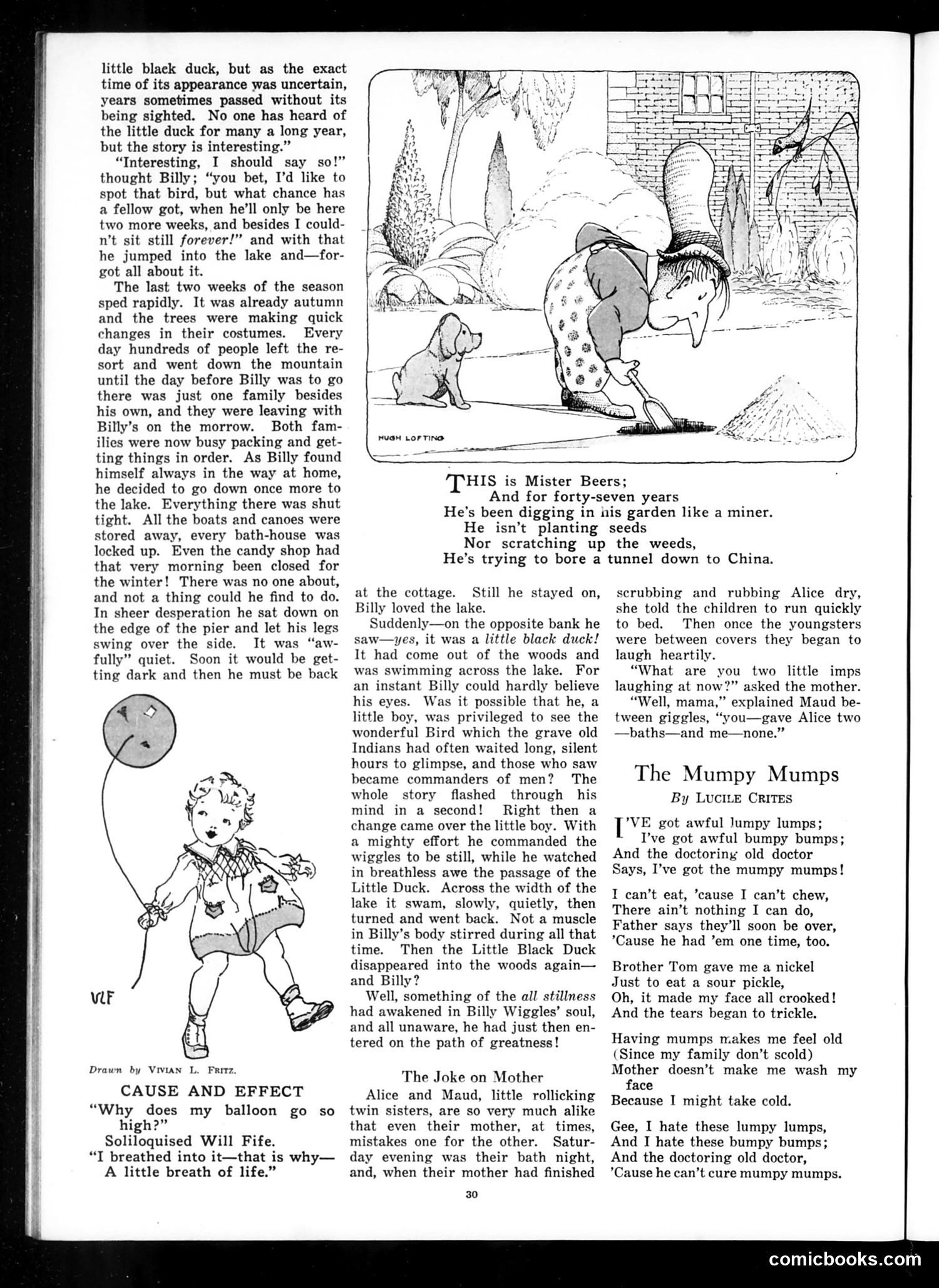
This page contains three humorous pieces typical of early 20th-century American humor: **"Cause and Effect"**: A simple visual gag about a boy's balloon—he explains it goes high because he "breathed into it—that is why—A little breath of life." The joke plays on the literal interpretation of giving something life force. **"Mister Beers"**: A satirical verse about a man spending 47 years digging in his garden, attempting to bore a tunnel to China. This references a common folk notion (appearing in period humor) of the absurd idea that one could tunnel straight through Earth to China. The humor mocks obsessive, futile labor. **"The Mumpy Mumps"** and **"The Joke on Mother"**: Light children's stories. The first is a humorous poem about having mumps (then a common childhood illness). The second involves twin sisters confusing their mother during bath time—she bathed one child twice, forgetting the other. The main illustration shows a boy at a lake watching a legendary "little black duck," which the narrative suggests represents a transformative spiritual moment. These are genteel, family-appropriate comedic pieces without political content.
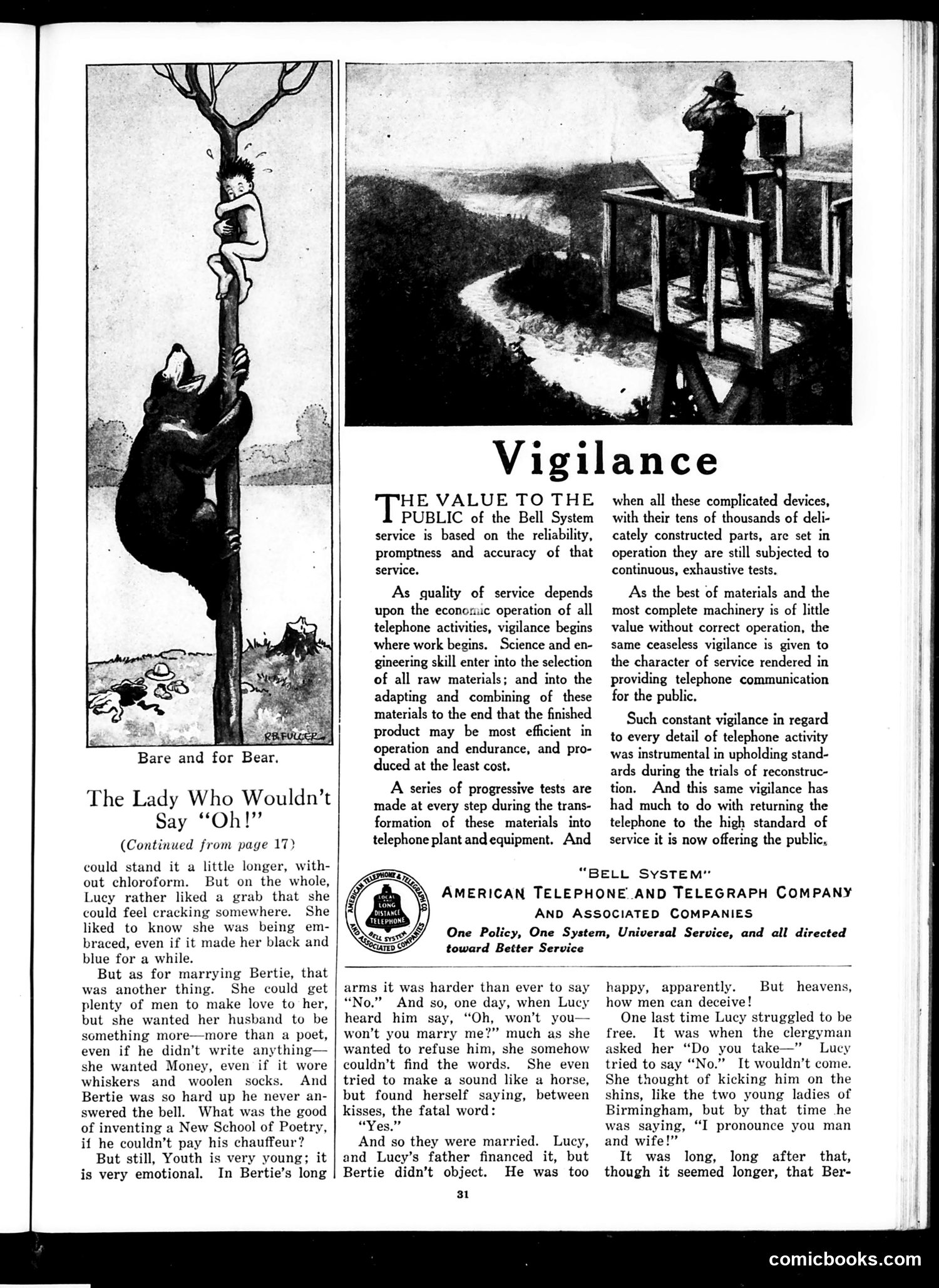
This Judge magazine page contains two distinct elements: **Left side:** A satirical cartoon titled "Bare and for Bear" (artist signed Cesare) showing a bear climbing a tree trunk while a man below reaches up. The crude joke plays on the double meaning of "bare" (naked) and "bear" (the animal). **Main story:** "The Lady Who Wouldn't Say 'Oh!'" — a serialized romantic comedy about Lucy, who struggles to refuse marriage proposals from an impoverished poet named Bertie, despite preferring a wealthy husband. The humor derives from her inability to say "no" despite her reservations, even attempting non-verbal resistance at the altar. **Right side:** A full-page advertisement for the Bell Telephone System (AT&T), emphasizing "Vigilance" in quality control and service reliability. This corporate ad contrasts sharply with the satirical content, typical of Judge's mixed advertising and editorial content. The page reflects early 20th-century attitudes toward marriage, money, and gender expectations, with light satirical treatment of romantic entanglement.
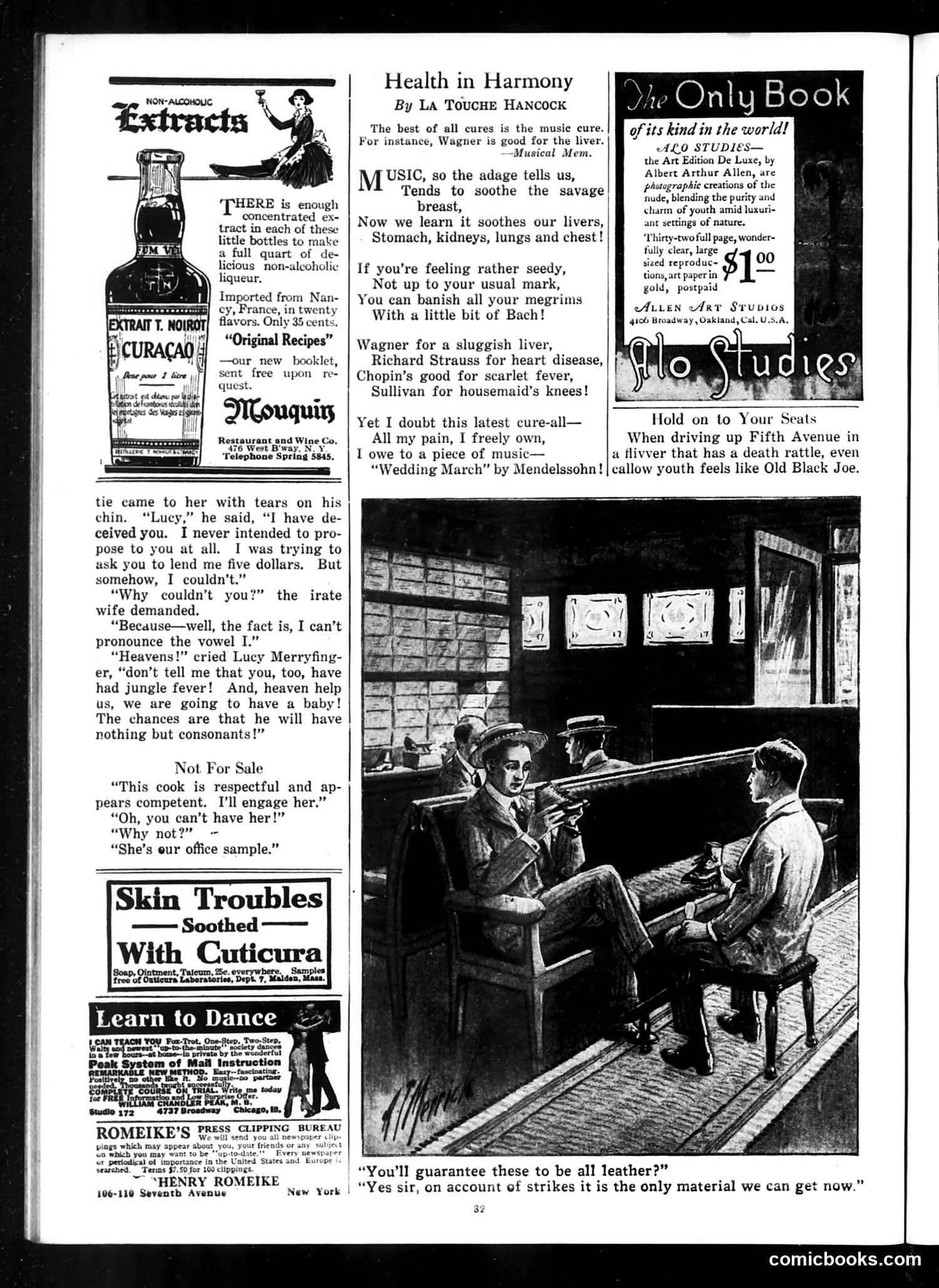
This page from Judge magazine contains multiple satirical pieces reflecting early 20th-century concerns: **Main Cartoon (bottom right):** A dialogue about car upholstery "guaranteed...all leather" because strikes prevent obtaining other materials. This references labor unrest of the era—likely post-WWI strikes affecting manufacturing. The joke cynically suggests scarcity forces acceptance of inferior goods as "premium." **"Health in Harmony" poem:** Satirizes pseudoscientific health fads claiming specific classical composers cure ailments (Wagner for liver problems, Chopin for scarlet fever). The punchline—that the author's pain comes from the "Wedding March"—mocks marital complaint humor common to the period. **Sidebar jokes:** Include wordplay about pronunciation difficulties and office employee disputes, typical of Judge's light humor content. **Advertisements:** Feature non-alcoholic liqueur extracts, dance lessons, and skin treatments—period consumer products. The page demonstrates Judge's blend of social commentary (labor strikes), fad mockery (musical medicine), and domestic humor typical of 1920s satire.
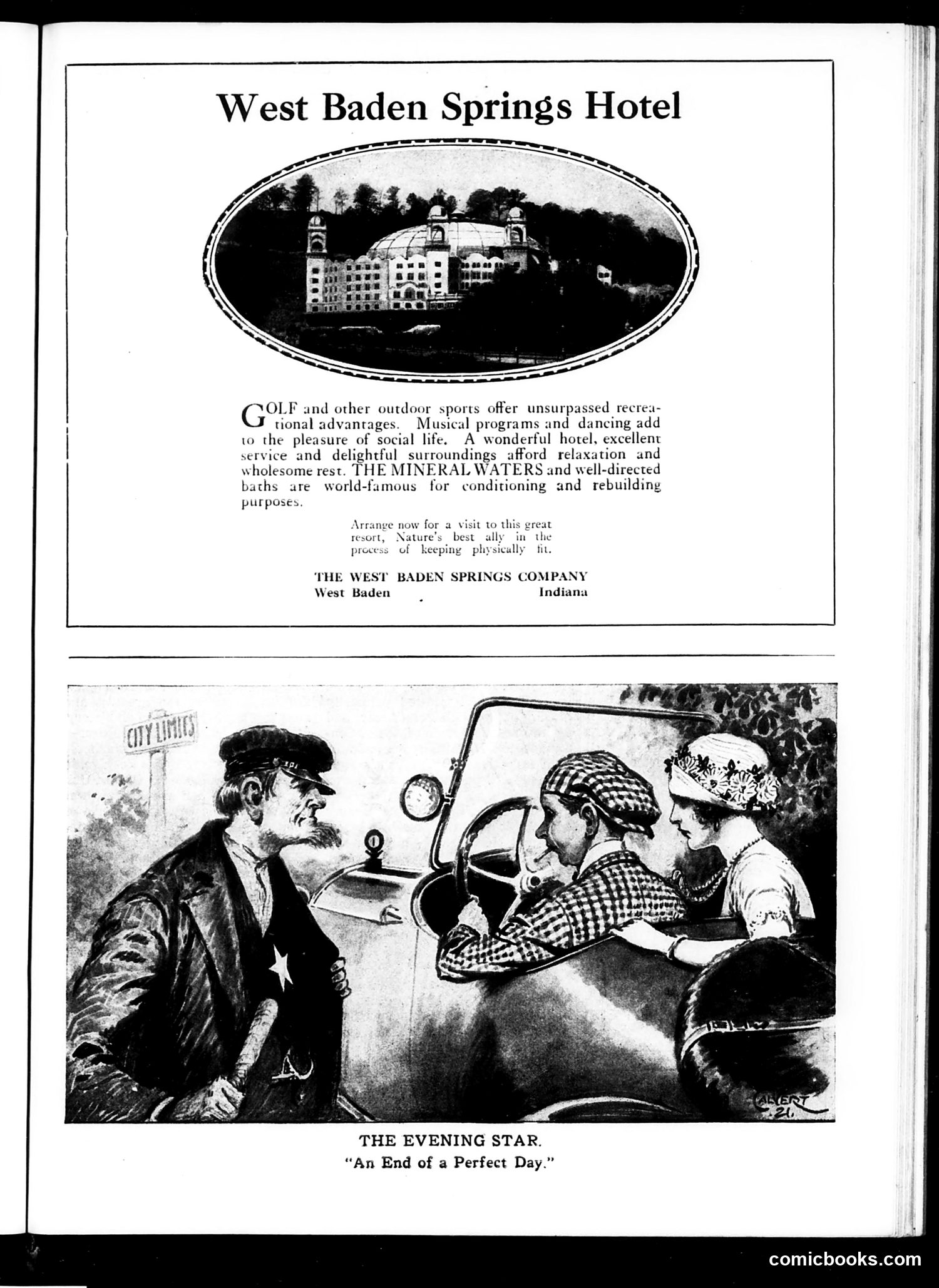
This page contains primarily **advertising** rather than political satire. The top half promotes the West Baden Springs Hotel in Indiana, emphasizing its mineral waters, recreational facilities (golf, dancing, music), and therapeutic baths—common luxury resort marketing of the early 20th century. The bottom illustration, titled "The Evening Star: An End of a Perfect Day," appears to be a **humorous domestic scene** rather than political commentary. It depicts a taxi driver or chauffeur confronting what appears to be a well-dressed man emerging from a vehicle with two women. The joke likely involves social awkwardness or domestic complications—possibly implying infidelity or an embarrassing situation, given the stern expression of the man on the left and the formal attire. The caption suggests ironic commentary on what constitutes a "perfect day." The image doesn't reference identifiable political figures or events, so this appears to be **general social humor** about automotive-era courtship and propriety.
This satirical essay by Benjamin Casseres mocks two Los Angeles residents, Horace and Sam Fowler, who've written a book called "The Industrial Republic" proposing a utopian work-based society. Casseres ridicules their visionary idealism as nonsensical jargon ("Crystalline beatitude," etc.)—attributing their muddled thinking to prohibition's effects on the American brain. The piece also attacks their anti-alcohol stance, sardonically preferring capitalism's traditional vices (drinking, bootlegging) to their earnest reformism. A secondary rant dismisses contemporary poets as mediocre versifiers, contrasting them with truly inspired lyricists. The overall point: prohibition-era idealism and social engineering schemes are laughable delusions. The "Night-cap" (alcohol) speaks wisdom compared to the "Eye-opener" (sobering reality).
This is **not a cartoon or satire page**—it's a **house advertisement** for *Leslie's* magazine (likely *Leslie's Weekly*, a major American periodical). The page promotes the publication's reader services to attract subscribers. The ad highlights two specific departments: 1. **Leslie's Investment Bureau** (19 years old, led by Theodore Williams)—offering free financial advice to readers seeking investments 2. **Leslie's Motor Department** (headed by H.W. Slauson, M.E.)—providing automotive expertise and unbiased advice to motorists For modern readers, the significance lies in understanding that *Leslie's* positioned itself as a trusted authority offering **free expert consultation** across multiple domains. This was a major selling point in the early-to-mid 20th century, when personalized professional advice was less accessible. The repeated phrase "IT IS AT YOUR SERVICE" emphasizes consumer convenience and demonstrates how magazines functioned as trusted intermediaries between readers and specialized knowledge.
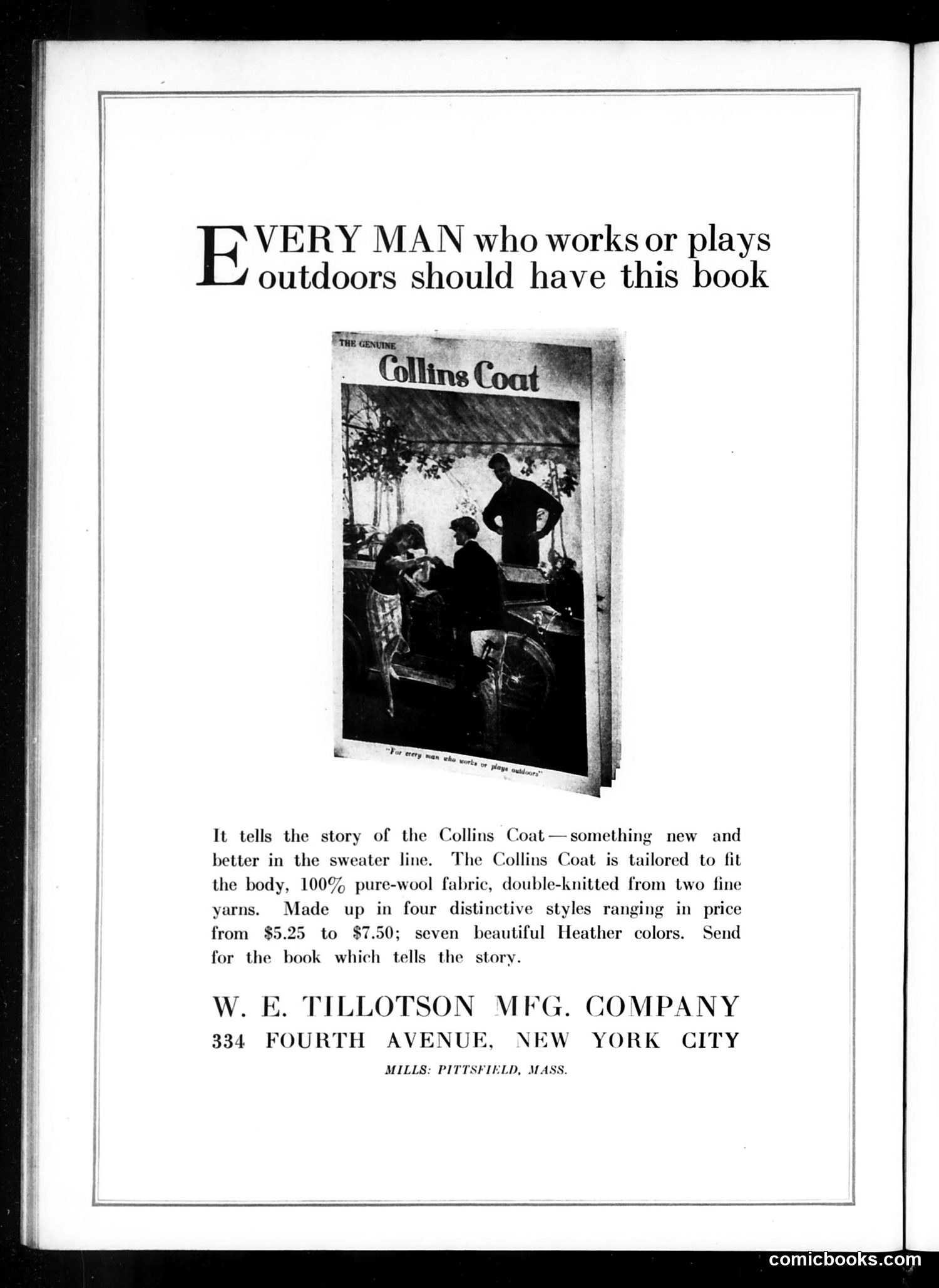
This page is a full-page advertisement, not satire or political commentary. It promotes the "Collins Coat," a wool sweater marketed to outdoor workers and sportsmen. The ad features a photograph showing men in work clothes, emphasizing the garment's practical appeal. The Collins Coat is presented as an innovation in sweater design—tailored, made from 100% pure wool, double-knitted, available in four styles priced $5.25-$7.50, and offered in seven colors. The W.E. Tillotson Manufacturing Company, based in New York with mills in Pittsfield, Massachusetts, encourages readers to request a promotional booklet "which tells the story." This is typical early 20th-century advertising content appearing in Judge magazine.