
Judge, 1921-10-01 · page 9 of 36
Judge — October 1, 1921 — page 9: what you’re looking at
What you’re looking at
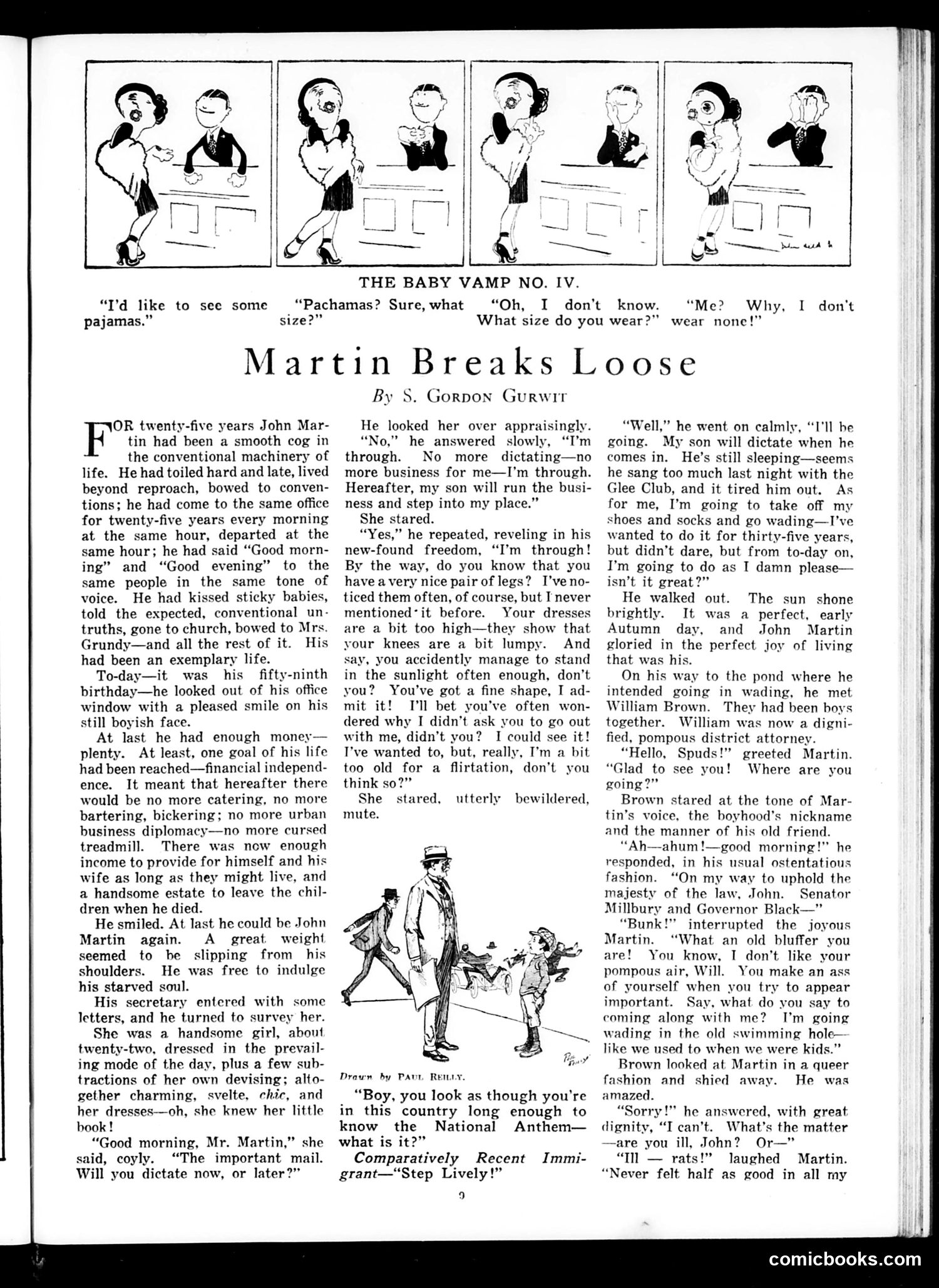
This story satirizes early-20th-century masculinity and conformity. John Martin, a 59-year-old businessman who has spent 25 years in rigid, respectable routines—arriving at the same time daily, maintaining social propriety—finally achieves financial independence and decides to abandon convention. The satire centers on his immediate rebellion: he makes inappropriate sexual comments to his young secretary about her legs and body, calls her "lumpy," and boasts about wanting to flirt with her. He then leaves work early to wade in a pond like a carefree child. The joke critiques how "respectability" is merely performative restraint. Once freed from social obligation, Martin doesn't become wise or noble—he becomes a lecherous fool, suggesting his decades of propriety masked base impulses rather than genuine character. The tone implies this behavior will humiliate him when he encounters his dignified friend, the district attorney. The cartoon at top ("The Baby Vamp No. IV") shows a flirtatious woman shocking a man with her boldness about wearing no pajamas—complementing the main story's theme about repressed desires breaking loose.
📄 Transcribed text from this page (OCR, searchable)
Machine-transcribed from the original scan — historical spelling and the odd misread are preserved.
“I'd like to see some pajamas.” size?” “Pachamas? Sure, what THE BABY VAMP NO. IV. “Oh, I don't know. “Me? Why, I don't What size do you wear?” wear none!” Martin Breaks Loose By S. Gorpon Gurwir tin had been a smooth cog in the conventional machinery of life. He had toiled hard and late, lived beyond reproach, bowed to conven- tions; he had come to the same office for twenty-five years every morning at the same hour, departed at the same hour; he had said “Good morn- ing” and “Good evening” to the same people in the same tone of voice. He had kissed sticky babies, told the expected, conventional un- truths, gone to church, bowed to Mrs. Grundy—and all the rest of it. His had been an exemplary life. To-day—it was his fifty-ninth birthday—he looked out of his office window with a pleased smile on his still boyish face. At last he had enough money— plenty. At least, one goal of his life had been reached—financial independ- ence. It meant that hereafter there would be no more catering, no more bartering, bickering; no more urban business diplomacy—no more cursed treadmill. There was now enough income to provide for himself and his wife as long as they might live, and a handsome estate to leave the chil- dren when he died. He smiled. At last he could be John Martin again. A_ great weight seemed to be slipping from his shoulders. He was free to indulge his starved soul. His secretary entered with some letters, and he turned to survey her. She was a handsome girl, about twenty-two, dressed in the prevail- ing mode of the day, plus a few sub- tractions of her own devising; alto- gether charming, svelte, chic, and her dresses—oh, she knew her little book ! “Good morning, Mr. Martin,” she said, coyly. “The important mail. Will you dictate now, or later?” F" twenty-five years John Mar- He looked her over appraisingly. “No,” he answered slowly, “I’m through. No more dictating—no more business for me—I’m through. Hereafter, my son will run the busi- ness and step into my place.” She stared. “Yes,” he repeated, reveling in his new-found freedom, “I’m through! By the way, do you know that you have avery nice pair of legs? I’ve no- ticed them often, of course, but I never mentioned’ it before. Your dresses are a bit too high—they show that your knees are a bit lumpy. And you accidently manage to stand in the sunlight often enough, don’t you? You've got a fine shape, I ad- mit it! I'll bet you’ve often won- dered why I didn’t ask you to go out with me, didn’t you? I could see it! I’ve wanted to, but, really, I’m a bit too old for a flirtation, don’t you think so?” She stared, mute. utterly bewildered, Drawn by Pav Reiry, “Boy, you look as though you're in this country long enough to know the National Anthem— what is it?” Comparatively Recent grant—“Step Lively!” 9 Immi- “Well,” he went on calmly, “I'll he going. My son will dictate when he comes in. He’s still sleeping—seems he sang too much last night with the Glee Club, and it tired him out. As for me, I’m going to take off my shoes and socks and go wading—I’ve wanted to do it for thirty-five years, but didn’t dare, but from to-day on, I’m going to do as I damn please— isn’t it great?” He walked out. The sun shone brightly. It was a perfect, early Autumn day, and John Martin gloried in the perfect joy of living that was his. On his way to the pond where he intended going in wading, he met William Brown. They had been boys together. William was now a digni- fied, pompous district attorney. “Hello, Spuds!” greeted Martin. “Glad to see you! Where are you going?” Brown stared at the tone of Mar- tin’s voice, the boyhood’s nickname and the manner of his old friend. “Ah—ahum!—good morning!” he responded, in his usual ostentatious fashion. “On my way to uphold the majesty of the law, John. Senator Millbury and Governor Black “Bun interrupted the joyous Martin. “What an old bluffer you are! You know, I don’t like your pompous air, Will. You make an ass of yourself when you try to appear important. Say, what do you say to coming along with me? I’m going wading in the old swimming hole— like we used to when we were kids.” Brown looked at Martin in a queer fashion and shied away. He was amazed. “Sorry!” he answered, with great dignity, “I can’t. What’s the matter —are you ill, John? Or—” “Til — rats!” laughed Martin. “Never felt half as good in all my comicbooks.com