
Judge, 1921-10-01 · page 16 of 36
Judge — October 1, 1921 — page 16: what you’re looking at
What you’re looking at
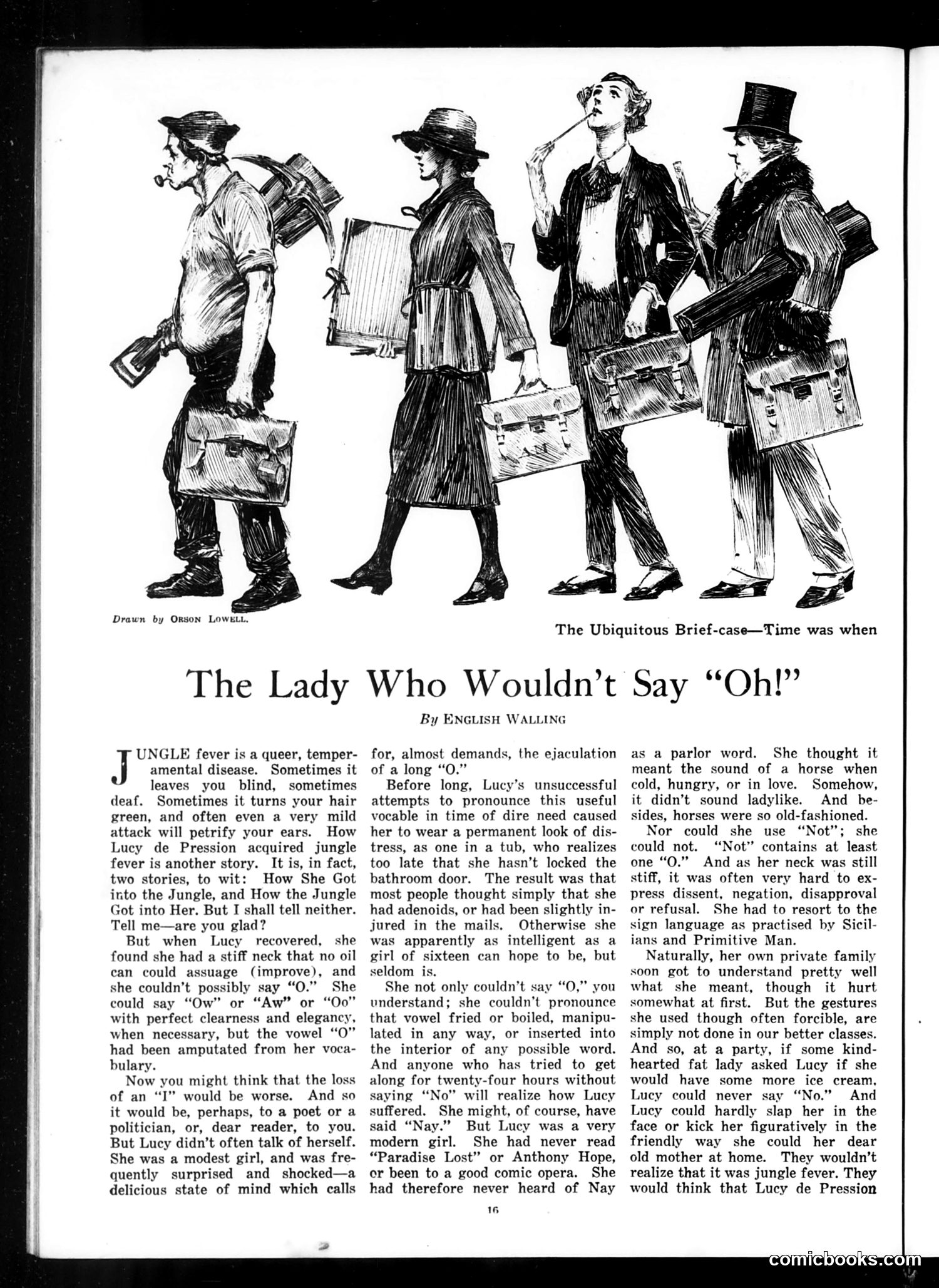
This humorous short story by English Walling satirizes social propriety and the limitations imposed on women in early 20th-century society. The premise: Lucy de Pression, a modest young woman who contracted jungle fever, loses the ability to pronounce the vowel "O"—a seemingly minor affliction that becomes socially catastrophic. She cannot say "No," "Not," or any word containing that sound, leaving her unable to express dissent or refusal in polite company. The satire targets how rigid social conventions trap women: Lucy cannot use alternatives like "Nay" (considered unfeminine and archaic) or resort to expressive gestures (deemed unladylike). The cartoon illustration shows well-dressed professionals carrying briefcases—representing the "modern" world—while Lucy remains confined by expectations of feminine restraint and decorum, unable to voice basic disagreement without violating social norms.
📄 Transcribed text from this page (OCR, searchable)
Machine-transcribed from the original scan — historical spelling and the odd misread are preserved.
Drawn by ORSON LoweLL, The Ubiquitous Brief-case—Time was when The Lady Who Wouldn’t Say “Oh!” By ENGLISH WALLING amental disease. Sometimes it leaves you blind, sometimes deaf. Sometimes it turns your hair green, and often even a very mild attack will petrify your ears. How Lucy de Pression acquired jungle fever is another story. It is, in fact, two stories, to wit: How She Got into the Jungle, and How the Jungle Got into Her. But I shall tell neither. Tell me—are you glad? But when Lucy recovered, she found she had a stiff neck that no oil can could assuage (improve), and she couldn’t possibly say “0.” She could say “Ow” or “Aw” or “Oo” with perfect clearness and elegancy, when necessary, but the vowel “O” had been amputated from her voca- bulary. Now you might think that the loss of an “I” would be worse. And so it would be, perhaps, to a poet or a politician, or, dear reader, to you. But Lucy didn’t often talk of herself. She was a modest girl, and was fre- quently surprised and shocked—a delicious state of mind which calls J UNGLE fever is a queer, temper- for, almost demands, the ejaculation of a long “0.” Before long, Lucy’s unsuccessful attempts to pronounce this useful vocable in time of dire need caused her to wear a permanent look of dis- tress, as one in a tub, who realizes too late that she hasn’t locked the bathroom door. The result was that most people thought simply that she had adenoids, or had been slightly in- jured in the mails. Otherwise she was apparently as intelligent as a girl of sixteen can hope to be, but seldom is. She not only couldn’t say “O,” you understand; she couldn't pronounce that vowel fried or boiled, manipu- lated in any way, or inserted into the interior of any possible word. And anyone who has tried to get along for twenty-four hours without saying “No” will realize how Lucy suffered. She might, of course, have said “Nay.” But Lucy was a very modern girl. She had never read “Paradise Lost” or Anthony Hope, or been to a good comic opera. She had therefore never heard of Nay 16 as a parlor word. She thought it meant the sound of a horse when cold, hungry, or in love. Somehow, it didn’t sound ladylike. And be- sides, horses were so old-fashioned. Nor could she use “Not”; she could not. “Not” contains at least one “O.” And as her neck was still stiff, it was often very hard to ex- press dissent, negation, disapproval or refusal. She had to resort to the sign language as practised by Sicil- ians and Primitive Man. Naturally, her own private family soon got to understand pretty well what she meant, though it hurt somewhat at first. But the gestures she used though often forcible, are simply not done in our better classes. And so, at a party, if some kind- hearted fat lady asked Lucy if she would have some more ice cream, Lucy could never say “No.” And Lucy could hardly slap her in the face or kick her figuratively in the friendly way she could her dear old mother at home. They wouldn’t realize that it was jungle fever. They would think that Lucy de Pression