
Judge, 1921-10-01 · page 31 of 36
Judge — October 1, 1921 — page 31: what you’re looking at
What you’re looking at
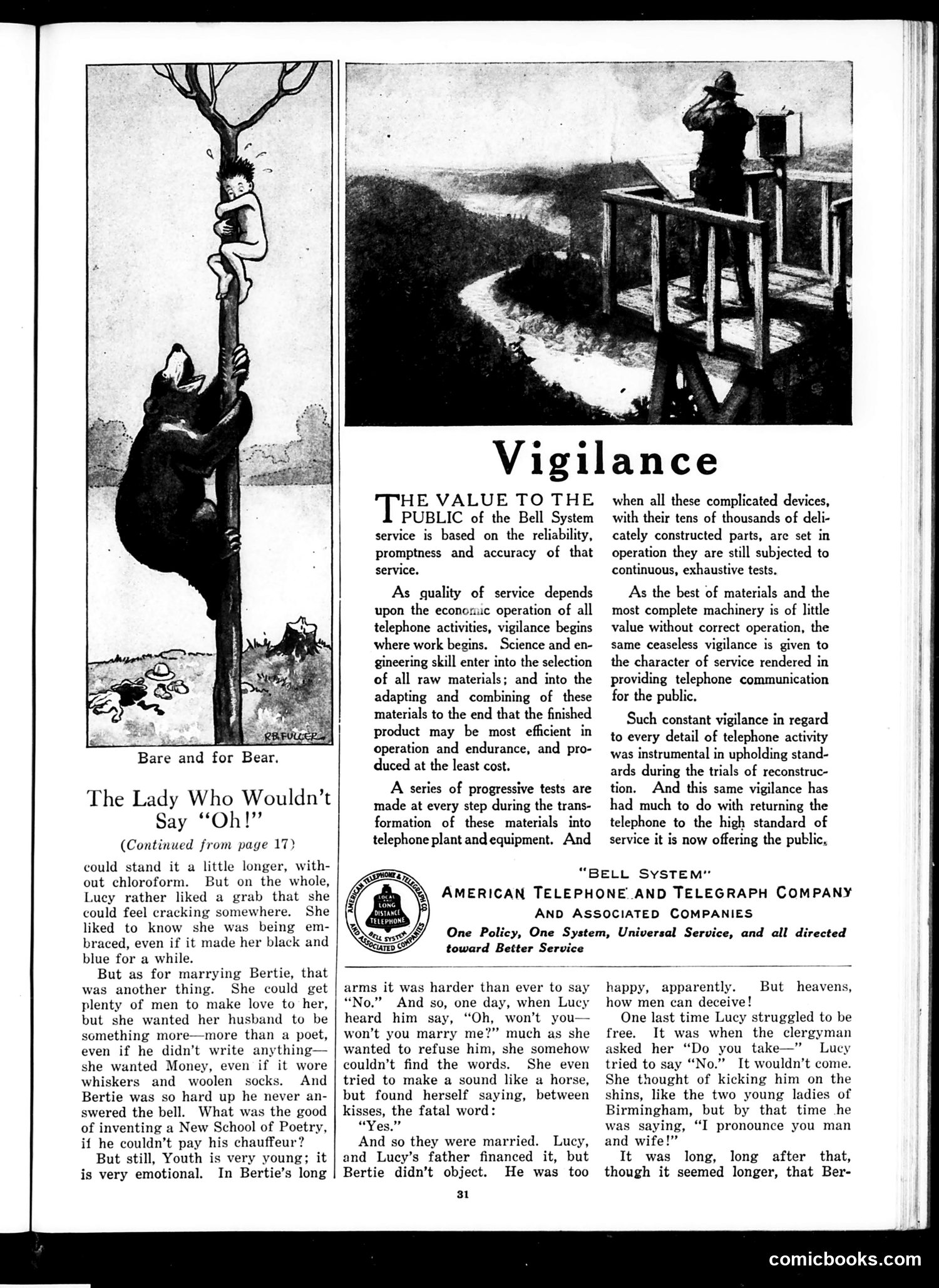
This Judge magazine page contains two distinct elements: **Left side:** A satirical cartoon titled "Bare and for Bear" (artist signed Cesare) showing a bear climbing a tree trunk while a man below reaches up. The crude joke plays on the double meaning of "bare" (naked) and "bear" (the animal). **Main story:** "The Lady Who Wouldn't Say 'Oh!'" — a serialized romantic comedy about Lucy, who struggles to refuse marriage proposals from an impoverished poet named Bertie, despite preferring a wealthy husband. The humor derives from her inability to say "no" despite her reservations, even attempting non-verbal resistance at the altar. **Right side:** A full-page advertisement for the Bell Telephone System (AT&T), emphasizing "Vigilance" in quality control and service reliability. This corporate ad contrasts sharply with the satirical content, typical of Judge's mixed advertising and editorial content. The page reflects early 20th-century attitudes toward marriage, money, and gender expectations, with light satirical treatment of romantic entanglement.
📄 Transcribed text from this page (OCR, searchable)
Machine-transcribed from the original scan — historical spelling and the odd misread are preserved.
Bare and for Bear. The Lady Who Wouldn’t Say “Oh!” (Continued from page 17} could stand it a little longer, with- out chloroform. But on the whole, Luey rather liked a grab that she could feel cracking somewhere. She liked to know she was being em- braced, even if it made her black and blue for a while. But as for marrying Bertie, that was another thing. She could get plenty of men to make love to her, but she wanted her husband to be something more—more than a poet, even if he didn’t write anything— she wanted Money, even if it wore whiskers and woolen socks. And Bertie was so hard up he never an- swered the bell. What was the good of inventing a New School of Poetry, if he couldn’t pay his chauffeur? But still, Youth is very young; it is very emotional. In Bertie’s long Vigilance HE VALUE TO THE PUBLIC of the Bell System service is based on the reliability, promptness and accuracy of that service. As quality of service depends upon the econosiic operation of all telephone activities, vigilance begins where work begins. Science and en- gineering skill enter into the selection of all raw materials; and into the adapting and combining of these materials to the end that the finished product may be most efficient in operation and endurance, and pro- duced at the least cost. A series of progressive tests are made at every step during the trans- formation of these materials into telephone plant andequipment. And when all these complicated devices, with their tens of thousands of deli- cately constructed parts, are set in operation they are still subjected to continuous, exhaustive tests. As the best of materials and the most complete machinery is of little value without correct operation, the same ceaseless vigilance is given to the character of service rendered in providing telephone communication for the public. Such constant vigilance in regard to every detail of telephone activity was instrumental in upholding stand- ards during the trials of reconstruc- tion. And this same vigilance has had much to do with returning the telephone to the high standard of service it is now offering the public, “BELL SYSTEM" g AMERICAN TELEPHONE AND TELEGRAPH COMPANY 4 AND ASSOCIATED COMPANIES One Policy, One System, Universal Service, and all directed toward Better Service arms it was harder than ever to say “No.” And so, one day, when Lucy heard him say, “Oh, won’t you— won’t you marry me?” much as she wanted to refuse him, she somehow couldn’t find the words. She even tried to make a sound like a horse, but found herself saying, between kisses, the fatal word: “Yes.” And so they were married. Lucy, and Lucy’s father financed it, but Bertie didn’t object. He was too 31 happy, apparently. But heavens, how men can deceive! One last time Lucy struggled to be free. It was when the clergyman asked her “Do you take—” Lucy tried to say “No.” It wouldn’t come. She thought of kicking him on the shins, like the two young ladies of Birmingham, but by that time he was saying, “I pronounce you man and wife!” It was long, long after that, though it seemed longer, that Ber- comicbooks.com