
Judge, 1921-10-01 · page 18 of 36
Judge — October 1, 1921 — page 18: what you’re looking at
What you’re looking at
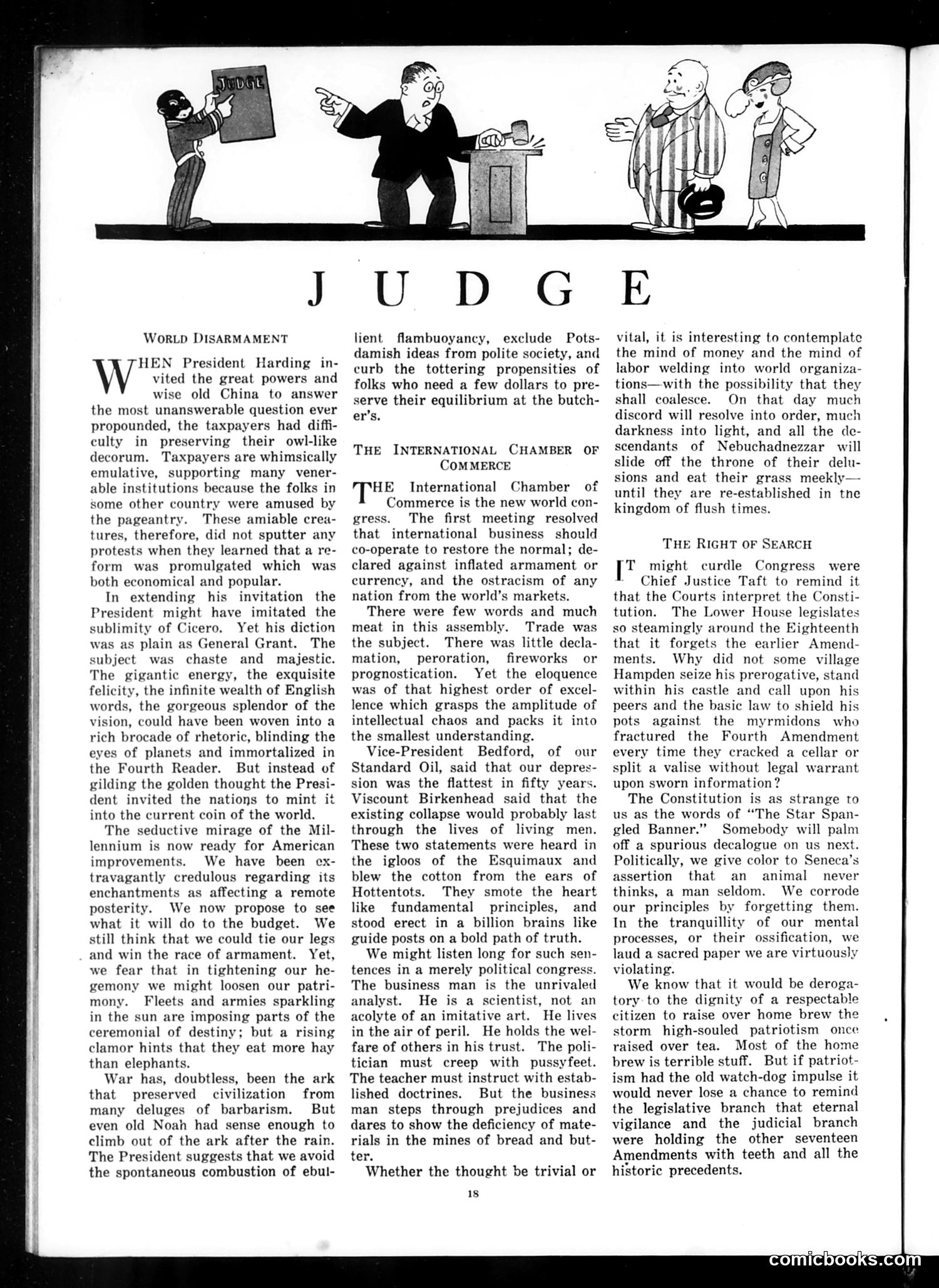
This page contains two distinct editorials from *Judge* magazine, likely from the early 1920s (referenced "President Harding" suggests 1921-1923). **The cartoon** (top) depicts a courtroom scene where a judge points accusingly at figures representing different nations/interests. It illustrates the satirical commentary on world disarmament negotiations that Harding initiated. **"World Disarmament"** praises Harding's invitation to world powers (including China) to discuss reducing military spending. The editorial sarcastically celebrates this as relief for taxpayers burdened by military costs, while mocking the flowery language politicians typically use—saying Harding spoke plainly "as plain as General Grant" instead. **"The International Chamber of Commerce"** praises business leaders as superior to politicians and teachers because they deal in practical facts rather than rhetoric. It contrasts statements from Standard Oil's Bedford and British politician Birkenhead, suggesting businessmen speak truth while politicians use evasive language ("creep with pussyfeet"). Both pieces celebrate pragmatism and cost-consciousness while mocking political ornamentation—typical *Judge* satire of the era.
📄 Transcribed text from this page (OCR, searchable)
Machine-transcribed from the original scan — historical spelling and the odd misread are preserved.
JVat WorLD DISARMAMENT HEN President Harding in- W vited the great powers and wise old China to answer the most unanswerable question ever propounded, the taxpayers had diffi- culty in preserving their owl-like decorum. Taxpayers are whimsically emulative, supporting many vener- able institutions because the folks in some other country were amused by the pageantry. These amiable crea- tures, therefore, did not sputter any protests when they learned that a re- form was promulgated which was both economical and popular. In extending his invitation the President might have imitated the sublimity of Cicero. Yet his diction was as plain General Grant. The subject w chaste and majestic. The gigantic energy, the exquisite felicity, the infinite wealth of English words, the gorgeous splendor of the vision, could have been woven into a rich brocade of rhetoric, blinding the eyes of planets and immortalized in the Fourth Reader. But instead of gilding the golden thought the Presi- dent invited the nations to mint it into the current coin of the world. The seductive mirage of the Mil- lennium is now ready for American improvements. We have been ex- travagantly credulous regarding its enchantments as affecting a remote posterity. We now propose to see what it will do to the budget. We still think that we could tie our legs and win the race of armament. Yet, we fear that in tightening our he- gemony we might loosen our patri- mony. Fleets and armies sparkling in the sun are imposing parts of the ceremonial of destiny; but a rising clamor hints that they eat more hay than elephants. War has, doubtless, been the ark that preserved civilization from many deluges of barbarism. But even old Noah had sense enough to climb out of the ark after the rain. The President suggests that we avoid the spontaneous combustion of ebul- lient flambuoyancy, exclude Pots- damish ideas from polite society, and curb the tottering propensities of folks who need a few dollars to pre- serve their equilibrium at the butch- er’s. THE INTERNATIONAL CHAMBER OF COMMERCE HE International Chamber of Commerce is the new world con- gress. The first meeting resolved that international business should co-operate to restore the normal; de- clared against inflated armament or currency, and the ostracism of any nation from the world’s markets. There were few words and much meat in this assembly. Trade was the subject. There was little decla- mation, peroration, fireworks or prognostication. Yet the eloquence was of that highest order of excel- lence which grasps the amplitude of intellectual chaos and packs it into the smallest understanding. Vice-President Bedford, of our Standard Oil, said that our depres- sion was the flattest in fifty years. Viscount Birkenhead said that the existing collapse would probably last through the lives of living men. These two statements were heard in the igloos of the Esquimaux and blew the cotton from the ears of Hottentots. They smote the heart like fundamental principles, and stood erect in a billion brains like guide posts on a bold path of truth. We might listen long for such sen- tences in a merely political congress. The business man is the unrivaled analyst. He is a scientist, not an acolyte of an imitative art. He lives in the air of peril. He holds the wel- fare of others in his trust. The poli- tician must creep with pussyfeet. The teacher must instruct with estab- lished doctrines. But the business man steps through prejudices and dares to show the deficiency of mate- rials in the mines of bread and but- ter. Whether the thought be trivial or 18 vital, it is interesting to contemplate the mind of money and the mind of labor welding into world organiza- tions—with the possibility that they shall coale: On that day much discord will resolve into order, much darkness into light, and all the de- scendants of Nebuchadnezzar will slide off the throne of their delu- sions and eat their grass meekly— until they are re-established in the kingdom of flush times. THE RIGHT OF SEARCH [? might curdle Congress were Chief Justice Taft to remind it that the Courts interpret the Consti- tution. The Lower House legislates so steamingly around the Eighteenth that it forgets the earlier Amend- ments. Why did not some village Hampden seize his prerogative, stand within his castle and call upon his peers and the basic law to shield his pots against the myrmidons who fractured the Fourth Amendment every time they cracked a cellar or split a valise without legal warrant upon sworn information? The Constitution is as strange to us as the words of “The Star Span- gled Banner.” Somebody will palm off a spurious decalogue on us next. Politically, we give color to Seneca’s assertion that an animal never thinks, a man seldom. We corrode our principles by forgetting them. In the tranquillity of our mental processes, or their ossification, we laud a sacred paper we are virtuously violating. We know that it would be deroga- tory to the dignity of a respectable citizen to raise over home brew the storm high-souled patriotism once raised over tea. Most of the home brew is terrible stuff. But if patriot- ism had the old watch-dog impulse it would never lose a chance to remind the legislative branch that eternal vigilance and the judicial branch were holding the other seventeen Amendments with teeth and all the historic precedents.