
Judge, 1921-10-01 · page 22 of 36
Judge — October 1, 1921 — page 22: what you’re looking at
What you’re looking at
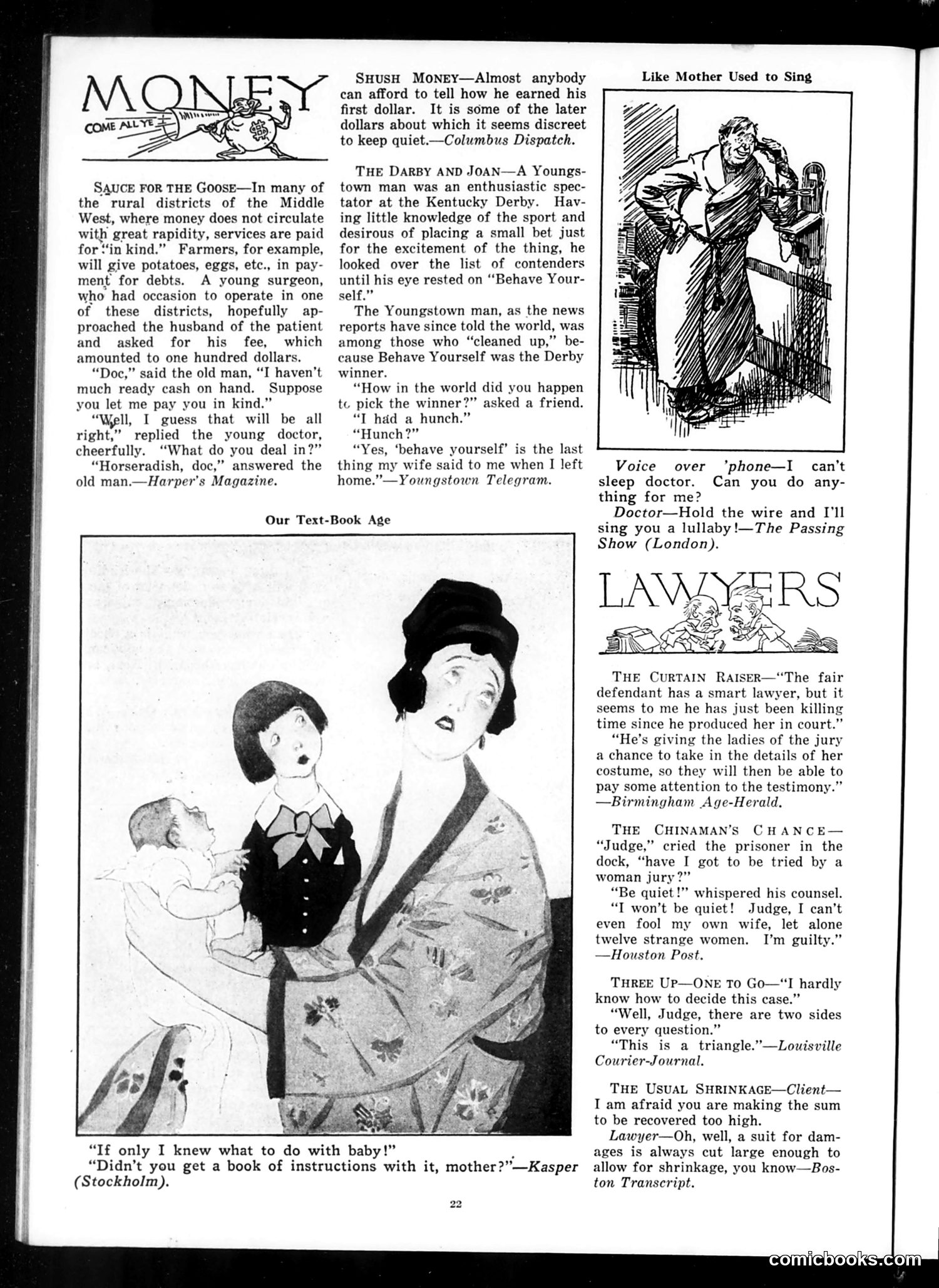
This page from *Judge* magazine contains six brief satirical humor pieces typical of early 20th-century American comedy: **"Sauce for the Goose"**: A rural doctor accepts payment in horseradish instead of cash—reversing the farmer's logic by taking "payment in kind." **"Our Text-Book Age"**: A cartoon mocking modern parenting's reliance on instruction manuals, showing a bewildered mother with babies, suggesting over-dependence on books rather than instinct. **"Shush Money"**: Commentary on financial hypocrisy—people boast about earning their first dollar but stay silent about questionable later earnings. **"The Darby and Joan"**: A man wins at the Kentucky Derby by betting on a horse named "Behave Yourself" because his wife said those parting words—luck based on domestic humor. **"The Chinaman's Chance"**: A prisoner refuses trial by women jurors, claiming he can't even deceive his own wife. References the idiom "Chinaman's chance" (meaning no chance at all), playing on male anxieties about female jurors. **"The Usual Shrinkage"**: A lawyer admits lawsuits are deliberately inflated knowing courts will reduce damages—cynical commentary on legal practice.
📄 Transcribed text from this page (OCR, searchable)
Machine-transcribed from the original scan — historical spelling and the odd misread are preserved.
SAUCE FOR THE GoosE—In many of the rural districts of the Middle West, where money does not circulate with great rapidity, services are paid for ‘in kind.” Farmers, for example, will give potatoes, eggs, etc., in pay- ment for debts. A young surgeon, who had occasion to operate in one of these districts, hopefully ap- proached the husband of the patient and asked for his fee, which amounted to one hundred dollars. “Doe,” said the old man, “I haven’t much ready cash on hand. Suppose you let me pay you in kind.” I guess that will be all right,” replied the young doctor, cheerfully. “What do you deal in?” “Horseradish, doc,” answered the old man.—Harper’s Magazine. (Stockholm). Our Text-Book Age “If only I knew what to do with baby!” ‘ “Didn’t you get a book of instructions with it, mother?”—Kasper SHuUsSH MoNEY—Almost anybody can afford to tell how he earned his first dollar. It is some of the later dollars about which it seems discreet to keep quiet.—Columbus Dispatch. THE DARBY AND JOAN—A Youngs- town man was an enthusiastic spec- tator at the Kentucky Derby. Hav- ing little knowledge of the sport and desirous of placing a small bet just for the excitement of the thing, he looked over the list of contenders until his eye rested on “Behave Your- self.” The Youngstown man, as the news reports have since told the world, was among those who “cleaned up,” be- cause Behave Yourself was the Derby winner. “How in the world did you happen te pick the winner?” asked a friend. “T hdd a hunch.” “Hunch?” “Yes, ‘behave yourself’ is the last thing my wife said to me when I left home.”—Youngstown Telegram. Like Mother Used to Sing *‘phone—I can't Can you do any- Voice over sleep doctor. thing for me? Doctor—Hold the wire and I'll sing you a lullaby!—The Passing Show (London). THE CuRTAIN RAISER—‘The fair defendant has a smart lawyer, but it seems to me he has just been killing time since he produced her in court.” “He’s giving the ladies of the jury a chance to take in the details of her costume, so they will then be able to pay some attention to the testimony.” —Birmingham Age-Herald, THE CHINAMAN’S CHANCE— “Judge,” cried the prisoner in the dock, “have I got to be tried by a woman jury?” “Be quiet!” whispered his counsel. “T won’t be quiet! Judge, I can’t even fool my own wife, let alone twelve strange women. I’m guilty.” —Houston Post. THREE UP—ONE To Go—“I hardly know how to decide this case.” “Well, Judge, there are two sides to every question.” “This is a triangle.”—Louisville Courier-Journal. THE USuAL SHRINKAGE—Client— I am afraid you are making the sum to be recovered too high. Lawyer—Oh, well, a suit for dam- ages is always cut large enough to allow for shrinkage, you know—Bos- ton Transcript.