
Judge, 1921-10-01 · page 24 of 36
Judge — October 1, 1921 — page 24: what you’re looking at
What you’re looking at
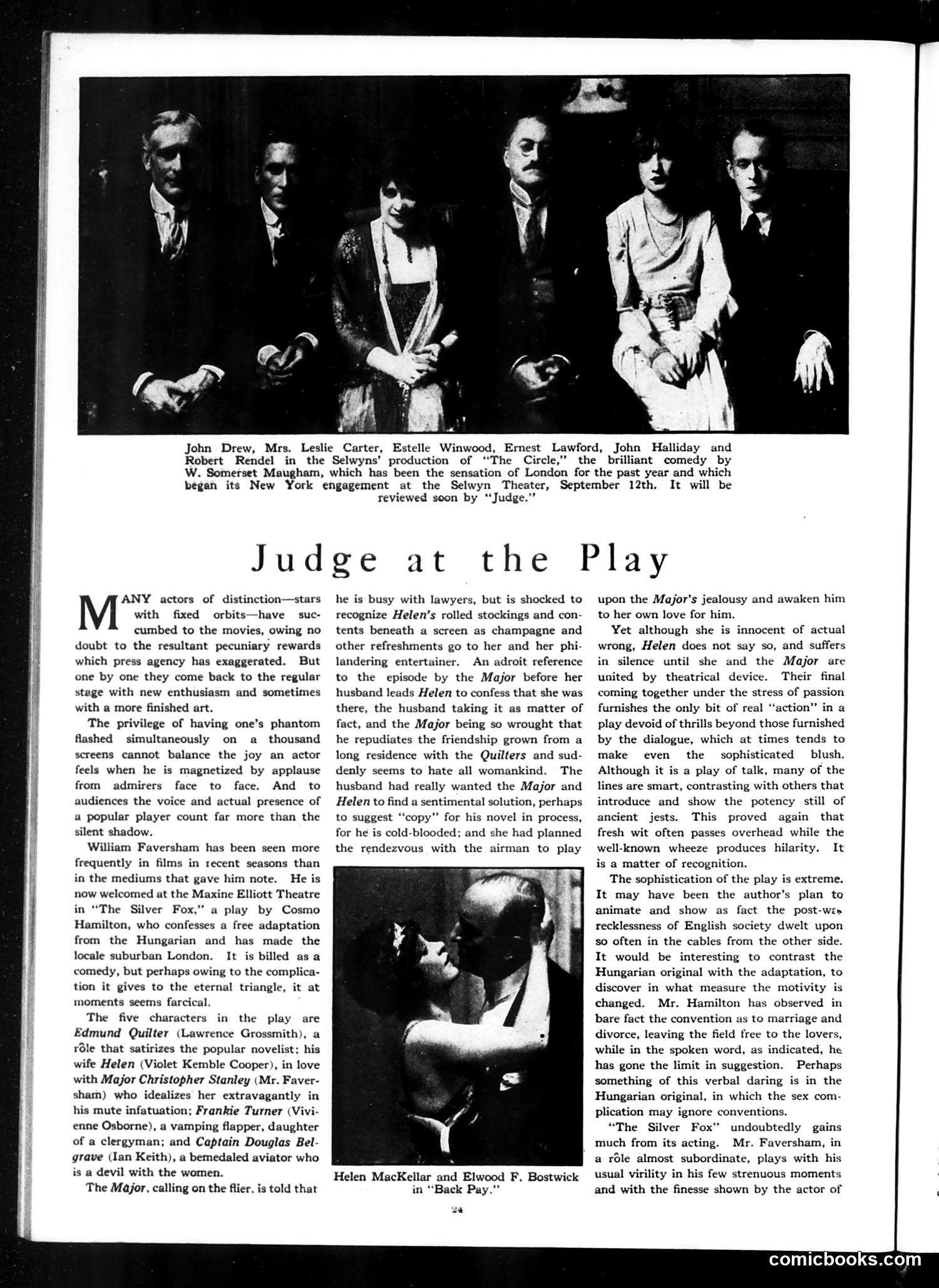
This page reviews two Broadway productions: W. Somerset Maugham's "The Circle" (opening photo) and Cosmo Hamilton's "The Silver Fox" (main review). The critic praises actors returning from Hollywood films to live theater, arguing that stage work requires genuine skill—"the voice and actual presence of a popular player count far more than the silent shadow." William Faversham's return to Broadway exemplifies this trend. "The Silver Fox" is a drawing-room comedy centered on marital infidelity and jealousy. The plot involves misunderstanding: a wife (Helen) meets an aviator; her husband (a novelist seeking "copy") and a major both misinterpret her innocence as guilt. The critic notes the play relies heavily on witty dialogue rather than dramatic action, though acknowledges some lines are clever while others recycle "ancient jests" that still generate laughs through familiarity rather than originality. The overall tone is sophisticated but somewhat thin on substance.
📄 Transcribed text from this page (OCR, searchable)
Machine-transcribed from the original scan — historical spelling and the odd misread are preserved.
John Drew, Mrs. Robert Rendel Leslie Carter, in the Selwyns’ production of “The Circle,” Estelle Winwood, Ernest Lawford, John Halliday and the brilliant comedy by W. Somerset Maugham, which has been the sensation of London for the past year and which began its New York engagement at the Selwyn Theater, September 12th. Judge at ANY actors of distinction—stars with fixed orbits—have suc- cumbed to the movies, owing no doubt to the resultant pecuniary rewards which press agency has exaggerated. But one by one they come back to the regular stage with new enthusiasm and sometimes with a more finished art. The privilege of having one’s phantom flashed simultaneously on a_ thousand screens cannot balance the joy an actor feels when he is magnetized by applause from admirers face to face. And to audiences the voice and actual presence of a popular player count far more than the silent shadow. William Faversham has been seen more frequently in films in recent seasons than in the mediums that gave him note. He is now welcomed at the Maxine Elliott Theatre in “The Silver Fox,” a play by Cosmo Hamilton, who confesses a free adaptation from the Hungarian and has made the locale suburban London. It is billed as a comedy, but perhaps owing to the complica- tion it gives to the eternal triangle, it at moments seems farcical. The five characters in the play are Edmund Quilter (Lawrence Grossmith), a réle that satirizes the popular novelist; his wife Helen (Violet Kemble Cooper), in love with Major Christopher Stanley (Mr. Faver- sham) who idealizes her extravagantly in his mute infatuation; Frankie Turner (Vivi- enne Osborne), a vamping flapper, daughter of a clergyman; and Captain Douglas Bel- grave (Ian Keith), a bemedaled aviator who is a devil with the women. The Major, calling on the flier, is told that reviewed soon by ‘‘Judge.’” he is busy with lawyers, but is shocked to recognize Helen’s rolled stockings and con- tents beneath a screen as champagne and other refreshments go to her and her phi- landering entertainer. An adroit reference to the episode by the Major before her husband leads Helen to confess that she was there, the husband taking it as matter of fact, and the Major being so wrought that he repudiates the friendship grown from a long residence with the Quilters and sud- denly seems to hate all womankind. The husband had really wanted the Major and Helen to find a sentimental solution, perhaps to suggest “copy” for his novel in process, for he is cold-blooded; and she had planned the rendezvous with the airman to play Helen MacKellar and Elwood F. Bostwick in “Back Pay.” ory It will be the Play upon the Major’s jealousy and awaken him to her own love for him. Yet although she is innocent of actual wrong, Helen does not say so, and suffers in silence until she and the Major are united by theatrical device. Their final coming together under the stress of passion furnishes the only bit of real “‘action” in a play devoid of thrills beyond those furnished by the dialogue, which at times tends to make even the sophisticated blush. Although it is a play of talk, many of the lines are smart, contrasting with others that introduce and show the potency still of ancient jests. This proved again that fresh wit often passes overhead while the well-known wheeze produces hilarity. It is a matter of recognition. The sophistication of the play is extreme. It may have been the author's plan to animate and show as fact the post-wee recklessness of English society dwelt upon so often in the cables from the other side. It would be interesting to contrast the Hungarian original with the adaptation, to discover in what measure the motivity is changed. Mr. Hamilton has observed in bare fact the convention as to marriage and divorce, leaving the field free to the lovers, while in the spoken word, as indicated, he has gone the limit in suggestion. Perhaps something of this verbal daring is in the Hungarian original, in which the sex com- plication may ignore conventions. “The Silver Fox’ undoubtedly gains much from its acting. Mr. Faversham, in a role almost subordinate, plays with his usual virility in his few strenuous moments and with the finesse shown by the actor of comicbooks.com